J. res.: fundam. care. online 2014. jul./set. 6(3):876-881
876
RESEARCH
Vacinação contra influenza em idosos residentes na comunidade Vaccination against influenza in elderly residents in the community Vacunación contra la influenza en los residentes ancianos en la comunidad
Claúdio Luís de Souza Santos 1 , Carolina dos Reis Alves 2 , Marta dos Reis Alves 3 ,Mariza Alves
Barbosa Teles 4 , Doane Martins da Silva 5 , Jorge Lucas Teixeira da Fonseca 6
Objective: identify the influenza vaccination coverage in elderly people enrolled in a family health unit in the city of Montes Claros, Minas Gerais and and analyze the factors associated with vaccination against influenza based on demographic and socioeconomic variables. Method: descriptive, transversal and quantitative study, conducted with 74 elderly, being used for data collection semi-structured and multidimensional, with analysis in light of the descriptive epidemiology, approved under Opinion nº 0334/2009 by the Committee of Ethics in Research of the Faculty United's North Mine. Results: the prevalence of vaccination among the elderly was 78,4% (n = 58), with greater adherence among older married/stable union, illiterate and aged 70 to 79 years old. Conclusion: this study contributes to the decision making of professionals providing tools that support do to meet the real needs of a full care order. Descriptors: health, elderly, vaccination.
Objetivo: identificar a cobertura vacinal contra influenza em idosos cadastrados em uma unidade de saúde da família no município de Montes Claros-MG e analisar os fatores associados à vacinação contra influenza com base em variáveis demográficas e socioeconômicas. Método: estudo descritivo, transversal e quantitativo, realizado com 74 idosos, sendo utilizados para a coleta de dados instrumento semi-estruturado e multidimensional, com análise à luz da epidemiologia descritiva, aprovado sob parecer nº 0334/2009 pelo Comitê de Ética em Pesquisa da Faculdade Unida do Norte de Minas. Resultados: a prevalência de vacinação entre os idosos foi de 78,4% (n=58), havendo maior adesão entre os idosos casados/união estável, analfabetos e com idade entre 70 a 79 anos. Conclusão: este estudo contribui para a tomada de decisão dos profissionais fornecendo ferramentas que subsidiam o fazer para atender as reais necessidades visando uma assistência integral. Descritores: saúde, idoso, vacinação.
Objetivo: identificar la cobertura de vacunación contra la influenza en ancianos inscritos en una unidad de salud de la familia en la ciudad de Montes Claros, Minas Gerais y analizar los factores asociados a la vacunación contra la gripe en función de variables demográficas y socioeconómicas. Método: estudio descriptivo, transversal y cuantitativo, realizado con 74 ancianos, siendo utilizado para la recolección de datos, semi-estructurada y multidimensional, con un análisis a la luz de la epidemiología descriptiva, aprobada bajo Dictamen nº 0334/2009 por el Comité de Ética en Investigación Norte Escuela de Minas. Resultados: la prevalencia de vacunación entre los ancianos fue del 78,4% (n = 58), con una mayor adherencia entre los ancianos casados/estable, analfabetos y con edades entre 70 y 79 años. Conclusión: este estudio contribuye a la toma de decisiones de los profesionales de proporcionar herramientas que apoyan la toma de satisfacer las necesidades reales que buscan una atención integral. Descriptores: salud, anciano, vacunación.
1 Nurse. Postgraduated in Teaching of higher education. United Faculty of Northern Minas-FUNORTE 2 Nurse. Master in Health
Sciences. Professor of Graduate Nursing Course of UNIMONTES, FUNORTE, Colleges Pitagoras de Montes Claros and College Santo Agostinho 3 Nurse. Master of the Postgraduate Program in Nursing and Health, State University of Southwest Bahia
(UESB).Scholarship from Foundation for Research Support of the State of Bahia (FAPESB) 4 Nurse. Professor of the Graduate
Nursing Faculty of FUNORTE and College Santo Agostinho 5 Nurse. Master of the Graduate Program in Nursing and Health,
State University of Southwest Bahia (UESB).Scholarship of the Coordination of Professional Development (CAPES) 6 Student of
nursing at UNEB.
ABSTRACT
RESUMEN RESUMO
J. res.: fundam. care. online 2014. jul./set. 6(3):876-881
877
T
he aging population is a phenomenon world-wide, with projections for the year 2050 suggest that there will be a total of approximately two billion people aged sixty and over the world, most of them reside in developing countries, such Brazil.1This aging process is accompanied by the increased use of health services, in which 26% of hospital resources in the Unified Health System (SUS) are related to the elderly population, where respiratory diseases are the leading cause of hospitalization.2
Infections of the respiratory system are a group of diseases affecting especially the elderly and children, in which the influenza virus is a major etiological agent, which is responsible for 75% of these infections. The influenza virus can cause clinical manifestations characterized as a mild form with benign self-limiting even serious and complicated and may result in death.3
Influenza or flu is an acute infectious disease of viral nature of high transmissibility that affects the respiratory system and has global distribution with the highest incidence during late fall and winter. It is estimated that, worldwide, about 600 million people/year have an episode of influenza.2,4,5
The influenza virus is spread through the respiratory tract, where contagion occurs directly through small aerosol droplets eliminated by the individual infected by speaking, sneezing or coughing or indirectly through contact with the secretions of the patient especially by hands that after contact with contaminated surfaces newly respiratory secretions may lead to the infectious agent through the oral mucosa, nasal and ocular. Another highlight is the possibility of direct transmission from animals, for example birds to humans.2-4
Symptoms are characterized by impairment of the upper airway, nasal congestion, rhinorrhea, cough, hoarseness, fever, malaise, myalgia and headache with benign and can be complications such as otitis, sinusitis, bronchitis and pneumonia in particular, account for a large number of hospitalizations. Severe cases can also occur commonly associated with Severe Acute Respiratory Syndrome (SARS) leading even to death.3-4
Note that the primary preventive intervention influenza vaccination is considered by the World Health Organization (WHO) as the most cost-effective technology for reducing morbidity, decreased work absenteeism, drug spending to treat secondary infections, hospitalizations and deaths.4-5
Studies have shown that influenza vaccination reduces 32-45% of the rate of hospitalizations by pneumonia and 39-75% of the overall mortality rate. This reduction is significant especially in institutionalized elderly people with reduced risk of pneumonia and 60% of overall risk of hospitalization and death in about 50% to 68%. 3
J. res.: fundam. care. online 2014. jul./set. 6(3):876-881
878
METHOD
In Brazil, since 1999, in order to ensure protection to the health of the elderly, the vaccine occurs annually and was established by the year 2007 a vaccination coverage of at least 70%, and after 2008 this target increased to 80%.3,6
Therefore, it is salutary the great contribution of influenza vaccination on quality of life of the elderly population increasing life expectancy coupled with prevention of disease, hospitalizations and mortality from respiratory diseases.
That said, this study aimed to: identify influenza vaccination coverage in the elderly enrolled in a Family Health Unit in Montes Claros/Minas Gerais; analyze factors associated with influenza vaccination based on demographic and socioeconomic variables.
The methodology was a survey of a cross-sectional, descriptive and quantitative approach. Data collection was conducted by the researcher with the use of semi-structured and multidimensional, containing the dimensions that meant knowing and understanding the following variables related to adherence to vaccination: demographic and socioeconomic.
The study setting was a Unit Family Health (USF) located in the east of the city of Montes Claros-MG. According to data from the Information System in Primary Care (SIAB), are registered in the catchment area of said USF, 1037 families, which corresponds to 4.112 people, of which 195 are elderly, ie 4,7% of enrolled population.7
We used a simple random probability sample, which consisted of the chance that each person in the study population had the same probability of being included in the study. To ensure scientific rigor, the elderly were selected through a simple drawing, with the use of the spreadsheet in Microsoft Excel for Windows 95, version 7.0, generated through the search performed with the tool identified as random numbers, with a view that the names of the elderly have previously been numbered 1-195.8-9
With the definition of the elderly respondents were drawn gerontes 74 (38%) from December 2009 to June 2010. We used the following inclusion criteria: elderly aged over 60 years, be of both sexes, be registered in the Family Health Strategy, the municipality of Montes Claros - MG, in the period of data collection, to be able to respond the form and accept their participation in research. Exclusion criteria were: being bedridden, not to be found in his residence until the third attempt, without being able to respond to the form.
Before completing the form, was carried out to clarify the main objective of the research, relevance and importance of collaboration, the guarantee of anonymity, as well as the withdrawal, without prejudice to the respondents at any time of the work, and, subsequently, asked to sign the Instrument of Consent, in two copies, one from another researcher and the participant.10
Data analysis was guided in the light of the descriptive epidemiology, with the use of absolute frequencies and measures of central tendency and dispersion. To ensure the ethical principles in accordance with Resolution 196/1996, the National Health Council, which recommends guidelines and standards for research involving human subjects, the
J. res.: fundam. care. online 2014. jul./set. 6(3):876-881
879
RESULTS AND DISCUSSION
study was approved by the Ethics and Research of the United Faculties of Northern Minas (FUNORTE), with a consolidated number 0334/2009.
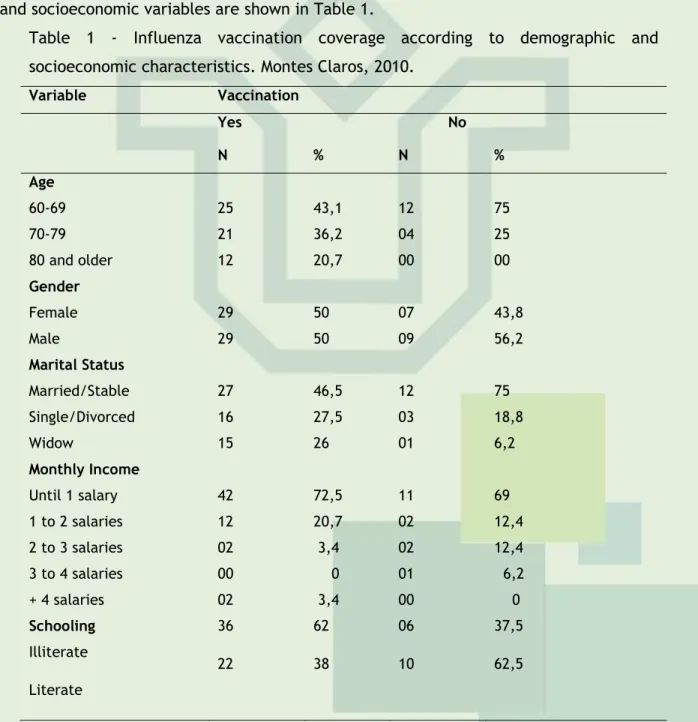
The prevalence of vaccination among 74 elderly enrolled in the unit was 78,4% (n = 58), which shows a large membership when compared to other studies conducted in other cities such as Campinas (62,6%), Botucatu (62,2%) and Belo Horizonte (66,3%). However, does not reach the goal set by the Ministry of Health which is 80%, which shows the need to conduct awareness activities on the importance of vaccination in improving the quality of life related to decreased morbidity. 11-13. Vaccination distributed according to demographic
and socioeconomic variables are shown in Table 1.
Table 1 - Influenza vaccination coverage according to demographic and socioeconomic characteristics. Montes Claros, 2010.
Variable Vaccination Yes No N % N % Age 60-69 25 43,1 12 75 70-79 21 36,2 04 25 80 and older 12 20,7 00 00 Gender Female 29 50 07 43,8 Male 29 50 09 56,2 Marital Status Married/Stable 27 46,5 12 75 Single/Divorced 16 27,5 03 18,8 Widow 15 26 01 6,2 Monthly Income Until 1 salary 42 72,5 11 69 1 to 2 salaries 12 20,7 02 12,4 2 to 3 salaries 02 3,4 02 12,4 3 to 4 salaries 00 0 01 6,2 + 4 salaries 02 3,4 00 0 Schooling Illiterate Literate 36 22 62 38 06 10 37,5 62,5
Source: survey data, 2010.
Of the 74 study participants, there was a higher proportion of vaccinees in the younger age groups compared to over 80 years and can also be observed noncompliance vaccination also aged 60-69, this aspect found in this study not found in other studies that
J. res.: fundam. care. online 2014. jul./set. 6(3):876-881
880
REFERENCES
CONCLUSION
showed a higher prevalence in individuals with advanced age, ie the probability of being vaccinated increases with age as referred to in study Donalisio; Ruiz and Cordeiro (2006). 13
As regards accession vaccination gender difference was not observed between genders but also found in other studies, thus, the issue of gender does not influence access to flu vaccination. As for marital status was no difference between elderly married/stable both in membership as the vaccine nonadherence representing respectively 46,5% and 75%, supporting the study of Lima-Costa (2008)12 also found an association between being single
and non-adherence to vaccination, however the study Francisco; Barros and Lamb (2011)11
there was no difference with regard to marital status.
With respect to income per capita had an association with vaccination in the range of less than 2 minimum wages and no significant association with adherence or non-vaccination.
Another aspect observed was the relationship of education and effective influenza vaccine in the elderly illiterate joined the majority (62%) vaccination, while literate accounted for the majority (62,5%) who did not receive the vaccination, this fact meets with the data from other studies and also the expectations of the Ministry of Health in the population with higher education have a greater tendency to perform specific protection combined with preventive attitudes among them adherence to vaccination.
The results clarify that adherence to immunization is less than the recommended by the Ministry of Health despite being higher compared to other studies. Another aspect is that no differences were seen with respect to sex, but the fact that less than 80 years, married/stable, have income under 2 wages has a positive association with adherence to influenza vaccination. This study contributes to the decision making of professionals providing tools that support the doing to meet the real needs seeking comprehensive care.
1. Brasil. Ministério da Saúde. Secretaria de Atenção à Saúde. Departamento de Atenção Básica. Envelhecimento e Saúde da pessoa idosa. Brasília: Ministério da Saúde, 2006.
2. Brasil. Ministério da Saúde. Informe técnico campanha nacional de vacinação contra a
influenza 2007. [citado 18 dez 2010]. Disponível em:
J. res.: fundam. care. online 2014. jul./set. 6(3):876-881
881
3. Brasil. Ministério da Saúde. Informe técnico campanha nacional de vacinação contra ainfluenza 2011. [citado 15 ago 2011]. Disponível em:
<http://portal.saude.gov.br/portal/pdf/informe_campanha_influenza_2011.pdf>.
4. Brasil. Ministério da Saúde. Secretaria de Vigilância em Saúde. Guia de Vigilância Epidemiológica. 7.ed. Brasília: Ministério da Saúde, 2010.
5. Brasil. Ministério da Saúde. Secretaria de Vigilância em Saúde. Doenças Infecciosas e parasitárias: guia de bolso. 8.ed. Brasília: Ministério da Saúde, 2010a.
6. Araújo TME, Lino FS, Nascimento DJC, Costa FSR. Vacina contra Influenza: conhecimentos, atitudes e práticas de idosos em Teresina. Rev Bras Enferm. 2007; 60(4): 439-43.
7. Sistema de informação da atenção básica- SIAB - 2010. [citado 15 ago 2011]. Disponível em: <http://portal.saude.gov.br/portal/siab>
8. Triviños ANS. Introdução à pesquisa em ciências sociais – A pesquisa qualitativa em educação. São Paulo (SP): Atlas; 2006.
9. Estrela C. Metodologia Cientifica: Ciência, ensino e pesquisa. 2ª ed. São Paulo (SP): Artes Médicas-Divisão Odontológica; 2005.
10. Brasil. Ministério da Saúde. Conselho Nacional de Saúde. Comissão de Ética em Pesquisa. Resolução nº 196, de 10 de outubro de 1996: aprova as diretrizes e normas regulamentadoras de pesquisa envolvendo seres humanos. Rev bioét. 1996; 4(2): 15-25. 11. Francisco PMSB, Barros MBA, Cordeiro MRD. Vacinação contra influenza em idosos: prevalência, fatores associados e motivos da não adesão em Campinas, São Paulo, Brasil. Cad Saúde Pública. 2011; 27(3): 417-26.
12. Lima MF. Fatores associados à vacinação contra gripe em idosos na região metropolitana de Belo Horizonte. Rev Saúde Publica. 2008; 42(1): 100-7.
13. Donalisio MR, Ruiz T, Cordeiro R. Fatores associados à vacinação contra influenza em idosos em município do Sudeste do Brasil. Rev Saúde Publica. 2006; 40(1): 115-9.
Received on: 20/11/2012 Required for review: No Approved on: 20/11/2013 Published on: 01/07/2014
Contact of the corresponding author: Marta dos Reis Alves Rua Magalhães Caetité, 56, bairro jequiezinho, Jequié-BA, cep