Licenciado em Engenharia Informática
Information Flow Analysis using Data-dependent
Logical Propositions
Dissertação para obtenção do Grau de Mestre em Engenharia Informática
Co-orientadores : João Costa Seco, Prof. Auxiliar, Universidade Nova de Lisboa Carla Ferreira, Profa. Auxiliar, Universidade Nova de Lisboa
Júri:
Presidente: Prof. Doutor João Alexandre Carvalho Pinheiro Leite
Arguente: Prof. Doutor Simão Melo Patrício de Sousa
Information Flow Analysis using Data-dependent Logical Propositions
Copyright c Paulo Jorge Abreu Duarte Ferreira, Faculdade de Ciências e Tecnologia, Universidade Nova de Lisboa
Acknowledgements
I would like to thank my thesis’ advisers, professor João Seco and professor Carla Fer-reira, for providing me with an opportunity to explore an interesting research area, and for their guidance and thorough comments during the elaboration of this thesis.
I would like to thank the members of the PLASTIC research group for their interesting talks and insightful comments that helped dispel some misconceptions in the earlier ver-sions of this work.
I would like to thank my friends Carlos Correia, Diogo Serra and Sérgio Silva, for the insightful discussions throughout the development of this thesis and for sharing their enthusiasm in their own theses and personal projects.
Abstract
A significant number of today’s software systems are designed around database sys-tems that store business information, as well as data relevant to access control enforce-ment, such as user profiles and permissions. Thus, the code implementing security mech-anisms is scattered across the application code, often replicated at different architectural layers, each one written in its own programming language and with its own data format. Several approaches address this problem by integrating the development of all applica-tion layers in a single programming language. For instance, languages like Ur/Web and LiveWeb/λDBprovide static verification of security policies related to access control, en-suring that access control code is correctly placed. However, these approaches provide limited support to the task of ensuring that information is not indirectly leaked because of implementation errors.
In this thesis, we present a type-based information-flow analysis for a core language based inλDB, whose security levels are logical propositions depending on actual data. This approach allows for an accurate tracking of information throughout a database-backed software system, statically detecting the information leaks that may occur, with precision at the table-cell level. In order to validate our approach, we discuss the imple-mentation of a proof-of-concept extension to the LiveWeb framework and the concerns involved in the development of a medium-sized application in our language.
Resumo
Um número significativo dos sistemas de software de hoje em dia são suportados por sistemas de base de dados que armazenam tanto informação relevante para o domínio da aplicação, como dados relevantes para a aplicação do controlo de acessos, tais como per-fis de utilizador e permissões. Assim, o código que implementa os mecanismos de segu-rança está espalhado pelo código da aplicação, frequentemente replicado em diferentes camadas arquitecturais, cada uma delas escrita na sua própria linguagem de programa-ção e com o seu próprio formato de dados. Existem várias abordagens que resolvem este problema através da integração do desenvolvimento de todas as camadas numa única linguagem de programação. Por exemplo, linguagens como Ur/Web e LiveWeb/λDB fa-zem verificação estática de políticas de segurança relacionadas com o controlo de acessos, garantindo que o código de controlo de acessos está onde é necessário. No entanto, es-tas abordagens fornecem um suporte limitado à tarefa de garantir que não são causadas fugas de informação devido a errors de implementação.
Nesta tese, apresentamos uma análise de fluxo de informação baseada em tipos para uma linguagem adaptada a partir deλDB, usando como níveis de segurança proposições lógicas que dependem dos próprios dados. Esta abordagem permite uma monitorização precisa da informação num sistema de software suportado por bases de dados, detec-tando estaticamente as fugas de informação que podem ocorrer, com precisão ao nível das células de uma tabela. De forma a validar a nossa abordagem, discutimos a imple-mentação de uma extensão à framework LiveWeb como prova de conceito e as preocu-pações envolvidas no desenvolvimento de uma aplicação de dimensão média na nossa linguagem.
Contents
1 Introduction 1
1.1 Motivation . . . 1
1.2 Proposed Approach . . . 4
1.3 Contributions . . . 6
1.4 Document Structure . . . 6
2 Background 9 2.1 Information Flow . . . 9
2.1.1 λSECandλREFSECcalculi . . . 11
2.1.2 Dependency Core Calculus . . . 16
2.1.3 Secure Monadic Calculus . . . 18
2.2 Type-Based Access Control . . . 21
2.2.1 λDBand the LiveWeb framework . . . 22
3 Related Work 31 3.1 Ur/Web . . . 31
3.2 Flow Caml . . . 33
3.3 Information-Flow in Data-Manipulation Primitives . . . 35
4 Language and Type System 39 4.1 Core Language . . . 40
4.2 Type System . . . 42
4.2.1 Lattice . . . 44
4.2.2 Typing Judgements . . . 44
4.2.3 Type Operators and Notation . . . 45
4.2.4 Typing Rules . . . 46
4.3 Extended LiveWeb . . . 55
4.3.1 Typing Judgements . . . 56
4.4 Approaching Non-interference . . . 58
5 Example 59 5.1 Scenario . . . 59
5.2 Application . . . 60
6 Implementation 69 6.1 LiveWeb . . . 69
6.2 LiveWeb Extension Core Module . . . 71
6.3 SMT Solver Module . . . 74
6.3.1 Encoding. . . 75
6.4 Type Checking Process: an example . . . 80
7 Conclusions and Future Work 85
A A Lattice of First-Order Logic propositions 91
List of Figures
2.1 Security lattice model for anonymous paper reviews . . . 10
2.2 λSECgrammar . . . 12
2.3 λSECtyping rules . . . 13
2.4 λSECREFgrammar . . . 14
2.5 SomeλSECREFtyping rules. . . 15
2.6 DCC grammar . . . 17
2.7 DCC type rules related to dependency propagation . . . 18
2.8 Performing program slicing in a security-typed calculus. . . 18
2.9 Secure Monadic Calculus grammar . . . 19
2.10 Some typing rules for the Secure Monadic Calculus . . . 21
2.11 λDBGrammar . . . 23
2.12 LiveWeb’s web-based development environment. . . 26
2.13 LiveWeb base grammar . . . 27
2.14 LiveWeb type grammar . . . 28
2.15 A login form generated by LiveWeb . . . 28
4.1 λDB−Flowgrammar for expressions . . . 41
4.2 λDB−Flowgrammar for types . . . 43
4.3 λDB−Flowgrammar for environments . . . 44
4.4 The⊔operation between types and security levels . . . 45
4.5 TheJ·Kxoperation applied to types and formulas . . . . 46
4.6 Definition of subrecord . . . 46
5.1 Possible rendering of the paper evaluation page . . . 66
Listings
1.1 Anonymous comments in LiveWeb/λDB . . . 3
2.1 SimpleλSECfunction . . . 12
2.2 Preventing reference aliasing inλSECREF . . . 15
2.3 Assigning a high security value in a low security context . . . 16
2.4 Writing below the reading level . . . 20
2.5 SMC program that benefits from informativeness . . . 21
2.6 Trusted function used to authenticate users . . . 24
2.7 Obtaining a phone number requires authentication . . . 25
2.8 Full example with knowledge propagation . . . 25
2.9 A LiveWeb entity definition . . . 26
2.10 Defining a login screen in LiveWeb . . . 28
2.11 Defining a login action in LiveWeb . . . 29
3.1 A sendClient policy in Ur/Web . . . 32
3.2 Explicit information-flows in Ur/Web . . . 32
3.3 Undetected information-flow in Ur/Web . . . 33
3.4 A user-defined list data type in Flow Caml . . . 34
3.5 Type inference and constraints in Flow Caml . . . 34
3.6 A login example in Flow Caml . . . 35
3.7 Selecting public values depending on private information . . . 36
3.8 Assigning a public value depending on private information . . . 36
3.9 Inserting a private value in a public field . . . 36
5.1 TheUserentity . . . 61
5.2 ThePaperentity . . . 61
5.3 ThegetTitlesaction . . . 62
5.4 ThegetTitlesForCommitteeaction . . . 62
5.5 TheAuthorentity . . . 62
5.6 ThegetTitleaction. . . 63
5.7 TheReviewIntentionentity . . . 64
5.9 TheReviewentity . . . 65
5.10 TheevaluatePaperscreen . . . 66
5.11 ThesubmitEvaluationaction . . . 67
6.1 LiveWeb – SMT solver benchmark example . . . 71
6.2 Visit method forlet-expressions . . . 73
6.3 Example of a solver interaction . . . 75
6.4 Preamble for the boolean type . . . 76
6.5 Preamble for the string type (1) . . . 77
6.6 Preamble for the string type (2) . . . 77
6.7 A genericTermsort. . . 78
6.8 Declaring and using theAuthorpredicate . . . 78
6.9 Declaring a record (1) . . . 79
6.10 Declaring a record (2) . . . 79
1
Introduction
1.1
Motivation
Security of data is an important concern in our everyday life since long ago. With the democratisation of Internet access, the need for information security became even more important, as we spend significant amounts of time online, and tend to trust private information to a variety of different websites: social networks (e.g. Facebook, Twitter, YouTube), shopping websites (e.g. Amazon, eBay), search engines (e.g. Google, Yahoo!, Bing) and others. Thus, security concerns are nowadays crucial in the development of software systems. The majority of security mechanisms used in software systems are in-spired or have some parallel with their non-digital counterparts, like encryption, security protocols, or access control mechanisms.
Access control in software systems is about having the right permissions to the infor-mation we want to access. However, current implementations are still subject to security flaws, often caused by a combination of (i) ad-hoc implementation methods, and (ii) a lack of tool support to ensure all needed verifications are in place. Moreover, a signif-icant number of today’s software systems are designed around database systems that store business information as well as data relevant to access control, such as user profiles and permissions. Thus, the code implementing security mechanisms is scattered across the application code, often replicated at different architectural layers, each one written in its own programming language and with its own data format. For instance, in a typical web application there are the database layer, using SQL; the server-side code written in PHP, Java, C#, etc.; and the client-side code written in JavaScript. This setting is even more intricate in the task of maintaining or evolving an application.
of all layers in a single programming language, avoiding incompatibilities between dif-ferent data formats and allowing the compile-time detection of invalid queries and other system-wide analyses. In particular, some approaches allow specification and static ver-ification of security policies related to access control, such as LiveWeb/λDB [Dom10,
CPS+11] and Ur/Web [Chl10], ensuring that the access control code is correctly placed. In Ur/Web, an abstract interpretation technique is applied to statically verify the con-formance of the code against access control policies, based on the idea of SQL queries as policies, where SELECT queries are used to specify an upper bound on the data ma-nipulated by a given database operation. On the other hand, LiveWeb implements the access control model presented in [CPS+11] forλDB, where policies are defined by arbi-trary logical propositions and knowledge is stored in dependent refinement types [GF09], yielding a more flexible and uniform approach.
Although access control provides guarantees aboutwhois able to access the tion, it is unable to prevent the misuse of access permissions to leak confidential informa-tion, because there is no control overhowinformation is used. The problem of controlling the use of information is addressed by a technique calledinformation-flow analysis, which consists in tracking the various flows of information to ensure confidential information is not leaked or, in general, that security policies are respected.
Information-flow analysis relies on annotating values or store locations with a secu-rity level and tracking, either statically or dynamically, if they are used by the program in a secure way. In this setting, program security is tied to a property callednon-interference, stating that confidential inputs of a program should notinterfere with the values of its public outputs. However, direct formulations of non-interference are too restrictive to be applied in practice: a login system would be automatically ruled out because it leaks information about whether a password was correct or not. There is a long thread of re-search on mechanisms to safely declassifyinformation (i.e. lower its security level) and their interplay with non-interference, surveyed in [SS05].
Compile-time analyses are usually encoded as type systems where types are anno-tated with security levels as well, thus guaranteeing that non-interference holds for well-typed programs. Type-based approaches to information security were pioneered by Vol-pano et al. in [VSI96], and followed by many others [ABHR99,Zda02,CKP05] in the con-text of both imperative and functional languages of increasing complexity, yielding two pragmatic applications to mainstream programming languages: Jif [Mye99], an exten-sion to Java, and Flow Caml [Sim03], an extension to Objective Caml. None of these ap-proaches directly address the data-centric setting of LiveWeb/λDB and Ur/Web, whose primitives’ information-flow only recently [LC12] got characterized.
Listing 1.1: Anonymous comments in LiveWeb/λDB
1 def entity Comment { 2 author : String, 3 content : String 4 }
5 read author where Auth(author) 6 read content where true
7 write author, content where Auth(author) 8
9 def action submit(username: {x: String|Auth(x)}, comment: String): Unit = 10 let signedComment = comment + " By " + username in
11 insert [
12 author = username, 13 content = signedComment 14 ] into Comment
approximations. Recent run-time approaches [AF12,YYSL12], are able to be even finer-grained than static approaches – although with increased run-time costs – by computing withfaceted values, pairs of a confidential value and a public value, during the whole com-putation. The purpose is to not reveal the confidential values to an untrusted principal, instead yielding the public value, computed in a parallel state.
In the next chapters we describe a necessarily non-complete list of significant works on information-flow in software systems. A more comprehensive survey of language-based approaches to information-flow analysis can be found in [SM03].
the advantages and limitations of this approach in the context of data-centric software systems.
1.2
Proposed Approach
Our solution consists in a proof of concept extension to the LiveWeb/λDB framework [Dom10,CPS+11], featuring a type-based approach to information-flow analysis whose security levels are first-order logic propositions. In the following, we illustrate the solu-tion with a brief series of small examples based in a simple version of the paper reviewing process, an example application that will be explored further in later chapters.
Consider a software system where registered users, represented by the database en-tityUser, are characterized by a uniqueid, anameand apassword. Theidandname
fields have security leveltrue(), meaning they are readable by any user of the system (i.e. public), and thepasswordfield has security levelSystem(), modeling the policy that it should only be read by trusted system functions.
def entity User { id: Int at true()
name: String at true(),
password: String at System()
}
Authenticated users are able to submit papers to the system, which are then available for any user to read. Papers are represented by the entityPaperwhich is characterized by a uniqueid, a single paper author identified byauthor_idand thebodyof the paper itself, all public.
def entity Paper { id: Int at true(),
author_id: Int at true(),
body: String at true()
}
Each paper can have several reviews, but a given review is only readable by the reviewer or the author of the paper, which is expressed in the security level of the paper_id
and contentfields. Likewise, the security level of the reviewer_id field expresses that reviewers are anonymous. Both security levels are specified in terms of a User
predicate, representing authenticated users, and aAuthorOfpredicate, which represents information readable by the author of a specific paper.
def entity Review { id: Int at true(),
reviewer_id: Int at User(reviewer_id),
paper_id: Int at User(reviewer_id) or AuthorOf(paper_id),
content: String at User(reviewer_id) or AuthorOf(paper_id)
Information-flow is tracked by associating the security level of each value to its type, just like in the entities’ specification, with composite expressions defining their security levels in terms of their sub-expressions’ security levels in a conservative way: while the sum of two public values should result in a public value, summing a public value with a private value should yield a value with the most restrictive of both security levels, i.e. private. For instance, consider aselect query that selects the ids of all papers whose reviewer is the user with id 3:
from r in Review where r.reviewer_id == 3 select r.paper_id
From the definition of theReviewentity, we know the paper ids we are selecting have security level User(r.reviewer_id) or Author(r.paper_id). However, which rows
the query will fetch is dependent on the where condition, composed by a comparison of thereviewer_idfield, with security levelUser(r.reviewer_id), and a literal 3, which we consider public. Since thereviewer_id’s level is themost restrictiveof the three, both the condition and the result of the query have security levelUser(r.reviewer_id), or more specificallyUser(3), meaning they can be read by an authenticated user with id 3. On the other hand, if we consider a query that involveswritingvalues to the database, it is important to consider that the values we read back later must correspond to the declared fields’ security levels. Thus, the security level of values we insert cannot be
more restrictivethan the security levels declared in the database. For instance, consider the followinginsertquery:
insert
[ id = 23, author_id = 5, body = "We present a..." ]
into Paper
All the values we are writing to the database are literals, which we consider public in this context. Comparing the security levels of each field in the database, we can see the query does not leak information, as wewritepublic information that will later bereadas public information.
Finally, consider an example where we combine both queries, in order to illustrate the detection of an information leak:
let paper_ids =
from r in Review where r.reviewer_id == 3 select r.paper_id
in
let first_id = head paper_ids in insert
[ id = 23, author_id = 5, body = "" + first_id ]
into Paper
We take the first paper’s id from the result of theselectquery, and use it as the body of the paper in theinsertquery. Since the results of the first query have security levelUser(3),
inserting, we are able to conclude that the value being inserted for thebodyfield is not public as required. In other words, we would bewritinga value with levelUser(3)and laterreadinga value with leveltrue(), incurring in an information leak.
1.3
Contributions
The work developed in this thesis provides three main contributions within its primary goal of developing a type-based information flow analysis whose security levels are data-dependent logical propositions, in the setting of data-centric applications.
Type System The definition of a core language and type system featuring type-based information flow analysis in a data-centric setting, whose security levels are logi-cal propositions dependent on the protected data itself, allowing for a expressive characterization of security policies with precision at the table-cell level.
Prototype A prototype implementation of our type system which extends the LiveWeb framework, allowing us to tackle the challenges of a concrete implementation, il-lustrate the approach in a practical setting and test its limits. Additionally, our use of asatisfiability modulo theories (SMT) solver resulted, as a by-product, in the defi-nition of an encoding from the terms of our language to the solver language and an implementation of a SMT solver module that abstracts those details, which could, in principle, be reused with minor modifications in other works.
Example The development of a medium-sized example in our prototype, a manager for conference submissions and reviews rich in confidentiality requirements, targeted at validating our type system and implementation, understanding best practices and discovering common pitfalls.
1.4
Document Structure
2
Background
2.1
Information Flow
In the context of software systems, it is critical to prevent confidential information from being released to the public or, more generally, to prevent information with a given access policy from being accessed by someone whose permissions do not comply with the given policy.
Most systems’ information leaks are caused by implementation errors when trying to enforce security policies using ad-hoc methods, even though there are sophisticated attack techniques, such as inferring information from the running time of a program (timing attacks), or monitoring the power consumption of the hardware in which a sys-tem is run (power analysis attacks). Several techniques exist to address and prevent these problems, with information-flow analysis being one of the most precise in avoiding in-formation leaks caused by implementation errors.
Information-flow analysis is a technique used to solve the problem of systematically preventing information leaks, which works by tracking the flows of information within a software system, enforcing there is no flow that violates its security policies. We con-centrate in (programming) language-based approaches, as they benefit from the use of the language’s semantics and type system, thus providing valuable security guarantees about the implementation.
information-flow policies of the system.
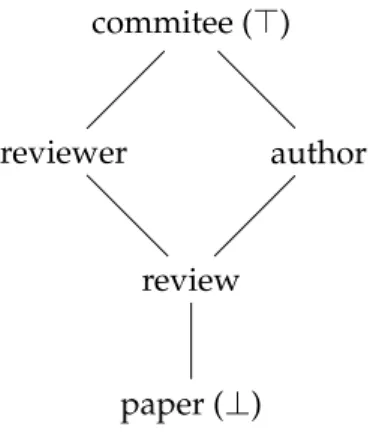
Security Lattices A lattice is defined by a set of elements Land partial order on those elements⊑such that, for any two elements aandbfromL, there is a least upper bound (ajoin), denoteda⊔b, and a greatest lower bound (ameet), denoted a⊓b. In particular, when the lattice is finite, there is a greatest element and a lowest element, also known as top (⊤) and bottom (⊥), respectively.
commitee (⊤)
reviewer author
review
paper (⊥)
Figure 2.1: Security lattice model for anonymous paper reviews
In the approaches we studied, the greatest element of a security lattice corresponds to the highest security level, and its least element corresponds to the lowest security level, thus it is always safe to restrict information with security level a to a security level b, provided thata ⊑b. Unless specified otherwise, our examples assume the use of a lattice defined by the set{⊥,⊤}, where⊤is the security level of confidential information and
⊥is the security level of public information, meaning that⊥ ⊑ ⊤.
Non-interference Language-based information security defines a secure program in terms of a property callednon-interference, stating that confidential inputs of a program should notinterferewith the values of its public outputs. More formally, given a program
Pand two initial statesS1andS2whose public variables have the same values (denoted
S1 =⊥ S2), running P with S1 (resp. S2) should yield a state S′1 (resp. S2′) such that
S′1=⊥S2′.
For instance, consider a function that takes a confidential booleanx as an argument and returns its logical negation as a public value:
λ x : bool⊤. if x then false⊥ else true⊥
If we consider the program where we apply this function to the confidential valuetrue⊤,
its result will be the public valuefalse⊥. Conversely, if we apply this function tofalse⊤, its result will betrue⊥. Thus, by changing the value of the confidential inputx, we get
different public outputs, meaning that non-interference does not hold for this program.
where a public value is expected. However, there exist alsoimplicit flowsof information such as those resulting from conditional expressions, which leak information about their condition through the control-flow of the system.
In general, implicit flows occur whenever wedeconstructa value to know more infor-mation about itsidentity. For example, we can deconstruct booleans by using the condi-tional expression, since we have a branch for when its condition istrueand other for when it isfalse; or we can deconstruct abstractions by applying them to some value, because we can distinguish which abstraction was used by looking at its result (e.g. increment vs decrement).
Outline The remaining of this section presents four language-based approaches to in-formation flow analysis, chosen in such away as to highlight different techniques and points of view. In Subsection2.1.1 we present λSEC and λSECREF, two functional calculi that follow the typical approach where all values and types have security annotations. Subsection2.1.2explores the view of information-flow analysis as adependencyanalysis by presenting the Dependency Core Calculus. In Subsection2.1.3we present the Secure Monadic Calculus, a functional calculus that follows an uncommon approach where only reference types and values have security annotations.
2.1.1 λSEC andλREFSEC calculi
The first example we illustrate here is λSEC, a core functional calculus presented by Zdancewic in his PhD thesis [Zda02] to introduce how one defines a type system that ensures well-typed programs do not leak high security information. We next present one of its extensions,λREFSEC, which extends the core calculus with references and imperative constructs.
A core calculus
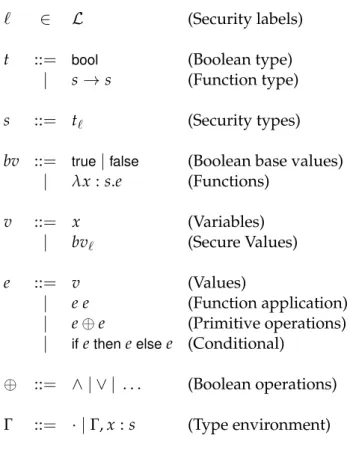
The first calculus,λSEC, is a variant of the simply-typed lambda calculus [Bar92] featuring boolean and functional values annotated with a security label from an arbitrary lattice. The type system ensures that well-typed programs will never break the security layers, leaking information to undesired contexts. This approach does not require runtime tests to be performed and is supported by the non-annotated semantics of the host language, in this case the standard semantics of the simply-typed lambda calculus.
The type system follows a conservative approach to security, since most typing rules ensure the security level of an expression is at least as restrictive as all its sub-expressions’ security levels (see Figure2.3). The only exception is the typing rule for application (λSEC-APP), since the security level ofe2is not explicit in the type of the result.
λSEC-APP
ℓ ∈ L (Security labels)
t ::= bool (Boolean type)
| s→s (Function type)
s ::= tℓ (Security types)
bv ::= true|false (Boolean base values)
| λx:s.e (Functions)
v ::= x (Variables)
| bvℓ (Secure Values)
e ::= v (Values)
| e e (Function application)
| e⊕e (Primitive operations)
| ifetheneelsee (Conditional)
⊕ ::= ∧ | ∨ | . . . (Boolean operations)
Γ ::= · |Γ,x:s (Type environment)
Figure 2.2: λSECgrammar
Notice also the typing rule for abstraction (λSEC-FUN), where we can see that if pa-rameter xis used in expression e, the resulting security level must be at least as secure as that ofx, since it is a sub-expression (e.g. Listing2.1). If that is not the case, no infor-mation from the parameter will be used ine, proving that the typing rule for application accurately describes the information that may be leaked.
λSEC-FUN
Γ,x :s1 ⊢e :s2 x6∈dom(Γ) Γ⊢(λx:s1.e)ℓ :(s1→s2)ℓ
It is also worth noting, that abstractions are labelled by a security level of their own which provides a lower bound on the security level of the result (seeλSEC-APP), allowing us to constrain the information that is leaked by knowingwhatfunction is being applied.
Listing 2.1: SimpleλSECfunction
1 // Has type (bool⊤ → bool⊤)⊤ 2 (λ h : bool⊤.
3 if h then true⊥ else false⊥ 4 )⊥
λSEC-TRUE Γ⊢
trueℓ :boolℓ
λSEC-FALSE Γ
⊢falseℓ:boolℓ
λSEC-VAR
Γ(x) =s Γ⊢ x:s
λSEC-FUN
Γ,x: s1 ⊢e:s2 x6∈dom(Γ) Γ⊢ (λx :s1.e)ℓ :(s1→s2)ℓ
λSEC-BINOP
Γ⊢e1 :boolℓ1 Γ⊢e2:boolℓ2 Γe1⊕e2 :boolℓ1⊔ℓ2
λSEC-APP
Γ⊢e1 :(s2→s)ℓ Γ⊢e2:s2 Γ⊢ e1e2:s⊔ℓ
λSEC-COND
Γ⊢e :boolℓ Γ⊢ e1 :s⊔ℓ Γ⊢e2 :s⊔ℓ Γ⊢ ifethene1elsee2:s⊔ℓ
λSEC-SUB
Γ⊢e :s Γ⊢s ≤s′ Γ⊢e :s′
Figure 2.3:λSECtyping rules
Although its simple nature is useful as an introduction to information-flow analysis’ techniques, it is also because of its simple nature that it is not a good representative of the challenges faced in mainstream programming languages: as a simple variant of the simply-typed lambda calculus, it still lacks the power of Turing-complete systems.
Coping with side-effects
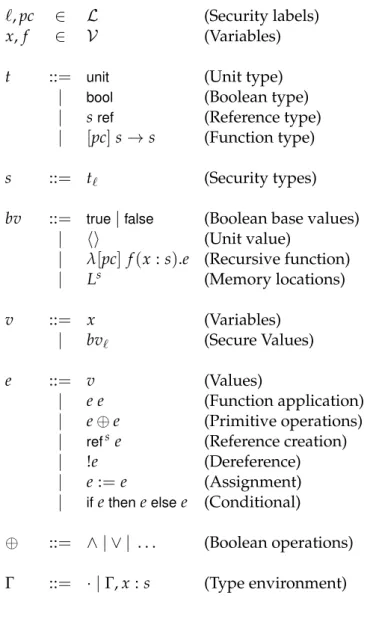
As a second step to address information-flow analysis in mainstream programming lan-guages, Zdancewic definesλREFSEC by extendingλSECwith references and recursive func-tions, thus making it Turing-complete and able to perform side-effects. Consequently, abstraction has a new local variable f that refers to the function itself and apcsecurity label that represents the security level of the program when its body is evaluated.
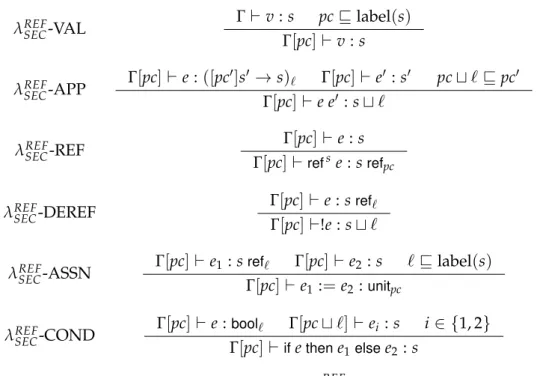
Type checking inλREFSECtakes a more fine-grained approach than inλSEC, tracking the security level of the program at each point by using judgements of the formΓ[pc]⊢e :s, stating that e has type s under a type environment Γ at security level pc (for program counter). Consequently, the type system is able to deal with the new implicit flows that arise by adding side-effects to the calculus, without being too conservative in its analysis. A complete listing of the typing rules can be found in Figure2.5.
ℓ,pc ∈ L (Security labels)
x,f ∈ V (Variables)
t ::= unit (Unit type)
| bool (Boolean type)
| sref (Reference type)
| [pc]s→s (Function type)
s ::= tℓ (Security types)
bv ::= true|false (Boolean base values)
| hi (Unit value)
| λ[pc] f(x:s).e (Recursive function)
| Ls (Memory locations)
v ::= x (Variables)
| bvℓ (Secure Values)
e ::= v (Values)
| e e (Function application)
| e⊕e (Primitive operations)
| refse (Reference creation)
| !e (Dereference)
| e:=e (Assignment)
| ifetheneelsee (Conditional)
⊕ ::= ∧ | ∨ | . . . (Boolean operations)
Γ ::= · |Γ,x:s (Type environment)
Figure 2.4: λREFSECgrammar
is somewhat implicit in the typing rules. The typing rule for values (λREFSEC-VAL) requires the security level of every value to be at least as restrictive as the current pc. Conse-quently, for an expression to be well-typed, its security level also needs to be at least as restrictive aspc, which often ends up requiring the use of subsumption to further restrict the security level.
λREFSEC-VAL Γ⊢v:s pc⊑label(s)
Γ[pc]⊢ v:s
InλSEC, the only source of implicit flows are conditional expressions, here handled by forcing the branches to be typed in apcat least as restrictive as the condition’s security level (see λREFSEC-COND). For instance, if the condition is a high security boolean (bool⊤),
λREFSEC-VAL Γ⊢v:s pc⊑label(s)
Γ[pc]⊢v:s
λSECREF-APP Γ[pc]⊢e :([pc
′]s′ →s)
ℓ Γ[pc]⊢e′ :s′ pc⊔ℓ⊑pc′ Γ[pc]⊢ e e′ :s⊔ℓ
λREFSEC-REF Γ[pc]⊢e :s
Γ[pc]⊢refse :srefpc
λREFSEC-DEREF Γ[pc]⊢ e:srefℓ
Γ[pc]⊢!e:s⊔ℓ
λREFSEC-ASSN Γ[pc]⊢e1 :srefℓ Γ[pc]⊢ e2 :s ℓ⊑label(s)
Γ[pc]⊢ e1 :=e2:unitpc
λREFSEC-COND Γ[pc]⊢e :boolℓ Γ[pc⊔ℓ]⊢ei :s i∈ {1, 2}
Γ[pc]⊢ifethene1elsee2 :s
Figure 2.5: SomeλREFSEC typing rules
write to low security memory locations, so that they cannot be exploited to leak secure information.
Since references are first-class values, they too have a security label of their own. Like the case for functions, this security label is used to avoid leaks caused by knowingwhat
reference we are dereferencing (seeλREFSEC-DEREF).
λSECREF-DEREF Γ[pc]⊢ e:srefℓ
Γ[pc]⊢!e :s⊔ℓ
If we did not have this annotation, the program in Listing2.2would be well-typed, as there would be no way to distinguish between both references. This notion of theidentity
of a reference is exactly what is compromised by allowing aliasing.
Listing 2.2: Preventing reference aliasing inλREFSEC
1 // Ill-typed because high cannot have type bool⊥ ref⊥ 2 (λ [⊥] high : bool⊥ ref⊤.
3 (λ [⊥] low : bool⊥ ref⊥. !low)⊥ high 4 )⊥
Possibly unsafe function calls are ruled out by the typing rule for function application (λREFSEC-APP), by requiring the function’s program counter to be at least as restrictive as the currentpc. Combined with the typing rule for assignments (λREFSEC-ASSN), this guarantees the function being called only writes to references at least as secure aspc.
λREFSEC-APP Γ[pc]⊢e:([pc
′]s′ →s)
λREFSEC-ASSN Γ[pc]⊢ e1 :srefℓ Γ[pc]⊢e2:s ℓ⊑label(s)
Γ[pc]⊢e1:=e2:unitpc
Listing2.3is an example of a well-typed function that writes high security informa-tion and yet can be called in low security contexts, since they will not be able to get any low security information from that reference.
Listing 2.3: Assigning a high security value in a low security context
1 // Has type ([⊥] bool⊤ ref⊤ → unit⊥)⊥ 2 (λ [⊥] high : bool⊤ ref⊤.
3 high := not !high 4 )⊥
For this calculus, the proof that non-interference holds is not obtained directly. In-stead, after defining its operational semantics and type system, Zdancewic advances to the definition ofλCPSSEC, a variation of λSEC with first-class continuations, for which non-interference is proven directly. The proof of non-non-interference forλSECREFis then obtained by encoding it inλCPSSEC.
Besides λCPSSEC, Zdancewic defines a calculus focused on concurrent programming,
λCONCURSEC , and its extension, λDISTRSEC , focused on distributed programming, all of which are out of the scope of this thesis.
2.1.2 Dependency Core Calculus
Non-interference, the fundamental property of information-flow security [Zda04], states that changing the values of a program’s high security inputs does not change the value of its low security outputs. In other words, it states that low security values do notdepend
on high security values, which information-flow analysis aims to guarantee by tracking those dependencies.
This idea of tracking the dependencies of a program can be found beyond information-flow analysis, ranging from compiler optimization techniques such as program slicing, used to determine the parts of a program in which its output depends, to side-effect seg-regation in the style of Haskell [JW93], in which pure values do not depend on impure values.
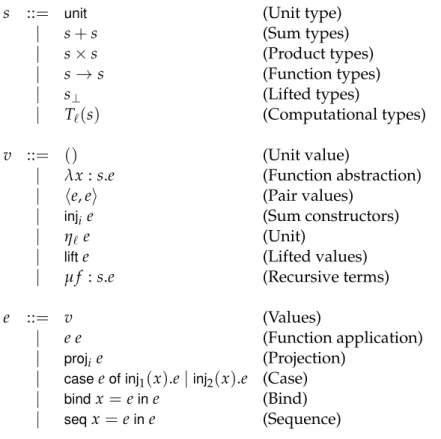
To capture this broader notion ofdependency, Abadi et al. introduce the Dependency Core Calculus (DCC) [ABHR99], an extension to the computational lambda calculus that relies in its use of a type constructorT, with the semantics of a monad, to model depen-dency between values and computations [Mog89]. More precisely, DCC includes such a type constructor for every label in a predefined information lattice, and further extends the calculus with sum types, lifted types and term recursion (see Figure2.6).
A monad can be defined by a triple (T,unit,bind) whereT is a type constructor,unit
s ::= unit (Unit type)
| s+s (Sum types)
| s×s (Product types)
| s →s (Function types)
| s⊥ (Lifted types)
| Tℓ(s) (Computational types)
v ::= () (Unit value)
| λx:s.e (Function abstraction)
| he,ei (Pair values)
| inji e (Sum constructors)
| ηℓe (Unit)
| lifte (Lifted values)
| µf :s.e (Recursive terms)
e ::= v (Values)
| e e (Function application)
| projie (Projection)
| caseeof inj1(x).e|inj2(x).e (Case)
| bindx =eine (Bind)
| seqx =eine (Sequence)
Figure 2.6: DCC grammar
monadic functionsunitandbind, and DCC’s constructs of the same name, made clearer by analysing the type system (Figure2.7).
Theunitfunction is used to wrap values in the monadic type constructor, correspond-ing to DCC’sηℓeconstruct, which takes an expressionewith some typesand wraps it in Tℓ (seeDCC-UnitM).
DCC-UnitM Γ ⊢e:s
Γ⊢ ηℓ e:Tℓ(s)
Thebindfunction is used to perform computations with wrapped values without un-wrapping them back, corresponding to DCC’sbindx= e1ine2construct, which takes an expressione1 with a typeTℓ(s1)and binds it to the namex, to be used by an expression
e2with a types2(seeDCC-BindM).
DCC-BindM Γ⊢ e1 :Tℓ(s1) Γ,x:s1⊢ e2 :s2 s2is protected at levelℓ
Γ⊢bindx=e1ine2 :s2
There is no guarantee thats2is a type of the formTℓ(β), because DCC’s type system
uses the concept oftypes protected at levelℓto model the propagation of dependencies in the typing rule for the bind construct, similarly to what is done in the typing rule for conditionals in security-typed languages. Such types are defined inductively as:
• Ifℓ′ ⊑ℓ, thenTℓ′(s)is protected at levelℓ;
• Ifs2is protected at levelℓ, thens1 →s2is protected at levelℓ;
• Ifsis protected at levelℓ, thenTℓ′(s) is protected at levelℓ.
By analogy with security-type systems, we can see the first three cases coincide with the typing rules for security restriction, binary operators and function abstraction, respec-tively, in terms of security labels. The last case reflects the fact that security levels are cumulative, i.e. writing a type as(sℓ)ℓ′is the same assℓ⊔ℓ′.
DCC-UnitM Γ⊢e:s
Γ⊢ ηℓ e:Tℓ(s)
DCC-BindM Γ⊢ e1 :Tℓ(s1) ΓΓ,x:s1⊢ e2 :s2 s2is protected at levelℓ
⊢bindx=e1ine2 :s2
Figure 2.7: DCC type rules related to dependency propagation
In the original article, DCC is used to successfully encode call-tracking, program slic-ing, binding-time analysis and simple security-type systems of both functional and im-perative calculi, evidencing that the main difference between various dependency analy-ses is often the lattice that is used. Although Abadi et al. recognise the similarity between dependency analyses, the article is focused on their encodings in DCC and does not ex-plore whether it would be possible to encode them into each other.
In this thesis, we study DCC from the point of view of information-flow analysis, leading us to observe that it may be possible to use some security-type systems to perform other kinds of analysis directly, even if security is the primary motivation behind them. For instance, we can model program slicing in the λSEC calculus (Subsection2.1.1) by following the same approach that DCC follows, giving a distinct labelℓi to every value and using the lattice (℘({ℓ1, . . . ,ℓn}),⊆), as shown for a simple example in Figure2.8. As expected, since λSEC’s typing rules for functions coincide with DCC’s typing rules when all types are protected at some level, we are able to conclude that the result of the function does not depend on its argument.
Γ,x :bool{2} ⊢false{1} :bool{1} x6∈dom(Γ)
Γ⊢ (λx :bool{2}.false{1}){0} :(bool{2} →bool{1}){0} Γ⊢ true{2} :bool{2}
Γ⊢ (λx :bool{2}.false{1}){0} true{2} :bool{0,1}
Figure 2.8: Performing program slicing in a security-typed calculus
2.1.3 Secure Monadic Calculus
and base their analysis on annotating all values with a security label. Another approach would be to focus on the places where information stops during a computation,memory locations, much like having security checkpoints.
In [CKP05], Crary et al. introduce the Secure Monadic Calculus, which follows this approach by annotating store locations with a security level, instead of values. They designate this as astore-orientedview of security, in opposition to the traditional value-orientedview of security, and prove it is equally expressive by encoding other languages in their calculus (namelyλREFSEC, presented in Subsection2.1.1). Besides including labelled first-class references, their calculus (Figure2.9) builds on the monadic distinction be-tween values and computations which forms the core of the computational lambda cal-culus [Mog89], denoting them as terms (M) and expressions (E), respectively.
r,w,a ∈ L (Security labels)
o ∈ {(r,w)∈ L × L |r ⊑w} (Operation levels)
A ::= (Types)
1 (Unit type)
| bool (Boolean type)
| A→A (Function types)
| refa A|refra A|refwa A (Reference types)
| o A (Monadic types)
V ::= (Values)
∗ (Unit)
| true|false (Boolean values)
| λx: A.M (Abstraction)
| ℓ (Store location)
| valE (Suspended computation)
M ::= (Terms)
x (Variables)
| V (Values)
| ifMthenMelseM (Conditional)
| MM (Application)
E ::= (Expressions)
[M] (Return)
| let valx = MinE (Sequencing)
| refa(M: A) (Store allocation)
| !M (Store read)
| M:= M (Store write)
Γ ::= · |Γ,x: A (Contexts)
Σ ::= {} |Σ{ℓ:A} (Store types)
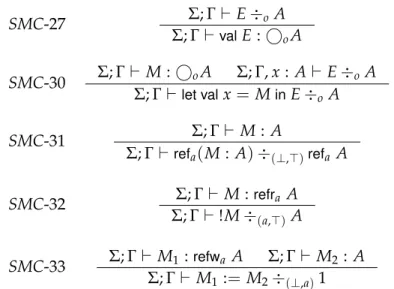
This distinction is very clear in the type system (Figure2.10) as well. Terms are typed with judgements of the form Σ;Γ ⊢ M : A, which are not concerned with the security level at all, because terms are unable to cause side-effects by definition. On the other hand, expressions can interact with the store, so their typing rules must take the security level into account. In this calculus, an expression is typed in aoperation level o = (r,w)
using judgements of the form Σ;Γ ⊢ E÷o A, wherer is a lower bound on the security levels of E’s reads andwis an upper bound on its writes. Clearly,r andwmust always be such thatr ⊑ w, since being able to write below what we are able to read is an open door to information leaks (see Listing2.4).
Listing 2.4: Writing below the reading level
1 // Ill-typed since the operation level would need to be (⊤,⊥) 2 let val high = val ref⊤ (false : bool) in
3 let val low = val ref⊥ (false : bool) in 4 let val h = val !high in
5 low := h
Interactions with the store are performed through allocation, reading and writing, and have a direct influence in the operation level. Store allocation is typed (SMC-31) with operation level (⊥,⊤), reflecting the fact that allocating a fresh location from the store is neither a read or a write, leading to no leaks of information1. Unsurprisingly, reading from a reference with security level a is typed (SMC-32) with operation level
(a,⊤), reflecting the fact that no write is performed. Conversely, writing to a reference with security levelais typed (SMC-33) with operation level(⊥,a), as expected.
The operation level is propagated through the program by the typing rule for thelet val construct (SMC-30), which corresponds to the monadic bind operation and establishes the bridge between terms and expressions. As it requires both its term and sub-expression to be typed in the same operation level (essentially), there is often the need to use subsumption to restrict both levels to their join, if it exists.
To approach the situation where we have high security computations inside low se-curity ones, Crary et al. introduce the concept ofinformativenessof a type with respect to a security level. Its judgements take the form⊢ Aրa, stating that type A only provides information at security levelaor above. Intuitively, this means that if we cannot gain any information from type A at our current operation level, we can safely lower it to(⊥,⊤). This fine-grained analysis allows us to type programs such as the one in Listing2.5 as low security computations, since we know that any two values of typeunitare indistin-guishable from each other. That is not the case in other calculi such asλREFSEC, for example, where an equivalent program would be typed as a high security computation.
Non-interference results for this calculus guarantee that, if a program is well-typed in an operation level (r,w), no information higher thanr is leaked. Their proof is built
1At least in the scope of information-flow analysis. Monitoring the memory usage of a program could
SMC-27 Σ Σ;Γ⊢E÷oA ;Γ⊢valE:oA
SMC-30 Σ;Γ⊢ΣM:oA Σ;Γ,x: A⊢E÷o A ;Γ⊢ let valx= MinE÷oA
SMC-31 Σ;Γ⊢ M : A
Σ;Γ⊢ refa(M: A)÷(⊥,⊤)refa A
SMC-32 ΣΣ;Γ⊢ M :refra A ;Γ⊢!M÷(a,⊤)A
SMC-33 Σ;Γ⊢ M1:refwa A Σ;Γ⊢ M2 :A
Σ;Γ⊢ M1:= M2÷(⊥,a)1
Figure 2.10: Some typing rules for the Secure Monadic Calculus
Listing 2.5: SMC program that benefits from informativeness
1 // Well-typed with operation level (⊥,⊤) instead of requiring (⊤,⊤) 2 let val high = val ref⊤ false in
3 let val h = val !high in 4 [if h then * else *]
on top of two main steps: the definition of an equivalence relation between computation states, parametrized by a security level, and the respective proof that the equivalence is preserved at each evaluation step.
2.2
Type-Based Access Control
Even though software systems exist to process and provide information, either to human users or to other software systems, there is often the need to protect the access to some of their information, either because it should not be accessible to every user of the system, or because its knowledge may directly compromise the established security policies, thus creating the need to control the access specific users have to specific information.
Severalaccess controlsystems were developed to enforce policies that specify whether a given user of the software system has permission to access a given information, more generally referred to as specifying whether a given subject has permission to access a given object. Depending on the entity to which permissions are associated, subjects or objects, access control systems can be classified in two main classes: those based in capa-bilities associate permissions with the subjects, while those based in Access Control Lists (ACLs) associate permissions with the objects.
forget any important verification code, which often leads to access control code being scattered everywhere “just in case”. However, there are language-based approaches that mitigate this problem by integrating the specification and verification of access control policies at the language level, detecting situations where there is no guarantee that the security policy is being respected.
Ur/Web is an embed domain-specific language for web applications that integrates the database and application layers, allowing the detection of common errors and incon-sistencies between the two. In [Chl10], Chlipala presents a tool to statically verify ac-cess control policies in Ur/Web without requiring any program annotations besides the policies themselves, based on the idea ofSQL queries as policies. The intuition is that SE-LECT queries can be used to specify an upper bound on the data manipulated by a given database operation, so the challenge is to ensure that data manipulated by database oper-ations is a subset of the data allowed by the policies. Given that the analysis also verifies information flows to some extent, it is discussed as a related work in Section3.1.
In [CPS+11], Caires et al. introduce a calculus with the same goals and setting, where policies are specified as arbitrary logic conditions and knowledge is registered in the types, yielding a different but more flexible approach. In the following, we describe the language in more detail through a series of small examples, given that our language draws on its core database model and type-based approach, and describe the core con-cepts of LiveWeb [Dom10], a domain specific language for web applications which was extended with the calculus’ type system.
2.2.1 λDB and the LiveWeb framework
Web-based applications alone are enough to show there is a significant number of data-centric software systems that rely on databases to store data, leading to a proliferation of multi-layered software architectures even though they are very challenging to build cor-rectly. Layers are often implemented in different programming languages and interface with each other using ad-hoc methods, difficulting every attempt to maintain coherence between them or enforce system-wide security policies.
TheλDBcalculus
In [CPS+11], Caires et al. introduce a language targeting both the database and applica-tion layers in a uniform way, in order to shift part of the challenging work from the devel-oper to the development tools. Their language,λDB, is a functional calculus with records, collections and core database primitives, which uses dependent refinement types to stat-ically enforce access control policies over data. Database policies are specified as read or write permissions, expressed in classical propositional logic extended with equality over terms and the axiom[m=v].mi =vito deal with records, which allows for precise access control at the table cell level. We present the calculus’ complete syntax in Figure2.11.
e ::= (Expressions)
v (Value)
| e(v) (Application)
| [m=e] (Record)
| e.m (Field Selection)
| e op e (Operation)
| e?e:e (Conditional)
| letx =eine (Let)
| e1, . . . ,ek (Collection)
| createt:βρine (Create)
| fromxintwhereeselecte (Select)
| updatexintwhereewithe (Update)
| appendetot (Append)
| deletexintwheree (Delete)
| assumeC (Assume)
| assertC (Assert)
ρ ::= (Permissions)
rd(m,R) (Read)
| wr(m,W) (Write)
C,R,W ::= (Propositions)
p(V) (Predicate)
| V=V (Equality)
| C∧C (Conjunction)
| C=⇒C (Implication)
u,v ::= (Values)
() (Unit value)
| true (True)
| false (False)
| x (Variable)
| λx:τ.e (Abstraction)
| [m=e] (Record)
| v1, . . . ,vk (Collection)
| ⋆(v) (Classified Value)
V ::= (Terms)
() (Unit value)
| true (True)
| false (False)
| x (Variable)
| λx:τ.e (Abstraction)
| [m=e] (Record)
| V1, . . . ,Vk (Collection)
| ⋆(V) (Classified Value)
| V.m (Field Selection)
to enhance the type system with more precise type information, allowing compile-time detection of a wider range of errors. In the style of [GF09], refinement types inλDB take the form{x: τ|C}, which can be read as the type of “all values xof typeτthat satisfy proposition C”. For instance, while Int is the type of all integers, the refinement type
{x:Int|Auth(x)} is the type of all integers that satisfy predicate Auth, which can be informally taken to mean the type of all authenticated user IDs of the system.
Note that Auth is not a special predicate, in the sense that it has no special meaning within the language, only within a particular system. To enforce the desired semantics, the only source of authenticated IDs would need to be a trustedauthenticatefunction like the one in Listing2.6. By typing its result as{x : Bool|x = true ⇒ Auth(uid)}, we reflect the knowledge that if the result equals true then the user ID we supplied as an argument was successfully authenticated, illustrating the potential of refinement types to specify the post-conditions of a function.
Listing 2.6: Trusted function used to authenticate users
1 authenticate , λ uid : Int. λ pwd : String.
2 let res = from u in Users where u.id = uid ∧ u.password = pwd select u in 3 isEmpty(res) ?
4 false
5 :
6 let _ = assume Auth(uid) in true
Database tables are defined by specifying a name and atable typeβρ where βis the type of its rows, typically a record type that defines the table’s schema, and a collectionρ
of read and write permissions of the formrd(m,C)andwr(m,C), respectively, wheremis a field name andCa logical proposition (as stated above). We are allowed to read (resp. write) a field if, and only if, we are able to prove the disjunction of its read (resp. write) permissions holds. For instance, theUserstable referred in the example of Listing2.6, could be defined with table type
[id :Int, name :String, password :String, phone :Int]ρ
whereρ ={rd(id,true),
rd(name,true),
rd(password,true),
rd(phone, Auth(this.id))}
Given that the current knowledge is registered in each type, we can write judgements of the form∆ ⊢Cto mean thatCholds based on the knowledge of type environment∆,
allowing us to cumulatively gather knowledge according to the usual scoping rules. For instance, in Listing2.7 we define a getPhonefunction that given a user ID selects the corresponding phone number from theUsers table, which is only well-typed because we require the user ID to be authenticated in order to fulfil the table’s read policy. Notice no explicit use ofauthenticateis required, because the type system will guarantee the function can only be called if it has the knowledge the user is authenticated.
Listing 2.7: Obtaining a phone number requires authentication
1 getPhone , λ uid : { x : Int | Auth(x) }.
2 let res = from u in Users where u.id = uid select u.phone in 3 head(res)
Knowledge is directly increased with each new declaration, but it is also propagated through the return types of function calls or the results of database primitives, refined with whereclause conditions. Other constructs, like the conditional or the assume, in-crease knowledge implicitly by extending the type environment with mappings of the form _ : {_ : unit | C}. In the example of Listing2.8, each branch of the conditional is typed under an extended type environment with knowledge about the condition, allow-ing it to prove the user is authenticated when callallow-ing thegetPhonefunction. Recall that the return type of theauthenticatefunction is {x : Bool | x = true ⇒ Auth(uid)}, so the first branch is typed with the additional knowledge _ : {_ : unit|true = true ⇒
Auth(user_id)}, implying that Auth(user_id)holds in that scope.
Listing 2.8: Full example with knowledge propagation
1 λ uname : String. λ pwd : String.
2 let res = from u in User where u.name = uname select u.id in 3 let user_id = head(res) in
4 authenticate(user_id, pwd) ? 5 "Phone: " + getPhone(user_id) 6 :
7 "Access denied"
The LiveWeb framework
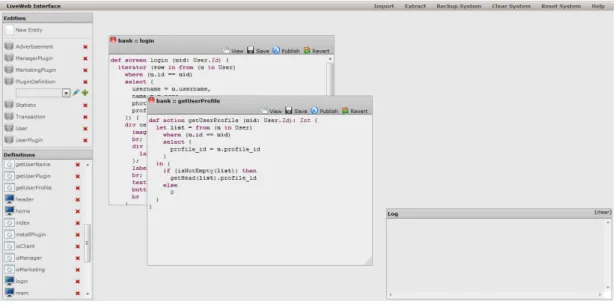
LiveWeb [Dom10] is a statically typed domain-specific language targeted at web applica-tions development, supported by a web-based development environment (Figure2.12) that allows for the management of successive versions of database entities, web pages and business logic. The framework was designed to serve as a prototype test-bed for various extensions regarding the use of static analysis in data-centric software systems, the first of which was an extension with theλDB’s type-based access control model.
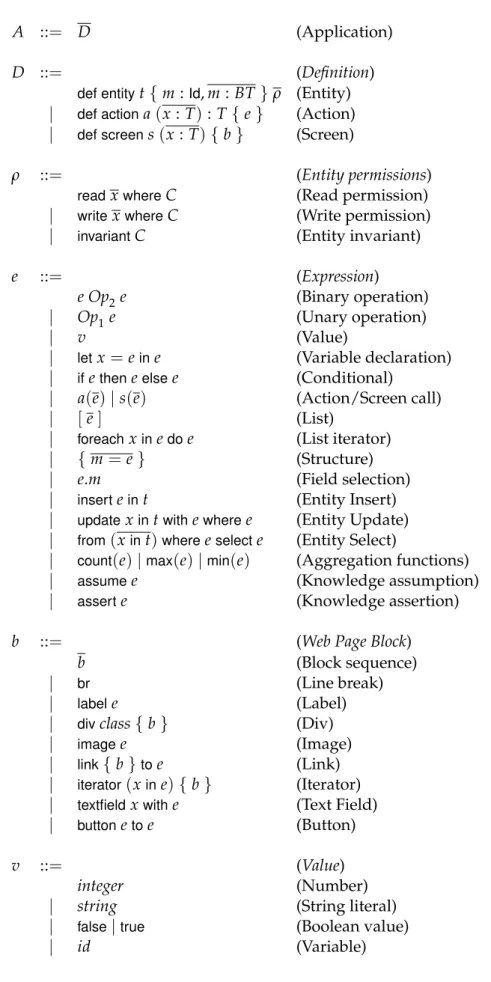
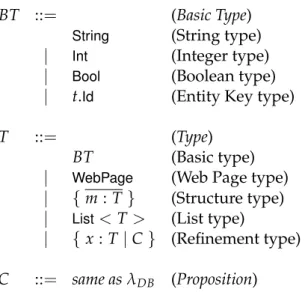
The language (Figure2.13) is composed by two major sub-languages: an expression language, whose syntax closely resembles that ofλDB, and aweb page blocklanguage mod-elled after a fragment of HTML, for presentation purposes. Along with the type language (Figure2.14), these sub-languages are used in three distinct types of top-level definitions inspired by the components of the Model-View-Controller architectural pattern [Ree79].
Figure 2.12: LiveWeb’s web-based development environment
Entitiescorrespond to database tables and specify their fields and types. Each entity must have a primary key field, indicated by the typeId, but can have several foreign keys by defining fields with types of the form entity-name.Id. For instance, in Listing2.9
we define an entityUser, with a primary key fieldid, two string fieldsusernameand
passwordand a foreign keyprofile_idreferring aProfileentity. Each field has a
read and write permission oftrue, meaning they can always be read or written.
Listing 2.9: A LiveWeb entity definition
1 def entity User {
2 id : Id, username : String, password : String, profile_id : Profile.Id 3 }
A ::= D (Application)
D ::= (Definition)
def entityt{m:Id,m:BT}ρ (Entity)
| def actiona(x:T):T{e} (Action)
| def screens(x :T){b} (Screen)
ρ ::= (Entity permissions)
readxwhereC (Read permission)
| writexwhereC (Write permission)
| invariantC (Entity invariant)
e ::= (Expression)
e Op2e (Binary operation)
| Op1e (Unary operation)
| v (Value)
| letx= eine (Variable declaration)
| ifetheneelsee (Conditional)
| a(e)|s(e) (Action/Screen call)
| [e] (List)
| foreachxinedoe (List iterator)
| {m= e} (Structure)
| e.m (Field selection)
| inserteint (Entity Insert)
| updatexintwithewheree (Entity Update)
| from(xint)whereeselecte (Entity Select)
| count(e)|max(e)|min(e) (Aggregation functions)
| assumee (Knowledge assumption)
| asserte (Knowledge assertion)
b ::= (Web Page Block)
b (Block sequence)
| br (Line break)
| labele (Label)
| divclass{b} (Div)
| imagee (Image)
| link{b}toe (Link)
| iterator(xine){b} (Iterator)
| textfieldxwithe (Text Field)
| buttonetoe (Button)
v ::= (Value)
integer (Number)
| string (String literal)
| false|true (Boolean value)
| id (Variable)
BT ::= (Basic Type)
String (String type)
| Int (Integer type)
| Bool (Boolean type)
| t.Id (Entity Key type)
T ::= (Type)
BT (Basic type)
| WebPage (Web Page type)
| {m: T} (Structure type)
| List< T> (List type)
| {x: T|C} (Refinement type)
C ::= same asλDB (Proposition)
Figure 2.14: LiveWeb type grammar
Screensspecify the web page layout by means of a sequence ofweb page blockswhich directly correspond to many HTML elements such as line breaks (br), divs, text fields and buttons. As with most server-side languages and frameworks, the content of the web page can be dynamically generated for each request either by parametrizing the screen (like a typical function) or by embedding queries (or any other expression) in the screen definition. In Listing2.10, we define a simple login page with two text fields and a submit button, which is parametrized by an error message. Figure2.15shows a possible rendering of the login page, if we attempted to login previously and got redirected back.
Listing 2.10: Defining a login screen in LiveWeb
1 def screen loginPage (errorMsg: String) { 2 div error { label errorMsg };
3 div loginForm {
4 label "Username: "; textfield uname; br; 5 label "Password: "; textfield pwd; br;
6 button "Login" to performLogin(uname, pwd) 7 }
8 }
Actions are executed in the server-side and encode the application’s business logic. Like screens, they can be parametrized, but unlike them no explicit web page blocks occur, only an expression that constitutes the action’s body. For instance, a common need among web applications is to perform the login of a user. Besides the layout aspects, already presented, we would need to define an action that, given an user name and a password, tries to perform a login and renders an appropriate web page in response, as exemplified in Listing2.11. The assume is required in order to provide knowledge that the integeruidis authenticated, i.e. has type{ x: Int | Auth(x) }.
Listing 2.11: Defining a login action in LiveWeb
1 def action performLogin (uname: String, pwd: String): WebPage { 2 let uids =
3 from (u in User)
4 where u.username == uname and u.password == pwd
5 select { id = u.id }
6 in
7 if isNotEmpty(uids) then
8 let uid = getHead(uids).id in (
9 assume Auth(uid);
10 homePage(uid, "Login was successful.") 11 )
12 else
13 loginPage("Wrong username/password combination.") 14 }
3
Related Work
There is a long thread of research on information-flow languages, which includes two ma-jor pragmatic approaches that extend mainstream programming languages. Jif [Mye99] is an extension of the Java programming language with information-flow analysis featur-ing polymorphic labels, first-class labels, runtime principals and declassification mecha-nisms. Flow Caml [Sim03] is an extension of the Objective Caml programming language with information-flow analysis fully supported by polymorphism and type inference.
While they both provide a powerful support to enforce security policies, in our opin-ion the focus of Jif is too general to fit as related work, more so as it addresses the problem in an object-oriented setting whose challenges are distinct from ours. Flow Caml, al-though with a general focus, overlaps with our language in its functional paradigm and is a pragmatic example of advanced features (polymorphism, type inference) that our approach lacks so far. Even so, our work will present an analysis where security levels are first-order logic propositions, allowing for a fine-grained specification of information-flow policies in the context of data-centric systems that is not addressed directly by either of these languages. Thus, in this chapter we discuss both Flow Caml and two works that share the same data-centric setting as ours.
3.1
Ur/Web
Listing 3.1: A sendClient policy in Ur/Web
1 table user : { Name : string, Password : string } 2
3 policy sendClient (SELECT user.Name FROM user WHERE true)
Listing 3.2: Explicit information-flows in Ur/Web
1 fun displayPassword(name) =
2 queryX (SELECT * FROM user WHERE user.Name = {name}) (row =>
3 write(row.Password)
4 )
by database operations. Thus, the analysis must be able to verify that the data manipu-lated by a given query is a subset of the results of one of the applicable policies.
For instance, in Listing3.1we define a database tableuserwith two fieldsNameand
Password, and a sendClient policy specifying that only the name of a user can be
sent to the web client — that is, fieldNameis public and fieldPasswordis confidential. Policies of typesendClientare used to specify which database information can be sent to the web client (e.g. the browser), corresponding to select statements, and other types of policies exist for insert, delete and update statements.
The language’s only loop constructs arequery loops, used to iterate the results of a query and repeatedly produce or accumulate a result. For instance, in Listing3.2we have adisplayPasswordfunction that selects all the users with a givenname, specified as an argument, and for each resultingrowwrites the user’s password to the web client using the writeprimitive. Given the policy we defined, Ur/Web is able to statically detect that writing the password consists in an information leak, because there is no policy – in our example – that allows for the password values of table user to be sent to the web client.
In order to statically detect information leaks, the provenance of the values is tracked throughout the program, as in standard information-flow approaches, but it is achieved by maintaining an abstract state of the program specified in terms of logical propositions. In the context of our previous example, the select query would augment the abstract state with the knowledge that row belongs to table user, and that the value of row.Name
equals that of parametername. Additionally, the policy in Listing3.1states that if there is some row r that belongs to the user table, then we are allowed to send the value of r.Name to the web client. Thus, the program’s state has no way to prove that we are allowed to write the value of row.Password, resulting in a compile-time error as expected.
Listing 3.3: Undetected information-flow in Ur/Web
1 fun login(name, password) =
2 queryX (
3 SELECT *
4 FROM user
5 WHERE user.Name = {name} AND user.Password = {password} 6 ) (row =>
7 write("Logged in!") 8 )
table permissions that depend on the current user, based on the notion that all the in-formation coming from the client is known to the user, which is then propagated transi-tively through equality assertions and container relationships introduced by the various queries.
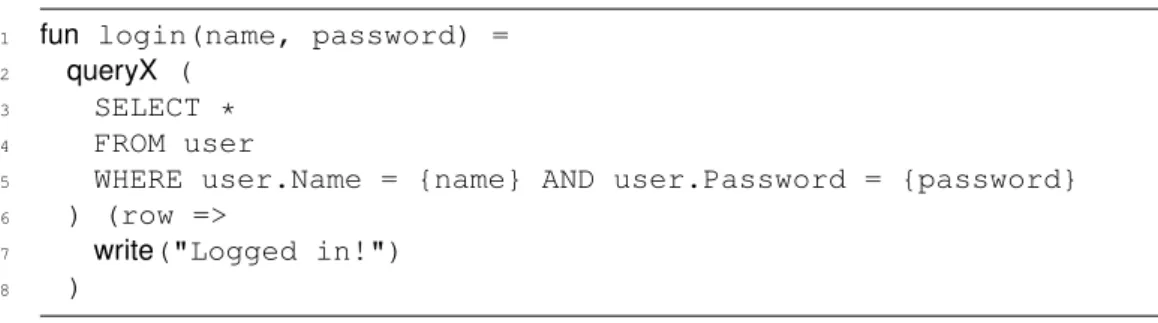
In spite of this powerful model, their analysis support for implicit flows is lacking, as they do not address the problem at all in the case of where clauses. For instance, the
login function in Listing3.3 sends the string "Logged in!" to the web client when the user’snameandpasswordmatch those in the database, and does not send anything otherwise. Thus, it is leaking information about whether the password is right or not, because the query depends on the password’s value. Although in this specific setting it is an acceptable consequence, Ur/Web considers that function to be secure without realizing there isa consequence, and does not prevent the developer from accidentally leaking information about a table field.
Discussion Standard approaches to compile-time information-flow analysis are based in the use of atype systemto enforce no information leaks occur, typically requiring ex-plicit security annotations in a program’s values and types but guaranteeing absence of leaks caused by programming mistakes and allowing for a local analysis of each part of the system. On the other hand, Ur/Web’s approach to information-flow analysis is based inprogram verification, requiring a global analysis of the software system, and does not prevent the developer from causing implicit leaks inadvertently. In spite of this limita-tions on scalability and soundness, Ur/Web provides a pragmatic model for declarative policy specification, which partially covers common use cases without requiring further program annotations.