UNIVERSIDADE DE LISBOA FACULDADE DE PSICOLOGIA
Japanese Red Cross vs Haiti Humanitarian Help Portuguese Team: Similarities and differences between their psychosocial functioning
Diana Lança Perdigão Maia Grilo
MESTRADO INTEGRADO EM PSICOLOGIA
Secção de Psicologia Clínica e da Saúde/Núcleo de Psicologia Clínica Sistémica
UNIVERSIDADE DE LISBOA FACULDADE DE PSICOLOGIA
Japanese Red Cross vs Haiti Humanitarian Help Portuguese Team: Similarities and differences between their psychosocial functioning
Diana Lança Perdigão Maia Grilo
Dissertação orientada pela Professora Doutora Maria Teresa Ribeiro
MESTRADO INTEGRADO EM PSICOLOGIA
Secção de Psicologia Clínica e da Saúde/Núcleo de Psicologia Clínica Sistémica
Index Acknowledgments………..……….…i Resumo………...ii Abstract………..iv 1.Theory………..1 2. Methodology………...…..10
2.1. State of the Art………10
2.2. Main Aim………10 2.2.1. Conceptual Map………...11 2.3. Specific Aims………..12 2.4. Research Questions……….12 2.5. Methodology………...13 2.5.1. Sample’s Description………...14 2.5.2. Measures………..16 2.5.2.1. Socio-demographic Questionnaire………17 2.5.2.2. Battery of Tests……….17
2.5.3. Procedure for Data Collection………..20
3. Results………..……….22
3.1. Quantitative Results………22
3.1.1. Descriptive analysis according to the psychosocial behavior variables:, resilience and symptomatology (depression)………22
3.1.2. Normality analysis of the study’s variables……….25
3.1.3. Correlations between the study variables……….25
3.1.3.1. Correlations between the socio-demographic variables and the psychosocial functioning variables……….25
3.1.3.2.Analysis of the possible correlation between symptomatology (depression) and resilience………...28
3.2. Qualitative Results………..29
4. Results Discussion………31
4.1. Psychosocial Functioning………...31
5. Conclusion……….33 Bibliography………..36 Annexes
Acknowledgements
I would like to thank…
The Japanese Red Cross for their patience, availability and support throughout this research
Professor Maria Teresa Ribeiro for all the support, guidance and patience through this journey.
Doctor Joana Faria for believing in me and helping me to follow my dreams.
Professor Isabel Narciso and Professor Wolfgang Lind for all the knowledge that you have shared throughout this journey.
Professor Eriko Sugiyama, for the enthusiasm and fellowship.
My colleagues, because of your support and friendship that never fails.
My uncle and aunt, for accepting me as a daughter and supporting me through thick and thin.
My mother and sister, because I’m incomplete without you.
All my family, because you make me a better person.
All my friends, for all the times you’ve never allowed me to give up.
Resumo
Este estudo tem como propósito estudar o funcionamento psicossocial de uma amostra de 18 indivíduos, profissionais da Cruz Vermelha Japonesa (CVJ), que foram accionados para o terreno, devido a uma situação de catástrofe - após o Terramoto e Tsunami de Tohoku, no Japão em 2011, sendo que até hoje continuam a prestar apoio. Pretende-se, então, um estudo focado no funcionamento psicossocial, mais específicamente ao nível da resiliência e da existência de sintomatologia depressiva, procurando-se relacionar estas variáveis com variáveis sócio-demográficas – idade, sexo, constituição familiar, situação professional, habilitações literárias e religiosidade. Para além disto, pretende-se fazer uma comparação dos resultados obtidos nesta investigação, com os resultados obtidos na Tese de Mestrado da Dr.ª Marlene Ribeiro, a qual propôs estudar o funcionamento psicossocial da Equipa Portuguesa de Ajuda Humanitária no Haiti (EPAHH).
Visto que se trata de uma investigação mais quantitativa, no sentido da recolha de dados, propos-se a utilização de um questionário socio-demográfico e uma bateria de testes, nomeadamente, a Escala de Resiliência de Connor e Davidson (CD-RISC) e o Inventário de Depressão de Beck (BDI), sendo que todos os instrumentos de avaliação são em Japonês, sendo a bateria de testes, composta por testes aferidos para a população Japonesa.
Para a análise de dados recorreu-se ao Statistical Package for Social Sciences software (IBM SPSS Statistics) 20.0 para o Windows, que nos permitiu ver que em relação à variável Resiliência os resultados demonstraram ser relativamente baixos na amostra da CVJ, contrariamente aos resultados da amostra da EPAHH. Ao nível da depressão, notou-se a existência de maior sintomatologia depressiva na equipa da CVJ do que na EPAHH e por fim, em relação às correlações entre as variáveis socio-demográficas e as variáveis de funcionamento psicossocial, é possivel afirmar que não foram encontradas correlações significativas em nenhuma das variáveis para a amostra de CVJ, ao contrário da amostra da EPAHH que verificou uma correlação positiva e significativa ao nível da resiliência e religião, e também ao nível da depressão e do número de filhos dependentes.
As diferenças poderão ser explicadas pelo facto dos participantes da CVJ ainda permanecerem em acção, nos locais mais afectados pelo terramoto e pela tsunami, tornando-se difícil gerir as quantidades de stress diárias e consequentemente ter menos
resiliência e maior possibilidade de vir a desenvolver uma Perturbação de Stress Pós-Traumático (PTSD). Enquanto que a equipa da EPAHH esteve apenas presente no Haiti durante um curto período de tempo, possuindo a informação de quando voltariam para Portugal.
Palavras-chave: Resiliênca, Depressão, PTSD, Situação de Catástrofe, Terramoto, Tsunami, Cruz Vermelha Japonesa (CVJ), Equipa Portuguesa de Ajuda Humanitária no Haiti (EPAHH).
Abstract
The purpose of this research is to examine the psychosocial functioning of individuals, who are part of the Japanese Red Cross (JRC) and went to the terrain after the 2011, Tohoku Earthquake and Tsunami in Japan. The psychosocial variables chosen for this study are the level of resilience and presence of symptomology (depression), which will in turn be related with the socio-demographic variables – gender; age; family constitution; working status; educational qualifications and religion. The results will be compared with the results obtained from Dr. Marlene Ribeiro’s Master Thesis, which focused on the study of the psychosocial functioning of the Haiti Humanitarian Help Portuguese Team (HHHPT).
Quantitative (questionnaire and battery of tests) methodology was used to collect the data and later the Statistical Package for Social Sciences software (IBM SPSS Statistics) 20.0 for Windows was used to provide de statistical analysis needed.
Results showed that the JRC team has very low levels of resilience compared with the HHHTP team, and also high levels of depression, in opposition with the HHHTP team. There were no significant correlations with the socio-demographic variables, also in contrary with the HHHTP. All this could be related to the fact that the JRC team is still working on the crisis situation with the future being uncertain, in opposition with the HHHTP team, which returned home after their mission.
Key-Words: Resilience, Depression, Socio-demographic variables, Earthquake, Tsunami, Japanese Red Cross (JRC), Haiti Humanitarian Help Portuguese Team (HHHPT).
1 – Theory
Psychological Trauma and Post-traumatic Stress Disorder
Most people are exposed to at least one violent or life-threatening situation during their lives (Ozer, Best, Lipsey, & Weiss cit. by Bonnanno, 2008).
Not everyone deals with potentially upsetting events in the same manner, since some people experience acute distress from which they can’t recover, others suffer as well but in a not so intense way and for a much shorter period of time, while other people seem to recover very rapidly but then begin to experience health problems, difficulty to concentrate or even find it hard to appreciate life in the same way they used to do before the event (Bonnanno, 2008; Bonnanno & Mancini, 2012).
Still, a great number of people is capable of withstanding relatively well, the temporary revolt associated with loss or potentially traumatic events, without any interruption when it comes to their work functioning abilities or in close relationships, moving on to new challenges without a great deal of difficulty (Bonnanno, 2008).
Considering the purpose of this investigation, it seems important that it begins by defining the concept of Psychological Trauma (as well as the Post-Traumatic Stress Disorder – PTSD), since it is one of the most discussed, debated and researched topics in the history of psychology and psychiatry, because of its resulting emotional effects which are associated with different contexts such as: global terrorism, genocide and war, natural disasters, industrial explosions, epidemic diseases and also (when referring to a more personal level) in relation to deaths, injuries, threats to one’s life or loved ones lives, abuse or infant and elder negligence, or even violence in families or in communities (Reyes, Elhai & Ford, 2008).
Out of the many proposed definitions to characterize the concept of psychological trauma, there’s a characteristic that is common to all of them which is the fact that psychological trauma represents events that are emotionally shocking or terrible, that threat or actually involve the death(s) or the violation of bodily integrity (such as in cases of rape or torture) or that cause the person or people involved to not be able to prevent or stop the resulting psychological or physical damage (Reyes, Elhai & Ford, 2008; De Sousa, 2010).
According to the Psychological Trauma Encyclopedia (Reyes, Elhai & Ford, 2008), the psychological trauma can involve physical trauma (such as serious injuries or illness), but the majority of traumatic psychological events involve just the imminent threat or severe physical trauma, or, being an observer or witness of the physical trauma experienced by other people, as such it is important to understand that psychological trauma involves a psychological component of terrible events, something that occurs independently of damage or physical trauma.
According to Reyes, Elhai and Ford (2008), it is possible to affirm that the experience of psychological trauma is related to the objective nature, or impact, of the traumatic events, but it is also a unique aspect of trauma in addition to the simply physical aspect.
In relation to the Post-Traumatic Stress Disorder (or PTSD), even though it is usually associated to a situation where an individual experiences a psychological trauma, in reality, just a small percentage of people (from 15% to 20%) that experience a psychological trauma actually develop PTSD, becoming very difficult to foresee which individuals will suffer from this disorder since many risk and protecting factors are associated, those of which predispose in favor or against the development of it (Reyes, Elhai & Ford, 2008).
According to the Psychological Trauma Encyclopedia (Reyes, Elhai & Ford, 2008), PTSD involves four types of general symptoms that include: intrusive memories of anterior traumatic experiences, attempts to try and avoid those memories, a reduction in the ability to feel positive emotions and an increase in physical tension, trouble sleeping, a state of alert in relation to danger as well as negative emotions (those being fury, frustration and anxiety). It is also important to refer that the PTSD symptoms involve changes in the brain as well as in systems that regulate bodily stress and disposition, that were identified in neuro-imagetic research and that they also have a genetic basis (e.g., Hull, 2002; Cicchetti & Curtis, 2006; Gillespie, Phifer, Bradley & Ressler, 2009).
Resilience
The fact that many people which are exposed to traumatic events don’t develop PTSD and that they have the ability to keep a healthy symptomless functioning, is associated with the concept of resilience (Bonnanno, Galea, Bucciarelli & Vlahov, 2006).
But after all what does the concept of resilience specifically mean? This concept can be interpreted as the ability to recover from stress (Smith, Tooley, Christopher & Kay, 2010), but, it could also be defined as the ability to maintain a balance when facing stress (Bonnanno, 2004), functioning above the average regardless to stress (Tusaie & Dyer cit. by Smith et al, 2010), positively adapting to adversity (Luthar, Cicchetti & Becker, cit. by Smith et al, 2010), balance internal necessities and desires according to the external environment (Block & Kremen citado por Smith et al, 2010) or a positive change that can emerge from the trauma experience (Lepore & Revenson citado por Smith et al, 2010).
Masten (2001, p. 228), defines resilience as “a class of phenomenon characterized by good results regardless of the serious threats to adaptation or to development”, Cicchetti (2010, p. 145), refers that resilience has been conceptualized as “a dynamic process of development that covers the reaching of a positive adaptation in the context of a significant threat, severe adversity or trauma”.
Even though there are many interpretations and definitions in relation to the concept of resilience, there isn’t any that is universally accepted in the scientific world, none the less, according to Wald, Taylor, Asmundson, Jang and Stapleton (2006), many of the proposed definitions, including the one from Bonnanno (2004), have constructs in common, namely the concepts of audacity, prosperity and post-traumatic growth. Audacity is related to resilience because it encompasses three interrelated personality traits which are represented by three general assumptions, namely control over one’s own life, commitment to one’s own existence and an openness to face change as a challenge (Wald et al, 2006). The prosperity that refers to the reaching of a superior level of functioning beyond a pre-traumatic status (Carver cit. by Wald et al, 2006), and finally the post-pre-traumatic growth that even though the “horror” of the psychological trauma is present, the idea that individuals might benefit from the experience or even grow towards a more efficient functioning is actually a very intriguing notion that is normally associated with the concept of resilience (Westphal & Bonnanno, 2007).
According to Almedom (2005), the positive or negative results, that is, the recovery or the trauma, are precisely the factors that determine which side of the coin is facing up when adversity arises, and that make all the difference, since it is of great importance the
consequences and the “luggage” that an individual acquires from the experiences he/she has been through.
According to Wald et al (2006), after many studies it was possible to affirm that the individual factors (personal resources such as personality traits or self-esteem), environmental factors (such as good social support and positive parenting qualities) as well as the interaction between both, provide essential constructs for the development of resilience in an adult.
The evolution of the concept of resilience (studies)
Studies in the area of resilience started off with empirical efforts that began by focusing on children and the protective forces that differentiated children with healthy adaptive profiles from non-adaptive ones (Werner & Smith cit. by Cicchetti, 2010).
With the evolution of work in this area and new studies such as those of Luthar, Cicchetti and Becker (2000), it can be concluded that there are factors which are exterior to children, such as aspects from their families and also the social characteristics of the environmental that surrounds them; therefore, the focus of empirical research was changed from looking for protective factors to the mechanisms that support this resilient functioning, something that allowed researchers to elaborate prevention and interventive strategies that are sensitive (in terms of development) to promote resilience in people that experience adverse or traumatic situations (Cicchetti, 2010).
A very illustrative study of the evolution of the research in the area of resilience was done by Bonnanno et al. (2006), where a sample of New York residing individuals was used six months after the September 11th, 2001, and considering having no PTSD symptoms or just one symptom as the criteria for the prevalence of resilience.
Through the use of interviews (also by telephone), it was demonstrated that, even though many individuals possessed the PTSD criteria (particularly when the exposure was greater), resilience was observed in 65,1% of the sample; even though it was less prevalent in individuals that were more exposed, the resilience frequency was never bellow a third, even in groups which were more exposed and where dramatic elevations of PTSD could be found (Bonnanno et al, 2006).
There have been different studies, mainly with children and adolescents exposed to adverse situations (such as abuse), that explore the inner mechanisms of resilience in these individuals and the impact of their adaptation to everyday life as adults, confirming the existence of individual, social and family factors that are inherent to resilience (Masten, 2001; Cicchetti, 2010; Afifi & MacMillan, 2011). There were also studies related to the concept of ego in children and how it can be related to the concept of resilience, such as it is demonstrated by Philippe, Laventure, Beaulieu-Pelletier, Lecours and Lekes (2011) where they refer that individuals that experience psychological trauma as children, have a greater probability of developing psychological or functional disorders as adults, but, there is a significant percentage of adults with a trauma history that have kept being healthy using ego resilience as a mediating factor in the relation between infant trauma and psychological symptoms
More recently, the social resilience is a multileveled construct, revealed by the individual, but also group, capacities to educate, involve and maintain positive social relationships pointing towards a way to resist and recover from stressors and social isolation (Cacioppo, Reis & Zautra, 2011), as such, the research in the area of resilience became very extensive, trying to go beyond the individual and focusing on groups and larger systems as it is demonstrated by a longitudinal study made by Haan, Hawley and Deal (2002), where they tried to make familiar resilience operational, being this a theme also researched by other researchers such as Patterson (2002). There were also studied in the military field with their main goal being to increase resilience in the troops (Cacioppo et al 2011)
There are also studies that were made in countries outside de United States and Europe, in sequence of natural disasters, such as the one demonstrated by Jang and Wang (2009), where 15 survivors were interviewed and demonstrated that accepting, readiness, self-confidence, spirituality, resources, social support, helping others and government involvement, are all essential factors for resilience, alerting us also to the importance of understanding a culture and the different habits associated to each people, something which could lead us to thinking how resilience could have variables associated to these very same factors. Yet, there is still a lot to explore and understand when it comes to this so further studies are required.
Richardson’s Resilience Model
Even if many models and concepts have been developed when it comes to investigation in the area of resilience, a model to highlight is the Richardson’s Resilience Model that bases itself on the belief that resilience is “a strength inside everyone, that leads us to search for personal achievement, altruism, wisdom and being in harmony with a spiritual source of strength”(Richardson, 2002, p.313). Summarizing, this theory refers itself to a biopsychoespiritual balance (homeostasis) that allows us to adapt (body, mind and soul) to the current life circumstances, since this balance is bombarded by stressors, adverse events as well as other expected or not expected life events, which means that our ability to adapt and deal with them is influenced by resilient qualities and previous resilient reintegration (Wald et al, 2006).
Looking at the model (see Figure 1), the resilient qualities are represented by arrows which are pointing upwards, those of which keep homeostasis; when a disruptive event happens in life this can result in negative or positive perceived consequences, as well as a variety of emotional and evaluative responses (Richardson, 2002).
According to Wald et al (2006), the process of reintegration can lead to one out of four consequences: (1) resilient reintegration, where adaptation points to a superior level of homeostasis, (2) return to the homeostasis of origin, in an effort to overcome the disruptive situation, (3) recovery with loss, establishment of an inferior level of homeostasis (e.g. permanent physical loss or death of a loved one), and finally (4) a dysfunctional state where non-adaptive strategies (such as auto-destructive behavior) are used to deal with the stressor. This means that resilience can be seen as a consequence of successful coping abilities (Richardson, 2002).
Figure 1. Richardson’s Resilience Model
According to Richardson (2002), a disruptive situation is necessary to access to the components of resilience because the biopsychosocial homeostasis is not sufficient for the growth or perfecting. None the less, the simple linear model reflects only an event while it related to a particular part, relation or experience; there are multiple disruptive or re-integrative growth opportunities that can be found occurring at the same time.
Catastrophe Intervention
According to Rodríguez, Puente, González-Gutiérrez and Cuadros (2003), it has been hard to develop a systematic research on the effect of the exposure to traumatic events on people, because only recently it was made possible to collect a sufficient amount of data on the subject and also because the notion of PTSD was first defined in the 80’s with the study of Post-Traumatic Stress in Vietnam War Veterans (Buchbinder & Miller, cit by Pierce, 1985). As such, there has been a lot of research on the psychological impact of hazards
such as war, terrorism, pandemics and particularly natural disasters like seasonal floods, hurricanes, fires, earthquakes and tsunamis, being also important to refer mass catastrophes such as South-east Asian tsunami, the Kashmir/Pakistan earthquake, Hurricane Katrina, Cyclone Nargis in Burma, the Wenchuan earthquake in China, the Haitian earthquake (Raphael & Ma, 2011) and most recently the Tohoku earthquake and tsunami in Japan. All of these situations always create very great challenges for survivors and also rescue teams because of the extent of death, injury, destruction and population dislocation that they usual produce (Raphael and Ma, 2011).
More recently, there are studies being done that focus not only on the actual victims of the catastrophe but also on the rescue teams, hence it is important to recognize not simply the cognitions but also the affects that are considered to be basic instinctive components of human response to catastrophe, to horror, to death and to destruction (Raphael, 2007). According to Raphael (2007, p.329), “fear, terror, anger, helplessness, rage, shock, grief, and many other feelings will dominate responses for both those directly affected and those who would help.”
Since the rescue teams work directly in helping the populations that face situations of urgency, emergency and disaster, risk is something that is always present and inherent to their job which demands quick and assertive responses since they are involved in many types of disaster events, such as fires, accidents, earthquakes, terrorism (Almeida, 2012), including others already mentioned.
Because of the nature of their work, this means that rescue workers have a high exposure to traumatic events, meaning that there is a great risk of developing PTSD for these professionals (Berger, Coutinho, Figueira, Portella, Luz, Neylan, Marmar & Mendlowicz, 2012; Farnsworth & Sewell, 2011; Corneil & Murphy, 1999; Haslam & Mallon, 2003). Even though the prevalence of this disorder is known to vary across occupational groups (such as firefighters, ambulance personnel or police officers), even when different types of rescue workers are deployed to the same disaster, the nature, severity and repetition of the exposure to traumatic events may actually influence the prevalence of PTSD (Berger et al, 2012).
A study made by Berger et al (2012), confirms that rescue workers worldwide generally have a higher prevalence of PTSD than that of the general population. Still, due
to the fact that Asian countries are repeatedly hit by the deathliest natural disasters it is not surprising that results indicate a higher percentage of PTSD in Asian rescue workers (Berger et al, 2012).
According to Bronisch, Maragkos, Freyer, Cyran, Butollo, Weimbs & Platiel (2006), apart from the strong visual and auditory stimuli associated with the number of death and severely hurt people, the suffering of the surviving and bereaved, which rescue workers are exposed in catastrophe events, there are also other factors that combined create a very great risk of PTSD development, such as the fear of epidemics, the climate and a foreign culture with a language not understood. But there are also other factors, for example, according to Fuse & Yokota (2012), a Disaster Medical Assistance Team that was dispatched for the Tohoku earthquake and tsunami, in Japan, were faced with many challenges such as not being able to reach the tsunami-affected areas because of debris left by tsunami, shortages of electricity, water, gas and gasoline, overloading of telephone lines (which seriously hampered medical relief activities) and lack of medical supplies, all of which contributed to a rise in the stress level of the team.
It is important for the rescue workers to maintain resilience levels which will help them handle the situation right as it is happening and also afterwards when they return home; a study made by Bronisch et al (2006), with a rescue team that was present in the rescue mission following the Thailand tsunami, showed that group cohesion maintained with a regular constant coaching of the team, phone contact with family and loved ones at home, the hotel which was distant from the area of intervention and united helpers from one country and available counseling during and after the intervention, were all considered to be protective factors.
According to Bronisch et al (2007), it can be concluded that exposure to catastrophe will always be related to a possible risk of developing psychological disorders. Still, depending on the variety and availability of protective factors related to each individual (hence resilience), there is the possibility to attenuate or even overcome psychological disorders such as PTSD.
2 – Methodology
2.1. State of the Art
This research is related to an ongoing Clinical Psychology Ph.D. research1, more specifically in the area of Resilience and Psychological Trauma.
This study is based upon a sample of adults, from both sexes, that were part of the Japanese Red Cross intervention team that was and still is involved in the aftermath of the 2011 Tohoku earthquake and tsunami in Japan. It is also based upon the results of Dr. Marlene Ribeiro’s thesis2 which also consists of a sample of adults, from both sexes, that were part of the Haiti Humanitarian Help Portuguese Team which was involved in the aftermath of the 2010 Haiti Earthquake. By acquiring the results on both cases, a comparison will be made.
This study consists mainly of quantitative data but also qualitative data, allowing to correlate socio-demographic variables with psycho-social functioning variables. They were evaluated by answering a semi-structured questionnaire (qualitative and quantitative data) and structured questionnaires (quantitative data), which happened 1 year and 5 months after the earthquake and tsunami.
2.2. Initial Question
1) Are there differences in the psychosocial functioning of the Japanese Red Cross Team and the Haiti Humanitarian Help Portuguese Team?
2) What are the social-demographic variables that correlated with each team’s functioning?
1 P.h.D. Research Project, in Clinical Psychology, more specifically about Resilience and Psychological Trauma, presented to the Faculty of Psychology of the Lisbon University by Dr. Joana Faria.
2 Thesis associated with the Resilience and Psychological Trauma Research Project, which involved the psychosocial functioning study of a Portuguese rescue team in Haiti, after the 2010 earthquake.
2.2.1. Conceptual Map
In this section we can find the Conceptual Map for this study (Figure 2). As for the socio-demographic variables it was considered: age, gender, marital status/cohabitation, working status, occupation in the Red Cross and religion. Regarding the psychosocial functioning, it will be studied by evaluating the resilience and the depressive symptomatology. The arrows indicate the relation between each variable and construct, therefore, it is also intended that a comparison and correlations are studied between both socio-demographic variables and the psychosocial functioning.
2.3. Aims
2.3.1. Main aim
This study aims to: a) understand if there are differences in the psychosocial functioning of the Japanese Red Cross Team and the Haiti Humanitarian Help Portuguese Team; b) understand how this functioning is related to some of the individual’s social demographic variables – age, gender, marital status, occupation in the Red Cross and religion – and some of the stress factors and protective factors.
2.3.2. Specific Aims
Considering as a basis the general aims, several specific aims were defined:
Analyze the relationship between the psychosocial functioning and the socio-demographic variables and consequently compare them with the HHHPT. Analyze the relation between depression and resilience on both the JRCT and
HHHPT.
Understand if cultural differences affect the resilience results in both the JRCT and the HHHPT.
2.4. Research Questions
This is considered to be an exploratory and comparative research, which will serve as a means to find answers to questions that have not yet been extensively studied in Portugal when it comes to Catastrophe Intervention. Several research questions were elaborated and divided by two different investigation poles: 1) Social Demographic differences between both JRCT and HHHPT and 2) Psychosocial Functioning differences between both JRCT and HHHPT – considering also the relation between both Poles.
Pole 1:
1.1 – Will there be any relation between the socio-demographic variables and psychosocial functioning of both JRCT and HHHPT?
1.2 – Is it possible that cultural differences influence results?
Pole 2:
2.1– Will there be any presence of depressive symptomatology in JRCT and how does it differ from HHHPT?
2.2– Will there be any relation between the existence or not of symptomatology and resilience and how does it differ from HHHPT?
2.5. Method
Since this thesis is exploratory but consists also of a comparison of results, it was important to mainly follow a quantitative research approach but enriching it with qualitative data. Given that it was impossible to actually go to Japan and have direct contact with the participants, the means to obtain the data were limited, therefore not allowing research methods such as an interview to be used. As a result, for the quantitative methodology used to obtain several of the dimensions of the psycho-social functioning of the Japanese Red Cross Team (JRCT) two questionnaires were used – the Beck Depression Inventory (Beck, cit by McDowell 2006) which was used to evaluate the presence of depressive symptoms; the CD-RISC (Connor & Davidson, 2003) which was used to measure the level of resilience; and finally, the semi-structured questionnaire which allowed to obtain the social-demographic data. As for the qualitative methodology, the semi-structured questionnaire was used to obtain not only the social-demographic data, but also important aspects (such as protecting factors/resources) that could only be obtained through open-ended questions which allow for a more exploratory research.
2.5.1. Sample Description
The sample consisted of 18 participants aged between 27 and 58 (M= 36.78 and SD= 8.96), respectively 11 being male and 7 being female.
First of all, it is important to know which of the areas were most affected by the earthquake and tsunami because it is relevant in terms of the participant’s current residence place and the place where they were born (Table 1). Therefore, when looking at Figure 3, we can see that what is marked in red are the places where the tsunami was higher.
Table 1 - Participant’s place of birth Figure 3 – Tsunami affected areas
Place of Birth Nº Tokyo 8 Ehime 1 Gifu 1 Fukuoka 2 Miyagi 1 Ishikawa 1 Nagano 1 Yamagata 1 Ibaraki 1 Kanagawa 1 Total 18
Table 2 – Participant’s current residence place
Current Municipality of Residence Nº
Tokyo 10 Kanagawa 5 Chiba 2 Saitama 1
According to Tables 1 and 2, only one participant was born in one of the most affected areas with none currently living in the affected areas.
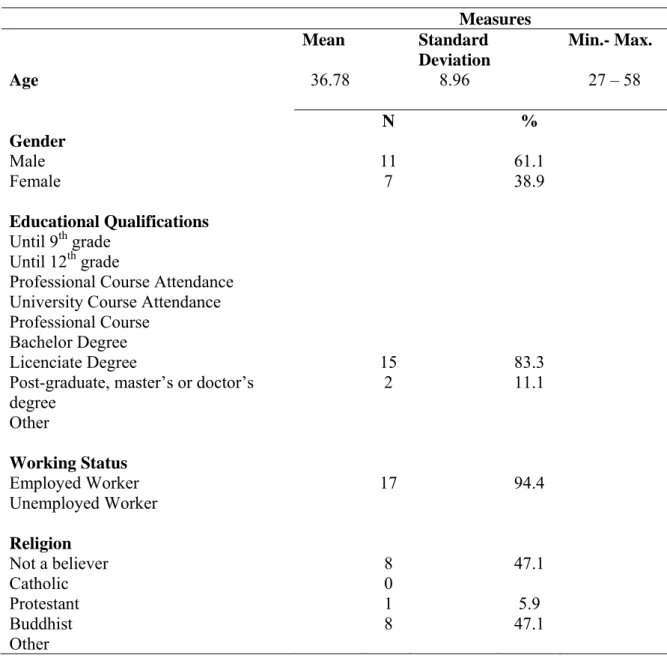
When it comes to Educational Qualifications, most of the participants have a Licenciate Degree (83.3%) with most of the participants Working Status being employed (94.4%). As for the Religious views, 53% consider themselves to have a Religion (47.1% being Buddhists) and 47.1% are Not Believers.
Table 3 – Socio-demographic Sample Description
Measures Mean Standard Deviation Min.- Max. Age 36.78 8.96 27 – 58 N % Gender Male Female 11 7 61.1 38.9 Educational Qualifications Until 9th grade Until 12th grade
Professional Course Attendance University Course Attendance Professional Course
Bachelor Degree Licenciate Degree
Post-graduate, master’s or doctor’s degree Other 15 2 83.3 11.1 Working Status Employed Worker Unemployed Worker 17 94.4 Religion Not a believer Catholic Protestant Buddhist Other 8 0 1 8 47.1 5.9 47.1
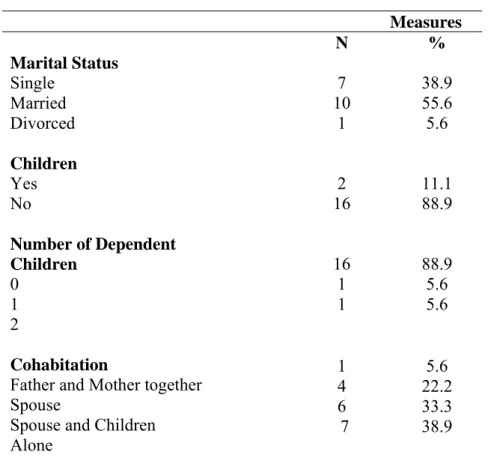
As for the family constitution, most of the participants are married (55.6%) but 88.9% have no children. The number of dependent children ranges between 1 (5.6%) and 2 (5.6%). As for the cohabitation, most of the participants live alone (38.9%) and with their spouse and children (33.3%).
Table 4 – Family Constitution
Measures N % Marital Status Single Married Divorced 7 10 1 38.9 55.6 5.6 Children Yes No Number of Dependent Children 0 1 2 Cohabitation
Father and Mother together Spouse
Spouse and Children Alone 2 16 16 1 1 11.1 88.9 88.9 5.6 5.6 1 4 6 7 5.6 22.2 33.3 38.9 2.5.2. Measures
In this section, the instruments (Annex I) used to acquire the pretended data for this investigation are described. Because of the impossibility to actually be in direct contact with the participants it was decided to opt for a more quantitative approach, therefore, a socio-demographic questionnaire was used (using only a few open ended questions for a more qualitative part of the analysis), followed by a battery of tests.
2.5.2.1. Socio-demographic Questionnaire
The socio-demographic questionnaire used in this investigation was generally based on the Portuguese one used by Dr. Marlene Ribeiro in her thesis, but translated and adapted to the Japanese population. The questionnaire consisted of: socio-demographic variables, psychosocial variables and personal variables.
For the socio-demographic variables we looked for relevant information about age, gender, residence, place of birth (to know if any of the participants had been born in one of the most tsunami-affected areas), nationality (to make sure all were Japanese) and marital status. For the psychosocial information, questions were asked about the number of dependent children, other dependent people and cohabitation, and finally for the personal variables there were questions about educational qualification, working status and religion.
Regarding the open ended questions which were added specifically to this Japanese questionnaire, they focused on different aspects such as how the event influenced the lives of those the participant lives with and even the participant him/herself; their occupation in the Red Cross; if what happened change their work status; understand if they feel that religion influences the way they feel at work and in which way or if what happened changed the way they behave.
2.5.2.2 Battery of Tests
CD-RISC
According to Connor and Davidson (2003), the CD-RISC was developed as a brief self-rated assessment (meaning a valid and reliable measure) to quantify resilience, to establish reference values for resilience in the general population and in clinical samples and as a clinical measure to evaluate treatment response.
The CD-RISC scale (Connor & Davidson, 2003), consists of a self-evaluation measure of 25 items, each one of them being classified by a five point scale (0-4) as follows: not true at all (0), rarely true (1), sometimes true (2), often true (3), and true nearly all of the
time (4). The total score ranges from 0-100, the highest results being associated with the highest resilience.
The CD-RISC possesses very solid psychometric properties which allow the distinction between individuals which are more or less resilient (Connor & Davidson, 2003). Through the use of this scale, the authors confirm that resilience is measurable and is also influenced by the mental state of the individual (people with mental illnesses have lower levels of resilience compared to the general population); it is a scale that can be very useful when it comes to clinical practice and research (Connor & Davidson, 2003; Wald et al, 2006; Ahern, Kiehl, Sole & Byers, 2006).
The CD-RISC has been tested in the general population and in clinical samples and demonstrates good psychometric properties and also good internal consistency and test-retest reliability (see Table 6), also demonstrating validity when compared with other measures of stress and hardiness (Connor & Davidson, 2003).
A cross validity study for the Japanese version of the CD-RISC was made by Ito, Nakajima, Shirai and Kim (2009), showing very good results (see Table 5).
Table 5 – Cronbach’s Alpha from CD-RISC with samples
Connor & Davidson (2003) Ito et al. (2009) Sample (HHHPT) Sample (JRC) CD-RISC 0.89 0.90 0.85 0.88
Table 6 – Internal Consistency of the sample’s CD-RISC Cronbach’s
Alpha
Inter-item Correlation Minimum Maximum Mean CD-RISC (JRC) 0.88 0.33 0.88 0.24 CD-RISC (HHHPT) 0.85 0.65 0.85 0.24
BDI
According to McDowell (2006), the BDI was created and revised by Aaron T. Beck in 1961 and 1996, by the time another version of the BDI (the BDI II) appeared, even thought the one used in this study is the first version so that they can be compared with the HHHPT results obtained by Dr. Marlene Ribeiro.
BDI evaluates twenty one depressive symptoms, fifteen of which cover emotions, four cover behavior changes and 6 cover somatic symptoms; each symptom is evaluated in a scale of four intensity points and the results are summed up to make up a result between 0 to 63 – the higher the results the more severe depression is according to the following scale: 0-9 Not Depressed; 10-20 Mild Depression; 20-30 Moderate Depression and 30-63 Severe Depression (Ribeiro, 2010).
According to Beck and Steer (1984), the symptoms and attitudes are (1) Mood; (2) Pessimism; (3) Sense of Failure; (4) Lack of Satisfaction; (5) Guilt Feelings; (6) Sense of Punishment; (7) Self-dislike; (8) Self accusations;(9) Suicidal Wishes; (10) Crying; (11) Irritability; (12) Social Withdrawal; (13) Indecisiveness; (14) Distortion of Body Image; (15) Work Inhibition; (16) Sleep Disturbance; (17) Fatigability; (18) Loss of Appetite; (19) Weight Loss; (20) Somatic Preoccupation; and (21) Loss of Libido.
The Japanese version of the BDI was created in 1987 by 林勝造 (cit by 岡田 顕宏, 2006)and a study of the validation of the Japanese version of the BDI was done by Hazama (1988, cit by. Adash, Aleksic, Nobata, Suzuki, Yoshida, Ono & Ozaki, 2012).
Table 7 - Cronbach’s Alpha from BDI with samples
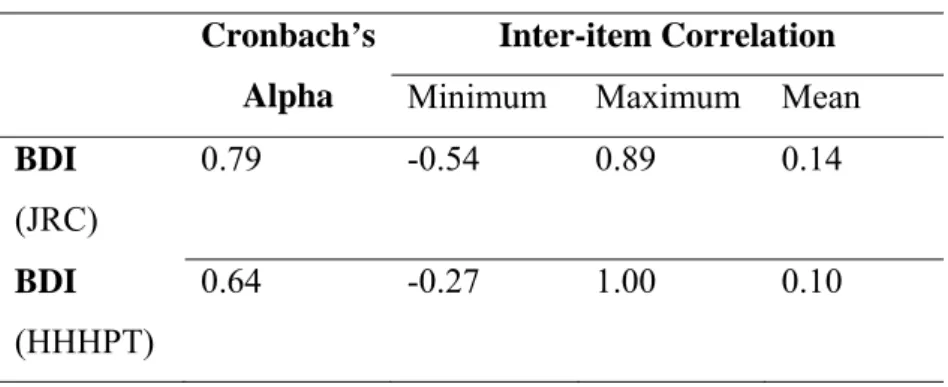
Beck (1961) 林勝造 (1987) Sample (HHHPT) Sample (JRC) BDI 0.88 0.83 0.64 0.79
Table 8 - Internal Consistency of the sample’s BDI Cronbach’s
Alpha
Inter-item Correlation Minimum Maximum Mean BDI (JRC) 0.79 -0.54 0.89 0.14 BDI (HHHPT) 0.64 -0.27 1.00 0.10
2.5.3. Procedure for data collection
Because the sample for this study is Japanese, a direct contact with the Japanese Red Cross was required; therefore, the first step was to get in touch with the Portuguese Red Cross, which provided several direct phone numbers from the JRC.
Through the International Relief Division, from the International Department in the JRC, it was possible to make the request for this study. Since it was needed that 18 JRC members answered a questionnaire and a battery of tests, there was also the need for a superior member of JRC to accept this study. Therefore, a formal e-mail was sent with all the information regarding the study and expected procedures, explaining that it was supposed to be a comparison made between this JRC rescue team and a Portuguese rescue team, since both were exposed to potentially traumatic events (in the consequence of earthquakes), and how resilience could play a major role in preventing PTSD as well as to study the differences in both team’s psychosocial behavior. The questionnaire and the battery of tests were also attached for approval.
Since it was impossible to be in direct contact with the participants (because of the geographic distance) and since confidentially and anonymity were aspects considered to be extremely important for them and the JRC, the JRC accepted the study as long as these aspects were maintained. Hence, the JRC took care of choosing and officially informing the participants, sending the measures and collecting them to send them back to Portugal.
Further e-mail contacts were made with the JRC, after the return of the measures, for additional details to the study and to thank them for all the help and collaboration from their part.
The data collection happened during the month of August and the measures were received by mail in September.
3 – Results
In this section the quantitative results obtained from this study will be presented and explained as well as compared with the HHHPT sample results, so that the objectives and general questions asked for this study might be answered.
Since this study was mainly quantintative, the Statistical Package for Social Sciences software (IBM SPSS Statistics) 20.0 for Windows, was used for the statistical analysis of the socio-demographic questionnaire and the battery of tests (both BDI and CD-RISC).
3.1. Quantitative Results
A descriptive analysis was elaborated to characterize the sample according to its psychosocial variables – resilience and depression – according to their mean, median, standard deviation, minimum and maximum values. To test for the normality of the sample, the Shapiro-Wilk (n<30) was used to analyze the normality of the distributions between the socio-demographic variables (age; gender; family constitution; working status; educational qualifications and religion) and the psychosocial variables (resilience and depression).
For the correlations between the variables being studied, regarding the fact that the sample is quite small, it was decided that the non-parametric Mann-Whitney test would be used to compare two independent groups. It is important to highlight however that whenever there were cases in which the distribution normality test of a variable (the CD-RISC or BDI) indicated the verification of the presupposition, the parametric T-Test was applied, however, the differences between groups remained non-significant, which indicated that the results between the parametric and non-parametric tests were consistent.
3.1.1. Descriptive analysis according to the psychosocial behavior variables: resilience and symptomatology (depression).
Table 9 – Descriptive statistics for CD-RISC
N Mean Median Standard
Deviation Minimum Maximum CD-RISC (JRC) 18 56,62 58,00 13,50 33,00 80,00 CD-RISC (HHHPT) 18 80,61 35,00 9,744 57,0 96,0
According to the results shown in Table 9, we can see that the mean results for the HHHPT sample are quite high (M=80,61), which means that there is a high level of resilience for that sample, since the quoting system ranges from 0-100. Nonetheless, there are differences from the minimum to the maximum results (57,0 to 96,0).
In terms of the JRC sample, the results indicate low levels of resilience (M= 56,62), which range from a very low minimum result (Min= 33,00) to a high maximum result (Max: 80,00).
In a general way, it is safe to assume that the JRC sample shows less resilience than the HHHPT sample.
Symptomatology - depression
To evaluate the presence of symptomatology associated with depression the BDI was used.
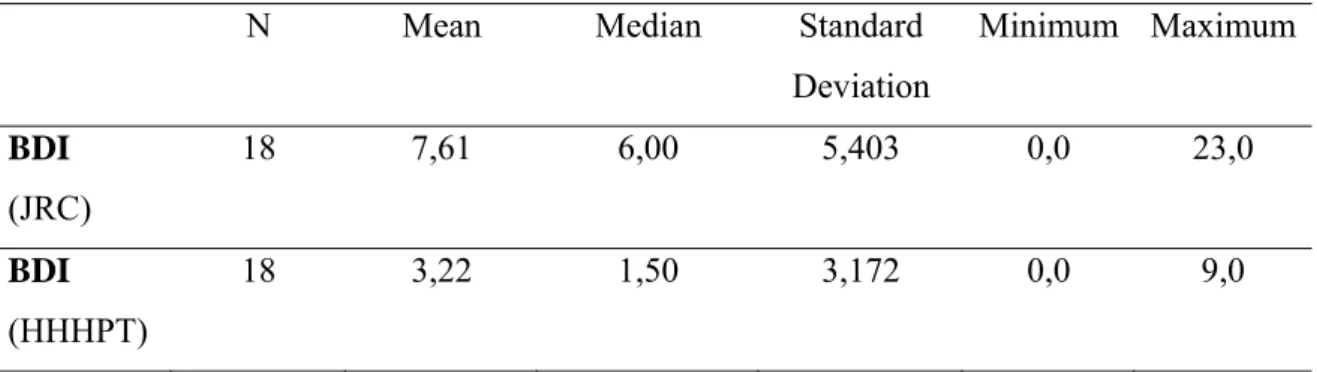
Table 10 - Descriptive Statistics for BDI
N Mean Median Standard
Deviation Minimum Maximum BDI (JRC) 18 7,61 6,00 5,403 0,0 23,0 BDI (HHHPT) 18 3,22 1,50 3,172 0,0 9,0
We can see from these statistics that in both samples (JRC and HHHPT) the mean values are different, being higher in the JRC sample (M= 7,61) and quite low in the HHHPT sample (M= 3,22).
According to the HHHTP sample since the values shown for BDI are: M=3,22; Min=0,0 and Max= 9,0 it is correct to affirm that they are considered “Not depressed” which ranges from 0-9. This is not the same for the JRC sample, where the values for BDI are: M=7,61; Min=0,0 and Max= 23,0.
Table 11 - Frequencies of results for BDI
Valid
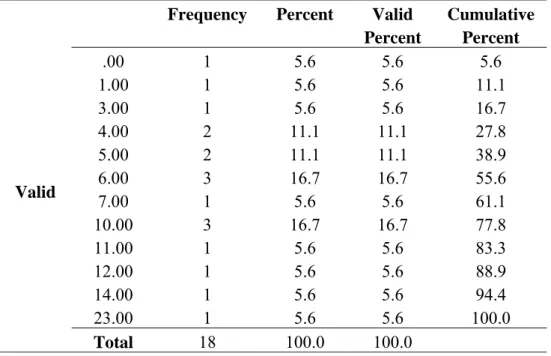
Frequency Percent Valid Percent Cumulative Percent .00 1 5.6 5.6 5.6 1.00 1 5.6 5.6 11.1 3.00 1 5.6 5.6 16.7 4.00 2 11.1 11.1 27.8 5.00 2 11.1 11.1 38.9 6.00 3 16.7 16.7 55.6 7.00 1 5.6 5.6 61.1 10.00 3 16.7 16.7 77.8 11.00 1 5.6 5.6 83.3 12.00 1 5.6 5.6 88.9 14.00 1 5.6 5.6 94.4 23.00 1 5.6 5.6 100.0 Total 18 100.0 100.0
By referring to Table 11 we can actually notice that even though most of the sample (11 participants) are within the “Not Depressed” range (0-9), 6 participants are within the “Mildly Depressed” range (10-20) (3 participants – score 10,00; 1 participant – score 11,00; 1 participant – score 12,00 and 1 participant – score 14,00) and “Moderately Depressed” range (20-30) (1 participant – 23,00).
3.1.2. Normality analysis of the study’s variables3
The Shapiro-Wilk (n<30) was used to analyze the normality of the distributions between the socio-demographic variables – age; gender; family constitution; working status; educational qualifications and religion – and the psychosocial variables – resilience and depression – (Maroco, 2007). All of the variables showed normal distribution.
3.1.3. Correlations between the study variables
Since this is an exploratory research, it is intended that the correlations between different variables are studied. Hence, it was decided that the non-parametric Mann-Whitney test would be used to compare two independent groups (Maroco, 2007).
3.1.3.1. Correlations between the socio-demographic variables and the psychosocial functioning variables
Table 12 – Correlations between CD-RISC and socio-demographic variables
CD- RISC M SD Mann-withney Test (U) p Gender Female 62,86 11,80 20,5 0,102 Male 52,73 13,50 Marital status Single or divorced 59,63 8,50 28 0,285 Married 54,30 16,55
Actually lives with
Lives with someone (spouse, spouse and children, father and mother) 55,00 15,87 29,5 0,414 Lives alone 59,29 9,12 Residence Tokyo 57,20 13,88 39 0,929 3 See Outputs 1,2,3,4,5,6,7,8 and 9 in Annex II
CD- RISC M SD Mann-withney Test (U) p Gender Female 62,86 11,80 20,5 0,102 Male 52,73 13,50 Marital status Single or divorced 59,63 8,50 28 0,285 Married 54,30 16,55
Municipality Other (Kanagawa,
Chiba or Saitama) 56,00 13,92 Religion Not a believer 60,50 9,86 24 0,247 Has a religion (protestant, buddhist, other) 53,89 16,57 Occupation in the red cross Support in Recovery and Reconstruction or Medicine 55,25 16,07 25 0,461 Other 58,75 13,12
Ever had any psychological or
psychiatric counseling
Never 57,80 13,21
33,5 0,883
Had in the past 55,86 15,69
Did what happened change they way you
behave?
Yes 55,60 5,90
13 0,463
No 50,86 15,74
As it is possible to confirm, there are no significant differences (=0,05) regarding the distribution of the CD-RISC variable between the two groups considered for the variables in Table 12 (p>0,05).
According to the HHHPT sample, results demonstrated positive and significant correlation between resilience and religion (r=,483; p<,05)
Table 13 - Correlations between CD-RISC and socio-demographic variables
BDI M SD Mann-withney Test (U) p
Gender Female 7,29 8,32 26,5 0,275 Male 7,82 2,82 Marital status Single or divorced 7,38 7,62 30,5 0,396 Married 7,80 3,16 Actually lives with
Lives with someone (spouse, spouse and children, father and mother) 7,45 3,21 34 0,682 Lives alone 7,86 8,09 Residence Municipality Tokyo 8,00 6,38 40 1,00 Other (Kanagawa, Chiba or Saitama) 7,13 4,26 Religion Not a believer 5,38 3,96 24,5 0,266 Has a religion (protestant, buddhist, other) 7,89 3,69 Occupation in the red cross
Support in Recovery and Reconstruction or Medicine
8,25 4,03 17,5 0,125
Other 5,13 3,64
Ever had any psychological or
psychiatric counseling
Never 5,60 3,44
25 0,326
Had in the past 8,29 4,27
Did what happened change
they way you behave?
Yes 11,80 6,69 11 0,287
As it is possible to confirm, there are no significant differences (=0,05) regarding the distribution of the BDI variable between the two groups considered for the variables in Table 13 (p>0,05).
According to the HHHPT sample, results demonstrated positive and significant correlation between depression and number of dependent children (r=,577; p<,05).
Table 14 – Correlation between CD-RISC, BDI and Age4
N r p
CD-RISC - Age 18 0,191 0,449
BDI - Age 18 0,233 0,353
Before applying the significance test over the correlation coefficient of Pearson, we tested the normality of the distribution for each of the variables. As there was no violation of the presupposition (CD-RISC: KS(18)=0,153 p=0,20; BDI: KS(18)=0,173 p=0,164; Age KS(18)=0,185 p=0,105) the test was applied.
According to Table 14, it was verified that no statistically significant correlation exists between the CD-RISC, BDI and Age variables (α=0,05).
3.1.3.2. Analysis of the possible correlation between symptomatology (depression) and resilience
Table 15 – Correlation between resilience and depression for JRC5
CD-RISC (resilience)
(JRC) BDI (depression)
(JRC)
-,170
The results indicate that the correlation between resilience and depression is negative for the JRC sample (r= -,170), also showing that is it a negative correlation.
4
See Output 2 in Annex II
5
Table 16 - Correlation between resilience and depression for HHHTP CD-RISC (resilience) (HHHPT) BDI (depression) (HHHPT) -,204
The same applies to the HHHPT sample, where the correlation between resilience and depression is also negative (r= -,204), also showing that is it a negative correlation.
3.2. Qualitative results
Regarding the open-ended questions that were in the socio-demographic questionnaires, because they were not many and some individuals did not answer them or the answers that they gave were usually very short, some variables were also used in the correlations with the psychosocial variables, that can be seen in this chapter in point 3.1.3.1.
In terms of any addictive behavior (for example in alcohol, Tabaco, shopping or video games) there were no results that could indicate an abnormal behavior.
Table 17 – Change in behavior after event
Did what happened change they way you behave?
Frequency Percent Valid Percent Cumulative Percent
Valid Yes 5 27.8 41.7 41.7 No 7 38.9 58.3 100.0 Total 12 66.7 100.0 Missing System 6 33.3 Total 18 100.0
Table 17 shows that 5 people (out of the 12 that answered this question) thought that what they lived changed the way they behave. Even though this is not a statistically significant number, it is nonetheless interesting to notice this detail because almost half of those who answered did feel this.
4 - Results discussion
The purpose of this chapter is to analyze and discuss the results obtained in Chapter 3 and also sustain them with theory.
4.1. Psychosocial functioning
Resilience
According to the results obtained by using the CD-RISC, we noticed that the JRC sample does not show very high levels of resilience, when compared with the HHHPT sample that showed an elevated resilient capacity. Ribeiro (2010), affirms that the sample was able to keep a relatively stable functional psychological functioning, being able to deal with the daily stressors and reintegrate them, which resulted in an increase in strength of the already present resilient qualities, which goes according to Bonnanno’s model (Richardson, 2002).
None the less, the fact that JRC still shows levels of resilience, even if low compared with the HHHPT sample, is something to take into consideration, regarding the fact that they are still being exposed to consequences related to the main potentially traumatic event (the Tohoku earthquake and tsunami).
Depression
The results obtained through the analysis of the BDI, show us that most of the JRC sample is associated with mild to moderate levels of depression, with some not being associated with depression at all. This contrasts with the HHHPT sample, which did not show any level of depression, even though some elements of the team showed symptomatology associated with anxiety.
I believe that these results are also associated with the fact that the JRC sample is still exposed and involved with difficult situations associated with the main event. When considering a situation where there is no time to reintegrate the experience and that the same stressors keep bombarding an individual (which might just be the case with the JRC
team), it might just be that there is no homeostasis to go back to; the individual cannot yet make a full adaptive reintegration (Richardson, 2002).
4.2. Relation between the study’s variables
CD-RISC, BDI and the socio-demographic variables
According to the data, the results do not support the existence of significant differences according to the levels of resilience or depression between men and women; between married or single/divorced participants; participants that live alone or not; between those who live in Tokyo and other regions; between those who are believers and those who are not believer; between those who work at the JRC in the recovery/reconstruction or medical areas (including the more administrative areas); between those which never had psychological support and those who did; and even between those that refer that what happened changed their way of behaving and those that refer that it did not.
This goes against the HHHPT sample results, that demonstrated how resilience can be positively associated with religion and how depression can also be positively associated with the number of dependent children.
Relation between resilience and symptomatology (depression)
In accordance with the HHHPT sample, there is no positive correlation between resilience and depression. This is to be expected because resilience is precisely the ability to maintain a balance when facing stress (Bonnanno, 2004).
5 - Conclusion
In this concluding chapter, the most relevant results of this research will be presented, as well as the contributions and limitations associated with them. There will also be a section about how this research could be a starting point for further research in the future.
General Conclusion
In general, the JRC team shows that even though it’s been a long since the actual event (the earthquake and tsunami), they show signs of depression and low resilience, contrary to the HHHTP that had accentuated resilience results and which the study was made in a much closer date to the event than this. I believe this is associated with several different reasons:
1) The HHHPT study was made 1 week after their return from exposure to the crisis situation, from which they did not return to. The JRC team is still exposed to the event to this day. Even if it has been 1 year and 5 months since the event, the situation has not yet been resolved and has in fact been getting worse due to the consequences associated with the it (giving as examples: the Fukushima’s Nuclear Crisis and disease associated to it, the general destruction, the hundreds of homeless people, the people missing to this day or the poor health conditions).
2) It might also be that people expect another crisis to happen again without the previous one resolved.
3) Asian people are used to expecting catastrophe situations and therefore experience higher levels of PTSD (Berger et al, 2012).
Still, I believe that the fact that the JRC team is still resilient in a general way, until today, comes from the very preparation they receive as professionals that live in a country, which is constantly subjected to so many crisis situations. It might also be related to culture factors since even though Japanese people tend to be seen as individualists (in a Western perspective) they are in fact very united and organized in catastrophe situations, in a way that contrasts very much when compared with the Western world and from which we should learn.
The results also showed that there were little significant correlations between the socio-demographic variables and psychosocial functioning (resilience and depression). I believe that this could be related to the fact that for the Japanese people, what we perceive as something that would makes us either resilient or depressed, could be different for them. Hence, there might be other variables that would be more appropriate for them and here I point out for cultural differences.
Contributions
As Dr. Marlene Ribeiro (2010) mentions in her thesis, there is not a lot of research made to study and understand the psychosocial/internal behavior of Portuguese elements that are part of rescue teams. Therefore, since Dr. Marlene Ribeiro’s thesis is focusing on that, I decided to go a little further and compare that research with a rescue team from a very different country and culture.
This study focused on two very difficult crisis events that were hard even for the most prepared of both rescue teams (which I consider to be the JRC team, due to all the country’s catastrophe history).
By shedding a little light on how a Japanese rescue team works and feels and then comparing it with a Portuguese team we can see differences. I believe that by knowing and understanding those differences in terms of behavior and beliefs, which are always present when we considering people from different cultures, and associating it with catastrophe intervention, we gain valuable knowledge and may as well learn from them, for future situations.
Limitations
One of the most obvious limitations to this study is definitely the fact that there is basically no qualitative analysis. An interview with each participants would have been very enriching for the research, unfortunately, there was no possibility that it could happen because of physical distance, language and confidentially/anonymity motives. It could have helped to understand and “visualize” a retrospective view of the mission for each of the participants.
The number of tests included in the battery of tests is also reduced, but it was impossible to find more official Japanese versions of further tests on the Internet and on a data basis.
The size of the sample is also a limitation since it is much reduced (n=18) but it was decided to go with that number due to the comparison made between both JRC team and HHHPT, matching the samples.
I believe that Japan has a lot of literature which could have been very useful for this study, unfortunately, my limited knowledge of the language made it hard to research for more Japanese articles and books, therefore, only a few were consulted in their original language.
Future Research
For future research, I believe it would be very important to make a more complete research studying exactly the differences between rescue missions from different countries and cultures, by using a more sophisticated battery of tests and interviews made during, right after the and several moments after the event. The data acquired from such a research would be very enriching for each country’s standard procedures in catastrophe situations and could lead to an improvement in it.
Research with the participant’s families and loved ones would also be important to enrich the data acquired and understand how they live and feel towards the participant’s job. Joining this data with the participant’s data, it would become possible to obtain many cultural differences worthy of analysis.
Bibliography
Adachi, Y., Aleksic, B., Nobata, R., Suzuki, T., Yoshida, K., Ono, Y., & Ozaki, N. (2012).
Combination use of Beck depression inventory and two question case-finding
instrument as a screening tool for depression in the workplace. BMJ Open, 2, 1-7.
Afifi, T. O., & MacMillan, H. L. (2011). Resilience following child maltreatment: A review
of protective factors. La Revue canadienne de psychiatrie, 56 (5), 266-272.
Ahern, N. R., Kiehl, E. M., Sole, M. L., & Byers, J. (2006). A review of instruments
measuring resilience. Issues in Comprehensive Pediatric Nursing, 29, 103-125.
Almedom, A. M. (2005). Resilience, hardiness, sense of coherence, and posttraumatic
growth: All paths leading to “light at the end of the tunnel”?. Journal of Loss and
Trauma, 10, 253-265.
Almeida, M. L. B. (2012). Prevalência de estresse pós-traumático em equipes de resgate:
Uma revisão sistemática. Psicologia, Saúde & Doenças. Publicação prévia online.
Beck, A. T., & Steer, R. A. (1984). Internal consistencies of the original and revised beck
Berger, W., Coutinho, E. S. F., Figueira, I., Marques-Portella, C., Luz, M. P., Neylan, T. C.,
Marmar, C. R., & Mendlowicz, M. V. (2012). Rescuers at risk: a systematic review
and meta-regression analysis of the worldwide current prevalence and correlates of
PTSD in rescue workers. Social Psychiatry Epidemiol, 47, 1001-1011.
Bonnanno, G. A. (2004). Loss, trauma, and human resilience: Have we underestimated the
human capacity to thrive after extremely aversive events?. American Psychologist,
59 (1), 20-28.
Bonnanno, G. A., Galea, S., Bucciarelli, A., & Vlahov, D. (2006). Psychological resilience
after disaster: New York City in the aftermath of the September 11th terrorist attack.
Psychological Science, 17 (3), 181-186.
Bonnanno, G. A. (2008). Loss, trauma, and human resilience: Have we underestimated the
human capacity to thrive after extremely aversive events?. Psychological Trauma:
Theory, Research, Practice, and Policy, S (1), 101-113.
Bonnanno, G. A., & Mancini, A. D. (2012). Beyond resilience and PTSD: Mapping the
heterogeneity of responses to potential trauma. Psychological Trauma: Theory,
Research, Practice, and Policy, 4 (1), 74-83.
Bronisch, T., Maragkos, M., Freyer, C., Cyran, A., Butullo, W., Weimbs, R. & Platiel, P.
(2006). Clinical insights-crisis intervention after the Tsunami Phuket and Khao Lak.
Cacioppo, J. T., Reis, H. T., & Zautra, A. J. (2011). Social resilience: The value of social
fitness with an application to the military. American Psychologist, 66 (1), 43-51.
Cicchetti, D., & Curtis, W. (2006). The developing brain and neural plasticity: Implications
for normality, psychopathology and resilience. Em A. Dante Cicchetti e B. Donald J.
Cohen (Eds.), Developmental psychopathology, developmental neuroscience (1-64).
John Wiley & Sons, Inc.
Cicchetti, D. (2010). Resilience under conditions of extreme stress: A multilevel
perspective. World Psychiatry, 9, 145-154.
Connor, K. M., & Davidson, J. R. T. (2003). Development of a new resilience scale: The
Connor-Davidson resilience scale (CD-RISC). Depression and Anxiety, 18, 76-82.
Corneil, W., Beaton, R.., Murphy, S., Johnson, C., & Pike, K. (1999). Exposure to
traumatic incidents and prevalence of posttraumatic stress symptomatology in urban
firefighters in two countries. Journal of Occupational Health Psychology, 4(2),
131-141.
De Sousa, A. (2010).Psychological issues in acquired facial trauma. Indian Journal of
Plastic Surgery, 43 (2), 200-2005.
Farnsworth, J. K., & Sewell, K. W. (2011). Fear of emotion as a moderator between PTSD
Fuse, A., & Yokota, H. (2012). Lessons learned from the Japanese earthquake and tsunami,
2011. Japan Nippon Medical School, 79 (4), 312-315.
Gillespie, C. F., Phifer, J., Bradley, B., & Ressler, K. J. (2009). Risk and resilience: Genetic
and environmental influences on development of the stress response. Depression
and Anxiety, 26, 984-992.
Haan, L. D., Hawley, D. R., & Deal, J. E. (2002). Operationalizing family resilience: A
methodological strategy. The American Journal of Family Therapy, 30, 275-291.
Haslam, C., & Mallon, K. (2003). A preliminary investigation of post-traumatic stress
symptoms among firefighters. Work & Stress, 17 (3), 277-285.
Hull, A. M. (2002). Neuroimaging findings in post-traumatic stress disorder: Systematic
review. British Journal of Psychiatry, 181, 102-110.
Ito, M., Nakajima, S., Shirai, A., & Kim, Y. (2009). Cross-cultural validity of
Connor-Davidson resilience scale: data from Japanese populations. Poster session presented in Atlanta Ballroom, Atlanta, GA.
Jang, L., & Wang, J. (2009). Disaster resilience in a Hakka community in Taiwan. Journal
of Pacific Rim Psychology, 3 (2), 55-65.
Luthar, S. S., Cicchetti, D., & Becker, B. (2000). The construct of resilience: A critical
Maroco, J. (2007). Análise estatística: Com utilização do SPSS (3rd ed.) Edições Silabo.
Masten, A. S. (2001). Ordinary magic: Resilience processes in development. American
Psychologist, 56 (3), 227-238.
McDowell, I. (2006). Measuring health: a guide to rating scales and questionnaires. NY: Oxford University Press.
岡田 顕宏. (2006).自己意識的感情尺度青年版
(
TOSCA-A)
日本語版の作成. 札幌国際大学心理相談研究所所報 第 5 号, pp. 1-17.
Patterson, J. M. (2002). Understanding family resilience. Journal of Clinical Psychology,
58 (3), 233-246.
Philippe, F. L., Laventure, S., Beaulieu-Pelletier, G., Lecours, S., & Lekes, N. (2011).
Ego-resiliency as a mediator between childhood trauma and psychological symptoms.
Journal of Social and Clinical Psychology, 30 (6), 583-598.
Pierce, K. A. (1985). A study of post traumatic stress disorder in Vietnam veterans. Journal
of Clinical Psychology, 41(1), 9-14.
Raphael, B. (2007). Commentary on “five essential elements of immediate and mid-term
mass trauma intervention: Empirical evidence by Hobfoll, Watson et al.. Psychiatry,