January 2017
Dissertation for obtaining the degree of Master in Product Design
Affective Design and the Pre-adolescent Child
The case of User-Centered Design & Portuguese Basketry
Jury Committee
President: PhD Teresa Michele dos Santos
Examiner: MA Pedro Cortesão Monteiro
Master’s degree student
:
Rafaela Mogas
January 2017
Dissertation for obtaining the degree of Master in Product Design
Affective Design and the Pre-adolescent Child
The case of User-Centered Design & Portuguese Basketry
Jury Committee
President: PhD Teresa Michele dos Santos
Examiner: MA Pedro Cortesão Monteiro
Master’s degree student
:
Rafaela Mogas
v
Acknowledgements
education that still stand to this day. I further thank the Board of the Colégio de
vii
a notion to younger generations that are at the age of understanding such a
doing.
Key words:
and Pre-adolescent Child
Resumo
ix
Faz tu mesmo
xi
Glossary
Affect - Moderator of emotions and feelings
Child-centered Design -
C
Acquiring luxury goods andG
P
Pre adolescent - Child aged 9 to 12
User-centered design
xiii
Acronyms and abbreviations
General Index
Acknowledgements Glossary Figures IndexPart I - Introduction
Introduction Problematic Research questions Goals GeneralBrief Methodological Note
Part II- Theoretical Framework
Affective Design, Sustainability & National Identity
Affective Design
1.1. Human’s wants and needs 1.1.1 Consumerism 1.2 Meaning and meaningful
Sustainability 1.1 Material National identity 1.1 Portuguese identity 1.1.1 Handicrafts 1.1.1.1 Textiles 1.1.1.2 Earthenware 1.1.1.3 Jewelry 1.1.1.4 Basketry 1.1.1.4.1History 1.1.1.4.2 Origin 1.1.1.4.4 By areas i iii ix xi xxi 1 3 7 9 11 11 11 13 17 20 20 30 33 35 37 39 40 41 43 46 47 47 48 48 48 50 51
User-centered Design & The pre adolescent Child
User-Centered Design
1.1 Child-Centered Design
Design Process
2.1 Tools and techniques
Part III Hipothesis
Part IV - Active Research
Preliminary Study
Questionnaire 1.2 Analysis 1.3 Discussion of results The Experience 2.3 Pilot testing 2.3.3 1st Session 2.3.4 2nd Session 2.3.5 Categories 2.4.2 Analysis 2.4.4 Discussion of resultsProject
2.2 BookletValidation
1.1 Analysis 1.2 Discussion of resultsIteration
Technical drawings Product’s tree 54 54 56 59 61 63 69 71 74 76 76 77 83 85 87 90 92 93 94 95 96 96 97 97 98 103 104 105 105 106 107 109 111 111 113 114 115 117 135Part V - Conclusions & Recommendations
Conclusions RecommendationsPart VI - Bibliography
Bibliographic References Bibliography 139 141 145 147 148 155User-centered Design & The pre adolescent Child
User-Centered Design
1.1 Child-Centered Design
Design Process
2.1 Tools and techniques
Part III Hipothesis
Part IV - Active Research
Preliminary Study
Questionnaire 1.2 Analysis 1.3 Discussion of results The Experience 2.3 Pilot testing 2.3.3 1st Session 2.3.4 2nd Session 2.3.5 Categories 2.4.2 Analysis 2.4.4 Discussion of resultsProject
2.2 BookletValidation
1.1 Analysis 1.2 Discussion of resultsIteration
Technical drawings Product’s treeFigures index
14 15 19 20 22 23 26 30 45 45 45 46 47 47 49 50 51 52 53 54 60 62 63 64 65 74 76 76 77 77 78 78 79 79 79 80 80 81 81 81xix
82 82 82 85 86 86 87 88 89 89 89 89 90 91 103 103 103 103 105 106 106 106 108 109 109 110 110 135 137 137 137xxi
Tables’ Index
62 64 75 91 92 94 98 99 99 100 100 101 101 102 102 103 112 113Part I
Introduction
Introduction Problematic Research questions Goals GeneralPart I Introduction
Objects apart from being able to satisfy a want or need are capable of craftsmanship as an unequivocal example of a product that represents of establishing a direct bridge between the past and present. The importance of transmitting such values is undeniable. Through their preservation we are able to stay connected to our ancestors and our own history. More than anything this type of objects are able to establish an identity and a sense of belonging that ultimately constitutes our heritage. Portugal, is a country with an extensively rich culture, though small, each corner of the country hides a deep sense of tradition and
such a rich history we can’t afford to let such a tradition dwindle away. part of our own identity.
The fact that this type of craftsmanship needs to be preserved stands more dire today as the rapid advances of technology dictate the origin of such phenomenons as globalisation1, conspicuous consumption2 and planned obsolescence3 the combining of such phenomenons results in an entire new generation being brought up into a society that seems value it. As such, an opportunity to help the younger generation connect with an older one becomes a strategy able to reverse the current trends 4 a group of interest as they are within an age range capable of building their own sense of new things in order to assess their value.
Affective Design is explored in a User-centered design approach where 1 Globalisation is the process of international integration arising from the interchange of world views, products, ideas and other aspects of culture
2 Conspicuous consumption is the spending of money on and the acquiring of luxury goods and services to publicly display economic power
3 Planned obsolescense in industrial design and economics is a policy of planning or designing a product with an artificially limited useful life, so it will become obsolete after a certain period of time
4 Children aged 9 to 12
Part I Introduction
participatory methods were exploited in order to help avail the researcher with a clear idea of how the targeted group perceives craftsmanship and user’s perceptions and needs to achieve a product capable of solving the problem found.
The proposed solution is the result of a research that intended to develop a product capable of stimulating younger generations to learn about their country’s culture and therefore understand the affective value that an object can hold, understanding its meaning and importance. To achieve this, research methods were used to determine the day-to-day life, tastes and habits of a preadolescent child and a more holistic approach level of interest and understand their perception of the current state of their generation in terms of interests in things other than technology related. The methods employed intended to gather valuable information produce a solution that met the user’s needs regarding the topics.
The following dissertation documents every step of this research, starting with the data collection, analysis, consequent project development and evaluation of the designed solution that allowed the optimization of the prototype.
Part I Introduction
Products are able to establish a connection between past and present. Therefore, the preservation of objects holding such meaning is essential to carry out our values and history through generations.
Portuguese craftsmanship is an example of that effect, as a product resulting from craftsmanship inherently provides the user with a piece of a country’s history and culture that no other object can possess. In this sense, craftsmanship products become of vital importance in a society that seems to have grown careless and forgetful of the meaning an object can hold at the expense of jeopardizing the existence of elements that build our country’s identity. This type of mindset becomes worrying when we consider what behavioural examples the younger
tradition and craftsmanship. In order to avail future generations with the understanding that such craftsmanship products are a part of our country’s identity and therefore important to understand and preserve.
intends to provide the user with. Consequently, the targeted group of this research are preadolescents willing to learn and experience a form preserving the country’s identity.
centered design methodologies become a powerful asset to do so. However, they become limited in range when they fail to understand the different needs of each target group as not all users hold the same cognitive abilities or level of development. Considering this scenario children appear as an intricate and delicate target group as they’re still during the design process dictates the bring about of methodologies
sense of the user’s realistic needs and wants. Due to its novelty this methodology appears more commonly associated to interface design
target group and ultimately understand the vital importance of properly understanding their perspective and experience in order to achieve a better design solution.
Part I Introduction
The research ultimately intended to answer the following a group of as such the questions appear below:
How can Product Design contribute in creating a more socially, economically and environmentally balanced product-consumer relationship?
Can the solution rely on developing a product meant to help stimulate a sense of affectivity over products?
Can the solution rely on developing a product meant to promote a country’s craftsmanship where craftsmanship is seen as an example of an affectively charged product?
future generations?
Can the answer rely on developing a children oriented product meant to stimulate a child’s creativity and at the same time allow children to affective effect such as those resulting from Portuguese craftsmanship,
Can participatory methods enhance this Design contribution?
Part I Introduction
General
Research and understand how user-centered design methods can help achieve a design solution that helps the Pre-adolescent child understand and appreciate the grounds of Affective
Contribute to the development of products that are more sustainable and mindful of the user’s affective needs.
as an art form but a symbol of national identity as well.
of products resulting from an Affective Design basis such as Portuguese craftsmanship.
Understand the intricacies of holding a user-centered design approach with a pre-adolescent child.
Contribute to the development of user-centered design approaches intended to have pre-adolescents as users. Develop and successfully achieve a product able to help pre-adolescents connect with a type of product that holds a strong identity driven and affective value.
Acquire the ability to successfully employ research methods and research methods as well.
Achieve personal growth as a Product Designer and a researcher.
Part I Introduction
Brief Methodolohical Note
Throughout this research a mixed methodology was used. This methodology compressed non-interventionist and interventionist qualitative methods.The development of this research focused on the processes of product development in Product Design and research methods that focused on the sustainable development of products through user-centered design techniques.
methodology was used to gather, analyse and critically synthesized the literature found on the research topics resulting in a theoretical
To prove this hypothesis right, an interventionist qualitative method named active research is employed due to its experimentational approach. This moment was sectioned into three separate moments each a preliminary study that comprised a questionnaire and a participatory session, both were held with sample groups of different proportions due to the goals of each but both were administered to subjects that represented the targeted group. This preliminary study helped set the requirements of the second stage that encompassed the interventionist qualitative method of project development that ultimately generated a product. Subsequently the third moment of the active research method encompassed the evaluation of the solution.
Therefore the product that originated a prototype was subjected to a Because the product needed to be tested with more than one subject, it was established that the test would include six subjects, three girls and three boys with the targeted ages. Six prototypes were made and experience the product in their own environment and a their own time without the interference of the research team.
The results of the usability test lead to a revisional moment that made it possible to rectify and adjust the prototype in order for it to better answer the needs of the user.
and the research made, this conclusions helped prove the hypothesis and answer the pre-established research questions. The process also made
was made and synthesize a number of future recommendations for
process, the research questions were recurrently analysed in order ultimately analysed the research question in three different ways that
The illustrated approaches are the literature review, the preliminary methodology used in this research.
fig.1 Methodological Triangle Source: Author
Research
Questions
Usability
test
Preliminary
Study
Literature
Review
Part I Introduction
fig.2 Process organogram Source: Author Research field
Product Design Theme
Sustainable development of products
Title
Affective Design and the Pre-adolescent child The case of User-Centered Design & P
Research question
How can Product Design contribute in creating a more socially, economically and environmentally balanced product-consumer
relationship? Literature review amewor Questionnaire Results (prototype) Conclusions Recommendations Usability test Hypothesis Contribute Iteration Research Project Evaluation Experience Project development Verify
Part II
Theoretical Framework
Affective Design, Sustainability & National Identity
Affective Design
Sustainability
National identity
User-centered Design & The pre adolescent Child
User-Centered Design
4. Theoretical framework
fig.3 Scheme of the main field areas Source: Author
in it the hypothesis place is revealed to better understand its
Su
st
ai
na
bil
ity
Aff ecti veDe sign N a ti on alId entity Por tu g u ese Identity Ba sk etry U ser -C e n te re d D esi gn Ch ild -Ce n te re d Des ign Hypothesisfig.4 Relations at play when evoking emotions Source: Adapted by the author from: DESMET, Pieter - Designing emo-tions. Technische Universiteit Delft, 2002. Aditional note (PHD Thesis).
Affective Design, Sustainability & National identity Affective Design
intellectual, as opposed to emotional and conscious this will prevent the dominance of the unconscious. This denial of an existing dialogue between the two entities body and mind still has an impact on discourse on beauty and aesthetic. A crucial step in the overall understanding of this phenomenon is to enjoy the process by which objects are seen in the mind of the viewer through perception. Perception involves immediate concludes by stating that emotion is the antonym of the intellect and questions how separated they actually are in real life.
As such, there are three variables that are interconnected emotion, stimulus and concern. These three variables and their interconnection,
determine if the stimulus (can be the product itself or not) incites an emotion, and if so, which emotion is experienced.
The most important feature of this model relies on the simple fact that there isn’t an unilateral relation between the design, the product and the
21 Part II Theoretical Framework
emotions can only be understood by the one who experiences them.
preconditions for the longevity of the relationship are not dependent on the object’s physical qualities and these are not necessarily entirely rational: the subconscious may play an active role in the decision leading up to this situation.
and because of that it represents more dimensions including feelings, emotions and moods, which all go beyond the physical qualities of objects.
1 is valued over 2, as he understands that this can relate to our waste culture
goes on to add that as consumers often are selective, attention to from being produced instead of wasted as shelf-warmers or being bought 3
a pattern, understood it and decided that the object means something positive to us, and therefore it is worth the buy and consequent usage.
atmosphere that feelings and emotions interact to form an affective response and the decision to establish a relationship with the object is
guarantee a human/object relation but not necessarily a durable one. It is the affective component, which has a determining impact on longevity. the brain interprets information in pattern recognition which is based on experience. Our ability to recognise improves over time and with it our
encounter between subject and object are more complex than often to be affective, to mix conscious experiences with subconscious, to act outwards by showing emotions, and to act inwards by having feelings,
1 way of making something different or strange 2 way of making sense of something
fig.5 Chain of concepts linked to affective decision making
Source: BORJESSON, K. (2007). Affect, Emotion and Rationality. Con-tradictory variables in the aspiration for object longevity?
[On line]. [Access. 10th November.2015].
Available in:http://storage.canalblog.com/52/04/299316/32118591.pdf.
object, which decides its future relationship with us and not what we see, the immediate reality, but what it represents on a more profound level that he calls immersive experience.
an important starting point for the relationship build up. However, a continued relationship.
items are often wasted before being consumed or shortly after but there is probably less awareness about the same fate often hitting consumer durables
distinctive concepts human ways of being and human ways of living as adapting to a changing context. On the other hand, human ways of living are more individual and fast changing due to social, economic and with a clear start and end. Humans are aware of their lifestyles and they ongoing processes of which humans are less aware. They have to be acts. She goes on to add that the conclusion drawn from this concepts was that a long-lasting human/object relationship is not possible if an object is designed for a lifestyle or certain way of living.
fig.6 Relation in human ways of being with humans ways of living Source: BORJESSON, K. (2007). Affect, Emotion and Rationality. Con-tradictory variables in the aspiration for object longevity?
[On line]. [Access. 10th November.2015].
durable attachment with their designs and the resulting positive impact on sustainability must have raised awareness in a number of important distinctions stated below:
_ There are two forms of experience, lived and learned, lived experience is the foundation for intuition.
to rationality.
The latter is based on controlled input, which most state of affairs cannot offer. _ Intuition enhances intellectual thought: it adds more dimensions, as it accesses the subconscious mind, but it does not promote rational
experiences and unlearns slowly. Once adapted, they inform our being from a developed basis.
_Human ways of living changes fast: they both learn and unlearn relatively rapidly.
The subconscious is the ‘host’ of lived experience and human ways of being. It is thus not static but adapts continuously, which means that our ‘self’ is constantly developing even if not changing.
them those that are manifested as traditions, become adapted by the subconscious as cultural codes and lived experiences. These sometimes to newness are counteracting sustainability with all the apparent power of the subconscious.
Affect is the moderator of emotions (which are outward) and feelings
sustainable. Meaning is created through patterns, which are reliant on facilitates the search for meaning of an object.
brain: the automatic, prewired layer, called the visceral level, the part as the behavioral level and the contemplative part of the brain, or the of people. He ads that because of it each level requires a different style of the brain, starting with primitive one-celled organisms and slowly evolving to more complex animals, to the vertebrates, the mammals,
set of threats and opportunities, and an animal must learn how to respond appropriately to each. The basic brain circuits, then, are really
that he states as being fast because it is responsive for rapid judgments of what is good or bad, safe or dangerous, and sends appropriate signals to the muscles (the motor system) and alerts the rest of the brain. This is the start of affective processing. He ads that these are biologically determined and can be inhibited or enhanced through control signals of most human behavior adding that its actions can be enhanced or
thought. It does not have direct access either to sensory input or to the bias the behavioral level.
especially valuable for well-learned, routine operations. At the highest
conscious thought, of the learning of new concepts and generalization. successfully drive our automobile subconsciously at the behavioral level
to falling, excessive speed, and heights. The second, the pleasure of accomplishment, and derives from the behavioral level. This is the pleasure any expert feels when doing something well, such as driving pleasure, in turn, is different from that provided by serious literature or art, people pay money to get scared. The roller coaster pits one level of pride of accomplishment).
plays off of another, for example the roller coaster. He questions if the roller coaster is so frightening, why its popularity. He differentiates at enjoy the high arousal and increased adrenaline rush that accompanies danger. The second reason comes from the feelings that follow the ride, the pride in conquering fear and of being able to brag about it to others.
The three levels interact with one another, each modulating the others.
come from the standard way of showing the processing structures of the brain, with the bottom layers associated with interpreting sensory inputs to the body and the top layers associated with higher thought those driven by perception whereas top-down are driven by thought. The brain changes its manner of operation when bathed in the liquid chemicals called neurotransmitters. A neurotransmitter changes how neurons transmit neural impulses from one nerve cell to another (that is, across synapses). Some neurotransmitters enhance transmission, some inhibit it. See, hear, feel, or otherwise sense the environment, and the affective system passes judgment, alerting other centers in the brain, and releasing neurotransmitters appropriate to the affective level and the thoughts are transmitted to the lower levels which, in turn, triggers neurotransmitters.
The result is that everything we do has both a cognitive and an affective component (cognitive to assign meaning, affective to assign value). is always there. More important, the affective state, whether positive or fig.7 Three levels of processing
Source: Adapted by the author from: NORMAN, Donald A. (2004). Emotional Design (why we love (or hate) everyday things, New York, Basic Books.
the brain processing, the muscles can relax, and the brain attends to the opportunities offered by the positive affect. The broadening means to interruptions and to attending to any novel idea or event. Positive
not to concentrate upon details. On the other hand, when we are sad before the forest, the details before the big picture. The role these
are more focused, the designer must pay special attention to ensure that
that the device is performing. Designers can get away with more if the product is fun and enjoyable. Things intended to be used under stressful situations require a lot more care, with much more attention to in thought processes of the two states is the impact upon the design followed by a considerable period of concentrated, focused effort. In the good mood. Thus, in brainstorming sessions, it is common to warm up by raise the level of anxiety among the participants. Good brainstorming positive affect. Once the creative stage is completed, the ideas that have been generated have to be transformed into real products. Now the design team must exert considerable attention to detail. Here, focus is essential. One way to do this is through deadlines just slightly shorter than it would feel comfortable. Here is the time for the concentrated focus that negative affect produces. This is one reason people often impose deadlines on themselves, and then announce those deadlines to
and most primitive part of the brain, it is sensitive to a very wide range of conditions. These are genetically determined, with the conditions evolving slowly over the time course of evolution. They all share one property, however: the condition can be recognized simply by the sensory information. The visceral level is incapable of reasoning, of scientists call pattern matching.According to Norman, designers can is no simple set of rules. The human mind is complex, and although all people have basically the same form of body and brain, they also have individual emotions, moods, traits, and personality, all aspects of
affective, emotional domain. Emotions change behavior over a relatively short term, as they are responsive to the immediate events. Emotions last for relatively short periods—minutes or hours. Moods are longer lasting, measured perhaps in hours or days. Traits are very long-lasting, years or even a lifetime. And personality is the particular collection of traits of a person that last a lifetime. But all of these are changeable
operating parameters to be appropriate for the situation we are in. This phenomenon occurs in almost all aspects of life, whether in interactions
at one moment may not be in another. The source of this complexity can be found in the three levels of processing. At the visceral level, people are pretty much the same all over the world. Although almost everyone is born with a fear of heights, this fear is so extreme in some people that they cannot function normally, they have acrophobia. Yet others have
are very sensitive to experiences, training, and education. Cultural views
Norman states that it is pre consciousness and pre thought. This is design is about the initial impact of a product, about its appearance, touch, and feel. The behavioral level is about use, about experience
it supports, what it is meant to do, if the functions are inadequate or of no interest, or if the product is of little value. Performance is about how well the product does those desired functions, if the performance is inadequate, the product fails. Usability describes the ease with which perform. Confusion or frustration can affect the usability of the product and negative emotions result. But if the product does what is needed, if it is fun to use and easy to satisfy goals with it, then the result is warm, the highest levels of feeling, emotions, and cognition reside. It is only here that the full impact of both thought and emotions are experienced. At the lower visceral and behavioral levels, there is only affect, but without interpretation or consciousness. Interpretation, understanding,
experience, education, and individual differences. This level can also or frightening visceral experiences that might repel others, or another’s Sophistication often brings with it a peculiar disdain for popular appeal, distress some intellectuals. There is one other distinction among the levels, time. The visceral and behavioral levels are about now, your feelings and experiences while actually seeing or using the product. But
about long-term relations, about the feelings of satisfaction produced by owning, displaying, and using a product. A person’s self-identity is between the product and our identity is important as demonstrated in pride (or shame) of ownership or use. Customer interaction and service matter at this level.
Visceral design > Appearance
Behavioral design > The pleasure and effectiveness of use
is intended any real experience involves all three levels: a single level is
and that they come from sustained interaction. Surface appearance and behavioral utility play relatively minor roles. Instead, what matters is the history of interaction, the associations that people have with the mementoes, postcards and souvenir monuments that are considered to be cheap and vulgar but while this may be true of the object itself, that object is important only as a symbol, as a source of memory, of aids to memory.
Perhaps the objects that are the most intimate and direct are those that we construct ourselves, hence the popularity of home-made crafts, furniture, and art. Similarly, personal photographs may have faded, or
1.1 Human’s wants and needs
in two distinct categories consisting of innate (physiological) needs and acquired (psychological) needs.
fig.8 Maslow’s pyramide of needs
Source: Adapted by the author from: MASLOW, Abraham (2012) [1984]. A Theory of human motivation. U.S.A: Start Publishing LLC.
ISBN: 978-1-62793-396-4
be torn and repaired with tape but their surface appearance is less
Known as Maslow’s Hierarchy of Human Needs, this theoretical model as water, food and breathable oxygen, safety and security needs, such as shelter, stability and a safe place in which to live; social needs, which may include companionship, tenderness and, perhaps, a sense of belonging, ego needs, which regularly include the need for prestige, such as the successful accomplishment of personal goals. In Maslow’s terminology, a need does not become salient until the needs below it are met.
and wants is a traditional way of describing the difference between what is truly necessary for a person’s activities (needs) versus what a person are determined by culture, by advertising, by the way we view ourselves and our self-image. An example of that is given by considering that a carrying papers, however it would be embarrassing to carry one into a serious situation. It is important to satisfy people’s true needs, including the requirements of different cultures, age groups, social and national requirements. Norman adds that if we add the necessity to cater to the many wants, whims, opinions, and biases of the people who actually
be different in each culture or environment, they are different in each historical period as well. It is suggested by Max-Neef that such assumptions are inaccurate, as they are the product of a conceptual shortcoming. A prevalent shortcoming in the existing literature and discussions about human needs is stated to be the fundamental
both concepts is considered necessary for both epistemological and methodological reasons. Max-Neef implies that human needs must be understood as a system in which all human needs are interrelated and subsistence, that is, to remain alive, no hierarchies exist within the system. On the contrary, simultaneities, complementarities and trade-offs are characteristics of the process of needs satisfaction. There is no may contribute simultaneously to the satisfaction of different needs or,
vary according to time, place and circumstance. An example is given, in can be simultaneously satisfying the infant’s needs for subsistence, protection, affection and identity.Having Max-Neef established a
human needs (such as those contained in the system proposed) are the over time and through cultures, is the way or the mean by which the
adopts different methods for the satisfaction of the same fundamental through the generation (or non-generation) of different types of
to a consumerist or to an ascetic society, his/her fundamental human
what is culturally determined is not the fundamental human needs, but
adopting new or different ones.
for development. This poses the problem of constructing a taxonomy of fundamental human needs which may serve as an instrument for both policy and action. Undoubtedly, there are many ways in which
taxonomy which establishes a clear-cut difference between needs and
at a limited number of needs which can be clearly yet simply labeled but, at the same time, be comprehensive enough to incorporate any fundamental felt need.
1.1.1. Consumerism
of other biological imperatives, so consumption is inherently a part of everyone’s life in every society. Thus we have consumer cultures in which buying new products and services plays a major role in most of everyone’s lives, often to the detriment of public spending, the simplest spending for private needs and desires overwhelms spending on public that consumer culture is premised upon the expansion of capitalist commodity production which has given rise to a vast accumulation of material culture in the form of consumer goods and sites for purchase and consumption. This has resulted in the growing salience of leisure although greeted as leading to a greater egalitarianism and individual freedom by some, is considered by others as increasing the capacity for ideological manipulation and seductive containment of the population from some alternative set of better social relations. Secondly, Berger view that the satisfaction derived from goods relates to their socially structured access in which satisfaction and status depend upon focus here is upon the different ways in which people use goods in order critical and capable of detecting inadequacies in the relation between the
cultures and in different historical moments, might vary considerably.
Destroyers. Violators or destroyers are elements of a paradoxical nature. do they annihilate the possibility of its satisfaction over time,but they also impair the adequate satisfaction of other needs. These paradoxical This need may bring about aberrant human behavior to the extent that its non-satisfaction is associated with fear. The special attribute of these violators is that they are invariably imposed on people. Max-Neef false sense of satisfaction of a given need. Although not endowed with them aggressiveness of violators or destroyers, they may on occasion annul, in the not too long term, the possibility of satisfying the need are generally induced through propaganda.
to create social bonds or distinctions. Thirdly, there is the question of the emotional pleasures of consumption, the dreams and desires which become celebrated in consumer cultural imagery and particular sites of consumption, which variously generate direct bodily excitement and the mechanism and motives of the group mind, it is not possible to control and regiment the masses according to our will without their science and the mysteries of human motivations are not all revealed. Accordingly, in order for consumer cultures to develop, people have to of the main things consumer cultures need to do, in order to develop, is to encourage people to cast off notions about asceticism and minimizing to live and to live pleasurably. In order to achieve this, each of us tries to deal with and dispose of destructive forces within himself, venting, diverting and fusing them in such a way to obtain the maximum security complicated adaptations. Some measure of greed exists unconsciously in everyone. It represents an aspect of the desire to live, one which mingled and fused at the outset of life with the impulse to turn aggression and destructiveness outside ourselves against others. By its very nature it is endless and being a form of the impulse to live, it ceases only with death. The longing or greed for good things can relate to any and advantages and privileges.
bring, in the depths of our minds they all ultimately signify one thing. They stand as proofs to us, if we get them, that we are ourselves good, and full of good, and so are worthy of love, or respect and honour, in return. Thus they serve as proofs and insurances against our fears of
idea, that we are being exposed as unworthy of good things, and so
endlessly, since having things is an instinctive need we have to feel alive and good.
1.2. Meaning and meaningful
can certainly elicit within users an emotional response to a given object, the explicit nature of the response is beyond the designer’s control, the unique assemblage of past experiences that is particular to each user,
user is very critical for a relation build up and not to be confused with pattern recognition, features of more familiar artifacts, and designers can act as their own arbiters to moderate the impact of temporal contextual conditions. The interaction between meaning and meaningful is not
envisage how product meaning can be loosely steered by designers but never fully directed. However, meaning could be the designer’s greatest opportunity to create individual, perceivably one-off experiences, within the peculiarity, the randomness and the idiosyncrasies of human emotion, contribute to the very foundations of individuality. The example of the rat, though obscure, serves to demonstrate that meaning, expectation and memory are all interconnected components of psychological function given human experience.
other in terms of an ultimate goal and that there is a temporal order, a causal connection between them. It assumes that phenomena are not
person’s intentions as an example we have the common: She usually their purposes in action; that their goals are expressed in predictable, third sense in which the word is used refers to ordering information, as when one says: Otorhinolaryngology means the study of ear, nose, and This sense of meaning points to the identity of different words, the relationship between events, and thus it helps to clarify, to establish
when it is related positively to a person’s goals. Life has meaning when is ordered. To achieve this order in experience it is often necessary to posit some supernatural force, or providential plan, without which life
place, feeling or atmosphere. It can be a particular item of memorabilia, or memory associated with it through a meaningful experience. Its or it ages and wears well. As such it presents a challenge to its user. may involve an ambivalent love-hate relationship. The companionship
Sustainability
the general development that meets the needs of the present without compromising the ability of future generations to meet their own needs. introduces the idea of limitations imposed by the state of technology and social organization on the environment’s ability to meet present and future needs.
imagine a different future is essential to our capability of developing a sustainable culture.
high priority the impact that a product or service will have upon the environment and the people, nd it needs to be planned from production to end of life.
the world as a system that connects space and time. Because when we that actions in one part of the world can have major negative effects on realize that the decisions our grandparents made about how to farm the land continue to affect agricultural practices today and the economic policies we endorse today will have an impact on urban poverty when our children are adults. As such, we understand that quality of life is a system as well. The IISD goes on to add that even if we are physically healthy, there’s still a chance we are poor or don’t have access to education. Thus the concept of sustainable development is rooted in world. IIDS concludes by establishing that the problems we face are complex and serious and we can’t address them in the same way we created them. But there’s room to address these problems.
which concerns individual actions, on this level we can include carbon footprint, home recycling, transportation (use of green vehicles such as bicycles) consumption of clean products, etc. The other level is referred to as the intermediate level and it concerns small groups of individuals even universities.This level acts as a mediator between the micro and
of this level is the city where the scale allows it to be big but not as of certain measures allowing conclusions to be drawn and perfected in a smaller scale. The macro-level includes governments, international organizations and big corporations that can reach the thousands or millions of employees.
for different approaches to the problem, the different approaches can compete with each other but only the best ones prevail. Therefore there are a variety of possibilities in which designers can act from the micro-level to the macro -micro-level. As such in each one of the micro-levels there’s a place for designers, as individuals and as a group to prepare and generate new that when we consider the need for a sustainable economy and a waste effective solution, perhaps the biggest obstacle is public ignorance.
the education for sustainability to be in the commitment agenda of the Objectives of Social Development (OSD),that will be established by the
a progressive transformation of economy and society. A development path that is sustainable in a physical sense could theoretically be pursued even in a rigid social and political setting. But physical sustainability cannot be secured unless development policies pay attention to such considerations as changes in access to resources and in the distribution a concern for social equity between generations, a concern that must logically be extended to equity within each generation.
compromise its ability to meet the essential needs of its people in the future just by overexploiting resources, for example. The direction of technological developments may solve some immediate problems but lead to even greater ones. Large sections of the population may be marginalized by ill-considered development.
numerous theories have been pioneered that attempt to generate
which, attend to the socio-psychological dimensions of the user psyche,
’’ In essence, sustainable development is a process of change in which the exploitation of resources, the direction of investments, the orientation of technological development; and institutional change are all in harmony and enhance both current and future potential to meet human needs and aspirations...The satisfaction of human needs and aspirations is so obviously an objective of productive activity that it may appear redundant to assert its central role in the concept of sustainable
challenge is to meet the needs and aspirations of an expanding developing world population.
1.1 Material
to coexist with nature.
a big impact upon the sustainability of a product or service.
Evidently, an industrial designer that aspires to ecological validation an isolated object but considers it as a part of a complex system of interactions
at the time of this selection we must consider the process of extraction, large amounts of energy that may be polluent. A good example of a low pollutant material is wood due to the fact that the material in a raw stage requires very little processing in order to obtain a product.
materials with low environmental impact. She further explains that a ‘sustainable’ material is one that does not impact negatively the natural environmental impact of a material or product consider all stages of the life cycle — the upstream stage (materials extraction and manufacture), the in-use or operational stage, and the downstream stage (disposal or reuse).
She further describes Life cycle assessment (LCA) has a highly detailed It provides us with increasingly more comprehensive and useful assessments of the sustainability credentials of products and materials, allowing better and easier comparisons between products.
Concrete Glass
National identity
particular, did not gestate and incubate in human experience naturally, did not emerge out of that experience as a self evident fact of life. It
idea implied, insinuated or prompted, and the status quo ante (the state of affairs preceding, and innocent of, human intervention).
the desire of security, which is by itself an ambiguous feeling. However exhilarating it may be in the short run, however full of promises and
between location, becomes in the long run an unnerving and anxiety-of possibilities is not an attractive prospect either. In our liquid modern
increasingly bad press. And according to the civic model of nationhood, national identity is purely political; it is nothing but the individual’s minded individuals. the ethnic version on the contrary maintains that national identity is purely cultural. Identity is given at birth; it imposes itself on the individual
modern sociology cannot answer the questions posited by our present plight is that if the problem of identity a hundred or more years ago was given shape by the operation of a cuius regio, eius natio principle1, today’s identity problems stem, on the contrary, from the abandonment of that principle or from the half-heartedness of its application and the ineffectiveness of its promotion where such promotion is attempted.
may bid for access.
1.1 Portuguese identity
of dealing with the problem of national identity, the one that seems to be simpler and more operational is the one based on the idea that the the identity of any other object, whether it is individual or collective.
identify any object one must:
1
identity he found it of high importance to highlight the fact that national it possible to state that Portugal was the oldest country in Europe, not economic or social factors. National diversity results, to a large extent, from the way in which the various constituent elements of its successive historical expressions are combined.
The last preliminary observation is based on the fact that national identity is not just a mental phenomenon. It always has an objective and it is almost inconceivable:
moment of history manifesting itself through the appropriation of a power endowed with a certain degree of autonomy (through some form of state);
to another point and the borders of the territory vary over time;
because of its power, even if it had been transmitted in a continuous line longer than that of any other European nation, but because its territory had been identical since the end of the thirteenth century, which was not the case with the other political formations of the old continent. Mattoso adds that most of the authors who have dealt with the national identity also attach great importance to the phenomenon of language, of its political borders. There is no doubt that this fact is of historical importance.
subjects concerned, the consciousness of belonging to a given country is expressed through an idea that could be translated in the phrase - we are Portuguese; The others are foreigners - That is, I belong common condition of being Portuguese and who are distinguished from all other men because they are not, and as such, they are foreigners. This awareness of belonging to a particular national category obviously
of the citizens who have already completed compulsory schooling and have
the inhabitants of the national territory, it was not so in times in which there was no compulsory schooling for all people nor military service for all the young men. It is therefore perfectly plausible the anecdote that King D. Luis tells about when, well into the nineteenth century, he
Portugal. The subdivision of medieval societies made the connection with the lord of the land and the village community prevail over any lived as a phenomenon of a completely different order from what the rights and duties of the citizens are today. The Portuguese Expansion, which put thousands of Portuguese in direct contact with other peoples and other civilizations, evidently strengthened national sentiment, from another lived experience. The others, with their physical characters and their customs, religions and languages so different, opposed, in their immense diversity, those who shared the common condition of people coming from the national territory. These differences showed what the Portuguese had in common.
The consciousness of national identity becomes generalized only after the dissemination of writing and the participation of the entire population in public life.
2
production context - rural life can function as representations of the national identity. Those objects that only we possess and others don’t were convoluted symbols in which our national identity rests. In the rurality. Rurality is a non contemporary object seen as a testimony of the past that we have to reconstitute. Popular culture is seen almost exclusively for the literature and the popular traditions. Although seen in the present, literature and popular traditions are seen as an ethnic
they came from in the country as they are globally recognisable as ours.
patrimonial and rustic aspects, despite losing to industry, it also manages manual production activity, assisted by common tools, which aims to satisfy daily necessities, both utilitarian and personal, as well as provide decorative objects for the home.
1.1.1 Handicrafts
traditional productions, their singularity relays on the places they’re
they hide. Therefore their singularity is not physical. It’s isn’t the
ideologically structured truth of political action. It is in him (Salazar) and by him that the lines of force of a Portuguese identity are framed, and, at the same time, of the political praxis of the Estado Novo - New state. Nationalism, the motor of the history of Portugal and its contribution to the world, our History; Secondly, because it is an inestimable factor of progress and social elevation, third, be-cause we are a living example of how the country feels, through action on all continents, has served
the locals and these have been transmitted throughout generations in culture or tradition. This is the heritage of a certain region and therefore it must be passed on. These products become important to different regions of a country and therefore are commonly represented in a map, as a whole.
3
are pottery and textiles that have interpretations in different regions of the country each interpretation constitutes the identity of a region. the daily life of the communities as well as their habits and needs.
commencing with the north. Sousa states that the northern crafts ceramics with bright colors, the boats made of shells and sweatshirts made in Povoa de Varzim, the Tracery of Bilros from Vila do Conde and
is an important center of pottery ever since the seventeenth century, because of its typical earthenware decorated in shades of brown, blue and purple. The central region is also famous for weaving, as the
common objects in the region.
fig. 9 Barcelos’ Rooster
Source: Costa, Miguel - Galo de barcelos, cm-barcelos, 2015.
[Access. 13th Dec. 2015].
Available in: http-//www.cm-barcelos.pt/ visitar-barcelos/artesanato/GalodeBarcelos. JPG/@@images/image/preview
fig. 10 Namorados handkerchiefs Source: Namorar Portugal, Os lenços de Namorados, Vila Verde.
[Access. 13th Dec. 2015].
Available in: http://www.namorarportugal.pt/ pt/conteudos/conteudo/id/168
fig. 11 Campino’s Costume
Source: MONTEIRO, Carlos, (1993), © DGPC, Lavrador ribatejano, Matrixpix, 2015. [Access. 13th Dec. 2015].
Available in: http://www.matrizpix.dgpc.pt/ MatrizPix/Fotografias/FotografiasConsultar. aspx?TIPOPESQ=2&NUMPAG=10®- PAG=50&CRITERIO=traje&IDFO-TO=38040
1.1.1.1 Textiles
embroidery. Linen, for example, was a material widely used in everyday life of the Portuguese in rural areas, and because of the high level of emerged. The is a pure linen fabric, which is still spun and woven in Tras-os-Montes region. Drawings can be formed on the linen during weaving, but they are also and Cerva.
Tracery and embroidery are very deep rooted arts in Portugal. The tracery
to weave delicate motifs and pieces of great beauty. Vila do Conde holds the Museum of ’ tracery. Colorful and very elaborate the common in traditional costumes of the region. Equally famous are the by motifs such as hearts, birds, carnations, roses and lilies. Embroidery of the Madeira region is used in table cloths, quilts towels.
fig. 12 Bilros’ tracery
Source: Rendas de Bilros de Vila do Conde ©, 2011.[Access. 13th Dec. 2015].
1.1.1.2 Earthenware
Vista Alegre and the artistic earthenware factory of Bordallo Pinheiro, the earthenware history and the name cames from its founder Rafael Bordallo Pinheiro. This factory is located Caldas da Rainha, in the center of the
included in this craftsmanship include nativity scenes, Religious statues, decorative miniatures and dishes painted with traditional motifs.
fig. 13 Bordallo Pinheiro’s tableware Source: Bordallo Pinheiro ©, 2015, Couve. [Access. 13th Dec. 2015].
Available in: http://pt.bordallopinheiro.com/ mesa-couve-cat
fig. 14 Portuguese jewelry
Source: Tradição Portuguesa, Filigrana Portu-guesa. [Access. 13th Dec. 2015].
Available in: http://tradicaoportuguesa.pt/ artesanato/joalharia-portuguesa/filigrana-por-tuguesa/
1.1.1.3 Jewelry
meaning. After the Discoveries period, the Portuguese royalty began to bring their overseas possessions stones and precious metals such as gold from Brazil, Angola diamond and other valuable assets. These
Maltese crosses, symbols of the sea, nature, religion and love, as the famous heart of Viana, used as a pendant or earrings example of such
1.1.1.4 Basketry 1.1.1.4.1 History
activity in the economy of rural and domestic life. In northern Portugal,
various techniques it also can be intended for different uses, from rural
is understood as a set of objects or utensils, obtained by twisted raw
fundamental types:
interlace type, encompassing the cross genres, piped, rolled and twisted,
reed, straw, bamboo cane, indian cane, willow tree, chestnut, cherry
in
1.1.1.4.2 Origin
search for storage solutions and transportation and food in antiquity.
battalion of the immortals.
for the product of weaving any number of natural materials, including
woven rush or reed furniture was buried with pharaohs in ancient Egypt,
The Romans were inspired by Egyptian woven furniture, and adopted empire.
appropriate for baby-related furniture, including cribs, bassinets and
material, more breathable and comfortable than solid wood, and more
that during the next couple of centuries, the rise of trade with Asia
perfect match for the curlicued fussiness of Victorian tastes.
and cane furniture as a hygienic and simple alternative to upholstery. It was around this time that an American company invented synthetic of the material.
fig. 15 Wicker in the 17th century
Source: Apartment therapy, 17th century wicker [Access. 13th April, 2016].
Available in: http://www.apartmenttherapy. com/wicker-furniture-quick-history-121303
1.1.1.4.3 Wicker
in marginal areas of the property, where there is no tillage and cultural
done in November, December, when there is more rain, with the use of
with the help of scissors. The process of getting into the hands of the
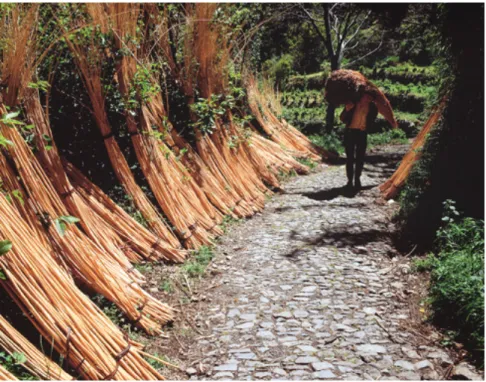
and exposed to the sun until well dried. Bairos concludes by explaining place.
fig. 16 Drying wicker
Source: Telmo Pereira, Vime a secar [Access. 13th Nov. 2015].
Available in: http://www.telmopereira.com/ Vimes.html
1.1.1.4.4 By areas S. Gonçalo
Cravos) didn’t help dissolve the crisis that only increased to this day.
fig. 17 S. Gonçalo’s basketry
Source: Gonçalo - Guarda Capital da Cestaria, 2015, [Access. 13th Dec. 2015].
Available in: https://www.fabook.com/15146019820 5221/photospb.151460198205221.-2207520000.145 2206746./962307853787114/?type=3&theater
fig. 18 Madeira’s basketry Source: Madeira-live, 2012. [Access. 13th Dec. 2015].
Available in: http-//www.madeira-a-z.com/uploads/ pics/Korbflechterei_Camacha/
Madeira
intricacy and mastery of numerous decorative designs that contaminated
on the island of Madeira, in the parish of Camacha, although handcrafted further explains that the climate of the Madeira islands, combined with
fig. 19 Algarve’s basketry
Source: BAPTISTA, Patricia , 2013, Cestaria [Access. 13th Dec. 2015].
Available in: http://aimericoalgarve.blogspot. pt/2013/02/cestaria.html
Algarve
to be made with very different appearances.
that has already been responsible for the income of several artisanal families in the Barrocal Algarve, nowadays, despite still being a type of representative craftsmanship, it no longer has the importance that once
made with the leaves of the palm that is found in the region, and with it several diverse objects are made. Initially this raw material came from the interior of the Algarve, it grew in the bushes of the Barrocal area. Later due to the scarcity of this plant, it began to be imported from the south of Spain.
User-Centered Design and the Pre-adolescent Child User-Centered Design
interaction with the users from the start, and this interaction is maintained all through the iterative process. The goal is to introduce
the need for design, secondly it determines the context of use and produces the user requirements, and then start designing solutions. they meet the requirements. However, creative iterative design enables the integration of the user study activities into all the stages of the process in a more dialogical way than the ISO standard. The research can initially resemble a journey of exploration: what is over the ocean,
fig.20 ISO 13407 /Standard of Human-Centered Design
Source: MATTELMAKI, Tulli. (2006). Design Probes. Publication Series of the University of Art and Design Helsinki A 69.
design methodology that puts users in the center of the design process. Because of it Userfocus determines that it is therefore an ideally suited method to develop products that must be simple and of a straightforward use. Their approach to User-centered Design follows three principles in all of User-Centered Design projects:
must understand our users and what they want to do. This understanding was achieved by their direct study of the users behaviour and attitudes. . Empirical measurement of user behaviour - Early in the development process, determines that users should actually use simulations and should be observed, recorded and analysed.
. Iterative design - Establishes that when problems are found in user design must be iterative: there must be a cycle of design, test and measure, and redesign, repeated until the usability objectives are met.
that intends to brings together in one document the basic principles requirements and recommendations for UCD principles and activities throughout the life cycle of interactive systems. As such based on both principles of ergonomics and UCD:
use) the objective of the design team.
the user’s experience with the system.
Regarding required project activities UCD methods:
and the users’ requirements.
designers.
on the project.
communicated to all the right people.
Required organizational management activities:
phases of the product life cycle.
design and
development process.
and for evaluating
process.
addition to the staff, public, and other users
and allocate
to design that grounds the process in information about the people who will use the product. UCD processes focus on users through the planning, design and development of a product.
In the eyes of Idler the concept of user-centered design has gained wide popularity, however she underlines a major limitation: ‘Users’ are not considered to include children. Children are different from adults and Neither does it justify ignoring children when designing products for
fig.21 Child-Centered Design Model
Source: IDLER, Sabina. 2013. Child-Centered Design is User-Centered Design, But Then Differ-ent. [On line]. [Access. 10th March.2016].
Available in:http://uxkids.com/blog/child-centered-design-is-user-centered-design-but-then-dif-ferent/
expressing that the only way to develop the fundamental understanding of how children perceive the world is by spending time with children of the age group you’re designing for, by observing and playing with them.
Branton elaborates by stating that whilst observing children playing can be useful in order to design more appropriately for them, we must recognise that this is limited by the form factor and functionality for a with objects they use in traditional play provides far more inspiration.
She goes on to add that real innovation happens when people move beyond existing beliefs and limitations. And elaborates by stating that
limitations of national curriculum guidelines and existing pedagogical methodologies in order to embrace exciting new learning opportunities.
learning.
need to identify and accept the need for child centered design. And
CCD, these people are children. In order to truly understand the context to parents, teachers, and other adults that can tell you about children
either observe them or engage them in a conversation to get more
all of those interests without losing sight of your users.
that must be met for the product to be successful.
Based on all the insights you gained from your context analysis and considering your product requirements, you can go ahead and create
patterns and best practices.
Now it’s time to evaluate your design – ideally through user testing your target audience. In this case, there is no way around getting together
1.1.1 The pre adolescent child
development that follows early childhood and prior to adolescence. It as ending with the start of the teenage years.
In compliance with the Institute for Human Services for The Ohio a pre-adolescent child by assessing their development in categories as the Institute further explains that within the preadolescent phase we can characterize the individual according to the given categories:
Emotional:
.Self-esteem based on ability to perform and produce;
.Develops alternative strategies for dealing with frustration and expressing emotions;
.Sensitive to other’s opinions about themselves;
Cognitive:
.Use language as a communication tool;
recognize and consider others’ viewpoints. In terms of concrete operations they hold: .Accurate perception of events;
attributes; understand concepts of space, time and dimension; .Can remember events from months, or years earlier;
.Understand how their behavior affects others; Social:
.Understand concepts of right and wrong;
is easy to use for your target age group, it also has to be fun and usually need extrinsic factors in order to even use your product.
.Rules relied upon to guide behavior and play, and provide child with structure and security;
.Less fantasy play, more team sports, board games;
.In terms of morality they avoid punishment and are self interested in exchanges.
to the stages of life from birth to death. As such responding to an
fig.21 Child development cycle
Source: LEVIN, P. (1982). The cycle of development. Transactional Analysis Journal, 12, 2, 136-137. Eliot, T. S. (1942). Little Gidding.
stage (which according to family issues we can revisit any time during
whole range of opinions and values in order to perceive the world in a structured, coherent way.
our own way and to have our own morals and methods.
.How do I build an internal structure that supports me, as well as others? .How do I develop the competence to master the technical and social
.I need to manage my own life and to live in my culture?
be adequate. To also learn to listen in order to collect information and
about structures and people outside the immediate family or familial develop internal controls. To disagree with others and still be loved. To learn what is their responsibility and what is the responsibility of others and ultimately to develop the capacity to cooperate.
Design Process
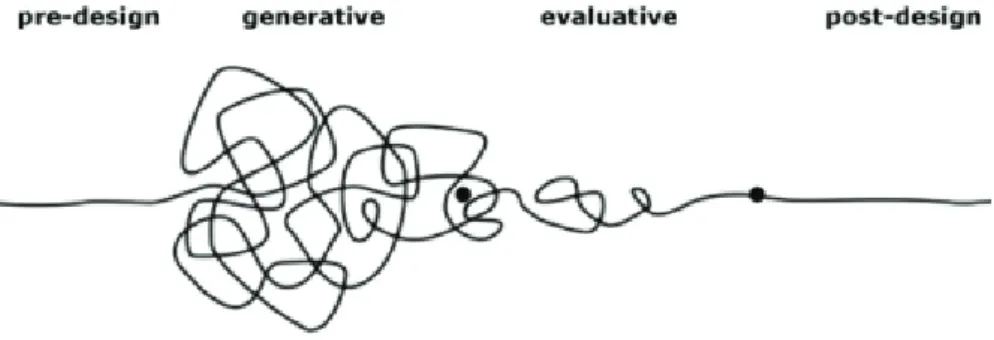
many activities that traditionally were not considered part of designing. A traditional product design project usually begins with a brief and a list of requirements. These days many additional activities have become considered to be a part of design as well, these activities are generally
situations or how a product is used after it has been released into the world.
indicates the point at which the design opportunity has been established.
front end of the design process. Prototypes are usually put into action once the design opportunity has been established.