~-~- ~-~~--~~~~~~~~~~~---,
FUNDAÇÃO
GETUUO VARGAS -
E P
G
E
~
Seminários de Pesquisa Econômica I
(2ª parte)
".BICI
8.&&
VlOB
URDIB
81ABCB ARD IRrLA'I'IOR"
~
Sheila N ajberg
(IPEA)
LOCAL:
EPGE
Praia de Botafogo, 190
10
0
andar
Auditório Eugenio Gudin
DATA:
28/04/94 (quinta-feira)
HORÁRIO: 15 :30h
Coordenaçlo: Prof. Pedro Cavalcanti Gomes Ferreira Te!.: 551-5295
Sheila Najberg
..
•
I. INTRODUCTION
It is a well known fact that the microeconomic background of an inflationary process is characterized by discrete jumps in individual prices. Sheshinski and Weiss' (1977) celebrated artic1e focused economists' attention on the fact that, in an
2
inflationary economy, firms' follow a policy whereby the nominal price is fixed over intervals, followed by discrete price adjustments between periods. The real price thus fluctuates between two fixed bounds-(s,S)- decreasing continuously over each intervalo A rise in the inflation rate has the effect of increasing price dispersion. The new pricing policy is characterized by both a higher upper bound S and a smaller lower bound of prices s.
When consumers acquire price information through cost1y sequential search, staggered (s,S) pricing behavior has an important effect on consumers' incentive to search. A rise in the inflation rate induces consumers to search through firms more aggressively (Benabou [1988]) and to recal! previously visited firms (Bonomo &
Najberg [1993]) since there is a possibility offinding lower real prices in the market. Under the assumption ofhomogeneity ofbuyers and sellers, these models predict that inflation is entirely to consumers' advantage and to the detriment of firms
In contrast, this paper demonstrates that, with heterogeneity of buyers, this result does not hold true.1 We show that an increase in the inflation rate, reduces both the welfare of non-searchers and firms' profits. For the searching consumers the negative effect is to make search a more time-consuming activity.
Under some very broad assumptions, firms increase the frequency oftheir price adjustments as inflations rises (Leidermen [1994] ). Given the assumption that the
1 The hypothesis of heterogeneity of firms together heterogeneity of consumers is investigated in Najberg (1994). The results are very similar to those presented in this paper.
•
•
process of adjusting prices is costly, we
will
show that an increase in the inflation rate will induce firms to charge higher real prices and therefore seU to consumers with higher willigness to pay.3
In order not to complicate the model, we make the simple assumption of two classes of consumers that differ in the leveIs of their search cost: consumers with high willingness to pay - "non-searchers"- and consumers with Iow willingness to pay-"searchers". At low inflation rates, a unique pooling equilibrium arises, with alI firms setting the same (s,S) path ofprices and selling to ali consumers. Under a one-band
pricing distribution, inflation benefits consumer and reduces firms' profit, as in
Benabou (1988). However, as inflation increases, this equilibrium is disrupted and a partial separating equilibrium characterized by a two-band pricing distribution emerges. In this equilibrium, consumers with low search cost purchase from firms that are selling in the lower band, and non-searchers purchase from firms they randomly happen to visit. The higher the inflation rate, the less likely it is to find firms choosing the lower-band ofprices.
Although this model is not a direct extension of Salop and Stiglitz's "Bargain and Ripoffs" (1977) modeL we obtain some similar results. While in their model both single-price equilibria and two-price equilibria are possible, we show that with inflation, single-band price equilibria and two-band price equilibria exists.
In contrast to Tommasi (1992), our result show that, on average, at higher inflation rates, consumers with low search cost will still purchase at lower prices,
although at the expense of increasing search expenditures. In his model, higher inflation induces searching consumers to search less.
Further, a literature based on the microfoundations ofthe welfare impact of inflation has emerged in recent years. Most related to our model is Benabou (1992) and Bali and Romer (1992). In the fust one, under the assumption of free entry, heterogeneity among buyers and homogeneity of firms, ali sellers follow the same (s,S) pricing rule. The model predicts that an increase in the inflation rate reduces both
•
upper and lower bound of prices and that profit is restored through the exit of firms. Increase in search by Iow search cost buyers and exit of firms Iimits equilibrium price dispersion and total resource spent on search. In our model, firms are able to change price strategy and still survive in the market. Higher inflation rate leads to fewer firms following the Iow-price strategy, which in tum increases the amount spent on search.
U sing a discrete time model, BalI and Romer assume that firms adjust their prices every two periods, and the fact that consumers have equal chances of meeting the firm in either period brings benefit for the buyers. Their result is a simple case of the microeconomic principIe that indirect utiIity functions are quasi-convex in prices (Varian (1984)). Consumers gain with inflation since they benefit trom relative price variability. Although their modeI assumes heterogeneity on both demand and suppIy side of the market, they do not investigate the possibility that some firms, with an increase in the inflation rate, may prefer to increase their prices at a cost of losing a proportion of their consumers.
4
The remainder of the paper is organized as follows. Section II presents the mode!. The existence of equilibrium with both types offirms following a unique (s,S) role ( "full overlap equilibrium") is analyzed in section
m.
Section IV analyzesequilibria with two price bands, in which searchers purchase from firms that choose the low band ("non-overlap equilibrium"). Simulations results are presented in section V, and section VI is Ieft for conc1uding remarks. Formal proof of alI propositions in the text are given in the Appendix.
11. THE MODEL
We assume that a homogenous good is produced by a continuum of identical infinitely-lived firms and that the econcmy is on a steady perfect1y anticipated inflationary path where alI aggregate prices grow at a rate of1t>O. Firms have a
..
marginal cost c, expressed in real terms, a discount rate r and pay
13
to adjust nominal pnces.F ollowing Sheshinski and Weiss (1977), we assume that, in an inflationary economy, firms' optimal price policy is to follow an (S,s) role, where they adjust their nominal prices so as to achieve a real value S, every time this real value has been eroded to
s
< S. The length oftime for adjustment ofprices is :T = in (S/s)/rr.. (1)
We wiIl require that the cross-sectional distribution of the firms' real prices be invariant over time. Given the constant rate of inflation, this corresponds to price adjustments which are uniformly staggered (Rotemberg(1983)) and the invariant distribution is the log-uniform on (s,S) (Caplin and Spulber(1987)):
dF(x) -_ dx .lor
~
alI . ( S) x m s, .xln(S / s) (2)
The demand side consists of a continuous flow into the market of Â. consumers per firm, who enter the market to make a one-time purchase of one unit ofthe good. Moreover, proportion (l-w) ofthe consumers are assumed to have such a high search cost that they wiil purchase as long the real price does not exceed their preference reservation price Z. The proportion w of the population that searches has a constant real cost of searching y, and wiIl purchase for offers below the minimum of their search reservation price Xs and Z.2 Moreover, we assume consumers' search to be sequential, and the first quotation to be free.
2 We assume that search is costly because it is time-consuming. The hypothesis that buyers' search cost y
is constant, implicitly assumes that consumers have savings and income completely indexed and therefore are "inflation-protected". If not, the search cost should change accordingly to the indexation system.
-..,
.
..
ill.
FULL OVERLAP PRICING POLICY
This section will investigate the existence of
an
equilibrium in which alI firms followan
(s,S) mIe with S =xs, thus selling to both types of consumers, at alI times.s
s
Figure 1 -Full Overlap Pricing Policy
fi-a. CONSUMERS' STRA TEGY
6
Given that searching consumers conjecture that firms foIlow the above pricing poIicy, their reservation price xs~ Z is determined by: 3
x, S
V = Y + J x.dF (x)+ JV.dF (x) (3)
x, x,
JF
(x)dx=y.It should be noted tha the higher consumers' search cost y, the higher is their
reservation price Xs. NevertheIess, consumers wiIl not purchase for prices above their preference reservation price Z, thus Xs ~ Z must be imposed.
Define Yp as consumers' search cost for which xs= Z.
(4)
For y < Yp it follows that Xs < Z, whiIe for y:2:: Yp it follows that Xs = Z.
z
s
v
yy p
Figure 2 - Consumers' Reservation Price for full overlap price conjectures
Consumers' strategy for a fuIl overlapping pricing policy is summarized beIow: 1) for search cost Y E(O, yp)' then Xs E (s, Z) and searching consumers wiIl purchase for offers xSxs and search for x>xs. Consumers with high willingness to pay
("non-searchers") wiIl buy for price offer x~;
2) for search cost Y :2:: Yp, then xs=Z and alI consumers wilI buy for price offer x~.
ID-b FIRMS' STRATEGY
As seen above, for y:2:: y p' buyers wiIl purchase for any price offer beIow their
preference reservation price Z. Under the assumption ofhomogeneity ofbuyers, it is not optimal for the firms to set prices above Z , since no sales wiIl take pIace for prices above the maximum consumers are willing to pay .
LEMMA 1. No firm wiIl, in their optimal pricing strategy (s,S), set S>Z .
8
Therefore, as long as firms' upper bound of prices is not above Z, each firm should expect to seU to Â. consumers per period. Thus, we define the upper band of prices as the (s,S) role in which S=Z. The lower bound
s
is obtained by maximizing the firms' intertemporal profits V Z given by:T;
Vz = -B + Â.
J
(Ze-7tt- c)e-rtdt + Vze-rT; .
o
(5)
Let T; be the optimal periodicity of price adjustment for firms that set S=Z.
THEOREM 1: Assume consumers do not search and purchase for offers below Z. For sufficient1y small adjustment cost, such that B5:Ã.Z/(r-Mt), the optimal pricing policy of a firm that sets S=Z and
z= Ze
-ttI';
is determined as the unique solution tofiT'
rVz
=Â.(Ze-
z -c). (6)Proof: See the appendix.
For
y<y
p' searching buyers have a reservation price xs<Z, and eachfirm
should expect to seU to Â. consumers per period, as long as their upper bound of prices is not above xs. Rence, we define the lower band of prices as the (s,S) role in which S=xs·
Let T* be the optimal periodicity of price adjustment for firms set S=xs, under the assumption that searching consumers' reservation price is xs<Z.
COROLLARY: Assume searching consumers have a search reservation price xs<Z.
For sufficient1y small adjustment cost, such that B5:À.xs /(r-Mt), the optimal pricing policy ofa firm that sets S=Xs and
s=x
se-
71T' is determined as the unique solution to
The proof is obtained by replacing Z by Xs in the proof of Theorem 1.
Notice that a change from the lower band (s, xs) to the upper band ofprices (z, Z), under the assumption that searching consumers reservation price satisfies xs<Z, leads to an increase in the path of prices at the expense of a reduction in sales.
Searchers wiU on1y purchase for prices E[Z, xs], while non-searchers wiU continue to purchase for prices E[Z,Z].
Assume Xs is sufficient1y low so that xss Z.4 lt foUows that a firm can choose the upper band (z, Z) and seU on1y to non-searchers, or choose the lower band (s, xs) and seU to searchers and non-searchers. Firms that choose the upper band (z, Z) will optimally obtain the lower bound z by maximizing the firms intertemporal profits V Z now given by: 5
T~
Vz
=
-f3
+
(1-w)Â.J
(Ze-m - c)e-rtdt+
Vze-rT~o
(8)
Firms will follow this pricing strategy if it does not decrease their profits, i.e. if Vx , s Vz , which implies
(9)
4 lt wiIl be shown. further in the paper, that Xs ~ z holeis in equilibrium for an important range oí parameters values. The case xs> z introduces some new complications that are briefly examined at the end oí the appendix.
5Notice that the values oí the upper band oí prices changes when the market is composed only oí non-searchers versus when it has a proportion w oí searchers. A higher w reduces the sales oí firms that íoIlow the upper band, thus increasing the ratio "adjustment costJ sales". Firms wiIl then preíer to delay price adjustment and wiIl optimally allow for a smaller z.
10
U sing (9), let us define xsH as the reservation price at alI finns are indifferent between the lower band (s, xs) and upper band (z, Z). For Xs ~ xsH alI finns will follow the same pricing policy (s, xs). Given that a reduction in Xs reduces the profit of the finns that choose the lower band,6 it follows that for Xs ::; xsH finns will prefer
(z,Z) to (s,xs).
Finally, let us now investigate how a change in the inflation rate affects finns behavior.
LEMMA 2. An increase in the rate of inflation decreases the profit of finns that follow the strategy of setting S =Xs. The optimallower bound of prices is reduced with a rise in the inflation rate. The effect on consumers is an increase in their welfare.
Proof: See the appendix.
ill-c. EQUILffiRIA
An equilibrium is a price band (s,S) with s<S::;Z, which satisfies: a)For the case S=Xs=Z,
aI) optimality ofprice adjustment: s=Ze-1tT; , e-1t T; determined by equation (a5) 7;
a2) best response for consumers: search cost y?:y . p,
b)For the case S=Xs< Z : b 1) s=x
s e -1tT' , with
e
-Tr T' determined by equation (a5) , replacing Z with xs;b2) search cost y<y . p,
b3) incentive compatibility for finns' choice ofprice band: Xs ~ xsH detennined by equation (9).
6 A reduction in Xs increases T*, which in turn reduces even more the profit of firms that choose the lower band of prices. See proof of theorem 1, in the appendix.
7 Equations starting with the letter "a" can be found in the Appendix.
BfBUOTEC4 MARIO HENRIQUE SIMONSE.
•
In an one-band pricing equilibrium alI buyers accept the first price offered, and search is on1y a credible threat constraining S. With an increase in the leveI ofinflation, if the pooling equilibrium can be sustained, we will observe a reduction of the whole (s,S) price path. As in Benabou's mo deI (1988), ours also predicts that for firms that follow the strategy of selling to alI types of consumers, an increase in the inflation rate reduces their profit. With no resources being spent on search, to purchase at the new lower equilibrium prices, we also observe an increase in consumers weIfare.
Simulations results presented in section V provide a sense of the magnitude of parameters needed for the pooling equilibrium.
IV- NON-OVERLAPPING PRICING POLICIES
This section will investigate the existence of an equilibrium in which some firms follow a higher pricing band (SR, Sro while others follow a lower pricing band (sL,SL), with the additional assumption that prices do not overlap, i.e. SL < SR .8
Figure 3 - Non-overlapping pricing policies
•
IV-a. CONSUMERS' STRATEGY
Given that consumers conjecture that firms follow the above pricing policies, those with a low cost of searching wiIl buy from firms that foIlow the lower bando Under the assumption of non-overlapping pricing policies, the searchers that flow in the market wiIl be evenly divided among the firms that seU at lower prices, while the non-searchers wiIl be distributed among all firms.
The higher consumers' search cost, the higher is searching consumers' willingness to pay and the higher the proportion of firms that will be interested in selling to searchers and non-searchers. In the limit, for sufficient1y high search costs, we will show that all the firms in the market will be interested in selling to both types of consumers. 9
Thus, for low enough search cost so that, at most, only a proportion a. of the firms wiIl be choosing the lower band, and continuing to require that Xs ~ Z, we wiIl have for searching consumers:
x,
o.SFL(x)dx::y
SL
12
For example, under the conjecture that 0.=1/2, i.e. 50% ofthe firms foIlow the lower pricing strateggy, searching consumers' cost y 0.5 satisfies:
9 It should be noted that we are assuming two-band pricing. The first band corresponds to an uniforrn distribution FL at lower leveis of prices, with offers E (SL, SL)· The second, FH'
corresponds to an uniforrn distribution at higher leveIs of prices, with offers E (SH, SH). Both
distributions follow equation (2).
•
SL
J
FL (x)dx = 2y 0.5 (10)SL
For high enough search cost alI firms will choose to sell to all consumers. Since searchers will not purchase for prices above xs, we obtain that for CJ.= 1
XSSZ
J
FL (x)dx = Ya1l (11)At most, for y ~ y ali ~ Y p' we obtain XS=Z.lO
x s
z
s L
y 0.5 Y ali Y p y
Figure 4 - Consumers' Reservation Price for non-overlapping price conjectures
Consumers' strategy, given the non-overlapping pricing policy, is summarized below:
1) for search cost y E(O,Yall). Xs ~ SL searchers will purchase from the proportion CJ. of
firms that choose the Iower band of prices, while non-searchers will purchase from any firm, for offers ~.
3) for search cost Y ~ Yp, then xs=Z and alI consumers will buy for price offer ~.
•
14
IV -b. FIRMS' STRA TEGY
Suppose a proportion a of the firms set SL9cs, while (1- a) ofthem set their upper bound of price at SH, with sH>SL. Then searching consumers will end up even1y divided among the a firms. The flow of consumers per
firm /..
corresponds to the total number of consumers that flow in the market per period (#C) divided by the number offirms in the market (#F). Since a proportion (1-w) ofthese consumers are non-searchers, alI firms in the market are expected to sell at least (1-w)/.. units. The searchers in the market (W#C) will be even1y distributed among the firms that set their upper bound of prices below or at xs. If on1y a proportion a ofthe total number of (#F) follow this pricing strategy, then their sales to non-searchers and searchers are expected to be (l-w)/.. + [W#C / [(#F)a]]= (1- w + w/a)/...LEMMA 3. No
firm
will, in its optimal pricing strategy (SL,sL), set SL <xs .Proof:
See the appendix.Analogous to the case of full overlapping pricing policy, using theorem 1, we obtain that for sufficient1y small adjustment cost, such that
~~(l-w + w/a)/..xs/(r+1t), the optimal pricing policy ofthe proportion a ofthe firms
that sets SL =Xs and sets sL =xse-1tT* is determined as the unique solution to rV
xs =(1-w + w/a)/..(xse-1tT* -c). (12)
The optimal periodicity of price adjustments given by:
-1tT. 1t -(1t+r)T. _ ( 1
~)
e
- - - e
-r - - -
.
1t+r 1t+r (l-w+ %)/..xs
(13)
Notice that, in (13), àRHS/8xs>O, sir..:e àLHS/àT*<O, we conc1ude the lower is Xs the less frequent are the price adjustment of firms that set SL =Xs .
•
15
Similar to the full overlapping case, an increase in the inflation rate reduces the profit of those finns that follow the strategy of selling to alI types of consumers. Besides the increase in 7t that per se reduces the profit -see equation (12)- , it decreases xs and delays price adjustment (increase in T*). The final result is that, at a rise in the leveI of inflation, finns that are selling to searchers and non-searchers wil1 reduce both their upper and lower bounds of prices .
We now further characterize low-cost finns' optimal pricing strategy.
LEMMA 4. No finn will, in their optimal pricing strategy (SL,sL), set SL>Z . Proof: See the appendix.
Since we have shown that SL < Xs and SL>Z are not optimal, we finally need
to consider policies SL E[XS'Z] with sL =SLe-7tT*. The purpose ofthe next lemmas is to show, that under not very restricted conditions, finns will maximize their profit either by setting very high prices and selling exc1usively to non-searchers or by offering low enough prices to attract alI consumers. In other words, we
wil1
demonstrate, that under fairly broad conditions, finns will have two local maximum consisting of theLEMMA 5. If the search reservation price is so low that finns prefer to seU only to non-searchers, the optimal strategy is to set their upper levei of prices at the maximum value that non-searchers are willing to pay.
Proof: See the appendix.
Again, in this case, the optimal pricing policy can be established with the use of Theorem 1. For sufficient1y small adjustment cost, such that ps(1-w)J2/(r+n:), the optimal pricing policy of a firm that sets SL =Z and obtains sL =Ze -11 T;;?: xs, is
•
16
Byanalogy, e-1t T; _ n/(n+r) e-(1t+r)T; = r[lI(n+r) - ~/(I-w)ÂZ]. (14)
LEMMA 60 For sufficient1y high search reservation price so that xs ~ sL, for any
choice of upper bound of prices, and if ôVs <
°
holds, then firms wiIl either be ôSL SL=X,following the price strategy (Ze-1t T;, Z) or (xse-1tTo, xs)·
Proof: See the appendix.
The above lemmas show us that if consumers have small search cost, a proportion of the firms will prefer to seIl on1y to non-searchers thus wiIl follow the
If consumers have higher search cost, these firms wiIl optimally decide between seIling to searchers and non-searchers at a lower price band (SL,xs), or to foIlow the higher price band (SH,Z). The next lemma precisely defines the size ofthe search cost that makes low costs firms prefer one strategy to the other.
LEMMA 70 A proportion
a
of the firms wiIl set SL =Xs with sL = xse-nT*
if
(l-w) (15)
Proof: See the appendix.
Assume SL>[(I-w)/(I-w+ w/ex.)](sH - c) + c, for all ex.E(O, 1]. Moreover, assume for ex.
=
1, that sL=
(l-w)(sH - c) + c. For firms that set SL =Xs, a rise in theinflation rate decreases Xs and leads to a less frequent price adjustment (equation (13)). This in tum, decreases sL. It is easy to see that a decrease in the entire path of prices can on1y be sustained with an increase in sales. Thus, at the new equilibrium, fewer firms will be selling at low-prices to the searching consumers and a higher proportion offirms
will
switehing to a high-priees strategy.Had we initia1ly assumed sL>(I-w)(SH - e) + e, and ifwith an inerease in the inflation rate the above inequality eontinued to hold, none of the low-eost firms would ehange their prieing poliey.
We ean eonclude that inerease in the inflation rate above the leveI at whieh alI firms are indifferent between the prieing poliey (SH,Z) and (SL,xg), will have the effeet of indueing a proportion of these firms to prefer to offer higher priees.
IV-c. EQUILffiRIA
An
equilibrium is a quadruple E =(xs, sL, sH, 0.), with s<xsQ;, whieh solves: 1) optimality ofpriee adjustment: sL = xse-1tT*, with T* determined by (12) andsw Ze-1tT* z, with T*z determined by (14).
2)best response for searehing eonsumers : y = y(xs (o.),SL) 3)non-overlapping (s,S) rules: sH ~ Xs
4)conditions for (sL, Xs) and (SH,Z) be the on1y local maxirnizers:
:~s
< OL SL=x,
5)ineentive compatibility partial separating: SL~(1-w)/(1-w+ w/o.)(sH-e) + e and for 0.'>0. SL~(1-w)/(1-w+ w/o.' )(SH-C) + e
•
18
Our model predicts that inflation increases production efficiency, because there is a leveI of inflation at which on1y high-cost firms
will
split off to the upper bandoSince, at this leveI, low-cost firms will have an increase their sales, we conclude that increase in the inflation rate increases production efficiency .
In the perfectly separating equilibrium, low costs firms are offering lower prices than high-costs firms. Given our assumption of non-overlapping price distributions, the whole path of prices reveals the firm's type. It is the most productive efficient
equilibrium since searchers purchase on1y from low-costs firms ..
Tommasi (1992), in a repeated purchase model, obtains the opposite resulto In his model, consumers
will
optima11y search less as inflation rises, since prices do not reveal costs. Firms are then able to increase their prices without loosing consumers.Sales are redistributed from the more efficient to the less efficient firms and . In our model, the above result could be obtained, if with an increase in the inflation rate a11 low-cost firm choose the lower band of prices. On1y in this case, our models predicts
market failure.
It is interesting to evaluate searching consumers expected total search expenditures (SE).
PROPOSITION: Increase in the inflation rate increases expected total search expenditure.
Proof: Each buyer with search cost y searches on average 11F(xs(Y' a.) times. Since the fust one is free, it should be expected that SE = y .[11F(xs(Y' a.)) - 1]. Increase in
the inflation rate reduces the number of firms that are selling for prices equal or below xs, thus increases SE.
In Benabou (1992), under the assumptions of free entry and homogeneity of firms, inflation increases search by low search-cost buyers and the exit of firms. Both
..
these effects impose a limit for price dispersion and total search. In our mo dei, the existence of a two band price distribution changes this result. We show that the higher the inflation rate the less likely it is to find firms that choose the lower band of prices, thus an increase in the search expenditure should be expected .
FinalIy, let us see how a reduction in the adjustment cost affects firms' pricing strategy. Clearly, firms will prefer to adjust more often, thus there will be a reduction in the price dispersion of the market. This wiIl increase consumers' search reservation price, which in tum may increase the number of firms offering prices attractive to alI types of consumers. In the equilibrium, a higher proportion of firms wil1 be offering attractive prices to alI types of consumers. However, given the increase in consumers' search reservation priée, the new (SL,xs) prices will be higher then before.
Numerical simulations presented in section V provide a sense of the different equilibria that may spring and indicates their magnitude.
v-
SIMULATIONS
The purpose of this section is not to match actual data, but simply to explore the various channeIs through which inflation operates in equilibrium, and provide a sense ofthe magnitudes invoIved. Since this section is a reproduction of Najberg (1994), it is assumed that the market is evenly composed by high and low costs firms.
The reference set of parameters is : inflation rates ranges from zero to 40% per period, total number of firms in the market = 10, proportion of low costs firms = 1/2, flow of consumers per period = 1000, proportion of searchers w= 1/2, consumers preference reservation price Z
=
100, price adjustment costf3
=
1000, production cost of low-cost firms CL = 40, production cost ofhigh-cost firms CH = 50 and firms discount rate r = 0.05.•
20
30 25 20 seareb cost 15 10 5 O 0.00001 5 10 15 20 25 30 34 inflation(% )1- . .
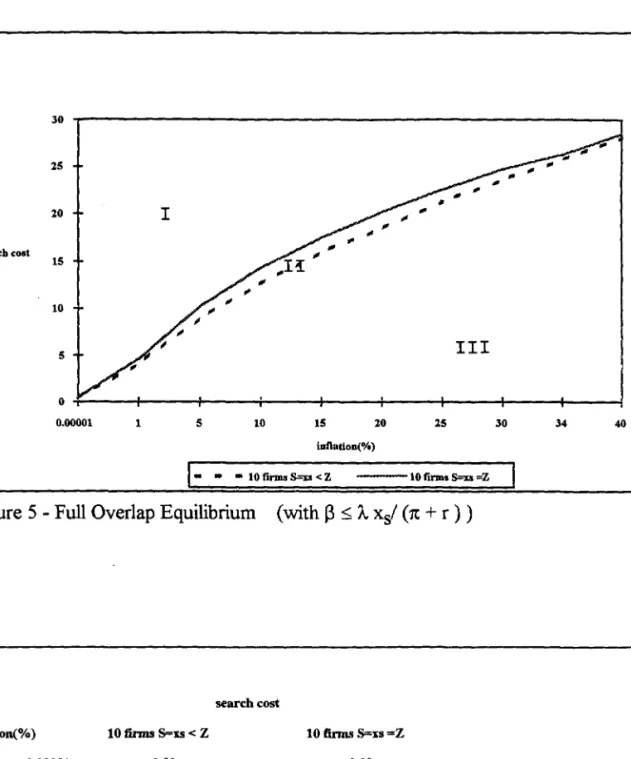
10 firms S=u < Z - - - 1 0 firms S--u =ZFigure 5 - Full Overlap Equilibrium (with
J3
~ 'A. xSI (1t+
r) )searchcost
inOation(% ) 10 firms S=xs < Z 10 firms S=<xs =Z
0.00001 0.50 0.50 4.07 4.65 5 8.94 10.18 10 12.64 14.32 15 16.04 17.50 20 18.47 20.19 25 21.23 22.56 30 23.61 24.69 34 25.74 26.29 40 27.92 28.50
Table 1 - Consumers' reservation price for full overlap equilibria
BIBLIOTECA MARIO HENRIQUE SIMONSn
Result 1. In region I, alI the firms in the market follow the same pricing strategy, with the upper bound of prices equal to consumers' preference reservation price (s= Z).
As the rate of inflation rises, the lower bound of prices decreases whi1e the upper bound of prices continues to be equal to Z. Thus, in this region, an increase in the inflation rate reduces real prices and increases consumers' welfare.
ResuIt 2. In region 11, alI the firms in the market follow the same pricing strategy, with the upper bound of prices equal to consumers' search reservation price (S= xs).
As the rate of inflation raises, both the lower bound and the upper bound of prices decrease. Thus, in this region, an increase in the inflation rate reduces real price and increases consumers' welfare.
ResuIt 3. In region I1I, the full overlap equilibrium does not existo For (n, y) elose to region 11, a proportion of the high-cost firms will prefer to set their upper bound of prices at Z. For an increase in the leveI ofinflation andJor decrease in search cost, a higher number of firms, ineluding the low-cost ones, wil1 prefer to set S= Z.
Figure 6 and Table 2 show the possible non overlapping equilibria.II
Under the assumption of heterogeneity of firms' costs, it is intuitive that the first firms to split off to the upper band of prices are those with higher costs. At increasing leveIs of inflation, also low costs firms will switch to the upper-band of prices. In the limit, for very high inflation rates,on1y a proportion ofthe low costs firms will be interested in selling at low-band prices.
11 The upper bound of region III (Fig. 7) is strictly above the upper bound of region IV-a (Fig. 8). That it to say , the full overlap equilibria region lays above non overlapping equilibria region. As the nurnber of finns approaches infinity, the upper bound of region m comes closer to the upper bound of region IV-a.
a 16 14 12 10 searcb co.t 8 6 4 2 O 1E..()6 5 10 15 20 InnatioD(% ) # of cOD.Um .... 1000 #offirms10 '. '. ".
-
-
-
--25 30 IV';;' C 34 40- • 10% firms S=xs - 50% firms S=xs • • • 50% firms S = xs - - -90"/. firms S= xs
Figure 6 - Non-Overlap Equilibrium
search cost
10% finns S=xs 50% finns S=xs 90% finns S=xs
Inflatíon (%) 0.000001 0.009 0.084 0.084 0.428 1 0.1338 0.741 0.778 3.543 5 0.2970 1.631 1.717 7.762 10 0.4210 2.312 2.436 10.980 15 0.5170 2.83 2.993 13.470 20 0.6000 3.285 3.467 15.588 25 0.6740 3.684 3.845 30 0.7420 4.050 4.129 34 0.7936 4.321 4.331 40 0.8648
Table 2 - Consumers' reservation price for non-overlap equilibria
Result 4. Region IV-a is characterized by having a proportion oH of the high-cost finns only selling to non-searchers (S=Z) and alllow-cost finns together with the proportion (1-
um
selling both types of consumers (S= xs). If inflation increases amilor search cost is reduced, the smaller is the proportion ofhigh-cost firms that are willing to seU searchers.Result 5. Region IV -b is characterized by having all the high-cost firms (uli1) selling only to non-searchers (S=Z) and alllow-cost firms selling to both searchers and non-searchers (S= xg). Despite the appearance in Fig. 8, this is a nontrivial region. As
we have shown in Lemma 8, there is a range of possibIe values for the inflation rate that wiil induce low-cost firms to choose the Iower band of prices whi1e high-cost finns choose the upper bando
Result 6. Region IV-c is characterized by having alI high-cost firms together with a proportion uL of the Iow-cost firms selling only to non-searchers (S=Z) and a
proportion (1- UL) of Iow-cost firms seUing to non-searchers and searchers that tlow in the market (S= xs) Ifintlation increases and/or search cost is reduced, the smaller is the proportion of low firms that are willing to sell searchers.
Result 7. In region IV -a and IV -c, the higher the inflation the smalIer is the
proportion of firms that set their upper bound of prices at S=xs. Thus, an increase in the intlation rate makes it less likely for searching consumers to buy immediately.
Result 8. In region IV-a, an increase in the inflation rate increases production efficiency. A higher inflation rate will induce high-costs finns to seU at higher prices,
•
24
Result 9. Region IV-b is the most informative ofthe regions concerning firm's type. In this region, prices reveals type and searchers will buy on1y from the low-cost firms .
Result 10. In region IV, increase in the inflation rate will increase cross-sectional variances of prices. At a higher inflation rate, firms that set their upper bound of prices at Z will select a lower z, whi1e firms that are selling to both types of consumers will decrease both their upper and lower bounds of prices.
Inflation operates through several channels in equilibrium. The next results derives exc1usively from our numerical simulation.
Result 11. In region IV, increase in the inflation rate
decreases non- searchers'
welfare.
According to our simulations, the possible gains, due to the higher price dispersion in the market, are offset by the increase in the quantity of firms that choose the upper band of prices.Result 12. In region IV, increase in the inflation rate
increases searchers' welfare.
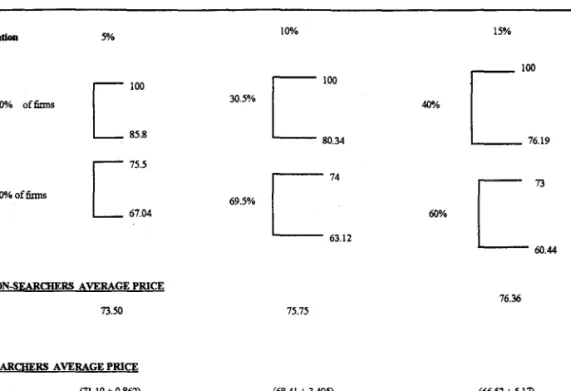
At a higher inflation, since less firms choose the lower band of prices, it is expected that searching consumers will have to search more and therefore search expenditure will increase. Yet, this negative effect is offset by the possibility of finding lower prices in the market.Example 1: Assume a high enough search cost so alI Iow-cost together with a proportion ofthe high-costs firms choose the Iower band ofprice. Moreover, assume search cost is y =7.76.
For a leveI ofinflation = 5 %, we will obtain in equilibrium,
90% firms choose Iower band (67.04, 75.5) & 10% firms choose upper band (85.86,100 ),
Average price for non-searchers $ 73.50,
Average price for searchers $ 71.198
+
search expenditures $ 0.862=>
$ 72.06. -For a leveI ofinflation = 10 %, we will obtain in equilibrium,69.5% firms choose lower band (63.12, 74) & 30.5% firms choose upper band (80.34, 100),
Average price for non-searchers $ 75.75,
Average price for searchers $ 68.418
+
search expenditures $ 3.405=>
$ 7l.82 -For a leveI ofinflation=15 %, we will obtain in equilibrium,60% firms choose lower band (60.44, 73 ) & 40% firms choose upper band (76.19, 100),
Average price for non-searchers $ 76.36,
lo Infta1Ion 5"A.
C'·
10% offirms 85.8[m
90%offums 67.04NON-SEARCHERS AVERAGE PRICE
73.50
SEARCHERS A VERAGE PRICE
(71.19 + 0.862) 72.06 30.5% 69.5% 10%
C'·
80.34C"
63.12 75.75 (68.41 + 3.405) 71.82 40% 60% 15%['~"
[~~
76.36 (66.52+5.17) 71.69 26Figure 7 - The effect of inflation on the equilibrium with high-search cost consumers
Example 2: Assume a low enough search cost so only low-cost firms choose the lower band ofprice. Moreover, assume search cost is y =1.63.
For a leveI ofinflation=5 %, we will obtain in equilibrium,
50% firms choose lower band (55.19, 6l.6) & 50% firms choose upper band (85.86,l00),
Average price for non-searchers $ 76.52,
-For a leveI ofinflation=lO %, we wiil obtain in equilibrium,
25% firms choose lower band (48.01, 54.5) & 75% firms choose upper band (80.34,100),
Average price for non-searchers $ 83.40,
Average price for searchers $ 51.185 + search expenditures $ 4.996::::::> $ 56.18
-For a leveI ofinflation=15 %, we will obtain in equilibrium,
21.5% firms choose lower band (46.56, 54) & 78.5% firms choose upper band (76.19, 100)
A verage price for non-searchers $ 83.79,
Average price for searchers $ 50.12
+
search expenditures $ 5.98::::::> $ 56.10. -For a leveI ofinflation=20 %, we will obtain in equilibrium,19.5% firms lower band (45.32, 53.5) & 80.5% firms upper band (72.75, 100), Average price for non-searchers $ 83.84,
5%
[00
SIl"A. oftirms 75% 85.86['
SIl"A. oftirms 25% 55.\9NON-SEARCHERS AY!i;RAGE PRlCE 76.52
SEARCHERS A VERAGE PRICE 59.91 (58.34+1.63) 11l"A.
['00
80.34[~'
48.01 83.40 56.\8 (51.18 + 4.996) 28 15% 21l"A.~N
['00
80.5%['00
76.19 72.75[~~
[~'
21.5% 195% 45.32 83.79 83.84 56.\0 56.01 (50.12 + 5.98) (49.30+6.m)Figure 8 - The effect of inflation on the equilibrium with low-search cost consumers
Result 13. A decrease in the cost of adjustment (P) reduces price dispersion and
increases consumers' reservation price. At the new equilibrium, a higher proportion of firms offering lower prices should be found, reducing expected search expenditure (SE) at the expense of purchasing for higher prices. Moreover, a decrease in
p
may reduces production efficiency.Below are the two-band pricing equilibrium for a market in which y =0.67,
1t = 25 % and
1)p=1000 =:> 10% ofthe firms offer prices E (42.91,49.5)
90% ofthe firms offer prices E (69.76, 100) .
2) p=100, =:> 22% ofthe firms offer prices E (50.42, 53.5)
78% ofthe firms offer prices E (100.94.27).
A decrease in
p
increases the proportion of firms that choose the lower band of prices. If a decrease inp
induces also high-costs firms to choose the upper band of prices, production efficiency is reduced.Result 14. A decrease in the cost of adjustment increases non-searchers' welfare and
decreases searchers' welfare.
Below are the average price found by each type of consumers in a market in which y =0.67, 1t = 25 % and lW=lOOO ~ non-searchers = $ 88.48 searchers = $ 52.16 (46.13
+
6.03). 2) f3=100, ~ non-searchers = $ 83.86 searchers = $ 52.23 (49.85+
2.37).VI- CONCLUSION
This paper has examined the functioning of a market with heterogeneity of consumers under inflation. For low leveIs of inflation, a pooling equilibrium exists with alI firms selling to alI types of consumers. An increase in the inflation reduces
firms' profits and increases consumers' welfare. However, above a certain leveI of inflation this type of equilibrium is disrupted. A degree of separation begins, with a proportion of firms choosing to set higher prices at the expense of not selling to searchers. Our numerical simulations suggests that non-searchers' welfare decreases with increase in the inflation rate:
Inflation increases price dispersion in the market. The possibility of finding better prices induces search, but the chances of finding firms that follow the low-band
•
30
represents a more time-consuming activity, which can be interpreted as an increase in
the resources spent on search.
Had we extended to a repeated purchase mo deI, we believe to have a model, with microeconomic foundations, that explains why consumers are frequent1y surprised with the prices they expect to observe in previously visited firms, even under increasing
expected leveIs of inflation. There is no need to assume unexpected inflation, to justify an increase in prices above past period's leveI of inflation rate. The increase in the frequency of price adjustment- with its reflection on the firms' costs- that results from
an increase in inflation rate, is sufficient to explain why firms wiIl adjust their prices beyond past period's inflation rate.
Our mo deI predicts that, increase in the inflation rate, will require searching consumers to alIo cate more time to search for a better price. In a model with a greater variety of types, both of consumers and firms, it should be expected that, each type of consumers wiIl need to seek more intensively to find lower price/lower cost firmo Intuition leads to believe that consumers may prefer to purchase product of inferior quality, in order to reduce time/resources spent on search and to meet their budget constraint. Inflation alters firms equilibrium price distribution and the distribution of buyers across firms.
This result holds true, under the assumption that buyers are fully inflation protected. Had we assumed consumers are on1y partially protected, the above results would be strengthen.
BIBLIOTECA MARIO HENRrQU! SIMONmt
•
APPENDIX
Proof of Lemma 1. Suppose a firm sets S> Z, so. that S=Ze7tt'. After an adjustment to S, sales are zero during a length of time t'>O. Thus, the firm real intertemporal profits is given by:
T
Vs = -~
+
Â.J
(Ze-1t(H') - c)e-rtdt
+
e-rTVs . (aI)t'
Now, imagine the firm in the next adjustment, sets S=Z, then resuming the same (s,S) policy. Therefore:
T-t' W
z = -~
+
Â.J
(Ze-m - c)e-rtdt+
e-r(T-t')Vs · (a2)o
lt is immediate to see that WZ>VS, thus S>Z cannot be optimal.
Proof of Theorem 1: The profit stream of a firm that set S= Z can be rewritten as
below: Tz -~ + Â.
J
(Ze-m - c)e-rtdt V z = _ _ ~o _ _-=--_ _
_
(1-e-
rTz ) (a3)j
• 32 . d d· .
av
z À(Ze-1lT~ - c) F1rst or er con 1110n - -=°
=>
Vz = --'---~aT
z r (a4) with e-1tT~ __ 1t_e-(1t+r)T~ = r(_I __ ~).1t+r 1t+r /..Z (aS)
Since àVz > 0, to ensure the existence of an optimal policy we need to impose that ôTz
Tz=O
àVz /..Z
< 0, thus it follows that 13 <
-8Tz 1t + r
Tz=co
(a6)
Proof of Lemma 2. lnitially assume search cost is so high that xs= Z. Define o = s/Z so that (a3) Can be written as:
a
v~/aT=
(r+ 1t) o - 1t01 + r/1t - r[1 - (r-+7t)I3//..Z]' We knowthata (a
v~/ ôT)/a
1t = o [1- o r/1t (1- r/1t Ln(o ))] + rl3//..Z > 0,since Ln( 1/0 r/1t)< 1/0 r/1t_I·
Moreover
a (a
v~/ 8T)/a
o = (r+ 1t)(1-o r/1t) > O.Thus
a
o /a
1t=-[a (a
v~/aT)/ a
1t] /[a (a
vi
z/aT)/ a
o] < O. (a7)We can conclude that an increase in the inflation rate increases price dispersion. Under the assumption of no search in the market, firms will continue to set their upper bound of prices at Z but will optimally allow for a decrease in the lower bound of prices s. For firms that are setting S = xs< Z, due to the existence of search in the market
(y<y p ), the reduction on profits caused by a higher in:t1ation rate is even stronger. The
possibility of finding lower prices causes a reduction in consumers reservation price (see equation 3 , in the main text).
The discounted profit stream of firms that set S = xs, can be obtain straightforward from theorem 1:
Vi ( -1tT' ) ( 8)
Xs = xse -c . a
From «a3), we have that a decrease in Z has the effect of delaying price adjustment (increasing T*). By analogy, a decrease in Xs increases T*. The final result is a reduction in firms' profit due to a decrease in both the upper and lower bounds of pnces.
•
Proof ofLemma 3. Suppose a firm sets SL:S; xs and any length oftime adjustment T= 1n(SL/sL)ht. The firm real intertemporal profits is given by:
T
Vs =
-B
+
(1- w+
w / a.)Â.J
(SLe-m - c)e-rtdt+
e-rTVso
(a9) 33
Assume in (a9), SL < xs. Imagine now that when a price change is expected to occur, the firm deviates once, sets SL =Xs, and then resume after a time T the same (sL,SL) mIe.
Clearly, for a given T, in the class ofpolicies SL ~ xs, SL = Xs is optimal.
Proof of Lemma 4. The proof is obtained by replacing S by SL and by the use of using the coefficient (l-w)Â. instead Â. in the proofof Lemma 1.
Proof of Lemma 5. Consider policies SL E [xs,Z] with sL =SL e-nT*. Define
xs=SLe-1tt', so that t'=ln(SL/xs)/n. If a finn is going to seU only to non-searches this implies that so~xs, thus T*~ t'. In this case, the firms intertemporal profits is given by:
T;
Vz =
-B
+
(1-w)Â.J
(SLe-m - c)e-rtdt+
Vze-rT; . (alO) oClearly, to set SL
=
Z is optimal in this class of policies.Proof ofLemma 6: The case sL~s ' i.e. T*:s; t', was already investigated in lemma 5, we are left to analyze firms behavior for which SL <xs' i.e. T*>t'.
In this case, finns that foUows the pricing strategy (SL,SL) will sell only to non-searchers for offers E[SL ,xs) and for alI consumers for offers E [xs,sLl· Its profit stream will be given by:
t'
Vs =
-B
+
(1-w)Â.J
(SLe-m - c)e-rtdtT* (all)
o
+
(1-w+
w / a. )Â.J
(SL e-m - c )e-rtdt+
Vse -rT*34 àV À. t' T-_ S = { (1-w)Je-(71+r)tdt + (1-w + w / a.)Je-(71+r)tdt àS L (1- -rT-) e o t'
_[w
(Xs-c)e-rt']~
}
a. àSL_ À ((1-W)(I-e-(x+r)t') (l-W+W/IX )(e-(x+r)t' _e-(x+r)T")
[w
-rt']
1J
- rT" + -(Xs -c)e
-(1-e - ) (7t + r) (7t + r) IX 7tS L
lnitially assume Z~s~c(1t+r)/r, then the intertemporal profit function V s is convex concerning SL. Figures AI and A2 illustrate the different V s graphs.
(a13)
(a14)
•
..
•v
Figure Al-V > - Xs
x
sz
Under the assumption that
av
s < 0, firms either select (z,Z) or (s,xs)·as
L SL;x.For xs:::;;c(n+r)/r the intertemporal profit function is concave concerning SL. But nothing more can be said about the convexity/concavity ofthe profit function for values higher than xs.
By analogy, under the assumption that
av
s < 0, low-cost firm either select (z,Z)aS
L SL;X,or (s,xs)
aVo
Thus for Xs > sL and __ S <
°
firms will either be following one of the twoas
L SL;x.pricing bands: (z,Z) or (s,xs).
Proof of Lemma 7: With non-overlapping pricing policies, and with a. of the firms setting SL =Xs, each one will obtain a profit of(l-w+ w/a.)Â.(xse-nT
* -
c), while ifone chooses to set SL =Z the protit would be of (l-w)Â.(Ze-nT; - c) .The case
Xs>
z , under the assumption of a pooling equilibriumDefine xs=Ze-1tt*. Then, the intertemporal protit of the firms that choose the upper band is:
•
•
av
Z À(Ze -nT Z -c)First order condition: - -
=
°
=>
V Z=
OT
Z
r
36
Notice that now the periodicity of price a," _stment depends on the firms' costs, since -nT n -(n+r)T Z
13
(1- e -(n+r)t*) * Ze Z - - - Z e Z = r(----)-wrZ +wc(1-e-rt )n+r n+r À n+r
We can see from above that decrease in
xs
implies an increase in t* and in Tz·Moreover, since aRHS / Bc>
°
and 8LHS / aTz > 0, in case ofheterogeneity on the supply, high- cost firms will split offfirst.The case ofa two price band distribution with partial overlap (xs> z),
introduces some new complication. The basic intuition is very simple. The closer is xs to Z, the higher the sales of those firms that choose the upper bando This has the effect ofreducing the ratio "adjustment cost/ per sale li, inducing more frequent price
adjustment (reduction in T;) and increasing profit. A change in xs affects the gains of the firms that set S=Z in two ways: a direct effect on sales and an indirect effect on the periodicity of price adjustment. Moreover, the profit of the firms that choose to set S=xs is affected direcdy with a change on xs, besides also being affected in the above two ways .
•
•
REFERENCES
BALL, L. and ROMER, D (1992), "Inflation and the Infonnativeness ofPrices, Mimeo
BENABOU, R. (1988), "Search, Price Setting and Inflation", Review of Economic Studies, LV, 353-376.
BENABOU, R. (1992), "Inflation and Efficiency in Search Markets", Review of Economic Studies, LIX, 299-329.
BONOMO, M. and NAJBERG, S. (1993), "Inflation and Time!y Recall", Anais do XV Encontro Brasileiro de Econometria, 201-230.
CAPLIN, A. and SPULBER, D. (1987), "Menu Costs and the Neutrality of Money",
Quartely Journal of Economics,
Cn,
703-725.LEIDERMAN, L. (1993), "Inflation and Disinflation - The Israeli Experiment ", University Chicago Press.
NAJBERG, S (1994), "Search and Inflation", Chapter lI, Ph.D thesis, UCSD. ROTEMBERG, J. (1983), "Aggregate Consequences ofFixed Price Adjustment",
American Economic Review, 73, 433-436.
SALOP, S. and STIGLITZ, J. E., (1977) "Bargain and Ripoffs: A Mode! of
Monopolistica11y Competitive Price Dispersion" Review of Economic Studies, XLIV,
493-510.
SHESIDNSKI, E. and WEISS: Y. (1977), "Inflation and Costs ofPrice Adjustment",
Review of Economic Studies, XLIV, 287-304.
TOMMASI, M. (1992), "The Welfare effects oflnflation: The Consequences ofPrice Instability on Search Markets", U.C.L.A. Working Paper # 665
MARIO HENi,roUE SIMONSEN
N.Cham. PIEPGE SPE N162p Autor: Najberg, Sheila.
Título: Price behavior under search and inflation.
1111111111111111111111 1111111111 11111111 086240 50032 FGV -BMHS N° Pat.:F3239/98 000086240 1111111111111111111111111111111111111 to