TAP Portugal – Lessons
from its turnaround
Gustavo Monsanto
June 2014
Dissertation submitted in partial fulfilment of requirements for the degree of MSc in Business Administration, at the Universidade Católica Portuguesa, June 2014.
i
Abstract
Title: TAP Portugal – Lessons from its turnaround Author: Gustavo Monsanto
This case study provides an overview of TAP Portugal and the recent evolution of the company, mainly after its current CEO, Fernando Pinto, assumed its control. The purpose of this master dissertation is to analyze the strategic decisions that were made and their consequences. Moreover, it describes what are the advantages of the “Triangulation Strategy”, which TAP Portugal practices nowadays.
The environment and situation of the aviation industry are also analyzed, including the potential opportunities and threats for the future.
Some strategic frameworks and modes of internationalization are studied in the teaching notes segment.
Key-words: “Triangulation Strategy”, “Hub-and-spoke”, “Point-to-point”, “LCC”, “Low-cost”
Resumo
Título: TAP Portugal – Lessons from its turnaround Autor: Gustavo Monsanto
Este caso de estudo fornece uma perspectiva da TAP Portugal, assim como a sua evolução, especialmente após Fernando Pinto assumir o controlo da empresa. O objectivo desta dissertação de Mestrado é analisar as decisões estratégicas que foram tomadas e quais as suas consequências. Também serão descritas as vantagens da estratégia de triangulação e placa giratória que a TAP Portugal usa actualmente.
A situação da indústria da aviação, assim como o ambiente externo à empresa, irão também ser analisados, incluindo as oportunidades e os perigos que o futuro poderá trazer.
Algumas ferramentas de análise estratégica e diferentes modos de internacionalização serão também estudados na secção das notas de ensino.
Palavras-chave: “Estratégia de Triangulação”, “Placa-giratória”, “Ponto-a-ponto”, “Low-cost”, “Baixo custo”
ii
Acknowledgements
I would like to thank all those who helped me, in the development and conclusion of my master thesis.
Firstly, a big acknowledgment goes to my family, specifically my parents, brother and grandparents. Their support and encouragement, during all this process, was crucial in order not to lose my motivation. Also, it is due to them that I had the opportunity to embrace several challenges that contributed to my personal and academic development and ambitions. For that, I will always be thankful.
I am equally grateful to all my friends, who always supported and helped me during all this process, giving me the boost of energy when I most needed.
I would also like to express gratitude to Carlos Paneiro, Sales Director of TAP, who had the kindness of volunteering his time in answering all my questions, and who always demonstrated availability to help me and provide me all the materials I asked for. This master dissertation would certainly be much less interesting without his help.
Finally, I want to thank my thesis advisor, João Simão Pires, for his suggestions and opinions, as well as the support he always demonstrated.
iii
Contents
Abstract ... i Resumo ... i Acknowledgements ...ii Contents ... iiiList of Figures and Exhibits ... v
Case Study ... 1
1. Introduction ... 1
2. The history of TAP ... 2
3. The situation of TAP at the beginning of the millennium ... 4
4. The arrival and effect of the Brazilian Management Team ... 5
5. Strategic Decisions ... 7
5.1 The closure of unprofitable connections ... 13
5.2 Optimization of the fleet and destinations ... 13
5.3 Decrease the labor costs ... 14
5.4 “Voar mais alto” – Fly Higher program ... 14
5.5 Hub-and-Spoke Strategy – Lisbon Airport ... 14
5.6 The focus in Brazil ... 16
5.7 Entry in Star Alliance ... 19
5.8 The acquisition of PGA - Portugália, a regional airline ... 20
5.9 A Response to LCC’s - “1 flight, 5 ways to travel” ... 20
6. The success of the Triangulation Strategy ... 24
7. The Future ... 28
Teaching Notes ... 30
1. Introduction ... 30
2. Synopsis ... 30
3. Suggested Questions (Core and additional) ... 30
3.1 Core case questions ... 30
3.2 Additional questions ... 31
4. Teaching Objectives ... 31
iv
6. Relevant Theory ... 32
6.1 Strategic frameworks and tools ... 32
6.2 Strategies in Aviation Industry ... 32
7. Analysis and Discussion ... 33
7.1 Core case questions ... 33
1. Fernando Pinto took many key decisions since he assumed TAP. Enumerate them, and explain the ones that were more important in the recovery of the company. ... 33
2. Which of the decisions are interconnected, and how they complement each other? ... 35
3. How do you describe the strategy of internationalization of TAP since its foundation? Should the company continue with the Triangulation Strategy? ... 37
7.2 Additional questions ... 40
4. Make an analysis of the industry where TAP competes. Describe TAP regarding its strengths and weaknesses. ... 40
5. Should TAP start its expansion to Asia in the next few years? ... 43
6. Do you think TAP should have a low-cost subsidiary? And if the airline decides for that option, should it be acquired or transform Portugália in a Low-cost? ... 45
Appendices ... 46
v
List of Figures and Exhibits
Figure 1 TAP S.A. - Debt outstanding (in million € and as a % of revenues) ... 8
Figure 2 Number of TAP aircrafts ... 8
Figure 3 Hours Flown in TAP aircrafts (Thousands) ... 8
Figure 4 Millions of TAP's PKO and PKU ... 9
Figure 5 Number of TAP's passengers (Millions) ... 9
Figure 6 Evolution of TAP’s PKU and the average PKU of the members of the Association of European Airlines, over 2000 ... 10
Figure 7 TAP Flight tickets revenues (Million €) ... 10
Figure 8 Other main sources of revenues (Million €) ... 11
Figure 9 TAP S.A. Results (Million €) ... 11
Figure 10 Grupo TAP ... 12
Figure 11 TAP M&E Results (Million €) ... 12
Figure 12 Grupo TAP Consolidated results (Million €) ... 13
Figure 13 Cumulative growth rate of TAP Passengers in transit in Lisbon-hub, over year 2000 ... 16
Figure 14 Number of TAP frequencies to Brazil ... 17
Figure 15 TAP Routes to Brazil with its inauguration year (Euromonitor International, Ministry of Tourism of Brazil, TAP) ... 17
Figure 16 TAP Revenues by market in 2013 ... 18
Figure 17 TAP Network in 2001 ... 25
Figure 18 TAP Network in 2012 ... 26
Figure 19 Number of TAP connections ... 26
Figure 20 % of Revenues by Market ... 27
Figure 21 Number of TAP passengers by region in 2012, and its load factor ... 28
Figure 22 The basic mechanism of internationalization: state and change aspects (Johanson & Vahlne,1977: 26 ... 37
Figure 24 Bogotá Airport and flight durations / Catchment Area ... 39
Figure 25 Porter's three Generic Strategies (Porter, Competitive Advantage, 1985, p. 12) ... 44
Figure 26 TAP's Chronogram ... 46
Figure 27 TAP destinations 2014 ... 47
1
Case Study
1. Introduction
Fernando Pinto was heading to a press conference to publically present the results of TAP S.A. in 2013. It was March 2014; the sun was starting to appear between the clouds, which was hurting the view of the company’s CEO while he was driving through the A5, a highway that connects Cascais to Lisbon. It was difficult to look clearly at the road and path ahead, which reminded him of the time when he first arrived at the company 14 years ago.
Back in that period, and after analyzing for the first time the situation of the company, the “Brazilian Navy”, (the name that the Portuguese government, some employees and even the media ended up dubbing the CEO and his team), was not certain about which path to follow and how the future would be. The only certainty was that if the company didn’t transform and undertake a major restructuration, it would most probably go bankrupt and be forced to cease its operations.
He was rehearsing mentally the presentation he was about to do, and its final details, including: the record level of 10.7 million passengers carried by the company in 2013; the 5 consecutive years in which the aviation business of TAP has been lucrative; or the fact that the subsidiary of the group, TAP Maintenance & Engineering, a maintenance aviation business unit located in Brazil, started being profitable in February 2014 for the first time since being acquired more than 10 years ago. Even though this profit was small, it was particularly important because this specific business had consistently contributed negatively with large losses to the annual consolidated results of the Group. He was proud about these results and confident that the company had never been so healthy or so well prepared for a privatization process, the main purpose and objective he and his team were originally hired for.
However, his mind wasn’t able to forget both the hard times the company had been through during all this period, or the obstacles and challenges his team had to face in order to accomplish the good situation TAP demonstrates nowadays.
One particular situation was never forgotten throughout this path and always came to the CEO’s mind when he had to make any tough decision. In the first meeting in TAP canteen, during the presentation of the new executive committee and where more than 500 employees were present, he remembered the exact words that one of the more than 10 Union’s representatives said when he
2 asked to publically speak: “I am the representative of the employees and I am here to say that you are not welcome”.
In the end, with a lot of communication, following a coherent path, with seriousness and professionalism, it was possible to engage and motivate the employees.
During 3 months, meetings were conducted with 800 or 900 employees every 3 days, where they were explained, with respect and sincerity, all the reasons for the sacrifices that were being asked of them.
After all these years, he was confident that the employees already understood the strategies that have been taken, and the reasons why some tough decisions were necessary.
Moreover, the fact that his team was called from the beginning “Brazilian Navy”, who had always bothered Fernando Pinto, was nowadays felt by him as a recognition and a compliment for all the work done.
2. The history of TAP
TAP Portugal (TAP – Transportes Aéreos Portugueses, S.A.) is the main national airline of Portugal and its central operations are air passenger and cargo transport.
It was founded in 1945, and one year later the company acquired its first aircraft. The first route was between Lisbon and Madrid and it was inaugurated in September of 1946. Later in that year, a world famous route was created. The connection Lisbon – Luanda – Lourenço Marques (today Maputo), which took 15 days to complete the round trip, and 12 stops were included. It was the longest world route operated with a DC-3 aircraft.
In 1947 the first domestic connection was created with the route Lisbon – Porto, being also created routes to Paris, London and Seville. In 1966 TAP opened the first route to Rio de Janeiro. The date of June 17 was specially chosen because it was the date on which Sacadura Cabral and Gago Coutinho made the first aerial crossing of the south atlantic in 1922. In 1967 the first Boeing 727 enters TAP’s fleet, while every non-jet aircrafts were removed, making the Portuguese company the first European airline working only with jets
In 1953 the company was privatized and, in 1975, it was nationalized again, being nowadays 100% owned by the state.
In 1991, the designation changed to TAP Air Portugal. At that time, the airline had a fleet composed by 32 recent aircrafts and regular connections to more than 40 cities, in 4 different continents.
3 The first decade of 2000 brought a lot of novelties to the Portuguese Company with the arrival of the Brazilian management team, led by Fernando Pinto.
As soon as their arrived, many strategies started to be applied. In 2001, Lisbon airport starts to be the main hub, being the center of all TAP operations. Furthermore, besides the creation of Grupo Tap, the Company made its integration in Star alliance, the largest world airline association.
In 2005, to celebrate its 60 years, TAP redesigned its institutional image and changed name to TAP Portugal. It also acquired a regional Portuguese airline company (PGA – Portugália Airlines).
Nowadays, TAP conducts an average of 2,250 flights per week, serving 76 destinations in 34 countries, being also the leading airline between Europe and Brazil. This situation derives from the huge investment in that country that started with the arrival Fernando Pinto, and the geographical privileged point of Lisbon for connections in Europe.
The fleet will finish 2014 with 61 Airbus aircrafts, plus 16 smaller aircrafts from others manufacturers at the service of Portugália Airlines, suitable to regional and short duration flights. Since 2010 that the fleet has not been modified, but in 2014 the fleet will increase to 77 aircrafts, with the entrance of 6 more Airbus, two of them appropriate for long-haul flights. Also two small PGA planes will be replaced by bigger, more comfortable and modern ATR 600 planes.
TAP has received various prizes and awards including:
“World’s Best Airline to South America” by World Travel Awards in 2009, 2010, 2011 and 2012;
“Best European Airline” by US magazine Global Traveler in 2011, 2012 and 2013; World’s Leading Airline to Africa, in 2011 and 2012.
In 2012 the company repositioned its brand and philosophy regarding the relationship with its clients. A new campaign was launched centered on the slogan “TAP with the arms wide open”. The company wants to transmit its warm welcome to all the cultural diversity through the destinations of TAP, and symbolize the role of connecting and unifying it has between Europe, Africa and South America.
4
3. The situation of TAP at the beginning
of the millennium
In 2000, TAP’s condition was problematic. Many financial problems, organizational complications to solve, employee low motivation and problems related with a huge number of labor unions described the environment within the company. Many internal conflicts existed, strikes were a constant, the hierarchy was very strict and internal communication was lacking.
Moreover, due to community directives by European Commission related to commercial airline industry, the Portuguese Government was forbidden to finance again the company. In fact, since its creation, it was usual for the Government to inject capital in the main Portuguese airline in order to maintain its sustainability and giving it the possibility of honor its financial responsibilities. The last time TAP received an injection of public capital was between 1994 and 1997, with a value of approximately 900 million euros.
Also, the final of the 1990’s and beginning of 2000’s brought a new phenomenon to the aviation industry. Due to the deregulation and liberalization of air transportation in Europe in 1997 by the European Commission, following what was already done in USA since 1978, many low-cost carriers appeared in the market, offering aggressive price promotions what quickly attract many customers. It was in this context that the Portuguese Government started studying the privatization of a percentage of the capital of the airline, as a solution to this troubled environment.
In order to prepare the company for a future privatization, and mainly to save TAP of its imminent bankruptcy, a group of former VARIG-Brazil managers are invited to assume the management of the company.
It is important to notice that until this year, all the major executive positions of the company were occupied by people indicated by successive Portuguese government cabinet, regardless of their expertise or knowledge in the kind of market the company operates. Hence, the management of TAP was conditioned by the political party that was in charge at that specific moment, being substituted whenever the Government changed.
Predicting already some risk of future interference by the Portuguese government and before accepting the invitation, Fernando Pinto required total independence and freedom for his team to take the actions they think would be necessary without public intervention, and enough time to conduct the strategies to be implemented.
5 Before accepting the invitation, Fernando Pinto collected and searched the maximum information possible about TAP. All the indicators and opinions about the company were negative and discouraged him1. However, he decided to accept the challenge.
4. The arrival and effect of the Brazilian
Management Team
The first task undertaken by Fernando Pinto in 2000 was the creation of a restructuring plan, with the guidelines to follow in the next years, in order to recover the company, regardless of the privatization process. Thus, in May 2001, the executives of TAP presented to the European Commission a reorganization plan for the company, supported by a study of economic and financial viability approved by the Portuguese Company, with the prevision of bank loans, but without any public subsidies.
After the success of the first assignment , many other projects followed, being elaborated and implemented in order to “led to a revolution in the company, converting it in a good place to work, travel and invest”, as Fernando Pinto described.
Incited to speak about the reality found in the company at the time of his arrival, Fernando Pinto admits having discovered some good and bad surprises. On the positive side, it was the qualification of the employees. “It was the most positive surprise. Their educational background is really good, almost everyone have undergrad degrees, many are post-graduates and many speak 3 languages perfectly. Also, it is noticeable the culture of a public company where everyone wants to leave his mark. However, the surprises weren’t all positive. There were a lot of bureaucracy, reports and paperwork, typical mechanisms in public companies. Good for taking orders, but no one is responsible for nothing once they are just taking orders. Moreover the deadlines were often not followed. Everything was postponed for the next week, on contrary what was common in Brazil”.
On the employees’ side, the arrival of the new management was also not peaceful. Being a state owned company used to have big labor conflicts, it was normal the position of strength and hostility by unions against the new administration as a way of marking position.
1
“I asked an Investment Bank in London to make me a report about TAP before I came. The answers and conclusions were clear: The situation is too complicated; the company is too much politicized, there are lots of strikes, 14 different labour unions and it is simply impracticable. But I like challenges!” Fernando Pinto, in “Conversas com vida”, in Económico TV 26/04/2014
6 It is important to notice that the labor relations in the commercial airline are complex due to the intensive operational activities, the high salary costs and the high unionization of employees. Often airlines prefer to raise salaries and labor costs, instead of suffering strikes or stoppage of their services. On the other hand, the employees are one of the most important assets any commercial airline can have, and are the responsible for the good performance and excellence in the quality of every service.
It is nowadays nearly consensual that most of TAP’s evolution, from being practically bankrupt to the positive results it has presented last years, is related to Fernando Pinto and his team. When they faced all the contestation to their arrival, only an outstanding and credible leadership would be able to carry a complete reorganization of the company, taking several though decisions, being even able to engage employees to their side.
During the first months of the management, it was necessary to understand the culture and situation of the company, and consequently, take actions to convince the most doubting and hesitant employees that the path that would be taken would be the only possible to save the company. Quickly, some good results were reached, what helped to gain the credibility and respect needed to continue making necessary decisions, with employees’ support.
The Brazilian philosophy also had an important role in all the reorganization and cultural change of TAP, with the increase of informality, flexibility, communication and spontaneity. The bureaucracy was reduced to the minimum, physical paper documents were reduced and most of the communication done directly by e-mail.
Mechanisms and procedures to promote the cohesion and internal union were created, in order to separate TAP of all changes in government political parties and external social issues. These modifications boosted the felling of passion, proud and commitment towards TAP by the employees. Those were typical characteristics of staff from commercial airlines with history and prestige like TAP, but with all the turbulence within the company in the years prior the beginning of the millennium, those positive feelings were vanishing.
An anonym employee in 2004 gave an interview to a Portuguese talking Fernando Pinto management. “Why the employees of a public company like TAP protect and defend ferociously a man that had the most austere and severe management of the history of the company, which obliged people to work more for the same salary? It is simple. Fernando Pinto was able to grab and bring workers to his side. He stimulated the work. Was not afraid of speak openly and sincerely with everyone, despite his awful reception. Some employees received recognitions and appreciations for
7 their efforts for the first time in more than 40 years of work. The success of a company like TAP depends heavily in the good connection between the manager and their workers, what has been done in an uncommon way by this management team, mainly through the confidence environment established”.
5. Strategic Decisions
When in 2000 TAP S.A. reported losses of €122 million, Fernando Pinto knew he had to conduct major changes to completely revolutionize the company. The existence of inefficiencies and waste within the company’s procedures was obvious. Moreover, the debt burden of the airline was a big concern. It had a value of 79% of the total revenues, which is reveling of the problematic situation of TAP.
“When we arrived, the company had 3 months to live.” - Fernando Pinto (“Conversas com vida” in Económico TV 26/04/2014)
The main lines for all the restructuring were related with commercial and operational management, once the operational revenues were unable to cover fixed structural costs, and a complete reorganization of the business.
The style of leadership was also a positive reinforcement to help engage the employees to surpass the difficulties. Some of the expressions heard to characterize the first years of implementation of changes in TAP are: Communication, team work, transparency, dialogue, professionalism, commitment, social peace, delegation and passenger satisfaction.
After 14 years, the situation of the company is, without any doubts, better.
With an exhaustive and rigorous management, it was possible to double the size of the airline, including airplanes and destinations, while lowering debt and its percentage comparing to total revenues, and maintaining nearly the same number of employees.
8 Figure 1 TAP S.A. - Debt outstanding (in million € and as a % of revenues)
Figure 2 Number of TAP aircrafts
Figure 3 Hours Flown in TAP aircrafts (Thousands)
2000 2012 Evolution 124 253 104% 948 842 79% 34% 0 500 1,000 1,500 0% 20% 40% 60% 80% 100% 2000 2004 2007 2010 2013
Total Debt (Million €) % Revenues (Total Debt / Total Revenues)
34 40 48 71 77 2000 2004 2005 2012 2014 126%
9 Regarding the number of seats and destinations offered during the year, as well as passengers served, TAP nowadays is nothing compared what it was, and its evolution is clear.
Figure 4 Millions of TAP's PKO and PKU
2000 2012 Evolution
Passenger Kilometers
Offered - PKO 13,640 35,450 175%
Passenger Kilometers
Utilized - PKU 9,900 27,220 160%
Figure 5 Number of TAP's passengers (Millions)
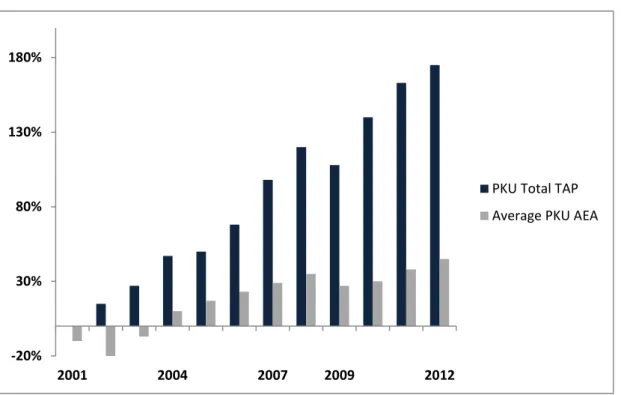
Comparing to the companies of Airline European Association, and having as comparative number the capacity in year 2000, TAP’s growth is impressively above the average in what concerns the evolution of capacity effectively used, measured in PKU (passenger per kilometre used).
5.3 5.4 5.3 5.6 6.2 6.4 6.9 7.8 8.7 8.4 9.1 9.8 10.2 10.7 2000 2004 2007 2010 2013 102%
10 Figure 6 Evolution of TAP’s PKU and the average PKU of the members of the Association of European Airlines, over 2000
In what concerns the main sources of revenue of the Company, they increased hugely, having the major source, revenues with Flight Tickets, increased more than 150%.
Figure 7 TAP Flight tickets revenues (Million €)
-20% 30% 80% 130% 180% 2001 2004 2007 2009 2012
PKU Total TAP Average PKU AEA
840
2,113
2000 2012
11 Figure 8 Other main sources of revenues (Million €)
2000 2012 Evolution
Manufacturing 86 115 34%
Cargo 78.5 127 62%
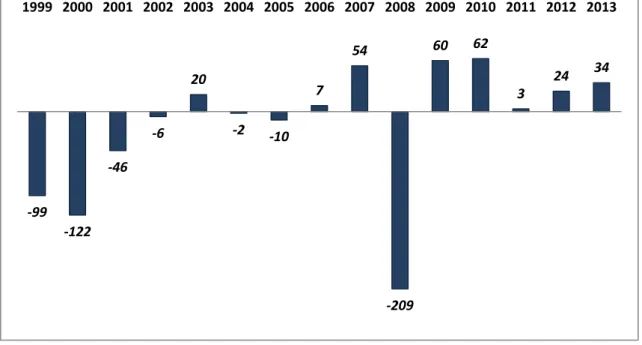
Financially, quickly new management reached impressive results. The aviation business of TAP presented losses in 2001 of €46 million, in 2002 losses of €6 million, but in 2003, for the first time, profits of €20 million.
More recently, TAP S.A. is reporting good results and the evolution of the airline has been positive and noticeable. However, in 2008 it presented a huge lost, mainly due to the international crisis and the massive petrol cost increase, which made the petrol costs to TAP increase 67% comparing to the previous year.
In the last 8 years, only 2008 had losses, being 2013 the 5th consecutive year that the aviation business of TAP is profitable.
Figure 9 TAP S.A. Results (Million €)
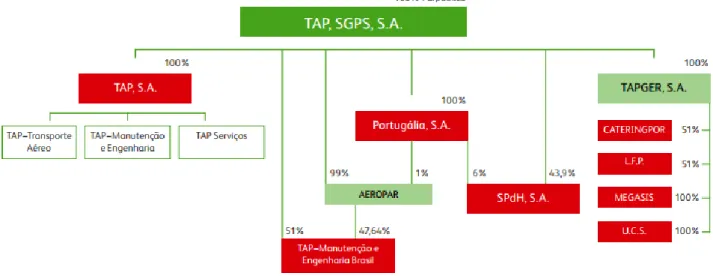
It important to notice that Grupo TAP is divided in several businesses, being the aviation one, TAP S.A, responsible for approximately 90% of volume of business. For more details of Grupo TAP see the following figure. -99 -122 -46 -6 20 -2 -10 7 54 -209 60 62 3 24 34 1999 2000 2001 2002 2003 2004 2005 2006 2007 2008 2009 2010 2011 2012 2013
12 Figure 10 Grupo TAP
Regarding the results of Grupo TAP, they continue to be negative, mainly because of the consecutive negative results of TAP M&E.
The TAP Maintenance & Engineering is located in Brazil and was acquired in 2005. It generated losses every year, and it is maybe the worst strategy decision of Fernando Pinto in TAP.
As is it possible to analyze in the graphic, the evolution of this unit in the last years has been positive, having in February 2014 reported a profitable month for the first time.
Figure 11 TAP M&E Results (Million €)
-29 -3 -73 -63 -50 -41 2008 2009 2010 2011 2012 2013
13 The overall results of the Group are shown in the next figure. (No data for two years)
Figure 12 Grupo TAP Consolidated results (Million €)
A big plan to reduce costs was implemented since 2000, and until 2012 just in TAP S.A, the total savings have reached €294 Million.
The main strategic decisions of TAP that lead to this growth and improvement will be now analyzed.
5.1 The closure of unprofitable connections
There were some loss-making connections that TAP decided to eliminate. Some of them were connections with a stop before final destination. This situation raises the operational costs, being the planes much time immobile in airports.
Examples of routes eliminated were Lisbon – Porto – Barcelona, or Lisbon – Boston. This closure of this last connection received a lot of contestation, since there is a huge Portuguese Emigrant Community in Massachusetts.
5.2 Optimization of the fleet and destinations
Some of the biggest airplanes of TAP were being used for medium European flights, when they have capacity for intercontinental routes. This situation occurred not because the demand was enough to fill the planes, but because the planes existed in the fleet and no wasn’t known what to do with them. This lead to a lot of empty places in the airplane and much bigger operational costs compared to smaller planes doing the same routes.
-122 20 9 -10 7 22 -285 -3.5 -57 -77 -31 -6 2000 2003 2004 2005 2006 2007 2008 2009 2010 2011 2012 2013
14 To face these problems, while some routes were eliminated, others were reinforced, mainly in key destinations in Europe, Africa and America.
With the increase of frequencies and capacity particularly to the long haul flights, it was possible to maximize the utilization resources available and dilute fixed costs2.
5.3 Decrease the labor costs
Due to the legislation, it was almost impossible to fire employees. Nevertheless, there were obtained some deals for friendly terminations and some pre-retirement agreements. Moreover, it was established a pioneer wage freeze agreement, and in some cases a reduction of salaries.
5.4 “Voar mais alto” – Fly Higher program
2002 was designated the customer’s year by TAP. With this, a project was launched with the objective of facilitate and expedite the contact between TAP and their passengers, with higher efficiency and speed.
In order to improve and renew all the service and the product offered by company, many changes were operated, being the common and distinctive factor the “Portugality”. Several internal practice and formation actions were made in order to increase the quality of customer service.
This project comprised 5 different programs: “Speak with us”; “Show who we are”; “Staff development”; “Personal presentation” and “Sympathy :) TAP”. The global objective was making TAP a well know Network Carrier recognized by the quality of the service. The filling and prosecution of this entire project was done by a team of external consultants that worked with representatives of several operational teams like Marketing, Handling, Sales or Air and Ground Staff. The external team was chosen because it was perceived that this will be the most efficient and effective way to spread the message and intentions of the management team.
5.5 Hub-and-Spoke Strategy – Lisbon Airport
In 2001, it was adopted a strategy of hub, being Lisbon Airport the center of all operations. Taking advantage of the most west and south point of Europe, Portugal can offer the best place to make connections between Europe, America (particularly South) and West Africa.
2 In 2003, TAP received an award of operational excellence by Airbus, for the wider use in the world, between 2001 and 2003, of Airbus 310 fleet.
15 This lead to a complete revolution in the way TAP conducted their flights and routes. There were created peaks of arrivals and departures of passengers, with time in ground inferior to 60 minutes, which are still praised today due to the innovations implemented.
Basically, TAP reorganized all its operations aiming to concentrate connections in 3 periods of the day:
1st Peak: between 6 am - 8 am 2nd Peak: between 11 am – 2 pm 3rd Peak: between 7 pm – 10 pm
Making Lisbon Hub an efficient and competitive place to change between flights, TAP was able to better compete in European Market and even eliminate the image of lack of punctuality that followed the company.
With the right articulation between arrivals and departures, the company offers a better number of connections, in a short period of time, increasing significantly the profitability.
This strategy provides to costumers convenient and favorable connections between flights. The flights within Europe are complemented with connections to Africa or America with short periods of waiting in ground, offering a better service to clients.
In 2006, was implemented a second operational hub in Porto, a north Portuguese city.
This strategy has been a complete success, having TAP constantly increased the number of transfer passengers in the Lisbon-Hub. In 2013, transit passengers accounted for 41% of total TAP passengers3. In 2013, Lisbon Airport had for the first time, more than 16 million passengers, being 59.1% TAP passengers4.
3
Teresa Lopes , TAP Finance Director in “Aviation Fleet & Finance Summit” 2014, by CAPA – Center For Aviation 4
16 Figure 13 Cumulative growth rate of TAP Passengers in transit in Lisbon-hub, over year 2000
5.6 The focus in Brazil
Since the arrival of the “Brazilian navy”, their bet in transatlantic flights, particularly in Brazil was obvious. Some employees were doubtful and expressed criticism to this strategy5.
TAP management was sure that Brazil was a crucial and attractive market for the Lisbon-Hub, with a huge potential growth regarding leisure, tourism and business6.
Hence, the number of frequencies to that country was reinforced, including daily flights to São Paulo, Rio de Janeiro and Recife. There were also created some new routes for the Northeast of Brazil. In 2012, and comparing to 2000, the number of frequencies increased more than 300%.
5
“They are betting in Brazil because they do not know anything else, they are aiming to take control of the
other side of the Atlantic again. They want to form an alliance with VARIG in order to go back to their country. Brazil is easier.” Statements made by TAP employees in the first years of Fernando Pinto’s management
6
“I found the ideal geographic position to, developing the hub of TAP in Lisbon, answer at the same time the
necessities of Brazil to their connections to Europe”, Fernando Pinto describing the opportunity he discovered
when he arrived in 2000 in an interview for the Portuguese Newspaper “Público” in 5/3/2014
148% 0% 20% 40% 60% 80% 100% 120% 140% 160% 2000 2001 2002 2003 2004 2005 2006 2007 2008 2009 2010 2011 2012
17 Figure 14 Number of TAP frequencies to Brazil
Besides the above mentioned destinations, nowadays TAP flies to Salvador, Fortaleza, Natal, Brasília, Belo Horizonte, Campinas, Porto Alegre and, in June 2014, will begin connections to Manaus and Belém.
Figure 15 TAP Routes to Brazil with its inauguration year (Euromonitor International, Ministry of Tourism of Brazil, TAP)
1,676
7,099
2000 2012
18 The cultural similarities and the ideal geographic position of Portugal made TAP a perfect option for Brazilians travel to Europe.
Analyzing the numbers, it’s easily perceived the success of this operation.
In 2012, 1.5 million customers were carried between Portugal and Brazil by TAP, comparing to 400 thousand in 20017.
According to TAP, nowadays half of the Brazilians that arrive in Lisbon use Portugal as a connection for other European countries. The other half stays in Portugal.8
Moreover, Brazil is currently a source of revenue as big as Portugal in terms of point of sale. Figure 16 TAP Revenues by market in 2013
To the Sales Director of TAP, Carlos Paneiro, it is obvious: “Without Brazil, TAP would not exist nowadays”.9
With the entrance of new airplanes in 2014, more seats available, 2 new routes projected, and the number of connections to Brazil increasing to 82 weekly flights, TAP is confident that the number of
7
According to a Portuguese Newspaper “Público” http://www.publico.pt/economia/noticia/a-tap-deu-asas-aos-brasileiros-e-eles-voaram-1626520#/0 (website visited in 1/5/2014)
8
“The Brazilian passenger is getting used of making a stop in Portugal, before its final destination in other
European country, and is discovering a country which surprises him positively” Fernando Pinto in an interview
for the Portuguese Newspaper “Público” in 5/3/2014. http://www.publico.pt/economia/noticia/a-tap-deu-asas-aos-brasileiros-e-eles-voaram-1626520#/0 (website visited in 1/5/2014)
9 Interview to Carlos Paneiro, Sales Director of TAP, in 28/03/2014 Portugal 24% Brazil 24% África 7% Europe 37% Venezuela 4% USA 4%
19 customers will continue to grow and it will reinforce the Company position of leader airline between Europe and South America.10
5.7 Entry in Star Alliance
In June 5 of 2004, TAP formally entered to Star Alliance group.
Star Alliance is the main global network of companies, which offers the possibility of its costumers fly to every place on earth. In this sense, it’s completely vital for a network carrier to be part of a global airlines alliance in such a complex and fierce market.
Nowadays, there are 26 companies in Star Alliance, including United, Lufthansa, Avianca, Air China, Singapore Airlines or Thai. The alliance does more than 18 000 departures per day, carries more than 635 million passengers a year, and serves 193 countries11.
By entering this global alliance, TAP acquired a global dimension, and a strategic position without precedents in the history of the company12.
TAP obtains many advantages of being inside this huge alliance. Besides the obvious synergies within all the partner airlines, the company can easily receive passengers from places that it does not serve with their planes, or can transport TAP costumers to places it is not flying yet. Also is likely to receive passengers with tickets from other Star Alliance partners, receiving after some revenue with them. Having TAP a Hub-and-Spoke strategy, the entrance in this kind of alliance gains even more value. For example, a TAP costumer can travel from Peking (China) to Funchal (Portugal), stopping in Lisbon, with the same code share between TAP and Air China. In this way all companies that are inside the alliance win, the costumer receives a better service.
This alliance gives to TAP even more possible transfer passengers from or to South America, mainly due to the strategic location of Lisbon as the most Western place in Europe.
10
TAP is the leader airline flying to South America, having received the respective award in 2013 during the ceremony of WTA, Word Travel Awards
11
The purpose of Star Alliance as described in their website is: “Bring together networks, lounge access, check-in services, ticketcheck-ing and dozens of other services to improve the travel experience for customers, wherever they are in the world”
12
Fernando Pinto in the ceremony of entrance of TAP to Star Alliance: “This is a major milestone in the history
of our company. From now on, we are able to count on a number of development opportunities of our business unimaginable for a company of this size.”
20 Other advantages of alliances are related to:
Rationalization of routes Elimination of irrelevant costs Know-how and experience sharing Coordination of contracts and
suppliers
Increase switching costs to passengers
New source of revenues
Higher negotiation power, and consequently, decrease of costs related to fuel or airport taxes
More brand-awareness for each airline
Abolish cultural barriers Lower marketing costs
5.8 The acquisition of PGA - Portugália, a regional
airline
In 2006, TAP acquired PGA - Portugália, a Portuguese regional airline which have smaller planes and could be an opportunity to create synergies. PGA was recognized in the first five years of the millennium as the best regional airline of the Europe13.
This bet was a success, giving TAP the possibility to serve shorter routes, as domestic or Iberian Peninsula connections, with smaller and less operational costly planes. It also led to an increase of available seats and planes for more profitable or new routes14.
The goal of the acquisition of PGA was not transforming it in a Low-cost. Besides the reduction of operational costs in European routes, this regional airline is a way of serving the long haul flights, connecting the hubs of Lisbon and Porto to close destinations.
5.9 A Response to LCC’s - “1 flight, 5 ways to travel”
The first years of the millennium brought huge obstacles to commercial airlines, including the terrorist attack to the World Trade Center in 2001 which had a huge negative impact in the demand of plane tickets, or the increase of crude barrel’s price by 90% between 2002 and 2004.
Moreover, since the deregulation of USA and European air skies, the airline industry has grown rapidly. Low-cost carriers started to become a success since 1990s in USA and early 2000 in Europe.
13
“This acquisition is a strategic move for the development of TAP, which will lead to a better satisfaction of the
needs of our customers and the development of operations from Lisbon, and mainly from Porto. It will give to TAP a new dimension, that is necessary in order to more fairly compete with other foreign airlines” Fernando
Pinto in TAP press release in 2006
14 “When we acquired PGA it was constantly having losses of €40 million per year. Nowadays it is a complete
23 These companies typically operate point-to-point, pay employees below the industry average and don’t offer almost any kind of additional service to passengers, unless costumers pay an extra for example for food in the plane.
These situations obliged networks carriers to rethink all their strategies and their business models in order to maintain their competitiveness and survive in this tough market.
The price that Low-cost carriers were offering and the efficiency they demonstrate attracted many costumers. This situation led to the bankruptcy of some historic carriers and huge financial problems in others. Famous bankruptcy cases are Swissair and Alitalia.
Full service carrier companies had to bring up some strategies to start competing with these new competitors. Almost every company undertook some form of restructuring, dismissing unnecessary personnel, eliminating unprofitable routes and cutting costs in all possible procedures. To reduce costs, some companies opted to reduce the services they were used to offer to clients. Iberia for example, interrupted the free food service on-board.
Usually, there were 2 kinds of alternative strategies to compete with low-cost carriers.
One was the establishment of a low-cost subsidiary. This was seen by KLM with Transavia or Lufthansa with Germanwings. Also Iberia created in 2006 Clickair, a low-cost airline with a base located in Barcelona-El Prat airport. This was a response to Vueling, a Spanish low-cost airline that was starting to be a huge competitor to Iberia. The strategy was so successful that in 2009, Vueling and Clickair merged being Iberia the major shareholder of the new company.
The other was reducing costs by using the main brand, increase efficiency of the operations and reinforce the hub and spoke strategies. This was what TAP decided to do.
In 2008, TAP launched a new pricing system with the goal of maximizing revenues and face Low-cost carriers operating in Portugal.
After recognizing the existence of passengers with different travel purposes on the same flight, including tourism, business or ethnic traffic, and perceiving the distinct interests and requirements of each group, TAP launched new 5 specific products, with the campaign entitled “1 flight, 5 ways to travel”.
Each one of them is associated with different advantages and services, being the buyer welcome to decide which one suits better his or her needs:
24 Tap-Executive is the product that offers more advantages and services, and is consequently
the most expensive. The company refers that is appropriate for those who appreciate comfort and efficiency on ground and in flight, full flexibility and don’t want to wait long at the airport.
Tap-Plus values the promptness and flexibility and aims to be an intermediate class between
the traditional economic and business class.
Tap-Classic is classified by the company with the phrase “The TAP you are used”. Has as
differentiating factors the availability, cheaper changes and refund.
Tap-Basic values the relationship quality-price and offer low prices in exchange of
convenience of hours/days of the week more attractive.
Tap-Discount has as the mainly differentiating aspect the low-price. The main goal of this
class is improve the percentage of seats occupied in each aircraft. This aggressive promotional pricing product is a direct response to Low-cost carriers.
With this innovative idea, TAP wanted to differentiate from competition, improve customer service, and attract more passengers, while offering more competitive prices and communicating transparently the differences between each product.
Regarding the loyalty program of the company, Victoria, the normal number of miles will be attributed to the ones who chose “Tap-Classic”. In what concerns the other products, who flies in Discount” class will receive 10% of the normal miles, 50% to those in Basic”, 125% in “Tap-Plus” and 200% in “Tap-Executive”
6. The success of the Triangulation
Strategy
The geographic position for any airline is crucial for its success. The business model should be decided according to its position in the Globe.
TAP managers understood that in the European market, the company will be disadvantaged, due to its position in the western end of Europe. Any airline from Center or Eastern Europe, as Germany or
25 Poland, can make connections to any part of the Continent with shorter flights and with better prices.
Contrariwise, regarding South América, Portugal is in the best position to establish the connection to Europe. For example, TAP can do the route Lisbon – São Paulo –Lisbon in one day, only with one airplane. Other airlines must use two aircrafts, what requires much more operational costs.
Also, regarding Occidental África, Portugal also benefits with its geographical position.
Summing all this, with the cultural and historical similarities and influences between África, Brazil and Portugal, it becomes clear why was this strategy implemented in TAP.
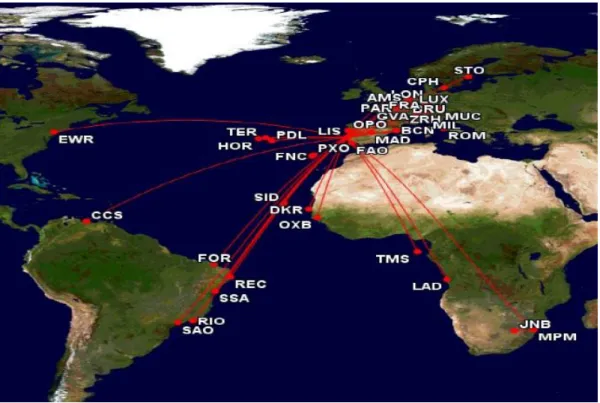
As is possible to visualize in the figures below, it was not with the entrance of the new millennium that TAP started this strategy. The company already had connections to África and Brazil, but it was with the implementation of the Hub strategy in Lisbon in 2001 that this strategy was intensified. More frequencies and more destinations were implemented in all three continents, in a coherent way, and there were eliminated and replaced unprofitable routes, as Johannesburg.
26 Figure 18 TAP Network in 2012
Figure 19 Number of TAP connections
2000 2012 Evolution
Africa 1,150 6,430 353%
Brazil 1,675 7,100 324%
Europe 27,360 73,220 168%
Analyzing the numbers, it is clear the positive evolution of the company since the implementation of the Hub strategy in Lisbon, and the intensification of the triangular operation:
The number of passengers arriving in Lisbon-hub in transit to other cities in 2012 is 148% higher than in 2012
In 2013, 41% of passengers of TAP were in transit
In 2013, the passengers flying between Europe-Americas with TAP overcome 1.2 million, 5 times more than 2001
Between Europe-Africa, TAP carried more than 360 thousand passengers, an increase of 400% comparing to 200115
In 2013, TAP carried 10.7 million passengers, more than the double of 2000
15
Teresa Lopes , TAP Finance Director in “Aviation Fleet & Finance Summit” 2014, by CAPA – Center For Aviation
27 The revenues from ticket sales increased more than 150% comparing to 2000
In 2013 TAP is the European airline with more destinations in Brazil, leading also in number of passengers carried
It is the 3rd in Europe in the number of passengers carried to Latin America
Moreover, the importance of the external market has been growing rapidly, representing nowadays more than 75% of the total sales of TAP.
Figure 20 % of Revenues by Market
2000 2013
Portugal 40% 24%
External Market 60% 76%
Another important consequence of the implementation of this strategy was the increase in the efficiency and productivity of TAP. Nowadays, TAP is one of the most efficient companies in terms of unit costs. Some of the facts that support this are:
Long-haul TAP’s fleet flown on average in 2013, 15 hours per day. More 13.6% than the European airlines average (13.2 hours)
Medium-haul TAP’s fleet flown on average in 2013, 11.5 hours per day. More 67% than the European airlines average (6.9 hours)
The regional fleet of Portugália flown on average in 2013, 9.3 hours per day. More 63.2% than the European airlines average (5.7 hours)
This increase of efficiency is also noticeable in the evolution of ASK (Available Seat per Kilometer) per employee of TAP. In 2000 it was 2.3 million, contrasting to 5.1 million passengers in 2013.
The level of occupancy rate on flights was 79.4% in 2013, which was described as “almost a miracle” by TAP CEO Fernando Pinto16.
Analyzing the levels of flights occupancy of TAP in 2012 in the following figure, it is noticeable that South America is the region where, on average, the flights are more crowded. The importance and success of the triangulation strategy is also supported by these numbers, once the regions of America and Africa are the ones with higher Load Factor.
16 Fernando Pinto in March 2014 during the presentation of TAP S.A. 2013 results: “80% of occupancy rate is a
28 Figure 21 Number of TAP passengers by region in 2012, and its load factor
7. The Future
“TAP has never been so wealthy. It is the second biggest exporter of Portugal, right after Galp, having been the number one for several years”.17 This is the opinion of TAP CEO Fernando Pinto.
It is worth mention that between 2013 and the beginning of 2014, TAP created 600 jobs, of which only 100 were to compensate employees leaving to other companies or retiring.
The network of TAP has increased over the years having been introduced 38 new destinations between 2001 and 2013. For 2014, the airline has announced more 10 new destinations, including Bogotá, in Colombia, and Panama. TAP will be flying to 87 destinations in 37 countries:
Portugal Europe Africa North America Central America South America
9 46 15 2 1 14
In 2012, for the first time in its history, TAP surpassed the barrier of 10 million passengers carried in one year of operations.
The “Hub and spoke” strategy has its advantages and disadvantages. Portugal has taken advantage of its location for the Triangulation strategy that TAP has established between Portugal, South America and West Africa, and with proven success.
However many obstacles are still in the market. Other airlines perceive the opportunity that lies in the other side of the Atlantic and can quickly enter the market. Iberia has recently increased the frequencies of flights to TAP’s future destination Panamá.
17 Fernando Pinto, in “Conversas com vida”, in Económico TV 26/04/2014
Passengers Load Factor
Portugal 567.243 59,8% Portugal Islands 947.448 69,6% Europe 6.105.387 72,7% África 675.402 73,5% North América 254.700 80,1% Central América 84.599 78% South América 1.551.587 82,5% Total 10.186.366 76,8%
29 Also low-lost carrier Ryanair is finally operating in Lisbon’s airport, after many years of challenges, having the goal of surpassing the number of passengers of TAP in that city in just 2 years.18 The company has already a daily domestic connection between Lisbon and Porto, in which TAP had a monopoly, and is aiming to announce a second daily connection shortly.
According to Carlos Paneiro, Sales Director of TAP, Ryanair’s entrance in this route is not a threat, and may even be an advantage19. He explains how the entrance of a low cost carrier in a route can be an advantage for TAP: “When they decide to start a connection that TAP already has, they create a new market. Because of the aggressive communication and marketing campaigns they launch, many customers start wondering to make that route. So it is common that the market increases in terms of number of passengers. Moreover, when the passengers search the flight, he finds out that TAP also does the same connection, having also competitive prices. Of course there are different routes and behaviors, but in the end, it often happens the situation where everyone wins.”20
For him, low-cost carriers have been a greater threat to TAP in the past, because they have a different business model21.
But, competing in such a fierce and challenging market, with so many and different competitors, what should be the next strategies implemented by TAP? Is the CEO taking the best decision by reinforcing the goal and strategy of explore a niche market, aspiring to transform TAP in the leader airline connecting South America, Africa and Europe? Or should the airline explore other world areas as Asia?
Would it be advantageous for TAP to acquire an airline or transform PGA in a low-cost subsidiary? These are questions the management team of TAP needs to solve in the next years.
18
“We will be the second airline in number of passengers in Lisbon’s airport in the end of 2014. Then, in 18
months to 2 years, we will be the first” Michael O’Leary, CEO of Ryanair in March 2014
19
“Sometimes we don’t sell a ticket for example Porto – Lisbon – Warsaw, because the connection Porto –
Lisbon is full. With the entrance of this new player, we will have more space for transit passengers. This route is crucial for us most because of the transit passengers, and not so much for those point to point passengers, who will probably change and fly with Ryanair”. Interview to Carlos Paneiro, Sales Director of TAP, in 28/03/2014
20
Interview to Carlos Paneiro, Sales Director of TAP, in 28/03/2014 21
“Low cost carriers have a diferent business model. TAP does not survive only within Europe. It will be impossible. We need Europe flights, with business and tourism passengers, but also in transit to América and África. That is our business model. We are the number 1 airline to Brazil, and aim to be the number 1 to South América.” Interview to Carlos Paneiro, Sales Director of TAP, in 28/03/2014
30
Teaching Notes
1. Introduction
The objective of this section is to provide to instructors a guide plan, by recognizing the most relevant aspects in this case study. Moreover, it will be given some recommendations and ideas to discuss with students in classes.
2. Synopsis
TAP Portugal is the main national airline of Portugal, being passenger and cargo transportation its main activities. Founded in 1945, it is nowadays 100% state owned. In 2014, TAP will be flying to 87 destinations in 37 different countries. Its fleet will be composed in the end of the year by 77 aircrafts, including 16 from its subsidiary Portugália.
Since 2001, TAP adopted and Hub-and-spoke strategy taking advantage of Portugal strategic position in the world. The company uses Lisbon as a transit stop by passengers flying through Europe, America and Africa. This strategy has been a success, having TAP constantly increased the number of passengers carried over the years, and transit passengers represented in 2013, 41% of the total. However, in a turbulent market as aviation where obstacles and unforeseen events often occur, what should be the next strategic moves for TAP? Invest in other markets besides America and Africa? Create a Low-cost subsidiary?
3. Suggested Questions (Core and
additional)
3.1 Core case questions
1. Fernando Pinto took many key decisions since he assumed TAP. Enumerate them, and explain the ones that were more important in the recovery of the company.
31 3. How do you describe the strategy of internationalization of TAP since its foundation? Should the company continue with the Triangulation Strategy?
3.2 Additional questions
4. Make an analysis of the industry where TAP competes. Describe TAP regarding its strengths and weaknesses.
5. Should TAP start its expansion to Asia in the next few years?
6. Do you think TAP should have a low-cost subsidiary? And if the airline decides for that option, should it be acquired or transform Portugália in a Low-cost?
4. Teaching Objectives
The preparation of this case study had the following teaching objectives:
Demonstrate that appropriate and coherent decisions and strategies can revolutionize companies
Make students analyse the environment where TAP competes, taking advantages of frameworks as SWOT, PESTLE or Porter five forces, in order to identify crucial aspects that influence the management of the company
Interpretation of exhibits and graphics to understand the evolution of TAP
Make students understand what aspects may influence the entrance in certain external markets, both aviation and in general industries
Make students understand the possibilities that a national airline has to face a entrance of a low-cost carrier in the market, and the benefits of each strategy
Understand leadership skill that can heavily transform any company
5. Use of the case
This case study illustrates a real situation that occurred in a Portuguese well known company. Having certain particularities, it can be used for different types of classes both in undergraduate or master programs. It might be used in strategy courses, once it is clear the strategic moves made throughout the years to revolutionize TAP. Also, due to the specificity and distinct leadership methods used by Fernando Pinto, it can be interesting to analyse this case in “Leadership development” courses.
32
6. Relevant Theory
6.1 Strategic frameworks and tools
The state of competition in an industry depends on five basic forces: threat of new entry, threat of substitute products, bargaining power of costumers, bargaining power of suppliers and rivalry among existing competitors. The joint strength of these forces determines the ultimate potential of an industry. Each force can be defined in intense, mild or soft. The weaker the strength of the forces, the higher the profitability of the industry is expected to be (Porter, 1979).
To analyse the macro-environment where a company is competing, it is valuable to conduct a PESTLE analysis. This is a framework where some factors that can interfere in the company’s performance are examined. The factors are: Political, Economic, Social, Technological, Legal and Environmental. Furthermore, in order to understand the micro-environment where the company is inserted, the previous analysis should be combined with a SWOT analysis. This method is used to study the strengths and weaknesses of a company, project, product or even a person, as well as the opportunities and threats that lie on its environment.
6.2 Strategies in Aviation Industry
Air transportation brings to communities many benefits, including access to a global air network, development of local markets, possibilities to increase business and attract foreign investments, tourism and employment (Nolan et. Al., 2005). Air service allows the transfer of goods and people, over long distances, in short periods of time, in a safe, flexible and reliable way.
Since the liberalization of airline industry (1978 in USA and 1997 in Europe), many changes were observed within the industry. The modifications were related to profitability, employment, volume of passengers or patterns of service. It resulted in the decrease in airfares, due to the intensification of competition (Goetz A. R. and Vowles T. M., 2009).
This liberalization led to the appearance of low-cost carriers. These airlines compete aggressively on price, selling a basic service where every extra as food or drinks on board is paid. They flight point-to-point and pay employees below industry average. They exploit all sources that can give them a cost advantage. Porter (1985) sustains that companies can reach competitive advantage through three different kinds of strategies: differentiation, focus or cost leadership. Low cost carriers use clearly the last one as their competitive advantage.
33 Low-cost carriers have many characteristics that give them advantages on short-haul routes. They maximize the utilization of planes and their employees on air; the unions have lower power what leads to smaller costs; operate in one single class; they do not provide free frills on board and often flight to secondary airports. It is obvious why Low cost carriers have benefits in flying point-to-point and exploit this business model (Graham and Vowles, 2006).
Network carriers have analysed two ways to compete with this new type of competitor. Firstly, they start creating a low cost subsidiary of their own, to directly compete the new entrants. Secondly, they can choose to reinforce the main brand and image, while reducing costs at the maximum (Graham and Vowles, 2006).
There are advantages and disadvantages in both strategies, even for passengers. Many network carriers opted to eliminate the business class in some routes or even abolish the service of free food on board.
With the creation of a low cost subsidiary, it is difficult to separate the operations from both companies, what typically leads to the elimination of one brand.
7. Analysis and Discussion
7.1 Core case questions
1. Fernando Pinto took many key decisions since he
assumed TAP. Enumerate them, and explain the ones
that were more important in the recovery of the
company.
The entrance of Fernando Pinto was crucial for the development of TAP. His leadership led to a complete revolution inside the company.
Prior to his arrival, TAP has always been managed by someone indicated by the political party in the Government. The consequences were that no one was really capacitated to take control of an airline, or at least they didn’t have any experience in this industry. Moreover, once the manager knew that after a change in the Government, he will also leave TAP, there was not created any long term strategies. Managers assumed the control of the airline as a step for other places in public companies. With the entrance of Fernando Pinto, this entire situation change.
34
Strategic
Decisions by
Fernando
Pinto
Meetings with employees to describe TAP’s long-term strategies, answer all their questions and explain why the sacrifices asked of them were mandatory
Transparency and communication between Top management and employees in all decisions made, led to the increase of respect by the workers, and to have them on his side. Also, Fernando pinto always demonstrated recognition and gratitude for the hard work that employees were doing for several years, and for the sacrifices he asked of them, what resulted in satisfied personnel, motivated to work and save TAP
Increase of informality, flexibility and reduction of bureaucracy. Physical paper documents reduced and communication done directly by e-mail, being employees free to contact member of the administration
Creation of mechanisms and procedures to increase commitment, cohesion and internal union, as well as feelings of passion and proud towards TAP by employees
Implementation of a reduction costs plan
Closure of unprofitable routes
Optimization of fleet distribution and destinations
Labour costs reduced, by the obtention of some friendly terminations and some pre-retirement agreements
Pioneer wage-freeze agreement
Implementation of “Hub-and-spoke” strategy in 2001, being Lisbon Airport the centre of TAP operations
Focus and growth in Brazil
Reinforcement of “Triangulation Strategy”, making TAP a specialized airline for flying between Europe, Africa and South America
Entrance in Star alliance
Acquisition of PGA
Creation of the new service: “1 flight, 5 ways to travel”
Before accepting the position, the Manager required autonomy and freedom to take actions, change procedures and independence to lead the company. He did not want the interference of Government in the decisions he decided to perform.