http://dx.doi.org/10.1590/2317-1545v40n2184101
Physiological performance of açai seeds (
Euterpe oleracea
Mart.) stored with
different moisture contents and treated with fungicide
11Submitted on 08/16/2017. Accepted for publication on 01/16/2018. 2 Universidade Federal de Lavras, 37.200-000 – Lavras, MG, Brasil.
3 Embrapa, Distrito Industrial, Cx. Postal 133, 69301-970, Boa Vista, RR, Brasil. *Corresponding author <[email protected]>
Juliana Maria Espíndola Lima
2*, João Almir Oliveira
2, Oscar José Smiderle
3,
André Vitor Carvalho Lousado
2, Maria Laene Moreira de Carvalho
2ABSTRACT - The expansion of açai production has increased the importance of management of seeds used for replanting or expanding
the plantation areas. Thus, the aim of this work was to evaluate the performance of açai seeds with different moisture contents, treated or
untreated with fungicide, and stored for 180 days. The seeds were divided into three moisture levels (35%, 30% and 20%), and with or without fungicide treatment, with four storage evaluation periods (0, 60, 120 and 180 days). They were packed in plastic bags and kept in natural environment. The experimental design was completely randomized, with a 3 x 2 x 4 factorial scheme (moisture contents x treated or untreated with fungicide x period of evaluation), with four replications of 50 seeds each. The following tests were conducted: moisture content, germination, tetrazolium test, seedling emergence, seedling emergence speed and X-ray. Açai seeds with 35% and 30% moisture contents treated with fungicide showed a better physiological quality in relation to the untreated ones. Storage longer than 120 days reduced seed germination to values below 50%, regardless of whether they were treated or not with fungicide, although
the reduction was greater in untreated seeds. The fungicide treatment is efficient in controlling fungi in açai seeds with 30% and 20%
moisture content for up to 180 days of storage, and in seeds with 35% moisture content for up to 60 days of storage.
Index terms: recalcitrant seed, drying, viability.
Desempenho fisiológico de sementes de açaí (
Euterpe oleracea
Mart.)
armazenadas com diferentes teores de água e tratadas com fungicida
RESUMO - Com a expansão da produção de açaí, os cuidados com o manejo das sementes utilizadas para replantio ou aumento de área de cultivo se tornaram importantes. Objetivou-se avaliar o desempenho de sementes de açaí com diferentes teores de água e armazenadas com e sem tratamento fungicida por 180 dias. As sementes de açaí foram separadas por graus de umidade (35%, 30% e 20%) e tratadas ou não com fungicida, com quatro épocas de avaliação do armazenamento (0, 60, 120 e 180 dias) em ambiente natural. O delineamento experimental foi inteiramente ao acaso, com arranjo fatorial 3 x 2 x 4 (graus de umidade x com e sem fungicida x épocas de avaliação), com quatro repetições de 50 sementes. As sementes foram avaliadas quanto ao
grau de umidade, germinação, teste de tetrazólio, emergência de plântulas, velocidade de emergência de plântulas e raio-X. As sementes de açaí com 30% e 35% de grau de umidade tratadas com fungicida tiveram melhor qualidade fisiológica em relação
às sementes sem tratamento fungicida. O armazenamento com duração superior a 120 dias reduziu a germinação das sementes para valores abaixo de 50%, independentemente de estarem com ou sem fungicida, porém a redução foi maior para as sementes
sem tratamento fungicida. O tratamento com fungicida é eficiente no controle de fungos até 180 dias de armazenamento, para as
sementes de açaí com 30% e 20% de grau de umidade, e até 60 dias, para as sementes com 35% de grau de umidade.
Termos de indexação: semente recalcitrante, secagem, viabilidade.
Introduction
The palm tree Euterpe oleracea Mart., popularly known as açai, has garnered attention due to the expansion of the
value of its pulp. It is rich in proteins, fiber, lipids, vitamin
E and minerals (manganese, copper, boron and chromium), besides being a considerable source of energy.
With the expansion of açai production, the management of seeds used to replant or expand the plantation area became more important, because this is the most usual form of propagation of the species. It presents recalcitrant seeds, that is, seeds that are intolerant to desiccation (Barbedo and Marcos-Filho, 1998).
Intolerance to desiccation makes the storage of seeds for
later use more difficult, because the function of storage is to
preserve the physiological and biochemical qualities of seeds for as long as possible. Conversely, recalcitrant seeds lose their viability very rapidly during storage due to their moisture content. In recalcitrant seeds, one of the main problems observable even in short periods of storage is the need for high relative humidity and high seed moisture, in order to maintain viability. This is how conservation is generally done. However, this type of storage causes proliferation of microorganisms, which favors deterioration, reducing vigor or causing the death of the seeds (Berjak, 1995; Nascimento and Moraes, 2011).
Quality deterioration of recalcitrant seeds due to fungal incidence has been little studied, but some works already showed that non-infested and disinfested seeds had an extended viability compared to the infested ones (Berjak, 1995; Mittal, 2003; Oliveira et al., 2011; Parisi et al., 2013).
In this context, a possible strategy is to use fungicides for treating the seeds, such as carbedazim, carboxin, captan, thiabendazole and thiram (Bonome et al., 2009; Krugner and Auer, 2005). Once applied, these products protect the seeds against fungal attack, maintaining the sanitary quality during
storage, and preventing fungi from affecting the physiological
quality of the seeds. Many fungal disease agents can be transmitted and disseminated by seeds, and the use of fungicides aims to control these pathogens, and to protect seedlings at a low cost (Balardin et al., 2011; Pereira et al., 2011).
Then, due to the difficulties of dealing with recalcitrant
seeds, which require adequate processing and storage conditions, the use of fungicides can reduce the loss caused by fungi, since these seeds need to be stored with high moisture contents. So, the objective of this study was to evaluate the physiological
performance of açai seeds with three different moisture contents,
treated or untreated with fungicide and stored for 180 days.
Material and Methods
Açai berries (E. oleracea) were collected in their native environment, in the city of Anorí, located in the Brazilian state of Amazonas (AM) (3o46’24”S latitude, 61o38’40”W
longitude). The collections were conducted in January 2014, and the berries were sent to the seed sector of the Embrapa Roraima, city of Boa Vista, state of Roraima (RR), where they were pulped. Further on, the samples were sent to the
Universidade Federal de Lavras (UFLA). The evaluation of the physical and physiological qualities of the seeds was managed by the central seed laboratory of UFLA, in the city of Lavras, located in the state of Minas Gerais (MG).
The berries were mechanically pulped, and then the seeds were washed until they were clean. Their initial moisture content was 42%, so they were put inside greenhouse, at room temperature (30-34 °C) to slow dry until they reached
30% moisture content (reached in five days), which would
be the minimum drying limit for this species, according to Nascimento et al. (2007). This moisture content was chosen, so the seeds would not arrive at destination with a high respiration rate caused by high moisture. This would potentially cause microorganism proliferation and losses.
The seeds were selected according to the average dimensions of 9.45 mm length and 10.62 mm width (large seeds). After that, they were packed in plastic bags and stowed in polystyrene foam sealed boxes to avoid gain or loss of moisture. A germination test was then carried out, using sterilized sand as substrate when seeds were 42% moisture content. The count was performed 90 days after the experiment setting, and an outcome of 91% germination rate was obtained. This test was performed only to verify the initial quality of the seeds and to check if there had been any quality loss during transportation.
The temperature inside the polystyrene foam boxes was measured (24-25 °C), and the moisture content was established as proposed in the Rules for Seed Testing (Brasil, 2009). The obtained result was similar to the moisture content after the drying process (30%). Regarding the seeds, it took three days
for the packages to arrive at UFLA, and after initial verification
at the reception, the lot was divided into three sample groups to
form three different moisture content treatments. This allowed the verifying of efficiency of the fungicide in controlling fungi
throughout the storage process.
Sample 1 seeds were submerged in distilled water (replaced every 24 hours), and kept in germinator at 25 ºC, until they reached 35% moisture content (taking four days). Water immersion technique was chosen because the seeds have a thick tegument and do not absorb water easily. Sample 2 seeds were kept with 30% moisture content, and sample 3
seeds were dried in air-circulating oven at 25 ºC, until reached
20% moisture content (at five days’ time).
monitored by weighing the seeds during the process and using the following formula:
Wf (100 - MCf) = Wi (100 - MCi) Wf: Final weight
MCf: Final moisture content Wi: Initial weight
MCi: Initial moisture content
After weighting, the moisture content of the seeds was determined for each sample (35% and 20%) to guarantee that seeds had the desired condition. In all cases, the methodology described in the Rules for Seed Testing (Brasil, 2009) was used (105 ±3 °C, w.b.).
After the moistening and drying procedures, the seeds were subdivided again. One subsample was treated with the fungicide Vitavax Thiran, in the proportion of 250 mL/100 kg of seeds, and the other remained untreated and served as a control treatment.
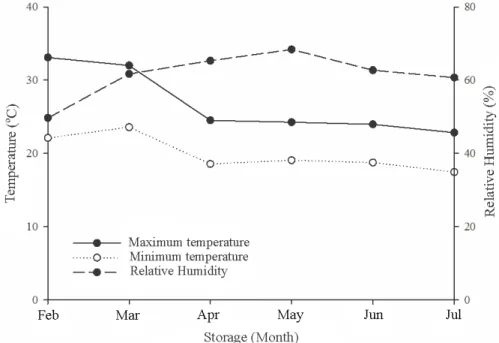
Both treated and untreated subsamples were divided into four other samples to study the storage periods (0, 60, 120 and 180 days). The seeds were ultimately packed in semipermeable transparent plastic bags (20 cm width x 30 cm length x 0.13 mm thickness), which were sealed. They were then stored at room temperature and ambient relative humidity, and monitored throughout the experiment (Figure 1). The experimental design was completely randomized with a 3 x 2 x 4 factorial scheme (three moisture contents x treated or untreated with fungicide x
four evaluation periods), with four replications of 50 seeds each. To determine the physical and physiological qualities of
the açai seeds with different moisture contents, treated or not
with fungicide, the following tests were carried out:
Moisture content (w.b.): for each treatment, four replications were performed. The seeds were cut into pieces smaller than 7.0 mm, and each replication corresponded to the
weight of five whole seeds. The samples were put in the oven
at 105 °C ±3 °C for 24 hours, according to Brasil (2009). The results were expressed as percentage.
Germination: four replications with 50 seeds were performed for each treatment. The seeds were placed on germitest paper, moistened with distilled water in the proportion of 2.5 times the dry paper weight (Brasil, 2009). The paper rolls were kept inside germinator at 30 ºC for up to 90 days, and normal seedlings counts were carried out every seven days. In the end of the test, the sum of the counts was expressed as percentage. The seedlings that exhibited primary root emission and aerial part larger than 2 cm from the germinal button (adjacent germination) were considered normal.
Tetrazolium test: four replications of 50 seeds were performed, and a small cut was made on the side of each seed to improve water absorption. The seeds were put to soak distilled water and kept in BOD (Biochemical Oxygen Demand) incubator at 25 ºC for 24 hours. After that, a transversal cut on the seeds’ raphe line was made. Only one half of each seed (endosperm and embryo) was let to imbibe in 1% tetrazolium
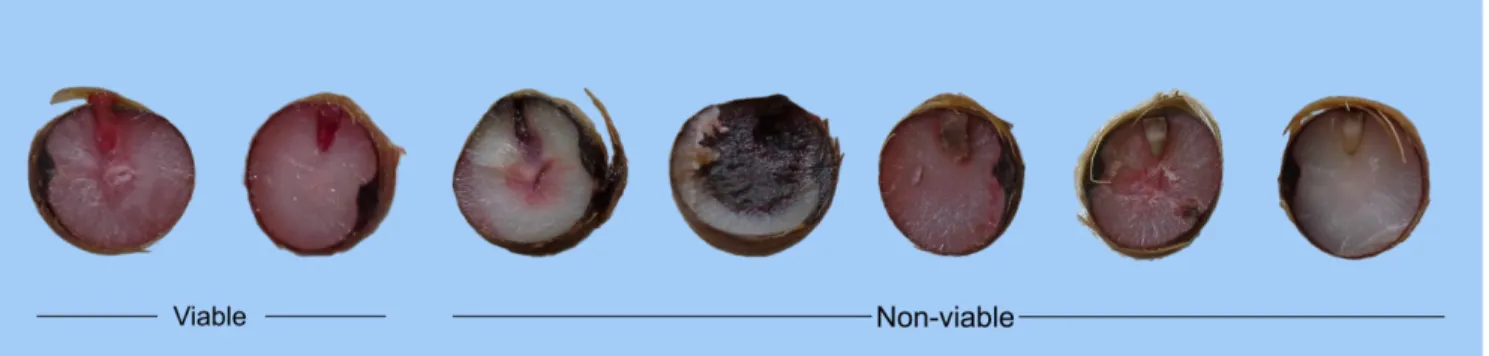
solution inside BOD, at a constant temperature of 30 ºC for 24 hours. The seeds were considered viable or unviable based on their color: viable seeds displayed colors from light to intense red, whereas unviable seeds showed colors from dark red to black or white (Figure 2). The results were expressed
as percentage of viable seeds. Since no specific methodology
for açai seeds was found in the literature, the tetrazolium test
was performed considering the difficulty of water absorption
during seeds moistening to 35% water content. Despite the existence of time variations, temperature and concentration were not assessed. Therefore, the applied method was successful for seed coloration.
Seedling emergence: four replications of each treatment were carried out, each one containing 50 seeds. They were sowed at 3 cm depth in plastic trays (45 cm length x 20 cm width x 10 cm depth) containing a 2:1 combination of gully soil and sand. The trays were maintained in a growth chamber at 30 ºC, and the count of normal emerged seedlings was performed daily, up until 90 days. The results were expressed as percentage.
Seedlings emergence speed: it was assessed together with the seedling emergence test, by counting the number of emerged seedlings daily. The index was calculated by summing the number of daily-emerged seedlings, and dividing it by the number of days passed from sowing to emergence (Maguire, 1962).
X-ray: four replications of 50 seeds were used. The seeds were placed on a polystyrene sheet with cavities, and then put in a Faxitron X-Ray machine, preset for radiation intensity (24 Kvp) and exposure time (14 s). The radiographies were evaluated according to the number of undamaged whole seeds, and the results expressed as percentage.
After obtaining the results, the statistical analyses were performed with the software SISVAR (Ferreira, 2011). They included the analysis of variation, comparison of means at 5%
significance by the Tukey’s test, and the regression analysis with coefficient of determination and significance of 1% by the T-test.
Results and Discussion
Significant interactions between moisture content x
storage (Figure 3A) and fungicide x storage (Figure 3B) were observed. Despite the fact that the seeds were stored in an uncontrolled environment (Figure 1), which may have led to a more intense water exchange between them and the environment due to higher temperature and relative humidity (RH) oscillations, the variation observed during storage stayed below two percentage points, when the lowest and the highest moisture contents reached by seeds were compared. The only exception were the seeds with 30% moisture content, which reached the highest variation of 2.36 percentage points.
For the seeds with 35% moisture content, the maximum
and the minimum values, which significantly differed from
each other, were 35.72% (120 days) and 34.29% (60 days). Seeds with 30% moisture content showed maximum and minimum values of 31.89% (180 days) and 29.53% (120 days); while for seeds with 20% moisture content, the values were 20.78% (60 days) e 19.73% (120 days).
In the interaction fungicide x storage (Figure 3B), a greater
significant water gain was observed in the end of storage (120 and
180 days) for seeds treated with fungicide (28.63% and 29.70%), when compared with the control treatment (28.02% and 28.62%, respectively). However, since it was low, this increase did not
affect directly the physiological quality of the seeds.
This oscillation in moisture content of the seeds happened because the semipermeable packaging allowed water
exchange between the seeds and the environment, as verified
in this study and also by Brasileiro et al. (2011) for loquat seeds (59% moisture content), stored at 8 ºC in paper and
plastic bags for 180 days. These authors verified a gradual
Figure 2. Classification of açai seeds into viable (light to intense red) and non-viable (dark red to black, or white) according to
Storage (Days) - A
0 60 120 180
M
oi
stu
re c
on
te
nt
(%)
0 5 10 15 20 25 30 35 40
35% - y=35,09
30% - y=30,543**-0,026x**+0,000179x2** R2=0,8065 20% - y=20,43
Storage (Days) - B
0 60 120 180
0 5 10 15 20 25 30 35
UF - y=28,698**-0,0101x**+0,000086x2** R2=0,979 TF - y=28,940**-0,0168x**+0,000082x2** R2=0,954
Figure 3. Mean values of the moisture content of açai seeds with different moisture contents (35% - ●, 30% - ○ e 20% - ▼) (A), treated (TF - ●) and untreated (UF - ○) with fungicide (B) and stored for 0, 60, 120 and 180 days.
**Significant at 1% according to the T-test.
reduction in moisture content of seeds packed in paper bags, and a small variation in those kept in plastic bags. Nascimento and Moraes (2011) also observed a variation in moisture content during storage at 20 ºC for 360 days of E. oleracea
(BRS Pará) seeds packed in paper bags, and with moisture content similar to the seeds used in this work.
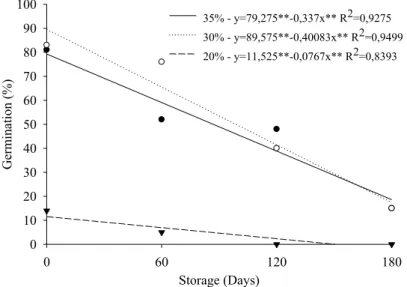
The açai seeds germination data showed interaction between the factors moisture content x storage (Figure 4) and moisture content x fungicide (Table 1). In the beginning of the storage (day 0), the seeds with 35% and 30% moisture contents displayed the highest germination percentages (81% and 83%, respectively), while the seeds with 20% moisture content presented 15% germination. A greater uniformity in germination was observed in seeds with 35% moisture, caused by the imbibition period used, which may have helped to break seed dormancy, accelerating the germination process.
Guedes et al. (2014) used different durations of imbibition
in water to break açai seed dormancy and also obtained a reduction in the germination period and a greater uniformity. Therefore, performing the imbibition before sowing is an alternative to accelerate the germination of açai seeds.
The germination test performed when seeds were with 42% moisture content (91% outcome) showed that, during transportation, there was a reduction of about 10%, in comparison with the germination and other tests realized
during the first stages, which presented results above 80%.
Therefore, the transportation did not compromise the realization of the study.
After 60 days of storage, the seeds with 30% moisture content showed a germination of 76%, which represents a
lower reduction than that observed in the seeds with other moisture contents (52% and 5% germination in seeds with 35% and 20% moisture contents, respectively).
The reductions that occurred from the first to the second
germination stages were of 29. 7 and 9 percentage points for the seeds carrying 35%, 30% and 20% moisture contents, respectively. Due to this greater reduction in the seeds with 35% moisture content, it is not recommended, for storage purposes, to remoisten seeds to maintain their moisture content above the tolerated limit proposed by Nascimento et al. (2007), because this accelerates the deterioration process.
Seeds moistening before sowing should be done only with the objective to obtain a greater uniformity in germination, as it was observed on the day 0 (Figure 4). After 120 and 180 days of storage, the germination rate was lower than 50% in seeds with 35% and 30% water contents, and 0% in seeds with 20% moisture content.
The second interaction (Table 1) showed that the seeds with 35% and 30% moisture contents treated with fungicide presented a germination percentage greater than the untreated
ones. However, no significant difference was detected in
seeds with 20% moisture content, regardless of the fungicide
treatment. This can be justified by the sharp reduction in seed
quality due to the drying process.
The efficiency of fungicide treatment in recalcitrant seeds
was also studied by Brasileiro et al. (2011), who observed a germination rate above 80% in recalcitrant loquat seeds treated with the fungicide Captan, and stored in paper bags at 8ºC for 180 days. Oliveira et al. (2011) worked with grumixameira,
Storage (Days)
0 60 120 180
G
erm
in
at
io
n (%)
0 10 20 30 40 50 60 70 80 90 100
35% - y=79,275**-0,337x** R2=0,9275 30% - y=89,575**-0,40083x** R2=0,9499 20% - y=11,525**-0,0767x** R2=0,8393
Figure 4. Mean germination values of açai seeds with different moisture contents (35% - ●, 30% - ○ and 20% - ▼) and stored
for 0, 60, 120 and 180 days.
**Significant at 1% according to the T-test.
Table 1. Mean germination values of açai seeds with
different moisture contents (35%, 30% and 20%),
treated (TF) and untreated (UF) with fungicide.
Moisture contents TF UF
35% 57 aA 41 bB
30% 58 aA 49 aB
20% 6 bA 3 cA
Mean 40 31
C.V. (%) 13.20
C.V. – Coefficient of Variation. * Mean values followed by the same lowercase letters, in the column, or by the same uppercase letter, in the row, do not differ from each other at 5% probability by the Tukey’s test.
stored at 8 ºC for 180 days, and obtained a better germination result in the seeds that had undergone drying and fungicide treatment, similarly to the observed in this work for seeds with 35% and 30% moisture contents.
The use of fungicide for controlling pathogens in recalcitrant species can be an alternative to improve storage. However, when seeds have a very high moisture content, the
fungicide functionality does not last for long, as verified in
this work for seeds with 35% moisture content, stored for a maximum of 60 days. After this period, fungi proliferation started to occur inside the plastic bags and during germination.
The viability data obtained from the tetrazolium test showed the same interaction as the germination test (moisture content x storage and moisture content x fungicide), with the decrease in viability during storage for all moisture contents and fungicide treatment being higher than those obtained in the control treatment. The highest percentage of viability was obtained in seeds with 35% and 30% moisture contents on day 0 (Figure 5), with mean values of 93% and 85%, respectively.
Still regarding Figure 5, it is possible to note that, during the storage for 60 days, there was a sharp reduction of 37 percentage points in the viability of seeds with 35% moisture content. For seeds with 30% moisture content, the reduction was of only 8 percentage points. This viability decrease was observed in the germination data (Figure 4) throughout storage.
This accentuated reduction in viability and germination of seeds with 35% moisture content stored for 60 days may have resulted from the remoistening, as previously
mentioned. On day 0, this procedure benefitted the uniformity
of germination due to the initial water absorption. However, this may have accelerated the process of deterioration during storage, once the water absorption increases the respiration rate, decreasing seed viability.
The most important alterations involved in seed deterioration are the reserves depletion; alteration in chemical composition, due to lipids oxidation and enzymes involved in deterioration and partial protein breakdown; alteration in cell membranes, due to integrity loss, increase in permeability, and membrane disorganization. Even though the deterioration rises as the water content of seeds increases, the repair mechanisms continue to work as long as there is respiration (Ibrahim and Roberts, 1983; Marcos-Filho, 2015). Some of
Storage (Days)
0 60 120 180
Tet
raz
ol
iu
m
(%)
0 10 20 30 40 50 60 70 80 90 100
35% - y=89,450**-0,384x** R2=0,9338 30% - y=91,000**-0,3892x** R2=0,9548 20% - y=15,500**-0,0979x** R2=0,9196
Figure 5. Mean values of tetrazolium test results of açai seeds with different moisture contents (35% - ●, 30% - ○ and 20% - ▼)
and stored for 0, 60, 120 and 180 days.
**Significant at 1% according to the T-test.
The seeds with 20% moisture content had their viability
and physiological quality affected by the drying process
since the beginning of storage. Therefore, drying is not recommended for this species at this moisture content. The interaction moisture content x fungicide (Table 2) showed a greater viability in seeds with 35% and 30% moisture contents treated with fungicide. However, in seeds with 20% moisture
content with or without fungicide treatment no difference was
detected, because of the low viability of the seeds.
In the evaluation of seedling emergence (Figure 6), there was a triple interaction, according to which was possible to observe a superior performance of the seeds treated with fungicide in all three moisture contents studied. The seeds with 35% moisture content showed the greatest initial vigor, with 87% seedling emergence in those treated with fungicide, and 64% in the untreated ones. Thus, the increase in emergence is more pronounced when remoistening and fungicide treatment are used combined.
Since açai seeds have a thick tegument, water absorption occurs slowly, which may cause lack of uniformity during germination and emergence. Remoistening seeds to increase their moisture content may contribute for the formation of a more uniform set, as seen in the seedling emergence test. However, after 60 days, there was a reduction of 30 and 16 percentage points in the emergence of seedlings from seeds with 35% moisture content treated and untreated with fungicide (57% and 48% emergence, respectively), in comparison with the day 0. The same was not observed in seeds with 30% moisture content, which, despite the lower initial emergence
(64% and 56%, in seeds treated and untreated with fungicide, respectively), presented a reduction of 10 and 9 percentage points (54% and 47%) after 60 days.
After 120 storage days, the seeds with 35% moisture
content exhibited statistically different results, with 47% and
34% emergence in seeds treated and untreated with fungicide, respectively. The seeds with 30% moisture content showed a
significant difference in emergence, with values of 37% and
30% for treated and untreated seeds, respectively, whereas the seeds with 20% moisture content had 0% emergence, regardless of having been stored with or without the fungicide treatment.
At the end of the storage (180 days), only seeds with 35%
moisture content showed a significant difference between the
emergence of seeds treated with fungicide and the untreated ones (38% and 30%, respectively). In seeds with 30% moisture content (28% and 24% emergence in fungicide-treated and
Table 2. Mean values of tetrazolium test results of açai seeds
with different moisture contents (35%, 30% and 20 %),
treated (TF) and untreated (UF) with fungicide.
Moisture contents TF UF
35% 60 aA 50 Ab
30% 62 aA 52 a B
20% 8 bA 5 Ba
Mean 43 36
C.V. (%) 16.12
Figure 6. Emergence of seedlings from açai seeds with different moisture contents (35%, 30% and 20%), treated (TF) and untreated (UF) with fungicide and stored for 0, 60, 120 and 180 days. (35UF - ○), (35TF - ●), (30UF - Δ), (30TF - ▼), (20UF - □) and (20TF - ■).
**Significant at 1% according to the T-test.
Storage (Days)
0 60 120 180
Em
erg
en
ce
of
s
ee
dl
in
gs
(%)
0 10 20 30 40 50 60 70 80 90 100
35UF - y=61,500**-0,196x** R2=0,9506
35TF - y=85,650**-0,523x**+0,00146x2** R2=0,9892 30UF - y=56,250**-0,192x** R2=0,9674
30TF - y=64,450**-0,205x** R2=0,9947
20UF - y=9,975**-0,184x**+0,00073x2** R2=0,9333 20TF - y=28,025**-0,516x**+0,00205x2** R2=0,9333
untreated seeds, respectively) and 20% moisture content (0% emergence, in both fungicide treatment conditions) such
difference was not significant.
The sanitary quality of the seeds was benefitted by the
fungicide treatment, thus increasing the emergence potential of the seedlings. Therefore, this is a good option for improving açai seed storage. However, seed moisture content is still a
factor that affects seed quality during storage, as observed by
Nascimento et al. (2007) and Nascimento et al. (2010), who also noticed a decrease in the emergence of açai seedlings, as the moisture content of the tested seeds reduced.
A point that should be emphasized is the fungicide intoxication, which can sometimes occur in the treatment of seeds. That was not observed in this study, so the dose (250 mL/100 kg of seeds) and the fungicide used (Vitavax Thiran) are recommended for açai seeds treatment. Bonome et al. (2009) worked with rubber tree recalcitrant seeds (moisture content above 30%) treated with fungicide, but the treatment did not succeed, because the seeds
suffered intoxication by the fungicide Captan.
Seedling emergence speed showed a triple interaction, and a progressive reduction in seedling emergence speed was observed throughout storage for all moisture contents assessed (Figure 7). At the stage zero, the seeds with 35% moisture content treated with fungicide showed a rate of 0.67, while the untreated ones showed a rate of 0.44, which represented
a significant difference. The seeds with 30% moisture content
with and without fungicide treatment presented rates of 0.41 and
0.40, respectively, not differing statistically from each another.
The seeds with 20% moisture content, in their turn, showed indexes of 0.19 and 0.07 for treatments with and without
fungicide, respectively, which were significantly different.
Throughout the storage (0, 60, 120 and 180 days), the seeds with 35% moisture content treated with fungicide presented
indices significantly higher than those of fungicide-treated
seeds of the other moisture contents. Thus, the combination of fungicide and moistening helped to maintain an emergence speed higher than that of the other seeds (30% and 20% moisture) treated with fungicide throughout the storage.
Among the seeds without fungicide treatment, those with 35% moisture content presented values statistically higher on day 0 and after 60 days of storage (0.44 and 0.42, respectively) than the seeds with 20% moisture content (0.07 and 0.01). The values of seeds with 35% moisture content after 120 and
180 days of storage (0.31 and 0.21) were also significantly
higher than in the seeds with 30% (0.18 and 0.12) and 20% (0.0 and 0.0) moisture content.
The data on the emergence speed showed the reduction of the indices throughout the storage caused by seed deterioration (which is greater, in this case, because they are recalcitrant) and also due to the water content of the seeds, which is a limiting factor for this species conservation. This
reduction was also verified in results of seedling emergence
speed obtained by Martins et al. (2009) with seeds of Juçara
bags at 10 °C. They found a lower index in the seeds with lower moisture content, and this index reduced over storage.
The X-ray test (Figure 8) indicated a reduction of the physical quality only at the end of the storage (180 days) for the seeds with 35% moisture content untreated with
fungicide (95%). This result can be justified by the high
moisture content of these seeds, which caused fungal and
bacterial proliferation, observable inside the plastic bags, and that accelerated the deterioration process. Therefore, it was
verified that the damages caused by fungi proliferation were
greater when the seeds presented a high moisture content and were not treated with fungicide. These damages compromised the physical structure of the seeds, causing tegument and endosperm rupture, and making them inviable.
Storage (Days)
0 60 120 180
Se
ed
lin
g Em
erg
en
ce
s
pe
ed
(Inde
x)
0.0 0.2 0.4 0.6
0.8 35UF - y=0,467-0,00134x R
2 =0,9393 35TF - y=0,6425-0,00242x R2=0,9626 30UF - y=0,411-0,00166x R2=0,9569 30TF - y=0,419-0,00152x R2=0,9735
20UF - y=0,0618-0,00114+0,000005x2 R2=0,9333 20TF - y=0,1805-0,00333x+0,000013x2 R2=0,9333
, , , ,
Figure 7. Seedling emergence speed in açai seeds with different moisture contents (35%, 30% and 20%), treated (TF) and untreated (UF) with fungicide and stored for 0, 60, 120 and 180 days. (35UF - ●), (35TF -○), (30UF - ▼), (30TF - Δ), (20UF - ■) e (20TF -□).
**Significant at 1% according to the T-test.
Storage (Days)
0 60 120 180
X
-ray
(%)
0 10 20 30 40 50 60 70 80 90 100
35UF - y=99,750**+0,0375x**-0,000347x2** R2=0,9333 35TF - y=99,88
30UF - y=99,88 30TF - y=99,63 20UF - y=99,88 20TF - y=100,00
Figure 8. Mean of X-ray results (whole seeds) in açai seeds with different moisture contents (35%, 30% and 20%), treated (TF) and untreated (UF) with fungicide and stored for 0, 60, 120 and 180 days. (35UF - ○), (35TF - ●), (30UF - Δ), (30TF - ▼), (20UF - □) e (20TF - ■).
**Significant at 1% according to the T-test.
** ** ** **
In summary, it was observed that, among the drying treatments (30% and 20%), the seeds with 30% moisture content remained viable. The storage in plastic bags for 180 days in a natural environment was not enough to maintain the physiological quality of the seeds, and in order to obtain a germination rate above 50%, the recommended storage time limit in these conditions is 60 days.
The seeds with 35% and 30% moisture contents treated with fungicide presented the best physiological quality results when compared to the treatments without fungicide. Therefore, fungicide treatment is recommended for this species.
Conclusions
Açai seeds with 35% and 30% moisture contents treated with fungicide have a better physiological quality in relation to the seeds untreated with fungicide.
Storage longer than 120 days reduces seed germination to values below 50%, regardless of whether they are treated or untreated with fungicide, but the reduction is greater for seeds without the fungicide treatment.
The fungicide treatment is efficient in controlling fungi
up to 180 days of storage in açai seeds with 30% and 20% moisture contents, and up to 60 days of storage in seeds with 35% moisture content.
References
BALARDIN, R.S.; SILVA, F.D.L.; DEBONA, D.; CORTE, G.D.; FAVERA, D.D.; TORMEN, N.R. Tratamento de sementes com fungicidas e inseticidas como redutores dos efeitos do estresse hídrico em plantas de soja. Ciência Rural, v.41, n.7, p.1120-1126, 2011. http://www.scielo.br/scielo.php?script=sci_ arttext&pid=S0103-84782011000700002
BARBEDO, C.J.; MARCOS-FILHO, J. Tolerância a dessecação
de sementes. Acta Botânica Brasileira, v.12, n.2, p.145-164, 1998. http://www.scielo.br/pdf/abb/v12n2/v12n2a05
BERJAK, P. The role of microorganisms in deterioration during storage of recalcitrant and intermediate seeds. In: OUÉDRAOGO, A.S.; POULSEN, K.; STUBSGAARD, F. (Ed.). Intermediate/recalcitrant tropical forest tree seeds: proceedings of a working on improved methods for handling and storage of intermediate/recalcitrant tropical forest tree seeds. Rome: IPGRI, 1995. p.121-126.
BONOME, L.T.S.; OLIVEIRA, L.E.M.; GRACIANO, M.H.P.;
MATTOS, J.O.S.; MESQUITA, A.C. Influência do tratamento fungicida e da temperatura sobre a qualidade fisiológica de sementes
de Seringueira durante o armazenamento. Agrarian, v.2, n.5, p.97-112, 2009. http://ojs.ufgd.edu.br/index.php/agrarian/article/ viewFile/808/488
BRASIL. Ministério da Agricultura, Pecuária e Abastecimento.
Regras para análise de sementes. Ministério da Agricultura, Pecuária e Abastecimento. Secretaria de Defesa Agropecuária. Brasília, DF: MAPA/ACS, 2009. 395p. http://www.agricultura.gov.br/arq_editor/
file/2946_regras_analise__sementes.pdf
BRASILEIRO, B.G.; SILVA, D.F.P.; BHERING, M.C.; MOURA,
E.B.B.; BRUCKNER, C.H. Qualidade fisiológica de sementes de Nêspera armazenadas em diferentes embalagens. Revista Brasileira Fruticultura, v.Especial, n.1, p.686-691, 2011. http://www.scielo.br/ pdf/rbf/v33nspe1/a96v33nspe1.pdf
CARVALHO, E.R.; MAVAIEIE, D.P.R.; OLIVEIRA, J.A.; CARVALHO, M.V.; VIEIRA, A.R. Alterações isoenzimáticas em sementes de cultivares de soja em diferentes condições de armazenamento. Pesquisa Agropecuária Brasileira, v.49, n.12, p.967-976, 2014. http://seer.sct.embrapa.br/index.php/pab/article/ view/18954/12838
CARVALHO, N.M. A secagem de sementes. 2.ed. Jaboticabal: FUNEP, 2005. 184p.
CORTE, V.B.; BORGES, E.E.L.; LEITE, H.G.; PEREIRA, B.L.C.; GONÇALVES, J.F.C. Estudo enzimático da deterioração de sementes de Melanoxylon brauna submetidas ao envelhecimento natural e acelerado. Revista Brasileira de Sementes, v.32, n.1, p.083-091, 2010. http://www.scielo.br/pdf/rbs/v32n1/v32n1a10.pdf FERREIRA, D.F. Sisvar: a computer statistical analysis system. Ciência e Agrotecnologica, v.35, n.6, p.1039-1042, 2011. http://www.scielo.br/ scielo.php?script=sci_arttext&pid=S1413-70542011000600001
GUEDES, C.; SEGUNDO JUNIOR, O.; SOUZA, A.R.S.; SOUZA, D.G.; SOUZA, D.R.D.S.; CUNHA NETO, M.P.D.; LINHARES,
R.L. Quebra de dormência em sementes de açaí. Anais Programa Ciência na Escola, v.2, n.1, p.14-16, 2014. http://gpaaa.inpa.gov.br/ index.php/RCE/article/view/217/124
HENNING, F.A.; MERTZ, L.M.; JACOB JUNIOR, E.A.; MACHADO, R.D.; FISS, G; ZIMMER, P. D. Composição química e mobilização de reservas em sementes de soja de alto e baixo vigor.
Bragantia, v.69, n.3, p.727-734, 2010. http://www.redalyc.org/ html/908/90816059026/
IBRAHIM, A.E.; ROBERTS, E.H. Viability of lettuce seeds: I. survival in hermetic storage. Journal of Experimental Botany, v.34, n.142, p.620-630, 1983. https://www.jstor.org/stable/23690685 KRUGNER, T.L.; AUER, C.G. Doenças dos eucaliptos. In: KIMATI, H.L.; BERGAMIN FILHO, A.A.; CAMARGO, L.E.A.; REZENDE, J.A.M. (Ed.). Manual de Fitopatologia:doenças das plantas cultivadas. Viçosa, MG: Ceres, 2005. p. 319-332.
MAGUIRE, J. D. Speed of germination-aid in selection and evaluation for seedling emergence and vigor. Crop Science, v.2, n.1, p.176-177, 1962. https://dl.sciencesocieties.org/publications/cs/ abstracts/2/2/CS0020020176/
MARTINS, C.C.; BOVI, M.L.A.; NAKAGAWA, J.; MACHADO, C.G. Secagem e armazenamento de sementes de Juçara. Revista Árvore, v.33, n.4, p.635-642, 2009. http://www.scielo.br/scielo. php?script=sci_arttext&pid=S0100-67622009000400006&lng=en &nrm=iso&tlng=pt
MITTAL, R.K. Mycoflora of recalcitrant tree seeds and its effects on
germination and storability. Journal of Mycopathological Research, v.41, n.1, p.127-134, 2003. http://direct.bl.uk/bld/placeorder. do?uin=15607751 3eetoc=rnefrom=searchengine
NASCIMENTO, W.M.O.; CICERO, S.M.; NOVEMBRE, A.D.L.C. Conservação de sementes de Açaí (Euterpe oleracea Mart.). Revista Brasileira de Sementes, v.32, n.1, p.24-33, 2010. http://www.scielo. br/pdf/rbs/v32n1/v32n1a03.pdf
NASCIMENTO, W.M.O.; MORAES, M.H.D. Fungos associados a sementes de Açaí: efeito da temperatura e do teor de água das sementes durante o armazenamento. Revista Brasileira de Sementes, v.33, n.3, p.415-425, 2011. http://www.scielo.br/pdf/rbs/v33n3/04.pdf
NASCIMENTO, W.M.O.; NOVEMBRE, A.D.L.C.; CICERO, S.M.
Consequências fisiológicas da dessecação em sementes de Açaí
(Euterpe oleracea Mart.). Revista Brasileira de Sementes, v.29, n.2, p.38-43, 2007. http://www.scielo.br/scielo.php?script=sci_ arttext&pid=S0101-31222007000200006
OLIVEIRA, C.F.; OLIVEIRA, D.C.; PARISI, J.D.; BARBEDO, C.J. Deterioração de sementes de espécies brasileiras de Eugenia
em função da incidência e do controle de fungos. Revista Brasileira de Sementes, v.33, p.520-532, 2011. http://www.scielo.br/scielo. php?script=sci_arttext&pid=S0101-31222011000300015
PARISI, J.J.D.; BIAGI, J.D.; BARBEDO, C.J.; MEDINA, P.F. Viability of Inga vera Willd. subsp. affinis (DC.) TD Penn. embryos
according to the maturation stage, fungal incidence, chemical treatment and storage. Journal of Seed Science, v.35, n.1, p.70-76, 2013. http://www.scielo.br/pdf/jss/v35n1/10.pdf
PEREIRA, C.E.; OLIVEIRA, J.A.; ROSA, M.C.M.; KIKUT, A.L.P. Armazenamento de sementes de braquiária peletizadas e tratadas com fungicida e inseticida.Ciência Rural, v.41, n.12, p.2060-2065, 2011. http://www.scielo.br/pdf/cr/v41n12/a19011cr5448.pdf