INFORMATION SYSTEMS’ PORTFOLIO:
CONTRIBUTIONS OF ENTERPRISE AND PROCESS
ARCHITECTURE
Fernandes, S. ([email protected]) Research Centre for Spatial and Organizational Dynamics and Faculty of Economics, University of Algarve, 8005-139 Faro, Portugal.
Fragoso, J. L. ([email protected]) Faculty of Economics, University of Algarve, 8005-139 Faro, Portugal.
ABSTRACT
New information technologies and systems (IT/IS) are challenging business models and products. One of the great shakes comes from the online and/or mobile apps and platforms.These are having a tremendous impact in launching innovative and competitive services through the combination of digital and physical features. This leads to actively rethink enterprise information systems' portfolio, its management and suitability. One relevant way for enterprises to manage their IT/IS in order to cope with those challenges is enterprise and process architecture. A decision-making culture based on processes helps to understand and define the different elements that shape an organization and how those elements inter-relate inside and outside it. IT/IS portfolio management requires an increasing need of modeling data and process flows for better discerning and acting at its selection and alignment with business goals. The new generation of enterprise architecture (NGEA) helps to design intelligent processes that answer quickly and creatively to new and challenging trends. This has to be open, agile and context-aware to allow well-designed services that match users’ expectations. This study includes two real cases/problems to solve quickly in companies and solutions are presented in line with this architectural approach.
KEYWORDS: information systems’ portfolio, process architecture, enterprise
architecture, intelligent processes.
JEL CLASSIFICATION: O31, O33
1. INTRODUCTION
The transition to information society required enterprises to select and organize their data. This has raised new values, more relevant than traditional ones, such as information and knowledge. Technology has made so much difference that its
association with human capital made emerge a greater potential of it. Information technologies (IT) are the platform for the company’s ability to develop information systems (IS) that meet the new management trends. For example, the increasing ability to control large volumes of data (big data), through the data warehouses, using advanced tools for relating those data (data mining), can answer to more selective and diverse customers. Some changes call for rethinking the ways to offer products/services and seek for different dissemination channels. Thus, companies should organize their IT/IS to develop new solutions to maintain or enhance their competitive position.
The roles that information systems and knowledge management play are complementary in current business scenarios. Connectivity, mobility, pervasiveness and real-time reaction are some of the keywords in today’s vocabulary of enterprises. The sustainability of competitive advantage is found in a company’s ability to channel the critical information to generate the business intelligence that enables it to constantly rethink its methods to suit its needs in real time. Given the actual pace of change, companies have to deal well with real-time business events. This requires that organizations and professionals adopt new attitudes and ways of managing the business intelligence to address numerous emerging challenges.
2. INFORMATION SYSTEMS IN PORTUGAL
2.1. The Portuguese economy
In Portugal, the companies (mostly small and medium-sized) invest little in R&D (research and development) due to their limited financial and organizational capacity. Thus, information systems are an important resource for their business performance. In terms of most innovative sectors in the Portuguese economy, which according to Sarkar (2014) tend to be more supported by IT/IS, the Community Innovation Survey (CIS) provides useful information. The EU (European Union) employs this statistical instrument to monitor Europe’s progress in the area of innovation, which is conducted by national statistical offices. In Portugal, following the methodological recommendations of Eurostat, the CIS aims to directly collect information on innovation (product, process, marketing, and organizational) in companies. It explores how firms interrelate with their surrounding external environment in order to access information considered important for the development of new projects or the completion of existing ones. Firms may use external agents as information sources or engage in more formal cooperation activities, meaning their active participation with other enterprises or institutions on innovation.
The recent CIS (period 2010-2012) reveals that main innovating sectors in the Portuguese economy are: research-based (computer, civil engineering, R&D) or knowledge-based (insurance, health) or service-based (retail trade). The external sources/agents most commonly used by the first are universities, suppliers by the second and firms’ group by the third. Private customers are important sources for all types of sectors, what means that Portuguese firms generally use customers’ information and relations for innovation purposes. These results are in line with the fact that Portuguese economy is mainly based on small and medium-sized firms (SME) which increasingly focus on services and knowledge. Customers’ data allow to expand the knowledge-base within their applied research and to materialize knowledge into goods and services (Sánchez-González & Herrera, 2014).
The IT/IS that Portuguese companies should bet on, especially those with a culture of customer service, are based on business intelligence tools such as CRM (Customer Relationship Management), ERP (Enterprise Resource Planning), Big-data tools and analytics. These tools, complemented on well planned platforms (even integrating data from social media) contribute to implement new ideas, design new products and services, improve existing processes and create new ones. Given this enormous potential, which may lead to a reconfiguration of the business model, managers should not only be familiar with these systems, but also get involved from the beginning of their adoption and cover everyone in the organization.
2.2. IT/IS Potential
Many Portuguese firms have used financial systems which automatically process invoices and other reports from the balance sheets. However, analyzing the process of decision support, it was found that managers make decisions based on many other documents and data in order to know what products they can offer, in what amount, which is the best way for distribution, the best location for shopping, etc. And in addition, the enormous amount of data that result from having a website, which leads to the use of new tools for database management (e.g. MySQL). An ERP can manage these issues, as it allows integration of different business functions and documents informing product traceability, i.e. from the order moment until knowing its stock level. Information flows result more rapid and complete, contributing to a better inventory management and a greater consistency with customer’s needs (Vasilev and Georgiev, 2003).
Companies can also put into the ERP new modules tailored to their business reality (health, banking, commerce, etc.) to turn it more flexible. Unlike departmental systems, an ERP is multifunctional covering different levels or functions in the
organization. ERPs are integrated systems, making the information flow easy between different areas to be shared by different processes. The information is then accumulated in a single huge repository (data warehouse), available to all business units at all functional levels. Managers can have all the information they need more accurately and in real-time (Laudon and Laudon, 2004). This type of system answers to queries such as: inform customers if the ordered product is in stock; maintain customers informed of the whole processing course of their orders; easy communication between production and financial areas to define new production plans, etc. Departmental systems, in contrast, create much fragmentation of data resulting in expensive and complex links that proliferate in companies, as these systems function separately. ERP systems, by consolidating the data, help to eliminate unnecessary or redundant links having a positive impact on business efficiency and performance.
On the other hand, CRM tools consist of analytical functions to manage the relationship with clients, consolidate information from different sources or channels of communication (phone, email, web, wireless points) to answer queries such as: what is the value of a certain client for the company; which are the most loyal customers; which are the most profitable ones, etc. Then, companies can use the answers to these questions to acquire new customers; improve their products/services to further customize them according to customers’ preferences; etc. CRM techniques are used to select and combine key information from different points of view to help companies to create unique services or successful innovations. CRM processes can also, by means of advanced techniques like data mining, capture profiles, attitudes and behaviors which were not previously perceived. These tools become effective in engaging the customer to the point of expecting for the services he has previously outlined (Vasilev and Georgiev, 2003). These trends, besides being a key for business performance, they can be a way of knowledge-base enhancement (Gudas, 2008; Fernandes, 2013). Figure 1 illustrates this aspect through the main lines of information systems’ support and enterprise knowledge expansion, answering questions like how and why for understanding and foresight.
Source: http://informationxdummies.blogspot.pt/2014/02/a-short-introduction-for-our-english.html
Another relevant trend to go on searching is the widespread use of mobile platforms due to their ubiquity (concept of being everywhere at the same time, related with pervasive devices – time and context-aware). These attributes have to do with the critical role that time and place play in today’s communications. Facing the increasing geographical scope and time-sensitiveness of services (real-time response), their development is making the difference. One of today’s standout potentials is the Internet of Things (IoT), i.e., the internetworking of physical devices, buildings, and other items embedded with electronics, software, sensors and network connectivity that enable these objects to collect and exchange data performing innovative services.
2.3. Potential of IoT
The full potential of the internet requires more flexible information and process architectures in companies. The main goal is to manage knowledge and adherence to new business models supported by mobile, cloud, big-data or IoT systems that tend to innovate several areas such as tourism and health. Recent discussions about smart cities and regions (bridging the physical and digital) have touched those issues. For example, future European structural investment funds are based on developing and matching these research and innovation strengths to business needs (European Commission, 2016).
Then a network of smart devices can be set up which can enhance the working of any business and its services. For example, in tourism, there can be a better assistance to tourists through mobile apps such as manage the experience of touring a place by the smart coordination of the objects at that place. This will enhance the overall experience of the tourist, giving information regarding the shortest route to reach there, traffic congestion in that route and alternate ways to reach the place. Mobile tours can be provided to tourists giving details of all local attractions, restaurants, etc. nearby and assisting them throughout their trip.
Also mobile work empowerment is possible, which is important in real-time or critical activities such as in healthcare. Networked sensors, either worn on the body or embedded in our living environments, make possible the gathering of rich information about our physical and mental health. Captured on a continual basis, then aggregated and effectively mined, such information can bring a positive change in healthcare (Hassanalieragh et al., 2015; Tyagi et al., 2016). The combination of wearable technologies with related apps at a smartphone can serve to integrate and monitor patient information and sensing throughout healthcare records and systems (Niewolny, 2013). However, due to certain issues like concerns over privacy of personal data generated by smart devices, measures have to be taken to deal with these concerns (Kaur and Kaur, 2016).
Figure 2 illustrates this wave of unstoppable growth of the Internet through IoT which brings the confluence between people, processes, information and things.
Source: RES (2013)
The five main factors that feed the Internet of Things are:
-use of assets (cost reduction) and employee productivity (greater efficiency in tasks);
-supply chain and logistics (elimination of expenses); -User experience (increase of customers);
-Innovation (‘time to market’ reduced).
The technological trends including cloud, mobility, big data and increased processing capacity are driving the economy of IoT. This is creating an unprecedented opportunity to connect what was still disconnected among people, processes, information and things (RES, 2013). A question and its answer is increasingly shaking enterprises and business models: can information systems’ portolio selection and management help?
3. WHICH INFORMATION SYSTEMS’ PORTFOLIO?
The issues raised by figures 1 and 2 remember us of the importance of information systems’s portfolio and management. There is a common problem in companies, related to an increasing amount of data (‘big data’) and of non-integrated information systems, affecting company’s performance and its relationships with customers and employees. Two main factors lead to this problem:
- one refers to the fact that there are many new information systems and technologies in organizations (such as ERP/CRM, clouds, sites, social networks, etc.) whose potential is far from being fully exploited, either in themselves or in integration with other existing systems;
- other factor is that people work differently, in terms of: training, willingness to work with technologies, willingness to cooperate with others, among other individual differences.
These factors raise the need for the information systems’ portfolio management and a working architecture/culture in which people synchronize their procedures and visions throughout the organization, within the same mind-set targets. This leads to an exercise of collecting the relevant processes and information (Robbins, 2006). For example, creative thinking makes people approach problems and solutions, in order to put existing ideas together in new productive combinations (Amabile, 1998).
The present work aims to develop an approach to these issues, which can be referred as a portfolio approach to information systems management. It should be understood here, as information systems’ portfolio, the set of tools and methodologies for business intelligence (ERP/CRM, intranets, clouds, social networks, etc.). This approach aims to bring attention to the appropriate management of this portfolio, i.e., its selection and alignment with business goals (figure 3).
Figure 3. Information systems’ portfolio and its strategic role
Source: adapted from Kraft (2002)
IS portfolio management level (Alignment) IT/IS level
3.1. Balance between selection and alignment
IT is playing an increasing role in almost every company’s business development and innovation. In some industries IT has been a strategic differentiator for years. Therefore, development of strategies, processes, products and services must consider technological opportunities and limitations (catalyst role). An IT/IS portfolio that supports knowledge and intelligence for the core processes is crucial for business value added. A data warehouse can be an appropriate ‘data center’ or meta-knowledge support, because it normally contains data from all departments and functions in the organization.
Indeed, it has become fashionable to have data warehouse (DW), data mining (DM) and data analytics (DA), but often expectations are higher than one can realistically take from these tools and techniques. Data analyzes (DA) allow to identify competitive advantages, however some are not feasible to be implemented by the companies given the big changes that entail (Ross et al., 2013). Companies should start by knowing how to use the data and tools they already have to make decisions. This requires having in day-to-day practice, throughout the organization, a decision-making culture based on data evidence. Companies must begin to take advantage of their operational data and make daily decisions based on those data. A company that does the appropriate organizational and cultural change to its work processes:
- is more able to take advantage of its data; - hardly goes back in its decisions;
- can reach a management level difficult to replicate by its competitors.
This company is then able to give access to data to all its organizational levels in real time. Also defines procedures and reviews them on a regular basis considering the day-to-day events. Thus, it decides based on the evidence of data (Ross et al., 2013). Such a company empowers its employees, an aspect initiated by the most innovative firms.
4. ROLE OF ENTERPRISE AND PROCESS ARCHITECTURE
Communication is desirable and necessary in transferring knowledge in the organization. One of the stages in the knowledge creation model of Nonaka and Takeuchi (1995) is socialization, involving tacit knowledge exchange between individuals. The shared experiences and their articulation consolidate knowledge, creating shared mental models and forms of trust. Those authors defend that knowledge is created by individuals and the organization has a role in expanding
the knowledge created by its individuals turning it as part of the organizational knowledge-base.
Systems’ analysts are those that deal more with the need to synchronize views in having dialogues with the entities that request them for information systems’ development. They use models to represent the reality they need to appreciate, like a structured design or architecture, to quickly explore and find a solution (Ambler et al., 2005). Ontologies have been increasingly used as they are models that represent a set of concepts within a domain and the relationships between them, in order to make inference on the objects of that domain. Ontologies generally describe individuals, classes, attributes, relationships and are used in artificial intelligence, web semantics, software engineering and information architecture as forms of representing knowledge about an event.
New computing paradigms, given the speed of change they cause in business processes, should be increasingly addressed using the enterprise architecture approach (Spewak and Hill, 1992). Enterprise architecture (EA) consists of defining and understanding the different elements that shape an organization and how those elements are inter-related (Sousa et al., 2006). In particular, EA provides a strategic context for the evolution of the IT/IS function in response to the constantly changing needs of business environment (Palli and Behara, 2014). This raises the importance of identifying and analysing enterprise processes. Next section concerns the contribution that process architecture can have to the issue under discussion. Information systems’ portfolio management requires an increasing need of modeling data and process flows for better discerning and acting at its selection and alignment with business perspectives.
4.1. Transition to process architecture
This concept reflects the concern on drawing or modeling the organizational processes for a better adequation of IT/IS in supporting business requirements. From a process perspective, an organisation regards its business as a system of vision-achieving vertical processes rather than specific activities and tasks of individual functions (holistic approach). Modern IS designing is more focused on processes – e.g. business process modeling (BPM) – because from it, besides emerging the problems, emerge the cross-functional links (interactions) that perform a product or service entirely (BPMessentials, 2015). This structure can discuss and overcome issues like:
- Do you rework and use workarounds because information is missing or inaccurate?
- Do you have multiple ways of doing work where one process would be more efficient and cost-effective?
- Do you need to streamline your processes and reduce complexity? - Is the market demanding you cut costs and be more agile?
Process modeling can take six months, and the analysis another six months after that. But it doesn’t have to: a structured approach centered on process architecture uses the skills of a cross-functional team of subject matter experts, and the required techniques to analyze current processes and build optimized ones. To be fully effective, BPM must not be approached as an IT toolset but rather as an environment where a business process-oriented view is the means of communicating business requirements throughout the organization (iGrafx, 2016). This should then be considered within the enterprise architecture approach.
Processes, however simple they may seem, can give rise to endless meetings and consequently generate business losses due to the time between the identification of a need and the process implementation. In this reality, the existence of platforms that allow all employees to build and adapt their processes are increasingly a critical success factor. And this allows to ensure the rapid adaptation of processes to customers’ needs. In this way, the creation of bases for a true business agility will allow to accelerate the process of digital architecture.
4.2. Enterprise architecture trends
There are many enterprise architecture models, each taking a slightly different approach. But in every model there is an explicit transition from business to IT/IS - from goals and requirements to applications and systems. However this transition or boundary can be less explicit due to abstract business process requirements and methods dictated by available IT tools. Software and enterprise architects should work together to create a set of technical frameworks to support specific work methods. That step must be carried out every time in order to accomplish business goals so that new approaches can be taken. Its success depends on whether best practices in EA modeling were applied. Enterprise architects can be a valuable, even essential, resource in optimizing changes and reducing errors. The boundary between the enterprise architecture model and development is softening to a zone rather than a line, and greater flexibility within it is essential to get the right outcome (Nolle, 2016).
According to Palli and Behara (2014), without an open EA there will be gaps and architecture conflicts such as: lack of consistency due to the absence of standards; dissipation of critical information and knowledge of the deployed solutions; redundancy and lack of flexibility in the deployed solutions; non-adoption of next
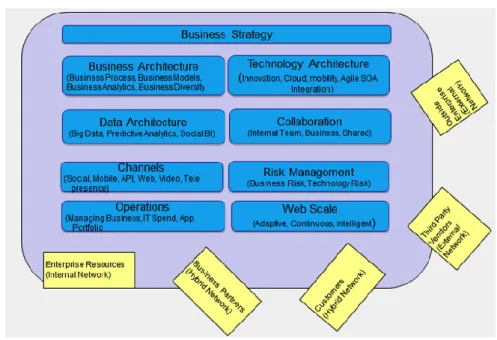
generation technologies; lack of integration and interoperability between applications; fragile and costly interfaces between incongruent applications. Traditional EA is more framework-centered and tool-driven. Most of its function is technology-centric and defined as a one-time initiative. Application building principles are business-constraint before they are completed. Next generation EA (NGEA) is business-centric, global, agile, continuous and social digital network. The organizations adopt latest digital capabilities like social web, service-oriented architecture (SOA), big-data analytics, cloud computing, virtualization, IoT, etc. These technologies can interrelate, either between them or across physical and virtual environments. So they fit together to define NGEA for an organization (Palli and Behara, 2014).
Business model is shifting from traditional EA to digital architecture which addresses networked community capabilities (interacting with users and other agents through social media), globalization (borderless enterprise), product/service innovation (open and virtual innovation), collaboration (employees in decision-making, mobile work), flexibility (to choose the technologies, infrastructure, applications) and context awareness – see figure 4.
Figure 4. Next generation EA model
Source: Palli and Behara (2014)
EA results should integrate with business planning and focus on business model architecture defining business outcome metrics. Also, EA program definition should
not span for years, it should deliver business value in months or weeks. For example, after having modeled and automated the required business processes, Bizagi1 helps to complete the BPM trajectory with its engine. It then executes those processes and distributes for desktops and mobile devices of all business users. With the right flexibility to fit business needs, this engine allows to start small, agile and tactical to further extend its BPM capabilities to departments, countries and time lags.
One of the main barriers that reduces flexibility and agility in IT/IS is related to inflexible or monolithic application silos, i.e., incompatible or non-integrated systems. Application silos limit IT/IS flexibility and agility which are essential to make quick and reliable business model changes (Adams, 2015). The adoption of a service-oriented architecture (SOA) using EA principles can improve IT/IS flexibility and agility. Transforming IT/IS from application silos to be service-oriented (or process-centered) enables business to adopt market opportunities quickly and reliably with minimum overheads. Well defined services are small, decoupled units of software that perform a specific process and can be reused by other applications. For example, when reusable services are developed for one project, the same services applied could be reused in other projects that require the same functionality. This service orientation increases flexibility and provide transparency across multiple applications and data sources (Hustad and Lange, 2014). Combining services to create business processes is a powerful technique to deploy new products that improve customer’s experience which will result in more revenue.
However, adopting SOA means a large transformation in the business culture which requires business cases that define a holistic view of business functions including the IT/IS architecture (Adams, 2015).
4.2.1 Some real cases
Here are two real cases/problems in companies whose best implemented solutions came from architectural thinking (or process thinking) rather than technological thinking.
Case 1:
X is a retail chain that sells cultural and electronic products. In the recent months, some problems have started due to difficulties some potential customers feel finding what they need in the company’s website. These include claims about the lack of a
virtual store which allows them to buy online. The head of sales department has been thinking about acquiring the services of a specialized company to solve these issues. And along with it installing a CRM (Customer Relationship Manager). However, the prices charged by this kind of companies have delayed this project. One day, a newbie from the sales department approached the director and offered to draw up a report with the solutions to the problems described. He presented a tool (SAAS – Software as a Service, a type of cloud computing) whose integration with the firm’s website and ERP (enterprise resource planning system) would increase its revenue and improve its relationship with customers. Resumming the case, the problems were:
- The firm’s website did not appear in the top spots of search engine results;
- Lack of an online store and client area did not provide the desired service or historical record of consumer.
The solutions were envisioned (by that newbie) through integration thinking which is related with an architectural (or process) approach adjusted to align emergent/new IT/IS with new business models/services. For example, to solve the problem related with the search engine results, attention must be paid to SEO (search engine optimization) and meta-tags associated with the firm’s activity and services/ products.
Regarding the online store, the system shall include the creation of a virtual basket with a checkout process (payment methods) so that the clients can pursue the order, pay and then obtain the product/service. Implementing the virtual basket opens the opportunity to get a CRM tool to register the sales history, understand buying patterns and, with these and other personal data, innovate and suggest products that meet real customer needs. This tool will also allow to reduce the costs of marketing campaigns as it performs public segmentation and targeting. As the acquisition of a CRM tool can become expensive, it is important to consider a SAAS solution. The choice of a Saas-CRM will allow purchases with the necessary assistance, properly adjusted to the company’s structure and customer needs. Also adjusted to possible future changes that might occur in the business model. Another advantage is that the payment for this cloud system can be monthly made and as long as the company needs it and the software fits its purpose.
Case 2:
Y is a management consulting firm for small and medium-sized enterprises, founded in 2001. In the last two years a considerable investment has been made in digital marketing (presence on social networks and website renewal). Despite this investment, the number of clients has not increased as expected. During the website
renewall, it was requested to include a chat tool so that the visitor could speak to an operator about any question, making the site more interactive. The operator had the task of turning online the tool dashboard, so that visitors received a message saying that an operator was available to clarify doubts. However, most days either by oblivion or work overload, the dashboard was not active. Resumming this case, the problems were:
-Low conversion of firm’s website;
-Chat availability dependent on just one person.
Associated with e-commerce, a conversion rate is an important metric for various digital marketing purposes such as completing a form, subscribing to a newsletter, or downloading an ebook. It is an indicator that will help to measure and optimize the results of a firm’s digital marketing investment, meaning to show if its investments in sponsored links, email marketing, social media or any other type of online advertising are producing results. The conversion rate of a website is the ratio between the number of visits to it and the number of actions taken, i.e., the actions performed by the visitor on the website. This means making the visitor perform a certain action on firm’s site that has value to its business (become a sales lead, get in touch, buy, among other).
In terms of key solutions, this company envisioned that its low site conversion may be linked to a lack of interaction with visiting customers. Having only a chat tool is not a guarantee that visitors will interact with the operator available. Currently, there are free chat tools that automate the process of interaction with customers (through triggers). The tool opens a dialog box after a while, or if the visitor opens a specific content, containing a message adapted to the context. If the visitor interacts with this dialog box, an operator goes into action through a notification. This tool does not need to be switched on by anyone as it is always online. Several employees from different departments in the firm can assume the operator roll and be called, depending on the answer required. Another advantage of this app is that it can be installed in a smartphone or tablet. And if this is connected to a CRM system, it can increase the likelihood to convert website visits in short to medium term, increasing firm’s turnover.
5. CONCLUSION AND FUTURE RESEARCH
The nature of business processes is changing, often due to the speed of emergence of information technologies. This brings many challenges to organizations, which join those that have not yet been fully resolved. Such events boil down to two main drivers of the present approach: there are so many systems and technologies that organizations are not coming to make the best of them; and people do not
continuously tune their visions and processes, at different levels of the organization, in order to obtain real-time relevant information. These two aspects lead to the necessity of a working model (architecture) to plan and facilitate the alignment throughout the entire organization, iteratively selecting critical business information on time.
An informational architecture of the company and its business, easy to understand and communicate, can help to identify the information, consistent with the company’s mission, objectives and critical success factors. It is mainly modeled with objects such as: processes (functional and cross-functional, internal and external); resources (functional and cross-functional, internal and external) and outputs (internal and external). This supports information systems’ portfolio management as it helps to identify the requirements for those systems in harmony with business perspectives.
However, given the heterogeneity of those objects and data characterizing them, one of the most pressing problems has been the conversion between structured and unstructured data. On this subject, the authors Carvalho and Ferreira (2001) carried out a survey for technological tools assessment, related with knowledge management and conversion between tacit and explicit knowledge, discussing their internalization or outsourcing. Some of these tools are: knowledge portals (corporate intranets and extranets); knowledge maps (lists of “who knows what”: skills/profiles); EDM (Electronic Document Management: cataloging, indexing, etc.); OLAP (Online Analytical Processes for data normalization); Data mining (advanced techniques to explore large amounts of data looking for consistent patterns); qualitative analysis tools; among others. This issue can be overcome by business intelligence systems and SOA, which support an intelligent gathering of data sources and an organizational structure by processes. This will allow a management focused on the delivery of products/services that are carried out through processes along the value chain. The purpose of a process-based framework is to evade a management based on separate and disconnected departments or hampered by the distance between hierarchical levels.
Acknowledgments:
This paper is financed by National Funds provided by FCT- Foundation for Science and Technology throught project UID/SOC/04020/2013.
References
Adams, H. (2015). Increase IT flexibility by adopting enterprise architecture and service oriented architecture. Acceded in 12th of January 2017, on the Web site of:
https://www.linkedin.com/pulse/increase-flexibility-adopting-enterprise-architecture-hayden-adams.
Amabile, T. (1998). How to kill creativity. Harvard Business Review. 76(5): 76-87. Ambler, S., Nalbone, J. and Vizdos, M. (2005). The enterprise unified process: Extending the rational unified process, Prentice Hall. New Jersey.
Borrero, J. and Caballero, E. (2013). Crawling big data in a new frontier for socioeconomic research: Testing with social tagging. Journal of Spatial and Organizational Dynamics. 1(1): 3-24.
BPMessentials (2015). Analyzing and optimizing a BPM process. Acceded in 14th of June 2016, on the Web site of: http://www.bpmessentials.com/analysis-and-redesign/.
Carvalho, R and Ferreira, M. (2001). Using information technology to support knowledge conversion processes. Information Research. 7(1): 1-24.
European Commission (2016). Smart regions conference. Acceded in 12th of
October 2016, on the Web site of:
http://ec.europa.eu/regional_policy/en/conferences/smart-regions/.
Fernandes, S. (2013). Aligning technology with business: A continuous effort. CIEO Spatial and Organizational Dynamics Discussion Papers. 12: 26-37.
Gudas, S. (2008). Enterprise knowledge management aspects and layers. Paper presented at the 12th World Multi-Conference on Systemics, Cybernetics and Informatics. Florida.
Hassanalieragh, M. et al. (2015). Health monitoring and management using internet-of-things (IoT) sensing with cloud-based processing: Opportunities and
challenges. Paper presented at the 12th IEEE International Conference on Services Computing, New York. USA.
Hustad, E. and Lange, C. (2014). Service-oriented architecture projects in practice: A study of a shared document service implementation. Procedia Technology. 16: 684-693. doi:10.1016/j.protcy.2014.10.017.
iGrafx (2016). Business process management. Acceded in 14th of June 2016, on the Web site of: http://www.igrafx.com/es/solutions/business-challenges/business-process-management.
Kaur, K. and Kaur, R. (2016). Internet of things to promote tourism: An insight into smart tourism. International Journal of Recent Trends in Engineering & Research. 2(4): 357-361.
Kraft (2002). Information systems portfolio management. Acceded in 16th of
February 2016, on the Web site of:
http://www.kraftfoodsgroup.com/home/index.aspx.
Laudon, C. and Laudon, J. (2004). Management information systems: Managing the digital firm, 9th edition, Prentice Hall. Boston.
Niewolny, D. (2013). How the internet of things is revolutionizing healthcare, Freescale. Acceded in 4th of November 2016, on the Web site of: https://cache.freescale.com/files/corporate/doc/white_paper/IOTREVHEALCARW P.pdf.
Nolle, T. (2016). Enterprise architecture model helps to maximize mobile empowerment. Acceded in 10th of October 2016, on the Web site of:
http://searchsoa.techtarget.com/tip/Enterprise-architecture-model-helps-to-
maximize-mobile-empowerment?utm_medium=EM&asrc=EM_NLN_65809390&utm_campaign=20 161007_Enterprise%20architecture%20holds%20the%20secret%20to%20mobile_f churchville&utm_source=NLN&track=NL-1806&ad=910397&src=910397. Nonaka, I. and Takeuchi, H. (1995). The knowledge-creating company, Oxford Press. New York.
Palli, P. and Behara, G. (2014). Enterprise architecture: A practitioner view. Acceded in 2nd of January 2017, on the Web site of: https://blog.opengroup.org/2014/09/17/enterprise-architecture-a-practitioner-view/.
RES (2013). 6 claves que debes conocer sobre internet de las cosas. Acceded in 2nd of February 2017, on the Web site of: http://www.ecointeligencia.com/2013/09/6-claves-internet-de-las-cosas-iot/.
Robbins, S. (2006). Organizational behavior. 10th Edition, Prentice Hall. Canada. Ross, J. (2013). Jeanne Ross of MIT CISR on enterprise architecture. Acceded in
17th of February 2016, on the Web site of:
http://www.youtube.com/watch?v=feI6_-v10Dk.
Ross, J., Beath, C. and Quaadgras, A. (2013). You may not need big data after all. Acceded in 17th of February 2016, on the Web site of: https://hbr.org/2013/12/you-may-not-need-big-data-after-all.
Sánchez-González, G. and Herrera, L. (2014). Effects of customer cooperation on knowledge generation activities and innovation results of firms. Business Research Quarterly. 17(4): 292-302.
Sarkar, S. (2014). Entrepreneurship and innovation, Escolar Editora. Portugal. Sousa, P., Caetano, A., Vasconcelos, A., Pereira, C. and Tribolet, J. (2006). Enterprise architecture modeling with the unified modeling language. In: P. Ritten (ed.), Enterprise modelling and computing with UML. IRM Press. Hershey.
Spewak, S. and Hill, S. (1992). Enterprise architecture planning: Developing a blueprint for data, applications and technology, John Wiley & Sons. New Jersey. Tyagi, S., Agarwal, A. and Maheshwari, P. (2016). A conceptual framework for IoT-based healthcare system using cloud computing. Paper presented at the 6th International Conference on Cloud System and Big Data Engineering, Noida. India.
Vasilev, J. and Georgiev, G. (2003). Tendencies in the development of ERP systems. Paper presented at the International Conference on Computer Systems and Technologies, Economical University of Varna. Bulgaria.