Afonso Sousa Guimarães de Castro
Advanced Paternal Age and risk for
Schizophrenia
Mestrado Integrado em Medicina Área: Psiquiatria
Trabalho efetuado sob a Orientação de: Mestre Celeste Silveira
Trabalho organizado de acordo com as normas da revista: International Journal of Clinical Neurosciences and Mental Health
Advanced Paternal Age and risk for
Schizophrenia
Aos meus pais, irmão e estimados amigos
Advanced Paternal Age and risk for
Schizophrenia
Sousa Castro, Afonso
1; Silveira, Celeste
21Faculty of Medicine, University of Porto, Porto, Portugal.
2 MSc, MD, Department Psychiatrics and Mental Health, Centro Hospitalar de São João, Porto and
Faculty of Medicine, University of Porto, Porto, Portugal.
Author Correspondence: Celeste Silveira, Psychiatric Department, Centro
Hospitalar São João, Porto; Alameda Professor Hernâni Monteiro, 4200-319 Porto, Portugal
Keywords: Schizophrenia; Paternal age; risk factor. Abstract word count: 248 words.
Body text word count: 3053 words. This study has 4 tables and 2 graphics.
Advanced Paternal Age and risk for Schizophrenia
Abstract
Background/Objective: Schizophrenia is one of the most disabling
psychiatric disorders. Its etiology is still poorly understood and one of the strongest theories for it is the Neurodevelopmental Hypothesis. As genetic and environmental factors affect the risk for Schizophrenia, one of the less studied is Advanced Paternal Age. Described in earlier studies as a risk factor for Schizophrenia, we decided to describe the paternal age in a group of Portuguese patients.
Material and Methods: We included the patients admitted between 2009 and 2013 with the diagnosis of Schizophrenia/Schizoaffective Disorder (ICD-10,WHO, 1992). Age, sex, diagnosis, Paternal Age at Birth, Maternal Age at Birth and Birth Rank were collected from the admission registries.
Results: 241 patients were enrolled in this study, from which 85 had the data of the Paternal Age at Birth. The mean Paternal Age at Birth was 30.06 ± 6.79 years with a range of 15-52years, a median of 30.00 and a mood of 28. After categorizing the Paternal Age at Birth in 5 groups, the 25-29 years was dominant with 28 (32.9%) patients, followed by the 30-34 and 35-39 groups. In the Birth Rank, 126 patients had data; the mean was 2.18 ± 1.53. After categorizing, 1st was the leading group (56 cases (44.4%)), followed by the ≥3rd group.
Discussion/Conclusions: The results achieved were comparable and similar to earlier studies, with a tendency for Advancing Paternal Age. Although limited by the missing data and the lack of comparison group, this study opens perspectives for further increasing and search for more consistent results.
Introduction
Schizophrenia is one of the most severe and devastating psychiatric disorders that are known, since it affects the essence of the person’s identity – the most complex functions that the brain mediates. It is also a challenging pathology, since its manifestations are so diverse, as to include positive, negative, cognitive, affective and motor symptoms. Also, these clinical manifestations can be very variable, not following a pattern or a linear evolution.
Positive symptoms are the one’s that make the patient loose contact with the reality, and they include hallucinations, delusions and thought disorders.
Hallucinations can be visual, auditory (the most common type), olfactory, tactile, gustatory or even multisensory, and they can be playing many roles, most frequently hearing two people stating comments about the patient or a voice giving orders. In addition, they can be continuous or come and go, severe or mild. Delusions can be defined as false beliefs that are not part of the person’s culture and are
unquestionable for the patient. It’s content can be widely miscellaneous, from believing that neighbors are controlling him with the use of magnetic waves, to thinking that they are someone else like an historical personality, among many others. Thought disorders are disabled ways of grouping the ideas. Schizophrenia patients can have difficulty on creating a logical organization with the thoughts, can have pauses when speaking because of blocking of thoughts, or can create new words.
Negative symptoms are more related to disturbances in the emotions and behaviors, and can be misdiagnosed as depression or other conditions. They can disrupt the patient’s affection, pleasure, interaction and ability to plan activities. The capacity for doing the everyday tasks is lost, like the hygiene tasks.
Cognitive symptoms can be delicate and, like the negative symptoms, can be hardly detectable. They can affect patient’s attention, memory or even the executive functioning, leading to great emotional stress and inability to have a normal life.
Motor symptoms can be described as strange body movements that can be wide-ranging, from catatonia, repetition of certain movements for undefined periods of time to dyskinesia and parkinsonism(1).
Epidemiological studies indicate that almost 1% of the population is affected by this condition during his life(2), with an estimated lifetime prevalence for
Schizophrenia of 0.87% and for Schizoaffective Disorder of 0.32%(3). The incidence of this pathology is around 0.20/1000 per year, with a peak in de 15-24 years in both females and males, having the women another peak around the 55-64 years and the men a higher lifetime risk(4).
Schizophrenia can be defined as a heterogeneous disease and the etiology is still little understood. There are lots of theories trying to link the genetic and
environmental factors and explain the etiology of this disease(5).
One of the strongest theories proposed to explain this doubts is the Neurodevelopmental Hypothesis, supported by epidemiological, genetic and neuropathological features that suggest its importance for the development of this disorder. It has been a long time since the first studies started describing
Schizophrenia as one of the neurodevelopmental disorders(6). Even Kraepelin in 1887 and Bleuler in 1911 noted abnormal neurological and behavioral signs in childhood histories of adults suffering from Schizophrenia. Early studies described Neurodevelopmental Hypothesis as a brain defect in the early development that predisposes to a specific arrangement of brain malfunction in the adult life, regarding the neuron migration and synapsis, from where Schizophrenia develops. So, authors expected that the abnormalities were silenced during the early childhood and during this latency period the cerebral function showed itself normal or near normal. At the disease onset the brain function would then express several malfunction(7). Recent studies added that the brain development progresses throughout the life, as it
includes the neuronal and synaptic formation and migration, but also myelination, neuronal pruning and also neuronal plasticity(8). So doubts appeared from how could the cerebral damage be disguised until the age of onset of Schizophrenia? Neurodevelopment can explain this, showing that the brain damage can occur not only in the early stages of life, but can be seen as a continuous line that can occur during all life, before and after the onset of the disorder. (8)
Genetic studies showed Schizophrenia’s heritability could go up to 80%(9). Moreover, anatomical and imaging studies showed minor physical anomalies, like the increase of the cerebrospinal liquid, reduction of the lobe and gray matter volumes in certain areas of the brain and also an increase in the ventricles(10). Investigators have been increasingly demonstrating that the integrity of the synaptic system, the transduction pathways and the glumate-related receptors has a pivotal role in the brain development, synapsis formation and plasticity. Besides that, genes like schizophrenia-1, neuroregulin-1, dysbindin-1 and AKT-1, that represent most of the genes associated with Schizophrenia, have also a function on the
neurodevelopment, neurotransmission and neuroplasticity(11).
So, some of the above-mentioned features denoted in Schizophrenia can be assigned to abnormal expression of these genes associated with neurodevelopment. Also, The interaction of genetic-environmental factors has been exhibited in
Schizophrenia(12). It is known that cannabis abuse, stress periods during
neurodevelopment, infections and obstetric complications (during pregnancy and at birth) can act as environmental factors increasing the risk for development of Schizophrenia(13). So, the genes involved can be influenced or triggered by the environmental factors to enhance the risk for Schizophrenia.
Several have been the stated risk factors for Schizophrenia, and one of the least studied is the Paternal Age. Advanced paternal age has been linked to Schizophrenia and confirmed as a risk factor in several studies (14-20), as first reports date since in the 1950s and 1960s. Malaspina et al, in 2001, investigated this effect in a population-based cohort in Jerusalem. Their results displayed a more than 4-fold difference in the risk for Schizophrenia between the oldest Paternal Age categories and the youngest ones. More than a quarter of the Schizophrenia cases were attributable to Paternal Age effect(14). In 2002, Brown and co-workers used the same cohort study configuration in the USA, showing similar results and adding that the risk unfolded by the Advanced Paternal Age was different and higher in
Schizophrenia when compared to other psychoses(15). A case-control study in Iran, repeated the positive relationship between Paternal Age and risk for Schizophrenia, but added the effect of the Birth Rank, stating that Birth Rank equal or higher than 3, along with the Advanced Paternal Age, were linked to the risk for Schizophrenia(18). Some studies also contradicted this linkage(21).
Other investigators studied the relationship of the Paternal Age with Sporadic Schizophrenia vs. Familiar Schizophrenia, showing significantly older fathers in the Sporadic cases in comparison with the Familiar ones. This can accomplish that the Advanced Paternal Age is not a consequence of delayed childbearing from fathers who carry a genetic risk for Schizophrenia and supports the hypothesis of de novo mutations, likely in the paternal germ lines, contribute to the risk for Sporadic Schizophrenia. The results showed differences around 4.7 years between the sporadic and the familial ones and linking approximately 27% of the sporadic cases to Paternal Age(22).
Considering the results from the studies displayed above, Rosenfield et al set the hypothesis that may exist a Paternal-Age Related Schizophrenia (PARS),
involving a different etiopathology and specific characteristics from the other
Schizophrenia cases. This group was defined as Sporadic cases with Paternal Age ≥35 years. PARS cases revealed more pronounced symptoms in the medication-free periods and better response to antipsychotic medication(23). Later, in 2011, Lee et al
continued to study this hypothesis, with results enhancing this evidence and suggesting discrepancies in the verbal performance and age of onset(24).
Some studies also tried to remove confounding factors like Maternal Age and family history to seek this relationship (15, 20), as Maternal Age has been associated with an increased risk in some of the primordial studies(15).
So, we are facing a great challenge, is Paternal Age a risk factor or part of a source of a different etiopathology for Schizophrenia?
Early research acknowledged that the major source of new mutations in humans is from Advanced Paternal Age (25), due to an increased rate of mitotic cell division in sperm cells comparing to the oocytes, and an higher risk of genetic errors(26). A linkage between Advanced Paternal Age and chromosomal
abnormalities, aneuploidies and other damage on the DNA in both human and mice sperm has been descripted(27). It is important to mention that the Paternal Age at Birth is increasing nowadays in the Western Civilizations along with the Maternal Age, probably due to economic, education and marriage changing patterns(28). With these evidences, we could be looking to a good source of diseases like the so called “paternal age” diseases(29). Can we insert Schizophrenia in this group of diseases?
The objective of this study is to describe the Age of Parents at Birth and the birth rank of a sample of patients suffering from Schizophrenia/Schizoaffective Disorder in Portuguese Population, a typically Western Europe country where there is still no registry of having a study of this topic. So this is a pioneer study, in which we question, if Advanced Paternal Age is a stated risk factor for Schizophrenia, whether we could reach results that would describe an effect of Advanced Paternal Age and higher Birth Rank on the risk for Schizophrenia.
Methods
This study was made from the registries of admissions on the Psychiatrics and Mental Health Department of Centro Hospitalar São João, Oporto, Portugal. This department contains the registries on these admissions since 1978. We used the registries dated from 1 of January of 2009 until 31 of December of 2013 and screened those that had the admission diagnosis of Schizophrenia and
Schizoaffective Disorder. All the other diagnosis were excluded. The classification used in the clinical records is the International Classification of Disease (ICD), 10th version, by World Health Organization, since 1992(30).
A total of 241 patients were initially included by their diagnosis and we had access to all of their admission registries. The data collected was age at that time of admission and birthdate, diagnosis credited by the psychiatrist, data of the
registration, age of mother, Age of father and Birth Rank. Using the mother/father age and the age of the patient at the registry we calculated the Age of Mother/Father at the Birth of the patient, having relied on the registries of the admissions made by the responsible psychiatrics. For the statistic data of the age at birth we excluded those who had no data of age of mother and/or father. So, there were a total of 132 (54,8%) of patients that were excluded from statistics regarding data of Age of Mother at Birth and 156 (64.7%) excluded from the statistics staring the Age of Father at Birth. So, there were 109 (45.2%) and 85 (35.3%), respectively, included in this data statistics.
Gender, diagnosis were defined as categorical variables, with age at the admission, Mother Age at Birth, Father Age at Birth, Birth Rank defined as
continuous and ordinal variables. All variables were characterized with descriptive statistics by calculating mean, standard deviation, range, median and mood.
Paternal Age at Birth and Birth Rank were then categorized, respectively into 5 (<25, 25-29, 30-34, 35-39 and ≥40 years) and 3 groups (1st child, 2nd child and ≥3rd child). The same descriptive statistics was applied to these categorical variables. Tables and graphics were created with the data from the statistic analysis.
The statistic analysis was performed with the use of IBM® SPSS® Statistics 21.
The Ethics Committee of Centro Hospitalar São João approved the execution of this study.
Results
In this study 241 patients were admitted. The majority of them were male (68.5%) and the mean age in the admission was 41.91±12.51 years with a range of 60, from a minimum of 19 years to a maximum of 81 years old for all patients. The mean age in female patients was 44.51±14.13 years, higher then in male patients, where it was 40.71±14.13 years. Considering the diagnosis, 46 (19.1%) had
Schizoaffective Disorder and 195 (80.9%) had Schizophrenia diagnosis. Considering the subtype of Schizophrenia, 156 (80.0%) had Paranoid subtype, 13 (6.7%) had Hebephrenic subtype, 17 (8.7%) had Residual subtype, 1 (0.5%) had Simple subtype and 8 (4.1%) were diagnosed with Schizophreniform psychosis. This data is
summarized in Table 1.
Concerning the Parents Age at Birth, we started by considering both Paternal and Maternal Age at Birth as continuous variables. Overall, there were 117 cases with the data from the Paternal Age at Birth plus Maternal Age at Birth missing. Furthermore, in the Maternal Age at Birth there were 132 cases of missing records (54.8%) and in the Paternal Age at Birth 156 cases (64.7%) (Table 2). The mean Maternal Age at Birth was 28.01 ± 7.28 years, extending from 14 to 54, with a mood of 24 and a median of 27.00, while the mean Paternal Age at Birth of the patients was 30.06 ± 6.79 with a minimum of 15 and a maximum of 52, a median of 30.00 and a mood of 28 (Table 3). So we could conclude that Father’s Age at Birth was, on average, higher.
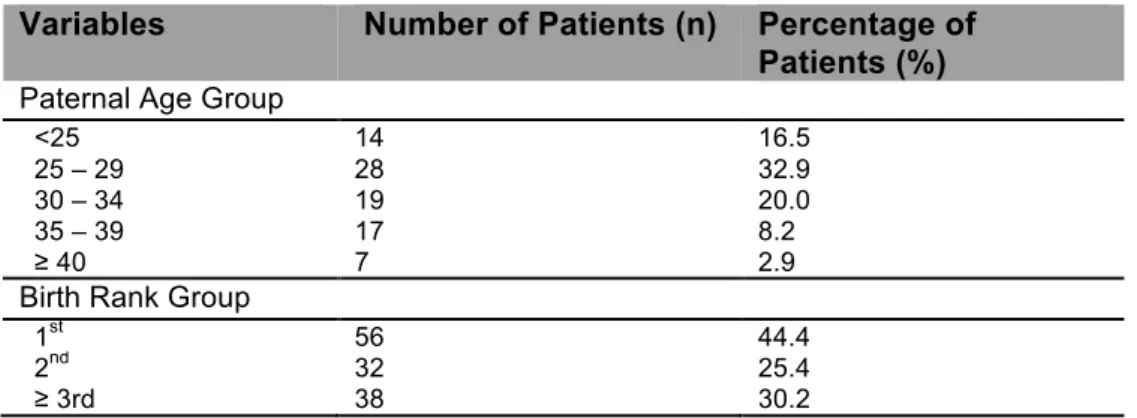
The Paternal Age at Birth of the patient was then categorized into 5 age groups: <25, 25-29, 30-34, 35-39 and ≥40 years. Focusing on this, from a total of 85 patients with data available, the group that had the highest number of patients was the 25-29 age group with 28 patients (32.9%) followed by the 30-34 and 35-39 with, respectively, 19 (22.4%) and 17 (20.0%) patients. The group with the lowest patients was the ≥40 age group (Table 4). Figure 1 summarizes this data.
Considering the Birth Rank, there were 115 (47.7%) cases missing the data from the order of their birth (Table 2). The mean rank was 2.18 ± 1.53 with the range from 1 to 10, median of 2.00 and mood of 1 (Table 3). After categorizing this variable into 3 groups as 1st child, 2nd child and ≥3rd child, the results were, correspondingly, 56 (44.4%) 32 (25.4%) and 38 (30.2%) patients, not showing a big difference between the 3 groups (Table 4 and Figure 2).
Discussion
The main goal for this study was to describe the Paternal Age at Birth of patients admitted with the diagnosis of Schizophrenia between 2009 and 2013 in the Psychiatric Department of Centro Hospitalar São João. We aimed to evaluate the possibility of the Advanced Paternal Age, a major source of de novo mutations(25), in accordance with the Neurodevelopmental Hypothesis, could suggest an effect of Paternal Age at Birth in the risk for Schizophrenia in the offspring.
The results achieved show us, first of all, higher number of male patients and a dominant diagnosis of Paranoid Schizophrenia, in similarity with the worldwide known facts from Schizophrenia(31).
As far as Paternal Age is concerned, our study, as descriptive, can only have its results compared to the cases groups from other studies.
Comparing the results achieved with other studies, our mean Age of Father at Birth was very similar to the one described by Naserbakth et al, in the case-control study in Iranian population, which also added that there was a growing risk with the increasing of Paternal Age at Birth(18). It can be concluded that this study had a higher number of cases in the groups above the reference age group. Our study shows a similar distribution of the cases by the analysis of Figure 1, in agreement with the previous cited study. Several other studies also confirmed this risk increase, by having higher number of cases in the older groups and emphasizing the effect of Paternal Age at Birth in this disease(16, 19).
Considering the Birth Rank, higher Birth Rank is likely to determine older father in comparison with first-born children. The Iranian population-based study sustained an increased risk with the higher Birth Rank(18). Our result showed a predominance of first-born children but the third or above born child category was the second with most cases, showing some tendency for higher Birth Rank (Figure 2), although this factor needed more cases to be viable in the conclusions advanced from it.
Advanced Paternal Age, not only is a major source of de novo mutations(25), as cited before in this study, but also is associated with elevated incidence of
environmental exposures that may disturb the spermatozoid development. The new developments in the Neurodevelopmental Hypothesis suggest there has to be not only genetic predisposition and damage but also environmental-induced changes to DNA that can affect the brain development. (8, 12, 13, 25) Advanced Paternal Age was identified as the major source of de novo mutations and its accumulation would occur in an exponential way, rather than a linear one(25). As Malaspina et al
proposed, the de novo mutations coming from the paternal germ cells could be a source of risk for Schizophrenia(22). These de novo mutations has been linked to several other diseases, like prostate cancer, Apert syndrome and
craniosynostosis(32-34).
Furthermore, Zammit et al showed that the Paternal Age effect for Schizophrenia was greater comparing to other psychosis, strengthening the hypothesis that Advanced Paternal Age is a risk factor for Schizophrenia(35).
This study was harshly limited by the missing data and the lack of a control-comparing group, as the National Institute of Statistics doesn’t gather data from Age of Fathers at the Birth. This has restricted the results, the statistic analysis but also doesn’t allow us to conclude that the results achieved represent a subgroup of ill people or just represent the distribution of the national population. Anyway, the objective of the study was achieved, as the results described can be linked to the results from the cases of the earlier studies and there was a similarity between them and the corresponding cases in the other studies. This study can be further extended in the number of cases that can be amplified by increasing the year range. With this we can give more viable results and boost the relation between Paternal Age and the risk for Schizophrenia.
Conclusion
In this study we could corroborate and replicate the results from the previous studies that searched the effect of Advanced Paternal Age in the risk for
Schizophrenia. Although clearly limited by the high number of missing cases and the lack of a comparison group, this study is likely to be increased in order to achieve more consistent results and have a better overview of the effect of Advanced Paternal Age in the risk for Schizophrenia.
References
1. Health NIoM. Schizophrenia 2009. Available from:
http://www.nimh.nih.gov/health/publications/schizophrenia/schizophrenia-‐
booket-‐2009.pdf
.2. Simona A. Stilo MRMM, DsC, FRS. The epidemiology of Schizophrenia: replacing dogma with knowledge. Dialogues in Clinical Neuroscience. 2010;12(3):11.
3. Perala J, Suvisaari J, Saarni SI, Kuoppasalmi K, Isometsa E, Pirkola S, et al. Lifetime prevalence of psychotic and bipolar I disorders in a general population. Archives of general psychiatry. 2007;64(1):19-28.
4. Messias EL, Chen CY, Eaton WW. Epidemiology of schizophrenia: review of findings and myths. The Psychiatric clinics of North America. 2007;30(3):323-38.
5. Rubesa G, Gudelj L, Kubinska N. Etiology of schizophrenia and therapeutic options. Psychiatria Danubina. 2011;23(3):308-15.
6. Murray RM, Lewis SW. Is schizophrenia a neurodevelopmental disorder? British medical journal. 1987;295(6600):681-2.
7. Weinberger DR. On the plausibility of "the neurodevelopmental hypothesis" of schizophrenia. Neuropsychopharmacology : official publication of the American College of Neuropsychopharmacology. 1996;14(3 Suppl):1S-11S.
8. Andreasen NC. The lifetime trajectory of schizophrenia and the concept of neurodevelopment. Dialogues Clin Neurosci. 2010;12(3):409-15.
9. Sullivan PF, Kendler KS, Neale MC. Schizophrenia as a complex trait: evidence from a meta-analysis of twin studies. Archives of general psychiatry. 2003;60(12):1187-92.
10. Tenyi T. Neurodevelopment and schizophrenia: data on minor physical anomalies and structural brain imaging. Neuropsychopharmacologia Hungarica : a Magyar Pszichofarmakologiai Egyesulet lapja = official journal of the Hungarian Association of Psychopharmacology. 2011;13(4):229-32.
11. Lu L, Mamiya T, Koseki T, Mouri A, Nabeshima T. Genetic animal models of schizophrenia related with the hypothesis of abnormal neurodevelopment. Biological & pharmaceutical bulletin. 2011;34(9):1358-63.
12. Tienari P, Wynne LC, Sorri A, Lahti I, Laksy K, Moring J, et al. Genotype-environment interaction in schizophrenia-spectrum disorder. Long-term follow-up study of Finnish adoptees. The British journal of psychiatry : the journal of mental science. 2004;184:216-22. 13. Schmitt A, Malchow B, Hasan A, Falkai P. The impact of environmental factors in severe psychiatric disorders. Frontiers in neuroscience. 2014;8:19.
14. Malaspina D, Harlap S, Fennig S, Heiman D, Nahon D, Feldman D, et al. Advancing paternal age and the risk of schizophrenia. Archives of general psychiatry. 2001;58(4):361-7. 15. Brown AS, Schaefer CA, Wyatt RJ, Begg MD, Goetz R, Bresnahan MA, et al. Paternal age and risk of schizophrenia in adult offspring. The American journal of psychiatry. 2002;159(9):1528-33.
16. Tsuchiya KJ, Takagai S, Kawai M, Matsumoto H, Nakamura K, Minabe Y, et al. Advanced paternal age associated with an elevated risk for schizophrenia in offspring in a Japanese population. Schizophrenia research. 2005;76(2-3):337-42.
17. Miller B, Messias E, Miettunen J, Alaraisanen A, Jarvelin MR, Koponen H, et al. Meta-analysis of paternal age and schizophrenia risk in male versus female offspring. Schizophrenia bulletin. 2011;37(5):1039-47.
18. Naserbakht M, Ahmadkhaniha HR, Mokri B, Smith CL. Advanced paternal age is a risk factor for schizophrenia in Iranians. Annals of general psychiatry. 2011;10:15.
19. Wu Y, Liu X, Luo H, Deng W, Zhao G, Wang Q, et al. Advanced paternal age increases the risk of schizophrenia and obsessive-compulsive disorder in a Chinese Han population. Psychiatry research. 2012;198(3):353-9.
20. Sipos A, Rasmussen F, Harrison G, Tynelius P, Lewis G, Leon DA, et al. Paternal age and schizophrenia: a population based cohort study. Bmj. 2004;329(7474):1070.
21. Pulver AE, McGrath JA, Liang KY, Lasseter VK, Nestadt G, Wolyniec PS. An indirect test of the new mutation hypothesis associating advanced paternal age with the etiology of schizophrenia. American journal of medical genetics Part B, Neuropsychiatric genetics : the official publication of the International Society of Psychiatric Genetics. 2004;124B(1):6-9.
22. Malaspina D, Corcoran C, Fahim C, Berman A, Harkavy-Friedman J, Yale S, et al. Paternal age and sporadic schizophrenia: evidence for de novo mutations. American journal of medical genetics. 2002;114(3):299-303.
23. Rosenfield PJ, Kleinhaus K, Opler M, Perrin M, Learned N, Goetz R, et al. Later paternal age and sex differences in schizophrenia symptoms. Schizophrenia research. 2010;116(2-3):191-5.
24. Lee H, Malaspina D, Ahn H, Perrin M, Opler MG, Kleinhaus K, et al. Paternal age related schizophrenia (PARS): Latent subgroups detected by k-means clustering analysis. Schizophrenia research. 2011;128(1-3):143-9.
25. Crow JF. Spontaneous mutation in man. Mutation research. 1999;437(1):5-9.
26. Tsuang D, Esterberg M, Braff D, Calkins M, Cadenhead K, Dobie D, et al. Is There an Association between Advanced Paternal Age and Endophenotype Deficit Levels in Schizophrenia? PloS one. 2014;9(2):e88379.
27. Sloter E, Nath J, Eskenazi B, Wyrobek AJ. Effects of male age on the frequencies of germinal and heritable chromosomal abnormalities in humans and rodents. Fertility and sterility. 2004;81(4):925-43.
28. Bray I, Gunnell D, Davey Smith G. Advanced paternal age: how old is too old? Journal of epidemiology and community health. 2006;60(10):851-3.
29. Goriely A, Wilkie AO. Paternal age effect mutations and selfish spermatogonial selection: causes and consequences for human disease. American journal of human genetics. 2012;90(2):175-200.
30. Organisation WH. ICD-10 Classifications of Mental and Behavioural Disorder: Clinical Descriptions and Diagnostic Guidelines. 1992.
31. Lake CR. Hypothesis: grandiosity and guilt cause paranoia; paranoid schizophrenia is a psychotic mood disorder; a review. Schizophrenia bulletin. 2008;34(6):1151-62.
32. Zhang Y, Kreger BE, Dorgan JF, Cupples LA, Myers RH, Splansky GL, et al. Parental age at child's birth and son's risk of prostate cancer. The Framingham Study. American journal of epidemiology. 1999;150(11):1208-12.
33. Tolarova MM, Harris JA, Ordway DE, Vargervik K. Birth prevalence, mutation rate, sex ratio, parents' age, and ethnicity in Apert syndrome. American journal of medical genetics. 1997;72(4):394-8.
34. Singer S, Bower C, Southall P, Goldblatt J. Craniosynostosis in Western Australia, 1980-1994: a population-based study. American journal of medical genetics. 1999;83(5):382-7.
35. Zammit S. Paternal age and risk for schizophrenia. The British Journal of Psychiatry. 2003;183(5):405-8.
Tables and Figures
Table 1 Patients overall characteristics
Variables n = 241
Age (years) – mean ± SD 41.91 ± 12.51
Male 40.71 ± 11.44 Female 44.51 ± 13.31 Gender – n (%) Male 165 (68.5%) Female 76 (31.5%) Diagnosis – n (%) Schizoaffective Disorder 46 (19.1%) Schizophrenia 195 (80.9%) Paranoid Subtype 156 (80.0%) Hebephrenic subtype 13 (6.7%) Residual subtype 17 (8.7%) Simple subtype 1 (0.5%) Schizophreniform psychosis 8 (4.1%) SD – Standard Deviation
Table 2 – Missing data in Paternal Age at Birth, Maternal Age at Birth and Birth Rank Variables n admitted for statistics Missing data – n (%)
Paternal Age at Birth 85 156 (64.7%)
Maternal Age at Birth 109 132 (54.8%)
Birth Rank 126 115 (47.7%)
Table 3 – Frequency Statistics on Paternal Age at Birth, Maternal Age at Birth and Birth Rank
Variables (n) Mean ± SD Range (min – max) Median Mood Paternal Age at Birth (85) - years 30.06 ± 6.79 15 – 42 30.00 28 Maternal Age at Birth (109) – years 28.01 ± 7.28 14 – 54 27.00 24 Birth Rank (123) 2.18 ± 1.53 1 - 10 2.00 1 SD – Standard Deviation; min – minimum value; max – maximum value
Table 4 – Statistic Frequencies of Paternal Age Groups and Birth Rank Groups
Variables Number of Patients (n) Percentage of
Patients (%) Paternal Age Group
<25 14 16.5
25 – 29 28 32.9
30 – 34 19 20.0
35 – 39 17 8.2
≥ 40 7 2.9
Birth Rank Group
1st 56 44.4
2nd 32 25.4
Agradeço à minha Orientadora Celeste Silveira, por todo o tempo despendido no supervisionamento e realização deste trabalho. Aos meus queridos pais, irmão e amigos por todo o apoio durante todo o curso.
Anexos
1
INSTRUCTIONS FOR AUTHORS
1. Aims and Scope
The International Journal of Clinical Neurosciences and Mental Health is an open-access peer-reviewed journal published trimonthly by ARC Publishing.
Our goal is to provide high-quality publications in the areas of Psychiatry and Mental Health, Neurology, Neurosurgery and Medical Psychology. Expert leaders in these medical areas constitute the international editorial board.
The journal publishes original research articles, review articles, drug reviews, case reports, case snippets, viewpoints, letters to the editor, editorials and guest editorials.
The International Journal of Clinical Neurosciences and Mental Health follows the highest scientific standards, such as the CONSORT / STROBE guidelines and the Uniform Requirements for Manuscripts Submitted to Biomedical Journals (ICJME).
The journal offers:
• Trusted peer review process
• Fast submission-to-publication time
• Open-access publication without author fees • Multidisciplinary audience and global exposure
Contents
1. AIMS AND SCOPE 1
2. TYPES OF PAPERS 2
2.1. Originalresearcharticles 2
2.2. reviewarticlesand drug reviews 2
2.3. caserepOrtsandcasesnippets 2
2.4. viewpOints 3
2.5. letterstOthe editOr 3
2.6. editOrialsand guest editOrials 3
3. MANUSCRIPT SUBMISSION 3
3.1. cOver letter 3
3.2. Manuscript preparatiOn 3
3.3. suppOrting infOrMatiOn 5
3.4. subMissiOn checklist 6
4. OVERVIEW OF THE EDITORIAL PROCESS 6
2
2. Types of papers
The International Journal of Clinical Neuroscience and Mental Health publishes scientific articles in the following categories:
• Original research articles. • Reviews.
• Drug reviews. • Case reports. • Case snippets. • Viewpoints.
• Letters to the editor.
• Editorials and guest editorials.
2.1. Original research articles
The International Journal of Clinical Neurosciences and Mental Health welcomes original clinical research related with psychiatry, mental health, medical psychology, neurosurgery and neurology.
Reports of randomized clinical trials should follow the CONSORT Guidelines and reports of observational studies should comply with STROBE Guidelines.
Body text of an Original Research Article should have no more than 4000 words (word count excludes title page, abstract, acknowledgments, references and tables). A maximum of 6 illustrations (figures or tables) are allowed. Supplementary online material may be submitted at the editor discretion.
2.2. Review articles and Drug Reviews
Review articles on CNS-related drugs, psychiatry, mental health, medical psychology, neurosurgery and neurology topics are welcome. Both invited and unsolicited submissions are accepted.
Manuscripts should be limited to a maximum of 4,500 words, excluding title page, abstract, acknowledgments, references and tables.
2.3. Case reports and case snippets
Case Reports and Case Snippets should have no more than 750 and 500 words, respectively (word count excludes references); one figure or table can be included.
Only highly meaningful Case Reports are accepted, including major educational content or major clinical findings. Case Snippets should describe a diagnosis or therapeutic challenge.
2.4. Viewpoints
Viewpoints should provide an expert opinion on important topics for medical research or practice, with possibility for covering social and policy aspects. This section encourages dialogue and debate on relevant issues with expert views based on evidence.
Viewpoints are limited to 1500 words (word count excludes references) and can include one figure or table.
3
2.5. Letters to the Editor
Letters to the Editor should share views on published articles, any findings insufficient for a research article or present ideas of any subject in the scope of the journal.
Letters to the Editor have a maximum of 600 words (including references) and can include one figure or table.
2.6. Editorials and Guest Editorials
Authors are invited by the Editor-in-Chief to comment on specific topics and express their opinions. Editorials and Guest Editorials have a maximum of 1,000 words and can include one figure or table.
3. Manuscript Submission
These instructions advise on how the manuscript should be prepared and submitted. Manuscripts that do not comply with the guidelines will not be considered for review.
All manuscripts should be prepared in A4-size or US-letter size, in UK or US English. Manuscripts should be submitted in *.doc and *.pdf formats, in the appropriate section of the journal website: IJCNMH online submission.
3.1. Cover Letter
A cover letter should be submitted together with the manuscript, in *.doc or *.pdf format, addressed to the Editor-in-Chief.
A template for the cover letter is available for download.
The cover letter should contain statements about originality of your publication, Ethics Committee approval and informed consent (if applicable), conflicts of interest and why in your opinion your manuscript should be published.
3.2. Manuscript Preparation
The manuscript must be divided in 2 files: the Title page (submitted in *.doc format and *.pdf formats) and the Manuscript body (submitted in *.doc and *.pdf formats).
Title page
This should be submitted as a separate file from your manuscript (to assure anonymity in the peer review process) and should include:
• Article title.
• Authors’ names, titles (e.g. MD, PhD, MSc, etc.) and institutional affiliations. • Corresponding author: name, mailing address, telephone and fax numbers. • Keywords (maximum of 10).
• A running head (up to 50 characters). • Abstract word count (up to 250 words). • Body text word count.
4
Manuscript body:
The Manuscript body must be anonymous, not containing the names or affiliations of the authors. Manuscript body must be structured in the following order: title, abstract, body text, acknowledgements, references, tables, and figures captions/legends.
• The text must be formatted as follow: • Arial fonts, size: 11 points.
• Single line spacing (see paragraph menu). • Aligned to the left (not justified).
Showing continuous line numbers on the left border of the page. For MS Word you can add line numbers by going to: Page Layout -> Line Numbers -> select “Continuous”; for OpenOffice: Tools -> Line Numbering -> tick “Show numbering”.
Title
A descriptive and scientifically accurate article title should be provided.
Abstract (250 words maximum)
An abstract should be prepared for Original Research Articles, Review Articles and Drug Reviews.
Should be structured and include: background/objective, material and methods, results, and conclusions. These sections should be separated by the respective headings.
If the publication is associated with a registered clinical trial, the trial registration number should be referred at the end of the abstract.
Body text
Original research articles
Original research articles should be structured as follows:
Introduction: Should present the background for the investigation and justify its relevancy. Claims should be supported by appropriate references. Introduction should end by stating the objectives of the study.
Methods: Should allow the reproduction of results and therefore must provide enough detail. Appropriate subheadings can be included, if needed.
Results: Should include detailed descriptions of generated data. This section can be separated into subsections with concise self-explanatory subheadings.
Discussion and Conclusions: Should be brief but comprehensive and well argued, summarise and discuss the main findings, their clinical relevance, the strengths and limitations of the study, future perspectives with suggestion of experiments to be addressed in the future.
Review articles and Drug Reviews
These types of articles should be organized in sections and subsections.
Acknowledgements
This section should name everyone who has contributed to the work but does not qualify as an author. People mentioned in this section must be informed and only upon consent should their names be included along with their contributions. Financial support (with grant number, if applicable) should also be stated here.
Any conflict of interests should be declared. If authors have no declaration it should be written: “The authors declare no conflict of interests”.
References
References citation in the text should be numbered sequentially along the text, within brackets.
5 The use of a reference management tool (such as Endnote or Reference Manager) is
recommended. References must be formatted in Vancouver style.
Only published or accepted for publication material can be referenced. Personal communications can be included in the text but not in the references list.
Tables
Tables should be smaller than a page, without picture elements or text boxes. Tables should have a concise but descriptive title and should be numbered in Arabic numerals. Table footnotes should explain any abbreviations or symbols that should be indicated by superscript lower-case letters on the body table.
Figures
Figures should have a concise but descriptive title and should be numbered in Arabic numerals. If the article is accepted for publication, the authors may be asked to submit higher resolution figures. Copyright pictures shall not be published unless you submit a written consent from the copyright holder to allow publishing.
Each figure file shall not be larger than 30MB.
Figures should be tested and printed on a personal printer prior submission. The printed image, resized to the intended dimensions, is almost a replication of how the picture will look online. It shall be clearly perceived, non-pixelated nor grainy. Only flattened versions of layered images are allowed. Each figure can only have a 2-point white space border, thus cropping is strongly advised. For text within figures, Arial fonts between 8 to 11 points should be used and must be readable. When symbols are used, the font information should be embedded.
Photographs should be submitted as *.tif or *.eps at high-resolution (300 dpi or more). Graphics should be submitted in *.eps format. MS Office graphics are also acceptable.
All figures, tables and graphics should have white background and not transparent. Lines, rules and strokes should be between 0.5-1.5 points for reproducibility purposes.
3.3. Supporting Information
Code of Experimental Practice and Ethics
The minimal ethics requirements are those recommended by the Code of Ethics of the World Medical Association (Declaration of Helsinki). Authors should provide information regarding ethics on research participants, patient informed consent, data privacy as well as competing interests. If the authors have submitted a related manuscript elsewhere should disclose this information prior submission.
Nomenclature
All units should be in International System (SI). Drugs should be designated by their International Non-Proprietary Name (INN).
3.4. Submission Checklist
Please ensure you have addressed the following issues prior submission: • Details for competing interests.
• Details for financial disclosure. • Details for authors contribution.
• Participants informed consent statement.
• Contributor copyright authorization of figures included in the manuscript, not produced by the authors and subjected to copyright.
6 • Cover letter addressed to the Editor-in-Chief.
• Identification of potential reviewers and their email addresses (to be introduced at the online submission platform).
• Manuscript, figure and tables comply with the author guidelines, including the correct format, SI units and standard nomenclature.
• Separated files for Title page (*.doc and *.pdf) and Manuscript body (*.doc and *.pdf)—4 in total.
• Manuscript body does not contain the names or affiliations of the authors. If you have any questions, please contact [email protected]
4. Overview of the Editorial Process
The International Journal of Clinical Neurosciences and Mental Health aims to provide an efficient and constructive view of the manuscripts submitted to achieve a high quality level of publications. The editorial board is constituted by expert leaders in several areas of medicine particularly in Clinical Neuroscience and Mental Health.
Once submitted, the manuscript is assigned to an editor which evaluates and decides whether the manuscript is accepted for peer-review. At this initial phase, the editor evaluates if the manuscript fulfils the scope of the journal according to the content and minimum quality standards. For peer-review, one or two additional expert field editors will comment on the manuscript and decide on whether it is accepted for publishing with minor corrections or not accepted for publishing. The editor may ask authors to resubmit after major revision. Decision is based on technical and scientific merits of the work. Reviewers can be asked to be disclosed or stay anonymous. Authors can exclude specific editors or reviewers from the process, upon submission, a rational should be provided.
Upon evaluation, an email is sent to the corresponding author with the decision. If accepted, the manuscript enters the production process. It takes approximately 6-7 weeks for the
manuscript to be published.
4.1. Appeal Process
The editors will respond to appeals from authors which manuscripts were rejected. Their interests should be sent to the Editor.
Two directions can be followed:
• If the Editor does not accept the appeal, further right to appeal is denied.
• If the Editor accepts the appeal, a further review will be asked. After the new review, the editor can reject or accept the appeal. If rejected, nothing else can be done, if accepted the author is able to resubmit the manuscript.
The reasons for not accepting a manuscript for consideration can be: • The manuscript does not follow the scope of the journal.
• The manuscript has potential interest but there are methodological concerns after peer-re-view or editorial examination.