low formaldehyde emission wood-based panels
Nuno José Alves da Costa
Dissertation presented for the degree of Doctor of Philosophy in Chemical and Biological Engineering
by
University of Porto Supervisors
Adélio Miguel Magalhães Mendes Luisa Maria Hora de Carvalho Enterprise coordinator João Miguel Macias Ferra
LEPAE – Laboratory of Engineering Processes, Environment and Engineering
Chemical Engineering Department University of Porto – Faculty of Engineering
A humanidade divide-se em céticos e fanáticos. Os fanáticos são os crentes, os céticos, por outro lado, são os que desconfiam criticamente. O meu objetivo é ganhar adeptos para a causa dos céticos.
Juan Fontcuberta
I would like to acknowledge to the financial support of the Fundação para a Ciência e Tecnologia (FCT) and EuroResinas – Indústrias Químicas, S.A. for my PhD grant (SFRH/BDE/33655/2009) as well as the financial support of E0_formaldehyde and ECOUF projects. I would also like to thank to: Chemical Engineering Department (FEUP), LEPAE – Laboratory for Process, Environmental and Energy Engineering, Department of Wood Engineering from the Polytechnic Institute of Viseu, all the Sonae Indústria group and ARCP – Competence Network in Polymers for giving me the conditions to carry out my work.
I am particularly thankful to my supervisors Professor Adélio Mendes and Professor Luisa Carvalho for believing in me, for your guidance, knowledge and experience. I would also like to express my thanks to my enterprise coordinator Dr. João Ferra for all the suggestions and essential contributions given.
My sincere appreciation and thanks to Dr. Paulo Cruz, Professor Jorge Martins and Professor Fernão Magalhães, for your endless contribution of ideas, daily challenges and hard questions. Thank you also for your encouragement and insightful comments.
I also want to thank to Professor Joaquim Agostinho Moreira for opening his laboratory and equipment as well as his essential time and support for Raman spectra interpretation.
A special thanks to Dr. Martin Ohlmeyer for having received me at Thünen-Institut of Wood Research, in Hamburg, Germany. Thank you for the hospitality and for the generosity on sharing your knowledge. Thanks to all the Thünen-Institut staff, to Jonas Vagt which never hesitate to help me. Thank you all for supporting me, and I will always support FC St. Pauli!
To all the staff from LEPAE and ARCP, specially to my labmates João Pereira, Daniela Martins, Ana Henriques and Nádia Paiva for the
for your support and advice, but mostly for the joy and optimism that you always gave to me.
For their unconditional love and never-ending support, my deepest gratitude to my lovely family, my parents José and Amélia and my sister Diana.
Finally, a special thanks to Lúcia. Thank you for your patience and for showing me that there is always a solution for each problem. Thank you for all your love, for support, for believing, for everything. Thank you for being my “Porto Seguro”!
This work is focused on new solutions for the production of low formaldehyde emission wood-based panels. Wood is a renewable material of excellence, contributing positively to the life cycle of carbon. In Portugal the forest-related economy is responsible for 9 % of the industrial jobs and contributes for 12 % of the total exports. Portugal is also the headquarter one of the largest global wood-based panels producers, Sonae Indústria SA.
In the last years, wood-based panel industry came across a big challenge: formaldehyde emission. Since the publication, by the International Agency for Research on Cancer (IARC) from World Health Organization (WHO) in 2006, of the reclassification of formaldehyde as “carcinogenic to humans (Group 1)”, panel producers and, consequently, wood adhesive producers were compelled to reduce significantly the formaldehyde emission, to avoid losing market share to other products from non-natural sources, such as plastic or metal.
The thesis begins with a general introduction followed by five parts reporting the various aspects of the developed work. The second part concerns the study of urea-formaldehyde (UF) resins synthesis. The effect of the most important parameters (pH and temperature) is studied and the polymeric structure formed characterized. Adhesive performance of the resins applied onto particleboards is assessed. In order to improve the adhesive properties of these resins, the addition of compounds containing hydroxyl groups, such as sucrose, is studied. Advanced characterization techniques, namely Nuclear Magnetic Resonance (NMR), Raman spectroscopy and Size-Exclusion Chromatography (SEC) are essential to assess the chemical reactions involved.
The third part of this thesis focuses the cure of UF resins. Conventional hardeners - so called latent catalysts, namely ammonium sulphate and ammonium nitrate, at high temperature, react with existing free formaldehyde in the resin, forming a strong acid that promotes resin cure.
produces hexamine as by-product, which decomposes when exposed to heat and moisture conditions during the lifetime of the panel. The performance of phosphoric, citric and oxalic acids as UF resin cure catalysts is evaluated. In addition, hexamine contribution to the formaldehyde emission is demonstrated.
The fourth part of this thesis deals with formaldehyde emission determination methods and the use of formaldehyde scavengers. The most used methods for determining formaldehyde emissions were compared: perforator (EN 120), gas analysis (EN 717-2) and desiccator (JIS A 1460). The performance of difference formaldehyde scavengers, their application methods, and the relation between data from different emission methods are discussed.
In the fifth part, Volatile Organic Compounds (VOCs) emission of two different wood species is studied: a softwood (Pinus pinaster) and a hardwood (Populus spp.). In addition, the performance of the most promising formaldehyde scavengers in terms of total VOCs emission reduction is assessed.
Finally, in the sixth part, the general conclusions were formulated from the knowledge acquired during this thesis, which permitted to propose future investigation trends.
A presente tese visa o estudo de novas soluções para a produção de painéis de derivados de madeira de baixa emissão de formaldeído. A madeira é um material renovável por excelência, contribuindo positivamente para o ciclo de vida do carbono. Na economia portuguesa, o setor florestal representa 9 % do emprego industrial e 12 % das exportações totais. Portugal é também sede de um dos maiores produtores mundiais de painéis de derivados de madeira, a Sonae Indústria SA. Nos últimos anos, a indústria de painéis de derivados de madeira deparou-se com um grande desafio: reduzir a emissão de formaldeído. Desde a publicação por parte da International Agency for Research on Cancer (IARC) da World Health Organization (WHO), em 2006, da reclassificação do formaldeído para “carcinogéneo para humanos (Grupo 1)”, os produtores de painéis e, consequentemente, os produtores de adesivos, viram-se obrigados a reduzir consideravelmente a emissão de formaldeído dos seus produtos, sob pena de perderem quota de mercado para produtos de fontes não naturais, tais como o plástico ou o metal.
Esta tese é composta por uma introdução geral seguida por cinco partes relativas aos diferentes tópicos abordados neste trabalho. A segunda parte aborda o estudo da síntese das resinas de ureia-formaldeído (UF). Foi estudado o impacto dos parâmetros mais importantes (pH e temperatura) e foi caracterizada a estrutura polimérica das resinas sintetizadas. O desempenho das resinas foi avaliado através da produção de painéis de aglomerado de partículas. De forma a melhorar as propriedades adesivas destas resinas, foi estudada a adição de compostos contendo grupos hidroxilo, nomeadamente a sacarose. As técnicas de caraterização avançada, tais como a Ressonância Magnética Nuclear (RMN), a espectroscopia Raman e a Cromatografia por Exclusão de Tamanhos, revelaram-se fundamentais para compreender as reações químicas envolvidas.
latentes, nomeadamente o sulfato de amónio e nitrato de amónio, reagem com o formaldeído livre existente na resina, a altas temperaturas, formando um ácido forte e acelerando a cura da resina. Atualmente estes endurecedores apresentam um baixo rendimento, devido à redução da concentração de formaldeído livre na resina. Por outro lado, esta reação produz hexamina como produto secundário, que se decompõe, libertando formaldeído, quando exposta ao calor ou à humidade ao longo do tempo de vida do painel. Foi avaliado o desempenho dos ácidos fosfórico, cítrico e oxálico como catalisadores da cura da resina UF, assim como a contribuição da hexamina para a emissão de formaldeído.
A quarta parte desta tese foca os métodos de determinação da emissão de formaldeído e a utilização de captadores de formaldeído. Foram comparados os métodos mais usados na determinação da emissão de formaldeído, nomeadamente: perforador (EN 120), análise de gás (EN 717-2) e exsicador (JIS A 1460). O desempenho de diferentes captadores, a sua forma de aplicação e a relação entre dados de diferentes métodos são também discutidos neste capítulo.
Na quinta parte, estudou-se a emissão de Compostos Orgânicos Voláteis (COVs) de duas espécies de madeira: uma da família das resinosas (Pinus pinaster) e outra da família das folhosas (Populus spp.), bem como o desempenho dos mais promissores captadores de formaldeído na redução da emissão total de COVs.
Finalmente, na sexta parte, são formuladas as conclusões gerais a partir dos conhecimentos adquiridos durante a realização desta tese, o que permitiu propor investigações futuras.
Cette thèse porte sur l’étude de nouvelles solutions pour la production de panneaux à base de bois de basse émission de formaldéhyde. Le bois é un matériel renouvelable par excellence, contribuant positivement pour le cycle de vie du carbone. Dans l’économie portugaise, le secteur forestier représente 9 % de l’emploi industriel et 12 % du total des exportations. Le Portugal est aussi le siège social d’un des plus grands producteurs mondiaux de panneaux dérivés du bois, Sonae Indústria SA.
Dans les derniers années, l’industrie des panneaux à base de bois a été confronté à un grand défi: réduire l’émission de formaldéhyde. À partir de la publication pour l’International Agency for Research on Cancer (IARC) de la World Health Organization (WHO), en 2006, du reclassement du formaldéhyde comme “cancérogène pour l’homme (Grupo 1)“, les producteurs de panneaux et par conséquence les producteurs d’adhésifs ont été forcés à réduire considérablement l’émission de formaldéhyde dans leurs produits, sous peine de perdre part de marché pour les produits de sources artificielles, tels que le plastique ou le métal.
Ce rapport de thèse est organisé par une introduction générale suivi par cinq parties contenant les différents thèmes couverts par cette étude. La deuxième partie présente l’étude de la synthèse des résines urée-formol (UF). L’effet des paramètres plus importants (pH et température) a été étudié et la structure polymérique des résines synthétisées a été caractérisée. La performance des résines a été évaluée par la production de panneaux de particules. Pour améliorer les propriétés adhésives des résines, l’addition de composés contenant des groupements hydroxyles, notamment le saccharose, a été étudié. Les techniques de caractérisation avancées, tel que la Résonance Magnétique Nucléaire, spectroscopie Raman et la Chromatographie d'Exclusion Stérique se sont avérées fondamentales pour comprendre les réactions chimiques impliquées.
savoir le sulfate d’ammonium et le nitrate d’ammonium, réagissent avec le formaldéhyde libre de la résine à hautes températures en formant un acide fort et accélérant le durcissement de la résine. Actuellement, ces durcisseurs présentent un faible rendement dû à la réduction de la concentration de formaldéhyde libre dans la résine. Par contre, cette réaction forme hexamine comme produit secondaire qui se décompose lors qu’il est exposé au chaleur ou à l’humidité au cours de la durée de vie du panneau. La performance des acides phophorique, citrique et oxalique en tant que catalyseurs du durcissement de la résine UF, a été évaluée, ainsi comme la contribution de l’hexamine pour l’émission de formaldéhyde.
La quatrième partie se rapporte sur les méthodes de détermination de l’émission de formaldéhyde et l’utilisation de capteurs de formaldéhyde. Les méthodes plus utilisées dans la détermination de l’émission de formaldéhyde ont été comparées, notamment: perforateur (EN 120), analyse de gaz (EN 717-2) et dessiccateur (JIS A 1460). La performance des différents capteurs, leur mode d’emploi et la relation entre les données obtenues avec les différentes méthodes, ont été aussi discutés dans ce chapitre.
Dans la cinquième partie, l’émission des composés organiques volatils (COVs) d’une essence de la famille des résineux (Pinus pinaster) et d’une de la famille des feuillus (Populus spp.), a été étudié, ainsi comme la performance des plus intéressants capteurs de formaldéhyde pour la réduction de l’émission totale de COVs.
Enfin, dans la sixième partie, des conclusions générales sont formulées à partir des connaissances acquises pendant la réalisation de cette thèse, qui a permit d’envisager de futures recherches.
1. CHAPTER 1–INTRODUCTION ... 3
1.1.WOOD ADHESIVES ... 3
1.1.1. Introduction to wood adhesives ... 4
1.1.2. Urea-formaldehyde synthesis process ... 8
1.1.2.1. Alkaline-acid process ... 12
1.1.2.2. Strongly acid process ... 13
1.1.3. UF resin cure ... 14
1.1.4. Resin Characterization ... 16
1.2.WOOD-BASED PANELS ... 23
1.2.1. Raw materials for wood-based panels ... 23
1.2.2. Particleboard manufacture ... 24
1.2.3. Characterization of wood-based panels ... 25
1.2.4. Particleboard Market ... 28
1.3.ENVIRONMENTAL IMPACT ... 31
1.3.1. Green carbon cycle ... 31
1.3.2. Formaldehyde emission concerns ... 32
1.3.2.1. Emission methods ... 34
1.3.2.2. Emission regulations ... 39
1.3.3. Volatile Organic Compounds emission concerns ... 41
1.4.REFERENCES ... 42
2. CHAPTER 2–RESIN SYNTHESIS ... 53
2.1.EFFECT OF URONS STRUCTURES OF AMINO ADHESIVES ON WOOD-BASED PANELS PERFORMANCE ... 53
2.1.1. Introduction ... 54
2.1.2. Material and methods ... 56
2.1.3. Results and discussion ... 58
2.2.1. Introduction ... 66
2.2.2. Material and methods ... 67
2.2.3. Results and discussion ... 69
2.2.4. Conclusions ... 80
2.3.REFERENCES ... 81
3. CHAPTER 3–RESIN CURE ... 87
3.1.ALTERNATIVE TO LATENT CATALYSTS FOR CURING UF RESINS FOR THE PRODUCTION OF LOW FORMALDEHYDE EMISSION WOOD-BASED PANELS .... 87
3.1.1. Introduction ... 88
3.1.2. Material and methods ... 89
3.1.3. Results and discussion ... 92
3.1.4. Conclusions ... 99
3.2.EMISSION IN WOOD-BASED PANELS: EFFECT OF CURING REACTIONS .. 100
3.2.1. Introduction ... 101
3.2.2. Material and methods ... 102
3.2.3. Results and discussion ... 103
3.2.4. Conclusions ... 107
3.3.REFERENCES ... 107
4. CHAPTER 4–FORMALDEHYDE ISSUES ... 113
4.1. SODIUM METABISULPHITE AS A SCAVENGER OF AIR POLLUTANTS FOR WOOD-BASED BUILDING MATERIALS ... 113
4.1.1. Introduction ... 114
4.1.2. Material and methods ... 116
4.1.3. Results and discussion ... 118
4.1.4. Conclusions ... 126
4.2. SCAVENGERS FOR ACHIEVING ZERO FORMALDEHYDE EMISSION ON WOOD-BASED PANELS ... 127
4.2.4. Conclusions ... 140
4.3.REFERENCES ... 141
5. CHAPTER 5–VOCS ISSUES ... 147
5.1. THE PERFORMANCE OF SCAVENGERS ON VOCS EMISSION IN PARTICLEBOARDS MADE FROM PINE AND POPLAR ... 147
5.1.1. Introduction ... 148
5.1.2. Material and methods ... 150
5.1.3. Results and discussion ... 151
5.1.4. Conclusions ... 155
5.2.REFERENCES ... 155
6. CHAPTER 6–GENERAL CONCLUSIONS AND FUTURE WORK ... 159
6.1.GENERAL CONCLUSIONS ... 159
6.2.FUTURE WORK ... 162
Figure 1.1.1 – Scheme of UF resin reactor [26] ... 9 Figure 1.1.2 – Formation of methylolureas (adapted from [29]) ... 10 Figure 1.1.3 – Formation of methylene and methylene ether bridges
(adapted from [29, 30]) ... 10 Figure 1.1.4 – Rate constant of condensation and methylolation reactions
under different pH (adapted from [14, 29]) ... 11 Figure 1.1.5 – Example of urea-formaldehyde polymerization forming a
cross-linked network (adapted from [25]) ... 15 Figure 1.2.1 – Particleboard process diagram [96] ... 25 Figure 1.2.2 – Example of determination of a bending (left) and an internal
bond test ... 27 Figure 1.2.3 – Example of thickness swelling determination (top left),
moisture content (top right) and density (below) ... 28 Figure 1.3.1 – The green carbon cycle of the wood-based panels [97]... 32 Figure 1.3.2 – Decrease of formaldehyde emission in wood panels (adapted
from [101]) ... 33 Figure 1.3.3 – Apparatus a chamber method (EN 717-1), including the
chamber and air source (left) and collecting system (right) – (Department of Wood Engineering, IPViseu) ... 36 Figure 1.3.4 – Apparatus of gas analysis method according to the standard
EN 717-2 (two closed chambers at left and corresponding collecting systems at right) – (Department of Wood Engineering, IPViseu) ... 37 Figure 1.3.5 – Apparatus of desiccator testing, according to JIS A 1460 (on
left an open desiccator with test pieces and an example of a test running at right) – (Department of Wood Engineering, IPViseu) ... 37 Figure 1.3.6 – Perforator equipment used in EN 120. Lower image shows
test samples boiling in toluene and upper image shows the collecting system for formaldehyde dissolved in water – (Department of Wood Engineering, IPViseu) ... 38 Figure 2.1.1 – Relative proportion between urons and urea for resins
produced under different acidic environments ... 59 Figure 2.1.2 – Relative proportion between urons and urea for resins
produced under different condensations temperatures ... 60 Figure 2.1.3 – Relation between concentration of urons and gel time of
Figure 2.2.2 - GPC/SEC chromatograms of the samples taken of resin B ... 71 Figure 2.2.3 – Dissociation of sucrose into fructose and glucose ... 72 Figure 2.2.4 – Equilibrium between cyclic and open structures of glucose
and fructose ... 72 Figure 2.2.5 – Scheme of reactions between formaldehyde and hydroxyl
groups ... 73 Figure 2.2.6 – Reactions of glucose and fructose with urea ... 73 Figure 2.2.7 – Example of a cyclic hemiacetal formed by reaction of
hydroxyl group of sucrose and formaldehyde ... 73 Figure 2.2.8 – a) Spectra of resins A2, C2 and F2; b) corresponding
derivative spectra ... 75 Figure 2.2.9 – Logarithm of the quotient between resin spectra and standard
spectrum ... 76 Figure 2.2.10 – GPC/SEC chromatograms of resins C, D, E and F ... 78 Figure 2.2.11 – High retention volume fraction of Figure 2.2.10 ... 79 Figure 3.1.1 – pH and reactivity of UF resin titrated with orthophosphoric
acid ... 92 Figure 3.1.2 – Pot-life of UF resin with catalysts ammonium sulphate and
orthophosphoric acid ... 93 Figure 3.1.3 – Shear strength history for resin containing catalyst
ammonium sulphate for curing temperatures between 85 and 115 °C (indicated in the legend) ... 94 Figure 3.1.4 – Shear strength history for resin containing catalyst
orthophosphoric acid for curing temperatures between 85 and 115 °C (indicated in the legend) ... 95 Figure 3.1.5 – ABES-derived Arrhenius plot for both catalysts ... 96 Figure 3.2.1 – Internal bond of boards produced with a standard E1 UF resin
catalysed by different hardeners (pattern bars correspond to an amount of acid of 1.0 wt.% and unpattern bars to 0.6 wt.%) ... 106 Figure 4.1.1 – Comparison between gel time of different resins produced
(resins with 0.90 F/(NH2)2 molar ratio with 10 wt.% of scavenger and
resin with 1.10 F/(NH2)2 molar ratio and 20 wt.% present gel time higher
than 120 seconds) ... 120 Figure 4.1.2 – Formaldehyde content of particleboards produced without
scavenger, with scavenger added to the resin, and with scavenger added to glued wood particles (N.A.: not available) ... 123
Figure 4.1.4 – Reaction between melamine and sodium bisulphite ... 126 Figure 4.2.1 – Comparison between internal bond and thickness swelling
with different amount of formaldehyde scavengers (SMBS: sodium metabisulphite, ABS: ammonium bisulphite) ... 135 Figure 4.2.2 – Formaldehyde content by perforator method (EN 120) of
particleboards produced with different formaldehyde scavengers ... 136 Figure 4.2.3 – Formaldehyde emission by desiccator method (JIS A 1460)
of particleboards produced with different formaldehyde ... 137 Figure 4.2.4 – Formaldehyde emission by gas analysis method (EN 717-2)
of particleboards produced with different formaldehyde scavengers ... 138 Figure 4.2.5 – Comparison between formaldehyde content by perforator
method (EN 120) and formaldehyde emission by desiccator method (JIS A 1460) of particleboards produced with different scavengers ... 139 Figure 5.1.1 – Amount of VOCs (aldehydes, acids, terpenes and terpenoids)
emissions from boards made from Maritime pine (Pinus pinaster Ait.) ... 152 Figure 5.1.2 – Amount of VOCs (aldehydes and acids) emission from
boards made from poplar ... 153 Figure 5.1.3 – TVOCs (total volatile organic compounds) emitted from the
Table 1.1.1 – Advantages and disadvantages of the main adhesives used in the manufacturing of wood-based panels (adapted from [26]) ... 8 Table 1.2.1 – Common test methods to evaluate particleboard properties ... 26 Table 1.2.2 – World production of wood-based panels (values in millions of
cubic meters, adapted from [90]) ... 29 Table 1.2.3 – Historical and prospective world production capacity (values
in millions of cubic meters [3]) ... 30 Table 1.3.1 – Test methods and standards for determination of
formaldehyde from wood based panels (adapted from [7]). ... 35 Table 1.3.2 – Relationship between different methods and standards limits
(avalues obtained by correlation; adapted from [109]) ... 40
Table 2.1.1 – Relative amount of urons, viscosity and gel time of the produced resins and corresponding particleboard properties; a) Particleboards were not produced due to the lower adhesive viscosity that will cause excessive penetration on wood particles ... 61 Table 2.2.1 – Particleboards properties of resins A and B ... 77 Table 2.2.2 – Particleboards properties of resins with different amount of
sucrose ... 79 Table 2.2.3 – Resin and particleboards properties of resins G and H ... 80 Table 3.1.1 – Results of physical and mechanical tests for boards produced
with both catalysts ... 97 Table 3.1.2 – Internal bond and standard deviation of boards produced with
both catalysts (results are expressed in N.mm-2) ... 97
Table 3.1.3 – Results of moisture (MC) and formaldehyde content (FC) for boards produced with both catalysts (formaldehyde content is expressed in mg/100 g of oven dry board) ... 97 Table 3.2.1 – Formaldehyde content of recycled wood, hexamine and cured
UF resin by perforator method ... 103 Table 3.2.2 – Formaldehyde content of boards produced with a standard E1
UF resin catalysed by different hardeners ... 107 Table 4.1.1 – Properties of particleboards produced with UF resins with
different final F/(NH2)2 molar ratios (standard deviation measurements
on at least three boards is presented between parenthesis) ... 119 Table 4.1.2 – Properties of particleboards produced with UF resin with
Table 4.1.3 – Properties of particleboards produced with UF resin and sodium metabisulphite added during the blending operation (standard deviation measurements on at least three boards is presented between parenthesis) ... 122 Table 4.1.4 – Properties of particleboards produced with MF resin and
sodium metabisulphite added separately (standard deviation measurements on at least three boards is presented between parenthesis) . 124 Table 4.2.1 – Properties of particleboards produced with sodium
metabisulphite and bisulphite ... 132 Table 4.2.2 – Properties of particleboards produced with ammonium
1.
C
HAPTER1
–
I
NTRODUCTION1.1.
W
OODA
DHESIVESAccording to SRI Consulting [1], the production of urea-formaldehyde (UF), MF (melamine-formaldehyde) and PF (phenol-formaldehyde) resins accounted 63 wt.% of the world demand of formaldehyde in 2009. Merchant Research & Consulting Ltd. [2], in their report “Formaldehyde: 2012 World Market Outlook and Forecast up to 2017” states that formaldehyde-based resins consumes 66 wt.% of the formaldehyde world production.
In wood-based panels market, these resins are the most common adhesive due to their competitive price, reactivity and performance. Particleboard is still one of the most important products in this industry, with a total world capacity around 100 million cubic meters, being Europe the largest producer with a market share of more than 50 % [3].
Portugal has three particleboard mills with a total capacity of 850 thousands of cubic meters. Sonae Indústria is one of the world largest wood-based panels producers and its headquarters is located in Portugal [4].
Moreover, forest and wood have an important impact in the Portuguese economy: one third of the Portuguese territory is covered by forest, representing 165,000 jobs, contributes 5.5 % to the gross national product (GNP) and represents 14 % of the industrial GNP, 12 % of the Portuguese total exportations and 9 % of the industrial jobs [5]. Wood and furniture industry is responsible for more than 54,000 jobs distributed among 5000 companies and revenue of 2500 million euros. Portuguese industrial production of wood-based panels is evaluated in 450 million euros per year [5].
In 2006, after the reclassification by International Agency for Research on Cancer (IARC) of formaldehyde as “carcinogenic to humans (Group 1)” [6], several efforts have been made in order to reduce formaldehyde emission from wood-based panels. Currently, attention is being paid not only to formaldehyde issues, but also to all volatile organic compounds (VOC) emitted by wood-based panels [7].
1.1.1. Introduction to wood adhesives
“An adhesive may be defined as a material which when applied to surfaces of materials can join them together and resist separation” [8]. This is a definition proposed by Kinloch, but the use of adhesives is reported since the early days of humankind. The oldest known adhesives used by modern humans are dated over 8000 years ago. The artefacts found in excavations at northwest of Mount Sedom in Israel have shown residues of collagen-based material believed to be derived from animal skins. Studies of burial sites dated before 4000 B.C. revelled vessels made from broken pottery repaired with sticky resins from trees [9]. The process of bonding wood materials with glue is also known since the early periods of civilization. The first glues were made from a wide range of natural sources, such as starch, collagen and blood. Proteins from milk curd, fish skins and legumes were used as adhesive substances for gluing wood and paper [10]. The bonds formed were strong and durable although moisture induced a faster deterioration. Alternatives were natural thermoplastics such as bitumen and tree pitch, but neither of them permitted to attain rigid bonds.
The first commercial glue plant was installed in Holland, around 1690, as reported by Delmonte [11]. Casein glues were used during the World War I to construct wood main-frames of aircraft, but these were found to have limited resistance do moisture and to mould growth. These limitations were a driving force for the development and expansion of new adhesives based on other materials and synthetic sources, since the 1930s [12]. The first U.S Patent on casein glue was registered in 1876
[13], despite the manufacturing of casein glues appear only at the beginning of nineteenth century in Germany and Switzerland [14].
Formaldehyde based adhesives
In the first formaldehyde monograph, J. Frederic Walker reports that formaldehyde was first prepared by Butlerov in 1859 and obtained by the reaction of methylene iodide with silver acetate [15]. Despite Butlerov had noticed the characteristic odour of formaldehyde, he was not able to isolate it. In 1868, A. W. Hofmann prepared formaldehyde by passing a mixture of methanol vapours and air over a heated platinum spiral. Formaldehyde was definitely identified. Moreover, this synthesis route was the forbear of the modern methods of formaldehyde production [15]. In the “golden age of organic chemistry” (last decades of the 19th century), Adolf von Baeyer and co-workers condensed formaldehyde with phenol and produced non-crystalline solids that they described as useless “goos and gunks” [16]. Leo Hendrik Baekeland, a Belgian chemist and his assistant Nathaniel Thurlow, invented the Bakelite, a condensate of formaldehyde and phenol under mild alkaline conditions [16].
The first study known about the condensation of formaldehyde and urea is dated from 1884 and was carried out by a German chemist, Bernard Tollens [17]. More than 10 years later, melamine-formaldehyde adhesive started being commercialised by American Cyanamid Corp., although the first report of condensation between these two monomers dated from 1933 by Ciba (now Ciba-Geigy) [16].
Urea-formaldehyde resins
Urea-formaldehyde (UF) resins were first synthesized in 1880s, when the production of urea was not well developed. At this time, UF resins were more expensive than phenol-formaldehyde (PF) resins and other natural
adhesives, which explains why the commercial application of UF resins as wood adhesive, did not occur until late 1920s [18]. Earlier studies about the reactions between urea and formaldehyde, published in the last years of the XIX century, such as the studies by Carl Goldschmidt, published in 1896, reported the formation of a precipitate as the result of the reaction between urea and formaldehyde under acidic conditions [19]. This precipitate was empirically identified as C5H10O3N4 and later
identified as a cyclically structured condensation product [20]. The basic chemistry of amino resins was established around 1908 [21, 22].
The first patent disclosing the UF polymer is dated around 1918 and issued to Hanns John [23], but the first commercial products were manufactured by E. C. Rossiter of British Cyanides Co. in 1924. In 1925 this company developed moulding materials that are still in use nowadays. A major step forward in the industrialization of amino resins became possible after the patent by A. Schmid and M. Himmelheber in 1932, in which the authors establish the basis for resin-bonded particleboard [22].
Melamine-formaldehyde resins
Melamine-formaldehyde (MF) and melamine-urea-formaldehyde (MUF) resins are among the most used adhesives for exterior wood-based panels and for the production and bonding of low- and high-pressure decorative laminates and overlay sheets. Their benefit, when compared with UF resin, is the significantly higher water and moisture resistance, despite the higher price and slight lower reactivity [14]. MUF resin, however, is cheaper than MF resin being the choice in most applications without compromising significantly its performance.
Phenol-formaldehyde resins
Phenol-formaldehyde resins (PF) are the polycondensation products of the reaction between phenol and formaldehyde. It was the first synthetic
polymer to be developed commercially, since the latest 1910s. Today, it has a vast and differentiated industrial uses [14]. Despite the higher price and lower reactivity, PF resins exhibit strong water resistance. In wood-based panels industry, it is used mainly in plywood manufacture for exterior conditions [12].
Other Adhesives
Isocyanates are applied in combination with several classes of wood adhesives. They are widely used because their reactivity with groups that contain reactive hydrogens, such as amine or alcohol groups. Despite isocyanates increase the reactivity and the cure rate of the adhesive, they react so rapidly with water present in wood that competes with desired reactions with wood, such as with the hydroxyl groups from cellulose and hemicellulose fractions, as well as the phenols and hydroxyl groups in the lignin domains [24]. They also react quickly and irreversibly with many compounds present in human bodies, especially when volatile isocyanates are present, being this the major disadvantage [25].
Epoxy adhesives are less common owing to their excessively high price and also due to their limited durability. They are mostly used for on-site repair of wood structures.
Tannins, despite the recent attention paid to bio-based adhesives, are difficult to be isolated or their extraction is extremely costly. Lignin, despite their large availability and low price, presents much slower reactivity and a large chemical variation in the feedstock, not being, at present, an efficient substitute of conventional formaldehyde-based resins.
Table 1.1.1 – Advantages and disadvantages of the main adhesives used in the manufacturing of wood-based panels (adapted from [26])
Properties Adhesive
UF MUF PF pMDI
Price Low Medium/
High Medium High
Cure temperature Low Medium High Low
Press time Short Medium High Medium
Susceptibility against
wood species High Medium Low Low
Efficiency Low Medium/
High
Medium/
high High
Manipulation Easy Easy Easy Difficult
Water and moisture
resistance Low Medium High High
Formaldehyde
emission High Low
Very Low
No emission
1.1.2. Urea-formaldehyde synthesis process
Classically the production of UF resins is carried out in a batch reactor, as shown in Figure 1.1.1. The maximum volume could be greater than 50 tons, but usually it is between 20 tons and 50 tons. Beyond heating and cooling systems and mechanical stirrer, industrial reactors usually present continuous additions of raw materials and vacuum systems.
The most important variables in UF resins synthesis are: purity of raw materials, formaldehyde to urea molar ratio at the different steps and production parameters (e.g. pH and temperatures profile, duration of each step, etc.) [27, 28].
Reaction between urea and formaldehyde is very complex. The combination of these two monomers results in both linear and branched polymers, as well as tridimentional network polymeric matrixes due to the tetrafunctionality of urea (four replaceable hydrogen atoms) and bifunctionality of formaldehyde. According to Pizzi [14], the most important factors that determine the UF polymer properties are: 1)
relative molar proportion of monomers, 2) reaction temperature and 3) condensation pH.
Figure 1.1.1 – Scheme of UF resin reactor [26]
UF resin production is based in two main steps: methylolation and condensation reaction. Methylolation is the reaction between urea and formaldehyde to form urea-formaldehyde oligomers, generally under excess of formaldehyde [23]. Urea is hydroxymethylolated by the addition of formaldehyde to the amino groups of urea, forming mono-, di-, and trimethylolureas (Figure 1.1.2). Tetrametylolureas, apparently are not formed [14, 29]. At the same time, these oligomers react together forming a continuous linear and/or branched structure – the UF polymer. The growth of polymer occurs as methylene ether bridges (-CH2-O-CH2-)
and/or methylene bridges (-CH2-) are been formed. Conner [29] states
that the formation of methylene ether bridges occurs as a result of the reaction between: 1) two methylol groups and the formation of methylene bridges by the reaction between: 2) methylol and amino groups, 3) splitting out of formaldehyde from methylene ether bridges and 4)
splitting out water and formaldehyde in the reaction between methylol groups. The two first schemes are presented in Figure 1.1.3.
Figure 1.1.2 – Formation of methylolureas (adapted from [29])
Figure 1.1.3 – Formation of methylene and methylene ether bridges (adapted from [29, 30])
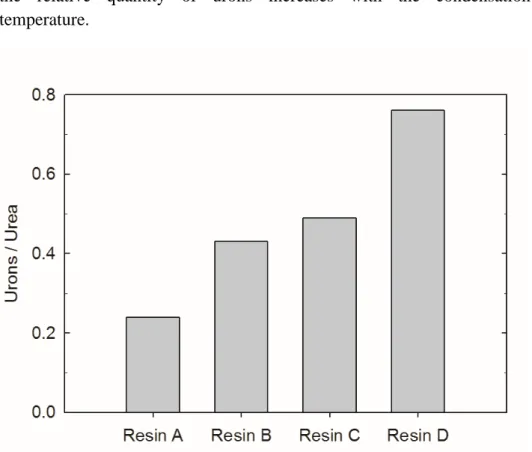
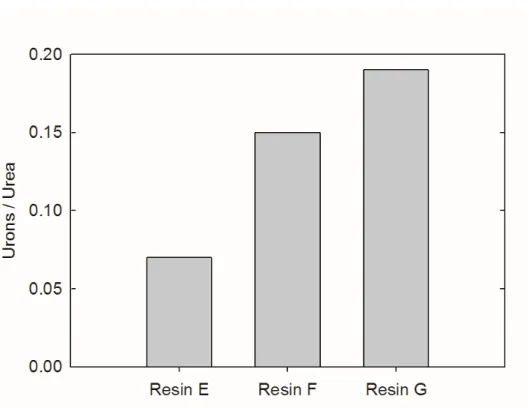
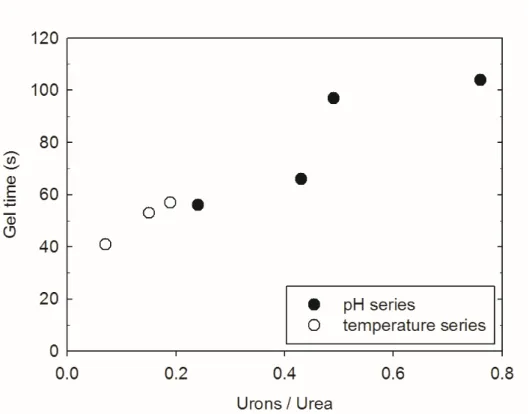
Figure 1.1.4 presents the effect of pH in methylolation and condensation steps; pH plays a major role on the kinetics of these stages. Some authors [31-33] have also identified the formation of cyclic structures, also called urons, essentially under low pH environments. Despite their strongly influence on adhesive performance, up to date, less attention has been given to these structures.
Figure 1.1.4 – Rate constant of condensation and methylolation reactions under different pH (adapted from [14, 29])
At industrial level, several processes can be used for UF resins production. Despite innovative processes, such as continuous processes [34], they present higher downtimes associated with the charging and discharging of reactor, disabling the possibility of producing different types of resins in the same reactor. Indeed, wood adhesives manufacturers produce more than one type of UF adhesive to fulfil the
expected properties and type of board to be produced. The production of products with different specification is a common practice among adhesive producers.
The most common process uses then a batch reactor to run the alkaline-acid process. In the following section, only the batch process is analysed.
1.1.2.1. Alkaline-acid process
Alkaline-acid is the most common process for UF resins synthesis. It consists in a first methylolation under alkaline environment, followed by a condensation step under slightly acid pH, neutralization and addition of the last urea to consume free formaldehyde (second methylolation). The synthesis protocol starts with charging the reactor with formaldehyde, followed by pH adjusting to slight alkaline environment. Then, the first urea is added under controlled temperature (generally above 90 °C) until attaining the desired F/U molar ratio, usually around 2.2 to 2.0 [14]. Methylolation reaction occurs while the exothermic effect is observed. The pH is then adjusted to ca. 5.0, moderate acid, and the second urea is added. As a consequence the condensation reaction is activated, as shown in Figure 1.1.4; the condensation step is monitored by viscosity measurement. When the desired viscosity is reached (normally between 400 cP to 800 cP), pH is adjusted to slightly alkaline, stopping the condensation reactions. Cooling operation starts and the last urea is added until the desired F/U molar ratio is reached (between 1.1 and 0.9). Last urea will consume unreacted formaldehyde and the endothermic dissolution effect will facilitate the cooling operation. An entire cycle of production takes approximately 8 hours.
The condensation step plays a major role during the synthesis process. Due to the complexity of on-line viscometers and their low reliability, the condensation step is normally monitored off-line. Samples are taken every 10 to 15 minutes, cooled to 25 °C and then the viscosity and pH
measured. The sampling time contributes to measurement uncertainty and consequently to the variability of the final product properties.
1.1.2.2. Strongly acid process
In the strongly acid process, the condensation step is carried out under strongly acidic conditions and takes place simultaneously with the first methylolation step. The synthesis protocol starts with charging the reactor with formaldehyde and adjusting pH usually to a value below 2.0, with sulphuric acid. The urea feed starts then at controlled feed rate; the temperature increase is controlled during the feed process, following a previously established temperature program. When desired F/U molar is reached, pH is adjusted to neutral or slight alkaline conditions with sodium hydroxide and the second urea is added. To increase the degree of condensation, a second condensation step, under moderate acidic conditions can be performed, following a similar procedure of the condensation step of the alkaline-acid process. After reaching the desired viscosity, pH is again adjusted to slight alkaline and the cooling step begins. The third (last) urea is added to consume unreacted formaldehyde.
According to Williams [35], the strongly acid process entails minimal energy consumption and involves a shorter batch time reaction, when compared with the conventional process. The shorter time is due to the simultaneous initial methylolation and condensation steps. Hatjiissaak and Papadopoulou [36] reported that the reaction occurring during the strongly acid step is extremely exothermic and difficult to transpose from the laboratory to the industrial scale. Ferra et al. [37] also observed the high exothermicity of the reaction and compared the reactivity of resins obtained by both strongly acid and alkaline-acid processes. Despite the difficulties of the acid synthesis protocol, this process is nowadays applied in some formaldehyde-based adhesives companies. However, a rigorous feed rate of raw materials (namely urea) and a powerful cooling system are needed.
1.1.3. UF resin cure
According to IUPAC [38], a thermosetting polymer, also known as a thermoset, is a prepolymer in a soft solid or viscous state that changes irreversibly into an infusible, insoluble polymer network by curing. A thermosetting polymer cure can be induced by the action of heat or suitable radiation, or both.
During UF polymer synthesis, the condensation step is stopped by neutralization and cooling. The crosslinking process can be restarted by acidification and temperature increase (Figure 1.1.5). Generally, the acidification is carried out by the addition of catalysts to resin. According to the definition of a catalyst as a substance which increases the rate of chemical reaction without being consumed in the process, providing a new reaction mechanism [39], catalysts for UF resins are not in fact “true” catalysts. They are involved in the curing reaction, being consumed and generating an acid that reduces the pH. Due to this ambiguity, these compounds are also called hardeners. However, the terms catalyst and hardener are used indiscriminately in wood and wood adhesive science [14, 40].
The most common catalysts are the latent (ammonium sulphate, ammonium chloride and ammonium nitrate) [41-45]. Latent catalysts, in the presence of water (which promotes dissociation), react with formaldehyde forming an acid, hexamine and water (equations 1.1 to 1.3). During the blending operation (mixing of wood particles with adhesive), the presence of free water is residual since the moisture content of the blended particles is around 11 %, below the fibre saturation point of wood (around 30 % for most wood species) [46]. The absence of free water avoids the pre-cure reaction. During the hot-pressing operation, water vapour is formed, and the formation of acid takes place, promoting the cure reaction.
Figure 1.1.5 – Example of urea-formaldehyde polymerization forming a cross-linked network (adapted from [25])
4NH4NO3 + 6HCHO ↔ 4HNO3 + (CH2)6N4 + 6H2O (1.1)
4NH4Cl + 6HCHO ↔ 4HCl + (CH2)6N4 + 6H2O (1.2)
2NH4SO4 + 6HCHO ↔ 2H2SO4 + (CH2)6N4 + 6H2O (1.3)
Beyond the requirement of free formaldehyde availability, these catalysts led to the formation of hexamine, which in presence of moisture and heat decomposes releasing formaldehyde (equation 1.4) [10, 15, 47].
In the last years, the reduction of the final F/U molar ratio due to formaldehyde emission issues led to a decrease of free formaldehyde in commercial resins. Residual free formaldehyde results from an insufficient curing reaction and affects also the curing rate [43]. New catalytic systems with no requirement of free formaldehyde are been studied. In North America, the use of buffered catalyst systems is more spread than in Europe and was implemented where ammonium sulphate was unsuccessfully used. Despite the lower reactivity of these systems, they are usually more stable towards premature cure [40].
Direct application of acids such as maleic, acetic, oxalic, formic, nitric [18, 27, 43, 48] have been proposed by several authors. However, the use of strong acids promotes the resin pre-cure (reduction of the adhesive pot-life) and could originate corrosion problems in the equipment, as well as wood degradation.
1.1.4. Resin Characterization
As mentioned before, UF resins are very complex polymeric structures mostly because the number of bonds that urea can originate. Besides that reversible reactions and structural rearrangements occurs during resin production and storage. For obtaining a product with uniform properties, a very accurate control during production and to the final product is needed. Although the characterization of formaldehyde-based resins is being performed for more than 60 years, only recently analytical methods are allowing distinguishing resins with relevant practical differences. Old characterization methods involve the control of physical properties that relate poorly with the resin performance, such as viscosity and solid content, and chemical properties such as reactivity, pH and buffer capacity [49]. New characterization methods are now being developed/used that give a more precise picture of the resin performance as adhesive, namely spectroscopy and chromatographic techniques.
Basic characterization
The usual characterisation of the resin is made using inexpensive methods. The most common characterisation methods are:
Solid content (%) is evaluated by oven drying. During the process not only the existing water, but also formaldehyde and water from the on-going condensation are released. Usual values for solid content ranges from 60 % to 64 %.
Density (kg· m-3) of an adhesive is usually determined based on the weight/volume ratio and it can be measured using a pycnometer or a hydrometer.
Viscosity (cP or mPa·s) gives a rough indication of the polymerization degree. Lower viscosities are expected to induce excessive wood penetration, increasing resin consumption, while higher viscosities will bring flow problems. Nominal values of viscosity at 25 ºC are comprised between 150 cP and 400 cP.
pH-value is related to the resin stability until its application. pH-values for UF resins are usually between 7.5 and 9.0.
Buffer capacity is evaluated by acid-base titration and measures the amount of acid (or base) needed to reduce (or increase) resin pH.
Curing time and gelation time, also called resin reactivity (s), is the time needed for the resin gelification under similar conditions of the hot-pressing process (at 100 ºC). Usual values of gel time range between 50 s to 100 s.
Advanced analyses
Advanced techniques have been developed for characterizing UF resins. Thereafter is referred some spectroscopic and chromatographic techniques as well as mechanical tests and corresponding relevant studies for UF resins, providing useful information about their structure,
functional groups composition, existing chemical bonds, curing behaviour, etc.
Spectroscopic techniques
There are several spectroscopic techniques useful for characterizing UF resin.
Fourier Transform Near-InfraRed spectroscopy (FT-NIR, 13000 – 4000 cm-1) is a non-destructive, reliable, fast, versatile technique and no sample preparation is required [50, 51]. There are several studies concerning the application of FT-NIR spectroscopy to UF resins. Chimar Hellas S.A. [52] developed a commercial methodology for on-line monitoring of the industrial resin production, called GNOSSITM. This software can be applied for the determination of formaldehyde concentration, as well as during UF resins production [53]. Application of NIR spectroscopy for on-line assessment of the reaction progress [54] as well as off-line measurements for quality control, namely F/U molar ratio [55, 56] or viscosity [57]. Combined with information collected from other techniques, it is also possible to study the polymeric structure of resin by FT-NIR [58].
Fourier Transform InfraRed spectroscopy or Mid-InfrarRed (FT-IR/MIR) detect functional groups by measuring fundamental molecular vibrations in the range of 4000 – 400 cm-1 [59], namely carbonyl groups (e. g. amide bonds) that have a high molar absorptivity.
Raman spectroscopy, as FT-MIR, involves the study of the interaction of radiation with molecular vibrations. However, while MIR and NIR spectroscopy are based on the absorption of radiation, Raman spectroscopy is a scattering technique [50]. Normally used as complement to FT-IR, Laser Raman spectroscopy was introduced by Hill et al. [60] to analyse the structure of UF resins. Minopoulou et al. [58] also studied the UF structure by Raman spectroscopy, while
Carvalho et al. [61] studied the UF oligomers and curing which permitted to obtain kinetic data as the basis for an empirical kinetic model.
Among the Nuclear Magnetic Resonance (NMR) spectroscopy methods, liquid-state 13C NMR provides the most complete information
on the chemical structures present in UF resins, allowing the identification of several functional groups and its quantitative determination [62]. Several authors have studied UF resins by 13C NMR under different synthesis conditions [31-33, 61, 63-65].
Matrix-assisted laser desorption/ionization (MALDI) mass spectrometry allows fast and efficient analysis of complex synthetic polymers, which always exhibit varying degree of polydispersity, including molar mass distribution and chemical composition distribution [66]. Several types of mass analysis instruments can be coupled, being the most common the Time of Flight (MALDI-TOF). For polymer characterization, MALDI provides useful information, such as weight average molecular weight (Mw), number average molecular weight (Mn),
the number of repeating units, and end group determination can be obtained from MALDI data [67]. Zanetti et al. [68] have studied with success formaldehyde-based resins by MALDI-TOF.
Chromatographic techniques
Chromatography is essentially a physical method of separation in which the components to be separated are distributed between two phases, one of which is stationary (stationary phase) while the other (the mobile phase) moves in a definite direction. When the stationary phase is a solid with a controlled pore size distribution solutes are separated by size differences and the technique is referred to as size-exclusion chromatography (SEC) [69]. Among SEC techniques, Gel Permeation Chromatography (GPC) is the chromatographic separation of macromolecules with the use of porous gels or rigid inorganic packing particles [70, 71]. GPC/SEC allows the determination of the molecular weight distribution (MWD) of a wide range of polymers. The mechanical
and bonding properties of an adhesive are strongly dependent on its molecular weight distribution [49].
High Performance Liquid Chromatography (HPLC) is widely used to analyse the monomer content or to characterize oligomers and additives in adhesives. Components in a mixture are separated by their affinity between the mobile and stationary phase, migrating along the column at different speeds and emerging from the column at different times, thus resulting in a mixture separation. This method is very effective in establishing and identifying low molecular weight components in resins [41, 72-74].
Cure evaluation techniques
The bond strength of thermosetting adhesives develops during the hardening or curing process, which is usually carried out in a hot-press at a defined pressure and temperature, and for a defined period of time. Bond strength between the wood substrate and the adhesive develops during the hardening or curing of the adhesives, which involves conversion of a liquid adhesive through gelation and vitrification to fully cured adhesive [75].
Hardening and gelling of thermosetting adhesives and resins can usually be monitored by exo- or endothermic behaviour during gelling and hardening (chemical curing); suitable test methods are Differential Thermal Analysis (DTA) or Differential Scanning Calorimetry (DSC). The solidification of the adhesive during curing by building up the three-dimensional network, also described by the achievable degree of cross-linking; usual test methods for this mechanical curing are Dynamic Mechanical Analysis (DMA), Thermal Mechanical Analysis (TMA), Torsional Braid Analysis (TBA), Thermal Scanning Rheometry (TSR), Dielectric analysis (DEA). The formation of the bond strength between two adherents (materials being bonded) can be followed by methods such as Automated Bonding Evaluation System (ABES), Composite Testing
System (ComTeS) and Integrated Pressing and Testing System (IPATES).
Differential Scanning Calorimetry (DSC) measures the change of the difference in the heat flow rate between a sample and into the reference sample, while they are subjected to a controlled temperature program [76]. The original idea of DSC technique born from the Differential Thermal Analysis (DTA). Thermogravimetric Analysis (TGA) is a test performed on samples that determines change in weight as a function of a temperature program under a controlled atmosphere. The weight loss of the sample is recorded as a function of the temperature, which is related to the volatile content (including dehydration and chemical reactions involving mass variation), but phenomena related with heat flux transitions are not detected [77].
Thermomechanical analysis (TMA) involves measurements of the dimensional changes of material under controlled conditions of force, atmosphere, time and temperature. Dynamic mechanical analysis (DMA), sometimes referred to as Dynamic mechanical thermal analysis (DMTA), analysis the response of a material subjected to a sinusoidal stress, which generates a corresponding sinusoidal strain. Torsional braid analysis (TBA) is the predecessor of DMA and characterizes cure properties of polymeric materials. Torsional oscillations are induced by applying a torque.
Dielectric analysis (DEA) or dielectric cure monitoring involves measuring changes in the dielectric properties of the material by using an impedance analyser over many decades of frequency. Tests on polycondensating binders used in wood-working industry show that this method is also suited for curing characterization of aminoplast resins. DEA is based on changes in the dielectric properties caused by cross-linking reactions. Immobile groups originated by polymeric processes result in dielectrical conductance decrease. In recent years, DEA technique has been described for the characterization of polycondensating phenoplast and aminoplast wood binders [78, 79].
Furthermore, DEA was also used for testing UF bonded particle boards [80].
The so-called Automated Bonding Evaluation System (ABES) has been developed and patented by Humphrey [81]. The ABES enables the determination of strength development characteristics of different adhesives in combination with an adherent. The system includes bonding and testing of a lap-shear specimen under controlled conditions. The system uses a pair of relatively thin adherent strips and the adhesive, which is applied to the end of one strip. The strips are put together to form a lap-shear specimen. The specimen is put in the testing device and pressed by side like in a small hot-press. After a certain pressing time, this small press opens and the specimen is immediately (or after a defined cooling interval of few seconds) tested in shear mode. The technique provides valuable data on the shear strength of the adhesive bond as a function of the pressing parameters (e.g. time and temperature) and conditions (e.g. the cooling effect) [82]. ABES and similar adapted methods have been found to be useful for determining the development of bond strength for various adhesive types under different pressing conditions [83-86].
The so-called Integrated Pressing and Testing System (IPATES) was developed for the determination of the adhesive cure in wood fibre and particle mats. The working principle is similar to the one of ABES. A disc mat is formed on a steel press platen with 100 mm in diameter. The mat is heated by two electrically heated blocks and compressed by a universal testing machine. A special adhesive is used to ensure the proper linkage between the press platens and the sample being tested. After pressing, the specimen is destructively tested in tensile mode for determination of the internal bond [87]. A similar method, the Composites Testing System (ComTeS) has been used for testing wood composites [88].
1.2.
W
OOD-
BASED PANELSWood is one of the most popular building materials in the world. However, it has some drawbacks that made it undesired for certain applications. Wood-based panels is a general term for a variety of board products, which have an impressive range of engineering properties overcoming some of the wood restrictions [89].
Solid wood is usually related to high quality products while wood-based panels are, errantly, often classified as a low quality product. Wood-based panels are distinct from solid wood products in their characteristics and applications, although can partially substitute solid wood products. Beyond the environmental benefits of wood products, wood-based panels are an alternative to wood products, due to their versatility, engineered properties and price. They convince by their higher versatility of shapes and dimensions, absence of defects, higher isotropy of properties and higher dimensional stability.
1.2.1. Raw materials for wood-based panels
Products made from particulate woody materials, in the shape of fibre, shaving, chips or other types of particles, can be made from woodworking waste, non-commercial or low value tree species or agricultural wastes [90]. Recovering forest and sawmills residues for manufacture of wood-based panels, particularly particleboards and fibreboards are the success of particleboard industry, presenting the advantage of reduction of raw materials cost, but also environmental benefits, extending the carbon cycle.
Besides the production process, raw-materials have a strong effect on panel performance. The qualities of wood may vary strongly depending on the regional differences and the assortment used, but also over time within the individual process [91]. Therefore, recycling wood is a common practice in a number of countries throughout Europe [92]. The
particleboard industry took up this challenge already quite some time ago. More recently, MDF manufacturers started to use recycled wood in their production processes. Wood-based panels industry is clearly responding positively to the aim of sustained industrial development, in other words, to create more value with less environmental impact [93]. In Portugal, the two major companies implemented strategies for sustainable use of forest resources through recycling of clean wood residues (sawmill), but also industrial wood waste (secondary transformation and wood-based panels manufacturers) and packaging [94].
1.2.2. Particleboard manufacture
Particleboard, as defined in EN 309, is a “wood-based panel manufactured under pressure and heat from particles of wood (wood flakes, chips, shaving, sawdust and similar) and/or other lignocellulosic material in particle form (flax shives, hemp shives, bagasse fragments and similar) with the addition of an adhesive”.
Particleboard raw-materials comprise not only logs but also sawmill residues, recycled wood as well as recycled fibres. These materials are stored in the plant raw-materials store, sorted by species and size. First, large samples are chipped in the Primary Breakdown Machines and later in the Secondary Breakdown Machines sectors, where wood particles are converted in smaller sizes through the hammer mills and flakers. Then, particles are sent to the dryer to achieve the desired moisture content and particles are then sorted according to their sizes. Some manufacturers sort their particles before drying in order to minimize the energy consumption. After these stages, wood particles are mixed with resin and other additives (gluing operation) in a continuous process. Additives could be added directly to wood particles or mixed previously with the resin. Moisture content of the blended particles plays a major role during the pressing stage. Particles in the surface layers present higher moister content than the core layer particles. This gradient will allow the steam flow to the core, inducing a faster heating of the core section. Core layer particles are usually larger than the in the surface; longer particles
provide better mechanical properties, namely in bending while the lower size of surface particles confers homogeneity to post-processes, such as laminating. After mattress formation, mat is pre-pressed and pre-heated in order to improve the efficiency of pressing operation, reducing the operational costs and improving the line speed. After pressed, boards are cut, their edges trimmed and finely are cooled in a star cooler and then stacked and stored. Prior to shipping, boards are sanded and cut-to-size. A schematic example of a particleboard plant can be seen in Figure 1.2.1. An exhaustive description of the overall process are also reported in the reviews written by Maloney [90] and Irle and Barbu [95].
Figure 1.2.1 – Particleboard process diagram [96]
1.2.3. Characterization of wood-based panels
Wood-based panels, and more specifically particleboards, can be characterized by several tests and methods. Usually, boards are assessed
according to methods defined by recognized international organizations, such as European Committee for Standardization, also known as Comité Européen de Normalization (CEN), American Society for Testing and Materials (ASTM), Japanese Industrial Standards (JIS) and other regionals standard organizations. Each organization defines, sometimes, different tests or experimental conditions for evaluating similar properties.
In this work, all physico-mechanical properties were evaluated according to the European standards (EN), except for formaldehyde emission that was also considered Japanese standards.
Regarding to the EN 312, particleboards can be classified according to different grades, from P1 to P7, where the minimal requirements are defined according to the product final application. For each grade it is defined general requirements, such as the range of moisture content or specific requirements. As example, a P1 grade refers to “General purpose” and a P2 is for “Interior fitments – dry conditions” while a P7 is for “Heavy duty load bearing – humid conditions”. The common tests and corresponding standards to evaluate particleboards properties are defined in Table 1.2.1
Table 1.2.1 – Common test methods to evaluate particleboard properties
Properties EN standards
Modulus of elasticity in bending EN 310
Bending strength EN 310
Tensile strength perpendicular to the plane EN 319 Swelling in thickness after immersion in water EN 317
Moisture Content EN 322
Density EN 323
Modulus of elasticity in bending, also called modulus of elasticity (Em),
Modulus of elasticity is calculated from the slope of the linear region of the load-deflection curve. Bending strength is calculated from the ratio of the bending moment (M) and the maximum load (Fmax) to the moment of
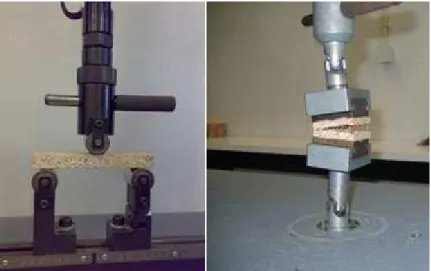
its full cross section, as stated in EN 310 standard. The test piece is supported by two roller-bearing parallel and then a load is applied to the test piece by an equidistant and parallel cylindrical load head capable to measure the deflection and the load applied. An example of a testing apparatus is shown in Figure 1.2.2 (left). Tensile strength perpendicular to the plane of the board is also commonly called “internal bond” (IB) and is determined according to EN 319. Figure 1.2.2 (right) shows the apparatus of an internal bond test.
Figure 1.2.2 – Example of determination of a bending (left) and an internal bond test
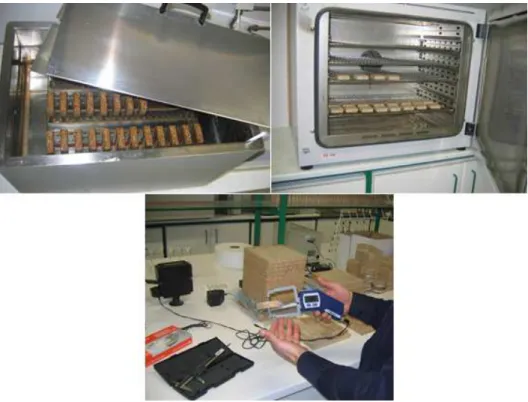
Swelling in thickness after immersion in water, “thickness swelling” (TS) is determined by measuring the increase in thickness of a test piece after complete immersion in water after 24 hours. Figure 1.2.3 (top left) shows a running test apparatus according to the EN 317. Moisture content (MC) of boards is determined by the loss of mass of a test piece dried in an oven at 103 ± 2 ºC and density is determined from the ratio between mass
of a test piece and its volume. Apparatus of these tests are also shown in Figure 1.2.3.
Figure 1.2.3 – Example of thickness swelling determination (top left), moisture content (top right) and density (below)
1.2.4. Particleboard Market
Particleboards market has changed since the last few decades. In 1956 there were 106 European mills producing 724 000 cubic meters of particleboard. In 1973, the production increased about 27 times when compared with 1956 [90]. This period was a period of great developments in wood-based panels and particleboards industry, with substantial increase on relevance of particleboards on global production of wood-based panels, as shown in Table 1.2.2.
![Figure 1.1.1 – Scheme of UF resin reactor [26]](https://thumb-eu.123doks.com/thumbv2/123dok_br/18899219.935065/31.748.113.636.178.502/figure-scheme-uf-resin-reactor.webp)
![Figure 1.1.5 – Example of urea-formaldehyde polymerization forming a cross-linked network (adapted from [25])](https://thumb-eu.123doks.com/thumbv2/123dok_br/18899219.935065/37.748.118.622.119.498/figure-example-formaldehyde-polymerization-forming-linked-network-adapted.webp)
![Figure 1.3.1 – The green carbon cycle of the wood-based panels [97]](https://thumb-eu.123doks.com/thumbv2/123dok_br/18899219.935065/54.748.110.643.108.468/figure-green-carbon-cycle-wood-based-panels.webp)