Vol.52, n. 1: pp.35-43, January-February 2009
ISSN 1516-8913 Printed in Brazil BRAZILIAN ARCHIVES OF
BIOLOGY AND TECHNOLOGY
A N I N T E R N A T I O N A L J O U R N A L
Screening and Enzymatic Study of a Composite Microbial
System FH3
Yi-Min Zhang
1*, Xue-Bin Lu
1, Han-Bin Dan
2and Ya-Kai Sun
11Key Laboratory of Green Chemical Technology; School of Chemical Engineering and Technology; Tianjin
University; Tianjin 300072; China. 2Department of Biological Sciences Lehman College; City University of New York; NY 10468; USA
ABSTRACT
Five strains of fungi and 18 strains of bacteria were isolated from the soil and horse manure with cellulose as the sole carbon source. Among them, two fungal, F9 and F13, and two bacterial, B16 and B21, showed the highest filter
paper activities, which were 7.79U g-1, 9.84 U g-1, 7.34 U g-1 and 9.68 U g-1, respectively. Four microbial systems, designed as FH1 (F13+B21), FH2 (F13+B16+B21), FH3 (F9+B16+B21) and FH4 (F13+F9+B16+B21) were developed.
The fermentation studies showed that the filter paper activity of the composite microbial system FH3 was higher than the others, which was 21.34 U g-1. The medium with bran and filter paper as the carbon source and peptone as nitrogen source was optimal and the maximum cellulase activity was reached at 30~35ºC and pH 6.0~6.5 when FH3 was incubated for 48 h. The enzymatic reaction conditions were estimated at 45~55 ºC, pH 4.5~5.5 and the thermal stability temperature was up to 60 ºC.
Key words: Cellulose-degrading bacterium, composite microbial systems, enzyme properties
INTRODUCTION
Cellulose is the major carbohydrate polymeric compound in the plants and is the most abundant organic compound on the earth. Accordingly, its turnover in the carbon cycle is of prime importance for all the living organisms (Peter et al., 1999; Garsoux et al., 2004). Huge amounts of the cellulosic wastes, measured in billions of tons annually, are produced worldwide as the residues from the agriculture activities and industrial food processing. In China, crop straw waste exceeds 100 million tons per year (Haruta et al., 2004). The enormous potential of cellulose as a renewable source of energy was recognized only after the
cellulose degrading enzymes or cellulases had been identified (Mandels, 1985). Cellulases are enzymes that hydrolyse β-1, 4-glycosidic bonds in cellulose, releasing cellobiose as the smallest product. These enzymes can be found associated
with the cellulosome, an extracellular
supramolecular assembly produced by some bacteria and fungi (Shoham et al., 1999; Carrard et al., 2000), but are generally secreted as
independent enzymes by the cellulolytic
microorganisms. Efforts have been directed to find the suitable cellulase-producing micro-organisms through the strain selection and development.
enzyme complex that is capable of hydrolysing cellulose. However it produces little cellobiase and xylanase activities, which is a disadvantage from the point of practical saccharification. Kang et al
(1994) found that Aspergillus niger was a more promising strain than Trichoderma reesei (Kim et al., 1997). Van Wyk et al (2003) treated various wastepaper materials with the cellulase from viride
and converted their cellulose component into fermentation sugars. In nature, the cellulose materials are degraded with mixed group of the microorganisms. It has been reported that a mixed culture of one cellulolytic bacterium together with another noncellulolytic bacterium is ideal for degrading the cellulose. As such, the utilization of a complex microbial community could be effective in achieving the high degradation efficiency for natural cellulosic materials.
In the present study, a composite microbial system FH3 was constructed, which had a higher enzyme activity than any of the separate composting strains. The conditions for the rapid and high cellulase production by the FH3 are described. Some of the properties of the enzyme consortium are also presented.
MATERIALS AND METHODS
Experimental materials
The soil and horse faeces were collected from the cornfield and meadow of Tianjin suburb (Tianjin, China). Xinhua mensurable filter paper was cut into pieces (6cm in length and 1cm in width). Cellulose-congo red medium was composed of 0.50g K2HPO4, 0.25g MgSO4, 1.88g cellulose powder, 0.20g congo red, 14.00g agar, 2.00g glutin, 100mL soil solution and 900mL H2O, pH7.0. The liquid fermentation medium 1 (bacterial) was composed of 1.00g KH2PO4, 0.10g NaCl, 2.50g NaNO3, 0.30g MgSO4, 0.01g FeCl3, 0.10g CaCl2, 10g bran and 1000mL H2O, pH 7.2. The liquid fermentation medium 2 (fungal) was composed of 3.00g peptone, 2.00g (NH4)2SO, 0.50g yeast extract, 4.00g KH2PO4, 0.30g CaCl2, 0.30g MgSO4, 0.20g Tween-80, 10g bran and 1000mL H2O, pH 6.0. The peptone cellulose substrate (PCS) was composed of 1.00g yeast extract, 5.00g peptone, 2.00g CaCO3, 5.00g NaCl, 20.00g cellulosic materials and 1000mL H2O.
Screening for cellulose decomposing microbial strains
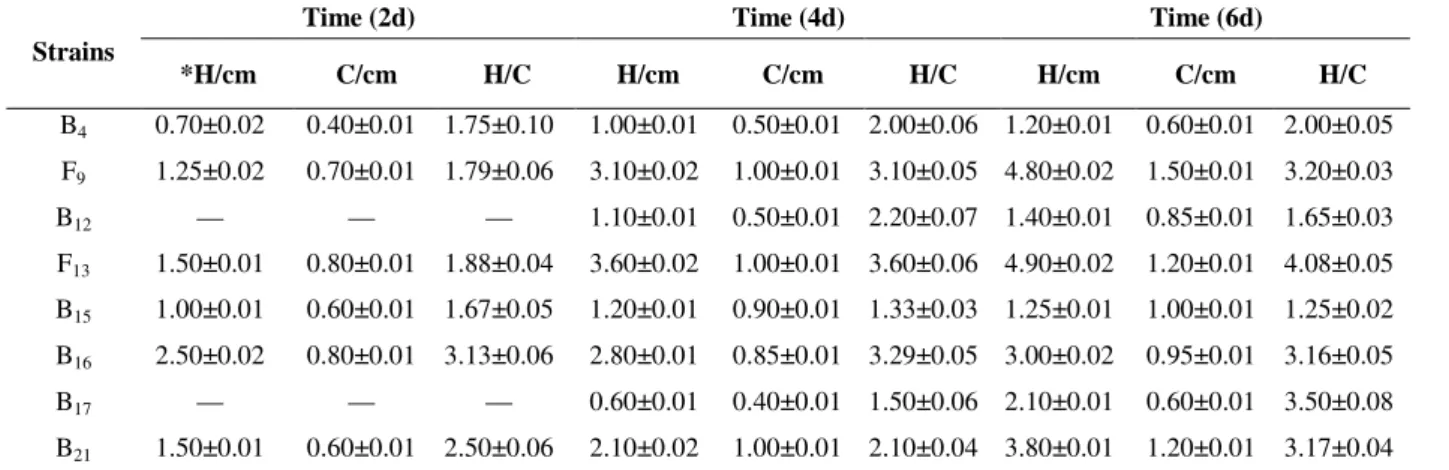
Different sample solutions were spread on the cellulose-congo red plates and incubated at 30ºC for 72h. The purified strains were obtained and inoculated on the cellulose-congo red medium and cultured at 30 ºC for six days. The strains were selected according to the value of H/C (Table 1). After that, one milliliter suspension of these strains was inoculated in the liquid medium 1 or 2 and cultured at 30 ºC for three days. By measuring the enzyme activity, some strains were chosen for the next combination experiment.
Strain combinations
Four composite microbial systems were developed according to their cellulose-degrading enzyme activities. One milliliter suspension of the four composite microbial systems was inoculated in the PCS liquid medium and incubated at 30 ºC for three days. The desired composite microbial systems were selected by its three enzyme activities and were used in the fermentation experiment.
Enzyme assays
The cellulase activities were measured by DNS (3, 5-dinitrosalicylic acid) assay (Miller, 1959), through the determination of the amount of reducing sugars from filter paper, CMC and cotton. The three reactions were performed under different experimental conditions (temperature: 50 ºC, 45 ºC and 45 ºC; time: 1h, 0.5h and 24h) and stopped by the addition of the DNS solution. The treated samples were boiled in the capped glass tubes for 10min, cooled in the water for color stabilization and the optical density was measured at A540. The cellulase activities were determined from a calibration curve for glucose (ε540=3.2×10
2
L.mol-1.cm-1).One unit (U) of the enzyme activity was defined as the amount of enzyme that released 1µmol of reducing sugar per minute under the assay conditions. All the enzymatic assays were performed in triplicate.
RESULTS AND DISCUSSIONS
Strains screening
bacteria were isolated from the soil and horse feces. Eight strains were finally chosen for further study according to the diameter of the hydrolysis
zones. Among them, F9 and F13 were fungi, while the others were bacteria (Table 1).
Table 1-The status of H, C, and H/C of the eight strains over six days.
Time (2d) Time (4d) Time (6d)
Strains
*H/cm C/cm H/C H/cm C/cm H/C H/cm C/cm H/C
B4 F9 B12 F13 B15 B16 B17 B21 0.70±0.02 1.25±0.02 — 1.50±0.01 1.00±0.01 2.50±0.02 — 1.50±0.01 0.40±0.01 0.70±0.01 — 0.80±0.01 0.60±0.01 0.80±0.01 — 0.60±0.01 1.75±0.10 1.79±0.06 — 1.88±0.04 1.67±0.05 3.13±0.06 — 2.50±0.06 1.00±0.01 3.10±0.02 1.10±0.01 3.60±0.02 1.20±0.01 2.80±0.01 0.60±0.01 2.10±0.02 0.50±0.01 1.00±0.01 0.50±0.01 1.00±0.01 0.90±0.01 0.85±0.01 0.40±0.01 1.00±0.01 2.00±0.06 3.10±0.05 2.20±0.07 3.60±0.06 1.33±0.03 3.29±0.05 1.50±0.06 2.10±0.04 1.20±0.01 4.80±0.02 1.40±0.01 4.90±0.02 1.25±0.01 3.00±0.02 2.10±0.01 3.80±0.01 0.60±0.01 1.50±0.01 0.85±0.01 1.20±0.01 1.00±0.01 0.95±0.01 0.60±0.01 1.20±0.01 2.00±0.05 3.20±0.03 1.65±0.03 4.08±0.05 1.25±0.02 3.16±0.05 3.50±0.08 3.17±0.04
*H: the diameter of hydrolysis zone, C: the diameter of colony, H/C: the ratio of H and C.
F9, F13, B16 and B21 had a higher ability of cellulose degrading than the other strains. F9 and F13 were two strains of fungi and their diameter of the hydrolysis zones developed quickly with the diversification of the diameter colony. On the sixth day, the H/C value of F9 reached 3.2, while F13 reached 4.08. In the screening process, the H/C values of B16 and B21 also reached 3.0. Though the H/C value of B17 reached 3.5, its hydrolytic zone and colony was very low. B17 grew slowly and had
a poor ability on cellulose decomposing.
Enzyme activity measuring
One-milliliter bacterial suspension of B4, B12, B15, B16, B17 and B21 was inoculated in 50mL liquid fermentation medium 1. The suspension of F9 and F13 was inoculated in liquid fermentation medium 2 in the same quantity. They were incubated at 30 ºC at 160rpm for three days. The results of enzyme activities are shown in Table 2.
Table 2 - Enzyme activities of different strains.
Cellulase activities Strain Nos filter paper
(U g-1)
CMC (U g-1)
Cotton (U g-1) B4 F9 B12 F13 B15 B16 B17 B21 3.05±0.12 7.79±0.43 1.17±0.08 9.84±0.49 3.41±0.17 7.34±0.37 3.81±0.19 9.68±0.58 10.22±0.61 23.66±0.96 9.68±0.48 27.78±1.02 28.86±1.05 39.53±1.23 6.09±0.30 60.05±1.60 0.32±0.02 0.30±0.02 0.18±0.01 0.51±0.03 0.56±0.03 0.56±0.03 0.38±0.02 0.65±0.04
Table 2 showed that all the strains of bacteria and fungi presented filter paper activity, and the largest values were obtained for F13 and B21 and the smallest value for the strain B12. Strain B21 had the largest value for CMCase, and B17 had the smallest. Strain B21 had the largest value for cotton
presented smaller values in relation to the other strains. Therefore, strain B21 was the best for CMCase and cotton activities. In this study, strain’s isolation was based on the filter paper enzyme activity. As cellulose material has
Therefore, the filter paper enzyme activity could reflect the cooperative action of three cellulases, and regarded as the basis of strain isolation. Among the eight strains of the cellulose-degrading microorganisms, F9, F13, B16 and B21 showed the higher filter paper enzyme activities, which were 7.79, 9.84, 7.34 and 9.68 U g-1, respectively. It proved that F9, F13, B16 and B21 had the highest cellulose-degrading ability. The result was consistent with H/C value.
Strain combinations
Strains F13 and B21, which had the highest filter paper enzyme activity, were combined to form the composite microbial system FH1. Strains F13 with the highest filter paper enzyme activity, B21 with the highest CMC enzyme activity and B16 with the highest cotton enzyme activity were combined to form the composite microbial system FH2. Strains F9 with a high filter paper enzyme activity, B21 with the highest CMC enzyme activity and B16 with the highest cotton enzyme activity were combined to form the composite microbial system FH3. All the four strains were combined to form
the composite microbial system FH4. The four composite microbial systems were inoculated in the PCS liquid medium and incubated at 30 ºC and 160rpm for three days. The crude enzyme activities were measured and results are shown in Table 3. Table 3 indicated that the filter paper activity of the composite microbial system FH1 was 11.13 U g-1 with an increase of 13.1% and 15.0% compared to F13 and B21, respectively. But its CMC enzyme activity and cotton enzyme activity were lower than its single strain. The filter paper activities of the composite microbial system FH2 and FH4 were lower than those of their single strains. Compared with F13, B16 and B21, the filter paper activity of FH2 decreased 45.3, 26.7 and 44.4%, the CMC enzyme activity decreased 10.3, 37.0 and 58.5%, while the cotton enzyme activity was improved by 127.5, 107.1, and 78.5%, respectively. The filter paper enzyme activity of FH4 decreased 49.2, 59.8, 46.0 and 59.1%, the CMC enzyme activity was improved by 160.2, 121.6, 55.8 and 2.5%, while the cotton activity decreased 23.3, 54.9, 58.9 and 64.6% compared with F9, F13, B16 and B21, respectively.
Table 3 - Results of enzyme activities of composite microbial systems FH1-4. Cellulase activities CMS* Nos
filter paper (U g-1) CMC (U g-1)
Cotton (U g-1) FH1
FH2 FH3 FH4
11.13±0.56 5.38±0.27 21.34±1.07
3.96±0.20
13.80±0.69 24.92±1.25 102.89±3.14
61.57±1.08
0.21±0.01 1.16±0.06 0.75±0.04 0.23±0.02
* CMS-Composite Microbial Systems
Among the four composite microbial systems, FH3 had the highest cellulose degradation ability. All the three enzyme activities got increased compared to that of three single strains. Being related to F9, B16 and B21, the filter paper enzyme activity of FH3 were improved by 174.0, 190.7 and 120.5%, the CMC enzyme activity were improved by 334.9, 160
.3
and 71.3%, and the cotton activity were improved by 150.0, 33.9 and15.4%, respectively. Therefore FH3 was the best and used in further studies
.
Effects of culture temperature on the enzyme production of FH3
0 20 40 60 80 100 120
20 25 30 35 40 45 50
R
el
at
iv
e
En
zy
m
e
Ac
tiv
ity
%
FPA Cx C1
Figure 1 - Effects of culture temperature on the enzyme production of FH3 FPA-filter paper activity, Cx-CMC activity, C1-cotton activity.
Temperature is one of the most important factors affecting microorganisms’ growth (Andreaus et al., 1999; Tuomela et al., 2000). Fig. 1 indicated that the filter paper activity and CMC enzyme activity were greatly affected by the temperature and reached the maximum at 30 ºC with a sharp peak. The cotton activity remained higher at 30~40 ºC and reached the maximum at 35 ºC.
Effects of initial pH of medium on the enzyme production of FH3
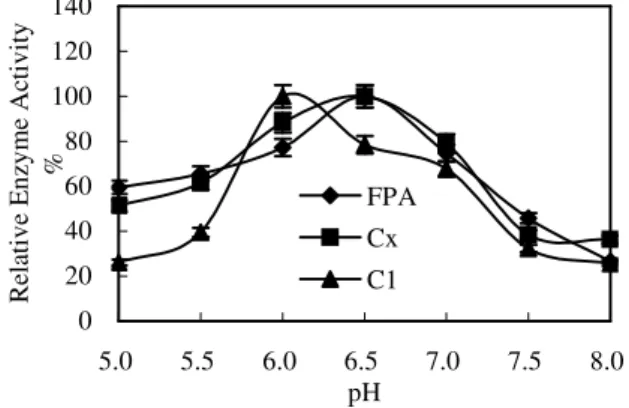
Another important factor significantly affecting the cellulase production was the initial pH of the medium. In this study, the FH3 was inoculated in the PCS liquid medium and incubated at 30 ºC for three days at different initial pH. The relationship between the relative enzyme activity and initial pH is shown in Fig. 2.
0 20 40 60 80 100 120 140
5.0 5.5 6.0 6.5 7.0 7.5 8.0
pH
R
el
at
iv
e
E
n
zy
m
e
A
ct
iv
it
y
%
FPA
Cx
C1
Figure 2 - Effects of initial pH value of medium on the enzyme production of FH3.
The initial pH of the medium showed a significant effect on the filter paper activity, CMC activity and cotton activity. When the initial pH value ranged from 5.5 to 7.5, the three activities had a strong variation. The filter paper activity and CMC enzyme activity reached the maximum at pH 6.5 and the cotton activity at pH 6.0.
Effects of different carbon sources on the enzyme production of FH3
0 20 40 60 80 100
B F G S B+G F+G F+S
R
el
at
iv
e
E
n
zy
m
e
A
ct
iv
it
y
%
FPA
Cx C1
Figure 3 - Effects of carbon sources on the enzyme production of FH3 B-bran; F-filter paper; G-glucose; S- sucrose.
Evidently the filter paper activity reached the maximum value when the carbon source was bran. The three enzyme activities were higher with the filter paper as the carbon source, especially for the CMC activity and cotton activity, which reached the maximum value. Therefore, bran and filter paper were the favorable carbon sources, which could induce the FH3 to produce cellulase (Kvesitadze et al., 1999). The use of the soluble sugars can reduce certain problems during the large-scale fermentation. In this study, pure sugars gave good growth but cellulase production was very poor. This could be due to the fact that easily metabolizable substrates might prevent the enzyme synthesis (Seyis et al., 2005).
For further studies on the enzyme production by FH3, some small molecule carbon sources such as
glucose and sucrose were added to the medium. Bran + sucrose, filter paper + glucose and filter paper + sucrose were used as the carbon sources in the PCS liquid medium. The results in Fig. 3 showed that the enzyme activity of FH3 decreased greatly because of glucose and sucrose. It was consistent with the inducible characteristics of the cellulase.
Effects of different nitrogen sources on the enzyme production of FH3
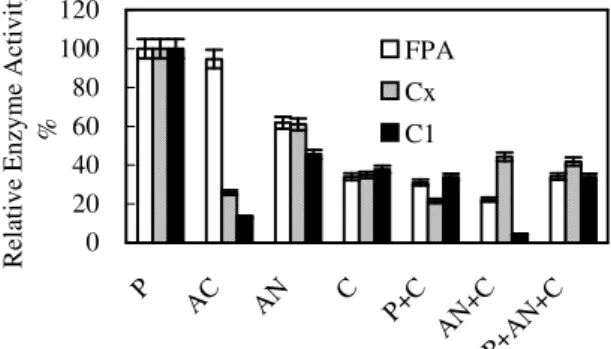
FH3 was inoculated in the PCS liquid medium with different nitrogen sources and incubated at 30 ºC, pH 6.0 for three days. The carbon source of medium was bran. The relationship between the relative enzyme activity and nitrogen sources is shown in Fig. 4.
0 20 40 60 80 100 120
P
AC AN C P+C
AN +C
P+A N+C
R
el
at
iv
e
E
n
zy
m
e
A
ct
iv
it
y
%
FPA
Cx
C1
Figure 4 - Effects of nitrogen sources on the enzyme production of FH3 P-peptone; AC-ammonium citrate; AN- ammonium nitrate; C-urea.
The nitrogen source used in the production medium is one of the major factors affecting the enzyme production and level. Fig. 4 indicated that FH3 had the highest enzyme activities when peptone was used as the sole nitrogen source. The
urea, ammonium nitrate + urea and peptone + ammonium nitrate + urea were used as the mixed nitrogen source for fermentation. The results showed that none of these were useful.
Relationship between culture time and enzyme production of FH3
The composite microbial system of FH3 was inoculated in the most favorable medium at 30ºC and pH 6.0 for five days. The enzyme activities of the crude enzyme were measured at 12h intervals. The variation of enzyme production with the culture time is shown in Fig. 5.
0 20 40 60 80 100 120
0 12 24 36 48 60 72 84 96 108 120
Time (h)
R
el
at
iv
e
E
n
zy
m
e
A
ct
iv
it
y
%
FPA
Cx
C1
Figure 5 - Relationship between culture time and enzyme production of FH3.
The enzyme production by FH3 increased from 24h to 48h and kept constant during 48h to 96h. After 96h, the enzyme activity decreased greatly. It might be concluded that the best culture time for FH3 was from 48h to 96h.
Effects of temperature on the enzyme reaction of FH3
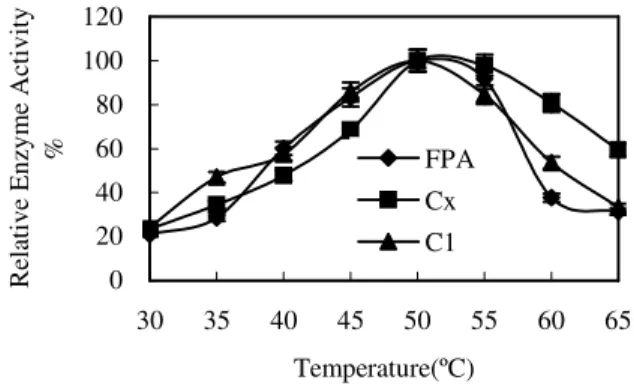
The variation of the enzyme activity at different temperatures is shown in Fig. 6. Filter paper
activity and cotton activity were at a high level when temperature was in the range of 45~55 ºC, where they were all above 80%. The relative enzyme activity of CMC was 63.38% at 45 ºC and it exceeded 80% at 50~60ºC. The highest activities of the three enzymes were at 50 ºC. It suggested that the best enzyme reaction temperature was 50 ºC. It could prove that FH3 had a very wide range of temperature, which was a very important parameter for the industry.
0 20 40 60 80 100 120
30 35 40 45 50 55 60 65
Temperature(ºC)
R
el
at
iv
e
E
n
zy
m
e
A
ct
iv
it
y
% FPA
Cx
C1
Figure 6 - Effects of temperature on the enzyme reaction of FH3.
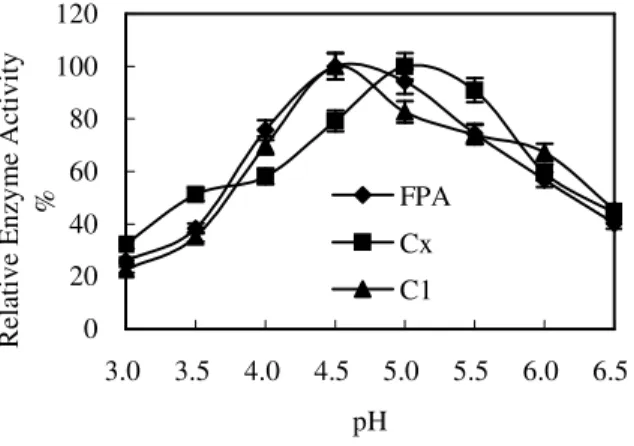
Effects of pH on the enzyme activity of FH3 The variation of crude enzyme of FH3 at different
(Shah et al., 2005). And the three kinds of enzyme activities of FH3 were very low under the highly acidic conditions, but they all increased slowly with the rise of pH. Filter paper and cotton activities reached the highest value at pH 4.5, and then they decreased slowly with the rise of pH. The CMC activity reached the highest at pH 5.0. Fig. 7 indicated that the filter paper and cotton activities kept a high level at pH 4.0~5.5, the range
was wider than that of CMC activity which was at pH 4.5~5.5.
Thermal stability of the crude enzyme of FH3 The thermal stability is a very important aspect when considering the industrial application of the enzymes (Heck et al., 2005). The profiles of the thermal stability of cellulase at 30, 35, 40, 45, 50, 55, 60 and 65 ºC are represented in Fig. 8.
0 20 40 60 80 100 120
3.0 3.5 4.0 4.5 5.0 5.5 6.0 6.5 pH
R
el
at
iv
e
E
n
zy
m
e
A
ct
iv
it
y
% FPA
Cx C1
Figure 7 - Effects of pH on the enzyme activity of FH3.
0 20 40 60 80 100 120
30 35 40 45 50 55 60 65
Temperature(ºC)
R
el
at
iv
e
E
n
zy
m
e
A
ct
iv
it
y
% FPA
Cx
C1
Figure 8 - The thermal stability crude enzyme of FH3.
The utilization of the enzymes in the industrial process often encounters the problem of the thermal inactivation of the enzyme. The thermal stability studies were carried out by preincubating the enzymes up to 3h in the range of 30~65ºC. The CMC activity had a better thermal stability than the other two activities. The three kinds of enzyme activities were at a higher level at 30~45ºC, and then decreased sharply above 50ºC. When the temperature reached at 65ºC, the filter paper activity, CMC activity and cotton activity
decreased 68.57, 40.57 and 66.62% respectively, compared to the highest enzyme activities. From Fig. 8, it could be concluded that the thermal stability temperature was around 60ºC
.
CONCLUSIONS
strain. The optimal enzyme production conditions of FH3 were as follows: initial pH 6.0~6.5, temperature 30~35ºC, shaker revolution 120~160 rpm and culture time 48h~96h. The optimal carbon source was filter paper and bran, and the optimal nitrogen source was peptone. The optimal
conditions for enzymatic activities were:
temperature 45~55ºC and pH 4.5~5.5. The thermal stability temperature of FH3 was under 60 ºC.
ACKNOWLEDGEMENTS
This work was supported by Shanxi Municipal Science and Technology Commission (No 030024).
REFERENCES
Andreaus, J.; Azevedo, H. and Cavaco-paulo, A. (1999), Effects of temperature on the cellulose binding ability of cellulase enzymes. Journal of Molecular Catalysis B: Enzymatic., 7, 233-239. Carrard, G.; Koivula, A. and Soderlund, H. (2000),
Cellulose-binding domains promote hydrolysis of different sites on crystalline cellulose. Proceedings of the National Academy of Sciences of the United States of America., 97, 10342-10347.
Garsoux G.; Lamotte, J. and Gerday, C. (2004), Kinetic and structural optimisation to catalysis at low temperatures in a psychrophilic cellulase from the Antarctic bacterium Pseudoalteromonas haloplanktis.
Biochemical Journal., 384, 247-253.
Haruta, S.; Cui, Z. and Huang, Z. (2002), Construction of a stable microbial community with high cellulose-degradation ability. Applied Microbiology and Biotechnology., 59, 529-534.
Heck, J. X.; Flores, S. H. and Hertz, P. F. (2005), Optimization of cellulase-free xylanase activity produced by Bacillus coagulans BL69 in solid-station cultivation. Process Biochemistry., 40, 107-112. Kim, S. W.; Kang, S. W. and Lee, J. S. (1997),
Cellulase and xylanase production by Aspergillus Niger KKS various bioreactors. Bioresource Technology., 59, 63-67.
Kubicek, C. P. (1992), The cellulase proteins of T.
reesei: structure,multiplicity, mode of action and regulation of formation. Advances in Biochemical Engineering and Biotechnology.,45, 1-27.
Kubicek, C. P.; Messner, R. and Gruber, F. (1993), The
Trichoderma reesei cellulase regulatory puzzle: From the interior life of a secretory fungus. Enzyme and Microbial Technology., 15, 90-99.
Kvesitadze, E.; Adeishvili, E. and Gomarteli, M. (1999), Cellulase and xylanase activity of fungi in a collection isolated from the southern Caucasus.
International Biodeterioration and Biodegradation., 43, 189-196.
Li, Z. H. and Lu, Y. T.(2003), Screening on the cellulose-decomposing microorganisms. Environment Pollution and Control., 23, 133-135
Mandels, M. (1985), Applications of cellulases.
Biochemical society transactions., 13, 414-416 Miller, G. L. (1959), Use of dinitrosalicilic acid reagent
for determination of reducing sugar. Analatical. Chemistry., 31, 426-428.
Peter, M.; Zarnea, G. and Adrian, P. (1999), Biodegradation and bioconversion of cellulose wastes using bacterial and fungal cells immobilized in radiopolymerized hydrogels. Resources Conservation and Recycling., 27, 309-332.
Seyis, I. and Aksoz, N. (2005), Effect of carbon and nitrogen sources on xylanase production by
Trichoderma harzianum 1073 D3. International Biodeterioration and Biodegradation, 55, 115-119. Shah, A. R. and Madamwar, D. (2005), Xylanase
production by a newly isolated Aspergillus foetidus
strain and its characterization. Process Biochemistry., 40, 1763-1771.
Shoham, Y.; Lamed, R. and Bayer, E. A. (1999), The cellulosome concept as an efficient microbial strategy
for the degradation of insoluble polysaccharides.
Trends in Microbiology., 7, 275-281.
Stewart, B. J. and Leatherwood, J. M. (1976), Depressed synthesis of cellulase by Cellulomonas.
Journal of Bacteriology., 128, 609-615.
Tuomela, M.; Vikman, M. and Hatakka, A. (2000), Biodegradation of lignin in a compost environment: a review. Bioresource Technology., 72, 169-183. Van Wyk, J. P. H. and Mohulatsi, M. (2003),
Biodegradation of wastepaper by cellulase from
Trichoderma Viride. Bioresource Technology., 86, 21-23.
Wood, T. M. (1985), Properties of cellulolytic enzyme systems. Biochemical Society Transactions., 13, 407-410.