http://www.uem.br/acta ISSN printed: 1679-9275 ISSN on-line: 1807-8621
Doi: 10.4025/actasciagron.v36i4.18172
EDTA-induced phytoextraction of lead and barium by brachiaria (
B.
decumbens
cv. Basilisk) in soil contaminated by oil exploration
drilling waste
André Fernão Martins de Andrade1, Nelson Moura Brasil do Amaral Sobrinho2, Fabiana Soares dos Santos3, Marcio Osvaldo Lima Magalhães4*, Alfredo Tolón-Becerra5 and Leilane da Silva Lima6
1
Instituto Federal de Educação, Ciência e Tecnologia do Rio de Janeiro, Pinheiral, Rio de Janeiro, Brazil. 2
Departamento de Solos, Instituto de Agronomia, Universidade Federal Rural do Rio de Janeiro, Seropédica, Rio de Janeiro, Brazil. 3
Departamento de Engenharia de Agronegócios, Universidade Federal Fluminense, Volta Redonda, Rio de Janeiro, Brazil. 4
Departamento de Agronomia, Universidade do Estado de Mato Grosso, Rodovia MT-358, km 7, 78300-000, Tangará da Serra, Mato Grosso, Brazil. 5Departamento de Engenharia Rural, Universidade de Almería, Almería, Andaluzia, Spain. 6Programa de Pós-graduação em Agronomia-Ciência do Solo, Universidade Federal Rural do Rio de Janeiro, Rio de Janeiro, Rio de Janeiro, Brazil. *Author for correspondence. E-mail: [email protected]
ABSTRACT. The phytoextraction of heavy metals using chelating agents has been widely studied for the
remediation of contaminated soils. To evaluate the efficiency of EDTA-induced phytoextraction of Ba and Pb using Brachiaria decumbens for the remediation of soil contaminated by oil well drilling and exploration waste, an experiment was conducted by applying a single dose (6 mmol EDTA kg-1 soil) and split doses of
EDTA (three applications of 2 mmol EDTA kg-1 soil). The samples were subjected to sequential
extractions using the method proposed by Ure et al. (1993) as modified by Rauret et al. (1999).The application of EDTA did not influence the distribution of Ba in various chemical fractions of the soil. The dry matter production did not differ significantly between the treatments and the control, thereby demonstrating the tolerance of plantsto the experimental conditions. The absorption of Pb by plants was influenced by the application of EDTA. The application of a single dose of EDTA influenced the absorption of Pb and its translocation to the aerial plant parts. The application of split doses favoured higher accumulation of Pb in roots. Because of its tolerance to heavy metals and EDTA, B. decumbens has the potential to be used in phytostabilisation.
Keywords: heavy metals, phytoremediation, chelating compounds.
Uso de EDTA na fitoextração induzida de chumbo e bário por braquiária (
B. decumbens
cv.
Basilisk) em solo contaminado por resíduos de perfuração de poços de petróleo
RESUMO. A fitoextração de metais pesados usando agentes quelantes tem sido amplamente estudado para
a remediação de solos contaminados. Para avaliar a eficiência do EDTA na fitoextração induzida de Ba e Pb, usando Brachiaria decumbens para a remediação de solos contaminados por perfuração poço de petróleo e resíduos de exploração, foi conduzido um experimento, aplicando uma dose única (6 mmol EDTA kg-1
solo) e divisão de doses de EDTA (três aplicações de 2 mmol EDTA kg-1 solo). As amostras foram
submetidas a extrações sequenciais com o método proposto por Ure et al. (1993), conforme modificado por Rauret et al. (1999). A aplicação de EDTA não influenciou a distribuição do Ba nas diferentes frações geoquímicas. A produção de matéria seca não diferiu significativamente entre os tratamentos e o controle, demonstrando assim a tolerância das plantas com as condições experimentais. Houve maior absorção de Pb pelas plantas com a aplicação de EDTA. A aplicação de uma dose única de EDTA influenciou a absorção de Pb e sua translocação para a parte aérea das plantas. A aplicação dividida das doses favoreceu maior acúmulo de Pb nas raízes. Devido à sua tolerância para os metais pesados EDTA, B. decumbens tem o potencial para ser utilizado em fitoestabilização.
Palavras-chave: metais pesados, fitorremediação, compostos quelantes.
Introduction
Exploration for oil generates waste that can potentially cause pollution. This waste arises from the drilling of prospecting wells and primarily consists of fragmented rock mixed with drilling fluid. This waste also contains hydrocarbons and
heavy metals, such as Ba and Pb (DEUEL JR.; HOLLIDAY, 1997).
studies to search for effective low-cost technologies to reduce the toxic effects of such contamination (GRATÃO et al., 2005).
Phytoremediation has been considered a promising and relatively cost-effective method compared to other techniques for the remediation of areas contaminated with heavy metals (SAIFULLAH et al., 2009; SALT et al., 1998). Phytoextraction can be classified as natural or induced. Natural phytoextraction involves the use of plants known as hyperaccumulators of heavy metals. Induced phytoextraction involves the use of plants with a high biomass production that can accumulate elevated heavy metal concentrations in their tissues when grown in soils treated chemically with chelating agents that increase the bioavailability of metals and absorption by the plant (MEERS et al., 2005).
Among the many chelating agents used to enhance phytoextraction, ethylene-diamine-tetraacetic acid (EDTA) has been shown to be very efficient in forming soluble complexes with metals, especially for the removal of Pb (DOUMET et al., 2008; KIM et al., 2003; LESTAN et al., 2007; XIA et al., 2009).
The objective of the present study was to evaluate the use of EDTA in the induced phytoextraction of Ba and Pb using Brachiaria
decumbens for the remediation of soil contaminated
by waste from oil exploration drilling.
Material and methods
The contaminated soil used in the experiment consisted of a mixture of waste from oil prospecting wells; this waste was deposited more than 20 years ago in an area containing Latossolo Vermelho Distrófico típico.
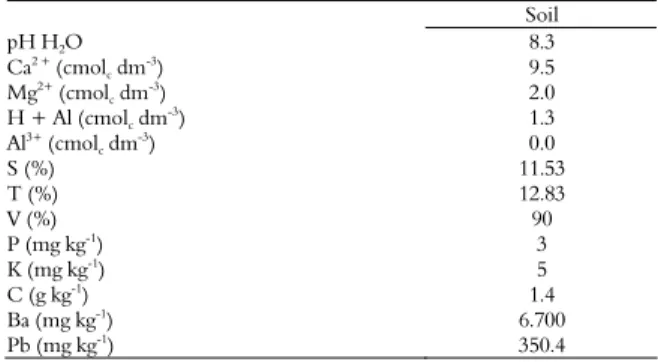
The chemical (Table 1) and physical characteristics of soil samples were determined according to Embrapa (1997). A soil particle size analysis showed a silt content of 62%, a sand content of 38% and a negligible percentage of clay.
Contaminated soils were used to assess the ability of Brachiaria decumbens cv. Basilisk to phytoextract Ba and Pb in the presence of EDTA. The experiment was assembled and conducted in a greenhouse at the Federal Rural University of Rio de Janeiro (‘Universidade Federal Rural do Rio de Janeiro’), and the contaminated soil samples were collected in Santa Maria do Oeste in the Brazilian State of Paraná.
Pots were filled with 4 kg of contaminated soil, and 24 seeds were placed in each pot. After sprouting, the number of plants was thinned to four
per pot. The pots were maintained at a moisture content equivalent to 80% the field capacity by the addition of deionised water. After the first month, approximately 100 mL of a one-quarter-strength Hoagland solution (HOAGLAND; ARNON, 1950) were added every three days. Two treatments plus the control were used; one treatment received a split application of EDTA, and the other received a single dose of EDTA. Each condition had four replicates for a total of 12 experimental units.
Table 1. Chemical characterisation of the soil used in the experiment.
Soil
pH H2O 8.3
Ca2 + (cmol
c dm-3) 9.5
Mg2+ (cmolc dm
-3
) 2.0 H + Al (cmolc dm
-3) 1.3
Al3+ (cmolc dm
-3
) 0.0
S (%) 11.53
T (%) 12.83
V (%) 90
P (mg kg-1) 3
K (mg kg-1
) 5
C (g kg-1) 1.4
Ba (mg kg-1) 6.700
Pb (mg kg-1
) 350.4
pH in water (1:2.5); Ca and Mg, H+Al – extracted in 1 mol L-1 KCl; Al - extracted in
1 mol.L-1 calcium acetate at pH 7.0; P - extracted with North Carolina solution;
K - extracted with 0.5 mol.L-1 potassium dichromate; C – Walkley – Black; Ba and
Pb - aqua regia digestion (pseudototal) (ISO 11466, 1995).
The treatment with a split application of EDTA, applied via the surface pot, consisted of three doses of 2 mmol EDTA kg-1 soil (0.6 mg EDTA g-1 soil).
The first dose was administered at 120 days after sowing the plants followed by two additional applications at intervals of seven days. The single EDTA dose was administered by the addition of 6 mmol EDTA kg-1 (1.8 mg EDTA g-1 soil) on the day
of the last dose in the split application treatment. Soil samples were collected at five days after the first application of 2 mmol EDTA kg-1 soil in the
split application treatment and after the application of 6 mmol EDTA kg-1 soil in the single-dose
treatment. The samples were subjected to sequential extractions using the method proposed by Ure et al. (1993) as modified by Rauret et al. (1999).
The plants were collected one month after the final application of EDTA, which completed a cycle of 164 days. After collection, the roots and leaves were separated, weighed, rinsed in deionised water and placed in an oven at 70 °C until a constant weight was obtained. The samples were ground and then digested using a 6:1 nitryl perchlorate solution according to the method of Tedesco et al. (1995).
detection (LD) and limit of quantitation (LQ) for Ba were 0.036 mg kg-1 and 0.36 mg kg-1, respectively,
and the LD and LQ for Pb were 0.020 mg kg-1 and
0.067 mg kg-1, respectively, in the soil digestion
extracts. The LD was calculated as the mean of the blanks plus three standard deviations of the blanks from all analyses (10 replicates). The National Institute of Standards and Technology (NIST) certified standard reference material (SRM) 22709a (San Joaquin soil; Ba and Pb concentrations of 979 ± 28 and 17.3 ± 0.1 mg kg-1, respectively) was used
to validate the determination of the pseudototal contents of Ba and Pb in the soil. NIST certified SRM 1573a (tomato leaves; Ba concentration of 63 ± 0.7 mg kg-1) was used to validate the Ba
contents of the plant material, and NIST certified SRM 1547 (peach leaves; Pb concentration of 0.87 ± 0.03 mg kg-1) was used to validate the Pb contents
of the plant materials. All analyses of the certified samples showed a range of recovery of 93-95%, which was within the ranges accepted as normal by NIST for soil and plant samples.
To evaluate the potential of Brachiaria to extract Pb and Ba, we determined the bioaccumulation factor (AF) and the index of translocation (IT) of each element in the plant according to Araújo et al. (2011); The phytoextraction efficiency (PE) was determined according to Vysloužilová et al. (2003), as described below:
AF = M (aerial part) / M (soil)
IT = (accumulation of the element in the aerial part / accumulation of the element in the plant) * 100.
PE = [M(plant) x Plant weight / M(soil) x pot weight] x 100, where M is the concentration of the metal contaminant.
The data were evaluated by analysis of variance using the F test (p < 0.05), and the means were compared using Tukey's test (p < 0.05). The analyses were performed using the statistical software SAEG statistical software package, version 9.0 (Arthur Bernardes Foundation at the Federal University of Viçosa, Viçosa State, Minas Gerais).
Results and discussion
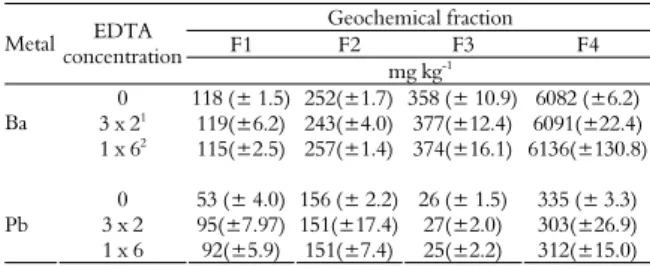
The geochemical fractionation of contaminated soil samples (Table 2) showed that the Ba was almost entirely in the most recalcitrant fraction (F4 - residual), thus resulting in low concentrations in the other soil fractions. The presence of EDTA, both in the split application and single-dose treatments, did not produce significant differences between the different factions. Studies conducted by Smeda and Zyrnicki (2002) also found higher levels
of Ba in the residual fraction. The occurrence of Ba in the soil, especially in the residual fraction, and the Ba2+ ion in the soil tends to be precipitated and
adsorbed over time in the form of oxides and hydroxides (PICHTEL et al., 2000).
Table 2. Geochemical fractionation of Ba and Pb in contaminated soils and soils with different EDTA concentrations.
Geochemical fraction
F1 F2 F3 F4
Metal EDTA
concentration
mg kg-1
0 118 (± 1.5) 252(±1.7) 358 (± 10.9) 6082 (±6.2) 3 x 21 119(±6.2) 243(±4.0) 377(±12.4) 6091(±22.4) Ba
1 x 62 115(±2.5) 257(±1.4) 374(±16.1) 6136(±130.8)
0 53 (± 4.0) 156 (± 2.2) 26 (± 1.5) 335 (± 3.3) 3 x 2 95(±7.97) 151(±17.4) 27(±2.0) 303(±26.9) Pb
1 x 6 92(±5.9) 151(±7.4) 25(±2.2) 312(±15.0)
F1 - acid-soluble fraction; F2 - fraction bound to iron oxides and manganese oxides; F3 - fraction bound to organic matter and sulphides; F4 - Residual. The values correspond to an average of 4 treatments ± standard deviation. There was no significant difference (Tukey’s test at 5% significance) between treatments. 1: Treatment with three applications of EDTA at 2 mmol kg-1 soil. 2: Treatment with the application of a single
dose of EDTA at 6 mmol kg-1
soil.
In the control, approximately 10% of the total Pb content was detected in the exchangeable phase (F1), where electrostatic and carbonate bonds occur, and approximately 30% occurred in the fraction bound to oxides (F2). This binding of Pb to carbonates and oxides was also mentioned by Pichtel et al. (2000). The Pb has a high affinity for iron oxides and, in particular, manganese oxides (XIA et al., 2009).
The addition of EDTA caused a significant change in the distribution of Pb in the geochemical fractions of the soil. Significant increases in Pb concentrations were observed in the soluble acid fractions (F1). Studies by Grčman et al. (2001) and Saifullah et al. (2009) also showed a marked increase in Pb levels in the soil solution with the addition of 3 mmol L–1 EDTA.
The plants developed without any symptoms of stress until the addition of EDTA. The treatment that received the first of three doses of 2 mmol EDTA kg-1 soil began to show leaves with a more
intense green colour at 125 days after sowing. In the treatment that received a single dose of EDTA (6 mmol EDTA kg-1 soil), the plants showed
a yellowing of the leaves at 140 days after sowing; this yellowing continued until the time of collection. These symptoms could be attributed to the solubilisation of metals in the soil at levels greater than the phytotoxicity limit in the region of the rhizosphere as well as the phytotoxicity of the EDTA itself (EVANGELOU et al., 2007).
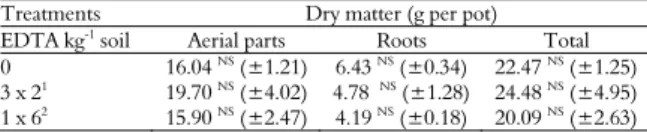
EDTA under the experimental conditions. In an evaluation of the effect of EDTA on the induced phytoextraction of Zn and Cd by Brachiaria
decumbens, Santos et al. (2006) also found that this
plant had a tolerance to high concentrations of Zn and Cd in the soil.
Table 3. Dry matter production in the different vegetative parts
of Brachiaria decumbens grown in contaminated soil with varied
concentrations of EDTA.
Treatments Dry matter (g per pot)
EDTA kg-1
soil Aerial parts Roots Total
0 16.04 NS (±1.21) 6.43 NS (±0.34) 22.47 NS (±1.25) 3 x 21 19.70 NS (±4.02) 4.78 NS (±1.28) 24.48 NS (±4.95) 1 x 62 15.90 NS (±2.47) 4.19 NS (±0.18) 20.09 NS (±2.63)
Values correspond to the means of four treatments ± standard deviation. NS - no significant difference (Tukey’s test at 5% significance) in column. 1: Treatment with 3 applications of EDTA at 2 mmol kg-1 soil. 2: Treatment with the application of a
single dose of EDTA at 6 mmol kg-1
soil.
Neugschwandtner et al. (2008) studied the application of split and single doses of EDTA and showed that signs of phytotoxicity in corn plants were more visible after the application of a single dose; the single dose also led to the death of the plants before harvest in some cases. According to Barocsi et al. (2003), the addition of the same amount of EDTA in split doses can increase the plants’ resistance to damage caused by heavy metals and EDTA compared to a single dose.
There was no significant difference in the concentration of Ba among the treatments (Table 4), which may have been caused by the low bioavailability of this element in the soil (Table 1).
Table 4. Concentrations of Ba and Pb in the leaves and roots of
Brachiaria decumbens (mg kg-1) grown in contaminated soil and
under different concentrations of EDTA.
Leaf Root
Metal 0 3 x 21 1 x 62
0 3 x 2 1 x 6
Ba 26.9 NS
(±5.8) 27.3 NS (±2.8)
24.3 NS (±1.28)
17.6 NS (±1.03)
18.5 NS (±2.56)
20.9 NS (±4.7)
Pb 0.5 C
(±0.0) 1.41 B (±0.07)
9.02 A (±3.18)
1.41 B (±0.18) 5.3 A (±1.11)
4.2 A (±0.90)
The values correspond to the means of four treatments ± standard deviation. Different letters along the rows indicate statistically significant differences (Tukey’s test at 5% significance or less) between the plant parts. NS = Not significant. 1: Treatment with three applications of EDTA at 2 mmol kg-1 soil. 2: Treatment with the application of a
single dose of EDTA at 6 mmol kg-1 soil.
However, there was a marked increase in the Pb concentrations in the leaves relative to the control plants, especially in the treatment with the application of a single dose of EDTA at 6 mmol kg-1
soil. The addition of EDTA also led to an increase in the concentration of Pb in the roots. The induction of Pb uptake by plant roots has also been observed by other authors (DOUMETT et al., 2008; KIM et al., 2003; LESTAN et al., 2007) and is in agreement with the geochemical fractionation results (Table 2). Although no significant difference was found in the geochemical fractionation of Pb
among the different treatments (Table 2), increased Pb absorption may have occurred due to the acidification of the medium in the region of the rhizosphere, which would increase the formation of soluble complexes around the roots.
The treatment with the split addition of EDTA retained the greatest amount of Pb in the roots, thereby reducing the extent of Pb translocation to the aerial parts. This greater ability to retain Pb in the roots may be due to the limited mobility of Pb within the plant (PICHTEL et al., 2000) as well as the capacity of the plant to acquire mechanisms to adapt and overcome injury caused by EDTA at lower concentrations (VASSIL et al., 1998).
The accumulation of Ba in the roots and aerial plant parts (Table 5) was not significant. However, the accumulation of Pb in the leaves was significantly higher in the treatment with a single addition of EDTA. In the roots, the application of EDTA also significantly increased the accumulation of Pb relative to the control plants.
Table 5. Accumulation of metals in the leaves and roots of
Brachiaria decumbens (mg per pot-1) grown in contaminated soil
and under different treatments with EDTA.
Leaf Root
Metal 0 3 x 21
1 x 62
0 3 x 2 1 x 6 Ba 0.42 NS (±0.08) 0.56 NS (±0.14) 0.38 NS
(±0.06) 0.11 NS (±0.01)
0.09 NS (±0.02)
0.09 NS (±0.02) Pb 0.01 C (±0.00) 0.03 B (±0.01) 0.13 A
(±0.05) 0.01 B (±0.00) 0.02 A (±0.00) 0.02 A (±0.00)
The values correspond to the mean of four replicates ± standard deviation. Different letters along the rows indicate significant differences (Tukey’s test of 5% significance or less) in each plant part. 1: Treatment with three applications of EDTA at 2 mmol kg-1
soil. 2: Treatment with the application of a single dose of EDTA at 6 mmol kg-1 soil. The IT and PE of Ba and Pb in Brachiaria
decumbens in response to the application of EDTA
are shown in Table 6.
Table 6. Index of translocation (IT) and phytoextraction efficiency (PE) in Brachiaria decumbens plants grown in contaminated soil and under different treatments with EDTA.
IT PE
EDTA Ba Pb Ba Pb
(mmol kg-1
soil) ____________________________
%____________________________
0 77.0 (±3.69) 47.6 (±5.26) 0.0018 0.0009
3 x 21 84.7 (±4.17) 53.4 (±8.40) 0.0021 0.003
1 x 62 80.6 (±4.42) 86.9 (±1.77) 0.0016 0.005
The values correspond to the mean of four replicates ± standard deviation. 1: Treatment with three applications of EDTA at 2 mmol kg-1 soil. 2: Treatment with
the application of a single dose of EDTA at 6 mmol kg-1 soil.
mobility of Pb in the plants. However, Santos et al. (2006) report that the presence of EDTA favours an increase in the Pb content in the leaves.
Despite the increased efficiency of Pb phytoextraction with the addition of EDTA when compared to controls, especially in treatments with a single-dose application, the values obtained in the present study are much lower than those reported by Huang et al. (1997) who state that greater than 1% of the total metal in the soil should be absorbed by the aerial parts for phytoextraction to be economically feasible. Similar results were observed by Neugschwandtner et al. (2008) who studied EDTA-induced the phytoextraction of Pb in corn.
The results of the present study suggest that the application of a single dose of EDTA enhanced the efficiency of Pb accumulation and translocation to the aerial plant parts. Similar results were reported by Neugschwandtner et al. (2008).
Conclusion
The application of EDTA did not influence the absorption of Ba in plants.
The application of EDTA caused an increase in the concentration of Pb in plants.
The application of EDTA increased the rate of Pb translocation to the aerial parts.
The efficiency of Pb phytoextraction was low, and under the experimental conditions, Brachiaria
decumbens doesnot have the potential to be used in
phytoextraction programs.
References
ARAÚJO, S. A. A.; GUILHERME, L. R. G.; LOPES, G.; CAMPOS, M. L. Phytoremediation of arsenic-contaminated soils using Brachiaria grass. Ciência Agrotécnica, v. 35, n. 1, p. 84-91, 2011.
BAROCSI, A.; CSINTALAN, Z.; KACSANYI, L.; DUSHENKOV, S.; KUPERBERG, J. M.; KUCHARSKI, R.; RICHTER, P. I. Optimizing phytoremediation of heavy metal-contaminated soil by exploring plants’ stress adaptation.
International Journal of Phytoremediation, v. 5, n. 1,
p. 13-23, 2003.
DEUEL JR., L. E.; HOLLIDAY, G. H. Soil remediation
for the petroleum extraction industry. 2nd ed.
Oklahoma: PennWell, 1997.
DOUMETT, S.; LAMPERI, L.; CHECCHINI, L.; AZZARELLO, E.; MUGNAI, S.; MANCUSO, S.; PETRUZZELLI, G.; DEL BUBBA, M. Heavy metal distribution between contaminated soil and Paulownia tomentosa, in a pilot-scale assisted phytoremediation study: Influence of different complexing agents. Chemosphere, v. 72, n. 10, p. 1481-1490, 2008.
EMBRAPA-Empresa Brasileira de Pesquisa Agropecuária.
Manual de métodos de análises de solos. Rio de
Janeiro: CNPS, 1997.
EVANGELOU, W. H. M.; EBEL, M.; SCHAEFFER, A. Chelate assisted phytoextraction of heavy metals from soil. Effect, mechanism toxicity and fate of chelating agents.
Chemosphere, v. 68, n. 6, p. 989-1003, 2007.
GRATÃO, L. P.; PRASAD, V. V. M.; CARDOSO, F. P.; LEA, J. P.; AZEVEDO, A. R. Phytoremediation: green technology for the clean up of toxic metals in the environment. Brazilian Journal of Plant Physiology, v. 17, n. 1, p. 53-64, 2005.
GRČMAN, H.; VELINKONJA-BOLTA, S.; VODNIK,
D.; LESTAN, D. EDTA enhanced heavy metal phytoextraction: metal accumulation, leaching and toxicity. Plant and Soil, v. 235, n. 1 , p. 105-114, 2001. HOAGLAND, D. R.; ARNON, D. L. The water-culture method for growing plants without soil. California
Agricultural Experimental Station Circular, v. 347,
n. 2, p. 347-352, 1950.
HUANG, J. W.; CHEN, J.; BERTI, W. R. Phytoremediation of Pb-contaminated soils: role of synthetic chelates in lead
phytoextraction. Environmental Science and
Technology, v. 31, n. 3, p. 800-805, 1997.
ISO 11466. Soil quality – Extraction of trace elements soluble in aqua regia. Geneva: International Organisation for Standardisation, 1995.
KIM, C.; LEE, Y.; ONG, S. K. Factors affecting EDTA extraction of lead from lead-contaminated soils.
Chemosphere, v. 51, n. 9, p. 845-853, 2003.
LESTAN, D.; LUO, C.-L.; LI, X.-D. The use chelating agents in the remediation of metal-contaminated soils: A review. Environmental Pollution, v. 153, n. 1, p. 3-13, 2007.
MEERS, E.; RUTTENS, A.; HOPGOOD, M. J.; SAMSON, D.; TACK, F. M. G. Comparison of EDTA and EDDS as potential soil amendments for enhanced phytoextraction of heavy metals. Chemosphere, v. 58, n. 8, p. 1011-1022, 2005.
NEUGSCHWANDTNER, W. R.; TLUSTOS, P.; KOMÁREK, M.; SZÁKOVÁ, J. Phytoextraction of Pb and Cd from a contaminated agricultural soil using different EDTA application regimes: Laboratory versus field scale measures of efficiency. Geoderma, v. 144, n. 3, p. 446-454, 2008.
PICHTEL, J.; KUROIWA, K.; SAWYERR, H. T. Distribution of Pb, Cd and Ba in soils and plants of two contaminated sites. Environmental Pollution, v. 110, n. 1, p. 171-178, 2000.
PULFORD, I. D.; WATSON, C. Phytoremediation of heavy metal-contaminated land by trees – a review.
Environmental International, v. 29, n. 4, p. 529-540,
2003.
SAIFULLAH, M. E.; QADIR, M.; CARITAT, P.; TACK, F. M. G.; DU LAING, G.; ZIA, M. H. EDTA-assisted Pb phytoextraction. Chemosphere, v. 74, n. 10, p. 1279-1291, 2009.
SALT, D. E.; SMITH, R. D.; RASKIN, I. Phytoremediation. Annual Review of Plant Physiology
and Plant Molecular Biology, v. 49, n. 1, p. 643-668,
1998.
SANTOS, F. S.; HERNÁNDEZ-ALLICA J.; BECERRIL, M. J.; AMARAL SOBRINHO, N.; MAZUR, N.; GARBISU, C. Chelate-induced phytoextraction of metal polluted soils with Brachiaria decumbens. Chemosphere, v. 65, n. 1, p. 43-50, 2006.
SMEDA, A.; ZYRNICKI, W. Application of sequential extraction and the ICP-AES method for study of the partitioning of metals in fly ashes. Microchemical Journal, v. 72, n. 1, p. 9-16, 2002.
TEDESCO, M. J.; GIANELLO, C.; BISSANI, C. A.; BOHNEN, H.; VOLKWEISS, S. J. Análise de solo,
plantas e outros materiais. Porto Alegre: Brasil, 1995.
URE, A. M.; QUEVAUVILLER, P.; MUNTAU, H.; GRIEPINK, B. Speciation of heavy metals in soils and sediments. An account of the improvement and harmonization of extraction techniques undertaken under the auspices of the BCR of the Commission of the
European Communities. International Journal of
Environmental Analytical Chemistry, v. 51, n. 1,
p. 135-151, 1993.
VASSIL, A. D.; KAPULNIK, Y.; RASKIN, I.; SALT, D. E. The role of EDTA in lead transport and accumulation by Indian mustard. Plant Physiology, v. 117, n. 2, p. 447-453, 1998.
VYSLOUŽILOVÁ, M.; TLUSTOŠ, P.; SZÁKOVÁ, J. Cadmium and zinc phytoextraction potential of seven clones of Salix spp. planted on heavy metal contaminated soils. Plant Soil and Environment, v. 49, n. 12, p. 542-547, 2003.
XIA, W.; GAO, H.; WANG, X.; CHUNHUA, Z.; LIU, Y.; FAN, T.; WANG, X. Application of EDTA decontamination on soils affected by mining activities and impact of treatment on the geochemical partition of metal contaminants. Journal of Hazardous Materials, v. 164, n. 2, p. 936-940, 2009.
Received on August 7, 2012. Accepted on November 7, 2012.
License information: This is an open-access article distributed under the terms of the Creative Commons Attribution License, which permits unrestricted use, distribution, and reproduction in any medium, provided the original work is properly cited.