
Jorge Miguel Ribeiro Dias
Bachelor of Science in Biomedical EngineeringDevelopment of a neurofeedback-based virtual
reality environment
Dissertation submitted in partial fulfillment of the requirements for the degree of
Master of Science in Biomedical Engineering
Adviser: Hugo Alexandre Ferreira, Assistant Professor, Instituto de Biofísica e Engenharia Biomédica, Faculdade de Ciências da Universidade de Lisboa
Examination Committee
Chairperson: Prof. Dr. Carla Maria Quintão Pereira Members: Dr. Daniel Simões Lopes
Development of a neurofeedback-based virtual reality environment
Copyright © Jorge Miguel Ribeiro Dias, Faculty of Sciences and Technology, NOVA Uni-versity of Lisbon.
The Faculty of Sciences and Technology and the NOVA University of Lisbon have the right, perpetual and without geographical boundaries, to file and publish this disserta-tion through printed copies reproduced on paper or on digital form, or by any other means known or that may be invented, and to disseminate through scientific reposito-ries and admit its copying and distribution for non-commercial, educational or research purposes, as long as credit is given to the author and editor.
This document was created using the (pdf)LATEX processor, based in the “unlthesis” template[1], developed at the Dep. Informática of FCT-NOVA [2].
À minha Mãe e ao meu Pai, pela paciência e motivação.
A c k n o w l e d g e m e n t s
Um enorme obrigado a todos aqueles que contribuíram, de alguma forma, para a minha formação universitária, que culmina com a elaboração desta tese; à minha Mãe e ao meu Pai, pelas possibilidades e pela educação, à minha irmã pela irmandade imortal, à Andreia Fradique pelo incentivo, à Rafaela Reis pela alegria, ao Flávio "Sem Cura" Jacinto pela garra, ao Ricardo Ferreira pelo exagero, ao João Baptista pelo atrofio, ao Rodrigo "Rambo" Santos pela modéstia, à Raquel "Guerreira" Lourenço pela resiliência, à Patrícia Lopes pela atitude, ao Diogo Santos pela despreocupação, ao Diogo "Piolho" Antunes pela camaradagem, ao João "Flamingo" Pereira pelo anhanço, ao André "Albino" Oliveira pela tranquilidade, ao Diogo "Padeiro" Silva pelo optimismo, ao João "Bolorrei" Ameixa pelo empenho, ao Miguel "Grelo" Gomes pela divagação, à Raquel "Terça-Feira" Cunha pelo sossego, à Laura Ribeiro pela aventura, à Sara "Sibelius" Cunha pela revolta, à Ana Rita Ensina pela serenidade, ao Francisco "Xico" Pinto pela filosofia, ao Eduardo "Vianas" Pontes pela iniciativa, à Bárbara Lopes pela confiança, ao Duarte "Dudu" Paulo pelo caos, ao José "Zé Carlos" Barbosa pela animação, ao Bernardo "Benny" Canelas pela aleatoriedade, ao André "Tonel" Duarte pela força, à Filipa "Fi" Belo pela insatisfação, à Catarina Castro pela bondade, à Mariana Barros pelo sonho, à Rita Catarino pelo apoio, à Cindy Vieira pela partilha, à Filipa Carvalho pela descontracção. A toda a minha família pelo inesgotável suporte. A todos os membros, passados e presentes, caloiros e tunos, activos e inactivos da anTUNiA - Tuna de Ciências e Tecnologia da Universidade Nova de Lisboa, pelas perspectivas, pela responsabilidade e pelas lições de vida. A toda a comunidade do grandioso curso que é o Mestrado Integrado em Engenharia Biomédica na FCT-UNL. E a todos aqueles que alguma vez cruzaram o meu caminho na comunidade FCTense.
My deepest appreciations for cgtrade user "ionchris", for the head model, for "Hedge-hog Team" from the Unity®asset store, for the skybox, for artist C418, for the creation of the whole Minecraft OST, and for all of the test subjects who sacrificed part of their time to contribute to this thesis project.
I would also like to express my gratitude to the Instituto de Biofísica e Engenharia
A b s t r a c t
Recent technology has continuously expanded the reaching spectre of psychotherapy. In the latest years, the development of digital environments, coupled with the evolution of sensorial hardware, has demonstrated usefulness and effectiveness in some areas of
psychotherapy such as phobia treatment and attention deficit hyperactivity disorder man-agement through neurofeedback training. However, the generality of these equipments is very expensive.
In this project, an audiovisual stimuli virtual reality environment was developed, ca-pable of displaying signals provided by an electroencephalography-based brain-computer interface. This environment has the objective of providing its user with neurofeedback training and being suited for affordable hardware equipments.
Development of the aforementioned environment took place in the Unity3D ® game engine version 5.3.0f4, using C# scripting developed in Microsoft ® Visual Studio 2015TM. As for the virtual reality display, an Oculus Rift ® development kit 1 was used for testing, together with the Oculus runtime for Windows ®, version 0.8.0.0. The used brain-computer interface was Neurosky’s Mindband TM, a research tool with a single electroencephalography channel, mediated through the ThinkGear Connector, version 3.1.8.0.
The creation of this environment as an application directed towards neurofeedback training and compatible with affordable equipments is a contribution towards a reality
where virtual reality is more synchronized with our society.
R e s u m o
Recentemente, a tecnologia tem contribuído progressivamente para o desenvolvi-mento das metodologias aplicadas em psicoterapia. Nos últimos anos, o desenvolvidesenvolvi-mento de ambientes virtuais digitais, agregado à evolução dehardwaresensorial, tem demons-trado particular utilidade e eficácia em algumas das áreas da psicoterapia, como por exemplo no tratamento de fobias e ainda no tratamento de défice de atenção através de treino deneurofeedback. No entanto, a generalidade destes equipamentos é muito dispen-diosa.
Neste projecto, foi desenvolvido um ambiente audiovisual de realidade virtual, capaz de exibir sinais eletroencefalográficos oriundos duma interface cérebro-computador. Este ambiente tem o objectivo de providenciar ao seu utilizador treino deneurofeedbacke de ser compatível com equipamentos acessíveis em termos de preço.
Para desenvolver este ambiente, fez-se uso dogame engineUnity3D ® versão 5.3.0f4, em conjunto com scriptingem C#, desenvolvido no Microsoft ® Visual Studio 2015TM. Quanto à interface de realidade virtual utilizada, foi seleccionado o Oculus Rift ® deve-lopment kit 1 para testar o programa, em conjunto com o Oculus Runtime for Windows ®, versão 0.8.0.0. Finalmente, a interface cérebro-computador utilizada foi a Mindband
TMda Neurosky ® , uma ferramenta exclusiva a investigação, contendo um único canal
EEG, comunicando com o computador através do ThinkGear Connector, versão 3.1.8.0. A criação deste ambiente com vista a treino deneurofeedbacke compatibilidade com equipamentos financeiramente acessíveis é um contributo no sentido de que a realidade virtual seja um conceito mais inserido no paradigma da nossa sociedade.
C o n t e n t s
List of Figures xv
List of Tables xvii
Glossary xix
Acronyms xxi
1 Introduction 1
1.1 Context and Motivation . . . 1
1.2 Objectives . . . 2
1.3 Dissertation Layout . . . 2
2 Theoretical Background 3 2.1 Virtual Reality . . . 3
2.2 Psychology . . . 5
2.2.1 Cyberpsychology . . . 5
2.3 Electrophysiology . . . 7
2.3.1 Electroencephalography . . . 7
2.3.2 Electrocorticography . . . 10
2.4 Brain-Computer Interfaces . . . 11
2.5 Neurofeedback . . . 12
2.5.1 Medical Uses . . . 13
2.5.2 Non-Medical Uses . . . 13
2.6 Game Engines . . . 14
3 State of the Art 17 3.1 Virtual Reality Head-Mounted Displays . . . 17
3.1.1 Oculus Rift ® . . . 18
3.1.2 Playstation VR ® . . . 19
3.1.3 HTC Vive ® . . . 20
3.2 Non-Invasive EEG Brain-Computer Interfaces . . . 21
3.2.1 Neurosky ® . . . 21
C O N T E N T S
3.2.3 OpenBCI ® . . . 24
3.3 3D Game Engines . . . 26
3.3.1 Unity3D ® . . . 26
3.3.2 Unreal Engine ® . . . 27
3.4 Neurofeedback Technology . . . 28
4 Materials and Methods 29 4.1 Materials . . . 29
4.1.1 Virtual Reality Head Mounted Display . . . 29
4.1.2 Non-Invasive EEG Brain-Computer Interface . . . 30
4.1.3 3D Game Engine . . . 31
4.2 Methods . . . 32
4.2.1 Scene Set-up . . . 32
4.2.2 Visual Effects . . . . 35
4.2.3 Sound Effects . . . . 37
4.2.4 Scripting . . . 37
4.2.5 Connectivity . . . 41
4.2.6 Electrode Color . . . 41
4.2.7 Neurofeedback Testing . . . 43
5 Results and Discussion 47 5.1 The Application . . . 47
5.2 Neurofeedback testing . . . 49
6 Conclusions and Future Work 51 6.1 Conclusions . . . 51
6.2 Future Work . . . 52
Bibliography 53
L i s t o f F i g u r e s
2.1 The Rift®, a VR HMD developed by Oculus® . . . 5
2.2 Distractions in a VR environment, created for ADHD diagnosis and therapy. Adapted from [28] . . . 7
2.3 The most common systems of electrode placement . . . 8
2.4 The 10-20 system for electrode placement. Adapted from [32] . . . 8
2.5 Examples of BCIs . . . 12
2.6 The stage in which the My Virtual Dream experience took place . . . 14
2.7 A Unity3D® generated environment for use in arachnophobia VRET . . . . 14
2.8 Modular game engine structure. Adapted from [51] . . . 15
3.1 The three existing versions of The Rift® . . . 18
3.2 Sony®’s Playstation VR. . . 19
3.3 The HTC Vive, developed by HTC®and Valve Corporation®. . . 20
3.4 Three of the most featured Neurosky’s® Brain-Computer Interface (BCI) prod-ucts. . . 22
3.5 EMOTIV®’s current BCI products. . . 23
3.6 OpenBCI®’s available board kits. . . 24
3.7 OpenBCI®’s available board kits. . . 25
3.8 A typical user interface in Unity3D® 5. . . 26
3.9 The interface of Unreal Engine®4. . . 27
4.1 Oculus®’ runtime software version 0.8.0.0. . . 30
4.2 Default structure of Unity®’s interface. . . 31
4.3 Hierarchical representation of Unity®’s classes. . . 32
4.4 Head models initially considered for the application . . . 33
4.5 The head model used for the application . . . 33
4.6 Arrangement of the sphere objects, according to the 10-10 electrode placement system. . . 34
4.7 The object created as a base for the model. . . 34
4.8 The DeepSpaceGreen skybox, together with the complete head model. . . 35
4.9 Comparison between the display with and without filters. . . 36
L i s t o f F i g u r e s
4.11 Unity®’s scene view, with the y axis represented in green. . . 38
4.12 The several User Interface (UI)s developed for the application. . . 39
4.13 Detailed digital format of an .edf file [82]. . . 40
4.14 Application running a file while in File Reading Mode. . . 42
4.15 Application showing Raw Electroencephalography (EEG) while in Live BCI Mode. . . 43
5.1 Several aspects of the developed application. . . 48
L i s t o f Ta b l e s
3.1 Technical description of the most relevant aspects of Virtual Reality (VR) HMDs 17
3.2 Technical comparison between the 3 released versions of The Rift®[54]. . . . 18
3.3 Technical specifications of the to-be released Playstation VR®[56]. . . 19
3.4 Technical specifications of the HTC Vive®[57]. . . 20
3.5 Technical description of the most relevant aspects of EEG BCIs . . . 21
3.6 Technical comparison between 3 of NeuroSky®’s products [59]. . . 22
3.7 Technical comparison between the 2 lead products of EMOTIV Inc.®[62, 63, 64]. . . 23
3.8 Technical comparison between the 2 boards developed by OpenBCI®[69, 70]. 25 3.9 Description of the equipment included in some of the cheapest Neurofeedback (NFB) training products available in the market [78, 79, 80]. . . 28
4.1 Description of the raw values indicated by each color. . . 42
4.2 Description of the values indicated by each color. . . 43
4.3 Experimental procedures applied to the control and study groups. . . 44
5.1 Description of the available commands in the application. . . 47
5.2 Results obtained from the control group. . . 49
5.3 Results obtained from the study group. . . 49
A.1 Spatial coordinates of the electrode objects. . . 61
G l o s s a r y
biofeedback Process of gaining awareness of physiological functions by means of a de-termined instrument, being able to manipulate them at will.
chromatic aberration The visual effect produced by the refraction of different
wave-lengths of light through different angles.
dongle Small hardware device that gains additional functionality when connected to
another device .
Fourier transform A series of sinusoidal functions resulting from the decomposition of a periodic function.
freeware Proprietary software available for free.
gamification The utilization of typical game elements in the managing of other areas of activity.
hemispatial neglect Neuropsychological condition in which damage to one of the brain’s hemispheres generates a deficit in attention and awareness of one side of space.
hyperactivity Exaggerated physical activity.
immersion State in which the mind has the perception of being present in a non-physical world.
object-oriented Defines a programming language which enables a system to be modelled as a set of objects that can be controlled and manipulated in a modular manner.
physiology The branch of biology that analyses the functionality of living organisms and their bodily components.
pixelation Visible presence of small square display elements.
G L O S SA RY
psychology The branch of social studies which embraces the study of the mind and
behaviour.
psychotherapy The use of psychological methods to improve on a person’s mental con-dition.
A c r o n y m s
3D Three-Dimensional.
ADHD Attention Deficit Hyperactivity Disorder.
BCI Brain-Computer Interface.
Cg C for Graphics.
CV1 Consumer Version 1.
DK1 Development Kit 1.
DK2 Development Kit 2.
ECoG Electrocorticography.
EEG Electroencephalography.
HDMI High-Definition Multimedia Interface.
HDR High Dynamic Range.
HEG Hemoencephalography.
HMD Head Mounted Display.
IBEB Instituto de Biofísica e Engenharia Biomédica.
LCD Liquid-Crystal Display.
LDA Linear Discriminant Analysis.
LED Light-Emitting Diode.
MCMI Millon Clinical Multiaxial Inventory.
AC R O N Y M S
NFB Neurofeedback.
ns number of signals.
NSD Normalised Slope Descriptor.
nsdr number of samples in each data record.
OLED Organic Light-Emitting Diode.
OS Operating System.
OST Original Soundtrack.
POV Point Of View.
PS4 PlayStation 4.
PTSD Posttraumatic Stress Disorder.
qEEG Quantitative EEG.
RF Radio Frequency.
RGB Red Green Blue.
rtfMRI Real-time Functional Magnetic Resonance Imagining.
SDK Software Development Kit.
SMR Sensory Motor Rhythm.
UI User Interface.
USB Universal Serial Bus.
VCASS Visually Coupled Airborne Systems Simulator.
VIVED Virtual Visual Environment Display.
VPL Visual Programming Languages.
VR Virtual Reality.
C
h
a
p
t
e
r
1
I n t r o d u c t i o n
1.1 Context and Motivation
Technology has been continuously evolving at an exponential rate in the past few decades. With the appearance of computers, science has made unforeseen breakthroughs in many fields, shifting a multitude of paradigms and subsequently creating numerous new tech-nologies, many inconceivable a century ago. We are striving to conquer the seas, the skies, space, life, energy, matter, everything.
This evolution comes as a consequence of the eternal search the human race has pledged itself into, ever seeking to rule triumphant against the forces of nature - We seek to defeat calamity, disease and death, while pursuing comfort, entertainment and life itself. Nature, however, is a tenacious opponent; we have uncovered much, and yet, there is still much more to be uncovered. One of the most intriguing mysteries nature has presented us with, lies ironically within the element which enables us humans to unveil any kind of mystery: The human mind.
Even though we already understand the anatomical and physiological constitution of our brain, the framework of the mind is a far more complex reality to decode. It involves the way we perceive reality, the thoughts we create, the emotions we experience, the reasonings we build, the memories we store and the shady works of our subconscious. Altogether, these elements of the mind synergize in the most incomprehensible of ways, producing the experience of human conscience. Endeavouring to decipher this unsolvable labyrinth we call mind, humankind created long ago the scientific field of psychology.
C H A P T E R 1 . I N T R O D U C T I O N
Through VR, the creation of an immersion environment becomes facile, enabling a variety of psychological studies and therapies according to the design of the environment. One of such therapies is NFB. However, currently available NFB technology, besides being mostly incompatible with VR, is still very expensive.
1.2 Objectives
The prime objective for this thesis project arose as follows:
• Development of an immersive VR environment which enables the user to be con-scious of his own mental state through a visual interpretation of electrophysiological brain signals. This environment will stand out due to the combination of its VR compatibility and the general affordability of its BCI and VR equipment.
In order to reach this final intent, a subset of secondary goals had to be established for the project. These are described below, in chronological order:
• Choice of the hardware and software to interact with;
• Creation of the VR immersion environment;
• Establishment of a connection between the environment and the selected BCI;
• Establishment of a connection between the environment and the selected VR HMD;
• Preliminary testing of the environment’s efficacy as an attention NFB tool;
1.3 Dissertation Layout
This dissertation is comprised of six chapters, including the present one, a chapter which contextualizes the reader on the motivations that led to the creation of such a project. The remaining chapters are organized in the following fashion:
• Chapter 2presents and describes all of the theory that directly sustains the creation of this thesis;
• Chapter 3exposes in detail the existing cutting edge technology which may concern the objective of the project;
• Chapter 4explains which materials and methods were chosen for the development of the project, and why they were chosen;
• Chapter 5reports on the final product resultant of this thesis, commenting on some of its particularities;
C
h
a
p
t
e
r
2
T h e o r e t i c a l Ba c k g r o u n d
2.1 Virtual Reality
Virtual Reality (VR) is a broad term used to refer to multimedia that replicates immersive environments, simulating real life experiences by recreating different kinds of sensory
input; these can include taste, smell, touch, sound and sight.
In 1993, author Michael R. Heim described VR as seven distinct concepts in his works: simulation, interaction, artificiality, immersion, telepresence, full-body immersion, and network communication [1]. Throughout history, however, the conception of VR has metamorphosed, becoming essential to delve in history to fully understand the meaning of VR.
The development of the concept of VR can be traced back to the 1950s, when cine-matographer Morton Heilig developed the SensoramaTMsimulator. The simulator con-sisted of a color video display with sound, scent, wind and vibration experiences. How-ever, being a film, it did not require user interaction at all [2, 3].
Heilig also developed the Telesphere MaskTM, a precursor of the HMD concept. The Telesphere Mask provided sound and blew air currents, just like the SensoramaTM[4].
In 1961, Philco Corporation® engineers developed HeadsightTM, a HMD enabling closed-circuit remote surveillance through the use of a camera with magnetic tracking of the user’s head direction. However, this HMD was only able to provide the user with mechanical film. Computer generated imagery had not been researched yet [5].
C H A P T E R 2 . T H E O R E T I CA L BAC KG R O U N D
supported a stereo view of a computer generated environment. This HMD corrected its display according to the user’s head position and orientation [7].
In the mid 1970s, the University of Connecticut developed VIDEOPLACETM, a tech-nology capable of combining a person’s video-image with a computer generated envi-ronment, with no need of a HMD. Instead, a camera and a projection screen made this technology possible [2, 5].
In 1982, Thomas Furness developed the Visually Coupled Airborne Systems Simulator (VCASS) at the US Air Force’s Armstrong Medical Research Laboratories. This system consisted of an advanced flight simulator which supplied the pilot with additional flight information through the use of a HMD[2]. Later in that decade, he would be responsible for the direction of the Super Cockpit program, a project aiming to create a more naturally perceptual interface for the pilot, reducing the complexity and number of controls from a regular cockpit. He achieved this through the use of a HMD which, besides supplying flight information like the VCASS, was able to translate gestures, utterances and eye movements into control modalities [8].
In 1985, Michael McGreevy created the Virtual Visual Environment Display (VIVED) at the National Aeronautics and Space Administration (NASA)’s Ames Research Center. This project represented a relatively cheap, small-scale VR immersive simulation that made use of a HMD. This would eventually raise commercial interest in VR systems [9]. In the late 1980s, the company Visual Programming Languages (VPL) Research® re-leased some of the first commercially available VR devices: DataGloveTM, a hand gesture input device which recognized finger bending, positioning and orientation, containing feedback tactile vibrators [10] and EyePhoneTM, a HMD containing twin Liquid-Crystal Display (LCD) screens and stereo sound, as well as compatibility with the DataGloveTM [11]. Jaron Lanier, one of the founders of VPL Research®, was the person to coin the term Virtual Reality, in 1989 [12].
However, approximately at the same time VPL Research® released the EyePhoneTM, Autodesk Inc.® released its Cyberspace®, a HMD which came with a glove of the same kind that VPL produced, intended as a visualization tool for use with Autocad®[13].
In the beginning of the 1990s, the concept of VR gained enormous popularity. Media like Star Trek, Lawnmower Man and The Matrix divulged the term, earning VR a place in pop culture. Many VR products were developed at the time with commercial designs -mostly for gaming, but also with therapy and training purposes, among others [2].
In beginning of the 2000s, many VR products could already be found in the market-place. By 2007, Google® launched Street View®, a feature which provided panoramic views of several streets in the world through Google Maps and Google Earth [14].
2 . 2 . P S YC H O L O G Y
Figure 2.1: The Rift®, a VR HMD developed by Oculus®
To conclude, VR has slightly shifted, along the last century, its meaning and signif-icance; through technological development and cultural trending, it is now defined as, quoting Oculus®, "[. . . ] an immersive medium [which] creates the sensation of being entirely transported into a virtual (or real, but digitally reproduced) three-dimensional world [. . . ]" [16]. It is a commercially available asset, expensive but increasingly popular and, as such, extensive research is being conducted in order to evolve it further; it will keep evolving, and when it finally becomes affordable there is a high chance VR will gain
a new dimension and a more dominant role in society.
2.2 Psychology
Psychology is the branch of social sciences responsible for the study of the mind. As such, in addition to trying to decipher the process of thought and the experience of con-sciousness, psychology tries to assess and treat mental ailments and disorders. In today’s fast-paced digital world, our mind has become undeniably formatted by technology and, as a consequence of this transformation, a new area blossomed in psychology - Cyberpsy-chology.
2.2.1 Cyberpsychology
Cyberpsychology encompasses the study of the interactions between the human mind and computer multimedia, which have become increasingly abundant since the internet became commercialized [17].
C H A P T E R 2 . T H E O R E T I CA L BAC KG R O U N D
To counter these ill effects, psychology is trying to apply computer technology to
psychotherapy, for instance conducting online counselling through e-mails, online chats or video conferences. The true effectiveness of this kind of counselling has always been
contested, though [20]. On the other hand, VR has proven to be an effective method for
conducting specific types of therapy, possibly moreso than conventional therapy methods [21]. The following chapter elaborates on some of these therapies.
2.2.1.1 Types of therapy
Exposure therapy focuses on immersing patients in environments where they feel anxious, in order to build self efficacy so as to confront such situations in real life more successfully.
It is a relatively common procedure in psychology [22].
Classical procedures for this kind of therapy include flooding, implosion and system-atic desensitization.
Both flooding and implosion involve exposure to anxiety-arousing stimuli for pro-longed durations, the difference lying in the method of exposure: While flooding presents
the patient with real stimuli, implosion involves only imagination-induced stimuli [23]. Systematic desensitization, on the other side, involves teaching relaxation techniques to the patient and then having him cope with his anxieties by applying these techniques while in anxiety-inducing environments, either real or imagined [24].
Exposure therapy has shown particular effectiveness while treating phobias and
Post-traumatic Stress Disorder (PTSD), and since the moment in which VR became able to create semi-realistic environments that the concept of Virtual Reality Exposure Therapy (VRET) appeared. VRET is practical, since, contrarily to traditional flooding, it does not imply arranging for a real environment and, unlike traditional implosion, does not depend on the imagination capabilities of the patient. In recent studies it has shown relatively effective results [25, 26].
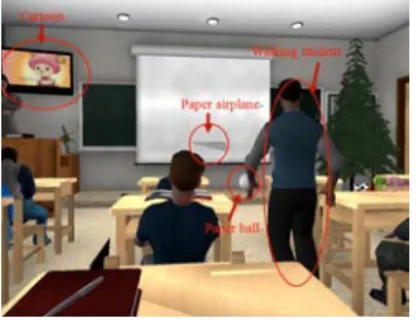
Apart from exposure therapy for anxiety-related disorders, VR appears viable and promising in a couple of other psychological conditions such as hemispatial neglect and Attention Deficit Hyperactivity Disorder (ADHD).
When applied to patients with hemispatial neglect, VR seems to provide a more precise and sensitive diagnosis than traditional diagnosis methods, providing therapists with a detailed description of a patient’s deficit in Three-Dimensional (3D) space, which might help direct training. It also appears to be more appropriate for monitoring the recovery of patients [27].
2 . 3 . E L E C T R O P H YS I O L O G Y
Figure 2.2: Distractions in a VR environment, created for ADHD diagnosis and therapy. Adapted from [28]
2.3 Electrophysiology
Electrophysiology refers to the branch of physiology that is concerned with the electrical phenomena associated with any kind of bodily activity. For this thesis, we focus on the neuronal monitoring methods existent in electrophysiology.
2.3.1 Electroencephalography
EEG is a medical imaging technique first applied in 1924. By recording the electrical activity present on the scalp, it becomes possible to directly infer on the electrical activity occuring in the brain. This procedure is absolutely non-invasive, and as such it can be repeatedly applied to patients with no kind of risk [30].
In order to process the information contained in a raw EEG signal, the two steps usually employed can be described as follows [31]:
• Feature extraction - This step aims at selecting the relevant values from the general information contained in a raw EEG signal, thus excluding noise and non-relevant information. All of the extracted features are generally compiled in a vector, known as a feature vector. Examples of these features include power spectrum bands, such as beta and alpha waves;
• Classification - This second step assigns a class, correspondent to a specific mental state, to a set of features extracted from the signal.
C H A P T E R 2 . T H E O R E T I CA L BAC KG R O U N D
2.3.1.1 Spatial Information
The conductors which contact with the scalp are called electrodes, and its placement has been the subject of thorough study. By selecting specific channels, different areas of the
brain can be studied. In figure 2.3 typical configurations of electrodes can be observed.
a Location and nomenclature of the 10-20 sys-tem
b Location and nomenclature of the 10-10 sys-tem
Figure 2.3: The most common systems of electrode placement
As reference points for positioning, the electrodes used are the nasion, placed in the delve at the top of the nose, and the inion, placed in the bone lump at the base of the skull at the back of the head. From these points, the skull perimeters are measured and divided in appropriate percentage intervals. In figure 2.4, the typical distribution of intervals for a 10-20 system can be seen [32].
a Perspective from the left side b Perspective from above
Figure 2.4: The 10-20 system for electrode placement. Adapted from [32]
The 10-10 system only differs from the 10-20 in the sense that instead of the 20%
2 . 3 . E L E C T R O P H YS I O L O G Y
2.3.1.2 Spectral Information
Typically, raw EEG signals range from 0.5 to 100 µV in amplitude and commonly form sinusoidal wave patterns. By means of a Fourier transform, we can obtain a power spec-trum from the raw EEG, allowing to scrutinize the dominance of certain frequencies over time. These frequencies appear in specific regions of the brain and are categorized as follows [30]:
• Beta waves: (13-30 Hz) measured in the parietal and frontal lobes, these waves are regarded as the "normal" brain activity, corresponding to someone who is awake and with his eyes open;
• Alpha waves: (8-13 Hz) measured in the occipital region, they evidence an awake albeit relaxed consciousness;
• Mu waves: (8-12 Hz) measured in the sensorimotor cortex, they show a rest-state of the motor neurons;
• Delta waves: (0.5-4 Hz) measured in the frontal region, these waves are typically associated with a deep sleep state;
• Theta waves: (4-8 Hz) measured in various regions, they may represent a state of lethargic consciousness or light sleep;
• Gamma waves: (> 30 Hz) measured in the somatosensory cortex, they translate a state of active information processing in the cortex.
2.3.1.3 Temporal Information
Temporal features of an EEG signal involve the analysis of EEG signal values at different
points in time or in different time windows. To select the optimal points in time for
this analysis, several statistical indicators are used; these are known as time domain parameters [31].
One of the most commonly used sets of indicators for EEG processing are the Hjorth parameters; these three parameters are called the Hjorth Activity, the Hjorth Mobility and the Hjorth Complexity. They are Normalised Slope Descriptor (NSD)s which can be described in the following terms [33]:
Activity constitutes the signal’s power, which can be translated as the surface of the signal’s power spectrum. It is illustrated as the variance of the time function correspond-ing to the representation of the signal. It can be displayed as follows:
C H A P T E R 2 . T H E O R E T I CA L BAC KG R O U N D
Mobility refers to the mean frequency of the power spectrum. It can be described as such:
Mobility
=
r
Activity(dydt(t))
Activity(y(t))
Complexity alludes to the change in frequency of the signal, by comparing it to a pure sine wave:
Complexity
=
Mobility(dy(t)
dt )
Mobility(y(t))
2.3.1.4 Classification
In order to translate the extracted features into mental states, either regression or classifi-cation algorithms can be used. By far, the most used algorithms in the BCI community are classifiers, which are characterized by their use of training sets (labeled feature vectors, gathered by means of training examples) [31].
These algorithms either model the area covered by the training feature vectors from each class (generative classifiers) or model the boundary between the areas of these vectors (discriminant classifiers). In BCI, the most used classifiers are of the discriminant kind, notably Linear Discriminant Analysis (LDA) classifiers [31].
LDA classifiers make use of hyperplanes to separate the feature vectors representing each different class. Besides having very low computational requirements, their simplicity
makes them good at generalizing unseen data, and consequently suitable for BCI systems [31].
2.3.1.5 Medical Applications
Some of the most important current medical applications of EEG include diagnosis of sleep disorders and assistance of disabled people with daily living tasks through the use of BCIs. However, one of the current preponderant problems in medical applications making use of EEG lies in the availability of clinicial EEG databases; for a more effective
use of these applications in medicine, the existance of public databases needs expansion [34].
2.3.2 Electrocorticography
Electrocorticography (ECoG) is a medical imaging technique, invented in the early 1950s, similar in almost every aspect to EEG. The exception lies fundamentally at the level of invasiveness: ECoG is performed by placing a net of electrodes on the exposed cortex[35].
2 . 4 . B R A I N - C O M P U T E R I N T E R FAC E S
2.4 Brain-Computer Interfaces
A BCI constitutes a communication route between the brain and an external output device of any kind.
The first traces of BCI technology can be found in the year 1924, when German psychi-atrist Hans Berger recorded the first human EEG, creating the first device able to identify human brain activity in history. Since then, EEG has always succeeded as the most widely used method in BCI [36]. However, three different types of BCI can be developed:
• The invasive type, in which the signal reading process is applied to the inside of the grey matter of the brain;
• The partially invasive type, in which the signal reading occurs inside the skull but outside of the brain’s grey matter;
• The non invasive type, in which the signal reading occurs outside of the skull, making it the safest and the most useful [36].
In the 1950s, the first wet-brain implants took place when Jose Delgado implanted electrodes into the brains of animals, stimulating them via a radio receiver lodged inside the skull [36].
Two decades later, substantial BCI research was initiated, along with the development of technology like the bionic ear and vision systems for the blind. Also in the 1970s, Jacques Vidal, developer of the scalp-recorded visual evoked potential, coined the term Brain-Computer Interface [36, 37].
During the year 1999, science was able to decode the EEG signals originating from a cat’s brain [36].
Along the 2000s, many kinds of research in BCI technology were developed. BrainGateTM, the first public BCI game was revealed in 2003, brain-controlled robotic arms were cre-ated and tested in 2005 and in 2009 images were reconstructed from a brain to a computer for the first time. Also in 2009, wireless BCI was developed by Starlab®, a spanish com-pany [37].
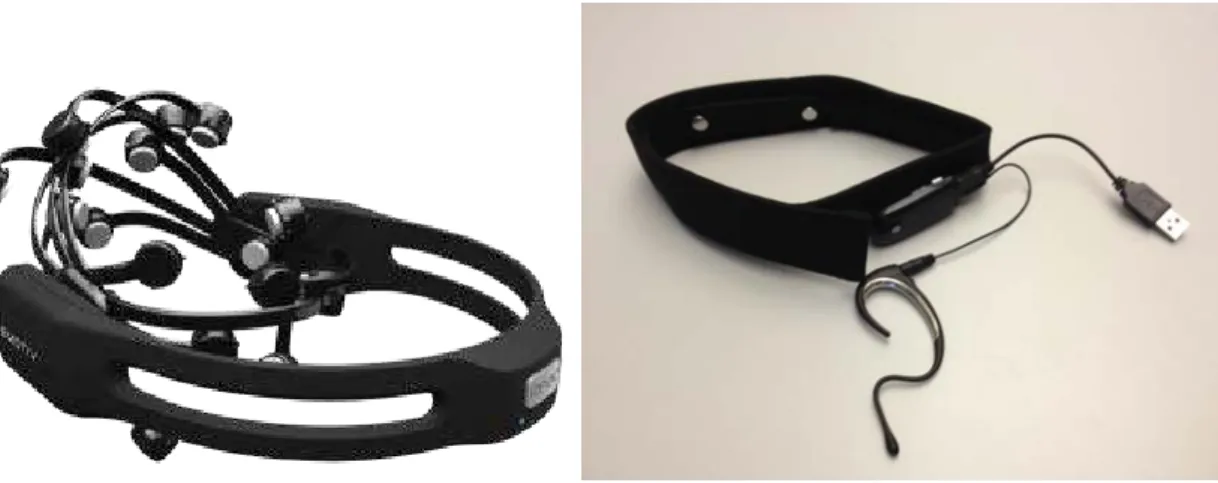
In 2009, Emotiv SystemsTM creates the Emotiv EPOCTM(illustrated in figure 2.5 a), a 14 sensor EEG system aimed at the gaming community.
C H A P T E R 2 . T H E O R E T I CA L BAC KG R O U N D
a The Emotiv EPOC b The Neurosky MindBand
Figure 2.5: Examples of BCIs
2.5 Neurofeedback
NFB describes a specific category of biofeedback that makes use of brain activity patterns to teach self-regulation of self brain function. Typically, this brain activity is measured through the use of EEG, while the method of self-regulation varies [38].
In the late 1950s, two medical doctors made the first contact with this mechanism; Dr. Joe Kamiya, at the University of Chicago, discovered that by using a simple reward system, could train people to alter their brain activity, detected through EEG. Dr. Barry Sterman, at University of California, Los Angeles, discovered that he could train cats to control their epileptic seizures [39].
In the late 1960s, NASA started applying NFB training to astronauts, originally suf-fering from seizures and hallucinations from exposure to lunar lander fuel. Today, this training is still used, although for focus and attention purposes[39].
Along the 1970s, NFB caught attention of religion, being used as a tool of meditation in some circles. At the time, that connection severed the interest of many researchers in the technique, due to the scientific scepticism of anything regarded as spiritual [39].
Through the next two decades, NFB started being applied as treatment to a series of psychological conditions, suffering a rebirth in the scientific community as a therapy tool
[39].
In the 2000s, with the change of medical perspectives on the brain, concepts like neuroplasticity gave a total new interest to NFB. Research into the area started gain-ing interest and investment, and thus many interestgain-ing projects were created, includgain-ing projects that used VR for training mental capabilities like inattention and impulsiveness [40].
In the last years, many different kinds of NFB training were developed. The following
2 . 5 . N E U R O F E E D BAC K
2.5.1 Medical Uses
One of the most clinically proved applications for NFB lies in ADHD treatment. Through the training of attention by means of computer software such as games, both children and adults have demonstrated improvement in their ADHD condition. Generally speaking, the symptoms of impulsivity and inattention show several improvements and hyperactiv-ity shows moderate amelioration [41].
Moreover, NFB shows a lot of promise in several other medical areas, as a replacement for pharmacological medications:
• Real-time Functional Magnetic Resonance Imagining (rtfMRI) training has been used successfully to decrease the magnitude of chronic pain in pain patients [42];
• EEG alpha-theta brainwave treatment has also been successfully applied to chronic alcoholics, using results from a self-rated depression inventory and a Millon Clinical Multiaxial Inventory (MCMI) [43]. Sensory Motor Rhythm (SMR) training has also exhibited success regarding therapy for opiate dependence disorder patients. These cases establish evidence of the effectiveness of NFB in the treatment of addictions
[44].
• Quantitative EEG (qEEG) guided treatment has also shown significant efficacy in
the improvement of schizophrenia patients [45].
2.5.2 Non-Medical Uses
Other applications for NFB have been successfully researched in diverse areas of art, such as music and dance.
Musical performance, in which practitioners must attain high levels of concentration when playing, has systematically shown improvement through appliance of alpha and theta NFB [46]. Demonstrable benefits have also been proven for acting performance, in consequence of SMR training [47].
C H A P T E R 2 . T H E O R E T I CA L BAC KG R O U N D
Figure 2.6: The stage in which the My Virtual Dream experience took place
2.6 Game Engines
The video game industry has consecutively pushed software technology onwards across the last 20 years; the need of resort to divergent content for the creation of a game has led to the development of all-embracing 3D platforms which combine physics, audio, animation, scripting and rendering mechanics, now labelled as game engines [49].
These platforms allow for the creation of programmable environments, featuring realistic interaction and thus granting them a place in science and education, also a fruit of the evergrowing awareness of the gamification concept. The use of the Unity3D® game engine can be seen in figure 2.7, while being applied to arachnophobia therapy [50].
Figure 2.7: A Unity3D® generated environment for use in arachnophobia VRET
2 . 6 . G A M E E N G I N E S
Figure 2.8: Modular game engine structure. Adapted from [51]
As can be observed in figure 2.8, directly under the virtual worlds, which constitute the scenarios with which the players interact, stands the game code, managing the con-nection between virtual worlds and the inner workings of the game engine; this game code is built in the form of scripts, in a game-specific scripting language [51].
C
h
a
p
t
e
r
3
S t a t e o f t h e A rt
3.1 Virtual Reality Head-Mounted Displays
The current state-of-the-art VR HMDs competing in the market are the Oculus Rift ®, the Playstation VR ®and the HTC Vive ® [52]. Table 3.1 offers a brief description of each of
the main parameters to consider when evaluating a VR HMD.
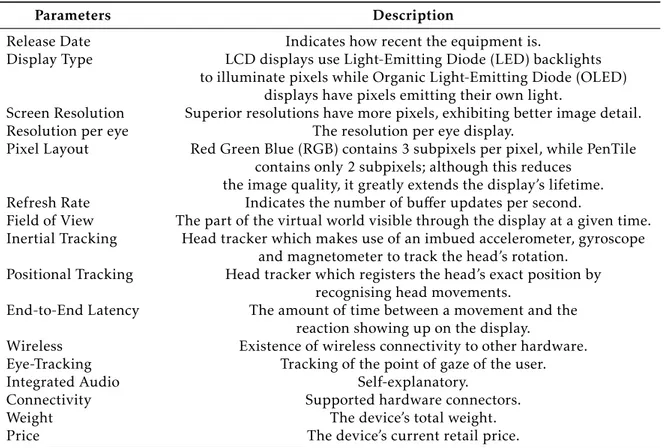
Parameters Description
Release Date Indicates how recent the equipment is.
Display Type LCD displays use Light-Emitting Diode (LED) backlights
to illuminate pixels while Organic Light-Emitting Diode (OLED) displays have pixels emitting their own light.
Screen Resolution Superior resolutions have more pixels, exhibiting better image detail.
Resolution per eye The resolution per eye display.
Pixel Layout Red Green Blue (RGB) contains 3 subpixels per pixel, while PenTile contains only 2 subpixels; although this reduces
the image quality, it greatly extends the display’s lifetime.
Refresh Rate Indicates the number of buffer updates per second.
Field of View The part of the virtual world visible through the display at a given time. Inertial Tracking Head tracker which makes use of an imbued accelerometer, gyroscope
and magnetometer to track the head’s rotation. Positional Tracking Head tracker which registers the head’s exact position by
recognising head movements.
End-to-End Latency The amount of time between a movement and the
reaction showing up on the display.
Wireless Existence of wireless connectivity to other hardware.
Eye-Tracking Tracking of the point of gaze of the user.
Integrated Audio Self-explanatory.
Connectivity Supported hardware connectors.
Weight The device’s total weight.
Price The device’s current retail price.
C H A P T E R 3 . S TAT E O F T H E A R T
3.1.1 Oculus Rift ®
Oculus VR ® is a virtual reality company, founded in June 2012 and funded in August of the same year through a Kickstarter®campaign. Their first product, The Rift®, had several versions, the initial ones meant for developers, to arouse and excite their willingness of developing VR-related multimedia. The Oculus Rift® has also had extended support for Unity® and Unreal engine® since March 2013 [53]. In figure 3.1, the three versions of The Rift can be observed, while their specifications can be compared in table 3.2.
a Developer Kit 1 (DK1) b Developer Kit 2 (DK2) c Consumer Version (CV1)
Figure 3.1: The three existing versions of The Rift®
Parameters DK1 DK2 CV1
Release Date 29/03/2013 24/07/2014 28/03/2016
Display Type LCD OLED OLED
Screen Resolution 1280x800 1920x1080 2160x1200 Resolution per eye 640x800 960x1080 1080x1200
Pixel Layout RGB PenTile PenTile
Refresh Rate 60 Hz Hz 90 Hz
Field of View 90º 100º 110º
Inertial Tracking Yes Yes Yes
Positional Tracking No Yes Yes
End-to-End Latency 50-60ms 20-35ms 25ms
Wireless No No No
Eye-Tracking No No No
Integrated Audio No No Yes
Connectivity DVI/HDMI + USB HDMI + USB HDMI + USB
Weight 380g 440g 470g
Price 300$ 350$ 600$
Table 3.2: Technical comparison between the 3 released versions of The Rift®[54].
3 . 1 . V I R T UA L R E A L I T Y H E A D - M O U N T E D D I S P L AYS
3.1.2 Playstation VR ®
Playstation VR®, known by codename Project Morpheus during development, is an up-coming VR gaming HMD developed by the Sony Interactive Entertainment® company. This VR product can be seen in figure 3.2.
Figure 3.2: Sony®’s Playstation VR.
In table 3.3, the specifications of the Playstation VR can be observed, seemingly at the level of both the Oculus Rift® and the HTC Vive®. However, Sony® plans on making it an exclusive to the PlayStation 4 (PS4) platform, limiting its usefulness for research [56].
Parameters Playstation VR
Release Date 13/10/2016
Display Type OLED
Screen Resolution 1920x1080 Resolution per eye 960x1080
Pixel Layout RGB
Refresh Rate 90-120 Hz
Field of View 100º
Inertial Tracking Yes Positional Tracking Yes End-to-End Latency 18ms
Wireless No
Eye-Tracking No
Integrated Audio No Connectivity HDMI + USB
Weight 610g
Price 400$
C H A P T E R 3 . S TAT E O F T H E A R T
3.1.3 HTC Vive ®
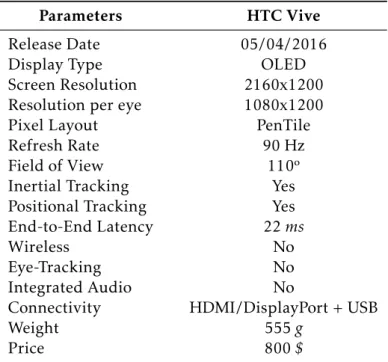
The HTC Vive® is a VR HMD developed in a collaboration between HTC®, an electronics company, and Valve Corporation®, a video game company. The HTC Vive can be seen below, in figure 3.3.
Figure 3.3: The HTC Vive, developed by HTC®and Valve Corporation®.
Table 3.4 represents the specifications of the HTC Vive.
Parameters HTC Vive
Release Date 05/04/2016
Display Type OLED
Screen Resolution 2160x1200 Resolution per eye 1080x1200
Pixel Layout PenTile
Refresh Rate 90 Hz
Field of View 110º
Inertial Tracking Yes Positional Tracking Yes End-to-End Latency 22ms
Wireless No
Eye-Tracking No
Integrated Audio No
Connectivity HDMI/DisplayPort + USB
Weight 555g
Price 800$
Table 3.4: Technical specifications of the HTC Vive®[57].
3 . 2 . N O N - I N VA S I V E E E G B R A I N - C O M P U T E R I N T E R FAC E S
3.2 Non-Invasive EEG Brain-Computer Interfaces
Among the many BCIs growing in today’s technological market, the brands standing out the most are Neurosky®, EMOTIV®and OpenBCI®. These next chapters elaborate on their products and their particularities, specifying each of the parameters described in table 3.5.
Parameters Description
Release date Indicates how recent the equipment is. Number of channels Number of existing EEG channels.
Sampling rate Number of numerical EEG samples registered per second. Resolution Number of available bits per channel to store EEG
information; higher bit rates allow for the recording of higher spatial frequencies. Platforms Supported OSs; “Win” for Windows,
“Mac” for Macintosh and “Lin” for Linux. Wireless Existence of wireless connectivity to other hardware. Sensor type Type of EEG electrode sensors.
Reference type Type of EEG reference sensors.
Battery type Self-explanatory.
Battery life Self-explanatory.
Connectivity Supported hardware connectors. Integrated Audio Self-explanatory.
Format The device’s physical format.
Price The device’s current retail price.
Table 3.5: Technical description of the most relevant aspects of EEG BCIs
3.2.1 Neurosky ®
C H A P T E R 3 . S TAT E O F T H E A R T
Table 3.6 compares these products’ specifications, while figure 3.4 illustrates them.
Parameters MindSet® MindBand® Mindwave®
Release date March 2007 Info not available 21/03/2011
Number of channels 1 1 1
Sampling rate 128 Hz 128 Hz 512 Hz
Resolution 8 bits 8 bits 12 bits
Platforms Win/Mac/Android Win/Mac/Android Win/Mac/Android
Wireless Yes Yes Yes
Sensor type Dry Dry Dry
Reference type Earphone Pad Earclip Earclip Battery type Built-in Li Battery Built-in Li Battery 1 AAA Battery
Battery life 10h 10h 8h
Connectivity Bluetooth Bluetooth USB RF receiver
Integrated Audio Yes No No
Format HMD Headband HMD
Price 200$ 200$ 80$
Table 3.6: Technical comparison between 3 of NeuroSky®’s products [59].
a The MindSet® b The MindBand® c The MindWave®
Figure 3.4: Three of the most featured Neurosky’s® BCI products.
All of these products have a particularity, characteristic of Neurosky®: They have only one EEG channel, the Fp1 channel [60].
3 . 2 . N O N - I N VA S I V E E E G B R A I N - C O M P U T E R I N T E R FAC E S
3.2.2 EMOTIV ®
Originally branded Emotiv Systems® but later reformed as EMOTIV Inc.®, this company has gained reputation as one of the current lead BCI developers. It has been actively researching BCI technology since 2003 and since then has released 2 major BCI systems: The EPOC/EPOC+® and Insight®. Figure 3.5 demonstrates the products’ appearance and table 3.7 elaborates on their technical specifications.
a The EPOC® b The Insight®
Figure 3.5: EMOTIV®’s current BCI products.
Parameters EPOC/EPOC+® Insight®
Release date 21/12/2009 August 2015
Number of channels 14 5
Sampling rate 128 Hz 128 Hz
Resolution 14 bits 14 bits
Platforms Win/Mac/Lin/Android/iOS Win/Mac/Lin/Android/iOS
Wireless Yes Yes
Sensor type Saline soaked pads Semi-dry polymer Reference type 1 left and 1 right mastoid sensor 2 Left mastoid sensors Battery type Built-in Li Battery Built-in Li Battery
Battery life 12h 8h
Connectivity Bluetooth/USB Bluetooth/USB
Integrated Audio No No
Format HMD HMD
Price 800$ 300$
Table 3.7: Technical comparison between the 2 lead products of EMOTIV Inc.®[62, 63, 64].
C H A P T E R 3 . S TAT E O F T H E A R T
EMOTIV® features two separate SDK environments, the EMOTIV® SDK Community, a free application, and the EMOTIV® SDK Premium, a paid application. EMOTIV also features a support package for Unity3D® application development, available for 80$[66, 67].
3.2.3 OpenBCI ®
OpenBCI ® distinguishes itself in the world of BCIs by taking the form of an open-source BCI platform. The project was funded through a Kickstarter campaign in late 2013 and since then has seen thorough expansion in its user database. The platform has several boards available for purchase, and being an open-source platform, its goal is for developers to acquire basic components and develop new software in a public and collaborative form [68]. Figure 3.6 showcases OpenBCI®’s available boards, while table 3.8 describes their specifications - Since these equipments only include the processor board itself, only some of the previously described BCI parameters are displayed.
a The 32bit Board® b The Ganglion Board®
3 . 2 . N O N - I N VA S I V E E E G B R A I N - C O M P U T E R I N T E R FAC E S
Parameters 32bit Board kit Ganglion Board Kit
Release Date December 2014 Scheduled December 2016
Number of channels 8 4
Resolution 24 bit 24 bit
Platforms Win/Mac/Lin Win/Mac/Lin
Wireless Yes Yes
Connectivity Bluetooth/USB Bluetooth/USB
Price 500$ 100$
Table 3.8: Technical comparison between the 2 boards developed by OpenBCI®[69, 70].
The superlative advantage of this platform is its flexibility: For a developer, it is the perfect tool since it offers complete customization, software-wise. As for the
counter-part, it becomes much harder to develop on such a versatile platform rather than on the straightforward, limited products offered by the standard BCI companies.
OpenBCI has also developed HMDs separately. These HMDs are fully compatible with any of their boards [71]. On figure 3.7, two of OpenBCI®’s HMD products can be observed.
a The Ultracortex Mark III® b The Ultracortex Mark IV®
C H A P T E R 3 . S TAT E O F T H E A R T
3.3 3D Game Engines
Among the diverse game engines available nowadays, two of them stand out mainly due to their cross-platform support: Unity3D® and Unreal Engine®.
3.3.1 Unity3D ®
Unity Technologies SF® , the developer of Unity3D®, is a company originally founded during the year 2004. Since then, Unity3D® has become arguably the most popular game engine in industry, spawning renowned game tiles such as Blizzard®’s HearthStone, Ubisoft®’s Assassin’s Creed - Identity or even Niantic® ’s Pokémon Go [72].
Since their firstly launched products that they have adopted a multi-plan policy, always creating both free and paid versions of their software. Their latest product, Unity3D® 5, was released during March of 2015; figure 3.8 exhibits this workspace’s general set-up.
Figure 3.8: A typical user interface in Unity3D® 5.
Some of Unity3D® 5’s features include global illumination together with physically-based shaders, High Dynamic Range (HDR) sky-boxes, reflection probes, a new audio mixer and enhanced animator workflows. Platform support includes Windows®, OS X, Unity®Webplayer, Android®, iOS®, BlackBerry®10, WindowsPhone®8, Tizen, We-bGL, PlayStation3®, PlayStation4®, PlayStationVita®, WiiU®, New Nintendo3DS®, Xbox 360º®, Xbox One®, Android®TV, Samsung®Smart TV, Oculus®Rift and Gear VR®. Script-ing in Unity® can be primarily written in C#, JavaScript ou UnityScript [73].
The various available plans for the current version of Unity® include the Personal plan, a free plan, the Plus plan, available for 35$ per month, the Pro plan, available for 125$ per month, and the Enterprise plan, a plan targeting organizations. Differences
3 . 3 . 3 D G A M E E N G I N E S
3.3.2 Unreal Engine ®
Originally showcased by the Epic Games® game company in 1998, the Unreal Engine®, like Unity®, has been used to create major game titles such as Unreal Tournament, Bioshock and Deus Ex. Since its creation that it has had a core role in gaming indus-try, only obfuscated by the recent success of Unity®[75].
Unreal Engine®is currently at version 4. Albeit it used to require a monthly subscrip-tion fee, the company’s current policy is to grant free access to all users and then charge royalties according to the revenue generated by the developed products [76]. Figure 3.9 illustrates the user interface of the Unreal Engine ®4.
Figure 3.9: The interface of Unreal Engine®4.
Its features involve total source code access, a powerful visual effects editor and an
C H A P T E R 3 . S TAT E O F T H E A R T
3.4 Neurofeedback Technology
State-of-the-art NFB research has already allowed for the development of fully integrated NFB systems. These systems contain both the software and hardware required to perform NFB training and are produced by companies such as NeurOptimal®, Brain-trainer® and BrainMaster®. The cheapest products available from these companies are, respectively, the Personal Trainer Laptop Bundle, the Signature Hemoencephalography (HEG) Package and the Freedom 7D. Table 3.9 specifies the components of each of these products [78, 79, 80].
NeurOptimal®’s Personal Brain-trainer®’s BrainMaster®’s
Trainer Laptop Bundle Signature HEG Package Freedom 7D
5500$ 1580$ 7000$
Windows 10 Laptop System nIT HEG Headband Freedom 7d Headset NeurOptimal® Personal Trainer BioExplorer BrainAvatar 4.0
software software software
300 software training sessions LIFE Game USB Bluetooth dongle 1 zAmp encoder x-wiz/Q-wiz Amplifier Micro USB Cable 1 set of solid silver sensors Measuring Tape
1 set of earbuds 2 USB cables Conductive paste
Table 3.9: Description of the equipment included in some of the cheapest NFB training products available in the market [78, 79, 80].
C
h
a
p
t
e
r
4
M a t e r i a l s a n d M e t h o d s
4.1 Materials
4.1.1 Virtual Reality Head Mounted Display
The VR HMD chosen to undertake this project was the Oculus Rift® DK1. The reason for this choice lies in two factors: versatility and availability.
Oculus® features cutting edge technology, and unlike the Playstation VR, it has both Windows® and OS X® support. This factor puts it at the same level of interest than the HTC Vive®. However, the HTC Vive® was not an available asset at the IBEB, thus making the Oculus Rift® the prime choice for the project.
At the IBEB there were two models of the Oculus Rift® available, the DK1 and the Development Kit 2 (DK2); since the DK2 was being used for another project, development for the DK1 took place.
The DK1 included the HMD, coupled with its respective control box, 3 pairs of dif-ferent lenses, a High-Definition Multimedia Interface (HDMI) cable, an USB cable, the power cord and a DVI/HDMI adapter.
C H A P T E R 4 . M AT E R I A L S A N D M E T H O D S
Figure 4.1: Oculus®’ runtime software version 0.8.0.0.
4.1.2 Non-Invasive EEG Brain-Computer Interface
Regarding availability, there were several possibilities available at the IBEB: Neurosky®’s Mindband and Mindset plus EMOTIV®’s EPOC and Insight. Since there were so many possible options, the OpenBCI® alternative was prematurely discarded.
After some tests with the EPOC, it became clear that connectivity with the selected game engine could only be achieved through the purchase of a specific connectivity pack-age, supplied only by EMOTIV®. This factor, conjointly with the difficulty of physically
fitting the EPOC together with a VR HMD, were very demotivating issues regarding the utilization of the EPOC; and since the Insight was required for another project, EMO-TIV®’s BCIs were both put aside.
Between the MindSet and the MindBand, since there were little differences, the
pre-ponderant factor was physical compatibility with VR HMDs. This elected Neurosky®’s MindBand as the preferred choice due to its flexible form, allowing for ease of use together with any kind of VR HMD.
The NeuroSky®MindBand kit contained the BCI band, a Bluetooth USB dongle and a USB/mini-USB connection cable.
4 . 1 . M AT E R I A L S
4.1.3 3D Game Engine
The game engine chosen for the development of this thesis was the Unity3D® version 5.3.0f4 for Windows®. This choice ensued from 3 key considerations:
• NeuroSky®’s and Oculus®’ well documented cross-platform support for Unity®;
• Previous experience utilizing the C# programming language;
• The considerable size of Unity®’s online community.
Paired with this choice came the consequent need to utilize one of Unity®’s supported script editors, either Visual Studio® or Monodevelop®. Visual Studio 2015® was pre-ferred due to past experience of the author with the editor.
Unity®’s interface is customizable, but its basic set-up is very practical. In figure 4.2 we can analyse this set-up.
Figure 4.2: Default structure of Unity®’s interface.
A description of the interface’s components follows:
• Theproject windowdisplays a library of the available assets to use in the project;
• Thescene viewallows a visual navigation and edition of the scene;
• Thehierarchy windowis a hierarchical text representation of every object in the scene;
• Theinspector windowallows visualization and edition of all of the properties of the currently selected object;
C H A P T E R 4 . M AT E R I A L S A N D M E T H O D S
Programming in Unity® involves, very generally speaking, the creation of scenes, the insertion of objects in these scenes, and then the attribution of specific scripts to these objects. This is why scripts in Unity® are object-oriented. In figure 4.3, some of Unity®’s basic classes are illustrated, the arrows representing the level hierarchy between these classes. A class which an arrows point to represents a superior element in the hierarchy.
Figure 4.3: Hierarchical representation of Unity®’s classes.
4.2 Methods
4.2.1 Scene Set-up
4.2.1.1 Head Model
To start setting up the scene, a realistic head model was required. This head model would serve as a base for the user to understand the relative positioning of the electrodes, enabling him to easily interpret the EEG data.
4 . 2 . M E T H O D S
a Head Model 1 b Head Model 2
Figure 4.4: Head models initially considered for the application
The final selected model was a head model submitted by cgtrader user ionchris, illus-trated in figure 4.5.
a Side view of the model b Front view of the model c Independent components of the model
Figure 4.5: The head model used for the application
Besides having relatively correct anatomical proportions, the independence of the eye structure relative to the rest of the head would prove useful for later design features. The model was available in .obj format, compatible with Unity®.
4.2.1.2 Electrode positioning
C H A P T E R 4 . M AT E R I A L S A N D M E T H O D S
a Without the head model. b With the head model.
Figure 4.6: Arrangement of the sphere objects, according to the 10-10 electrode placement system.
4.2.1.3 The base of the head model
At this point, a problem had become evident: The bottom part of the head model was unfinished.
This part of the model would produce a visualization glitch every time the camera was directed towards the base of the model, displaying the model’s interior surface as an invisible object.
As a measure to solve this problem, a particle system was created, simulating smoke in order to obstruct the camera view of this part of the model. However, in a later part of the project it became perceptible that this particle system was diminishing the frame rate of the application, demanding too much from the camera rendering system. So, instead of a particle system, a solid object was implemented in order to visually block this part of the model. This object is represented in figure 4.7.
4 . 2 . M E T H O D S
4.2.1.4 Skybox
Finally, for the scene to be set, a background was required. In game engines there is a specific method of creating backgrounds named skybox. This method applies a cuboid to the camera view of the scene, creating the illusion of distant 3D surroundings.
After a search through Unity®’s asset store, an interesting skybox showed up; skybox volume 2 (Nebula) pack by Hedgehog Team had an excellent rating, was free and pre-sented a spacial setting, which seemed fitting for an application featuring what used to be a science fiction concept. Various skyboxes were available in the pack, and after some experimentation, the DeepSpaceGreen skybox was selected. In figure 4.8, the result can be observed.
Figure 4.8: The DeepSpaceGreen skybox, together with the complete head model.
4.2.2 Visual Effects
4.2.2.1 Lighting
Unity® ’s integrated lighting system allows for the creation of light emitting objects. Several settings for these objects were experimented, and since the model was coloured black, 4 different lighting objects had to be created for the model to have its outward
C H A P T E R 4 . M AT E R I A L S A N D M E T H O D S
4.2.2.2 Camera filters
To produce a smooth experience, several filters were implemented and optimized in the camera object:
• An anti-aliasing filter, to improve the pixelation of the display;
• A bloom filter, which causes light to appear to leak into surrounding objects;
• A vignette filter, which darkens, blurs and introduces chromatic aberration in the edges of the image.
Figure 4.9 illustrates the difference in visual display between the filterless and the
applied filter camera object.
a Display without the filters. b Display with the filters.
Figure 4.9: Comparison between the display with and without filters.
4.2.2.3 Glow
A simple and effective method of transmitting the EEG data to the user seemed to be
through the color of the electrode objects. However, to make this visually appealing, solid color did not seem enough; as such, a shader was programmed to simulate glow in the scene objects.
Shader programming in Unity® uses the C for Graphics (Cg) high-level shading language, wrapped in a ShaderLab script. Figure 4.10 exhibits the result of the shader in the electrode and eye objects.
The use of the glow shader in the eyes object was initially merely for aesthetic pur-poses. However, to increase the environment’s dynamism, a script was developed to produce a periodic variation in the eye glow.
4 . 2 . M E T H O D S
Figure 4.10: The Unity® environment with the shader applied in both the electrode and the eye objects.
4.2.3 Sound Effects
To expand the user’s immersive experience, music would be a substantial addition. As such, two tracks were implemented in the program, both being calm, ambient musics: Haggstrom and Subwoofer Lullaby by artist C418, originally utilized in Minecraft®’s Original Soundtrack (OST). A script was also developed to transition between these musics and to mute them.
4.2.4 Scripting
4.2.4.1 Camera Movement
To enable the dislocation of the user’s Point Of View (POV), a script which controlled the location of the camera had to be developed. With this objective, an invisible sphere object was created in the approximate center of the head model, and the camera object assigned as its child; this child-parent property forces the camera to maintain its distance toward the parent object, and to accompany its rotation. Following this fashion, a script to control the sphere’s rotation was created, since this rotation would be automatically replicated in the camera object.
Horizontal rotation was trivial to implement, since it only required rotation around the y axis, represented in figure 4.11. However, vertical rotation needed the script to be aware of the sphere’s current position, relative to the y axis, requiring geometry cal-culations. An upper and lower limit also had to be established for the vertical rotation, since the rotation would glitch whenever the camera reached the location directly above or under the model.
C H A P T E R 4 . M AT E R I A L S A N D M E T H O D S
Figure 4.11: Unity®’s scene view, with the y axis represented in green.
4.2.4.2 User Interfaces
Five UIs were implemented:
• A main menu window;
• A help window;
• A file loader window;
• A "no file name inserted" error message;
• A "non-existent file" inserted error message.
The first three UIs can be activated through a specific key. The main menu window has several interactive toggles, allowing the user to activate or deactivate “ghost mode” and to select the type of represented BCI data. The help window describes the available keyboard commands. The file loader window asks the user for the file name of the .eeg file to load in the program; a script then accesses a specific folder and locates the file requested by the user. Three scenarios can then occur with the latter UI: In case the user did not input any text, the "no file name inserted" error message will appear; in case the name inserted does not correspond to any of the existing files in the folder, the "non-existent file" error message will appear; in case the file exists, its information is processed by the appointed scripts.
4 . 2 . M E T H O D S
a The main menu window. b The help window.
c The file loader window.
d The "no file name inserted" error message.
e The "non-existent file" error mes-sage.
Figure 4.12: The several UIs developed for the application.
4.2.4.3 .edf File Loader
Halfway along the thesis, since the Mindband® was not available in the IBEB at the time, an .edf file reader and interpreter was implemented. Overall, .edf files can be divided in three major components:
• The general header record;
• The signal-specific header record;
![Figure 2.4: The 10-20 system for electrode placement. Adapted from [32]](https://thumb-eu.123doks.com/thumbv2/123dok_br/16545923.736935/30.892.218.677.795.1014/figure-electrode-placement-adapted.webp)

![Table 3.2: Technical comparison between the 3 released versions of The Rift®[54].](https://thumb-eu.123doks.com/thumbv2/123dok_br/16545923.736935/40.892.132.767.633.995/table-technical-comparison-released-versions-rift.webp)
![Table 3.3: Technical specifications of the to-be released Playstation VR®[56].](https://thumb-eu.123doks.com/thumbv2/123dok_br/16545923.736935/41.892.293.602.731.1092/table-technical-specifications-released-playstation-vr.webp)
![Table 3.6: Technical comparison between 3 of NeuroSky®’s products [59].](https://thumb-eu.123doks.com/thumbv2/123dok_br/16545923.736935/44.892.144.746.603.836/table-technical-comparison-neurosky-s-products.webp)
![Table 3.7: Technical comparison between the 2 lead products of EMOTIV Inc.®[62, 63, 64].](https://thumb-eu.123doks.com/thumbv2/123dok_br/16545923.736935/45.892.139.764.642.961/table-technical-comparison-lead-products-emotiv.webp)
