
Ultimate flexural strength of prestressed concrete
beams: validation and model error evaluation
Momento último de vigas de concreto protendido:
validação e cálculo do erro do modelo
a Escola de Engenharia, Universidade Federal do Rio Grande, Rio Grande, RS, Brasil;
b Departamento de Engenharia Civil, Universidade Federal de Santa Catarina, Florianópolis, SC, Brasil.
Received: 23 Mar 2017 • Accepted: 25 Sep 2017 • Available Online: 9 Apr 2018
M. W. MOURA a
M. V. REAL a
D. D. LORIGGIO b
Abstract
Resumo
In this work a computational model is presented to evaluate the ultimate bending moment capacity of the cross section of reinforced and pstressed concrete beams. The computational routines follow the requirements of NBR 6118: 2014. This model is validated by comparing the re-sults obtained with forty-one experimental tests found in the international bibliography. It is shown that the model is very simple, fast and reaches
results very close to the experimental ones, with percentage difference of the order of 5%. This tool proved to be a great ally in the structural analy
-sis of reinforced and prestressed concrete elements, besides it is a simplified alternative to obtain the cross section ultimate bending moment.
Keywords: reinforced concrete, prestressed concrete, ultimate bending moment, beams.
Neste trabalho é apresentado um modelo computacional que calcula o momento resistente último de seções transversais de vigas de concreto armado e protendido. As rotinas computacionais seguem as prescrições da NBR 6118: 2014. Este modelo é validado através da comparação
dos resultados obtidos com quarenta e um ensaios experimentais encontrados na bibliografia internacional. É mostrado que o modelo é bastante simples, rápido e atinge resultados muito próximos dos experimentais, com diferença percentual da ordem de 5%. Esta ferramenta se mostrou uma grande aliada na análise de elementos estruturais de concreto armado e protendido, além de uma alternativa simplificada para obtenção
do momento de ruína da seção transversal.
1. Introduction
One of the assumptions of structural analysis is to have at hand a good mathematical model that satisfactorily represents the behavior of the structural element. Thus, in this article, we will present the validation of
a mathematical model that calculates the ultimate flexural strength of
cross sections of reinforced and prestressed concrete beams. In this validation, the model results are compared to 41
experi-mental tests. The determination of the flexural response of the
prestressed concrete structures requires initial conditions such as compatibility of deformations, geometric and material properties and equilibrium equations. In this way, it is possible to formulate a mathematical model to obtain the ultimate bending moment MRd. The developed model allows the nonlinear analysis of prestressed concrete beams with adherence for two types of cross-section: rectangular and T. An iterative procedure, which uses the secant method, is applied to obtain the depth of the neutral axis, during the process of calculating the bending moment that causes the cross-section failure.
To conclude, it will be shown that this model presents good results and, therefore, can be used as a simple and fast way of calculating
the ultimate flexural strength of prestressed concrete beams.
2. Prestressed concrete beams – ultimate
flexural strength evaluation
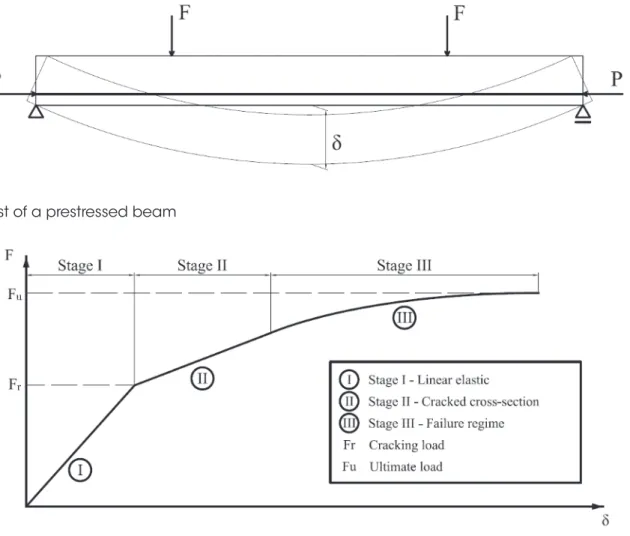
Prestressed concrete beams generally exhibit three distinct behav-ioral phases when subjected to increasing static loads until failure.
Figure 1 shows a beam under flexural test and Figure 2 shows the
behavior of a prestressed concrete beam with adherent tendons subjected to this test.
2.1 Stage I: linear elastic
The linear elastic regime corresponds to the interval between the beginning of the loading and the load that causes the cracking of concrete, Fr. In this case, the concrete, the non-prestressed steel and the prestressed steel have a linear elastic behavior and the tensile stress in the concrete does not exceeds its tensile strength in bending. Through Figure 3 it is possible to see that all the cross-sectional area collaborates in the balancing of the internal forces.
2.2 Stage II: cracked cross-section
This stage is achieved after loading on the beam reaching the load
Figure 1
Flexural test of a prestressed beam
Figure 2
Fr that causes cracking. The materials continue to work in the elas-tic regime, but the tensile stress in the concrete is greater than its tensile strength in the bending and thus only steel is considered to withstand tensile stresses in the member cross-section (Figure 4). The cross-section is cracked.
2.3 Stage III: failure mode
As the load increases, the materials exhibit different behavior from
the other phases until failure. The concrete presents non-linear behavior, the reinforcement reaches the limit of yielding and the
concrete has tensile stresses greater than the tensile strength of the concrete in bending. It is assumed (Figure 5) that the stress distribution in the concrete occurs according to a parabola-rectan-gle diagram. Only the compressed concrete zone contributes to resistance to the internal forces.
3. Cross-section geometry
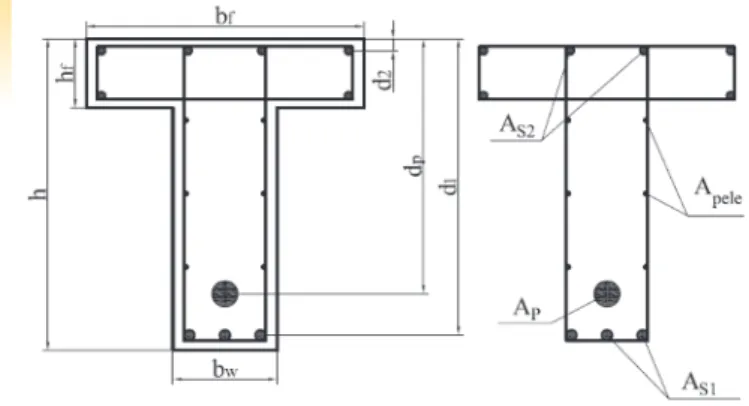
The developed numerical model applies to rectangular and T cross-sections, for any number of layers of non-prestressed and prestressed reinforcement. The dimensions of the section are
Figure 3
Stresses in the cross-section at Stage I
Figure 4
Stresses in the cross-section at Stage II
Figure 5
taken as input data of the model. Values referring to web width (bw), flange width (bf), total section height (h) and flange height (hf) should be entered.
Figure 6 and 7 are presented to illustrate the elements that com-pose the geometry of a typical rectangular and T cross-section,
cor-respondingly. The position and identification of the non-prestressed and prestressed reinforcement are also showed in these figures.
- b is the web width;
- h is the cross-section total height;
- As1 is the area of non-prestressed tension reinforcement; - As2 is the area of non-prestressed compression reinforcement; - Ap is the area of prestressed tension reinforcement;
- Apele is the area of skin reinforcement;
- di is the effective depth = distance from extreme-compression
fiber to centroid of reinforcement layer “i”.
- bf is the flange width; - bw is the web width;
- h is the cross-section total height; - hf is the flange thickness;
- di is the effective depth = distance from extreme-compression
fiber to centroid of reinforcement layer “i”.
- As1 is the area of non-prestressed tension reinforcement; - As2 is the area of non-prestressed compression reinforcement;
- Ap is the area of prestressed tension reinforcement; - Apele is the area of skin reinforcement.
4. Fundamental assumptions
Since the evaluation of the flexural strength of prestressed con -crete beams aims to determine the ultimate bending moment MRd, for a given cross-section, where the dimensions, reinforcement and material properties are previously known, the analysis is car-ried out in Stage III. Below are presented the fundamental hypoth-eses for analysis at such stage.
The cross-sections initially plane and normal to the beam axis re-main plane and normal in relation to the deformed axis.
There is perfect adherence between prestressed and non-pre-stressed reinforcement and the concrete surrounding them. The strain distribution diagram in the failure regime shall comply with the provisions of NBR-6118:2014, ABNT [3], see Figure 8. The previous elongation must be included in the deformation of the prestressed reinforcement.
(1)
Where:
P∞ is the prestressing force;
Ep is the prestressed reinforcement modulus of elasticity; σ(c,p) is the compression stress in the concrete caused by the
pre-Figure 6
Cross-section geometry and reinforcements
Figure 7
T cross-section geometry and reinforcements
Figure 8
stress at the centroid of the prestressed reinforcement; Ec is the concrete modulus of elasticity.
The tensile strength of the concrete is neglected.
For the purposes of simplification, according to NBR-6118: 2014, ABNT [3], a rectangular stress diagram with a depth of 0.8 ∙ x for
concrete class up to C50 is allowed, where x is the depth of the neutral axis.Figures 9, 10 and 11 illustrate the constitutive rela-tions, respectively, of the concrete, the non-prestressed reinforce-ment and the prestressed reinforcereinforce-ment.
In the case of concrete, for analysis in the ultimate limit state, the idealized tensile-strain diagram shown in Figure 9 can be used. The compressive stresses in concrete should obey equation (2).
(2)
For concrete classes up to C50, the value adopted for the strain of For concrete classes up to C50, the value adopted for the strain of concrete at the maximum stress is εc2 = 2,0‰, and the strain at
failure is equal to εcu = 3,5‰.
The stress-strain relationship shown in Figure 10 is elastic-per-fectly plastic and recommended by NBR-6118:2014, ABNT [3], for calculation in the service and ultimate states. The ultimate strain εu applied in this case for passive reinforcement is equal to 10‰.
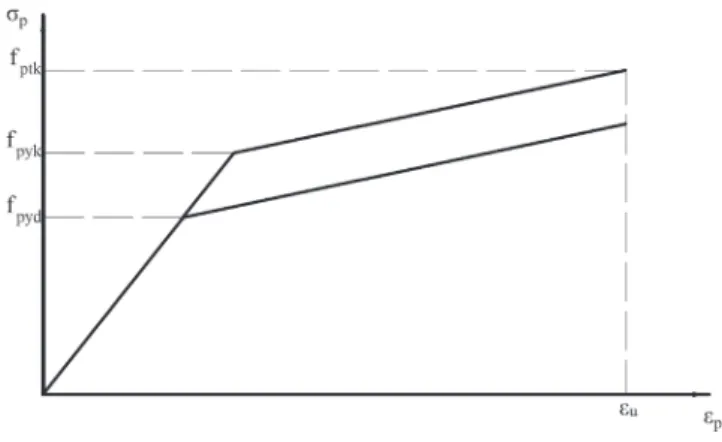
For calculations in the service and ultimate limit states,
NBR-6118:2014, ABNT [3], allows using the simplified bilinear
strain-strain relationship according to Figure 11. Where:
fpyk : nominal yielding strength of prestressed steel reinforcement;
fptk : nominal tensile strength of prestressed steel reinforcement; εu : strain at failure of prestressed steel reinforcement.
5. Calculation of the ultimate
flexural strength
The two equilibrium equations required for the calculation of the
ulti-mate bending moment use the basic assumptions and simplifications
Figure 9
Stress-strain relationship for concrete in compression
Figure 10
Stress-strain relationship for non-prestressed steel
reinforcement
Figure 11
Stress-strain relationship for the prestressed steel
reinforcement
Figure 12
From Figure 13, the calculation of the stresses can be done from the equations:
(8)
(9)
(10)
(11)
(12)
Using the simplification of the rectangular diagram 0,8 ∙ x and
σcd = 0,85 ∙ fcd, the resultant forces on concrete and non-prestressed
and prestressed reinforcement will be given by:
(13)
(14)
allowed in NBR-6118:2014, ABNT [3].
The methodology used allows the computation of the ultimate bending moment for several layers of non-prestressed and pre-stressed reinforcement, however, since it is a very common case, Figures 12, 13 and 14 show only one layer of non-prestressed ten-sion reinforcement, a layer of non-prestressed compresten-sion rein-forcement and a prestressed reinrein-forcement layer.
Observing Figures 12, 13 and 14 and assuming that the safety Observing Figures 12, 13 and 14 and assuming that the safety condition, Msd = Mrd, is satisfied, it becomes possible to make the following considerations.
From Figure 12, the calculation of the strains can be made from:
(3)
(4)
(5)
(6)
(7)
Figure 13
State of stress
Figure 14
(15)
(16)
In the cross-section, the balance of forces and moments comes In the cross-section, the balance of forces and moments comes from ∑ Fh = 0 and ∑ Mcc = 0. The sum of moments will be made around
the centroid of the concrete compression zone that is at a distance
of 0,4∙x from the compressed edge.
(17)
(18)
Where MRd is the ultimate bending moment of the cross-section. Expanding equations 17 and 18 in the form of stress and making
some simplifications, we have:
(19)
(20)
Equation 19 serves to find the depth of the neutral axis x, and consequently, the ultimate bending moment of the section is found in Equation 20. However, the depth of the neutral axis cannot be found directly because the stresses are also functions of x. Then, it is necessary to use an iterative numerical process, the secant method, to solve the problem.
Equation 19 can be written generically in the form f (x) =0, where:
(21)
The secant method is an iterative procedure used for the root solution of an Equation (See, for example, ARAÚJO [2]). In this context, the root of Equation 21 should be in the interval [0,ds1],
which encompasses the domains of deformation for simple bending. The bounds of the range where the root is located are x0 = 0 and xu = ds1. Hence, the function f(x) values at the extremes are f(x0 ) = f0 and f(xu ) = fu, respectively, as shown in Figure 15.
As can be seen, the first approximation x1 to the root of the
func-tion is taken as the intersecfunc-tion of the line through the funcfunc-tion ends and the axis of the abscissa.
The value of x1 is given by:
(22)
Then f1 = f(x1) is calculated and the convergence is tested. For the
con-vergence to be satisfied and the solution to the problem to be found, the
absolute value of the calculated root must be less than a pre-established tolerance | f1 | < tol. This tolerance, tol, can be as small as you wish. In case that convergence is not achieved, the evaluation inter-val should be reduced. For this, it is tested whether the product f1 ∙ f0 > 0 and if it is true, as shown in Figure 15, the new evaluation interval is [ x1,xu ], otherwise [ x0,x1 ].
With the new interval, smaller than the previous one, the procedure is repeated and a new value of x is now found, x2, and, again
con-vergence is verified. These steps are repeated until the tolerance
reaches the expected value.
Knowing the depth of the neutral axis, we find the ultimate bending
moment of the cross-section using Equation 20.
6. Model validation
We present below experimental results in the literature for the ul-timate bending moment of prestressed concrete beams with initial adherence, denominated here as Mu,exp. Then, the ultimate flexural strength of the beams, called Mu,calc, is calculated using the numeri-cal model. Thus, it was possible to compare the obtained results and to analyze the limitations of the model.
6.1 Experimental results
Forty-one concrete beams with adherent prestressing were
Figure 15
evaluated. They are presented in Table 1. There are 27 beams of BILLET [4], 6 of FELDMAN [5], 3 of WARWARUK [12], 3 of TAO
and DU [11] and 2 of MATTOCK [8] classified according to the
author of tests.
b : is the beam web width; bf : is the beam flange width; h : is the beam height; hf : is the beam flange height;
dp : is the effective depth of the prestressed reinforcement; ds : is the effective depth of the non-prestressed reinforcement; Ap : is the prestressed steel reinforcement area;
As : is the non-prestressed steel reinforcement area; fc : is the mean value of the concrete compressive strength; fpt : is the mean value of the prestressed steel reinforcement tensile strength;
fpy : is the mean value of the prestressed steel reinforcement yield-ing strenth;
fy : is the mean value of the non-prestressed steel reinforcement yielding strength;
Ep : is the modulus of elasticity of the prestressed steel reinforcement; Es : is the modulus of elasticity of the non-prestressed steel rein-forcement;
fse : is the effective stress applied to the prestressing tendons. For the calculation of the pre-elongation of the prestressed rein-forcement, it is enough to do:
(23)
The modulus of elasticity Ep measured in the tests carried out by BILLET [4] was equal to 20684.27 kN/cm².
Table 1
Data from the beams tested by BILLET [4]
Beam cmb cmh dp
cm
Ap cm2
fc kN/cm2
fpt kN/cm2
fpy kN/cm2
fse kN/cm2
Mu,exp kN ∙ m
B1 15.24 30.48 23.14 1.497 3.79 169.34 142.03 74.33 49.975
B2 15.62 30.86 24.21 0.748 3.74 169.27 142.03 80.53 29.679
B3 15.24 30.78 24.43 0.374 2.59 169.34 142.03 82.74 15.361
B4 15.49 30.71 23.34 1.497 2.37 169.34 142.03 78.53 45.162
B5 15.49 30.63 23.70 1.606 3.90 171.68 151.55 78.67 55.602
B6 15.39 30.63 20.62 2.206 2.03 171.68 151.55 79.98 50.938
B7 15.57 30.81 20.55 3.013 4.07 171.68 151.55 77.77 72.943
B8 15.57 30.63 20.29 3.013 2.26 171.68 151.55 77.84 67.167
B9 15.39 30.63 23.44 1.510 4.36 165.47 142.51 13.72 47.725
B10 15.39 30.56 22.89 0.381 2.43 165.47 142.65 13.10 13.314
B11 15.39 30.63 23.39 1.510 2.70 165.47 142.51 14.07 47.223
B12 15.39 30.81 21.16 2.832 3.83 165.47 142.65 14.07 62.029
B13 15.29 30.73 20.70 2.077 2.59 165.47 142.51 14.62 48.023
B14 15.24 30.68 20.29 2.832 2.59 165.47 142.51 13.93 53.094
B15 15.32 30.71 23.60 1.510 3.94 165.47 142.65 103.42 48.308
B16 15.27 30.51 22.86 0.381 2.30 165.47 142.65 103.63 14.141
B17 15.24 30.51 23.09 1.510 3.16 165.47 142.65 104.11 45.894
B18 15.24 30.38 21.06 2.077 2.83 165.47 142.51 102.59 52.172
B19 15.44 30.66 21.01 2.832 4.29 165.47 142.65 104.32 71.560
B20 15.37 30.81 23.55 1.006 2.63 171.68 151.55 81.77 31.753
B21 15.44 30.66 22.99 1.006 4.52 171.68 151.55 81.36 34.397
B22 15.42 30.66 23.19 2.006 5.26 171.68 151.55 79.43 66.937
B23 15.34 30.56 20.83 3.013 5.65 171.68 151.55 80.88 79.980
B24 15.42 30.58 20.93 2.406 4.22 171.68 151.55 80.25 66.964
B25 15.39 30.58 20.35 2.006 2.25 171.68 151.55 78.94 50.165
B26 15.49 30.40 23.55 1.606 0.88 171.68 151.55 80.32 38.993
The modulus of elasticity Ep measured in the tests by FELDMAN [5] are presented in table 3.
The modulus of elasticity Ep measured in the tests carried out by WARWARUK [12] was equal to 20684.27 kN/cm².
Table 5: Data of the beams tested by TAO e DU [11]
Table 6: Additional data for the beams tested by TAO e DU [11]
Table 7: Data of the beams tested by MATTOCK [8]
Table 8: Additional data for the beams tested by MATTOCK [8]
Through the developed model, the ultimate bending moment for the forty-one beams was calculated with the purpose of evaluating
the ability of the method to determine the flexural strength of the
midspan cross-section.
The process is carried out with the aid of spreadsheets that use subroutines created in Visual Basic for Application to calculate the stresses and strains of the element, checking the strain diagram at failure and then obtaining the ultimate bending moment of the cross-section.
Table 2
Data of the tests carried out by FELDMAN [5]
Beam b cm h cm dp cm Ap cm2 fc kN/cm2 fpt kN/cm2 fpy kN/cm2 fse kN/cm2 Mu,exp kN ∙ m
F28 15.62 30.56 20.14 1.494 1.72 128.24 97.91 63.78 30.70
F29 15.65 30.58 20.50 2.615 2.95 128.24 97.91 63.91 50.63
F30 15.47 30.73 20.52 0.561 1.99 170.99 137.90 69.71 17.64
F31 15.44 32.26 20.90 1.868 2.38 170.99 137.90 64.88 44.93
F32 15.24 30.81 23.67 1.839 4.95 176.51 169.61 79.50 65.31
F33 15.32 30.66 23.06 1.103 5.74 176.85 163.41 80.60 43.36
Table 4
Data of the beams tested by WARWARUK [12]
Table 5
Data of the beams tested by TAO e DU [11]
Beam b cm h cm dp cm Ap cm2 fc kN/cm2 fpt kN/cm2 fpy kN/cm2 fse kN/cm2 Mu,exp kN ∙ m
W34 16.00 30.48 23.01 1.361 2.74 184.09 151.68 78.60 40.79
W35 15.27 30.48 23.11 0.587 3.64 184.09 151.68 81.50 22.37
W36 15.39 30.48 23.06 2.335 3.61 184.09 151.68 76.67 64.29
Beam b cm h cm dp cm Ap cm2 fc kN/cm2 fpt kN/cm2 fpy kN/cm2 fse kN/cm2 Mu,exp kN ∙ m
TD37 16.00 28.00 22.00 0.588 3.56 166.00 136.00 92.40 35.00
TD38 16.00 28.00 22.00 1.568 3.56 166.00 136.00 87.90 61.60
TD39 16.00 28.00 22.00 1.960 3.56 166.00 136.00 82.50 71.40
Table 3
Modulus of elasticity of the beams tested by
FELDMAN [5]
Beam Ep
Table 6
Additional data for the beams tested by TAO e DU [11]
Table 8
Additional data for the beams tested by MATTOCK [8]
Beam Ep
kN/cm2
Es kN/cm2
fy kN/cm2
As cm2
ds cm2
TD37 20000.00 20000.00 26.70 1.57 25.00
TD38 20000.00 20000.00 26.70 2.36 25.00
TD39 20000.00 20000.00 26.70 1.00 25.00
Beam Ep
kN/cm2
Es kN/cm2
fy kN/cm2
As cm2
ds cm
bf cm
hf cm
M40 19500.00 21000.00 37.71 Sup. 0.62 1.91 – –
Inf. 0.62 28.58
M41 19500.00 21000.00 37.71 Sup. 0.62 1.91 96.52 5.08
Inf. 0.62 28.58
Table 7
Data of the beams tested by MATTOCK [8]
Beam b
cm
h cm
dp cm
Ap cm2
fc kN/cm2
fpt kN/cm2
fpy kN/cm2
fse kN/cm2
Mu,exp kN ∙ m
M40 15.24 30.48 25.40 2.534 2.76 192.36 175.89 129.76 93.44
M41 15.24 30.48 25.40 2.534 2.76 192.36 175.89 125.90 103.44
the Greek letter η is used.
By analyzing the forty-one results of the relation between the ex-perimental ultimate bending moment and those of the model all
together, it can be verified that the ratio η presented a mean value equal to 1.0524 and a standard deviation equal to 0.0963.
the maximum distance between the values of cumulative probability distribution of the data and the normal curve was below the limit
con-sidering a level of significance of 95%. It is possible to note a relative
symmetry of the results around the mean, presenting values both below and above. This indicates a non-biased model.
Figure 16
ered. The estimation of the model error followed the recommenda- represented by Equation 24.
Table 9
Experimental results
versus
numerical results
Beam Mu,exp
[kN ∙ m]
Mu,calc [kN ∙ m]
Mu,exp
Mu,calc Beam [kN ∙ m]Mu,exp
Mu,calc [kN ∙ m]
Mu,exp Mu,calc
B1 49.975 46.049 1.085 B22 66.937 65.933 1.015
B2 29.679 25.226 1.177 B23 79.980 83.915 0.953
B3 15.361 12.872 1.193 B24 66.964 66.650 1.005
B4 45.162 43.951 1.028 B25 50.165 47.249 1.062
B5 55.602 53.684 1.036 B26 38.993 30.326 1.286
B6 50.938 47.026 1.083 B27 70.136 73.456 0.955
B7 72.943 77.557 0.941 F28 30.70 26.056 1.178
B8 67.167 54.800 1.226 F29 50.63 46.377 1.092
B9 47.725 47.467 1.005 F30 17.64 15.678 1.125
B10 13.314 12.157 1.095 F31 44.93 45.150 0.995
B11 47.223 45.071 1.048 F32 65.31 69.177 0.944
B12 62.029 67.702 0.916 F33 43.36 41.489 1.045
B13 48.023 45.198 1.063 W34 40.79 44.74 0.912
B14 53.094 48.060 1.105 W35 22.37 21.060 1.062
B15 48.308 47.966 1.007 W36 64.29 71.916 0.894
B16 14.141 12.260 1.153 TD37 35.00 27.744 1.262
B17 45.894 45.833 1.001 TD38 61.60 58.039 1.061
B18 52.172 52.538 0.993 TD39 71.40 60.004 1.190
B19 71.560 73.274 0.977 M40 93.44 94.840 0.985
B20 31.753 33.621 0.944 M41 109.93 105.484 1.042
B21 34.397 34.005 1.012 – – – –
Figure 17
(24)
Onde:
Vη é o coeficiente de variação da razão η ; Vmodel is the model error coefficient of variation;
Vbatch is the coefficient of variation of the laboratory test results of the system variables, such as dimensions and resistances; Vtest is the coefficient of variation of the results obtained experi -mentally in the test of the prestressed concrete beams.
(25)
The coefficient of variation of the ratio η was determined through the 41 experimental results ( ). The coefficient of varia -tion of the test must be equal to or less than 0.04, MAGALHÃES [6]. The maximum value was used: Vtest = 0.04.
The batch coefficient of variation was adopted, according to MAG -ALHÃES [6], as being equal to 0.044 (Vbatch = 0.044).
In these conditions, using Equation 25, the value Vmodel = 0.068 was calculated.
In general, the model error has a mean value close to 1.00 and a standard deviation between zero and 0.10, depending on the ac-curacy of the numerical model.
The mean value of the model error can be evaluated through Equation 26.
(26)
As the batch mean value and the test mean value are close to the unit, the mean value of the model error can be calculated through Equation 27.
(27)
According to NOWAK [9], the model error follows a Normal prob-ability distribution, with a mean value between 1.04 and 1.06 for prestressed concrete beams.
Using the model error coefficient of variation (Vmodel = 0.068) and the error model mean value (μmodel = 1.052), the results for the ulti -mate flexural strength of the beam can be corrected by the model
error estimate (θR) randomly generated in each simulation,
accord-ing to Equation 28. The corrected values of the ultimate bendaccord-ing moment are used in the reliability analysis.
(28)
7. Results and discussion
The methodology used to evaluate the ultimate bending moment of prestressed concrete beams is the traditional model that
calcu-lates the ultimate flexural strength of the cross-section based on
the assumptions of the plane sections and perfect adherence be-tween steel and concrete. In addition the following premises were also considered: the ultimate strain distribution diagram according to NBR-6118:2014, a rectangular stress diagram for concrete, an elastic-perfectly plastic tension diagram for non-prestressed
re-inforcement steel and a bi-linear stress diagram for prestressed reinforcement steel. The secant method is employed to solve the non-linear system of equations resulting from equilibrium and com-patibility conditions.
This methodology is a simplified alternative to obtain the ultimate
bending moment of reinforced and prestressed concrete beams that complies with the requirements of NBR 6118: 2014. A satisfac-tory validation was obtained for this model when compared with experimental results found in the literature.
By observing the results of Table 9, it can be noted that the model for calculation of the ultimate bending moment exposed in this work presents good results.
This tool is a great ally in the analysis of structural elements of reinforced and prestressed concrete, presenting good results and a low computer processing time.
This model will be used in the evaluation of the reliability of beams of prestressed concrete bridges.
8. References
[1] ANG, A. H.; TANG, W. H. Probability concepts in engi-neering planning and design. Volume I: basic principles. John Wiley & Sons, 1975.
[2] ARAÚJO, J. M. Curso de concreto armado, Volume I, II, III e IV. Editora Dunas, 2014.
[3] ASSOCIAÇÃO BRASILEIRA DE NORMAS TÉCNICAS.
NBR 6118: Projeto de estruturas de concreto - Procedi-mento. Rio de Janeiro, 2014.
[4] BILLET, D. F. Study of prestressed concrete beams failing
in flexure. 1953. Thesis, University of Illinois.
[5] FELDMAN, A. Bonded and unbonded prestressed
con-crete beams failing in flexure. University of Illinois, 1954.
[6] MAGALHÃES, F. C. A Problemática dos Concretos
Não-Conformes e sua Influência na Confiabilidade de Pilares
de Concreto Armado. 2014. Tese (Doutorado em haria Civil) – Programa de Pós-Graduação em Engen-haria Civil, Universidade Federal do Rio Grande do Sul, Porto Alegre.
[7] MAGALHÃES, F.; REAL, M. V.; SILVA FILHO, L. C. P.
The problem of non-compliant and its influence on the
reliability of reinforced concrete columns. Materials and structures, v. 49, p. 1485-1497, 2016.
[8] MATTOCK, A. H.; YAMAZAKI, J.; KATTULA, B. T. Com-parative study of concrete prestressed beams, with and without bond. ACI Journal, February, 1971.
[9] NOWAK, A. S.; COLLINS, K. R. Reliability of Structures. MC Graw Hill, 2000.
[10] ROCHA, R. G.; REAL, M. V.; MOURA, M. W. Estudo da
confiabilidade de vigas de concreto protendido. Engevis -ta (UFF), v. 17, p. 573-587, 2015.
[11] TAO, X.; DU, G. Ultimate stress of unbonded tendons in partially prestressed concrete beams. Journal of Building Structures, December, 1985.
![Table 6: Additional data for the beams tested by TAO e DU [11]](https://thumb-eu.123doks.com/thumbv2/123dok_br/16320618.719211/9.892.454.830.618.793/table-additional-data-beams-tested-tao-e-du.webp)
