UNIVERSIDADE FEDERAL DO CEARÁ
DEPARTAMENTO DE ENGENHARIA DE TELEINFORMÁTICA
PROGRAMA DE PÓS-GRADUAÇÃO EM ENGENHARIA DE TELEINFORMÁTICA
FRANCISCO RAFAEL MARQUES LIMA
MAXIMIZING SPECTRAL EFFICIENCY UNDER MINIMUM SATISFACTION CONSTRAINTS ON MULTISERVICE WIRELESS NETWORKS
UNIVERSIDADEFEDERAL DOCEARÁ
DEPAR TAMENTO DEENGENHARIA DE TELEINFORMÁTICA
PROGRAMA DE PÓS-GRADUAÇÃO EMENGENHARIA DETELEINFORMÁTICA
Maximizing Spectral Efficiency under Minimum
Satisfaction Constraints on Multiservice Wireless
Networks
Doctor of Science Thesis
Francisco Rafael Marques Lima
Advisor
Prof. Dr. Francisco Rodrigo Porto Cavalcanti
FRANCISCO RAFAEL MARQUES LIMA
MAXIMIZING SPECTRAL EFFICIENCY UNDER MINIMUM SATISFACTION CONSTRAINTS ON MULTISERVICE WIRELESS NETWORKS
Tese apresentada à Coordenação do Programa de Pós-graduação em Engenharia de Teleinformática, da Universidade Federal do Ceará, como parte dos requisitos para obtenção do título de Doutor em Engenharia de Teleinformática.
Área de concentração: Sinais e Sistemas
Orientador: Prof. Dr. Francisco Rodrigo Porto Cavalcanti
Contents
Acknowledgement vi
Resumo vii
Abstract viii
List of Figures ix
List of Tables xii
List of Algorithms xiii
Nomenclature xiv
1 Introduction 1
1.1 Thesis Scope and Motivation . . . 1
1.2 Background . . . 2
1.2.1 Multiple access methods . . . 2
1.2.2 Multiple antennas techniques . . . 4
1.2.3 QoS and satisfaction . . . 5
1.2.4 Radio Resource Allocation . . . 6
1.3 State of the Art . . . 6
1.4 Open Problems . . . 9
1.5 Contributions and Thesis Organization . . . 11
1.6 Scientific production . . . 12
2 System Modeling, General Problem and Framework for Solution 14 2.1 General System Model . . . 14
2.2 General Problem . . . 16
2.3 Framework for Heuristic Solution . . . 18
3 Maximizing Spectral Efficiency under Minimum Satisfaction Constraints in SISO Scenario 21 3.1 System Modeling . . . 21
3.2 Problem Formulation . . . 22
3.3 Characterization of the Optimal Solution . . . 22
3.5 Performance Evaluation . . . 27
3.5.1 Simulation assumptions . . . 27
3.5.2 Results . . . 29
3.6 Partial Conclusions . . . 37
4 Maximizing Spectral Efficiency under Minimum Satisfaction Constraints in SU MIMO Scenario 38 4.1 System Modeling . . . 38
4.2 Spatial Filters . . . 39
4.2.1 MRT spatial filter . . . 39
4.2.2 SVD-based spatial filter . . . 39
4.2.3 ZF spatial filter . . . 40
4.3 Problem Formulation, Optimal and Heuristic Solutions . . . 40
4.4 Performance Evaluation . . . 43
4.4.1 Simulation assumptions . . . 43
4.4.2 Results . . . 43
4.5 Partial Conclusions . . . 46
5 Maximizing Spectral Efficiency under Minimum Satisfaction Constraints in MU MIMO Scenario 47 5.1 System Modeling . . . 47
5.2 BD-ZF Spatial Filtering . . . 49
5.3 Problem Formulation . . . 51
5.4 Characterization of the Optimal Solution . . . 51
5.5 Low-Complexity Heuristic Solution . . . 53
5.6 Performance Evaluation . . . 56
5.6.1 Simulation assumptions . . . 57
5.6.2 Results . . . 57
5.7 Partial Conclusions . . . 63
6 Maximizing Spectral Efficiency with and without Minimum Satisfaction Constraints in SC-FDMA Uplink Scenario 64 6.1 System Modeling . . . 64
6.2 Unconstrained Rate Maximization . . . 66
6.2.1 Problem formulation . . . 66
6.2.2 Characterization of the optimal solution . . . 66
6.2.3 Low-complexity heuristic solution . . . 66
6.2.4 Performance evaluation . . . 69
6.3 Constrained Rate Maximization . . . 73
6.3.1 Problem formulation . . . 73
6.3.2 Characterization of the optimal solution . . . 73
6.3.3 Low-complexity heuristic solution . . . 75
6.3.4 Performance evaluation . . . 80
6.4 Partial Conclusions . . . 88
Appendix A Pseudo Code and Computational Complexity of the Algorithms in
Chapters 3 and 4 92
A.1 Complexity of Optimal Solution . . . 92 A.2 Algorithm and Complexity of Proposed Heuristic Solution . . . 92 Appendix B Pseudo Code and Computational Complexity of the Algorithms in
Chapter 5 98
B.1 Complexity of Optimal Solution . . . 98 B.2 Algorithm and Complexity of Proposed Heuristic Solution . . . 98
Appendix C Pseudo Code and Computational Complexity of the Algorithms in
Chapter 6 106
C.1 Complexity of Optimal Solution to the URM Problem . . . 106 C.2 Algorithm and Complexity of Proposed Heuristic Solution to the URM Problem . 106 C.3 Complexity of Optimal Solution to the CRM Problem . . . 111 C.4 Algorithm and Complexity of Proposed Heuristic Solution to the CRM Problem . 111
Acknowledgements
This thesis would not be finished without the special help of some people. I acknowledge the confidence of my advisor, Rodrigo Cavalcanti, in my potential since the beginning when I was only an undergraduate student. Moreover, I could not forget the guidance, support and countless discussions with my co-advisor Tarcísio Maciel and all members of UFC.22 and UFC.30 projects with special thanks to Ricardo Brauner, Níbia Bezerra and Walter Freitas.
I am also grateful to Wireless Telecom Research Group (GTEL) and Ericsson Research for the financial support and for giving me opportunity of working on several research projects that dealt with the state of the art in wireless engineering. Thanks also to FUNCAP and CNPq for the financial support in the first year of the Ph.D course.
Moreover, I would like to thank my parents, Garcia and Fátima, for all effort and sacrifice that they made in order to give me opportunity to study and finish this thesis. They together with my sister, Josétima, have always believed in my capacity and understood that doing research implies in some restrictions.
Resumo
Redes celulares entraram recentemente no competitivo mercado de provimento de serviços de dados devido principalmente aos avanços tecnológicos da terceira geração (3G) e da iminente quarta geração (4G). Os sistemas Long Term Evolution (LTE) e LTE-Advanced são exemplos de redes celulares que proporcionam altas taxas de dados a seus usuários. A necessidade de estar conectado de forma permanente e os novos e poderosos dispositivos móveis são fortes indicadores que o mercado de banda larga móvel ainda possui potencial de crescimento em nível global.
Este novo cenário com sofisticados dispositivos móveis permite a rápida popularização de novas aplicações de dados móveis. Como consequência, esperamos que o tráfego nas redes móveis tenham um aumento considerável nos próximos anos. Portanto, o provimento de Qualidade de Serviço (do inglês,Quality of Service (QoS)) para serviços heterogêneos consiste em um cenário desafiador para os operadores dos sistemas e indústria em um futuro próximo. De forma a enfrentar esses desafios, algumas melhorias foram realizadas no núcleo da rede por meio do advento da arquitetura por chaveamento por pacotes baseado em protocolo da internet (do inglês, Internet Protocol (IP)). Na rede de acesso de rádio, tivemos como avanços o uso de múltiplas antenas nos nós da rede e a adoção dos esquemas de múltiplo acesso por divisão de frequências ortogonais (do inglês,Orthogonal Frequency Division Multiple Access(OFDMA)) e múltiplo acesso por divisão de frequências com portadora única (do inglês, Single Carrier - Frequency Division Multiple Access (SC-FDMA)) nos enlaces direto e reverso do sistema LTE, respectivamente. Outra funcionalidade que destacamos como relevante para enfrentar os desafios das próximas gerações de redes celulares consiste no uso de alocação de recursos de rádio (do inglês, Radio Resource Allocation (RRA)). Algoritmos de RRA são responsáveis pelo gerenciamento dos recursos de rádio tais como intervalos de tempo (do inglês,time slots), canais espaciais e grupos de frequências que em geral são escassos.
Neste contexto, nós estudamos nesta tese o uso de RRA em redes celulares de forma a melhorar a eficiência no uso dos recursos e garantir um provimento sustentável de múltiplos serviços. Especificamente, modelamos RRA como o problema de otimização de maximização da taxa total de transmissão sujeito a restrições de satisfação mínimas por serviço. Este problema é estudado ao longo da tese em diferentes cenários resultantes da combinação de diferentes esquemas de múltiplo acesso e múltiplas antenas. Como principais contribuições temos a caracterização de soluções ótimas, propostas de heurísticas de baixa complexidade, avaliação de desempenho por meio de simulações computacionais e por fim a análise da complexidade dos algoritmos envolvidos.
Abstract
Cellular networks are now a new player in the competitive market of data service provision mainly due to the technological advances of 3rd Generation (3G) and the upcoming 4th Generation (4G). Long Term Evolution (LTE) and LTE-Advanced are examples of systems that are capable of providing high data rates to the end user. The need of being connected anytime and anywhere and the appealing mobile devices/applications are strong indications that the mobile broadband market has potential for further worldwide increasing.
This new scenario with sophisticated mobile terminals enables the quick popularization of new appealing data mobile applications. As a consequence, it is expected that the traffic on mobile networks will have a considerable increase in the next years. Therefore, the sustainable Quality of Service (QoS) provision of heterogeneous services appears as a challenging scenario for mobile network operators and industry in the near future.
In order to deal with this challenging scenario, improvements in the core network have been done by means of an Internet Protocol (IP)-based packet-switched architecture. In the radio access network, the use of Orthogonal Frequency Division Multiple Access (OFDMA) and Single Carrier - Frequency Division Multiple Access (SC-FDMA) as the multiple access schemes of downlink and uplink of LTE system, respectively, and the addition of multiple antennas techniques have boosted the achieved data rates in the radio part of the networks. Another relevant functionality that is useful to deal with the challenges of next generation cellular networks is efficient Radio Resource Allocation (RRA). RRA algorithms interact with multiple access schemes and multiple antenna schemes and are responsible for the management of the scarce radio resources such as power, time slots, spatial channels and frequency chunks.
In this context, we study in this thesis the use of RRA in cellular networks in order to improve the resource usage efficiency and guarantee the sustainable provision of multiple services. More specifically, we model this RRA problem as the optimization problem of maximizing the overall data rate subject to minimum satisfaction constraints per service. Along this thesis, we study this problem in different scenarios with different multiple access strategies and multiple antennas schemes. As main contributions we provide the characterization of optimal solutions, proposal of low-complexity heuristic solutions, performance evaluation by means of computational simulations and computational complexity analysis of the involved algorithms.
List of Figures
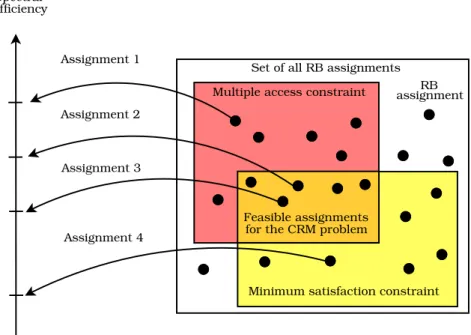
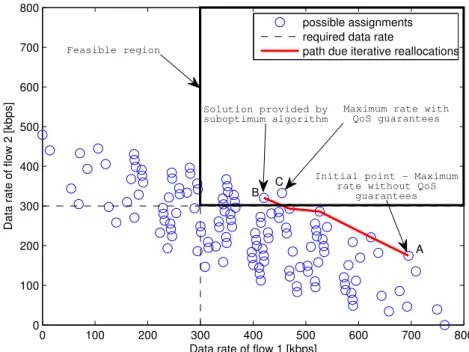
1.1 Frequency-time resource grid in OFDMA. . . 3 2.1 Illustration of the system modeling and RRA. . . 15 2.2 Illustration of the main aspects of the CRM problem. . . 17 2.3 Capacity region for a two-flow example to illustrate the proposed heuristic
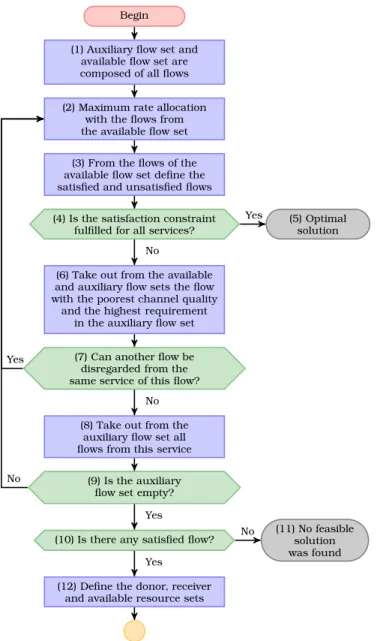
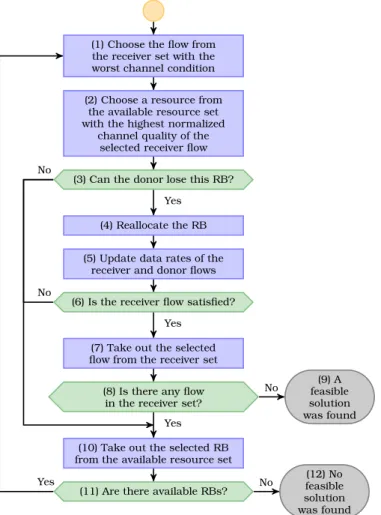
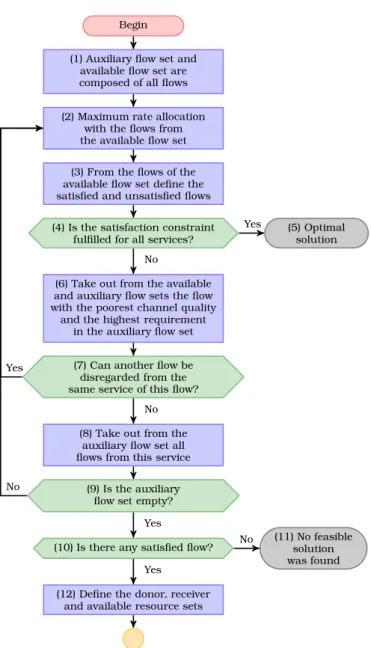
framework. . . 19 3.1 Flowchart of the first part of the proposed solution for the SISO case:
Unconstrained Maximization. . . 25 3.2 Flowchart of the second part of the proposed solution for the SISO case:
Reallocation. . . 26 3.3 Outage rate versus required data rate for CRM OPT, URM OPT and the proposed
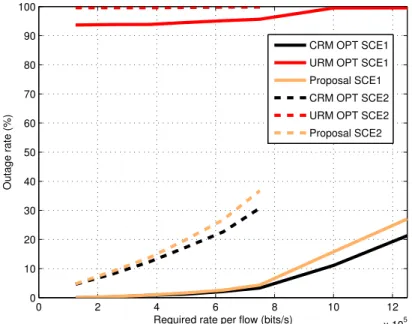
solution with one service in scenarios 1 and 2 for the SISO case. . . 29 3.4 Outage rate versus required data rate for CRM OPT, URM OPT and the proposed
solution with two services for the SISO case. . . 30 3.5 Outage rate versus required data rate for CRM OPT, URM OPT and the proposed
solution with three services for the SISO case. . . 32 3.6 Outage rate versus required data rate for CRM OPT, URM OPT and proposed
solution with four services for the SISO case. . . 33 3.7 CDF of total data rate for CRM OPT, URM OPT and the proposed solution with
two services in scenario 3 for the SISO case. . . 34 3.8 CDF of total data rate for CRM OPT, URM OPT and proposed solution with three
services in scenarios 9 and 12 for the SISO case. . . 35 3.9 CDF of total data rate for CRM OPT, URM OPT and the proposed solution with
four services in scenarios 13 and 14 for the SISO case. . . 36 4.1 Flowchart of the first part of the proposed solution for the SU MISO and SU
MIMO cases: Unconstrained Maximization. . . 41 4.2 Flowchart of the second part of the proposed solution for the SU MISO and SU
MIMO cases: Reallocation. . . 42 4.3 Comparison of outage rate versus required data rate for CRM OPT and proposed
4.4 CDF of the total downlink data rate for CRM OPT, URM OPT and proposed solution at the flows’ required rate of 2Mbps with single and multiple antenna schemes for the SU MISO and SU MIMO cases. . . 45 4.5 CDF of the total downlink data rate for CRM OPT, URM OPT and proposed
solution at the flows’ required rate of 2.75Mbps with single and multiple antenna schemes for the SU MISO and SU MIMO cases. . . 45 5.1 Flowchart of the first part of the proposed algorithm for the MU MIMO case:
Unconstrained Maximization. . . 54 5.2 Flowchart of the second part of the proposed algorithm for the MU MIMO case:
Reallocation. . . 56 5.3 Outage rate versus required data rate with CRM OPT, URM OPT and the proposed
solution for the SU MIMO and MU MIMO antenna configurations with MT = 2
andMR= 2. . . 58
5.4 CDF of total data rate for the data rate requirements of 2Mbps and 3.25Mbps with CRM OPT, URM OPT and proposed solution in the SU MIMO and MU MIMO antenna configurations withMT = 2andMR= 2. . . 59
5.5 Outage rate versus required data rate with CRM OPT, URM OPT and the proposed solution for the SU MIMO and MU MIMO antenna configurations with MT = 4
andMR= 4. . . 60
5.6 CDF of total data rate for the data rate requirements of 4Mbps and 6Mbps with CRM OPT, URM OPT and the proposed solution in the SU MIMO and MU MIMO antenna configurations withMT = 4andMR= 4. . . 62
6.1 Basic flowchart of the proposed algorithm for the URM problem in the uplink case. 67 6.2 Illustration of steps (1) and (2) of the proposed algorithm with 3 flows and 10
RBs for the URM problem in the uplink case. . . 67 6.3 Illustration of the process for building new VRs based on the example of Figure
6.2 for the URM problem in the uplink case. . . 69 6.4 CDF of total data rate for URM OPT, Wong Alg and proposed solution considering
different number of flows and 12, 18 and 24 RBs for the URM problem in the uplink case. . . 71 6.5 Average total data rate versus the number of flows for URM OPT, Wong Alg and
proposed solution considering 12, 18 and 24 RBs for the URM problem in the uplink case. . . 72 6.6 Flowchart of the first part of the proposed solution for the CRM problem in the
uplink case: Unconstrained Maximization. . . 75 6.7 Flowchart of the second part of the proposed solution for the CRM problem in
the uplink case: Reallocation. . . 77 6.8 Illustration of the process for selecting the available resources for flow 2 based
on 4 examples of resource assignment in the first part of the proposed solution for the CRM problem in the uplink case. We consider 10 RBs and that flows 1 and 4 are the donors and that flows 2 and 3 are receivers. . . 78 6.9 Illustration of the process to generate the RB groups based on the second
6.10 Illustration of the process to generate the RB groups based on the available RB of the second example of Figure 6.8 consideringiequal to 1, 2 and 3 for the CRM problem in the uplink case. . . 80 6.11 Outage rate for CRM OPT, URM OPT and the proposed solution with one service
in scenarios 1, 2 and 3 for the CRM problem in the uplink case. . . 82 6.12 Outage rate for CRM OPT, URM OPT and the proposed solution with two services
in scenarios 4, 5 and 6 for the CRM problem in the uplink case. . . 83 6.13 Outage rate for CRM OPT, URM OPT and the proposed solution with three
services in scenarios 7, 8 and 9 for the CRM problem in the uplink case. . . 83 6.14 CDF of total data rate for CRM OPT, URM OPT and proposed solution with one
service in scenarios 1 and 2 for the CRM problem in the uplink case. . . 85 6.15 CDF of total data rate for CRM OPT, URM OPT and proposed solution with two
services in scenarios 4 and 5 for the CRM problem in the uplink case. . . 86 6.16 CDF of total data rate for CRM OPT, URM OPT and proposed solution for required
List of Tables
3.1 Main simulation parameters for the SISO case. . . 27 3.2 Parameters of the considered scenarios for the SISO case. . . 28 4.1 Main simulation parameters for the SU MISO and SU MIMO cases. . . 43 5.1 Main simulation parameters considered in the performance evaluation for the
MU MIMO case. . . 57 6.1 Main simulation parameters considered in the performance evaluation for the
URM problem in the uplink case. . . 70 6.2 Main simulation parameters considered in the performance evaluation for the
CRM problem in the uplink case. . . 81 6.3 Parameters of the considered scenarios for the CRM problem in the uplink case. 81 A.1 Description of the main parameters used in Algorithms A.1, A.2 and A.3 for the
SISO and SU MIMO cases. . . 93 B.1 Description of the main parameters used in Algorithms B.1, B.2, B.3, B.4, B.5
and B.6 for the MU MIMO case. . . 99 C.1 Description of the main parameters used in Algorithms C.1, C.2, C.3 and C.4 for
the URM problem in the uplink case. . . 107 C.2 Description of the main parameters used in Algorithms C.5, C.6, C.6, C.7, C.8
List of Algorithms
5.1 BD-ZF withMT ≥J′·MR. . . 49
5.2 BD-ZF withMT < J′·MR. . . 50
A.1 Initialization for the SISO and SU MIMO cases. . . 93
A.2 First part of the proposed solution (Unconstrained Maximization) for the SISO and SU MIMO cases. . . 95
A.3 Second part of the proposed solution (Reallocation) for the SISO and SU MIMO cases. . . 96
B.1 Initialization for the MU MIMO case. . . 100
B.2 First part of the proposed solution (Unconstrained Maximization) for the MU MIMO case. . . 101
B.3 Second part of the proposed solution (Reallocation) for the MU MIMO case. . . . 102
B.4 Procedure 1 that is part of the second part of the proposed solution (Reallocation) for the MU MIMO case. . . 103
B.5 Procedure 2 that is part of the second part of the proposed solution (Reallocation) for the MU MIMO case. . . 104
B.6 Procedure 3 that is part of the second part of the proposed solution (Reallocation) for the MU MIMO case. . . 105
C.1 Initialization for solution to the URM problem in the uplink case. . . 107
C.2 Part 1 of the proposed solution for the URM problem in the uplink case. . . 108
C.3 Part 2 of the proposed solution for the URM problem in the uplink case. . . 109
C.4 Part 3 of the proposed solution for the URM problem in the uplink case. . . 110
C.5 Initialization for solution to the CRM problem in the uplink case. . . 113
C.6 First part of the proposed solution (Unconstrained Maximization) for the CRM problem in the uplink case. . . 114
C.7 Second part of the proposed solution (Reallocation) for the CRM problem in the uplink case. . . 115
C.8 Procedure 1 that is part of the second part of the proposed solution (Reallocation) for the CRM problem in the uplink case. . . 115
Nomenclature
Here we summarize the conventional notational of this thesis. Firstly, we present a list of acronyms, followed by an overview of the notation of more general nature. We conclude with the specific notation for this thesis.
Acronyms
The abbreviations and acronyms used throughout this thesis are listed here. The meaning of each abbreviation or acronym is indicated once, when it first appears in the text.
3G 3rd Generation
3GPP 3rd Generation Partnership Project 4G 4th Generation
ADSL Asymmetric Digital Subscriber Line BB Branch and Bound
BD Block Diagonalization BER Bit Error Rate
BS Base Station
CDF Cumulative Distribution Function CQI Channel Quality Indicator
CRM Constrained Rate Maximization CSI Channel State Information DFT Discrete Fourier Transform DPC Dirty Paper Coding
FDM Frequency Division Multiplexing FDMA Frequency Division Multiple Access FFT Fast Fourier Transform
IID Independent and Identically Distributed ILP Integer Linear Problem
IMT-A International Mobile Telecommunications - Advanced IP Internet Protocol
ISI Inter Symbol Interference LTE Long Term Evolution
LTE-A LTE - Advanced
MRT Maximum Ratio Transmission MU Multi-User
OFDM Orthogonal Frequency Division Multiplexing OFDMA Orthogonal Frequency Division Multiple Access PAPR Peak-to-Average Power Ratio
QoS Quality of Service RB Resource Block
RRA Radio Resource Allocation
SC-FDMA Single Carrier - Frequency Division Multiple Access SCM Spatial Channel Model
SDMA Space-Division Multiple Access
SINR Signal to Interference-plus-Noise Ratio SISO Single Input Single Output
SIMO Single Input Multiple Output SNR Signal to Noise Ratio
SU Single-User
SVD Singular Value Decomposition TDMA Time Division Multiple Access TTI Transmission Time Interval
UMTS Universal Mobile Telecommunications System URM Unconstrained Rate Maximization
VR Virtual Resource
WiMAX Worldwide Interoperability for Microwave Access ZF Zero-Forcing
Notations
The following notation is used throughout this thesis. We use uppercase and lowercase boldface to denote matrices and vectors, respectively. Plain letters are used for scalars. Other notational conventions are summarized as follows:
|A| - Cardinality of setA
S i∈IA
i - Set operation that represents the union of the setsAi ∀i∈ I
|a| - Absolute value of the scalara
(·)T - Transpose of a vector or matrix Ia - Identity matrix with dimensiona×a
0a,b - Matrix composed of 0’s with dimensiona×b
1a - Column vector of lengthacomposed of 1’s
0a - Column vector of lengthacomposed of 0’s
diag(· · ·) - Block diagonal matrix with the arguments in the main diagonal arg mina∈Af(a) - Value ofa∈ Athat minimizes the functionf(·)
arg maxa∈Af(a) - Value ofa∈ Athat maximizes the functionf(·)
min (· · ·) - Minimum value among all arguments max (· · ·) - Maximum value among all arguments k · k2 - Euclidean norm or 2-norm of a vector
(·)H - Hermitian of a matrix (·)−1 - Inverse of a matrix
a b
- Number of distinctb-element subsets of any set containingaelements (binomial coefficient)
loga(·) - Logarithm to baseaof the argument ln (·) - Natural logarithm of the argument
Specific Notations of the Thesis
We summarize here the symbols and notations that are used in the considered system modeling of this thesis. The variables defined in the appendices are presented in specific tables.
an,p - Assumes the value 1 if the RBnis present in the assignment patternp
A - Matrix composed of the elementsan,p
bj,n - Transmit signal vector to flowj on RBnin MIMO scenarios b
bj,n - Prior-filtering received signal vector of flowj on RBnin MIMO scenarios
e
bj,n - Post-filtering received signal vector of flowj on RBnin MIMO scenarios c - Number of subcarriers in an RB
cj,n - Number of streams that are transmitted to flowj on RBnin MIMO scenarios
dlj,n - lth row vector of the matrixD j,n
Dj,n - Receive matrix employed by the flow j when receiving data on RB n in MIMO
scenarios
G - Total number of SDMA groups that can be built withJ flows
G - Set with all the SDMA groups that can be built with the flows of setJ Gn - Set of flows that compose the SDMA group assigned to RBn
f(·) - Link adaptation function that maps SNR on transmit data rate
hDLj,n - Channel transfer function of the link between flow j and the serving BS on the RBnin the downlink when considering single antenna transceivers
hDLj,n,a,b - Channel transfer function of the link between theath receive antenna of flowj
and thebth transmit antenna of the serving BS on RBnin downlink
hULj,z,n - Channel transfer function of the link between flow j and the serving BS at the
zthsubcarrier of RBnin uplink
Hj,n - Channel transfer matrix of flowj on RBncomposed of the elementshDLj,n,a,b J - Total number of flows
Js - Number of flows that belongs to services
J - Flow set
Js - Set of flows that belongs to services
ks - Required minimum number of flows that should be satisfied for services MR - Number of receive antennas at terminals in the downlink scenario MT - Number of transmit antennas at BS in the downlink scenario
Mj,n - Transmit matrix employed by the serving BS when transmitting to flowjon RB nin MIMO scenarios
nj,n - Noise vector at terminaljon RBn N - Total number of RB
N
-RB set
Np - Set of Resource Blocks (RBs) that composes the assignment patternp og,j - Assumes the value 1 if flowj is a member of the SDMAg
O - Binary matrix composed of the elementsog,j
P - Number of RB patterns according to the number of available RBs
PDL - Total power available at the serving BS (downlink)
rMU DLg,j,n - Transmit data rate of flowjwhen the SDMA groupgis assigned the RBnin the MU MIMO downlink scenario
rSU DLj,n - Transmit data rate of flow j when RB n is assigned to flow j in SU downlink scenario
rULj,p - Transmit data rate of flowj when RB patternpis assigned to flowjin SC-FDMA
uplink scenario
S - Total number of services
S - Service set
tj - Required data rate of flowj
u(x, b) - Step function atbthat assumes the value 1 ifx≥band 0 otherwise
xMU DLg,n - Assumes value 1 if the SDMA groupg is assigned to RB n and 0 otherwise in MU MIMO downlink scenario
xSU DLj,n - Assumes value 1 if RBnis assigned to flow j and 0 otherwise in SU downlink scenario
xULj,p - Assumes value 1 if RB pattern p is assigned to flow j and 0 otherwise in SC-FDMA uplink scenario
XMU DL - Assignment matrix with elementsxMU DLg,n
XSU DL - Assignment matrix with elementsxSU DLj,n
XUL - Assignment matrix with elementsxULj,p
αDLj - Joint effect of the path loss and shadowing on the link between the serving BS and flowj in the downlink
αULj - Joint effect of the path loss and shadowing on the link between the serving BS and flowj in the uplink
γj,nDL
-SNR of flowj when receiving in RBnin the SISO downlink scenario
γj,n,lDL
-SNR of thelth stream of flowj on RBnin downlink with multiple antennas γj,pUL MMSE - Effective SNR using MMSE frequency equalizer when RB patternpis assigned
to flowj in SC-FDMA uplink
γj,z,nUL
-SNR of flowj onzth subcarrier of RBnin SC-FDMA uplink νj,n - Rank of the channel matrixHj,n
ρj - Binary selection variable that assumes the value 1 if the flowj is chosen to be
satisfied in the CRM problem
σRB2 - Noise variance considering the bandwidth of an RB
1
Chapter
1
Introduction
This is an introductory chapter where we present the motivation and scope of this thesis in section 1.1. After that we present basic concepts and background about relevant topics to this thesis in section 1.2 while the state of the art is reviewed in section 1.3. The open problems studied in this thesis and our main contributions are depicted in sections 1.4 and 1.5, respectively. Finally, the main scientific production during the Ph.D. course are presented in section 1.6.
1.1 Thesis Scope and Motivation
With its 3rd Generation (3G) advent, cellular networks were able to switch from the provision of the single circuit-switched voice service to a multi-service scenario with a wide variety of multimedia services. These networks are continuously evolving and, in particular, we are witnessing the beginning of the commercial deployment of the Long Term Evolution (LTE) system. Furthermore, 3rd Generation Partnership Project (3GPP) and other standardization bodies have been working on the specifications of LTE-Advanced in order to meet the requirements of International Mobile Telecommunications - Advanced (IMT-A) or 4th Generation (4G) [1]. The fierce competition for data service provision among wireless and wired networks, the need of being connected anytime and anywhere and the appealing mobile devices/applications are strong indications that the mobile broadband market has potential for further worldwide increasing.
3G and further generations have been designed to provide high transmit data rates and offer to smartphones, tablets and notebooks a plenty of options for mobile access. Those sophisticated mobile terminals enable the quickly popularization of new appealing data mobile applications. Not surprisingly, the Universal Mobile Telecommunications System (UMTS) Forum has predicted that voice and data traffic on mobile networks will grow more than 30-fold during the decade ahead [2]. This increased mobile data traffic and the need to provide high quality data services with sustainable Quality of Service (QoS) appear as a challenging scenario for mobile network operators and industry.
In order to deal with that scenario, improvements in the core network have been done by means of an Internet Protocol (IP)-based packet-switched architecture. This architecture allows for cost-efficient deployment and efficient support of mass market usage of any IP-based service.
1.2. Background 2
use of the available spectrum. OFDMA has been selected as the downlink multiple access scheme of modern networks such as LTE/LTE-Advanced [3] and Worldwide Interoperability for Microwave Access (WiMAX) [4]. Due to the high Peak-to-Average Power Ratio (PAPR) of the OFDM signal and consequently, the need of highly linear power amplifiers at the transmitter, LTE network adopted Single Carrier - Frequency Division Multiple Access (SC-FDMA) (also known as Discrete Fourier Transform (DFT)-spread OFDMA) instead of OFDMA in the uplink direction. Compared to OFDMA, SC-FDMA signals have inherently lower PAPR [5].
Other functionality that is mandatory in the new standards is the use of multiple antennas at the transmitter and receiver, i.e., Multiple Input Multiple Output (MIMO) [6]. MIMO techniques have been intensively studied in the last decade and have become part of most modern communication standards such as LTE, LTE-Advanced and WiMAX. Making use of advanced signal processing algorithms, MIMO techniques together with OFDM-based multiple access schemes allow for the exploitation of the spatial dimension of frequency channels for obtaining diversity and/or multiplexing gains.
The use of those new multiple access strategies with MIMO are capable of boosting the achievable data rates in the radio access. However, in order to obtain maximal capacity, a relevant and useful functionality to deal with the challenges of next generation cellular networks is an efficient Radio Resource Allocation (RRA). RRA algorithms interact with multiple access schemes and MIMO and are responsible for the management of the scarce radio resources such as power, time slots, spatial channels and frequency chunks [7].
RRA functionalities are capable of improving the spectral efficiency by a proper assignment of such resources. Moreover, in multiservice scenarios RRA algorithms can be used to satisfy the QoS requirements of the connected flows1 that in general have heterogeneous demands and different channel quality states. Specifically, we call resource assignment the functionality responsible for assigning frequency resources to the connected flows.
1.2 Background
This section is devoted to the introduction of basic concepts that are relevant for the remaining of this thesis. In the following sections we introduce the OFDMA and SC-FDMA multiple access methods, multiple antennas techniques, QoS and satisfaction concepts, and RRA.
1.2.1 Multiple access methods
As will be clear later, multiple access schemes are important when studying and designing RRA solutions. Along this thesis we will study RRA problems in the downlink OFDMA and uplink SC-FDMA. Both multiple access methods will be modeled in this thesis not in the signal processing level but in the level of how the resources are organized and accessed by mobile terminals. In the following we present a brief description of those two multiple access methods.
1.2.1.1 OFDMA
OFDMA is a multiple access scheme based on OFDM [8]. OFDM is a transmission technology that has been utilized in wired and wireless communications. Asymmetric Digital Subscriber Line (ADSL) broadband access and power line communications are examples of applications of OFDM in wired systems. In wireless systems, the OFDM technology is utilized in IEEE 802.11 a/g, LTE, LTE - Advanced (LTE-A) and Mobile WiMAX standards.
1.2. Background 3
In OFDM, the frequency band available for transmission is divided into several subcarriers that have narrower bandwidth than the channel coherence bandwidth, as in Frequency Division Multiplexing (FDM) systems. However, the subcarriers in OFDM are designed to be orthogonal among each other, which leads to higher spectral efficiency than FDM. OFDM transceivers can be efficiently implemented using the Fast Fourier Transform (FFT), and as consequence of the narrowband subcarriers, sophisticated equalization structures are not needed. Besides that, as the data rate transmitted in each subcarrier is low and consequently the modulated symbols are longer than the delay spreading, OFDM is robust against Inter Symbol Interference (ISI). In order to effectively mitigate the effects of ISI, a guard interval named cyclic prefix, that consists in a copy of part of the OFDM symbol, is inserted before the OFDM symbol transmission.
OFDM systems also allow for the practical use of multiple antenna schemes (MIMO). Although, the transmission of high data rates turns the MIMO channel to be frequency selective, the combination of multiple antenna and OFDM technologies transforms the frequency-selective channel into a set of parallel frequency-flat channels.
With OFDMA [9], the multiple access is achieved by the assignment of different subcarriers or block of them to individual flows at different time periods. Therefore, OFDMA is used jointly with Time Division Multiple Access (TDMA) multiple access. Assuming single antenna systems, the system resources in OFDMA can be arranged in a time-frequency grid as shown in Figure 1.1. In the frequency axis the granularity is defined by the subcarriers while in the time axis it is defined by an OFDM symbol. In MIMO OFDMA systems the spatial dimension is added to the resource grid leading to more flexibility in the resource assignment. A Resource Block (RB) is defined as the minimum allocable resource that consists in a group of one or more adjacent subcarriers in the frequency dimension and a number of consecutive OFDM symbols. The number of subcarriers and OFDM symbols in an RB depends on the system design and channel characteristics.
Flow 1
Flow 2
Flow 3
Time (Set of OFDM symbols)
Frequency (Group of subcarriers) Resource block
Figure 1.1: Frequency-time resource grid in OFDMA.
1.2. Background 4
assigned to different flows at the same time within a cell. As it will be presented later, this constraint renders a combinatorial component to the studied RRA problem. We define this constraint asexclusivityconstraint. Note that the exclusivity constraint is not present when multiple antennas are used to provide multiple access to the flows, as it will be presented later.
1.2.1.2 SC-FDMA
Despite the many advantages of OFDMA, it suffers from strong envelope fluctuations resulting in a high PAPR. Signals with high PAPR place a significant burden on mobile terminals due to the need of highly linear power amplifiers to avoid excessive signal distortion. Motivated by that reason and other practical aspects, 3GPP has chosen SC-FDMA as the multiple access technology for the uplink of LTE networks.
SC-FDMA, that is also known as DFT-spread OFDMA, transforms the time domain data symbols to frequency domain by a DFT before going through OFDMA modulation. Compared to OFDMA, SC-FDMA signals have inherently lower PAPR. On the other hand, in order to mitigate inter-symbol interference, the base station employs adaptive frequency domain equalization. In summary, SC-FDMA reduces the requirements on linear power amplifiers of mobile terminals but still requires frequency domain equalization at the base station [5].
SC-FDMA imposes additional constraints on RRA compared to OFDMA. Particularly, the frequency resource blocks assigned to a given mobile terminal for transmission should be adjacent to each other in order to obtain benefits in terms of PAPR. This new constraint significantly reduces the freedom in RRA compared to the OFDMA case in which this constraint does not exist. In summary, SC-FDMA imposes the following constraints when assigning resources:
◮ Exclusivity: The same RB cannot be shared by flows within a cell. Note that this
constraint already exists for the OFDMA case;
◮ Adjacency: The RBs assigned to the flows should be adjacent to each other in the
frequency domain. This constraint is not necessary in the OFDMA case. 1.2.2 Multiple antennas techniques
At the end of the 1990s multiple antenna techniques were theoretically shown to provide a novel means to achieve improved performance in wireless systems [10]. The use of multiple antennas at the transmitter and/or receiver is now part of any modern mobile communication system.
The multipath propagation due to the interaction of the electromagnetic waves with the environment by means of reflections, refractions, scattering and diffractions has been considered as a degrading characteristic of wireless systems when single antennas systems are employed. Surprisingly, the multipath propagation is of utmost importance for obtaining the gains with the use of multiple antenna systems.
1.2. Background 5
Basically, multiple antennas can be employed to obtain diversity and/or multiplexing gains. Diversity gains can be obtained by the transmission/reception of redundant signals representing the same information. At the receiver the transmitted signals should be coherently combined in order to achieve gains in signal strength that have as consequence improvements in the link reliability and error performance. Basically, the SIMO and MISO schemes are used to provide diversity gains. Multiplexing gains can be achieved by the simultaneously transmission of different pieces of information or data streams at the same time and frequency resources by means of the so called spatial channels. In general, the number of data streams that can be transmitted at the same time is limited by the minimum between the number of antennas at the transmitter and receiver. Therefore, MIMO schemes can be used to obtain multiplexing and diversity gains. The spatial multiplexing is an attractive technique to improve the data rates without resorting to more frequency bandwidth. The use of MIMO can also be classified according to the capacity of transmitting to multiple users. In Single-User (SU) MIMO schemes, multiple antennas are used for transmitting data to a single user within a given time-frequency resource. Therefore, the spatial dimension is not used to multiplex different flows in the spatial domain. Multi-User (MU) MIMO schemes enable the allocation of different spatial subchannels to different flows in the same time-frequency resource. In this case, the spatial dimension can be used as another tool to exploit the multiuser diversity as it was already done with time, frequency and power [11]. MU MIMO schemes are also known as Space-Division Multiple Access (SDMA) due to its capacity to multiplex different users similar to other multiple access technologies such as TDMA and Frequency Division Multiple Access (FDMA).
In order to perform spatial multiplexing with SU MIMO it is necessary the transmission of multiple interference-free streams. So as to be able to do that, multiple antennas should be employed at the transmitter and at the receiver. In other words, the number of interference-free data streams is limited by the minimum number of antennas at the transmitter and receiver. However, this is not mandatory with MU MIMO since the set of mobile terminals can be seen as a virtual receiver with multiple antennas. In the case of single antenna receivers, if the selection of mobile terminals to be spatially multiplexed guarantees that they are far apart from each other, improved channel correlation properties can be obtained as compared to the case of multiple receiver antennas at the same device.
The MU MIMO capability turns the RRA problems even more challenging due to the added degree of freedom. Furthermore, MU MIMO imposes strong requirements regarding channel state information available at the transmitter in order to achieve performance gains. This requirement is not essential in SU MIMO schemes and compromises the uplink capacity of the mobile systems due to the need of channel state information feedback [12].
1.2.3 QoS and satisfaction
The popularity of fixed networks with very high data rates motivated the development of several data services that demand exchange of different multimedia information. The development of mobile networks has opened the possibility of having access to these services on mobile devices. Also, the improvement of the processing power of mobile devices such as smartphones and tablets has contributed to the popularity of data services in mobile networks.
1.3. State of the Art 6
employment of a sophisticated control of the parameters that impact on how well a service is perceived. Parameters such as data rate, packet delay and jitter are among the most common QoS requirements. In fact, in order to support more flows in the network, resources should be assigned to flows so as to guarantee the minimum contracted QoS. With this, more resources are left to support new flows.
From the operator’s point of view it is important to provide the different services with a sustainable quality. In order to measure the quality level in which each service is provided in the network, system operators could adopt the QoS management strategy of considering minimum user satisfaction ratios for each service. In this way, in order to consider that a given service is provided with acceptable quality, the operators should satisfy a minimum percentage of the data sessions. As these minimum satisfaction ratios are defined for each service, the system operators can establish a priority hierarchy between the provided services [13].
1.2.4 Radio Resource Allocation
RRA is a system functionality that is responsible for allocating the available resources of the radio access network to the connected flows. When the system bottleneck is in the radio access instead of the core network, efficient RRA can dictate the performance of the overall system.
Among the available resources that can be allocated in the modern cellular networks we can mention frequency bandwidth (in terms of subcarrier or group of them in OFDMA or SC-FDMA), time slots, power and spatial subchannels when MIMO is employed. All these resources are limited and should comply with specific constraints. As an example, the assignment of subcarriers or group of them should be in accordance with the considered multiple access constraints. Another example is that the number of spatial subchannels depends on the number of antennas at the transmitter and receiver.
Besides the constraints imposed on the resources, we also have different design targets depending on the objective to be attained. As it will be presented in section 1.3, we can find in the literature many objectives such as improving the spectral efficiency or assuring fairness among the connected flows.
RRA in general rely on different information in order to achieve the design targets. Up-to-date channel state information is of fundamental importance in order to exploit the frequency and multiuser diversity. By the knowledge of the channel state information RRA can take advantage of the frequency selective nature of the wireless channel (frequency diversity) and also the different propagation channels that each individual terminal experiences (multiuser diversity).
1.3 State of the Art
In general, RRA problems are formulated in mathematical form as optimization problems composed of objective functions and constraints that limit the search space and feasible solutions. In the literature we can find many RRA problems with different objectives and constraints. Particularly, different multiple access schemes and antenna configurations impose new constraints to the problems.
1.3. State of the Art 7
transmit data rate. The solution to this problem is accomplished when each subcarrier is assigned to the flow with the best channel quality on that subcarrier and the power per subcarrier is distributed following the water-filling policy [14,15]. The study of this problem provides important insights regarding the maximum spectral efficiency that can be obtained with given limited resources. However, it is well-known that the solution to this problem does not consider QoS aspects and usually leads to service starvation of the terminals at the cell border. In fact, maximization of spectral efficiency and QoS fulfillment for the flows are two contradicting goals in mobile wireless networks [16].
As presented in section 1.1, the provision of multiple services imposes minimum QoS constraints to the connected flows. In order to address QoS aspects, other problems were formulated, such as the margin adaptive problem which consists in minimizing the total transmit power subject to individual data rate requirements for each flow. For this problem, a Lagrangian-based algorithm is proposed in [17], which is able to obtain considerable power efficiency gains but at the cost of a prohibitive computational complexity. In [18], a heuristic and low-complexity solution to this problem is proposed considering fixed modulation types. A further improved scheme with similar complexity is proposed in [19]. In [20], a heuristic algorithm that determines firstly how many and secondly which subcarriers should be assigned to each flow is proposed to solve the margin adaptive problem.
Another RRA problem is the rate adaptive problem in which the objective is to maximize the minimum flow data rate. Note that this problem is a particular case of theweighted rate balancing problem whose objective is to maximize the total downlink data rate in the cell while assuring that the flows’ achievable data rates are proportional to pre-defined weights that can be seen as fairness constraints. The solution to these problems tends to balance the achievable data rate of the flows in the cell, i.e., achieve fairness among the data rates allocated to the connected flows. In [21], a heuristic solution to this problem is proposed which firstly assigns to each flow its best subcarrier, then the remaining subcarriers are assigned to the flows with lowest data rate. The work in [22] studies theweighted rate balancingproblem. The disadvantage of the solutions of therate adaptive andweighted rate balancing problems is that they may penalize the terminals with better channel qualities and reduce the system efficiency, since many resources are assigned to the flows with high weights independently of their channel states.
In order to assure a minimum QoS to the flows, some works have studied the problem of maximizing the overall data rate subject to minimum flow data rate constraints. In [23], a suboptimal solution is proposed that firstly determines the amount of resources to be assigned to each flow. Then, the resources are assigned to each flow in an opportunistic manner. Since the Hungarian algorithm is used for resource assignment, the computational complexity may be prohibitive [24]. In [25], this problem is formulated as an Integer Linear Problem (ILP) and a low-complexity suboptimal solution is proposed. Computational complexity is further reduced in [26]. For more details on these RRA problems and solutions for single antenna systems see [7,11].
1.3. State of the Art 8
with this antenna scheme RRA has the freedom to assign spatial subchannels corresponding to the same frequency resource to different flows. This is also known as SDMA.
Due to the additional complexity of RRA with multiple antennas, differently of the SISO case, the solution to theunconstrained rate maximization problem is no more trivial. In [27] the authors have found the achievable sum rate capacity for multi-antenna downlink channel. The work in [28] provides strategies to achieve the sum rate capacity using non-linear processing Dirty Paper Coding (DPC) firstly described in [29]. However, obtaining the optimal transmission policy when employing DPC is a computationally complex non-convex problem. Therefore, in [30] the authors use duality to transform this problem into a well-structured convex problem for the multiple access channel.
Among the QoS aware solutions for MIMO we can mention the reference [31] that proposed solutions for the margin adaptive problem based on DPC and the uplink-downlink duality between multiple access channels and broadcast channels. However, the DPC complexity imposes constraints on the practical implementation of those solutions. The works [32,33] provided low-complexity solutions to themargin adaptive problem by using linear processing at the transceivers. Theweighted rate balancingproblem has been studied for MIMO in [34,35] by using non-linear DPC-based techniques. Efficient solutions with affordable computational complexity using linear transceivers were considered in [36]. Another work studied the problem ofmaximizing the overall data rate subject to minimum user data rate constraints[37]. The main idea is to assign more resources to the users which can contribute most to sum capacity.
As pointed out in section 1.2.1.2, the uplink of LTE employs SC-FDMA as the multiple access scheme. Particularly, this multiple access method imposes a new constraint on the RRA: resource adjacency. With the resource adjacency constraint, the frequency blocks assigned to each flow should be adjacent to each other in order to get benefit of the low PAPR characteristic of SC-FDMA. Furthermore, there is also the constraint that the same Modulation and Coding Scheme (MCS) should be used in all resources assigned to a given flow.
1.4. Open Problems 9
Zero-Forcing (ZF) and Minimum Mean Square Error (MMSE) frequency domain equalizers are employed.
As the unconstrained rate maximization problem does not consider QoS aspects, some works have considered other RRA problems that can guarantee a better resource distribution. In [42], a suboptimal solution is proposed to the problem of utility maximization. The considered utility functions were the sum of flows’ data rates and the sum of the logarithm of the flows’ data rates; the last one designed to achieve proportional fairness. Although SC-FDMA is considered in that work, the subcarrier adjacency constraint was not taken into account for RRA. In [43], the authors studied an RRA problem based on a general metric that quantifies the efficiency of assigning each resource to each terminal. Then, a search-tree based algorithm was proposed that equally divides the resources among the flows. This simplifying assumption limits the flexibility for RRA and the potential gains on multi-user diversity. The authors of [43] subsequently proposed another algorithm in [44] that allows the assignment of different amounts of frequency resource to the flows in order to achieve proportional fairness. The proposed algorithm iteratively finds the terminal and frequency resources combination with highest metric and expand the allocated bandwidth to that terminal by assigning the contiguous frequency resources in which the selected terminal has the highest metric compared to all other flows. The algorithm stops when all resources are assigned. Based on the same modeling of [43,44] and considering the knowledge of a metric for each terminal-resource pair, the authors in [45] proposed three different suboptimal solutions. The algorithm that meets the best performance-complexity trade-off presents similar ideas as those shown in [44]. In [46] that algorithm is modified to provide better performance at the cost of higher computational complexity. Proportional fairness is also the subject of [47], in which the authors show that the adjacency constraint is sufficient to characterize NP-hardness. Furthermore, the authors propose suboptimal algorithms to deal with the formulated problem and which exploit frequency correlation as in [44–46].
Other contributions with QoS-aware solutions for SC-FDMA uplink were [48–50]. In [48], the authors consider the problem of utility maximization with constraints on the minimum terminal data rates and maximum request delay. Heuristic solutions are proposed but the simulation results do not include comparisons of the proposed solutions with an upper bound or even with other related solutions. The main contribution of [49] consists in the integration of a well-known downlink scheduling solution with a method of estimating packet delays in uplink that is not as trivial as in downlink. Although, LTE uplink is considered, the adjacency constraint is not modeled. Finally, the margin adaptive problem that has been extensively studied in downlink OFDMA was considered in [50] for SC-FDMA uplink. The authors propose a suboptimal solution with variable complexity by adaptively defining the size of the search space composed of the possible terminal-resource assignments.
1.4 Open Problems
In section 1.3 we presented different RRA problems that were studied in some scenarios with different antenna configurations and multiple access schemes. As shown by the literature review, the community research is aware of the relevance of QoS fulfillment to modern networks what shows the importance of the subject. In this thesis we are still concerned with the QoS fulfillment, however, we add another constraint motivated by the system operator needs.
1.4. Open Problems 10
of minimum satisfaction constraints for each provided service type. More specifically, they require that a certain fraction of the connected flows of each service be satisfied with the provided QoS [13,51,52]. With this in mind, we propose a new RRA problem that is the maximization of the overall data rate subject to minimum satisfaction constraints per service. Basically, the objective of the studied problem is to maximize the total data rate in the system. This objective is the same as some of the problems presented in section 1.3 and aims at guaranteeing that the system resources are used in an efficient way. The main problem constraint consists in assuring that a pre-defined number of flows from each provided service are satisfied with the resource distribution. Due to the relevance of theunconstrained rate maximization problem to our work we denote hereafter this problem by the acronym Unconstrained Rate Maximization (URM). Moreover, for the sake of simplicity we denote the maximization of the overall data rate subject to minimum satisfaction constraints per service problem by Constrained Rate Maximization (CRM). Although we have presented many other problems that impose constraints to the RRA problem, the use of this acronym refers only to the main problem studied in this thesis.
To the best of our knowledge the CRM problem was not considered in the literature so far. Related to this new problem some engineering/scientific questions arise and need to be answered:
i. Problem formulation and modeling: As presented in the literature review, this problem has not been studied before as far as we know. The presented RRA problems shown in section 1.3 were formulated as optimization problems. Therefore, the identification of the system variables and a model for the problem in the optimization form are themselves open research topics to be studied.
ii. Characterization of optimal solution: The knowledge of the best possible solution (optimal) to a problem or a bound for it provides important insights to researchers and engineers. Therefore, an open problem to be studied in this thesis is to find (if possible) methods to obtain the optimal solution to the presented problem without resorting to brute force methods.
iii. Existence of low-complexity solutions: In general the RRA problems that involve RB allocation are combinatorial and hard to optimally solve. Therefore, the proposal of low-complexity solutions is of utmost importance. Consequently, another open issue to be studied is whether good (probably suboptimal) solutions can be found to the considered problem.
iv. Performance metrics and evaluation: The studied problem is composed of two contradicting goals: maximization of total data rate (problem objective) and satisfaction guarantees (problem constraints). Consequently, new performance metrics should be identified in order to measure how efficient are the solutions. Moreover, performance evaluation of the involved solutions should be addressed.
v. Different scenarios: As presented in the literature review, the different RRA problems were studied in different scenarios. The previous open problems have different particularities depending on the considered scenario. The other open problem to be studied in this thesis is how the following scenarios impacts on the answer of problems i,ii,iiiandiv.
1.5. Contributions and Thesis Organization 11
(b) Downlink SU MIMO (c) Downlink MU MIMO (d) Uplink SC-FDMA
vi. Computational complexity analysis: As we are dealing with algorithms, besides the performance evaluation by means of computational simulations, the computational complexity is needed in order to compare different algorithms in terms of the performance-complexity trade-off.
1.5 Contributions and Thesis Organization
In Chapter 2 we present the basic system model assumed along the thesis. As different scenarios are considered along the thesis, in this chapter we only present the common aspects of the modeling. Also, in this chapter we present the studied problem in a general form so as to provide an overview without going into details that are specific of each scenario. We finish this chapter presenting a heuristic framework to be followed in order to conceive efficient solutions to the studied problem. The contributions of this chapter help to address the open problemsiandiii.
The scenario with single antennas and downlink OFDMA is approached in Chapter 3. In this chapter we mathematically formulate the problem and provide a discussion about a method to obtain the optimal solution. It is important to highlight here that few works in the literature as shown in section 1.3 provide means to obtain or characterize the optimal solutions or bounds to their studied problems. Due to the high computational complexity of the involved optimal solution we propose a low-complexity heuristic solution. This chapter is finished with a performance analysis of the solutions by means of computational simulations. The contributions of this chapter are related to the open problemsi,ii,iii,ivandv(a).
Chapter 4 is devoted to the extension of the studied problem to the multiple antennas case with SU MIMO scenario. Firstly, the system modeling considered in the last chapter is extended to the SU MIMO including the MIMO channel and spatial filters. Then, similar steps considered in Chapter 3 are followed: problem formulation, discussion about optimal solution, proposal of heuristic solutions and performance analysis. The open problems i,ii, iii,ivandv(b) are addressed in this chapter.
In Chapter 5 we generalize even more the downlink OFDMA scenario considered in previous chapters by considering the multiple antenna case with possibility of sharing the same frequency resource with different flows, i.e., MU MIMO scenario. As in the previous chapter, we extend the system modeling and notation. In this chapter we introduce the concept of SDMA groups that impacts considerably in the problem formulation and proposal of heuristic solutions. Then we formulate the optimization problem, discuss the methods to obtain the optimal solution, propose efficient solutions and present a performance analysis of the involved solutions. In this chapter we present answers to the open problemsi,ii,iii,iv and v(c).
1.6. Scientific production 12
here: problem formulation, characterization of the optimal solution and performance analysis. Besides the proposal of efficient solutions to the URM problem, in this chapter we present answers to the open problemsi,ii,iii,ivandv(d).
In Chapter 7 we summarize the main conclusions obtained along the thesis. Furthermore, we point out the main research directions that can be considered as extension of the study performed in this thesis. Finally, in the appendices we present the computational complexity of all algorithms proposed in this thesis. This contribution addresses the open problemvi.
1.6 Scientific production
The content and contributions present in Chapter 3 were published with the following information:
◮ Lima, F. R. M.; Maciel, T. F.; Freitas, W. C.; Cavalcanti, F. R. P., “Resource Assignment for Rate Maximization With QoS Guarantees in Multiservice Wireless Systems”. IEEE Transactions on Vehicular Technology, 2012.
The technical content of the Chapter 4 was published with the following information:
◮ Lima, F. R. M.; Bezerra, N. S.; dos Santos, R. B.; Maciel, T. F.; Freitas, W. C.; Cavalcanti,
F. R. P., “Maximizing Spectral Efficiency with Acceptable Service Provision in Multiple Antennas Scenarios”. European Wireless Conference, 2012.
Three provisional United States patents of the low-complexity algorithms proposed in Chapters 5 and 6 were filled.
At the time of writing, we are working for publishing the technical content of Chapters 5 and 6. In parallel to the work developed in the Ph.D. course that was initiated on the second semester of 2008, the Ph.D. candidate has been working on other research projects. Although the studied problems in these projects are not the same as the ones of the Ph.D. study, the context is within the area of radio resource management for wireless cellular networks. The complete list of the articles is presented in the following:
◮ Silva, J. M. B.; Lima, F. R. M.; Maciel, T. F.; Cavalcanti, F. R. P., “Distributed Resource Allocation for Wireless Service Provision in a Competitive Scenario”. XXIX Brazilian Telecommunications Symposium, 2011.
◮ Lima, F. R. M.; Cavalcanti, F. R. P.,; Neto, R. O., “Radio Resource Management for Churn Rate Control in Cellular Data Operators”. IEEE Globecom 2010 Workshop on Mobile Computing and Emerging Communication Networks, 2010.
◮ dos Santos, R. B.; Freitas, W. C.; Lima, F. R. M.; Cavalcanti, F. R. P., “Method and Arrangement for Resource Allocation”. United States Patent, (20100150088), Publication date: July 2010.
◮ Lima, F. R. M.; Wänstedt, S.; Cavalcanti, F. R. P.; Freitas, W. C., “Scheduling for Improving System Capacity in Multi-service 3GPP LTE”. EURASIP Journal of Electrical and Computer Engineering, 2010.
◮ Lucena, E. O.; Lima, F. R. M.; Freitas, W. C.; Cavalcanti, F. R. P.; “Overload Prediction Based on Delay in OFDMA Systems”. IEEE Globecom 2010 Symposium, 2010.
1.6. Scientific production 13
◮ Lucena, E. O.;Lima, F. R. M.; Freitas, W. C.; Cavalcanti, F. R. P.; “Congestion Control Framework for Real-Time Services in OFDMA-based Systems”. XXVII Brazilian Telecommunications Symposium, 2009.
◮ Lima, F. R. M.; Freitas, W. C.; Cavalcanti, F. R. P.; “Scheduling Algorithm for Improved System Capacity of Real-Time Services in 3GPP LTE”. XXVII Brazilian Telecommunications Symposium, 2009.
◮ da Silva, A. P.; dos Santos, R. B.; Lima, F. R. M.; Cavalcanti, F. R. P.; Freitas,
W. C., “A Resource Assignment Study on Wireless OFDMA Systems”. XXVI Brazilian Telecommunications Symposium, 2008.
14
Chapter
2
System Modeling, General Problem
and Framework for Solution
In the next chapters we study the CRM problem in different scenarios such as downlink/uplink and single/multiple antenna(s). Therefore, in section 2.1 of this chapter we present the common aspects regarding the system model assumed along this thesis. In section 2.2 we present the general view of the CRM problem without detailing the aspects that depend on the considered scenarios. Later in the next chapters, we will refine the system model according to their specificities. In section 2.3 we introduce a heuristic approach that was followed along this thesis to propose alternative solutions to the CRM problem.
2.1 General System Model
We consider a cellular system1 composed of a number of sectored cells. For a given sector of a cell, there is a group of flows2 connected to cell’s Base Station (BS). In this thesis we consider the CRM problem in different scenarios including downlink and uplink directions. In the downlink case we consider that the system combines OFDMA and TDMA while in the uplink case the system employs SC-FDMA and TDMA. In both cases the available resources are arranged in a time-frequency resource grid, where the minimum allocable resource, or RB, is defined as a group of one or more adjacent subcarriers and a number of consecutive OFDM symbols in the time domain, which represent the Transmission Time Interval (TTI). The flows of a same sector can be simultaneously served by the assignment of different orthogonal frequency-time RBs and, therefore, there is no intra-cell interference among flows of the same sector in either downlink or uplink. The only exception to this is in the MU MIMO case where the RBs are shared and interference (intra cell) could appear. As it will become clear later, this interference could be controlled by spatial filtering.
Although intra-cell interference can be controlled by the considered multiple access schemes (OFDMA in downlink and SC-FDMA in the uplink), the flows might still experience inter-cell interference from other sectors that reuse the same frequency band in the cellular system. Especially in packet-switched systems, inter-cell interference is quite unpredictable. The reason for this is that at each TTI the resource usage pattern defined by the resource
1Note that the contributions presented in this thesis could be applied with small modifications in other systems that preserve similar characteristics as the one that will be shown such as flexible resource allocation.
2.1. General System Model 15
Base Station
Terminal
Flow
Selection Frequencyresources
Frequency resources
Resource Assignment Data flows
Channel state of flow 1
Channel state of flow J
Figure 2.1: Illustration of the system modeling and RRA.
assignment at each cell of the system can change considerably due to the dynamic traffic conditions. There are many approaches to deal with inter-cell interference in the literature [53].
Interference management is out of the scope of this work and we assume the simplifying assumption that the inter-cell interference is modeled as a Gaussian random variable and that it is part of the thermal noise in the Signal to Noise Ratio (SNR) expression. We highlight that this assumption becomes more and more valid as the sector load and the number of cells in the system increase [54].
In this thesis we consider a snapshot optimization problem that has as output the proper association between flows and RBs (resource assignment). In other words, at each TTI we intend to solve an assignment problem given the current system state such as channel state, traffic state and QoS related variables.
The sequential solution to this problem along consecutive TTIs leads to decisions on which packets are delivered using which resources. This solution is equivalent to the decisions taken by a time-domain packet scheduler. Although the allocation along the time is not considered in this thesis, this could be performed by the dynamic adaptation of the input variables of the optimization problem. More comments about this issue are drawn in Chapter 7.
In this thesis we consider the approach followed by the works [7,11]. More specifically, we consider that the RRA is split into two parts: flow selection (or flow scheduling) and resource assignment. The system modeling, and the flow selection and resource assignment parts are illustrated in Figure 2.1. As illustrated in this figure, the flow selection part is responsible for pre-selecting the flows with high priorities among all connected flows in order to compete for resource assignment in the second part. Among the criteria that can be used for flow selection we can mention QoS aspects such as current packet delay, average data rate and amount of buffered data. For good references about this topic see [55,56]. In the second part, resource assignment, the proper association among the selected flows and RBs is done based on but not limited to the RB channel states of each selected flow as shown in Figure 2.1. The scope of this work is limited to resource assignment strategies such as the works discussed in section 1.3 of this thesis.