BGD
6, 3563–3654, 2009Effects of hypoxia on coastal benthos
L. A. Levin et al.
Title Page
Abstract Introduction
Conclusions References
Tables Figures
◭ ◮
◭ ◮
Back Close
Full Screen / Esc
Printer-friendly Version
Interactive Discussion
Biogeosciences Discuss., 6, 3563–3654, 2009 www.biogeosciences-discuss.net/6/3563/2009/ © Author(s) 2009. This work is distributed under the Creative Commons Attribution 3.0 License.
Biogeosciences Discussions
Biogeosciences Discussionsis the access reviewed discussion forum ofBiogeosciences
E
ff
ects of natural and human-induced
hypoxia on coastal benthos
L. A. Levin1, W. Ekau2, A. J. Gooday3, F. Jorissen4, J. J. Middelburg5, W. Naqvi6, C. Neira1, N. N. Rabalais7, and J. Zhang8
1
Integrative Oceanography Division, Scripps Institution of Oceanography, 9500 Gilman Drive, La Jolla, CA 92093-0218, USA
2
Fisheries Biology, Leibniz Zentrum f ¨ur Marine Tropen ¨okologie, Leibniz Center for Tropical Marine Ecology, Fahrenheitstr. 6, 28359 Bremen, Germany
3
National Oceanography Centre, Southampton, European Way, Southampton SO14 3ZH, UK
4
Laboratory of Recent and Fossil Bio-Indicators (BIAF), Angers University, 2 Boulevard Lavoisier, 49045 Angers Cedex 01, France
5
Netherlands Institute of Ecology, Centre for Estuarine and Marine Ecology, P.O. Box 140, 4400 AC Yerseke, The Netherlands
6
National Institution of Oceanography, Dona Paula, Goa 403004, India
7
BGD
6, 3563–3654, 2009Effects of hypoxia on coastal benthos
L. A. Levin et al.
Title Page
Abstract Introduction
Conclusions References
Tables Figures
◭ ◮
◭ ◮
Back Close
Full Screen / Esc
Printer-friendly Version
Interactive Discussion
8
State Key Laboratory of Estuarine and Coastal Research, East China Normal University, 3663 Zhongshan Road North, Shanghai 200062, China
Received: 17 January 2009 – Accepted: 6 February 2009 – Published: 3 April 2009
BGD
6, 3563–3654, 2009Effects of hypoxia on coastal benthos
L. A. Levin et al.
Title Page
Abstract Introduction
Conclusions References
Tables Figures
◭ ◮
◭ ◮
Back Close
Full Screen / Esc
Printer-friendly Version
Interactive Discussion Abstract
Coastal hypoxia (<1.42 ml L−1; 62.5µM; 2 mg L−1, approx. 30% oxygen saturation)
oc-curs seasonally in many estuaries, fjords, and along open coasts subject to upwelling or excessive riverine nutrient input, and permanently in some isolated seas and ma-rine basins. Underlying causes of hypoxia include enhanced nutrient input from natural 5
causes (upwelling) or anthropogenic origin (eutrophication) and reduction of mixing by limited circulation or enhanced stratification; combined these lead to higher surface water production, microbial respiration and eventual oxygen depletion. Advective in-puts of low-oxygen waters may initiate or expand hypoxic conditions. Responses of estuarine, enclosed sea, and open shelf benthos to hypoxia depend on the duration, 10
predictability, and intensity of oxygen depletion and on whether H2S is formed. Un-der suboxic conditions, large mats of filamentous sulfide oxidizing bacteria cover the seabed and consume sulfide, thereby providing a detoxified microhabitat for eukary-otic benthic communities. Calcareous foraminiferans and nematodes are particularly tolerant of low oxygen concentrations and may attain high densities and dominance, 15
often in association with microbial mats. When oxygen is sufficient to support meta-zoans, small, soft-bodied invertebrates (typically annelids), often with short generation times and elaborate branchial structures, predominate. Large taxa are more sensitive than small taxa to hypoxia. Crustaceans and echinoderms are typically more sensitive to hypoxia, with lower oxygen thresholds, than annelids, sipunculans, molluscs and 20
cnidarians. Mobile fish and shellfish will migrate away from low-oxygen areas. Within a species, early life stages may be more subject to oxygen stress than older life stages.
Hypoxia alters both the structure and function of benthic communities, but effects may differ with regional hypoxia history. Human-caused hypoxia is generally linked to eutrophication, and occurs adjacent to watersheds with large populations or agricultural 25
BGD
6, 3563–3654, 2009Effects of hypoxia on coastal benthos
L. A. Levin et al.
Title Page
Abstract Introduction
Conclusions References
Tables Figures
◭ ◮
◭ ◮
Back Close
Full Screen / Esc
Printer-friendly Version
Interactive Discussion
and elevated abundances of enrichment opportunists, sometimes prior to population crashes. Areas of low oxygen persist seasonally or continuously beneath upwelling re-gions, associated with the upper parts of oxygen minimum zones (SE Pacific, W Africa, N Indian Ocean). These have a distribution largely distinct from eutrophic areas and support a resident fauna that is adapted to survive and reproduce at oxygen concentra-5
tions<0.5 ml L−1. Under both natural and eutrophication-caused hypoxia there is loss
of diversity, through attrition of intolerant species and elevated dominance, as well as reductions in body size. These shifts in species composition and diversity yield altered trophic structure, energy flow pathways, and corresponding ecosystem services such as production, organic matter cycling and organic C burial. Increasingly the influences 10
of nature and humans interact to generate or exacerbate hypoxia. A warmer ocean is more stratified, holds less oxygen, and may experience greater advection of oxygen-poor source waters, making new regions subject to hypoxia. Future understanding of benthic responses to hypoxia must be established in the context of global climate change and other human influences such as overfishing, pollution, disease, habitat 15
loss, and species invasions.
1 Introduction
1.1 Sources of coastal hypoxia
Hypoxia, a shortage of dissolved oxygen, can originate in the ocean naturally, from hu-man influences, or increasingly, from interactions between huhu-man activities and natural 20
processes that make estuarine and coastal waters more susceptible to oxygen deple-tion. Fundamentally, the same processes are at work in most instances of natural and human-induced hypoxia. Biological oxygen demand exceeds the supply of oxygen from surface waters, typically as a result of increased microbial respiration, stimulated by ac-cumulated carbon from enhanced primary production in surface waters. The enhanced 25
BGD
6, 3563–3654, 2009Effects of hypoxia on coastal benthos
L. A. Levin et al.
Title Page
Abstract Introduction
Conclusions References
Tables Figures
◭ ◮
◭ ◮
Back Close
Full Screen / Esc
Printer-friendly Version
Interactive Discussion
Nutrients are injected into surface waters either as a result of upwelling (a natural pro-cess driven by winds that occurs along continental margins) or via air and rivers as a result of anthropogenic activities. Cultural eutrophication (sensu Nixon, 1995; Diaz and Rosenberg, 1995, 2001, 2008) typically occurs where human population or agricultural production is high (Rabalais, 2004). Nutrient enhancement stimulates excessive phyto-5
plankton growth. When the resulting organic matter exceeds the capacity of metazoan consumers to metabolize it, the remaining organic matter settles to a pynocline or the sediments, where it is decomposed, mainly by heterotrophic bacteria. This decay de-pletes the dissolved oxygen at a rate faster than resupply from surface, well-oxygenated waters because of the inhibited diffusion of dissolved oxygen across a sharp density 10
difference, i.e., pycnocline.
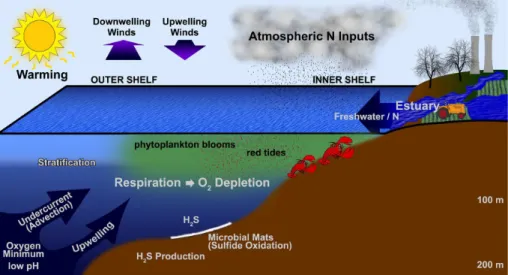
Oxygen depletion is exacerbated in situations where water masses are highly strati-fied or isolated from oxygenated water bodies. Stratification results from strong thermal or salinity gradients including freshwater lenses formed from excessive rain or runoff from land. In many instances, warming or intense rainfall (e.g., monsoons) are sea-15
sonal events, and act to create seasonal hypoxia. Most of the time stratification is a natural process, but long-term warming trends in the ocean, climate-related precipita-tion changes, and altered riverine input can insert a human element (Fig. 1). Land-enclosed water bodies, such as estuaries, the Black or Baltic seas, fjords, silled basins and even the Arabian Sea, have a long residence time and little exchange with sources 20
of oxygenated water. In regions and at water depths where well-oxygenated currents prevail, hypoxia is rare. The interaction of such currents (e.g., the California Current, The Humboldt Current, the Benguela Current) with strong upwelling and high primary production creates sharp natural oxygen gradients along the coast and continental margin.
25
BGD
6, 3563–3654, 2009Effects of hypoxia on coastal benthos
L. A. Levin et al.
Title Page
Abstract Introduction
Conclusions References
Tables Figures
◭ ◮
◭ ◮
Back Close
Full Screen / Esc
Printer-friendly Version
Interactive Discussion
oxygen-rich water sinks and begins a long “conveyor-belt” like trek through the interior of the oceans (Rahmstorf, 2006). Oxygen is slowly used up over periods of over 1000– 2000 years, leading to much lower base oxygen levels in the northern Pacific and Indian Oceans, than in the Atlantic and Southern Oceans. Hypersaline waters and warm waters hold less dissolved oxygen than cold, fresher water. Where warm, saline waters 5
(e.g., from the Red Sea) enter the ocean (e.g., the Arabian Sea) or where waters are very old, hypoxia is more likely.
Finally, many continental shelf systems experience variable advection (or bathing) of low-oxygen waters from adjacent or deeper water masses or systems. Seasonal wind reversals can shift the relative influence of undercurrents that transport such wa-10
ters, leading to seasonal hypoxia or even anoxia. Remote forcing of these currents, combined with warming and reduced wind stress (that normally drives ventilation), ap-pear to dominate oxygen dynamics on the shelves of the central Benguela ecosystem offNamibia (Monteiro et al., 2008) and Oregon (Grantham et al., 2004), and offIndia (Naqvi et al., 2006). Larger-scale climate modes associated with Kelvin waves such 15
as El Ni ˜no Southern Oscillations (ENSO Schaffer et al., 2002) and the Benguela Ni ˜no (Monteiro et al., 2008) force decadal shifts in shelf oxygenation by altering relative ad-vection of equatorial water masses, although the oxygenation effects can be in opposite directions.
The factors described above (Fig. 1) can come together in different ways, over a 20
range of space and time scales, to generate oxygen depletion of varying intensity, du-ration and recurrence. Within a single region, hypoxia severity can vary over time as a function of amount of productivity and degree of stratification (Rabalais and Turner, 2001; Naqvi et al., 2006; Rabalais et al., 2007b). How hypoxia affects benthos, and whether the effects vary fundamentally under conditions of human-caused versus nat-25
BGD
6, 3563–3654, 2009Effects of hypoxia on coastal benthos
L. A. Levin et al.
Title Page
Abstract Introduction
Conclusions References
Tables Figures
◭ ◮
◭ ◮
Back Close
Full Screen / Esc
Printer-friendly Version
Interactive Discussion
provide a synthetic overview of oxygen thresholds and gradients responsible for pop-ulation, community and ecosystem-level responses to hypoxia, distinguishing human and natural forcing where possible and (d) evaluate recovery potential, the influence of concurrent stresses, and future prospects for benthos subject to hypoxia. We treat all major benthic life forms, with the exception of microbial responses other than those of 5
macroscopic, mat-forming sulfur bacteria.
1.2 Coastal hypoxia: environments and time scales
Coastal hypoxia will be treated here in three settings: estuaries and embayments, enclosed seas, and open continental shelves. Often there is a distinction between pro-cesses controlling hypoxia on the inner shelf (∼0–100 m), and those on the outer shelf/ 10
upper slope (100–400 m). Where appropriate we have tried to emphasize this distinc-tion (Fig. 1). In areas with deep shelves or steep continental margins, even depths below 200 m can be considered coastal. Open ocean, deep-water oxygen minimum zones (OMZs,<0.5 ml L−1) occur permanently at depths between 100 and 1200 m in
the Arabian Sea, the Bay of Bengal, the E South Pacific and E Subtropical North Pa-15
cific, and seasonally in the Gulf of Alaska and W Bering Sea. The world OMZs have a surface area of 30.4 million km2(8% of ocean area) (Paulmier and Ruiz-Pino, 2008), and where they intercept the slopes, confer hypoxia on about 2% or 1.15 million km2of the continental margin (Helly and Levin, 2004). These settings and deep, silled basins subject to permanent hypoxia, though significant in area, will not be considered directly 20
except where they impinge on the shelf or provide relevant ecological or evolutionary insight.
Different settings experience hypoxia on different time and space scales. Estuaries for example, are often subject to seasonal (on an annual basis) or episodic hypoxia (Diaz and Rosenberg, 1995, 2001). Sometimes hypoxia is localized within a specific 25
BGD
6, 3563–3654, 2009Effects of hypoxia on coastal benthos
L. A. Levin et al.
Title Page
Abstract Introduction
Conclusions References
Tables Figures
◭ ◮
◭ ◮
Back Close
Full Screen / Esc
Printer-friendly Version
Interactive Discussion
and Azov seas encompass massive hypoxic regions. When the hypoxia is the result of eutrophication, active reductions in nutrient inputs can reverse low dissolved oxy-gen trends and reduce or eliminate hypoxia (Mee et al., 2005). Continental shelves receiving input from large rivers (e.g., Mississippi, Po, Rhine), or near large population centers, are bathed in nutrients from land, wastewater, or from atmospheric deposi-5
tion. These coastal areas are likely to experience hypoxia during summer when high temperatures strengthen salinity stratification. In the Gulf of Mexico, this affects up to 22 000 km2each summer, in waters mainly shallower than 45 m (Rabalais and Turner, 2001; Rabalais et al., 2007b). Outer shelves are subject to the influence of interannual and decadal climate cycles as well as seasonal winds, through their effectsion on up-10
welling, downwelling and advection. On the Pakistan and West India margins there is a monsoon-driven seasonal shoaling of the oxygen minimum zone and additional devel-opment of inshore hypoxia (Naqvi et al., 2000, 2006; Brand and Griffiths, 2008). Similar conditions have developed in recent years on the Oregon inner shelf, although for dif-ferent reasons (Grantham et al., 2004; Chan et al., 2007). On the Chile margin the 15
inner shelves are seasonally hypoxic with low DO in austral summer (Sellanes et al., 2003). Outer shelves offPeru and Chile are subject to the pervasive influence of ENSO cycles. During normal and La Ni ˜na years production is high there and the regions be-low 100 m are permanently hypoxic. During El Ni ˜no events, strengthened influence from equatorial water masses oxygenates the shelf and deepens the upper boundary 20
of the OMZ offPeru (Helly and Levin, 2004), whereas El Ni ˜no causes a shoaling of the OMZ and oxygen depletion on the southern California shelf (McClatchie et al., 2009).
1.3 Oxygen thresholds and levels deleterious to benthos
Dissolved oxygen (DO) concentrations are typically measured in units of mg L−1, ml L−1, micromolar (µM=µmol L−1) or percent saturation. From here on we will either 25
BGD
6, 3563–3654, 2009Effects of hypoxia on coastal benthos
L. A. Levin et al.
Title Page
Abstract Introduction
Conclusions References
Tables Figures
◭ ◮
◭ ◮
Back Close
Full Screen / Esc
Printer-friendly Version
Interactive Discussion
of 0.5 ml L−1are used to identify permanent oxygen minimum zones (Helly and Levin, 2004; Paulmier and Ruiz-Pino, 2008). However, at 2 mg L−1, DO shortages can in-duce avoidance, or altered behavior, growth, reproduction or survivorship in taxa for which normoxia is the rule. Hypoxia represents the degradation of water quality for an average species. Among fishes and invertebrates, different taxonomic groups, body 5
sizes and skeletal types have different oxygen tolerances and thresholds (Diaz and Rosenberg, 1995; Wannamaker and Rice, 2000; Rabalais et al., 2001a; Karlson et al., 2002; Vaquer-Sunyer and Duarte, 2008), so that no single definition of hypoxia fits all organisms.
Mobile nekton on the northern Gulf of Mexico continental shelf will avoid oxygen 10
levels <2 mg L−1 (1.4 ml L−1) (Pavela et al., 1983; Renaud, 1986). Fish avoidance
generally occurs at oxygen concentrations 0.5 to 2 mg L−1 (0.35 to 1.4 ml L−1) higher than the LC 50s, when tolerance has been tested (Vaquer and Duarte, 2008). Within estuaries, reduced densities of hogchoaker (Triinectes maculates) occur at<1 mg L−1
(0.7 ml L−1), for spot (Leiostomus xanthurus) at<1.5 mg L−1(1.1 ml L−1) and for Atlantic
15
croaker (Micropogonius undulates) at 3 to 5 mg L−1(2.1–3.5 ml L−1). Lethal oxygen lev-els are 0.4 mg L−1(0.28 ml L−1) for hogchoker and 0.7 mg L−1(0.5 ml L−1) for spot (Pihl et al., 1991); Atlantic croaker in the Gulf of Mexico avoid oxygen concentrations of less than 2 mg L−1 (1.4 ml L−1) (Rabalais et al., 2001a; Craig and Crowder, 2005). In Long Island Sound, 15 out of 18 fish species occur more frequently and at higher densities 20
at sites with DO>3 mg L−1 (>2.1 ml L−1) than at sites with DO<2 mg L−1 (1.4 ml L−1)
(Howell and Simpson, 1994).
Some invertebrates may experience mortality at <4 mg L−1 (2.7 ml L−1), with larval
stages being the most sensitive (Gray et al., 2002). A meta-analysis by Vaquer-Sunyer and Duarte (2008) revealed that the median oxygen concentration eliciting sublethal ef-25
fects in 62 invertebrate species (265 experiments) was 2.13 mg L−1(1.5 ml L−1; 67µM).
BGD
6, 3563–3654, 2009Effects of hypoxia on coastal benthos
L. A. Levin et al.
Title Page
Abstract Introduction
Conclusions References
Tables Figures
◭ ◮
◭ ◮
Back Close
Full Screen / Esc
Printer-friendly Version
Interactive Discussion
explaining why piles of dead crabs or lobsters are often the first sign and a common feature of hypoxia (Officer et al., 1984; Chan et al., 2008). Thresholds are clearly affected by temperature and the presence of H2S (Vaquer and Duarte, 2008).
Thresholds are lower for animals that have evolved in permanently hypoxic settings such as oxygen minimum zones (O2<0.5 ml L−1), which drape margins of the
east-5
ern Pacific, the Arabian Sea and West Africa (Levin, 2003). Within OMZs, inverte-brate species composition and diversity are affected at DO concentrations below 0.4 to 0.5 ml L−1(Levin and Gage, 1998; Levin et al., 2000). Little is known about species-specific thresholds in OMZs but clearly some metazoan populations can survive at oxy-gen levels close to the limits of detection (e.g., Levin et al., 2003). Studies on Volcano 7 10
offMexico (Levin et al., 1991) and the Pakistan margin (Levin et al., 2009) suggest that multispecies macrofaunal communities occur down to an oxygen threshold of around 0.1 ml L−1, but exceptions (where animals thrive at lower levels) have been found off
Peru (Levin et al., 2002) and recently offIndia (Kitazato et al., unpublished data). The severity of hypoxia experienced by coastal benthic ecosystems is determined 15
by the nature of the exposure in addition to the actual DO concentrations. At the com-munity and ecosystem level, the area affected, the frequency and duration of exposure and the evolutionary history of exposure will all determine the “severity” of impacts and the nature of the response, making prediction of standard successional patterns difficult (Conley et al., 2007).
20
2 Regional studies of benthic responses
2.1 Estuaries and bays
Estuarine hypoxia, where present, is most often seasonal, due to increased temper-ature and salinity stratification between late spring and early fall. Exposure to low oxygen conditions may be aperiodic (not every year; lasting for tidal cycles, days or 25
BGD
6, 3563–3654, 2009Effects of hypoxia on coastal benthos
L. A. Levin et al.
Title Page
Abstract Introduction
Conclusions References
Tables Figures
◭ ◮
◭ ◮
Back Close
Full Screen / Esc
Printer-friendly Version
Interactive Discussion
that normoxic refugia may remain elsewhere in the estuarine complex. Estuaries are also subject to harsh extremes of salinity and temperature. In studies of multiple stres-sor effects on macrofaunal distribution and abundance, dissolved oxygen explains more of the variability than temperature or salinity (Rainer and Fitzhardinge, 1981; Flemer et al., 1999). In addition, organic loading often interacts with DO, and together they 5
explain much of the variation in species presence and density (Flemer et al., 1999). Factors such as reduced solar radiation (reducing phytoplankton oxygen production), reduced tidal range (enhancing haline stratification), and precipitation (inducing runoff) can contribute to estuarine hypoxia in tidally mixed estuaries.
Detailed lists of estuaries and bays subject to human-induced hypoxia and faunal 10
responses are summarized in Diaz and Rosenberg (1995, 2001, 2008) and Gray et al. (2002). The majority of hypoxic estuaries are reported from the North Atlantic Ocean and adjacent seas (Diaz and Rosenberg, 2008). Over 46% of US estuaries are subject to seasonal hypoxia in one or more localized regions (Gray et al., 2002, Bricker et al., 2007). Of these, the majority occur on the US East and Gulf Coasts. The US 15
West coast appears more resistant, although hypoxic events have been recorded from Hood Canal (Puget Sound), Los Alamitos and Newport Bay, with nutrient enrichment implicated. Estuarine hypoxia is of widespread concern because estuaries support major shellfisheries (oysters, scallops, clams), provide nursery habitat to numerous finfish and shellfish species harvested commercially, and are key sites for aquaculture. 20
2.1.1 Chesapeake Bay
Chesapeake Bay is one of the largest estuaries in North America, with a length of 320 km. Episodic hypoxia has occurred in Chesapeake Bay since at least 1600 and seasonally since 1900 (Zimmerman and Canuel, 2002; Willard and Cronin, 2007; Goo-day et al., 2009). Seasonal hypoxia increased in extent, duration and intensity during 25
BGD
6, 3563–3654, 2009Effects of hypoxia on coastal benthos
L. A. Levin et al.
Title Page
Abstract Introduction
Conclusions References
Tables Figures
◭ ◮
◭ ◮
Back Close
Full Screen / Esc
Printer-friendly Version
Interactive Discussion
When the water column is stratified in summer, about 40% of Chesapeake Bay lies below the pycnocline. The volume of hypoxic water in summer has tripled in the last 40 years and may comprise up to 25% of the bay waters (Hagy et al., 2004). Sedi-ment laminations occur in the deep central bay sediSedi-ments, indicating that macrofauna are absent and permanent hypoxia may have existed for∼100 years (Schaffner et al., 5
1992).
Demersal dwellers and feeders, such as blue crabs, croaker and spot, are partic-ularly susceptible to the effects of hypoxia (Caddy, 1993). Death of crabs in pots, disappearance of crabs in deep water below 4–6 m, and shoaling of crabs during sum-mer have been noted since the 1950s (Officer et al., 1984). In Chesapeake Bay bottom 10
fishes experience habitat compression and potentially reduced access to food (Officer et al., 1984; Breitburg, 1992; Breitburg et al., 2001). However, macrobenthos expe-riencing hypoxia in the York River migrate to the sediment-water interface and may enhance, at least temporarily, food supply for higher trophic levels (Pihl et al., 1991, 1992).
15
The combined factors of oxygen depletion and overfishing have had cascading con-sequences for the bay’s ecosystem. Oyster reefs are key habitats in the shallower wa-ters of Chesapeake Bay. In the lower Rappahannock, oyster reefs are suffocated dur-ing hypoxic events, yielddur-ing “black bottoms” (Officer et al., 1984; Breitburg et al., 2001). Loss of oysters led to diminished filtration of phytoplankton and consequently reduced 20
light transmission and declines in submerged aquatic vegetation (Newell, 1988; Newell and Koch, 2004). Loss of oyster reef substrates required for benthic life stages of sea nettles led to declines in this key plankton predator that controls ctenophores within the Bay (Breitburg and Fulford, 2006). Bottom-dwelling fishes on the remaining viable oyster reefs are often killed during intrusions of hypoxic water into shallower waters. 25
(Officer et al., 1984; Breitburg, 1992; Breitburg et al., 2001).
BGD
6, 3563–3654, 2009Effects of hypoxia on coastal benthos
L. A. Levin et al.
Title Page
Abstract Introduction
Conclusions References
Tables Figures
◭ ◮
◭ ◮
Back Close
Full Screen / Esc
Printer-friendly Version
Interactive Discussion
al., 1977; Holland et al., 1977, 1987), followed by fall recolonization. At oxygen con-centrations<1.4 ml L−1, macrobenthic communities in the Rappahannock River show
reduced species diversity (50% lower), lower biomass (70% lower), and loss of deep-dwelling, long-lived species (Dauer et al., 1992). Shallow-deep-dwelling, short-lived op-portunist species dominate under hypoxic conditions. These include the polychaetes, 5
Paraprionospio pinnata, Polydora ligni, Streblospio benedicti, Mediomastus ambiseta, Leitoscoloplos fragilis, Glycinde solitaria, Eteone heteropodaandAsabellides oculata,
and the bivalveMulinia lateralis(Dauer et al., 1992).
In the York River, benthos was resistant to periodic hypoxia (0.2–0.8 ml L−1) of short (6 to 14-d) duration that affects mainly areas deeper than 9 m. There were few perma-10
nent effects of hypoxia on macrobenthos (Dauer et al., 1992). Epifaunal communities tolerated hypoxic events of up to 1 week in the York River but exhibited behavioral re-sponses including migration up in the water, development of resting stages in sessile taxa, and reduced feeding and growth by mobile taxa (Sagasti et al., 2001). Evidence of long-term changes in benthos of the York River suggests that hypoxia has shaped 15
the benthic communities (Boesch et al., 1976). Observations of macrobenthic and epibenthic resistance and resilience to short-term hypoxia (Pihl et al., 1991; Dauer et al., 1992; Sagasti et al., 2001) have led to speculation of long-term conditioning of the community to episodic oxygen depletion (Diaz and Rosenberg, 1995).
2.1.2 Changjiang (Yangtze River) estuary and inner shelf of East China Sea
20
The Changjiang (Yangtze River) is among the five largest rivers in the world with 928.5×10⁹m3yr−1 of water discharged historically, and 0.4–0.5×10⁹tons yr−1 of sed-iment (Qu et al., 2005). The river is ca. 6400 km in length with a drainage area of 1.81×10⁶km2. In the East China Sea, the dilute riverine waters (i.e. river effl u-ent plumes) can disperse over∼104km2across the broad shelf in summer when the 25
BGD
6, 3563–3654, 2009Effects of hypoxia on coastal benthos
L. A. Levin et al.
Title Page
Abstract Introduction
Conclusions References
Tables Figures
◭ ◮
◭ ◮
Back Close
Full Screen / Esc
Printer-friendly Version
Interactive Discussion
(KSW) and Sub-surface (KSSW) waters, Taiwan Strait Warm Water (TSWW), East China Sea Coastal Current (ECSCC) and Changjiang Diluted Water (CDW) (cf. Zhang and Su, 2006). These play a crucial role in regulating biogeochemical processes (e.g. hypoxia) on the shelf (Zhang et al., 2007).
Seasonal hypoxia off the Changjiang Estuary is found in summer and sometimes 5
early autumn (i.e. July–September), presumably owing to the stratification that is in-duced by the buoyancy effect following increase in riverine water influx and high pro-duction in surface waters fueled by terrestrial inputs of nutrients. The hypoxic water (i.e. DO≤1.4 ml L−1) is mainly constrained near the 20–75 m isobath about 10–20 m beneath the sea surface, with a minimum DO level of ca. 0.35 ml L−1. Over the last 10
several decades the area of hypoxia offthe Changjiang Estuary has tended to increase by a factor of 5–10. The hypoxic area in the inner shelf of the East China Sea was ca. 1800 km2in August of 1959, approximately 13 700 km2in August 1999 (Li et al., 2002) and>15 400 km2in August 2006 (Zhu, 2007). Owing to the very dynamic character of
circulation in the East China Sea, the coastal hypoxia offthe Changjiang Estuary has 15
strong temporal and spatial variability. The center or core of hypoxia, where minimal DO was observed in near-bottom waters, ranges from 29◦N to 33◦N in the area of the 40–50 m isobaths. Sometimes, two hypoxic cores can be identified offshore of the Changjiang Estuary (Li et al., 2002).
Total organic carbon (TOC) of bottom sediments (i.e. 0–5 cm) can be as low as 0.1– 20
0.3% in areas affected by seasonal hypoxia offthe Changjiang Estuary, then increase to 0.5–1.0% further offshore. Similarly, Chl-a in bottom sediments is 50–100 ng g−1
(dry weight) in areas of summer hypoxia, whereas it can be 200–400 ng g−1in offshore regions (Zhu, 2007). The benthic fauna in this region is composed of Polychaeta (e.g.
Glycera chirori), Crustacea (e.g. Callianassa japonica), Echinodermata (e.g.Ophiura
25
BGD
6, 3563–3654, 2009Effects of hypoxia on coastal benthos
L. A. Levin et al.
Title Page
Abstract Introduction
Conclusions References
Tables Figures
◭ ◮
◭ ◮
Back Close
Full Screen / Esc
Printer-friendly Version
Interactive Discussion
reduced when summer hypoxia prevails in the water column. The densities of sessile species do not fully recover in late autumn after hypoxia disappears. At this time strong mixing and water column instability associated with increasing northeast winds may prevent settlement. This is in contrast to the open shelf area outside the hypoxic wa-ters, where animal abundance is higher but exhibits less seasonal variability. The outer 5
shelf meiofaunal (i.e.<0.5 mm) abundance in surface sediments (i.e. 0–5 cm) is
de-pressed (0.5–1.0×10⁶individuals m−2[=500–1000 ind 10 cm−2]) but doubles in autumn when hypoxia starts to fade owing to wind-induced vertical mixing; higher meiofaunal abundance (e.g. 2.0×10⁶ind m−2 [2000 ind 10 cm−2] occurs in areas where normoxic conditions dominate in the water column (Tang, 2004). Macrobenthic densities in hy-10
poxic surface sediments reach 100–200 ind m−2 in spring before the development of seasonal hypoxia, but are <100 ind m−2 in autumn when the normoxic conditions
re-cover; outside the hypoxic area abundances are 2–3 times higher (Zheng et al., 2003; Tang, 2004, 2006).
Fish species dwelling in near-bottom waters avoid and/or escape from the hypoxic 15
conditions offshore of the Changjiang Estuary. However, because this region is a tra-ditional spawning and hatching grounds for some economically important fish species (e.g.Trichiurus lepturus,Larimichthys polyactiandPortunus trituberculatus), persistent hypoxia in summer can cause damage to early life-history stages, leading to reduction of recruitment of crucial marine resources (Zheng et al., 2003; Qu et al., 2005). Adults 20
of benthic invertebrates and fish exhibit higher biomass outside the hypoxic zone, with aggregations along the fringe of normoxic waters. Densities (i.e. kg h−1 of trawling) of yellow croakers, hairtail and crabs in the hypoxia region offthe Changjiang Estuary can be 5-fold lower than in normoxic areas further offshore on the shelf (cf. Tang, 2006). Hypoxia in this region interacts with eutrophication induced by nutrient enrichment from 25
BGD
6, 3563–3654, 2009Effects of hypoxia on coastal benthos
L. A. Levin et al.
Title Page
Abstract Introduction
Conclusions References
Tables Figures
◭ ◮
◭ ◮
Back Close
Full Screen / Esc
Printer-friendly Version
Interactive Discussion
2.2 Fjords and enclosed seas
Enclosed water bodies such as fjords, lochs, basins and shallow seas often exhibit stratification of temperature and/or salinity with oxygen depletion in deeper waters. When thermal stratification is most intense during summer, hypoxia can be seasonal, persisting for weeks to months.
5
2.2.1 Fjords
Anoxia is usually a local event and does not encompass the whole water body. Mussel bed presence will enhance oxygen depletion, due to enhanced oxygen consumption. Summer anoxia typically elicits a mortality sequence. Motile species such as fish will move away from the anoxic areas. Somewhat less mobile crustaceans such as shrimp 10
and crabs die first, followed by lamellibranch molluscs, and snails, with polychaetes often most resistant (Jørgensen, 1980). Sulfide oxidizing bacteria (Beggiatoa, Thiovu-lum) form mats at the sediment-water interface where both sulfide and oxygen are present. Areas less affected provide source organisms for recolonization.
Oxygen-tolerant taxa in NE Atlantic fjords typically includeHeteromastus filiformis, 15
Melinna cristata,Spiophanes kroyeri, Abra nitida, andThyasira equlis. Thyasira sarsi,
Amphiura chiajei,A. filiformis, andCapitella capitataare dominant at deeper stations, although they require higher oxygen levels (Josefson and Widbom, 1988; Nilsson and Rosenberg, 2000). Indices that combine animal abundance measures with sediment structure and redox potential discontinuity (RPD) depth provide good characterization 20
of the successional response to hypoxia by fjord benthos (Nilsson and Rosenberg, 2000)
Fjords and lochs have limited flushing, and thus are susceptible to hypoxia through human inputs of organic matter via fish farming, pulp mill effluent, and sewage. Salmon farming is a common practice in high-latitude fjords and lochs. When flushing is re-25
BGD
6, 3563–3654, 2009Effects of hypoxia on coastal benthos
L. A. Levin et al.
Title Page
Abstract Introduction
Conclusions References
Tables Figures
◭ ◮
◭ ◮
Back Close
Full Screen / Esc
Printer-friendly Version
Interactive Discussion
waters. In lochs such as Loch Ailort, subject to farming for several decades, the fish food may contribute up to 50% of the total particulate organic carbon (POC) supply.
Scalibregma inflatum was the dominant taxon beneath fish farms in Loch Ailort. Mel-lina cristata, with the ability to build long tubes up into the water, was dominant in the Gullmarfjord after extended hypoxia. Tube extension may increase turbulence and 5
enhance oxygen supply (Nilsson and Rosenberg, 2000). The benthic fauna was elimi-nated near a sulphite pulp mill in the upper reaches of the Gullmar Fjord (Lepp ¨akoski, 1975).
2.2.2 Black Sea
The Black Sea drains areas from 17 countries, receiving input from Europe’s 2nd and 10
3rd largest rivers, the Danube and Dnieper (Mee et al., 2005, Shapiro et al., 2006). Prior to 1973, the Black Sea shelf (50 000 km2) was dominated by a red alga Phyl-lophora nervosa that supported a rich assemblage of 118 invertebrates and 47 fish species. Along a vertical oxygen gradient in the northwestern Black Sea there is a transition fromMytilus galloprovincialis(62 m) toModiolus phaseolinusbiocoeneses at 15
100 m. The high filtration rates of the mussels regulate phytoplankton biomass. Dur-ing the 1960s agricultural and lifestyle transformations in countries surroundDur-ing the Black Sea led to increased agricultural, animal, industrial and human waste inputs to surface waters. Eutrophication and increased phytoplankton biomass resulted in light limitation that led to the die offof the macroalgal mats. As eutrophication increased, 20
mussels were unable to regulate phytoplankton blooms and massive buildup of detri-tus generated excessive oxygen demand (Mee et al., 2005). In 1973 the northwestern shelf experienced 3500 km2of summer hypoxia as a result of eutrophication. By 1978 this had expanded to 30 000 km2. By 1989, mass mortalities of benthos had occurred (Zaitsev, 1992) and in 1990 the “dead zone” encompassed 40 000 km2. Anoxia led to 25
BGD
6, 3563–3654, 2009Effects of hypoxia on coastal benthos
L. A. Levin et al.
Title Page
Abstract Introduction
Conclusions References
Tables Figures
◭ ◮
◭ ◮
Back Close
Full Screen / Esc
Printer-friendly Version
Interactive Discussion
biomass up to 5 kg m−2, further impaired function of the ecosystem (Vinogradov, 1992). Economic failure and social change in the late 1980s led to a dramatic reduction in nutrient and waste inputs to the Black Sea, and ultimately to a shift in political and management regimes. A variety of treaties and altered practices have greatly reduced eutrophication in the Black Sea and provided valuable information about capacity for 5
ecosystem recovery. Benthic studies suggest limited recovery within 6 years, with some macroalgae and mussels present (Mee et al., 2005). However, humans cannot control all aspects of Black Sea hydrography and oxygenation. External forcing from the continental margin waters and from climate events are important in this system, along with nutrient loads. Episodic phytoplankton blooms result when cold, nutrient-rich 10
waters from the northern slope and shelf mix with the cold intermediate layer. Winter production may rival the eutrophic production (Sorokin, 2002). In 2001 late rainfall and high temperatures triggered a hypoxic event on the northwestern shelf (Mee et al., 2005).
Along a vertical oxygen gradient in the northwestern Black Sea, elevated meiofauna 15
density occurs at the transition from oxic to anoxic bottom waters, which begins around 130 m (<5µM O2, Wenzhofer et al., 2002). Some hypoxia-tolerant species persist
be-tween 130 and 185 m where the transition zone is subject to instability and appears to fluctuate vertically (Gulin and Kovalevsky, 2008). The oxic/anoxic transition inter-acts with methane seepage creating a complex geochemical setting inhabited largely 20
by microbes, Foraminifera and nematodes (Sergeeva and Gulin, 1998). Larvae and adults of the polychaetesProtodrilus sp. andVictorniella zaikai (a chrysopetalid) are abundant in the transition water column and sediments, respectively (Sergeeva et al., 1999).
2.2.3 Baltic Sea
25
BGD
6, 3563–3654, 2009Effects of hypoxia on coastal benthos
L. A. Levin et al.
Title Page
Abstract Introduction
Conclusions References
Tables Figures
◭ ◮
◭ ◮
Back Close
Full Screen / Esc
Printer-friendly Version
Interactive Discussion
water about 8000 cal. yr BP (Sohlenius et al., 2001). Hypoxia was intermittently present through the Holocene (Zill ´en et al., 2008), and persistently present since about 1900 (Fonselius, 1981). The Baltic Sea now has a permanent halocline that prevents mixing and oxygenation of water (Andersin et al., 1978). The occurrence of hydrogen sulfide at depth in the Baltic fluctuates with flushing by Kattegat waters, with hydrogen sulfide 5
present as shallow as 110 to 115 m (Fonselius, 1981). During the 20th century, nitro-gen increased fourfold and phosphorus inputs to the Baltic increased eightfold (Lars-son et al., 1985), which led to eutrophication and worsening hypoxia/anoxia. There is an early history of extreme fluctuation in bottom-water oxygen concentrations (>80 m)
from both natural cases and human-induced eutrophication. Hydrogen sulfide was 10
documented as early as 1931 in the Gotland Deep, and macrobenthos were reported absent from the Bornholm Basin in 1948. Episodic flushing events involving North Sea water occurred in the 1950s and 1960s causing oxygenation (3–5 ml L−1) followed by rapid drops in oxygen to near 0 in the Bornholm Basin (Tulkki, 1965, Lepp ¨akoski, 1975). During these events the normally low-diversity macrobenthos (e.g., 7–8 species) be-15
came heavily dominated in numbers and biomass by one or a few hypoxia-tolerant species (e.g.,Scoloplos armiger in 1965;Capitellasp. in 1967). While macrobenthos biomass increased above the halocline, severe hypoxia and anoxia developed below (Elmgren, 1989), causing elimination of bioturbating macrofauna and formation of lam-inated sediments over large areas of seafloor (Schaffner et al., 1992).
20
In the eastern Gotland Deep biological features and abiotic factors result in distinct faunal zones (Olenin, 1997). Up to 50 species were found at oxygenated depths<30 m,
only 11–14 species were present in hypoxic waters from 50 to 124 m, and no species were recovered between 124 and 140 m. High biomass in shallow areas was asso-ciated with a hard-bottom community of Mytilus edulis and with Macoma balthica in 25
BGD
6, 3563–3654, 2009Effects of hypoxia on coastal benthos
L. A. Levin et al.
Title Page
Abstract Introduction
Conclusions References
Tables Figures
◭ ◮
◭ ◮
Back Close
Full Screen / Esc
Printer-friendly Version
Interactive Discussion
Hypoxia-tolerant ostracods include Cyprideis torosa, Heterocyprideis sorbyana, and
Candona neglecta. These taxa reflect either omnivorous mobile (swimming) taxa, i.e., the crustaceans, or shallow infaunal deposit feeders. Both groups have minimal biotur-bation capacity.
2.3 Continental shelves
5
2.3.1 Chilean shelf
Hypoxia on the outer Chile shelf is associated with Equatorial subsurface water. The influence of this water mass is greatest offnorthern Chile, where more or less perma-nent hypoxia occurs from the inner shelf to 400 m. Off central Chile, the outer shelf is seasonally hypoxic to 41◦S due to upwelling in shallow water during spring and 10
summer (Sellanes et al., 2003, 2007). Thick mats of sulfide oxidizingThioploca and
Beggiatoaare key features on the Chile shelf during normal summer hypoxia. These bacteria attain a wet weight of 1 kg m−2between 50 and 100 m water depth (Gallardo, 1963, 1977). Associated with the bacteria mats are nematode-dominated meiofaunal assemblages (Neira et al., 2001b; Sellanes et al., 2003). Macrofauna are abundant 15
(e.g., up to 73 900 ind m−2, 68.4 g m−2wet wt.) but diversity is low (Sellanes et al., 2007). Body size is reduced under hypoxic conditions on the Chile shelf (Quiroga et al., 2005). Most of the macrofauna are annelids and about half are represented by the polychaeteParaprionospio pinnata. This species is highly adapted for low oxygen conditions, with elaborate branchial structures that enhance oxygen diffusion and enzy-20
matic adaptations for anaerobic metabolism (Gonz ´alez and Quino ˜nes, 2002; Quiroga et al., 2007).Mediomastus branchiferus, Aricidea pigmentata, Nephtys ferrugineaand
Cossura chilensis, combined with the amphipodAmpelisca araucana, form most of the remaining macrofauna. It is hypothesized that uptake of H2S by the large filamentous bacteria acts to detoxify the setting, protecting annelid prey and their predators such 25
BGD
6, 3563–3654, 2009Effects of hypoxia on coastal benthos
L. A. Levin et al.
Title Page
Abstract Introduction
Conclusions References
Tables Figures
◭ ◮
◭ ◮
Back Close
Full Screen / Esc
Printer-friendly Version
Interactive Discussion
There is a strong coupling of upwelling, primary production, oxygen budgets and benthic communities on the Chile shelf; this has been best documented off Concep-cion, Chile (36◦S). Bacterial mat cover and biomass is greatest after consecutive years of upwelling-favorable, highly productive, La Ni ˜na-like conditions;Thioplocathrives at DO levels between 0.2 and 0.3 ml L−1 (Guti ´errez et al., 2000). During El Ni ˜no years, 5
when primary production declines and the shelves become better oxygenated (Schaf-fer et al., 1999), Thioploca biomass is depressed and densities of the tube-dwelling
P. pinnatadecline (Guti ´errez et al., 2000; Sellanes et al., 2007). Larger-bodied, sub-surface, bioturbating species (e.g., Cossura chilensis) increase in density and there is an overall deepening of faunal activity within the sediments (Guti ´errez et al., 2000; 10
Sellanes et al., 2003). This leads to greater irrigation, and more sediment reworking (Guti ´errez et al., 2000).
Meiofauna show parallel trends offcentral Chile during El Ni ˜no events. Meiofaunal abundance and biomass increase, dominance by nematodes is diminished, remain-ing nematodes dwell deeper in the sediments, and harpacticoid copepods increase 15
in abundance (Neira et al. 2001b; Sellanes et al., 2003; Sellanes and Neira, 2006). Overall meiofaunal abundance is positively correlated with bottom-water oxygen con-centration. The cumulative effect of El Ni ˜no is to attenuate seasonality and create better oxygenated, winter-like conditions on the shelf throughout the year, with effects on the benthic community lasting up to five years beyond the cessation of detectable 20
climate shifts.
2.3.2 Peru margin
Long-term monitoring of shelf bacteria and metazoans in sediments off Peru (12◦S; 94 m) show variations in bottom-water oxygen concentrations and community structure driven remotely by coastal trapped waves originating in the Equatorial region; these are 25
often but not always associated with ENSO cycles. There are three community ‘states’. Prevailing conditions involve anoxia-hypoxia (DO<10µM) with few macrofauna and
domination of biomass by nematodes. During intermediate oxygenation (10–20µM),
BGD
6, 3563–3654, 2009Effects of hypoxia on coastal benthos
L. A. Levin et al.
Title Page
Abstract Introduction
Conclusions References
Tables Figures
◭ ◮
◭ ◮
Back Close
Full Screen / Esc
Printer-friendly Version
Interactive Discussion
higher oxygenation levels associated with strong El Ni ˜no events (>40µM), macrofauna
are dominant. Macrofaunal dominance may persist long after reformation of hypoxia, apparently due to the bioturbation activity of nemerteans and enteropneusts, which mixes what little oxygen is available into the sediments (Guti ´errez et al., 2008). Thus different oxygen levels are not always linked to distinct assemblages and transitions 5
are observed frequently.
Shallow waters in the Bay of Ancon, Peru (11◦S) are subject to frequent hypoxia at 15 m and nearly permanent hypoxia (and sometimes anoxia) at 34 m. Macroben-thos during “normal” (non El Ni ˜no) years are characterized by low faunal densities (4000 and 425 ind m−2 at 15 m and 34 m, respectively), low biomass (<1.08 g and
0.-10
2 g ash free dry wt. m−2), and low numbers of species (3–17 and 0–6) (Tarazona et al., 1988a, 1988b). The numerically dominant taxa wereOwenia collaris,Magelona phyl-lisae,Chaetozone sp. andPhoronissp. at 15 m and Paraprionospio pinnata,M. phyl-lisae, Chaetozone sp. andLeitoscoloplos chilensis at 34 m (Tarazona et al., 1988a). Since monitoring of macrobenthos began in 1981 there have been four El Ni ˜no events 15
that have raised temperatures and oxygenated the inshore waters. The community response consistently involved nearly immediate, dramatic elevation of diversity and reduced dominance, with colonization of local species (Tarazona et al., 1988a, 1988b; Arntz et al., 2006). While density and biomass increases followed oxygenation in some cases, this response was not consistent, possibly due to increased predation 20
by megafaunal species that also recolonized. Sometimes high macrofaunal densities continued following the return of hypoxia. Similar results have been obtained for macro-fauna in the Bay of Independencia (14◦20′S) (Tarazona et al., 2001, Arntz et al., 2006). Numerous fisheries species on the central Peru shelf respond positively to oxygena-tion events during El Ni ˜no. These include the scallop (Argopecten purpuratus), octopus 25
BGD
6, 3563–3654, 2009Effects of hypoxia on coastal benthos
L. A. Levin et al.
Title Page
Abstract Introduction
Conclusions References
Tables Figures
◭ ◮
◭ ◮
Back Close
Full Screen / Esc
Printer-friendly Version
Interactive Discussion
In contrast to the central Peru dynamics, at sites further north on the Peru coast (Paita 05◦S, and San Jose 06◦45′S) time series of macrobenthos at 35-m and 65-m water depth reveal a negative response to El Ni ˜no conditions. Most species, except
Paraprionospio pinnata, declined in density during the 1997–1998 El Ni ˜no. This situa-tion was attributed to increased river runoffand reduction in food supply (Guti ´errez et 5
al., 2005).
2.3.3 Oregon shelf
Summer hypoxia on the inner Oregon shelf (<50 m) is a recent occurrence (Grantham
et al., 2004; Chan et al, 2008) and most benthic responses have yet to be quantified. Hypoxia was first reported in July to September 2002, when oxygen concentrations 10
dipped to 0.21–1.57 ml L−1 over the shelf, and mortalities of schooling and benthic rockfishes were recorded (Grantham et al., 2004). Mass mortality of brachyuran crabs and absence of fishes was recorded by ROV surveys in 2006, when hypoxia covered 3000 km2, occurred over 80% of the water column, and reached within 2 km of shore (Chan et al., 2008). The 2006 hypoxia event extended over much of the Washington 15
shelf as well (Connolly et al., 2008). In 2007 a number of long-lived species such as large asteroids, holothurians and echinoid urchins remained absent from the system. In summer 2006 (the most intense hypoxic period to date), the benthic community at 100 m off Astoria (oxygen concentration 1.67 ml L−1) exhibited high dominance by
Mediomastussp. andSphaerosyllis sp. withPrionospiosp., lumbrinerids, magelonids 20
and bivalves all abundant (>5% representation) (Levin, unpublished). No comparison
data for normoxic years are available.
2.3.4 California shelf
Recent analyses of the CalCOFI oxygen time series off southern California by Bo-grad et al. (2008) have documented declining oxygen concentrations over the past 22 y 25
BGD
6, 3563–3654, 2009Effects of hypoxia on coastal benthos
L. A. Levin et al.
Title Page
Abstract Introduction
Conclusions References
Tables Figures
◭ ◮
◭ ◮
Back Close
Full Screen / Esc
Printer-friendly Version
Interactive Discussion
30%, with a shoaling of the hypoxic boundary (1.42 ml L−1) of up to 90 m within inshore regions of the southern California Current system. Both increased stratification from warming, and advection of low-oxygen equatorial waters are proposed to contribute to oxygen declines. During April 2008, oxygen was measured below 2 ml L−1 at 100 m depths and between 1 and 2 ml L−1 over much of the inner southern California shelf 5
(J. Wilkinson, personal communication). McClatchie et al. (personal communication), suggest that similar oxygen declines associated with shoaling of the OMZ were also ob-served offCalifornia in 1950-60 and that hypoxia at 200–300 m is common in summer. The outer shelf provides habitat for several valuable rockfish (Sebastes spp.). New analyses reveal that 37% of the rockfish conservation area at 180-240 m is hypoxic 10
during a normal summer, but this may increase to 55% during El Ni ˜no years when the California undercurrent, carrying saline low-oxygen water, is strengthened (McClatchie et al., personal communication). While the fish can migrate inshore, this causes loss of habitat for populations already stressed by overfishing. There are few outer-shelf fish or invertebrate surveys that track changes in animal distributions in response to 15
hypoxia. However, many changes in animal distributions are noted offCalifornia during El Ni ˜no (Arntz et al., 2006); some of these might be driven by responses to oxygen depletion in addition to warming.
Alta California (USA) has no records of shelf anoxia, but during June 2007, inshore anoxia was recorded over a 5 km stretch of coastline at Erendira, a strong upwelling 20
region offBaja California, south of Ensenada, Mexico. Most animals died and a walk-out involving many tons of lobsters was observed, similar to events offNambia. The anoxic event was attributed to a combination of upwelling, intrusion of deep, subtrop-ical salty, low-oxygen waters, and red tide conditions (J.M. Hernandez-Ayon et al., pers. comm.). Recent local observations of declining oxygen levels combined with 25
BGD
6, 3563–3654, 2009Effects of hypoxia on coastal benthos
L. A. Levin et al.
Title Page
Abstract Introduction
Conclusions References
Tables Figures
◭ ◮
◭ ◮
Back Close
Full Screen / Esc
Printer-friendly Version
Interactive Discussion
2.3.5 Northern Gulf of Mexico
The northern Gulf of Mexico hypoxic zone, adjacent to and influenced by the Mississippi and Atchafalaya Rivers, is the second largest zone of human-caused, oxygen-depleted waters in the world’s coastal ocean (Fig. 2). River and landscape alterations over two centuries have significantly lessened the buffering capacity of the watershed (Turner 5
and Rabalais, 2003), but anthropogenic additions of nutrients resulted in eutrophication and the development of hypoxia in the last half of the 20th century (Rabalais et al., 2007 a,b).
Seasonal hypoxia – spring through early fall – is the result of persistent stratification coupled with the high organic production in overlying surface waters that is fueled by 10
river-derived nutrients (Rabalais et al., 2007a). There is a persistent haline stratification due to the high discharge of the Mississippi River, which, coupled with thermal warming in the spring and summer, intensifies the density differences. The mid-summer extent of bottom-water hypoxia (<2 mg L−1; 1.4 ml L−1) has averaged 13 500 km2since 1985,
and reached its maximal size of 22 000 km2in 2002. Hypoxic waters are most prevalent 15
at depths between 5 and 45 m.
The responses of the fauna vary, depending on the concentration of dissolved oxy-gen, but there is a fairly consistent pattern of progressive stress and mortality as the oxygen concentration decreases from 2 to 3 mg L−1(1.4 to 2.1 ml L−1) to anoxia (0 mg L−1) (Fig. 3). Elasmobranchs (rays and sharks) typically leave the area when oxygen 20
concentrations fall below 3 mg L−1. Other demersal fishes migrate away from the area when oxygen concentrations fall below 2 mg L−1, although drum, red fish and snapper are occasionally seen by divers when the oxygen concentrations are near 1.5 mg L−1 (1 ml L−1) and the layer of hypoxic water is not thick (N. Rabalais, personal observa-tion). Demersal fishes and crustaceans can die en masse when hypoxic water masses 25
BGD
6, 3563–3654, 2009Effects of hypoxia on coastal benthos
L. A. Levin et al.
Title Page
Abstract Introduction
Conclusions References
Tables Figures
◭ ◮
◭ ◮
Back Close
Full Screen / Esc
Printer-friendly Version
Interactive Discussion
tapes at oxygen concentrations below that level (Rabalais et al., 2001a). Some pe-naeid shrimp and stomatopods were observed in ROV tapes at oxygen levels as low as 1.7 to 1.8 mg L−1 (1.2–1.3 ml L−1) but never below 1.5 mg L−1 (1 ml L−1). Stomato-pod presence in hypoxic waters as low as 1.5 mg L−1 is consistent with the results of Pihl et al. (1991) who indicated thatSquilla empusafirst adapted physiologically to hy-5
poxia and then migrated as hypoxia became more severe, a trend consistent with its more stationary and territorial behavior.
As the oxygen level decreases from 1.5 to 1 mg L−1(1 to 0.7 ml L−1) bottom-dwelling organisms exhibit stress behavior (Rabalais et al. 2001a). Crabs (e.g., Libinia sp.,
Persephona sp.) and sea stars (Astropecten sp.) climb on top of high spots, such 10
as burrow excavation mounds. Brittle stars emerge from the sediment and use their arms to raise their disks off the substrate. Burrowing shrimp (Alpheus sp.) emerge from their burrows, and gastropods (Oliva sayana, Terebrasp.,Cantharus cancellarius
and Distorsio clathrata) move through the surface sediments with their siphons ex-tended directly upward. Large burrowing anemones (Cerianthus sp.) become partly 15
or completely extended from their tubes and lie on the substrate, in a flaccid and non-responsive condition. Polychaete worms emerge from the substrate and lie motionless on the surface (e.g. Chloeia viridis and Lumbrineris sp.). These behaviors are pre-sumed to position the organisms in higher oxygen content waters, even though moving from the safety of the sediments exposes them to greater risk of predation. The pres-20
ence of large, typically infaunal organisms on the sediment surface, however, supports the idea presented earlier that bottom-feeding fish are excluded from the hypoxic lower water column, unlike in the York River of Chesapeake Bay where predators move into such areas and feed on stressed infauna (Pihl et al. 1992).
As oxygen levels decrease from 1 to 0.5 mg L−1(0.7 to 0.35 ml L−1) even the most 25
BGD
6, 3563–3654, 2009Effects of hypoxia on coastal benthos
L. A. Levin et al.
Title Page
Abstract Introduction
Conclusions References
Tables Figures
◭ ◮
◭ ◮
Back Close
Full Screen / Esc
Printer-friendly Version
Interactive Discussion
of ambient water and placed in shallow dishes with ambient water that naturally re-oxygenated by diffusion (Rabalais et al. 2001a). Jørgensen (1980) also found that many of the organisms seen lying on the bottom in hypoxic areas were moribund, not dead. If these organisms survive, they may re-enter the sediment and may partially account for the recolonization of benthos when hypoxia abates. Below oxygen concen-5
trations of 0.5 mg L−1(0.35 ml L−1) there is a fairly linear decline in species richness, abundance and biomass of benthic macroinfauna (Rabalais et al., 2001b).
Benthic communities in seasonally severe hypoxic conditions on the Louisiana con-tinental shelf are characterized by decreases in species richness, abundance and biomass of organisms relative to similar habitats without low oxygen levels (Rabalais et 10
al., 2001b). Some macroinfauna, including the polychaetesAmphareteandMagelona
and sipunculans, are capable of surviving extremely low dissolved oxygen concentra-tions and/or high hydrogen sulfide concentraconcentra-tions. The abundance of macrofauna dur-ing the period of lowest oxygen concentrations are less than comparable areas offthe southwestern Louisiana coast, on the Texas shelf, and in the Chesapeake Bay main-15
stem and tributaries (Rabalais et al., 2001b). Abundances of macroinfauna, primarily opportunistic polychaetes, increase in the fall following the dissipation of hypoxia, but the numbers of individuals can be only slightly greater than the summer depressed fauna and result in no or a negligible increase in biomass. Fewer taxonomic groups characterize the severely affected area throughout the year. Long-lived, higher biomass 20
and direct-developing species are never members of the severely affected community. Suitable feeding habitat (in terms of severely reduced populations of macroinfauna that may characterize substantial areas of the seabed) is thus removed from the foraging base of demersal organisms, including the commercially important penaeid shrimps.
Murrell and Fleeger (1989) surveyed the meiofaunal assemblages at three shallow 25
BGD
6, 3563–3654, 2009Effects of hypoxia on coastal benthos
L. A. Levin et al.
Title Page
Abstract Introduction
Conclusions References
Tables Figures
◭ ◮
◭ ◮
Back Close
Full Screen / Esc
Printer-friendly Version
Interactive Discussion
1989). Benthic harpacticoid copepods were least tolerant to low oxygen, while ne-matodes and kinorhynchs were less affected. Copepods declined from high values of 100–410 to zero ind 10 cm−2when hypoxia developed. Nematode abundance ranged from 600–3100 ind 10 cm−2 before hypoxia and from 500–1100 ind 10 cm−2 after hy-poxia. There was clear evidence from settlement traps deployed in the area of hypoxia 5
that nematodes migrated into the water column away from hypoxic sediments and set-tled to the sediments with the return of normoxic conditions (Wetzel et al., 2001). These same settling traps provided evidence that the polychaeteParaprionospio pinnata de-layed settlement and remained in the water column until oxygen values returned to a level above 2.0 mg L−1(Powers et al., 2001).
10
At oxygen values below 0.2 mg L−1but above anoxia (0 mg L−1), various sized patches of “cottony”Beggiatoamats cover the sediment surface on the Louisiana shelf. Filaments of the bacteria Beggiatoaand other unidentified filamentous bacteria form on the surface of the sediments at oxygen levels up to 1 mg L−1 (L. Duet, Q. Dortch, N. Rabalais, unpublished data). The obviousBeggiatoamats, observed by ROV video 15
and divers, are present at oxygen concentrations<0.2 mg L−1. Similar bacterial mats
were observed by divers on the inner shelf offFreeport, Texas in June 1979 following a severe hypoxic event (Harper et al., 1981).
2.3.6 Benguela shelf, West Africa
The Benguela shelf, extending to 350 m, is among the deepest in the world outside 20
Antarctica (Shannon, 1985). There are three distinct regimes with respect to oxygena-tion and sulfide producoxygena-tion: the inner shelf with extremely oxygen-depleted bottom waters, the oxygen minimum zone on the outer shelf and upper continental slope, and the better oxygenated continental slope (below the OMZ) (Br ¨uchert et al., 2003). The Luderitz upwelling cell divides the outer shelf and slope into a northern region, 25
BGD
6, 3563–3654, 2009Effects of hypoxia on coastal benthos
L. A. Levin et al.
Title Page
Abstract Introduction
Conclusions References
Tables Figures
◭ ◮
◭ ◮
Back Close
Full Screen / Esc
Printer-friendly Version
Interactive Discussion
density between 100 m and 200–300 m water depths and a 10-fold increase in diversity as oxygen shifted from just under 2% saturation to 11–15% saturation (Sanders, 1969). Most studies of the Benguela benthic ecosystem response to hypoxia conducted since that time focus on fisheries species (Sakko, 1998) or sediment microbiology (Schulz and deBeer, 2002; Br ¨uchert et al., 2003).
5
Recent investigations have revealed that the central Benguela outer shelf experi-ences significant oxygen variability, driven by advection over both seasonal and inter-annual time scales (Monteiro et al., 2006, 2008; Monteiro and Van der Plas, 2006; Br ¨uchert et al., 2006, Mohrholz et al., 2007). The relatively better oxygenated Cape Basin South Atlantic central water and the warm, saline hypoxic Angola Basin Central 10
water provide opposing biogeochemical influences that mix on the shelf after upwelling at Cape Frio and L ¨uderitz. Hypoxia intensifies from December to May when the pole-ward flow of the equatorial current strengthens and peaks in June and July due to contributions from in situ oxygen consumption. This seasonality has been intensifying due to warming trends (Monteiro et al., 2008). Interannual variability is also strong, with 15
Benguela Ni ˜nos shifting the hypoxic boundary vertically, and driving hypoxia to persis-tent anoxia on the central Benguela shelf (Monteiro et al., 2006). The shape of the shelf has a large influence on the sources and tempo of physical forcing by regulating influence of the ocean-shelf boundary and regional wind-stress driven advection.
Fish assemblages change along latitudinal and depth gradients on the Benguela 20
shelf. The oxygen-depleted central inner shelf (to depths of approximately 150 m) is populated almost exclusively by the gobySufflogobius bibarbatus, but diversity is much higher on the outer shelf (150–300 m) where hake and horse mackerel are found in bot-tom waters. Squid and cuttlefish are present to the south where oxygenation improves (Sakko, 1998). Benthic ostracods also show low diversity in the north and higher diver-25
BGD
6, 3563–3654, 2009Effects of hypoxia on coastal benthos
L. A. Levin et al.
Title Page
Abstract Introduction
Conclusions References
Tables Figures
◭ ◮
◭ ◮
Back Close
Full Screen / Esc
Printer-friendly Version
Interactive Discussion
in crabs, shrimp and ophiuroids on different margins, appear to be a common feature of lower OMZ boundaries (Levin, 2003).
Biomass spectra of fishes reveal greater abundance of small species with rapid turnover rates, lower community diversity, reduced importance of elasmobranches, and declining biomass in the central, most productive shelf areas, relative to less productive 5
regions (Macpherson and Gordoa, 1996). Although oxygen is not mentioned by these authors, it almost certainly is a key agent producing these patterns. The dynamics of hake populations on the shelf and slope are driven largely by oxygen. The two preva-lent hake species have different habitat preferences and tolerances to low oxygen; this is reflected in their temporal variability. Merluccius paradoxus moves N and S with 10
the better-oxygenated Cape Basin central water. This species resides at the boundary between the equatorial and Cape Basin waters, retaining some access to oxygen but gaining protection from less hypoxia-tolerant predators (Monteiro et al., 2008). In con-trast,M. capensis resides on the shelf and through physiological adaptation tolerates relatively lower oxygen. Severe oxygen limitation causes massive biomass fluctuations 15
in this species rather than a redistribution of the population (Monteiro et al., 2008) The inner Benguela shelf (to 100–125 m water depth) is distinct in having muddy, diatomaceous sediments rich in opal and organic carbon that accumulate at high rates due to elevated productivity. There are measurable sulfide fluxes to the water column, and sediments are also sulfidic (Br ¨uchert et al., 2003). Overlying water is often hypoxic 20
or anoxic with oxygen depletion resulting from in situ degradation of organic matter combined with periodic advection of low oxygen Angola current water. Hypoxic con-ditions (<0.5 ml L−1) cover almost 4700 km2, which is 55% of the total shelf whereas
extreme anoxia (oxygen concentrations less than 1µM) occurs over almost 900 km2,
roughly 10% of the total shelf area (Br ¨uchert et al., 2006). There is some disagreement 25
BGD
6, 3563–3654, 2009Effects of hypoxia on coastal benthos
L. A. Levin et al.
Title Page
Abstract Introduction
Conclusions References
Tables Figures
◭ ◮
◭ ◮
Back Close
Full Screen / Esc
Printer-friendly Version
Interactive Discussion
close match between the combined sediment and water column oxygen consumption versus primary production on the inner shelf supports local, sedimentary regulation (Br ¨uchert et al., 2006).
High rates of sulfate reduction occur within inner shelf sediments (Br ¨uchert et al., 2003) and when sulfate is depleted, methanogenesis occurs. Sulfide removal is bacte-5
rially mediated by large, sulfide oxidizers, includingBeggiatoaspp. andThiomargarita
namibiensis (Schulz and deBeer, 2002). However, both methane and sulfide may
ac-cumulate as free gas and emerge in small quantities, creating pockmarks (Emeis et al., 2004), or as massive, episodic eruptions, generating a toxic water column (Weeks et al., 2002, 2004; Ohde et al., 2007). UnlikeBeggiatoa spp., T. namibiensis is not 10
obligately microaerophilic, and can survive during outgassing events that bring them into contact with oxygenated waters (Schulz and deBeer, 2002).
In this very harsh system, large areas of the inner shelf are covered by extensive sulfur bacterial mats (Fig. 4b). The benthic fauna of the inner shelf ecosystem have yet to be quantified, but spionid, onuphid, pectinarid, hesionid, sigambrid and nereid 15
polychaete species are present along with nematodes (B. Currie, unpublished data). All have elaborate branchial proliferations (Fig. 5). and most are associated with Beg-giatoa and Thiomargarita mats. The bearded goby (Sufflogobius bibarbatus) is the only fish abundant in the mat-covered sediments, and shows remarkable capacity to tolerate anoxia (Palm et al., personal communication). The bacteria, especially the 20
Beggiatoa, are capable of removing most of the sulfide using nitrate as an electron acceptor (Schulz and deBeer, 2002; Br ¨uchert et al., 2006). Thus the microbial mats act to detoxify the sediment, permitting the goby to use the benthic habitat as a preda-tor refuge, and providing both the goby and the invertebrates with a low sulfide (but oxygen-depleted) habitat. The gobies migrate to oxygenated waters and feed diur-25