RBCCV 44205-1458 DOI: 10.5935/1678-9741.20130026
Results of Castro Bernardes intraluminal ring
in surgery for ascending aortic aneurysms and
dissections
Resultados do anel intraluminal de Castro Bernardes nas cirurgias de aneurismas e dissecções da aorta
ascendente
Fernando Rotatori Novaes
1, Tulio Pinho Navarro
2, Rodrigo de Castro Bernardes
3, Fernando Antonio
Roquete Reis Pinto
4, Luiz Cláudio Moreira Lima
4, Ernesto Lentz da Silveira Monteiro
4, Carla
Patrícia Perpétua Medeiros
51. Head of the Cardiac Surgery Unit of the Montes Claros/MG public hospital (Santa Casa), Montes Claros, MG, Brazil.
2. Medical Doctor. Coordinator, Unit of Vascular and Endovascular Surgery, Hospital das Clínicas, Federal University of Minas Gerais, Belo Horizonte, MG, Brazil.
3. Head of the Cardiovascular Unit of the Instituto do Coração (Heart Institute) of the Madre Teresa Hospital, Belo Horizonte, MG, Brazil. 4. Member of the cardiovascular surgery team of the Madre Tereza Hospital,
Belo Horizonte, MG, Brazil.
5. Undergraduate student of Medical School at the State University of Montes Claros (UNIMONTES), Belo Horizonte, MG, Brazil.
Work carried out in the Public Hospital – Santa Casa – in Montes Claros,
MG, Brazil in a partnership between the State University of Montes Claros (UNIMONTES) and Madre Tereza Hospital, Belo Horizonte, MG, Brazil.
Correspondence address: Fernando Rotatori Novaes
Cardiovascular Surgeon of the Montes Claros/MG Public Hospital – Santa Casa Rua Londres, 211 – Ibituruna District – Montes Claros, MG, Brazil Zip code: 39408-111
E-mail: [email protected]
Article received on August 8th, 2012 Article accepted on March 7th, 2013 Abstract
Objective: To demonstrate surgical results using Castro Bernardes intraluminal ring in ascending aorta surgery, instead of conventional suture.
Methods: 95 patients underwent ascending aorta surgery from December 2008 to April 2011 at Madre Tereza Hospital (Belo Horizonte, MG, Brazil), using Castro Bernardes intraluminal ring instead of conventional suture of the aorta.
Results: Ninety ive patients underwent ascending aorta surgery with Castro-Bernardes intraluminal ring. Thirty patients presented acute dissection and 65 aneurism. Overall postoperative mortality was 15.78% (15/95). Nine patients in 15 (60%) died due to acute type A dissection. For acute type A dissection, mortality was 30% and for aneurism mortality was 9.23%. The intraluminal ring was inserted in distal position in 89 patients and in proximal and distal position in 6 patients. Mortality was related to Bentall & De Bono or Cabrol associated
techniques. Average extracorporeal circulation time was 57.4 minutes and average aortic cross-clamping time was 37 minutes.
Conclusion: The use of Castro Bernardes intraluminal ring in ascending aortic surgery avoiding conventional suture reduces extracorporeal circulation time and aortic cross-clamping time, improving surgical results. This approach simpliies ascending aortic surgery whether the disease is type A dissection or aneurysm, and may be considered a good alternative technique.
Descriptors: Aneurysm, dissecting. Aortic aneurysm. Blood vessel prosthesis.
Resumo
Objetivo: Demonstrar os resultados do uso do anel intraluminal de Castro Bernardes no tratamento cirúrgico dos aneurismas e dissecções da aorta ascendente.
cirurgia de aorta ascendente, no período de dezembro de 2008 a abril de 2011, no Hospital Madre Teresa (Belo Horizonte, MG, Brasil), nos quais foi utilizado anel intraluminal de Castro Bernardes, ao invés de sutura convencional na aorta.
Resultados: A mortalidade pós-operatória geral foi de 15,78% (15 pacientes em 95). Dos óbitos, 60% (nove pacientes) foram por dissecção aguda tipo A. Do total de 95 pacientes operados, 30 apresentavam dissecção aguda tipo A, com mortalidade de 30% e 65 pacientes apresentavam aneurismas de aorta ascendente, com mortalidade de 9,23%. Utilizou-se o anel em posição distal em 89 pacientes e, em posições proximal
e distal, em seis A mortalidade foi maior no grupo de pacientes submetidos a técnica cirúrgica de Bentall & De Bono ou Cabrol, quando comparados àqueles submetidos ao uso de prótese de Dacron, associada ou não à plastia ou troca valvar aórtica. O tempo médio de circulação extracorpórea (CEC) foi de 57,4 minutos e o tempo médio de pinçamento de aorta, 37 minutos.
Conclusão: A utilização do anel intraluminal de Castro Bernardes, que evita sutura convencional, foi eicaz em reduzir o tempo de CEC e de pinçamento de aorta e, por conseguinte, de melhorar os resultados pós-operatórios. Essa opção contribuiu para simpliicar o tratamento cirúrgico dos aneurismas e dissecções da aorta ascendente e constitui boa alternativa técnica.
Descritores: Aneurisma dissecante. Aneurisma aórtico. Prótese vascular.
Abbreviations, Acronyms & Symbols
INTRODUCTION
The most common diseases of the ascending aorta that require intervention are aneurysms and dissections, associated
or not with valve and coronary insuficiency [1].
Aneurysms can involve the aortic root and the sinuses of Valsalva (annuloaortic ectasia) or the ascending aorta above
the coronary ostia (supra-coronary aneurysm) [1]. Chronic
dissections present behaviour similar to that of aneurysms
[2]. Acute dissections of the ascending aorta can extend to the
aortic arch and supra-aortic branches, and/or to the descending aorta and intercostal, visceral and iliac branches.
The incidence of aneurysms of the thoracic aorta is estimated
at 10.4 cases per 100,000 people/year [3] and for acute dissections it is 10 to 20 per 1,000,000 people/year [4]. The average age in the
diagnosis ranges from 59 to 69 years old, with a predominance of men at a frequency two to four times greater than in women. Around 50% to 60% ofaneurysms of the thoracic aorta compromise the ascending aorta, 30% to 40% the descending aorta, 10% the aortic
arch and 10% the thoracoabdominal portion [5].
In acute dissections that involve the ascending aorta, surgical intervention should be immediate and has the aims of preventing rupture and death by cardiac tamponade, correcting aortic regurgitation when present, preventing
myocardial ischemia, excludingthe torn part from the intima
and redirecting the low by the true lumen to the supra-aortic branches and descending aorta [6].
Ascending aorta surgeries can be lengthy with long times
of extracorporeal circulation (ECC) and of aortic cross-clamping due to the anatomical complexity of the aortic root, the presence of friable structures of dificult hemostasis, the
necessity of approaching the aortic valve by means of plasty or substitution and of reimplantation of the coronary ostia.
Bentall & De Bono [7] described the technique for the
correction of the diseases that involve the aortic root, through
implant of a valved tube with reimplantation of coronaries. Since then some contributions have been made to its improvement,
such as the technique described by Cabrol et al. [1].
The operation requires sutures in friable tissues. This is due to that fact that there may be the need to reinforce the line of suture to prevent bleeding. Frequently, pericardial patches are used as
reinforcement, or polytetraluoroethylene (Telon) plate and/or
biological adhesives such as GRF-gelatin - resorcinol-formaldehyde or Cryolife Bioglue®. This however, implies an increase in the surgical times, in the ECC and the aortic cross-clamping.
The intraluminal prosthesis for the confection of anastomosis without conventional suture in aortic surgeries
was proposed in 1978 by Dureau et al. [8] and Ablaza et al. [9] and subsequently, by Lemole et al. [10]. Initially the ring was
associated with complications such as: migration, formation of pseudo aneurysms and bleeding. In 1988, Bernardes et al.
[11,12] developed an intraluminal ring with a wider and deeper groove, which facilitated its ixing in the aorta, and avoided the
complications described above. Their works demonstrated the effectiveness of the use of this ring in the surgical treatment of the aorta at all its levels: ascending, arch, descending, thoracoabdominal and infrarenal, as it allowed rapid and safe anastomosis.
The objective of this study is to demonstrate the results of the use of the Castro Bernardes intraluminal ring in the surgical treatment of the ascending aorta diseases in relation to postoperative mortality, ECC time, aortic cross-clamping time, associated surgical technique and patients' demographic and intraoperative variables of the patients.
METHODS
A transverse and descriptive study was carried out, obtaining secondary data of patient medical records from Madre Teresa Hospital database (Belo Horizonte, MG, Brazil). CABG
ECC
During the period from December 2008 to April 2011, 114 patients with aneurysms and/or dissections of the ascending aorta were operated. The patients that did not use the ring and/or that were submitted to associated surgeries, such as coronary artery bypass grafting (CABG) and aneurysmectomy
of the left ventricle were excluded. Ninety-ive patients were
studied in which the Castro Bernardes intraluminal ring was used without suture.
The variables investigated were: 1) gender; 2) age; 3) postoperative mortality; 4) ECC time; 5) aortic cross-clamping time; 6) associated surgical techniques: isolated use of Dacron
prosthesis, use of Dacron prosthesis with plasty of the aortic valve, use of Dacron prosthesis with substitution of the aortic valve, Bentall & De Bono or Cabrol techniques; 7) complications: migration, formation of pseudo aneurysms and bleeding. A descriptive analysis was carried out of the clinical characteristics using frequency distributions, measures of centre and spread (average and standard deviation).
Femoral cannulation was used in the majority of patients
(88.4%), axillary (12.6%) and aortic (5.2%), in some cases two
cannulation sites were associated depending on the surgical time and the anatomy of the lesions (Table 1).
This research was approved by the Research Ethics Committee (CEP) of the State University of Montes Claros – UNIMONTES (Montes Claros, MG, Brazil).
RESULTS
Ninety-ive patients submitted to ascending aorta surgery
were studied, 33 of them (34.37%) were female, average age was 57.5 years-old and the average hospitalization time was 16.6 days (Table 2).
Table 2. Demographic, clinical and surgical variables of the 95 patients submitted to surgery of the ascending aorta at Madre Tereza Hospital (Belo Horizonte, MG, Brazil), from 2008 to 2011.
Variable
Sex
Female Male Age bracket
≤40
41 to 50 51 to 60 61 to 70 71 to 80 Mortality Survived Died
Type of condition
Aneurysm of the ascending aorta Acute dissection
Chronic dissection
Aneurysm of the ascending aorta and bicuspid valve Aneurysm of the ascending aorta and chronic dissection Aneurysm of the ascending aorta and acute dissection Use of the ring
Distal ring
Proximal and distal ring
Surgical technique Isolated Dacron prosthesis
Dacron prosthesis and aortic valve plasty Dacron prosthesis and aortic valve substitution Bentall & De Bono
Cabrol
n
33 62
7 19 23 34 12
80 15
42 29 5 14 4 1
89 6
14 27 15 31 8
%
34.7 65.3
7.3 20.0 24.2 35.7 12.6
84.2 15.7
44.2 30.5 5.2 14.7
4.2 1.0
93.6 6.31
14.7 28.4 15.7 32.6 8.4 Table 1. Preoperative variables.
Variable Cardioplegia Femoral cannulation
Axillary cannulation
Femoral and axillary cannulation
n 95 85 2 8
Eight patients were submitted to the Cabrol technique, 31 to the Bentall & De Bono and the remaining 56 to the use of the isolated Dacron either associated with plasty or aortic valve replacement.
The mortality rate was 15.78% (15/95 patients), for the patients with acute dissection the mortality was 30%, and in patients with aneurysm the mortality was 9.23%. The technique
used also inluenced mortality since it was greater in the cases
submitted to the techniques of Cabrol (62.5%), and Bentall & De Bono (19.35%) and only 7.1% when the Dacron was used associated or not with plasty or the substitution of the aortic valve. The ECC and aortic cross-clamping times were lower when the isolated Dacron was used and longer with the
more complex techniques such as Cabrol and Bentall & De
Bono (Table 3).
Complications such as migration, formation of pseudo aneurysms and bleeding were not reported.
DISCUSSION
Since DeBakey and Cooley described the irst successful
surgery for aneurysm of the descending thoracic aorta utilizing prosthesis in 1953, several techniques have arisen with different applications depending on the structures affected
[13]. The same author, DeBakey, in 1955, described the irst
case of dissection of the descending thoracic aorta operated
successfully [13].
The complications observed by Dureau et al. [8] and Ablaza et al. [9] with the use of the ring, such as migration,
bleeding and formation of pseudo aneurysms were due to the
dificulty in ixing the ring to the friable tissues and to the
characteristics of the ring they used. The development of the Castro Bernardes ring with a wider and deeper groove, added
to the greater experience of the surgical team, practically
abolished these complications, which were not observed in
any patient of this series [12].
The bicuspid aortic valve is a risk factor for the development of aneurysms and dissections of the ascending
aorta [14]. Larson & Edwards [15] observed that dissection
of the ascending aorta occurred nine times more in patients with bicuspid aortic valve than in patients with tricuspid valve. Schmid et al. [16] reported the association of aneurysm of the ascending aorta with bicuspid aortic valve in 35% to 80% of the cases. In the present study, the association of bicuspid aortic valve and ascending aorta diseases was found in 14 of the 95 (14.7%) patients (Table 2).
Studies have demonstrated that the ECC time, the aortic
cross-clamping time and age are identiied as strong predictors of worst forecast [17], which justiies the concern in reducing
these times, through use of the intraluminal ring that allows us to bypass conventional suture.
Prifti et al. [18], on the other hand, reported that the
mortality is directly related to the type of condition, being greater in acute dissections than in aneurysms and chronicdissections, to the preoperative clinical conditions such as cardiogenic shock, cerebrovascular accident and
kidney failure and to surgical indings, such as cardiac tamponade, aortic arch deficiency, coagulation disorders and friableness of the aortic wall [19].
Dissections of the ascending aorta and aneurysms that need surgical treatment remain as challenges to cardiovascular surgeons, due to the anatomy of this region, frequently with involvement of the aortic valve, of the Valsalva sinuses, of the coronary ostia, of the straight tubular portion of the aorta,
perhaps extending up to the aortic arch and its branches. The
coagulation disorders which are common in these patients,
added to the technical dificulties commonly found in carrying out sutures in friable structures and of dificult access, result in increased bleeding, which is a dificult problem to be solved, extension of surgical times, of ECC and cross-clamping of the
aorta, with possible catastrophic consequences for these patients.
Trimarchi et al. [19] demonstrated that in patients with
type A acute dissection of the aorta, the mortality is higher in the patients that were unstable in the preoperative period
(31.4%), if compared with the stable patients (16.7%), deining
as unstable the presence of cardiac tamponade, cardiogenic shock, acute kidney failure, cerebrovascular accident, mesenteric ischemia and/or acute myocardial infarction. The
Table 3. Types of surgical techniques of the 95 patients related to ECC and aortic cross-clamping times and mortality.
Variables
Extracorporeal circulation time
Aortic cross-clamping time Deaths, n (%)
Survival, n (%)
Use of isolated Dacron prosthesis
n:14 Average
34.9 18.2 __ 14 (100%)
Use of Dacron prosthesis + aortic
valve plasty n:27 Average
65.0 55.0 2 (7.4%) 25 (92.2%)
Use of Dacron prosthesis + aortic
valve substitution n: 15 Average
67.7 50.2 2 (13.3%) 13 (86.6%)
Use of Bentall & De Bono technique
n: 31 Average
69.9 50.0 6 (19.3%) 25 (80.6%)
Use of Cabrol technique
n: 8 Average
dificulty access of the patients to the reference centres should
be remembered, which can increase the interval between diagnosis and surgery, which is crucial, especially in the cases
of acute dissections and ruptured aneurysms [20].
The general postoperative mortality in this study was 15.7%, that is, 15 of the 95 patients. In the patients with a diagnosis of aneurysm, the mortality was 9.23% (6 in 65 patients). In the patients with acute dissection, the mortality was 30% (9 in 30 patients). Of the 15 deaths of this series, nine (60%) patients were diagnosed as acute dissection and the
remaining six (40%) as aneurysm (Table 4). The techniques
of Bentall & De Bono and Cabrol were associated with greater mortality due to the greater gravity of these patients, to disorders of the aortic root and the need to manipulate the aortic valveand coronary sinuses, which is also found in other
studies [21]. Of the 15 patients that died, six were operated by the technique of Bentall & De Bono, ive by the Cabrol
technique, four by the use of a Dacron tubular prosthesis associated or not with aortic valve plasty, which resulted in a mortality of 19.35% (6 in 31 patients) for the Bentall & De Bono technique, 62.5% (5 in 8 patients) for the Cabrol technique and 7.1% (4 in 56 patients) when the Dacron tube was used (Table 4). In the present study the diagnosis of acute dissection led to a tendency to greater mortality in relation to patients with aneurysm. Perhaps with a larger sample this
tendency could prove to be statistically signiicant (chance of
error less than 5%).
In the majority of patient femoral cannulation was used due to its practicality, however it was used in conjunction
with aortic and axillary cannulation in some cases, depending on the anatomy of the lesions and the necessity of low in a
determined moment of the surgery. Studies show beneits with the use of axillary cannulation with a reduction ofthe rate of
cerebrovascular accidents in comparison to the retrograde low
that we observe in femoral cannulation that increases the shift of plates at the level of the descending aorta and aortic arch. The cardiovascular surgeon should familiarize him or herself
with the use of axillary cannulation, in spite of its technical dificulties.
In this study, the Castro Bernardes intraluminal ring was used in 95 patients out of the total of 114, 89 being in the distal
position and 6 in distal and proximal positions. The use of the ring in the proximal position is more dificult in the ascending
aorta, due to the anatomical characteristics of the aortic root with the presence of the coronary ostia and the pillars of the aortic valve, its use was reserved for cases in which there is a condition of the aorta above the sinotubular junction. The use of the ring in the distal position is easily handled and of
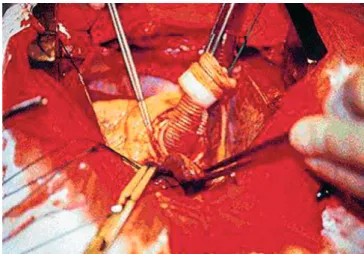
rapid execution (Figures 1 and 2).
Of the six patients where the Castro Bernardes ring in the proximal and distal position was used, none died,probably as
they are less complex cases, with no condition of the aortic
root, treating only the tubular portion of the ascending aorta, by means of substitution by Dacron straight tubular prosthesis, associated with aortic valve plasty in two cases. It was chosen to employ the Castro Bernardes intraluminal ring without suture whenever possible, because its use is associated with less surgical time, of ECC and of aortic cross-clamping. The ring was not used in 14 patients, because of the impossibility of proper accommodation in the distal portion of the ascending
aorta next to the aortic arch, which would result in an unsafe
anastomosis, with the risk of the ring working loose.
Table 4. Distribution of patients who died and their demographic, diagnostic characteristics and surgical techniques used.
n 1 2 3 4 5 6 7 8 9 10 11 12 13 14 15 Sex* M M F M M M M F M M M M M M M Age 60 49 35 57 53 63 61 62 64 70 71 46 42 57 40
Type of condition**
ADAA ADAA ADAA ADAA ADAA ADAA ADAA ADAA ADAA AAA AAA AAA AAA AAA AAA Surgical technique
Dacron prosthesis + aortic valve plasty Dacron prosthesis + aortic valve plasty Dacron prosthesis + aortic valve plasty
Bentall & De Bono Cabrol Cabrol Cabrol Cabrol
Dacron prosthesis + aortic valve plasty Bentall & De Bono
Bentall & De Bono Bentall & De Bono Bentall & De Bono Bentall & De Bono
Cabrol
Position of the ring Distal Distal Distal Distal Distal Distal Distal Distal Distal Distal Distal Distal Distal Distal Distal
*F = Female; M = Male.
Fig. 1 – Surgical treatment of type A acute dissection of the aorta.
Preparation of the intraluminal prosthesis with two rings Fig. 2 – Surgical aspect of anastomosed proximal intraluminal ring above the coronary ostia. Distal ring prepared for implant
Studies carried out on patients submitted to surgeries with the employment of the conventional suture technique demonstrated results with ECC and aortic cross-clamping times longer than that observed in the patients of this work,
submitted to the use of the intraluminal ring. Hagl et al. [22]
in a work analysing the employment of the Bentall & De Bono
technique with conventional suture in 142 patients, reported average ECC time of 209 minutes and aortic cross-clamping time of 142 minutes, while in this work an average ECC time of 69.9 minutes and an aortic cross-clamping time of 50 minutes were found, in 31 patients submitted to the same technique with the use of the intraluminal ring in distal anastomosis. A
study performed by Gelsomino et al. [21] demonstrated an
average ECC time of 198 minutes and an aortic cross-clamping time of 135 minutes, obtained by the analysis of 45 patients submitted to the Cabrol technique with conventional suture. In the present study an average ECC time of 86.7 minutes was observed and of aortic cross-clamping of 63.3 minutes, in eight patients submitted to the same technique with the use of the
distal intraluminal ring. These data conirm the reduction of the
ECC and aortic cross-clamping times with the use of the ring. The use of Castro Bernardes intraluminal ring without suture is contributing to simplifying the operation reducing the ECC and cross-clamping time, avoiding sutures in friable tissues, bleeding
controlled with dificultly and excessive use of blood products.
The results with the use of the ring have already been demonstrated in previous studies. Wei et al.[23] reported the use of the intraluminal ring without suture in 19 patients, with anastomosis times from 1 to 2 minutes, without bleeding or
other complications. Bernardes et al. [11,12] demonstrated
in various papers that the intraluminal ring can be used in substitution of conventional suture in all the segments of the
aorta with good results, as it is an easy and rapid execution
technique with low cost.
CONCLUSION
It has been demonstrated that the use of Castro Bernardes intraluminal ring without suture in surgeries on the ascending aorta led to a reduction of the ECC and aortic cross-clamping times with consequent improvement in the results of the surgery. It, therefore, constitutes a safe alternative technique which produces good results and it is easy and low costly, which can be performed in centres with few resources.
REFERENCES
1. Cabrol C, Gandjbakhc I, Pavie A. Surgical treatment of ascending aortic pathology. J Cardiac Surg. 1988;3(3):167-80.
2. Coady MA, Rizzo JA, Goldstein LJ, Elefteriades JA. História Natural, patogênese e etiologia dos aneurismas e dissecções da aorta torácica. Clin Cardiol Am N. 1999;17(4):836-9.
3. Clouse WD, Hallet JW Jr, Schaff HV, Gayari MM, Ilstrup DM, Melton LJ 3rd. Improved prognosis of thoracic aortic aneurysms: a population-based study. JAMA. 1998;280(22):1926-9.
4. Sorensen HR, Olsen H. Ruptured and dissenting aneurysms of the aorta. Incidence and prospects of surgery. Acta Chir Scand. 1964;128:644-50.
of smooth muscle cell apoptosis and expression of cell death-initiating proteins. Eur J Cardiothorac Surg. 2003;23(4):537-43.
6. Albuquerque LC, Braile DM, Palma JH, Saadi EK, Almeida RMS, Gomes WJ, et.al. Diretrizes para o tratamento cirúrgico das doenças da aorta da Sociedade Brasileira de Cirurgia Cardiovascular. Rev Bras Cir Cardiovasc. 2009;24(2 suppl):7-33s.
7. Bentall H, De Bono A. A technique for complete replacement of the ascending aorta. Thorax. 1968:23(4):338-9.
8. Dureau G, Villard J, George M, Deliry P, Froment JC, Clermont A. New surgical technique for the operative management of acute dissections of the ascending aorta. Report of two cases. J Thorac Cardiovasc Surg. 1978;76(3):385-9.
9. Ablaza SG, Ghosh SC, Grana VP. Use of a ringed intraluminal graft in the surgical treatment of dissecting aneurysms of the aorta. A new technique. J Thorac Cardiovasc Surg. 1978;76(3):390-6.
10. Lemole GM, Strong MD, Spagna PM, Karmilowicz NP. Improved results for dissecting aneurysms. Intraluminal sutureless prosthesis. J Thorac Cardiovasc Surg. 1982;83(2):249-55.
11. Bernardes RC. Dissecção aguda de aorta. Tratamento cirúrgico precoce com menor agressividade: maior chance de sobrevivência. Rev Bras Ter Intensiva. 1996;8(2):68-74.
12. Bernardes RC, Rabelo RC, Reis Filho FAR, Rabelo W, Marino MA, Marino RL. Tratamento cirúrgico das dissecções agudas de aorta tipo B. Técnica da “tromba de elefante” modiicada pelo emprego de prótese intraluminal sem sutura. Rev Bras Cir Cardiovasc. 1996;11(1):12-7.
13. Kouchoukos NT, Blackstone EH, Doty DB, Hanley FL, Karp RB. Cardiac surgery. 3rd ed. Philadelphia: Churchill Livingstone; 2003.
14. Edwards WD, Leaf DS, Edwards JE. Dissecting aortic aneurysm with congenital bicuspid aortic valve. Circulation.1978;57(5):1022-5.
15. Larson EW, Edwards WD. Risk factors for aortic dissection: a necropsy study of 161 cases. Am J Cardiol. 1984;53(6):849-55.
16. Schmid FX, Bielenberg K, Schneider A, Haussler A, Keyser A, Birnbaum D. Ascending aortic aneurysm associated with bicuspid and tricuspid aortic valve: involvement and clinical relevance of smooth muscle cell apoptosis and expression of cell death-initiating proteins. Eur J Cardiothoracic Surg. 2003;23(4):537-43.
17. David TE, Maganti M, Armstrong S. Aortic root aneurysm: principles of repair and long-term follow-up. J Thorac Cardiovasc Surg. 2010;140(6 Suppl):S14-9.
18. Prifti E, Bonacchi M, Frati G, Proietti P, Giunti G, Babatasi G, et al. Early and long-term outcome in patients undergoing aortic root replamecent with composite graft according to the Bentall’s technique. Eur J Cardiothoracic Surg. 2002;21(1):15-21.
19. Trimarch S, Nienaber CA, Rampoldi V, Myrmel T, Suzuki T, Mehta RH, et al; International Registry of Acute Aortic Dissection Investigators. Contemporary results of surgery in acute type A aortic dissection: The International Registry of Acute Aortic Dissection experience. J Thorac Cardiovasc Surg. 2005;129(1):112-22.
20. Oliveira JF, Reis Filho FAR, Lima LCM, Monteiro ELS, Martins SA, Faria PEA, et al. Resultados a médio prazo do tratamento cirúrgico da dissecção aguda de aorta tipo A com o emprego de prótese intraluminal. Rev Bras Cir Cardiovasc. 2001;16(2):136-40.
21. Gelsomino S, Frassani R, Da Col P, Morocutti G, Masullo G, Spedicato L, et al. A long-term experience with the Cabrol root replacement technique for the management of ascending aortic aneurysms and dissections. Ann Thorac Surg. 2003;75(1):126-31.
22. Hagl C, Strauch JT, Spielvogel D, Galla JD, Lansman SL, Squitieri R, et al. Is the Bentall procedure for ascending aorta or aortic valve replacement the best approach for long-term event-free survival? Ann Thorac Surg. 2003;76(3):698-703.