318 318 318 318 318
Instituto do Coração do Hospital das Clínicas – FMUSP
Mailing address: Paulo Manuel Pêgo Fernandes - InCor – Av. Dr. Enéas C. Aguiar, 44 – 05403-000 – São Paulo, SP, Brazil – E-mail: [email protected] English version by Stela Maris C. e Gandour
Objective - To test the hypothesis that short periods of
ischemia may increase the myocardial protection obtai-ned with intermittent crossclamping of the aorta.
Methods - In the control group (18 patients), surgery
was performed with systemic hypothermia at 32ºC and in-termittent crossclamping of the aorta. Extracorporeal cir-culation was used. In the preconditioning group (17 pati-ents), 2 crossclampings of the aorta lasting 3min each we-re added prior to the intermittent crossclamping of the conventional technique with an interval of 2min of reper-fusion between them. Blood samples for analyses of pH, pCO2, pO2, sodium, potassium, calcium, and magnesium were obtained from the coronary sinus at the beginning of extracorporeal circulation (time 1), at the end of the first anastomosis (time 2), and at the end of extracorporeal cir-culation (time 3).
Results - No difference was observed in the results of
the 2 groups, except for a variation in the ionic values in the different times of blood withdrawal; sodium values, however, remained stable. All patients had a good clinical outcome.
Conclusion - The results of intermittent
crossclam-ping of the aorta with moderate hypothermia were not al-tered by the use of ischemic preconditioning.
Key words: myocardial revascularization, myocardial pre-conditioning, ions
Arq Bras Cardiol, volume 77 (nº 4), 318-23, 2001
Paulo Manuel Pêgo Fernandes, Fabio Biscegli Jatene, André Felix Gentil, Fabrício Ferreira Coelho, Karina Kwasnicka, Noedir Antonio Groppo Stolf, Sérgio Almeida de Oliveira
São Paulo, SP - Brazil
Influence of Ischemic Preconditioning in Myocardial Protection in
Patients Undergoing Myocardial Revascularization with Intermittent
Crossclamping of the Aorta. Analysis of Ions and Blood Gases
Despite theoretical criticism of the technique of inter-mittent crossclamping of the aorta with hypothermia at 32ºC, the simplicity of the procedure and its good clinical results have led several surgeons to use it, particularly in myocar-dial revascularization surgery 1,2.
In Brazil, Jatene et al 3 have been using it since 1969,
wi-th good clinical results. A few randomized studies 4,5
compa-ring the efficacy of intermittent crossclamping of the aorta with the use of cardioplegic solutions exist, but none of them conclude that one method is superior to the others.
One question about the technique is that the repetition of ischemic episodes, which are individually reversible, may cause cumulative damage resulting in necrosis. Reimer et al 6
disproved this concept by showing experimentally that in-termittent reperfusion avoids cumulative metabolic deficit and myocardial ischemia with cell death and that the first episode of ischemia reduces the consumption of high ener-gy phosphates in subsequent episodes. Other studies 7
have shown that short periods of ischemia do not induce ir-reversible cellular damage and that they do not result in cu-mulative metabolic, structural, and functional deficits. It has also been reported that, paradoxically, short periods of is-chemia increase the tolerance of the heart instead of making it more vulnerable to subsequent ischemic episodes. This induction of tolerance to ischemia is called ischemic precon-ditioning 8.
The objective of this study was to assess the influen-ce of ischemic preconditioning on myocardial protection obtained with intermittent crossclamping of the aorta in pa-tients undergoing myocardial revascularization.
Methods
319 319 319 319 319
group were operated upon by 2 surgeons following the con-ventional myocardial revascularization technique, which uses systemic hypothermia at 32ºC with intermittent cross-clamping of the aorta and extracorporeal circulation. In the other group, called the preconditioning group, 2 short cros-sclampings of the aorta were added prior to the intermittent crossclamping of the aorta of the conventional technique with an interval of reperfusion between them.
The control group comprised 18 patients, and the pre-conditioning group 17 patients. The inclusion criteria were as follows: preoperative ejection fraction higher than 30%; not a reoperation; lesion present in at least 2 coronary arte-ries; predicted use of extracorporeal circulation; no unstable angina at the time of surgery; not an acute phase of myocar-dial infarction; no need for other associated corrections, su-ch as valvar diseases or left ventricular aneurysm; no need for ventriculotomies.
Fourteen control group patients and 12 preconditio-ning group patients were males. Ages ranged from 41 to 76 years (mean of 60.6) in the control group and from 41 to 74 years (mean of 65.2) in the preconditioning group.
Cannulation of the ascending aorta and venae cava was used in all patients for installation of extracorporeal cir-culation. Then, a catheter of the 3M brand, which is usually used for retrograde cardioplegia, was introduced into the co-ronary sinus, and blood samples were withdrawn through it. It was only at this time that the surgeon and other mem-bers of the medical team knew whether the patient belonged to the control or the preconditioning group.
Crossclampings of the aorta were started after syste-mic cooling to 32ºC. In the control group, during each cros-sclamping of the aorta, an anastomosis was performed between the graft and the coronary artery to be revasculari-zed. For each 3-4min of aortic crossclamping, we performed 1min of reperfusion. This procedure was used both for distal and proximal anastomoses. In the ischemic preconditioning group, 2 aortic crossclampings of 3min of duration each were performed, with an interval of 2min of reperfusion between them. After the second interval of reperfusion, the surgery was performed in an identical method as that in the control group. During the last anastomosis, patient’s syste-mic warming was started. By the end of the last anastomo-sis, the aortic crossclamping was released and extracorpo-real circulation was disconnected.
Blood samples were withdrawn from the coronary si-nus at 3 different times: at the beginning of extracorporeal circulation in normothermic condition (time 1); immediately after the first anastomosis was performed at 32oC (time 2);
and at the end of the extracorporeal circulation, again in nor-mothermic condition (time 3). The analysis of these blood gas samples was performed with a blood gas analyzer, Ra-diometer model 620. Analysis of sodium and potassium was performed with the Radiometer device model ML 100, accor-ding to the selective electrode method; the analysis of cal-cium was performed using the cresolphthalein method with the Integra device (Roche); the analysis of magnesium was
performed through the colorimetric method with chloro-phosphonazo III, with the Integra device (Roche).
The statistical analysis for comparing the homogenei-ty of proportions of the two groups was performed with Fi-sher exact test. Studentt test,and the Wilcoxon test were used to compare the quantitative data of the 2 groups.
The significance level established for analysis was 5%, and all calculations were performed using the SAS (Sta-tistical Analysis System). All laboratory measurements and the statistical analysis were performed by persons who were blinded to the groupings.
The study was approved by the scientific committee and the committee on ethics of the Instituto do Coração of the Hospital das Clínicas of the Faculdade de Medicina of the University of São Paulo.
Results
No difference was observed in the preoperative cha-racteristics age, sex, weight, height, incidence of diabetes mellitus, presence of previous myocardial infarction, pre-sence of bundle-branch block on electrocardiography, and previous unstable angina of the 2 groups, which confirms the homogeneity between the groups.
We performed an average of 3.3 grafts/patient in the control group, and 3.2 grafts/patient in the preconditioning group. In regard to intraoperative characteristics, including the maximum time of aortic crossclamping, sum of the times of aortic crossclamping, number of coronary arteries revas-cularized, duration of extracorporeal circulation, duration of anesthesia, and the surgeon involved, no difference was observed between the 2 groups of patients (tab. I). In the postoperative period, no patient had signs of intraoperative myocardial infarction, according to assessment with electro-cardiography and measurements of CKMB and troponin I.
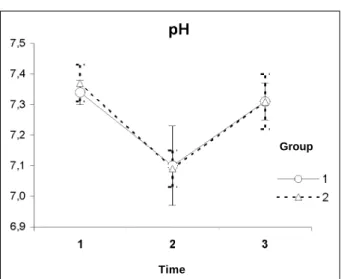
In regard to blood gases, a drop in the pH was obser-ved in time 2 as compared with times 1 and 3 (p<0.001). A trend toward reversion in this drop was observed in time 3, but it did not return to the values of time 1 (p<0.001) (fig. 1). The drop in pH was accompanied by an elevation in pCO2, also with a trend toward reversion not being reached (p<0.001) and with more negative base excess values. These differences occurred in the same way in both groups.
An increase in partial oxygen pressure occurred in time 2 but not in time 1 (p=0.009). In time 3, a return to the values of time 1 occurred (p=0.438) (fig. 2). These differences took place in the same way in both groups.
No difference was observed between the 2 groups in the sodium, potassium, calcium, and magnesium ions analy-zed in the 3 blood samples collected in the coronary sinus in the intraoperative period. Differences, however, were ob-served in the times. Potassium was elevated in time 2 but not in time 1 (p<0.001), dropped in time 3, but did not reach the values of time 1 (p<0.001) (fig. 3).
320 320 320 320 320
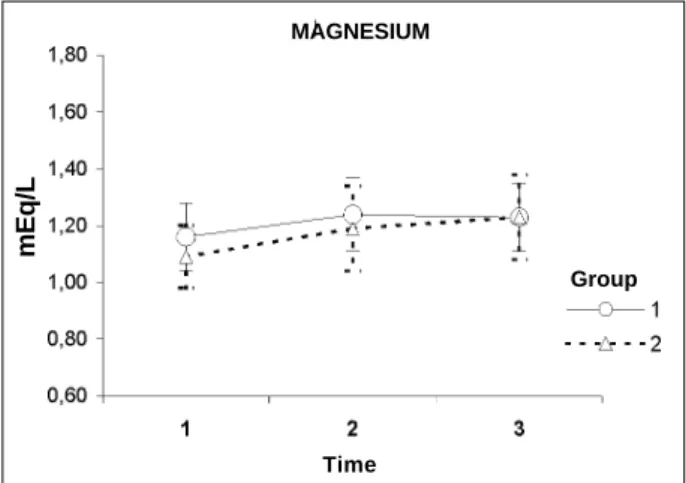
drop in values occurred in time 3, which was similar to the in-crease from time 1 to 2 (fig. 4); and the mean values of mag-nesium were elevated in time 2 but not in time 1 (p<0.001); and time 3 was similar to time 2 (p=0.445) (fig. 5). Complete data on these variables are shown in table II.
Discussion
Currently, ischemic preconditioning is an endogenous adaptive mechanism of the myocardium, induced by short periods of reversible ischemia, which increases heart resis-tance to a subsequent period of more prolonged ischemia.
Table I – Descriptive measurements of intraoperative data
Variable Group n Minimum Maximum Median Mean Standard deviation P
Duration of ECC 1 18 75.00 215.00 118.50 121.00 29,75 0,389(2)
(min) 2 17 100.00 240.00 130.00 132.88 37,19
Duration of anesthesia 1 18 320.00 555.00 412.50 419.44 55,06 0,542(1)
(min) 2 17 350.00 530.00 420.00 430.59 51,63
Maximum time of 1 18 8.00 19.00 12.50 13.39 3,01 0,150(1)
Crossclamping (min) 2 17 9.00 16.00 11.00 12.06 2,25
Number of 1 18 5.00 8.00 6.50 6.28 1,07 0,854(2)
Crossclampings 2 17 3.00 11.00 6.00 6.53 2,58
Total time of 1 18 36.00 75.00 56.50 56.28 10,81 0,457(1)
Crossclamping (min) 2 17 24.00 79.00 46.00 52.65 17,18
(1) Student t test; Wilcoxon test; ECC- extracorporeal circulation; group 1- control; group 2- preconditioning.
Fig. 1 - Graphic representation of the evolution of the mean values of pH, throughout the 3 times of measurement.
Time
Group
Fig. 3 - Graphic representation of the evolution of the mean values of potassium, throughout the 3 times of measurement.
mEq/L
Group
Time POTASSIUM
Fig. 4 - Graphic representation of the evolution of the mean values of calcium, throughout the 3 times of measurement.
mEq/L
CALCIUM
Time
Group
Fig. 2 - Graphic representation of the evolution of the mean values of pO
2,
throu-ghout the 3 times of measurement.
Time
321 321 321 321 321
This endogenous protection mechanism occurred in all ani-mal species studied 9, and some authors also suggested its
existence in man 10,11.
In 1986, Murry et al 8 were the first to report this
pheno-menon in a canine model. Since their initial observation, ischemic preconditioning has proved to be the most po-werful and reproducible experimental method for delaying the development of myocardial infarction. The beneficial effect of ischemic preconditioning on postischemic recove-ry of myocardial function results more from limitation of the infarct size than from a reduction in stunning 12.
Because preconditioning has been recognized as one of the most powerful and reproducible methods for delaying cellular necrosis, an important question to be answered is whether ischemic preconditioning may occur in human beings 13. At least 4 types of published studies report the
oc-currence of preconditioning in human beings 14: 1) studies
on angioplasty show less alteration in the ST segment and lactate production, when the first episode of angioplasty is compared with the subsequent one 15; 2) clinical studies
suggest that the occurrence of angina prior to myocardial infarction provides beneficial acute effects 16; 3) acute
tole-rance to angina may be developed 17; 4) analysis of human
tissues obtained through surgeries shows biochemical and functional properties that reflect a state of preconditioning. According to Carrol et al 17, the protection provided
by ischemic preconditioning may be divided into 2 phases,
an earlier phase lasting 1 to 2 hours, and a later one, which begins 24 hours after the initial ischemic event and lasts up to 72 hours. These authors also suggest that, even though these 2 phases of protection are initially determined by simi-lar receptors and paths of intracellusimi-lar communication, the end target for each of the effects observed may be different. Evidence exists that ionic alterations may take part in the fi-nal routes of the ischemic preconditioning mechanism.
During the initial episode of ischemic preconditioning, endogenous substances are formed or secreted, initiating the protective mechanisms of ischemic preconditioning; these and other substances may subsequently maintain protection during the following ischemia. Adenosine, ace-tylcholine, catecholamines, angiotensin II, bradykinin, and opioids take part in ischemic preconditioning; their quanti-tative contribution and their effective participation at the beginning or as mediators, however, vary from species to species 18.
Evidence exists that the end target of the late phase of protection determined by preconditioning is a potassium channel sensitive to ATP 17. Several studies have shown
that adenosine may activate the potassium channel re-ducing the duration of the action potential, and, therefore, decreasing the use of ATP 14. This mechanism promotes
significant myocardial protection in in vivo and in vitro mo-dels; evidence exists that the basic mechanism of increase in tolerance to ischemia during intermittent crossclamping of the aorta is related to the cardioprotective effects of ade-nosine through stimulation of the A1 receptor 19.
In addition to adenosine, other hyperpolarizing agents (potassium channel activators) are being studied as alterna-tives for depolarizing drugs, which are commonly used in cardioplegic solutions. However, these agents have low cardioselectivity and may cause systemic vasodilation be-fore cardioprotective effects are manifested, therebe-fore, hin-dering their clinical application 20.
Some researchers 21 studied the difference between
the arterial measurement and that in the coronary sinus of the potassium levels, after release of the aortic crossclam-ping in a randomized group of 72 patients, who had under-gone myocardial revascularization in normothermia and dif-ferent models of hypothermia. A greater difference was found between the arterial measurement and that in the co-ronary sinus during the first period of reperfusion than in the subsequent periods. These findings were observed
Table II - Values of the variables measured for the 2 groups
Control (1) Precond. (1) Control (2) Precond. (2) Control (3) Precond. (3)
pH 7.34±0.0 7.37±0.0 7.10±0.1 7.09±0.0 7.31±0.0 7.31±0.0 p: 0.906
BE -3.2±2.1 -3.1±1.7 -8.2±3.5 -8.3±2.7 -3.4±2.6 -3.9±3.3 p: 0.751
pCO2 40.3±6.2 38.0±5.9 74.5±23.2 72.7±7.8 45.5±9.3 44.5±7.3 p: 0.585
pO
2 37.5±7.6 34.5±4.6 43.1±7.9 39.2±11.2 35.8±9.3 34.1±10.7 p: 0.170
Potassium 4.08±0.5 3.98±0.6 5.25±0.8 5.29±0.8 4.9±0.9 4.68±0.7 p: 0.661
Sodium 134±3.0 134±2.9 133±3.2 134±2.7 133±2.1 135±3.1 p: 0.310
Calcium 1.17±0.0 1.17±0.0 1.19±0.0 1.20±0.0 1.17±0.1 1.16±0.1 p: 0.923
Magnesium 1.16±0.1 1.09±0.1 1.24±0.1 1.19±0.1 1.23±0.1 1.23±0.1 p: 0.335
Fig. 5 - Graphic representation of the evolution of the mean values of magnesium, throughout the 3 times of measurement.
mEq/L
Time
322 322 322 322 322
ding those about potassium levels, and they probably re-flect the action of a mechanism of ischemic preconditio-ning. Years later, one of the authors 22, reviewing the results,
drew attention to the existence of a reduction in the washing of the metabolites after subsequent intervals of ischemia, as a result of the increase in tolerance to ischemia. Even though the washing of metabolites was lower in the hypothermic group than in the normothermic group, the preconditioning effect remained the same even during hypothermia of 25ºC. These data were especially significant for our study, be-cause other authors 23 have reported that the ischemic
pre-conditioning effect might not occur in situations of hypo-thermia, even in the mild cases (32ºC).
In our study, the potassium level had an elevation between the beginning of extracorporeal circulation and the first coronary anastomosis, with a drop after the end of ex-tracorporeal circulation, even though not reaching its initial values.
The decrease in the levels of tissular ATP was follo-wed by a significant increase in intracellular Ca+2 levels 24.
Several authors 19,25,26 suggest that the increase in the
intra-cellular calcium is one of the major determinants of the is-chemic lesion, through a calcium-dependent mechanism that activates the catabolic enzymes, leading to irreversible damage of the plasmatic membrane, and determining cellu-lar death.
Catecholamines are known to increase intracellular cal-cium. If a release of catecholamines occurs during precon-ditioning, a lower concentration of catecholamines will exist at the end of more prolonged episodes of ischemia. Downey et al 27 showed that adenosine antagonists block
precondi-tioning. Therefore, the effect of adenosine might be media-ted by the inhibition of the release of endogenous catecho-lamine accompanied by a lower concentration of intracellu-lar calcium.
In addition to the relation between the increase in in-tracellular calcium and the irreversible lesion of the plasma-tic membrane, some authors also suggest that this increase is directly related to a contractile postischemic dysfunction (stunning).
Steenbergen et al 28 investigated the ionic alterations in
perfused hearts of rats undergoing preconditioning. The 2 study groups underwent 30min of global ischemia, and one of the groups was treated with 4 periods of 5-min ischemia with 5-min intervals of reperfusion (preconditioning) at 37oC
between them. The group undergoing preconditioning had a lower release of intracellular enzymes, a delay in the be-ginning of the ischemic contracture, and a better functional performance after the period of global ischemia. The group of preconditioned hearts had a significant reduction in the levels of intracellular H+ and Ca+2 at the end of the global
is-chemia period, and a mild but not significant reduction oc-curred in the increase in intracellular Na+. This last finding
may be explained by the thermodynamic differences between the Na+-Ca+2 exchanger, which exchanges 3 Na+
ions for every 2 Ca+2 ions.
The use of cardioplegia prior to ischemia proved to be
effective in delaying the increase in intracellular calcium and consequent cellular death. Murry et al 8 reported that after
40min of ischemia, the production of lactate in precondi-tioned hearts was 40% lower than that in nontreated hearts. Steenbergen et al 28 suggest that this reduction in the
pro-duction of lactate may be due to a lower acidification of the intracellular medium. A lower concentration of hydrogen may reduce intracellular sodium and calcium increase through Na+-H+ and Na+-Ca+2 exchangers, respectively.
Walker et al 29 performed an experiment confirming that
right atrial musculature may be preconditioned. These au-thors showed that the human muscle might be pharmaco-logically preconditioned with the use of an adenosine A1 agonist. Similarly, Ikonomidis et al 30 showed that isolated
human cardiomyocytes can be preconditioned. Human ventricular myocytes were obtained during surgery and maintained in culture; the cells underwent anoxia for 90min, followed by 30-min exposure to normal levels of oxygen. The preconditioning of the cells during 20 min of anoxia follo-wed by 20 min of reoxygenation reduced the cellular lesion caused by a period of subsequent 90-min ischemia. In addi-tion, the floating material originating from the precon-ditioned cells had a lower concentration of hydrogen ions, lactate, and lactic dehydrogenase. Therefore, these authors conclude that not only may human myocardial cells be pre-conditioned, but also this preconditioning occurs indepen-dently of interactions with other types of cells.
In our study, ischemia produced by aortic crossclam-ping caused a drop in pH accompanied by an elevation in pCO2 and pO2, and also by more negative values of base ex-cess, with a tendency toward normalization after the anasto-moses were finished. However, no significant alterations in these variables were observed in the 2 groups studied.
No evidence existed that preconditioning significantly reduced the elevation of calcium levels during the periods of ischemia. A delay occurred in the increase in calcium con-centration, which was not avoided. The mean values of so-dium were maintained throughout the 3 times of measure-ment in both groups studied.
It is important to emphasize that, until now, the atte-nuation in the increase in intracellular calcium through pre-conditioning has only been shown in experimental studies with rats, and its occurrence in other species is uncertain.
Infusion of magnesium sulfate enhances myocardial recovery after 8-12min of hypoxia in rats. Magnesium sulfa-te probably causes relaxation of the myocardial fibers du-ring and after the period of hypoxia, in addition to a decrease in the incidence of ventricular fibrillation and asystole 31.
Ischemic preconditioning obtained with the use of adenosine provides myocardial protection similar to that provided by cardioplegia with potassium supplemented with magnesium. Both techniques promote an enhancement in postischemic recovery from the functional point of view, and they also reduce the extension of the infarct in the aged myocardium 32.
323 323 323 323 323 1. Flameng W. Intermittent ischemia. Semin Thorac Cardiovasc Surg 1993; 5: 107-13.
2. Kirklin JW, Naftel CD, Blackstone EH, Pohost GM. Summary of a consensus concerning death and ischemic events after coronary artery bypass grafting. Cir-culation 1989; 79(6 Pt 2): I - 81-91.
3. Jatene AD. Late results of aorto coronary saphenous vein by-pass grafts. J Car-diovasc Surg (Torino) 1975; special issue: 91-4.
4. Jatene FB, Ferreira HP, Ramires JA, et al. Estudo comparativo da cardioplegia e do clampeamento intermitente da aorta em cirurgia de revascularização do miocár-dio. Arq Bras Cardiol 1990; 54: 105-9.
5. Gerola LR, Oliveira SA, Moreira LF, et al. Blood cardioplegia with warm reperfu-sion versus intermittent aortic crossclamping in myocardial revascularization: randomized controlled trial. J Thorac Cardiovasc Surg 1993; 106: 491-6. 6. Reimer KA, Murry CE, Yamasawa I, Hill ML, Jennings RB. Four brief periods of
myocardial ischemia cause no cumulative ATP loss or necrosis. Am J Physiol 1986; 251 (6 Pt 2): H1306-15.
7. Henrichs KJ, Matsuoka H, Schaper J. Influence of repetitive coronary occlusions on myocardial adenine nucleosides, high energy phosphates and ultrastructure. Basic Res Cardiol 1987; 82: 557-65.
8. Murry CE, Jennings RB, Reimer KA. Preconditioning with ischemia: a delay of lethal cell injury in ischemic myocardium. Circulation 1986; 74: 1124-36. 9. Downey JM, Liu GS, Thornton JD. Adenosine and the anti-infarct effects of
pre-conditioning. Cardiovasc Res 1993; 27: 3-8.
10. Jenkins DP, Pugsley WB, Alkhulaifi AM, Kemp M, Hooper J, Yellon DM. Is-chaemic preconditioning reduces troponin T release in patients undergoing co-ronary artery bypass surgery. Heart 1997; 77: 314-8.
11. Alkhulaifi AM, Yellon DM, Pugsley WB. Preconditioning the human heart du-ring aorto-coronary bypass surgery. Eur J Cardiothorac Surg 1994; 8: 270-6. 12. Jenkins DP, Pugsley WB, Yellon DM. Ischaemic preconditioning in a model of
global ischaemia: infarct size limitation, but no reduction of stunning. J Mol Cell Cardiol 1995; 27: 1623-32.
13. Barry WH. Calcium and ischemic injury. Trends Cardiovasc Med 1991; 1: 162-6. 14. Ragazzi E, Wu S-N, Shryock J, Belardinelli L. Electrophysiological and receptor binding studies to assess activation of the cardiac adenosine receptor by adenine nucleotides. Circ Res 1991; 68: 1035-44.
15. Murphy E, Steenbergen C, LeFurgey A, Lieberman M, London RE. Cytosolic free calcium and miocardial cell injury. In: Lemasters JJ, Hackenbrock CR, Thur-man RG, Westerhoff HV (eds). Integration of Mitochondrial Function. New York: Plenum Publishing Corp. 1988: 413-20.
16. Alkhulaifi AM, Jenkins DP, Pugsley WB, Treasure T. Ischaemic preconditio-ning and cardiac surgery. Eur J Cardiothorac Surg 1996; 10: 792-8.
References
17. Carroll R, Yellon DM. Myocardial adaptation to ischaemia—the preconditio-ning phenomenon. Int J Cardiol 1999; 68(suppl 1): S93-101.
18. Downey JM, Cohen MV. Signal transduction in ischemic preconditioning. Z Kardiol 1995; 84(suppl 4): 77-86.
19. Murphy E, Perlman M, London RE, Steenbergen C. Amiloride delays the ische-mia-induced rise in cytosolic free calcium. Circ Res 1991; 15: 33-44. 20. Perrault LP, Menasche P. Preconditioning: can nature’s shield be raised against
surgical ischemic-reperfusion injury? Ann Thorac Surg 1999; 68: 1988-94. 21. Van der Vusse GJ, Van der Veen FH, Flameng W, et al.. A biochemical and
ultras-tructural study on myocardial changes during aorto-coronary bypass surgery: St. Thomas Hospital cardioplegia versus intermittent aortic cross-clamping at 34 and 25° C. Eur Surg Res 1986; 18: 1-11.
22. Flameng W. Intermittent ischemia. Semin Thorac Cardiovasc Surg 1993; 5: 107-13. 23. Di Salvo C, Hemming A, Jenkins D, et al. Can the human myocardium be precondi-tioned with ischaemia under hypothermic conditions? In: Proceedings of the 9th
Annual Meeting. Paris: European Association for Cardiothoracic Surgery, 1995: 324. 24. Steenbergen C, Murphy E, Watts JA, London RE. Correlation between cytosso-lic free calcium, contracturem ATP, and irreverrsible ischemic injury in perfused rat heart. Circ Res 1990; 66: 135-46.
25. Lee HC, Smith N, MahabirR, Clusin WT. Cytossolic calcium transients from the beating mammalian heart. Proc Natl Acad Sci USA 1987; 84: 7793-7. 26. Fox JEB, Goll DE, Reynolds CC, Phillips DR. Identification of two proteins
(ac-tin-binding protein and P235) that are hydrolysed by endogenous Ca++ -
depen-dent protease during platelet aggregation. J Biol Chem 1985; 260: 1060-6. 27. Downey JM. The role adenosine in preconditioning. J Molec Cell Cardiol 1990;
23(suppl III): S.28.
28. Steenbergen C, Murphy E, Levy L, London RE. Elevation in cytossolic free cal-cium concentration early in myocardial ischemia in perfused rat heart. Circ Res 1987; 60: 700-7.
29. Walker DM, Walker JM, Pattison C, Pugsley W, Yellon DM. Preconditioning protects isolated human muscle. Circulation 1993; 88(suppl 1): I-138. 30. Ikonomidis JS, Tumiati LC, Weisel RD, Mickle DAG, Li RK. Preconditioning
human ventricular cardiomyocytes with brief periods of simulated ischaemia. Cardiovasc Res 1994; 28: 1285-91.
31. Siemkowicz E. Magnesium sulfate solution dramatically improves immediate re-covery of rats from hypoxia. Resuscitation 1997; 35: 53-9.
32. McCully JD, Uematsu M, Parker RA, Levitsky S. Adenosine-enhanced ischemic preconditioning provides enhanced cardioprotection in the aged heart. Ann Thorac Surg 1998; 66: 2037-43.
does not exist in the literature. The levels of magnesium had a tendency to increase after the beginning of extracorporeal cir-culation, and no tendency to decrease at the end of surgery. We may suppose that the intermittent crossclamping of the aorta, as we and most other surgeons use it, may be an effective form of preconditioning. Another hypothesis is that ischemic preconditioning, in the way it was performed in this study, is either not effective or the protection provided by the intermittent crossclamping of the aorta is already enough, and, therefore, it is difficult to enhance it by ische-mic preconditioning. We emphasize that this study was conducted in human beings, and, therefore, periods of is-chemia unnecessarily long were avoided. If this, on the one hand, may have occasionally promoted preconditioning, on the other hand, it may have worsened myocardial injury. In fact, some authors 15,17,18 suggest that ischemic
precondi-tioning in the different protocols did not effectively show a benefit, when they did not worsen myocardial protection. Recent studies 20 have raised questions about the panacea
that has been created about the great benefits of ischemic preconditioning.
One criticism of our study is the inclusion of diabetic patients using sulfonylureas. This was due, at the begin-ning, to the fact that we ignored the possibility that these drugs could interfere with preconditioning. However, the small number of diabetic patients in our study and their ho-mogeneous distribution between the control and precondi-tioning groups make us feel confident that the results were not influenced by this factor.
In conclusion, even though the 2 methods of protec-tion cause a certain degree of alteraprotec-tion in the ions and blood gases, the behavior of these parameters was similar in the 2 groups of patients. This indicates that intermittent cross-clamping of the aorta with moderate hypothermia was not altered by the preconditioning protocol used. The study of ischemic preconditioning in cardiac surgeries is relatively recent, and its actual benefit is still an open question.