DOI: 10.1590/0004-282X20160083 ARTICLE
Prolactinomas may have unusual
presentations resulting from massive
extrasellar tumor extension
Prolactinomas podem ter apresentações incomuns resultantes de maciça extensão
tumoral extrasselar
Marise Ribeiro de Sousa Berriel1, Giovanna Aparecida Balarini Lima1, Alessandro Severo Alves de Melo2,
Maria Laura Vasconcelos dos Santos1, Hassan Rahhal1, Giselle Fernandes Taboada1
Giant prolactinomas correspond to 0.5–4.4% of all pitu-itary tumors, based on retrospective analysis1,2,3,4,5. hey rep
-resent 2–3% of all prolactin-secreting tumors and are more prevalent in men with a male to female ratio of 9:1 and a
mean age at diagnosis of 40 years. he linear relationship be -tween prolactin levels and tumor size can be lost in this group
of patients, either because of the hook efect or due to the
presence of necrotic or hemorrhagic components in the tu-mor6. Hook efect is caused by an excess of soluble antigen
binding separately to both the solid-phase and the soluble
antibody in one-step immunometric assays. he ‘sandwich’
in which the antigen molecule binds simultaneously to both antibodies is not formed and during the washout phase these
antigen-soluble antibody complexes are removed therefore resulting in a lower than expected reading. he hook efect
can be eliminated by using a two-step process or more usu-ally by performing analysis at two sample dilutions7. Criteria
for the deinition of a giant prolactinoma vary among au -thors. Recently Maiter and Delgrange6 suggested that these
tumors should be deined on the basis of the following:
1Universidade Federal Fluminense, Hospital Universitário Antônio Pedro, Unidade de Endocrinologia, Niterói RJ, Brasil;
2Universidade Federal Fluminense, Hospital Universitário Antônio Pedro, Departamento de Radiologia, Niterói RJ, Brasil.
Correspondence: Giselle Fernandes Taboada; Rua Marquês do Paraná, 303; 24033-900 Niterói RJ, Brasil; E-mail: [email protected]
Conflict of interest: There is no conflict of interest to declare.
Received 05 January 2016; Received in final form 06 May 2016; Accepted 16 May 2016.
ABSTRACT
The purpose of this case series is to report eight patients with giant prolactinomas emphasizing presentations and a treatment complication. The study group included six men and two women. The median age was 29 years (18–54 years); median serum prolactin level was 4,562 ng/ml (1,543–18,690 ng/ml); three patients (37.5%) had panhypopituitarism; median tumor diameter was 50 mm (41–60 mm). Five patients (62.5%) had visual field defects and three had improvement during treatment; six patients (75%) reached prolactin normalization, with a median time of 10.5 months (7–84 months) and median dose of 2.0 mg/week (1.0 to 3.0 mg/week). One patient presented as a true incidentaloma. One patient presented a cerebrospinal fluid leakage during medical treatment and refused surgery, however this resolved with conservative measures. This case series illustrate a rare subtype of macroprolactinomas, the importance of considering unusual presentations at the diagnosis, the effectiveness of pharmacological treatment and its possible complications.
Keywords: prolactinoma; dopamine agonists; hyperprolactinemia.
RESUMO
O objetivo desta série de casos é relatar oito pacientes com prolactinomas gigantes enfatizando as formas de apresentação e uma complicação do tratamento. O estudo incluiu seis homens e duas mulheres. A mediana de idade foi 29 anos (18–54); e dos níveis de prolactina foi 4.562 ng/ml (1.543–18.690); três pacientes (37,5%) apresentaram pan-hipopituitarismo; a mediana do máximo diâmetro tumoral foi 50 mm (41–60 mm). Cinco pacientes (62,5%) apresentaram alterações no campo visual e três tiveram melhora durante o tratamento; seis pacientes (75%) alcançaram normalização da prolactina em 10,5 meses (7–84) com dose mediana de cabergolina de 2,0 mg / semana (1,0 a 3,0). Um paciente se apresentou como um verdadeiro incidentaloma. Um paciente apresentou uma fistula liquórica durante o tratamento medicamentoso e recusou correção cirúrgica. No entanto a fistula foi resolvida com medidas conservadoras. Esta série de casos ilustra um subtipo raro de macroprolactinomas, a importância de considerar apresentações incomuns no diagnóstico, a eficácia do tratamento farmacológico e suas possíveis complicações.
1) Size – largest diameter of 4 cm or more in any direction
with massive extrasellar extension; 2) prolactin (PRL) lev
-els at diagnosis usually above or equal to 1,000 µg/L using a modern and well-standardized assay; 3) Exclusion of con
-comitant GH and ACTH secretion. he therapeutic goals are
the same as for the non-giant prolactinomas, however rapid
relief of neurologic symptoms is usually critical. here are no speciic evidence-based recommendations for the manage -ment of these tumors and most of the literature consists of case reports or small case series.
he purpose of this case series is to report eight patients with giant prolactinomas followed at the Endocrinology Clinics of the Hospital Universitário Antônio Pedro, adding
information of such a rare condition to the literature.
METHODS
A review of the medical records of patients with prolac-tinomas from the endocrinology outpatient clinics was per-formed with special interest to the patients with tumors with
maximum diameter of more than 4 cm. he study was ap
-proved by the local Ethics Committee.
Eight patients (six men; male/female ratio 3:1) were in -cluded in the analysis.
At diagnosis median age was 29 years (18–54) and medi
-an PRL concentration was 4,562 ng/mL (1,543–18,690 ng/mL; Reference values: male 2.5–17; female 1.9–25). All patients
had hypogonadotropic hypogonadism and additional
pitu-itary hormone deiciencies were observed in three patients
(#4, #7, and #8), the latter two being afected in all adenohy
-pophyseal axis.
RESULTS
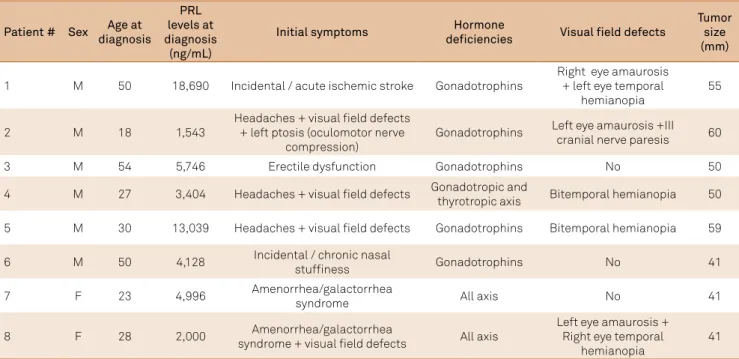
Median maximum tumor diameter was 50 mm (41–60). Five patients (62.5%) had visual ield defects (detailed in
Table 1). Regarding the presenting features, the two female
pa-tients (#7 and #8) had the classic amenorrhea/galactorrhea syndrome and in one patient (#8), additionally, signiicant vi
-sual symptoms were also noted. One patient (#3) sought medi
-cal care in the context of an erectile dysfunction and laboratory tests conirmed hyperprolactinemia. hree patients (#2, #4 and #5) had symptoms predominantly related to the tumor mass ef
-fect with headache and visual ield de-fects (suprasellar exten
-sion). Patient #2 also manifested left oculomotor nerve paresis (cavernous sinus extension). One patient (#6) had a very rare presentation due to large anterior tumoral extension. Giant pro
-lactinoma was discovered in the context of the investigation
of chronic nasal obstruction unresponsive to usual treatment
(“incidental” inding of paranasal sinus computed tomography). Finally, one patient (#1) presented as an incidentaloma in imag
-ing studies ordered in the context of an acute ischemic stroke.
Data are summarized in Table 1.
Treatment and follow up
All patients but one (#4) were initially treated with cab
-ergoline (CAB). Patient #4 underwent transfrontal surgery at diagnosis, in 1998, in another center, for unclear reasons.
Table 1. Baseline characteristics.
Patient # Sex Age at diagnosis
PRL levels at diagnosis
(ng/mL)
Initial symptoms Hormone
deficiencies Visual field defects
Tumor size (mm)
1 M 50 18,690 Incidental / acute ischemic stroke Gonadotrophins
Right eye amaurosis + left eye temporal
hemianopia
55
2 M 18 1,543
Headaches + visual field defects + left ptosis (oculomotor nerve
compression)
Gonadotrophins Left eye amaurosis +III cranial nerve paresis 60
3 M 54 5,746 Erectile dysfunction Gonadotrophins No 50
4 M 27 3,404 Headaches + visual field defects Gonadotropic and
thyrotropic axis Bitemporal hemianopia 50
5 M 30 13,039 Headaches + visual field defects Gonadotrophins Bitemporal hemianopia 59
6 M 50 4,128 Incidental / chronic nasal
stuffiness Gonadotrophins No 41
7 F 23 4,996 Amenorrhea/galactorrhea
syndrome All axis No 41
8 F 28 2,000 Amenorrhea/galactorrhea
syndrome + visual field defects All axis
Left eye amaurosis + Right eye temporal
hemianopia
41
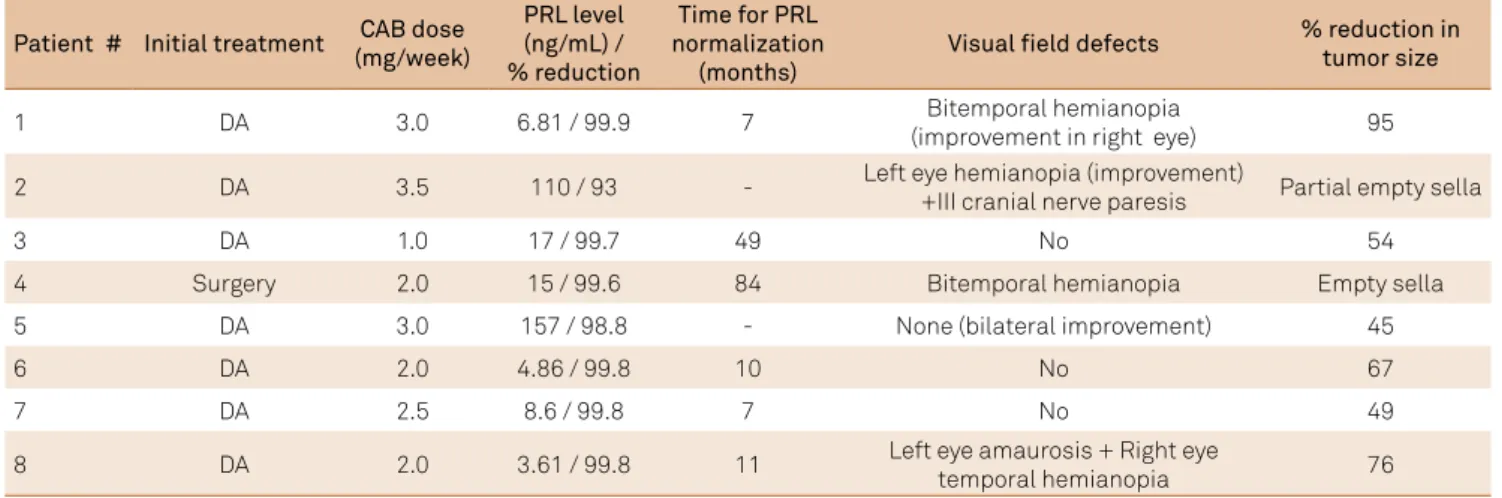
During follow up, six patients treated with CAB achieved normal PRL levels after a median time of 10.5 months (7–84), with a median dose of 2.0 mg/week (1.0–3.0 mg/week). Patients #3 and #4 only reached normalization of PRL levels after 49 and 84 months, respectively, due to noncompliance with treatment. Two patients did not normalize PRL levels (#2 and #5). Nevertheless patient #2 had 93% reduction in se
-rum PRL levels, with the last imaging study showing a partial empty sella. Patient #5 developed a cerebrospinal luid (CSF)
leak diagnosed on the basis of a clear rhinorrhea which
start-ed two months after CAB was initiatstart-ed (1.5 mg/week). As he refused surgical correction of the CSF leak, CAB dose was re
-duced (0.5 mg/week) to allow tumor re-growth as an attempt
to stop CSF leak, however it was unsuccessful and after two
months CAB dose was progressively increased (3.0 mg/week) to attain PRL level reduction/normalization and tumor shrinkage. Patient was constantly told to keep the head of his
bed elevated, among other conservative measures, as well as repeatedly informed of the risks and gold standard surgical treatment for his condition. During follow up, CSF leak
re-solved spontaneously after seven months of continued CAB
treatment with no intercurrent infection.
Of the ive patients who had visual ield defects, three showed improvement during treatment. Only one patient (#3) recovered gonadal function. No other patients with hypopi
-tuitarism at diagnosis experienced recovery of the pituitary function. At the inal evaluation, median maximum tumor di
-ameter was 22 mm (patients #2 and #4 showed partial empty
sella and empty sella, respectively). All patients showed
sig-niicant tumor shrinkage (reduction ≥ 25% in tumor volume and/or ≥ 30% in tumor diameter) (Figures 1 and 2).
Data are summarized in Table 2.
Figure 1. (A) Patient #1. Sella turcica MRI coronal view T1WI, showing a large tumor extending from the sella to supra, infra and parasellar regions, with heterogeneous contrast enhancement, measuring 4.8 x 4.0 x 5.5 cm. (B) After two years of treatment with cabergoline 3.0 mg/week, residual lesion, with cystic areas, irregular enhancement of contrast, measuring 1.0 x 2.2 x 2.4 cm.
A
B
Figure 2. (A) Patient #2. Sella turcica MRI coronal view T1WI, showing an expansive sellar tumor measuring 6.0 x 5.2 x 5.3 cm, extending to the suprasellar region and to the left temporal lobe and periventricular region, with massive left cavernous sinus invasion. In the superior portion a hyperintensity area suggests acute bleeding inside the tumor. (B) Partial empty sella (after seven years of treatment with cabergoline 3.5 mg/week).
DISCUSSION
Giant prolactinomas show presenting features diferent from non-giant tumors, generally relecting massive tumor extension into surrounding structures6.
In the present case series, two patients (#1 and #6) had
presentations that are worthy to note. In one patient, giant
prolactinoma was an incidental inding of a head MRI or
-dered in the context of an acute ischemic stroke (#1). In the other (#6), giant prolactinoma was discovered during the in -vestigation of chronic nasal obstruction which was due to
large anterior tumor extension into the nasopharynx. Patient (#1) is a 50-year-old man who was admitted to the
emergency department with a right hemiplegia. In addition to an acute ischemic stroke in topography in the semiovale centrum, corona radiata, caudate nucleus, internal capsule
and insula on the left, head MRI showed an expansive sel
-lar lesion with upper extension to the suprasel-lar cistern and below to the sphenoid sinus as well as a lateral extension,
especially to the right, involving the cavernous portion of
the right carotid artery, measuring 4.8 x 4.0 x 5.5 cm. Patient reached normalization of PRL levels and signiicant reduc
-tion of tumor diameter with CAB (data are summarized in
Tables 1 and 2). A few cases of stroke related to giant pituitary tumours have been described in the literature. However, they
are often associated with pituitary apoplexy (PA)8. Multiple
hypotheses have been proposed to explain a stroke in PA, but the most accepted is the extraluminal compression of the
main brain vessels caused by the acute growth of the tumor.
his seems not to be the case of the present patient since no clinical or radiological evidence of PA were present at the
time of acute ischemic stroke.
In patient #6, as previously stated, giant prolactinoma was
discovered during the investigation of chronic nasal
obstruc-tion which was due to large anterior tumor extension into the nasopharynx. here are few cases in the literature reporting
this type of presentation. In one of them9 a 14-year-old boy
presented with progressive weight gain, nasal obstruction, snoring, and a polypoid mass in his left nostril. Imaging
stud-ies revealed a homogenously enhancing mass extending from the loor of sella to the nasopharynx, measuring in the maxi -mum diameter 9.9 cm. Only after biopsy and laboratory analy-sis the diagnoanaly-sis of giant prolactinoma was done and
success-ful treatment with CAB was instituted. In another case10 a
30-year-old man presented with recurrent sinusitis not relieved by several courses of antibiotics. Imaging studies revealed an
extensive skull base mass with a nasopharyngeal component which suggested a nasopharyngeal carcinoma. Patient was
submitted to a biopsy and the histological pattern suggested a low grade neuroendocrine tumour. Only after laboratory tests
and speciic staining techniques, the diagnosis of a giant inva -sive prolactinoma was made. As previously seen, sometimes the diagnosis of prolactinoma may be made through the
bi-opsy of a nasal polypoid mass. hese cases should remind the
clinician that giant pituitary tumors, and notably giant
prolac-tinomas, may extend far from the sella and cause symptoms diferent from cranial nerve compression6.
Regarding the follow up, it is important to mention that
patient #5 developed a CSF leak, a possible complication of dopamine agonist (DA) treatment, after two months of start
-ing CAB (1.5 mg/week). here have been several reports of de -velopment of CSF rhinorrhea following the initiation of
medi-cal treatment for pituitary adenomas. he classimedi-cal description
of this phenomenon has been in the setting of DA therapy for prolactinomas11. Lam et al.12 reviewed the literature between the
years 1980 and 2011, describing 52 patients with spontaneous
or medically induced CSF leaks in the setting of pituitary
adeno-mas. In 38 patients (73%), CSF rhinorrhea developed following initiation of medical therapy. Forty-two patients (81%) had pro -lactinomas and the medical agents associated with CSF leakage
were DA (97%) and somatostatin analogs (3%; one patient). he
average time from initiation of medical treatment to onset of
rhi-norrhea was 3.3 months (range 3 days–17 months).
Table 2: Treatment and follow up.
CAB: cabergoline; DA: dopamine agonist; PRL: prolactin.
Patient # Initial treatment CAB dose (mg/week)
PRL level (ng/mL) / % reduction
Time for PRL normalization
(months)
Visual field defects % reduction in tumor size
1 DA 3.0 6.81 / 99.9 7 Bitemporal hemianopia
(improvement in right eye) 95
2 DA 3.5 110 / 93 - Left eye hemianopia (improvement)
+III cranial nerve paresis Partial empty sella
3 DA 1.0 17 / 99.7 49 No 54
4 Surgery 2.0 15 / 99.6 84 Bitemporal hemianopia Empty sella
5 DA 3.0 157 / 98.8 - None (bilateral improvement) 45
6 DA 2.0 4.86 / 99.8 10 No 67
7 DA 2.5 8.6 / 99.8 7 No 49
8 DA 2.0 3.61 / 99.8 11 Left eye amaurosis + Right eye
Another complication from medical treatment of pro-lactinomas is empty sella which occurs quite frequently
and may cause or aggravate pre-existent visual distur
-bances. In the present series, patients #2 and #4 had re -spectively partial and total empty sella, both asymptom-atic and not associated with worsened visual field defects. Secondary empty sella usually develops following radia-tion therapy or surgery of the sellar region or during do-pamine agonist treatment for prolactinomas13,14,15. In that
scenario, visual disturbance is caused by traction of the chiasm or the optic nerves toward the sella floor by the adhesion scar or pituitary stalk16,17,18. Gradual dose
reduc-tion of the dopamine agonist and systematic visual field evaluation may be attempted as a medical treatment to
recover visual field defects19. Alternatively, surgical
treat-ment should consist of chiasmapexy or sellar packing2.
In conclusion, the giant prolactinoma is a rare subtype of macroprolactinoma with diagnostic criteria still not clearly
deined. It is proposed that the most important criterion is the maximum tumor diameter greater than 4 cm. Regarding the presenting features, this series reports the irst case of
a giant prolactinoma presenting as a true incidentaloma, to the best of our knowledge. Also it reminds the importance of considering unusual presentations resulting from massive
extrasellar tumor extension. Finally, pharmacological treat
-ment with dopamine agonists is an efective anti-secretory
and anti-proliferative option and its use may result in mas-sive tumor shrinkage which may complicate with CSF leak.
References
1. Molitch ME, Thorner MO, Wilson C. Management of
prolactinomas. J Clin Endocrinol Metab 1997;82(4):996-1000. doi:10.1210/jcem.82.4.3845
2. Shrivastava RK, Arginteanu MS, King WA, Post KD. Giant prolactinomas: clinical management and long-term follow up. J Neurosurg. 2002;97(2):299-306. doi:10.3171/jns.2002.97.2.0299
3. Corsello SM, Ubertini G, Altomare M, Lovicu RM, Migneco MG, Rota CA et al. Giant prolactinomas in men: efficacy of cabergoline treatment. Clin Endocrinol (Oxf). 2003;58(5):662-70. doi:10.1046/j.1365-2265.2003.01770.x
4. Colao A, Sarno AD, Cappabianca P, Briganti F, Pivonello R, Somma CD et al. Gender differences in the prevalence, clinical features and response to cabergoline in hyperprolactinemia. Eur J Endocrinol. 2003;148(3):325-31. doi:10.1530/eje.0.1480325
5. Schaller B. Gender-related differences in prolactinomas:
a clinicopathological study. Neuro Endocrinol Lett. 2005;26(2):152-9.
6. Maiter D, Delgrange E. Therapy of endocrine disease: the challenges in managing giant prolactinomas. Eur J Endocrinol. 2014;170(6):R213-27. doi:10.1530/EJE-14-0013
7. Haller BL, Fuller KA, Brown WS, Koenig JW, Eveland BJ, Scott MG. Two automated prolactin immunoassays evaluated with demonstration of a high-dose “hook effect” in one. Clin Chem. 1992;38(3):437-8.
8. Navarro-Bonnet J, Martínez-Anda JJ, Balderrama-Soto A,
Pérez-Reyes SP, Pérez-Neri I, Portocarrero-Ortiz L. Stroke associated with pituitary apoplexy in a giant prolactinoma: a case report. Clin Neurol Neurosurg. 2014;116:101-3. doi:10.1016/j.clineuro.2013.09.039
9. Sunil B, Reddy A, Bryant N, Young DW, Ashraf AP. Invasive giant prolactinoma presenting as a nasal polyp. J Pediatr. 2013;162(2):435-435.e1. doi:10.1016/j.jpeds.2012.08.029
10. Care RH, Sunkaraneni VS, Theaker J, Harries PG. Rapidly progressing giant invasive prolactinoma. J Laryngol Otol. 2012;126(8):840-3. doi:10.1017/S0022215112001296
11. Afshar F, Thomas A. Bromocriptine induced cerebrospinal fluid rhinorrhoea. Surg Neurol. 2004;18(1):61-3. doi:10.1016/0090-3019(82)90020-9
12. Lam G, Mehta V, Zada G. Spontaneus and medically induced cerebrospinal fluid leakage in the setting of pituitary adenomas: review of the literature. Neurosurg Focus. 2012;32(6):E2. doi:10.3171/2012.4.FOCUS1268
13. Gallardo E, Schächter D, Cáceres E, Becker P, Colin E, Martínez C et al. The empty sella: results of treatment in 76 successive cases and high frequency of endocrine and neurological disturbances. Clin Endocrinol (Oxf). 1992;37(6):529-33. doi:10.1111/j.1365-2265.1992.tb01484.x
14. Hamlyn PJ, Baer R, Afshar F. Transsphenoidal chiasmopexy for long standing visual failure in the secondary empty sella syndrome. Br J Neurosurg. 1988;2(2):277-9. doi:10.3109/02688698808992681
15. Jones SE, James RA, Hall K, Kendall-Taylor P. Optic chiasmal herniation: an under recognized complication of dopamine agonist therapy for macroprolactinoma. Clin Endocrinol (Oxf). 2000;53(4):529-34. doi:10.1046/j.1365-2265.2000.01039.x
16. Czech T, Wolfsberger S, Reitner A, Görzer H. Delayed visual deterioration after surgery for pituitary adenoma. Acta Neurochir (Wien). 1999;141(1):45-51. doi:10.1007/s007010050265
17. Guinto G, Valle R, Nishimura E, Mercado M, Nettel B, Salazar F. Primary empty sella syndrome: the role of visual system herniation. Surg Neurol. 2002;58(1):42-7. doi:10.1016/S0090-3019(02)00766-8
18. Olson DR, Guiot G, Derome P. The symptomatic empty sella: prevention and correction via the transsphenoidal approach. J Neurosurg. 1972;37(5):533-7. doi:10.3171/jns.1972.37.5.0533