5 9 5 9 5 9 5 9 5 9
Instituto Dante Pazzanese de Cardiologia.
Mailing address: Sergio Luiz Navarro Braga – Instituto Dante Pazzanese de Cardiologia – Av. Dr. Dante Pazzanese, 500 – 12º - 04012-180 – São Paulo, SP – E-mail: [email protected]
Arq Bras Cardiol, volume 81 (nº 1), 59-63, 2003
José Ronaldo Mont’Alverne Filho, João Alexandre Rezende Assad, Alexandre do Canto Zago, Ricardo Leite Vieira da Costa, Antonio Guarany Mont’Alverne Pierre, Mohamed Hassan Saleh, Rodrigo Barretto, Sérgio Luiz Navarro Braga, Fausto Feres, Amanda Guerra Moraes Rego Sousa,
José Eduardo Moraes Rego Sousa
São Paulo, SP - Brazil
Comparative Study of the Use of Diltiazem as an Antispasmodic
Drug in Coronary Angiography Via the Transradial Approach
Transradial access for percutaneous procedures, either diagnostic 1 or therapeutic 2, in the coronary artery is
an alternative to the femoral approach particularly in cases of complex peripheral vascular disease and in some patients using anticoagulants, antiplatelets, or fibrinolytic drugs. Although some doctors consider this approach the first choice 3,4, it is still used as an alternative in most centers 5,6,
partly because of its limitations and complications. The most frequent complications are local bruising, spasms, and radial artery occlusion. Bleeding, brachial artery perforation or dissection, pseudo aneurysm, and arteriovenous fistula are less frequent complications. Heparin use through a pro-per radial artery sheath decreased the incidence of occlu-sion from 70% to the current levels, around 10%. The use of antispasmodic medications has proven efficient in decrea-sing radial artery spasms, and no reports exist of its influence on occlusion. Thus, the vasodilating drugs are not standar-dized, many different combinations have proven effective, and, therefore, the use of these drugs varies considerably. The objective of this study was to evaluate the influence of injectable diltiazem on local complications of transradial coronary angiography.
Methods
Fifty-one patients with an indication for elective trans-radial coronary angiography were selected. The patient had to have a positive Allen’s test and to give written consent to be included in the study. Exclusion criteria were previous radial or brachial coronary angiography, a history of myo-cardial revascularization, cardiac arrhythmia, ascending aorta aneurysm, valvular disease, congenital cardiopathy, and continuous use of calcium channel blockers. Patients were divided into 2 groups according to double-blind ran-domization before the beginning of the examination. Patien-ts who received placebo were called group I (GI), and
Objective – To evaluate the impact of the use, prior to the procedure, of injectable diltiazem to prevent complications.
Methods – Between September 2000 and July 2001, 50 patients underwent transradial coronary angiography and were randomized to receive placebo (GI) or diltiazem (GII) through a catheter inserted into the radial artery. All patients received isosorbide mononitrate. Ultrasound analyses of the radial artery were performed before exami-nation, 30 minutes afterwards, and 7 days afterwards to evaluate the flow, the diameter, and the artery output.
Results – The radial artery diameter of GI was 2.4± 0.5 mm before the procedure and 2.3±0.5 mm after 30 minutes (NS), whereas in GII the diameter was 2.2±0.3 mm before the examination and 2.5±0.4 mm 30 minutes after it (P<0.001). Radial artery output in group 1 was 7.3±5.l2 mL/ min before the examination and 6.1±3.5 mL/min 30 minutes after the examination (NS), and GII had an increase of 5.9±2.5 mL/min before examination to 9.05± 7.78 mL/min after the examination (P=0.04). Complications (spasm, occlusion, and partial obstruction) occurred in 4 patients (17.4%) in GI and did not occur in GII (P=0.04).
Conclusion - The study suggests a decrease in vascu-lar complications through the transradial access for coro-nary angiography with the use of diltiazem as an antispas-modic drug, resulting in the significant increase in the diameter of the radial artery and radial artery output.
6 0 6 0 6 0 6 0 6 0
patients who received diltiazem were called group II (GII). Drug infusion (placebo or diltiazem) was performed for 2 minutes to avoid hypotension and bradycardia. Both groups also received isosorbide mononitrate through an arterial sheath, which is part of the routine used in transra-dial coronary angiography at this institution. The study protocol was approved by the Ethical and Research Com-mittee of the Instituto Dante Pazzanese de Cardiologia (Dante Pazzanese Institute of Cardiology).
After randomization, the patient was sent to the Department of Echocardiography and underwent a prelimi-nary ultrasound study of the radial artery. The right radial artery was the option in all cases, and the corresponding region was prepared conventionally for the examination. Local anesthesia was 1 mL of lidocaine 2% administered 1 cm below the styloid process of the radius. The right radial artery was punctured with a puncture needle n0 21, and a
0.018” guidewire was introduced, followed by a 6 Fr sheath (CookTM Co.) 23-cm long with an external diameter of 2.3 mm.
After sheath insertion into the artery, 5,000 UI of sodium heparin were administered and a solution of 20 mg of iso-sorbide mononitrate was added to a placebo or to 25 mg of diltiazem according to the randomization.
During catheterization, a 0.035” guidewire 260-cm long was positioned in the ascending aorta to exchange the catheters. Our first choice was the Judkins 4 curve for the right coronary artery, Judkins 3.5 curve for the left coronary artery, and a pigtailcatheter. We evaluated the procedure duration from the introduction of the sheath until its removal, the number of catheters used, and the complications that occurred during the examination. After the end of the proce-dure, the sheath was removed slowly and progressively with monumental flow release through the radial artery. After this maneuver, a compression dressing in “X” was applied and loosened after 30 minutes, and the patient was sent to the Department of Echocardiography again.
An arterial duplex-scan of the right superior limb was performed using a 5- to 8-MHz (General Electric System Five) linear transducer with a suitable vascular protocol by an experienced echocardiographer with no knowledge of the groups studied.
The examinations were performed 30 minutes before, 30 minutes after (post-immediate), and 7 to 10 days after (post-late) the performance of coronary angiography. In each examination, we assessed the patency of the subcla-vian, axillary, brachial and ulnar arteries. The analysis of the radial artery is made through the calculation of the systolic peak velocity assessed, mean diameter in diastoles by the bi-dimensional (average of 3 measures) and of the minute volume (pulse Doppler). We performed Allen’s maneuver during ultrasound analysis prior to the procedure, and we observed retrograde flow in the ulnar artery. Ultrasound fin-dings can be classified into 3 types: (A) absence of steno-sis, (B) partial obstruction (stenosis lower than 70%), and (C) occlusion.
Homogeneity between groups was evaluated by the chi-square test and Fisher’s exact test. Data were expressed
in mean ±SD. Ultrasound data for diameter and radial artery output before, 30 minutes after, and 7 to 10 days after coro-nary angiography performance were compared between GI and GII by using the paired t test. Statistical significance was considered P<0.05.
Results
Between September 2000 and July 2001, 51 patients were randomized to receive placebo (GI = 23) or diltiazem (GII = 27) prior to coronary angiography through a radial approach. In 1 case, it was difficult to advance the 0.018-in guidewire after appropriate radial artery puncture, and the procedure was performed through a femoral access. The 2 groups did not have differences in clinical characteristics (tab. I).
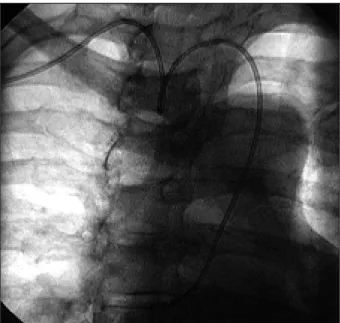
Coronary angiography was successfully performed in the 50 cases analyzed with selective catheterization of the coronary arteries. The examination was performed with 3 catheters in 17 patients (73.9%) in GI and in 23 patients (85.2%) in GII. Two catheters were used in only 1 patient (2%) in GI and in no patient in GII. Four catheters were used in 5 patients from GI (21.7%) and 4 patients from GII (14.8%). No statistically significant difference existed between the groups (P=0.35) regarding the number of catheters used. The examination period was 23.5±13.1 minutes in GI and 19.88±8.l6 minutes in GII (P=0.23). Radial artery spasms occurred in 1 patient (2%) from GI, whose procedure was performed with 4 catheters, in 60 minutes, because it had extreme tortuosity in the right subclavian artery (fig. 1). Only 1 patient (2%) from GI had hypotension after injection of the solution. Accentuated tortuosity of the right subcla-vian artery was found in 3 patients (6%), and this was res-ponsible for excessive prolonging of the time of the proce-dure in these cases.
Subclavian, axillary, brachial, ulnar, and radial arteries were patent and with a three-phase flow in all cases. Radial artery diameter in GI was 2.39±0.45 mm (1.8 to 3.5 mm) before coronary angiography, and 2.35±0.47 mm (1.6 to 3.51 mm) after its end (P=0.73). Regarding GII, the previous diameter was 2.15±0.32 mm (1.3 to 3.0 mm) and after examination it was 2.46±0.39 mm (1.9 to 3.l mm) with P<0.0001 (fig. 2).
Table I – Clinical characteristics of patients (n=50)
Group I Group II P (n=23) (n=27)
Age (years) 58.6±9.27 54.7±9.09 0.13 Male gender 18 (78.3%) 19 (70.4%) 0.52 Body mass index 28.1±3.8 27.05±3.8 0.31 Blood hypertension 18 (78.3%) 17 (63%) 0.23
Diabetes 4 (17.4%) 3 (11.1%) 0.52
Smoking 7 (30.4%) 11 (40.7%) 0.44
Dyslipidemia 10 (43.5%) 7 (25.9%) 0.19 Familial history of 11 (47.8%) 13 (48.1%) 0.9 coronary disease
6 1 6 1 6 1 6 1 6 1
In GI, previous radial artery output was 7.07±5.37 mL/ min (1.65 to 21 mL/min), and afterwards it was 5.89±3.33 mL/ min (2.3 to 12.4 mL/min), P=0.26. In GII, output prior to the procedure was 5.74±2.79 mL/min (1.3 to 12 mL/min) and 9.06±7.78 mL/min (2.5 to 35.2 mL/min) after coronary angio-graphy, P=0.039 (fig. 3). The systolic peak velocity of the radial artery had the same decrease in both groups when compared with previous analyses and analyses preformed 30 minutes after the examination.
Seven days after the performance of coronary angio-graphy, the radial artery diameter observed was 2.41± 0.5 mm in GI and 2.46±0.42 mmin GII, and the output was 12.3±13.47 mL/min in GI and 11.9±12.26 mL/Imin in GII, res-pectively, with no statistically significant difference bet-ween the groups.
We observed a slight hematoma in at the site of
punc-ture in 2 cases (4%), which healed spontaneously in 3 days, according to the patients, and the hematomas were no longer observed by the echocardiographer after 7 to 10 days. Vascular complications observed in this sample were spasm, occlusion, and partial obstruction of the radial artery (fig. 4), which occurred right after the end of coronary angio-graphy in 4 patients from GI (17.3%) but not in patients from GII (P=0.038). All patients who experienced complications had prolonged examination times, and in half of the cases, the previous radial artery diameter was smaller than 2.3 mm, referring to the external diameter of the sheath. Complica-tions after 7 to 10 days (occlusion and partial obstruction) occurred in 4 patients from GI (17.2%) and not in patient from GII (tab. II). The only case of radial artery occlusion in the analysis performed immediately after the procedure was patent in the later analysis, whereas the case in which the radial artery was occluded in this later analysis, had only flow disturbance, in the analysis performed 30 minutes after the procedure. We did not observe the presence of great
Fig. 1 – Extreme tortuosity in right subclavian artery found in one of the patients justifying greater duration of coronary angiography.
Fig. 3 – Increase in the radial artery output in GII (to the right) compared before and after examination, according to its diameter increase. Such phenomenon is not observed in GI (to the left).
Fig. 4 – A) Bi-dimensional ultrasound image of right radial artery with normal aspect; B) Normal pulsed-Doppler showing three-phase flow with peak systolic velocity = 68 cm/s; C) Bi-dimensional ultrasound imaging of the suboccluded radial artery; D) Altered pulsed- Doppler showing bi-phase flow with increased peak systolic velocity (506 cm/s).
Fig. 2 – Radial artery diameter prior to and 30 minutes after the examination in the 2 groups studied assessed by ultrasound analysis, presenting statistically signifi-cant increases in GII (right), which was not observed in GI (to the left).
Radial Artery Diameter
Group I (placebo) Group II (diltiazem)
Diâmetro prévio da artéria radial (em mm)
Diâmetro da radial pós angio (em mm)
Débito da Artéria Radial
Group I (placebo) Group II (diltiazem)
Débito prévio da artéria radial (ml/min)
Débito da radial pós angio (ml/min)
6 2 6 2 6 2 6 2 6 2
hematomas or hemorrhaging; therefore, blood transfusion was not necessary in any of the cases.
Discussion
Transradial access to perform diagnostic procedures, introduced by Campeau 1 and adapted for therapeutic
procedures by Kiemeneij and Laarman 2 has been
progres-sively used more due to its technological advances, such as in the sheaths, guidewires, and specific catheters but, above all, due to the inherent advantages of the technique. These advantages are its applicability in patients with aor-toiliac disease and intense lumbar pain, its enabling of pre-cocious ambulation, the lower hospitalization period with consequent cost reduction, but, especially because it has smaller vascular and hemorrhagic complications then the femoral access has 7. Radial versus femoral approach
stu-dies 6,8, demonstrated high success rates with the radial
access, although this requires a more experienced techni-cian than is necessary with the femoral access, which cau-ses greater local discomfort to the patients longer examina-tion time and exposure to radiaexamina-tion. In the ACCESS 9 study,
transradial access caused fewer vascular complications than did the femoral access (2% versus 0%, P=0.053) . A si-milar result was found by Mann et al 10, 4% for the femoral
access and 0% for the transradial access (P<0.04). These advantages of the radial access over the femoral access are more clearly verified in the therapeutic percutaneous proce-dures, because in these cases, greater doses of heparin are administered during the procedure and, mainly, because of the increasing use of glycoprotein IIb/IIIa inhibitors, espe-cially when acute myocardial infarction and unstable angina are present. Choussat et al, 11 comparing radial and femoral
access for coronary angioplasty with the concomitant use of abciximab, observed much fewer vascular complications with the use of the radial access (hematoma: 3% femoral x 0% radial; blood transfusion: 1.5% femoral x 0% radial; and vascular surgery: 4.4% femoral x 0% radial). Therefore, the safety of the radial access for therapeutic procedures with the use of glycoprotein IIb/IIIa inhibitors exceeds its limi-tations.
The majority of the transradial technique limitations are radial artery spasm and excessive tortuosity of the sub-clavian artery, which is more difficult to achieve than aorto-iliac tortuosity, hindering the finalization of the procedure through this access 12. Radial artery spasm was reported by
Table II – Local radial artery complications assessed after 30 minutes (post-immediate) and late (post-late) to coronary angiography
Post-immediate Post-late Group I Group II Group I Group II
(n=23) (n=27) (n=23) (n=27)
Spasm 1 (4.3%) 0 0 0
Occlusion 1 (4.3%) 0 1 (4.3%) 0
Partial obstruction 2 (8.7%) 0 3 (12.9%) 0
Hildick-Smith et al 5 in 10.4% of patients, and only 2%
nee-ded to change to the femoral access. Vasodilator drugs used in the beginning of the procedure through the sheath to avoid spasm vary considerably, according to the perso-nal experience of each team. Lidocaine use was practically abandoned, so that the “antispasmodic cocktail” is formed by isosorbide mononitrate (20 mg) or isosorbide dinitrate (2 to 3 mg) or nitroglycerin (250 µg) and verapamil (250 to 500 µg) 5,6,7,13. Nevertheless, no other study compared these
drugs to others regarding the advantages or disadvantages of one over another, related to decreasing spasm or other vascular complications. Radial artery occlusion, which is ge-nerally asymptomatic because the palmar blood flow is sup-plied effectively by the ulnar artery, is tested before the pro-cedure. This occlusion varies from 6 to 10% with a recanali-zation rate after 1 month in 40 to 60% of the cases 14,15.
Parti-cularly in this evaluation, ultrasound use is of great impor-tance, because clinical pulse evaluation may be misinterpre-ted by retrograde flow from the ulnar artery 16. Ultrasound
analysis of the radial artery made by Nagai et al 13 showed
9% occlusion of the radial artery and 21% of flow disturban-ce in the analysis conducted immediately after the prodisturban-ce- proce-dure. In late analysis, radial artery occlusion was 5% and flow disturbance was 23%. We observed in this study that some radial arteries that were patent in the analysis conduc-ted right after the procedure, were occluded or had flow disturbances in the later analysis. This study enabled the determination of risk factors for radial artery occlusion: 1) radial diameter before the examination, more relevant when it is <2 mm; 2) correlation between this diameter and the external diameter of the sheath; and 3) diabetes.
In the present study, in the group that used diltiazem, the diameter, considered a risk factor for occlusion, and the radial artery output had a significant increase 30 minutes after the end of the examination, which could justify the smaller complication rate in this group. Factors, such as di-abetes, examination duration, and the number of catheters used, are not predictors of complications, corroborating the idea that diltiazem had acted effectively to prevent the com-plications reported. The limitation of this study is the small number of patients assessed.
In conclusion, this study suggests that the use of dil-tiazem, as an adjunctive drug to isosorbide mononitrate administered through the transradial sheath, decreases the rate of vascular complications, because it decreases the incidence of spasms and increases the radial artery diame-ter, with a consequent decrease in its occlusion rate. It is necessary to include a greater number of patients to deter-mine this benefit, so relevant to enhancing the transradial coronary angiography technique.
Acknowledgments
6 3 6 3 6 3 6 3 6 3
References
1. Campeau L. Percutaneous radial artery approach for coronary angiography -Cathet Cardiovasc Diagn 1989: 16: 3-7.
2. Kiemeneij F, Laarman GJ. Percutaneous transradial artery approach for coronary stent implantation. Cathet Cardiovasc Diagn 1993; 30: 173-8.
3. D’Urbano M, Cafiero F. Percutaneous radial approach for coronary angiographv. G Ital Cardiol 1996; 26: 1149-55.
4. Kiemeneij F, Laarman GJ, Slagboom T, et al. Outpatient coronary stent implantation. J Am Coll Cardiol 1997; 29: 323-7.
5. Hildick-Smith DJR, Lowe MD, Walsh JT, et al. Coronary Angiography from the radial artery-experience, complications and limitations. Intern J Cardiol 1998; 64: 231-9.
6. Ludman PF, Stephens NG, Harcombe A, et al. Radial versus femoral approach for diagnostic coronary Angiography in stable angina pectoris. Am J Cardiol 1997; 79: 1239-41.
7. Safian RD, Freed MS. The Manual of Interventional Cardiology. 3th edition.
Phisicians’ Press, 2001.
8. Louvard Y, Lefevre T, Allaim A, et al. Coronary angiography through the radial or the femoral approach: The CARAFE Study. Cathet Cardiov Interv 2001; 52: 181-7.
9. Kiemeneij F, Laarman GJ, Odekerken D, et al. A randomized comparison of
percutaneous transluminal coronary angioplasty by the radial, brachial and femoral approaches: The ACCESS Study. J Am Coll Cardiol 1997; 29: 1269-75. 10. Mann T, Cubeddu C, Bowen J, et al. Stenting in acute coronary syndromes: a comparison of radial versus femoral access sites. J Am Coll Cardiol 1998; 32: 572-6.
11. Choussat R, Black A, Bossi A, et al. Efficacy and safety of percutaneous transluminal coronary angioplasty by the radial compared to femoral approaches in patients treated by abciximab. Am J Cardiol 1999; 22: 35P.
12. Kiemeneij F, Laarman GJ, Melker E. Transradial artery coronary angioplasty. Am Heart J 1995; 129: 1-8.
13. Nagai S, Abe S, Sato T, et al. Ultrasonic assessment of vascular complications in coronary angioplasty and angioplasty after transradial approach. Am J Cardiol 1999; 83: 180-6.
14. Stella P, Kiemeneij F, Laarman G, et al. Incidence and outcome of radial artery occlusion following transradial artery coronary angioplasty. Circulation 1995; 92: 1-225.
15. Byers J, Brown S, Robertson R, et al. Procedural outcome and clinical results after stent deployment from the radial approach. Am J Cardiol 1999; 84: 1088-90. 16. Hall JJ, Arnold AM, Valentine RP, et al. Ultrasound imaging of the radial artery
following its use for cardiac catheterization. Am J Cardiol 1996; 77: 108-9.
Congonhas - MG "Aleijadinho" Luiza Guilherme
Editor da Seção de Fotografias Artísticas: Cícero Piva de Albuquerque