41
ANTI-MICROBIAL AND ANTI-AMOEBIC ACTIVITY SOME
AZOMETHINES - POTENTIAL TEXTILE DYESTUFFS
DJORDJEVIC Dragan
1, AMIN Goran
2, MICIC Aleksandra
3, MILIC Dragan
4,
SMELCEROVIC Miodrag
51, 2University of Nis, Faculty of Technology, Textile Department, Bulevar oslobodjenja 124, 16000 Leskovac, Serbia, E-Mail: [email protected]
3, 5Higher Vocational School for Textile, Textile Department, Vilema Pusmana 17, 16000 Leskovac, Serbia, E-Mail: [email protected]
4Center of the Ministry of Defence Leskovac, Majora Tepica 4, 16000 Leskovac, Serbia, E-Mail: [email protected]
Corresponding author: Djordjevic, Dragan, E-mail: [email protected]
Abstract: In this paper, new synthesized three azomethine derivatives applied in dyeing textiles checking the anti-microbial properties of active components, at the same time [1-3]. The emphasis is thrown on the verification of anti-microbial properties that are important for obtaining textile with significantly improved performance. All compounds were characterized and evaluated for their anti-microbial activity against 7 pathogenic bacteria, 1 parasitic protozoan and 1 fungus. It estimated anti-bacterial activity in vitro against the following microorganisms Staphylococcus aureus, Bacillus anthracis, Streptococcus faecalis, Enterobacter sp., Escherichia coli, Pseudomonas aeruginosa, Proteus mirabilis, and Candida albicans. The anti-amoebic activity in vitro was evaluated against the HM1: IMSS strain of Entamoeba histolytica and the results were compared with the standard drug, metronidazole. The synthesized azomethines, showed very good substantivity for wool fibers, gave fine coloring, with good degree of exhaustion after dyeing. The combination of extended synthetic analogues of natural molecules leads to discovery of chemical entities which might be excellent anti-microbial and anti-amoebic compounds as depicted in our results. Being highly the effects this compound can be explored in future as an option for decreasing pathogenic potential of infecting from different sources. Azomethines containing hydrazone (dyestuff 1) and phenylhydrazone (dyestuff 2) as moiety show average yield and moderate inhibition activity while azomethines containing thiosemicarbazone (dyestuff 3) as moiety show higher yield and greater inhibition activity towards gram-negative and gram-positive bacteria as well as a fungus.
Key words: Azomethine, Anti-bacterial, Anti-amoebic, Dyeing, Wool.
1.
INTRODUCTION
42
products like pesticides, analytical reagents and dyestuffs other than drugs. Most of the compounds of biological interest are derived from plant sources. Isatin is also a natural product obtained from the plants Couropita guianancis Aubl and Calanthe discolor Lindl belonging to the genus Isatis [1, 2].
Azomethines (isatin derivatives) are also produced biochemically by Altermones sp strain inhibiting the surface of Cardiean shrimp Palaemon macrodectylus embryos which protect them from the pathogenic fungus Lagenidium callinectes. The synthetic importance of Isatin has led to the extensive use of this compound in organic synthesis [3, 4].
The biological activities of azomethines have been revealed due to the imine moiety present in these compounds. The azomethines have broad applications in food and dye industries, and in analytical chemistry, catalysis and also in the field of agrochemical. These have played an influential part in the improvement of modern coordination chemistry, but also they can also be found at key points in the development of inorganic biochemistry, catalysis and also in optical materials [5, 6].
Fig. 1: The condensation reaction for synthesis of azomethines
Azomethine will mainly react at three different sites, namely aromatic substitution at C-5, N -alkylation, and carbonyl reactions at C-3. If the system carries electron-withdrawing groups in the benzene ring or at the nitrogen attack at C-2 can also occur [7, 8].
Fig. 2: Reactivity of azomethine
Azomethines can be synthesized from an aliphatic or aromatic amine and a carbonyl compound by nucleophilic addition forming a hemiaminal, followed by a dehydration to generate an imine. Compounds having the structure RN=CR2 (R ≠ H). Many consider the term to include the compounds RN=CRH (R ≠ H), thus making azomethines synonymous with Schiff bases [8].
43
The aim of this work was to used synthesized isatin azomethines, and tested it on anti-bacterial and anti-amoebic activity, as well as coloring properties after wool textile dyeing. It is assumed that the anti-microbial activity of azomethine transferred to the textile material after processing, i.e. after dyeing.
2. EXPERIMENTAL
2.1. Materials and methods
The chemicals used for the synthesis of the compounds were obtained from Aldrich and Merck Chemical Company without further purification. The solvents used were of spectroscopic grade.
Equimolar amounts of isatin and amine component (hydrazine, phenylhydrazine and thiosemicarbazide) were dissolved in 95 % ethanol. The solution was heated under reflux for 1 hour. The products were filtered, washed with ethanol and dried in vacuum over CaCl2 [6, 7].
Azomethines were used to verify the in vitro anti-bacterial activity against the following microorganisms Staphylococcus aureus, Bacillus anthracis, Streptococcus faecalis, Enterobacter sp., Escherichia coli, Pseudomonas aeruginosa, Proteus mirabilis, and Candida albicans.
Anti-bacterial screening was performed by the agar diffusion method using a paper disc. The sterilized (autoclaved at 120C for 30 min.) agar was inoculated (1 cm3/100 cm3 medium) with the suspension of the microorganism (matched to a McFarland Barium sulphate standard) and poured into a Petra dish. The paper discs impregnated with the azomethine (500 mgcm-3) in N, N-dimethylformamide (DMF) were placed on the solidified medium. The plates were incubated at 37C for 24 h [6, 7].
The anti-amoebic activities of azomethines in vitro were carried out using the HM1:IMSS strain of E. histolytica to ascertain the effectiveness of those compounds in comparison with
metronidazole as the reference drug with IC50 1.8 μM. The E. histolytica strain HM1:IMSS was cultured using Diamond TYIS-33 medium. All the compounds were dissolved in DMF, which maximum concentration of DMF did not exceed 0.1 % at which level no inhibition of amoebae growth occurred. All the experiments were carried out in triplicate at each concentration level and repeated twice. The optical density of the resulting solution in each well was determined at 490 nm with a microplate reader. The % inhibition of amoebae growth was calculated from the optical densities of the control and test wells and plotted against the logarithm of the dose of the drug tested. Linear regression analysis was used to determine the best fitting straight line from which the IC50 value was found [8, 9].
2.2. Dyeing procedure
The wool fabric dyeing was performed in Linitest device for laboratory dyeing. The dyeing was performed at 60C, for 60 minutes, finally followed by rinsing and drying. The process was carried out in a solution of ethanol/water (50/50 %) without additives in the presence of the new dyestuffs.
Dyestuff 1 represents hydrazone (yellow powder), dyestuff 2 represents isatin-3-phenylhydrazone (orange crystalline) and dyestuff 3 represents isatin-3-thiosemicarbazone (orange powder).
The degree of dye bath exhaustion as a function of time describes the rate and extent of the dyeing process:
100 %
0 0
C C C
Exhaustion s
44
Where Co and Cs are the concentrations of dyestuff in the dye bath initially and at some time during the process, respectively.
3. RESULTS AND DISCUSSION
3.1. Anti-microbial activity
Azomethine dyestuffs were tested for its in vitro anti-microbial activity against 7 pathogenic bacteria, one ameba and one yeast (Table 1-3).
From Table 1, dyestuff 3 shows significant results, the inhibition zone is largest, 30, 34 and 20 mm for S. aureus, B. anthracis and S. faecalis, respectively. Synthetic drug, Sulfamethoxazole gives similar results as azomethine 3 (isatin-3-phenylhydrazone), that is 35, 30 and 25 mm for S. aureus, B. anthracis and S. faecalis, respectively. Sulfamethoxazole, is an antibiotic and it is used for comparison of the results. It was used for bacterial infections such as urinary tract infections, bronchitis, and prostatitis and is effective against both gram negative and positive bacteria.
Other dyestuffs, i.e. azomethines, give inferior results in an average of 50 %, as compared to the dyestuff 3.
Table 1: The inhibition zones (mm) of azomethines against gram-positive bacteria
Active components S. aureus B. anthracis S. faecalis
Dyestuff 1 16 10 13 Dyestuff 2 16 12 15 Dyestuff 3 30 34 20 Sulfamethoxazole 35 30 25
According to the results in Table 2, azomethine 1 and 2 possesses moderate activityagainst all gram-negative bacteria and fungi, while azomethine 3 is the most active against all, especially toward P. aeruginosa and C. albicans, where the inhibition zones is 30 and 31 mm, respectively.
As expected, the antibiotic Sulfamethoxazole showed generally the best results, i.e. inhibition zones against all bacteria are the broadest.
Therefore, all dyestuffs show significant anti-bacterial activity, especially azomethine 3. Since all compounds are soluble in DMF, the different activities cannot be correlated with different solubility, but can with azomethine structure, since azomethine 3 possess C=N and C=S groups, which are known to be anti-bacterial active. The anti-bacterial activity is slightly higher at azomethine 2 then 1, which can be explain with similar structure and aromatic moiety within azomethine 2.
Table 2: The inhibition zones (mm) of azomethines against gram-negative bacteria and fungi
Active components Enterobacter sp. E. coli P. aeruginosa P. mirabilis C. albicans
Dyestuff 1 15 14 14 14 22 Dyestuff 2 16 17 17 16 26 Dyestuff 3 20 22 30 20 31 Sulfamethoxazole 22 16 35 28 - Clotrimazole
-
-
-
-
3545
fungus C. albicans. Otherwise, Clotrimazole (brand name Canesten or Lotrimin) is an anti-fungal medication commonly used in the treatment of fungal infections both humans and other animals.
Amoebiasis, an infectious disease caused by Entamoeba histolytica, results in severe liver and brain abscess and causes high rate of morbidity and mortality in humans. The anti-amoebic effect of applied dyestuffs was compared with the most widely used anti-amoebic medication Metronidazole. Metronidazole has been the synthetic drug of choice for several decades in the treatment of amoebiasis and it is used to treat bacterial infections of the stomach, skin, joints, and respiratory tract [12].
Applied azomethines possess a good anti-amoebic activity and all results give in Table 3, together with the antibiotic value. The results showed that the dyestuff 1 (IC50 = 4.11 M), dyestuff 2 (IC50 = 4.05M) and dyestuff 3 (IC50 = 3.90 M) exhibited quite enough anti-amoebic activity as well as standard drug metronidazole (IC50 = 4.80 M).
Detailed studies of the toxicity of these compounds, mechanism of action as well as in vivo studies are in progress.
Table 3: In vitro amoebic activity of dyestuffs against the (HM1: IMSS) E. histolytica
Active components IC50/M Standard deviation
Dyestuff 1 4.11 0.10 Dyestuff 2 4.05 0.11 Dyestuff 3 3.90 0.14 Metrodinazole 4.80 0.10
3.2. Dying properties
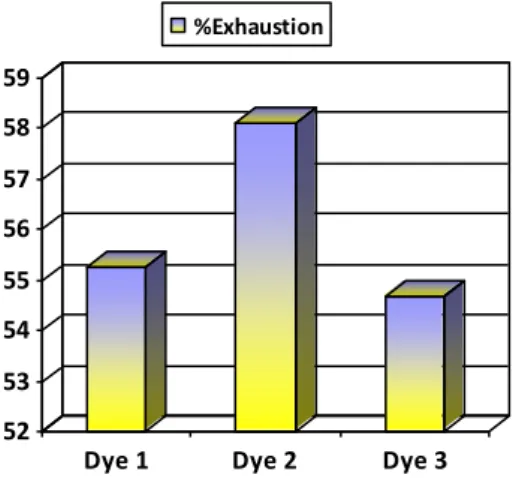
The results of the degree of exhaustion of dyestuffs from dye baths are given in Fig. 3. The tendency is that the degree of exhaustion is as large as possible in order to be less loss of dyestuff (wastewater), although in this case does not need to worry too much because it is some readily biodegradable natural active agents.
The range of the degree of exhaustion of the dyestuffs goes from 54 % to 58 %, depending on many parameters, but considering it was under the same reaction conditions, to the exclusion of common parameters leads to the fact that visible and decisive contribution have applied dyestuff.
52 53 54 55 56 57 58 59
Dye 1 Dye 2 Dye 3
%Exhaustion
46
5. CONCLUSIONS
The synthesized azomethines, showed very good substantivity for wool fibers, gave fine coloring, with good degree of exhaustion after dyeing.
The combination of extended synthetic analogues of natural molecules leads to discovery of chemical entities which might be excellent anti-microbial and anti-amoebic compounds as depicted in our results. Being highly the effects this compound can be explored in future as an option for decreasing pathogenic potential of infecting from different sources.
The inhibition depends on type of bacterial strain, solvent as well as the structure of compound. All the azomethine compounds contain the same central moiety with different side chains. So in a particular solvent, for a particular effect side chains play important role in inhibition.
Azomethines containing hydrazone (dyestuff 1) and phenylhydrazone (dyestuff 2) as moiety show average yield and moderate inhibition activity while azomethines containing thiosemicarbazone (dyestuff 3) as moiety show higher yield and greater inhibition activity towards gram-negative and gram-positive bacteria as well as a fungus.
Based on all the results, it can be assumed that applied azomethines exhibit anti-bacterial and anti-parasitic properties on textile materials too, since they can dyestuff them. Thus, the process of dyeing we receive new properties woolen textiles that protect the skin of external influences from bacteria and fungi but it is a new additional research.
REFERENCES
[1] A. M. Khedr and F. A. Saad, "Synthesis, structural characterization, and antimicrobial efficiency of sulfadiazine azo-azomethine dyes and their bi-homonuclear uranyl complexes for chemotherapeutic use", Turk J Chem., vol. 39, pp 267-280, 2015.
[2] D. P. Singh, V. Grover, K. Kumar and K. Jain, Synthesis and characterization of divalent metal complexes of the macrocyclic ligand derived from isatin and 1,2-diaminobenzene, J. Serb. Chem. Soc., vol. 76, pp. 385–393 2011.
[3] Y. Al-Kahraman, H. Madkour, A. Dildar and M. Yasinzai, "Antileishmanial, Antimicrobial and Antifungal Activities of Some New Aryl Azomethines", Molecules, vol. 15, pp. 660-671, 2010;
[4] G. R. Patel, J. J. Maru and R. Yadav, "Antimicrobial screening of synthesized some novel azomethines via organic base", ILCPA, vol. 43, pp. 26-33, 2015.
[5] E. Jayapriya, P. Lalitha and M. J. Firdhouse, Isatin-Mediated Synthesis and Characterization of Silver Nanoparticles, IJPCR, vol. 2, pp. 46-54, 2016.
[6] H Khanmohammadi, M. Pass, K. Rezaeian and G. Talei, "Solvatochromism, spectral properties and antimicrobial activities of new azo–azomethine dyes with N2S2O2 donor set of atoms", J. Mol. Struct., vol. 1072, pp. 232-237, Aug. 2014.
[7] G. Kumar, S. Devi and D. Kumar, "Synthesis of Schiff base 24-membered trivalent transition metal derivatives with their anti-inflammation and antimicrobial evaluation", J. Mol. Struct., vol. 1108, pp. 680-688, Mar. 2016.
[8] K. Husain, A. R. Bhat and A. Azam, "New Pd(II) complexes of the synthesized 1-N-substituted thiosemicarbazones of 3-indole carboxaldehyde: Characterization and antiamoebic assessment against E. histolytica", Eur. J. Med. Chem., vol. 43, pp. 2016-2028, Sept. 2008.