a non-ferrous metal-processing plant
Vesna B. Lazarević1, Ivan M. Krstić2, Miodrag L. Lazić3, Dragiša S. Savić3, Dejan U. Skala4*,
Vlada B. Veljković3
1Centre for Preventive and Medical Protection, Niš, Serbia 2University of Niš, Faculty of Occupational Protection, Niš, Serbia 3University of Niš, Faculty of Technology, Leskovac, Serbia
4University of Belgrade, Faculty of Technology and Metallurgy, Belgrade, Serbia
Abstract
The treatment of spent oil-in-water emulsion (SOWE) from a non-ferrous metal-processing plant by using aluminum sulfate and hydrated lime was studied in order to determine the purification efficiency, optimize the operating conditions and scale up the treatment pro-cess. The purification efficiency was estimated by comparing the compositions of the SOWE and the processed wastewater. The treatment efficiency does not depend on the type of mineral oil and filter aid. The optimum doses of aluminum sulfate and hydrated lime must be experimentally determined for each batch of SOWEs, but the results ob-tained at laboratory level are applicable at pilot level. The processed wastewater and the filter cake from the process can be safely disposed into public sewage systems and at municipal waste landfills, respectively. The purification efficiency was higher than 98% with respect to total suspended solids, chemical oxygen demand and oil and grease, and was comparable to the known treatment processes based on coagulation/flocculation fol-lowed by sedimentation.
Keywords: aluminum sulfate, chemical wastewater treatment, coagulation, flocculation, mineral oil-in-water emulsion, sedimentation..
SCIENTIFIC PAPER
UDC 628.316.12:546.62:66
Hem. Ind. 67 (1) 59–68 (2013)
doi: 10.2298/HEMIND120317055L
Available online at the Journal website: http://www.ache.org.rs/HI/
Mineral oil-in-water emulsions (OWEs) are used in the metal-processing industry as cooling and lubricating agents [1]. They also have secondary functions, such as to ensure the corrosion protection of both processed metal parts and operating tools, and to provide assis-tance in taking away metal scraps and chips from the metal-processing area. OWEs help to improve the func-tion of the tool and to prolong its service life.
OWEs can have the above-mentioned positive ef-fects on metal processing, but can also negatively af-fect the environment. During utilization, an OWE un-dergoes changes under the influence of mechanical, thermal, chemical and biological factors, is no longer safe to be used because of reduced operating functions and emerging health hazards and it must be replaced [2,3]. Because of a small concentration of mineral oil in spent OWEs (SOWEs), also known as used or waste OWEs, mainly as a result of microbial contamination, their regeneration is not recommended. Therefore, from time to time or on every day bases, SOWEs are
Correspondence: V. Veljković, University of Niš, Faculty of Techno-logy, Bulevar oslobodjenja 124, Leskovac, Serbia.
E-mail: [email protected]
*Present address: University of Belgrade, IChTM, Center for Catalysis and Chemical Engineering, Njegoševa 12, Belgrade, Serbia.
Paper received: 17 March, 2012 Paper accepted: 21 May, 2012
disposed from manufacturing plants into the basins as wastewater, where they are exposed to uncontrolled natural processes of destruction. Generally, SOWEs contain residual mineral oil, tramp oils, greases, biocides, emulsifiers, metal ions, other components of original OWEs and the products of their degradation. When irresponsibly and non-professionally handled, SOWEs appear as environmentally hazardous wastewaters. To reduce their negative impact on the environment, SOWEs must not be discharged into sew-age systems, rivers or lakes without previous extensive treatment. Environmental and economical importance of the pretreatment is extremely important due to the impact of SOWEs on traditional wastewater treatment processes caused by their volume and high contami-nation levels [4]. The SOWE amount is estimated to be more than ten times the worldwide usage, which ex-ceeds 2×10⁶ m3 per year [5]. Greeley and Rajagopalan [3] reported that eleven dollars would be spent on management and disposal of SOWEs for each dollar spent on purchasing OWE concentrate.
coagulation pretreatment is coupled to deep bed fil-tration [10], membrane separation [4,13] and vacuum evaporation [7]. Treatment plants involving combina-tions of physical and biological processes are also em-ployed [5]. So far, the SOWE treatment studies have been performed primarily at laboratory level, while modular pilot plant for the treatment of oil-containing wastewaters has been only reported [14].
Among the most common methods, chemical treat-ment is frequently used because of its relatively low operating costs, small capital investment and simplicity [15]. This method can be used for volumes of SOWE from 190 L per day to more than 3.8 million L per day [16], but it is extremely economic for large SOWE vo-lume producers, e.g., higher than 1135 m3 per day [17]. The treatment has three main phases [18,19]: coagu-lation, flocculation and phase separation. Coagulation is caused by adding a coagulant agent to intensively agitated SOWE. The coagulating agent neutralizes negatively charged colloids by cationic hydrolysis pro-ducts and/or forms an amorphous hydroxide precipi-tate, which drags down oil droplets, colloids, soluble organic compounds and other impurities [20]. During the flocculation phase, the obtained floccules grow while the suspension obtained is moderately agitated. Once the floccules have reached a size large enough, they are removed from the water by gravitational set-tling or centrifugation.
Chemical treatment usually takes place in batch re-actors [19]. Strong inorganic acids (sulfuric acid), inor-ganic salts (aluminum sulfate or chloride, ferric chlo-ride, calcium chloride or sulfate) and organic chemicals (ionic polymers) are usually used as coagulating agents to destabilize or break SOWEs. Industrial chemical treatment processes frequently employ salts for coagu-lation [18,19]. Aluminum salts (sulfate or chloride) are traditionally used as coagulating agents in emulsified wastewater treatment. At the same salt dose, lower values of the residual COD were achieved when a mo-del SOWE (based on a commercial mineral oil Fesol 05 and Fesol 09, produced by FAM Kruševac, Serbia) was treated by aluminum sulfate, and after that with ferric chloride [21]. Aluminum sulfate has already been shown to be effective in separation of oil and greases from SOWEs via destabilization of oil droplets and destruction of emulsions [22].
The present paper deals with chemical treatment of the SOWE from a non-ferrous metal-processing plant at laboratory and pilot levels. Aluminum sulfate was used as a coagulant to destroy the emulsion while hydrated lime was used as a base and a precipitating agent. Both model and real SOWEs were used; the former were prepared in the laboratory by emulsifying mineral oils in distilled water, and the latter were taken from the basin of the non-ferrous metal-processing plant where
they have been collected. The attention was paid to the effects of the coagulant dose, the hydrated lime dose, the speed and time duration of agitation as well as type and dose of filter aid on the efficiency of the SOWE treatment. The treatment efficiency was estimated by comparing the composition of SOWEs with that of the processed wastewater. The main goals were to deter-mine the efficiency of purification of both model and real SOWEs by coagulation/flocculation, to optimize the process operating conditions, to develop an effec-tive chemical treatment of the SOWE from the non-ferrous metal-processing plant and to get the chemical engineering data needed for the design of an industrial process.
MATERIALS AND METHODS
Materials
Two commercial mineral oils, Fesol 05 and Fesol 09 (FAM, Kruševac, Serbia) were used in this study. The basic properties of the mineral oils used are given in Table 1 [23]. Aqueous emulsions of the mineral oils, used as models of the SOWE, were prepared by mixing the oil with distilled water; the oil concentration was 10.0 g/L, if not differently specified. A real SOWE was taken from the basin located within a metal-processing plant (FOM, Prokuplje, Serbia). Floating tramp oil was separated from the SOWE.
Table 1. Basic properties of mineral oils used [23]
Property Fesol 05 Fesol 09 Viscosity at 40 °C, mm²/s 29 24
Density at 20 °C, kg/m3 915 950 pH Value (5% in water) 9.5 8.8
Aluminum sulfate, Al2(SO4)3·18H2O, p.a. or technical grade, was purchased from Merck or Marking (Užice, Serbia), respectively; an aqueous solution, 0.75 mol/L (500 g/L), was prepared. Hydrated lime, technical grade, was purchased from Veljko Dugošević Co. (Ku-čevo, Serbia). Celite filter-cel, Celite Standard super-cel and Celite 512 (Celite Corp., Lompoc, USA) were used as filter aid. Sawdust (common beech; particle size: 0.6–2.0 mm), used as a filter aid and an adsorbent, was taken from a local sawmill.
Equipment
were used in the scaling-up studies of the chemical treatment of the real SOWEs.
Laboratory studies
Model SOWE
The model SOWE (0.5 L) was poured into a number of glass beakers. The coagulant solution was added while the emulsion was intensively agitated at 120 rpm to favor the coagulation. In some experiments, the filter aid was added immediately after the coagulant solution. The suspension formed was agitated for 3 min. Then, the agitation speed was slowed down at 30 rpm and the agitation was continued for 30 min to favor the flocculation. Finally, the solid phase obtained was separated by filtration under vacuum using a Seitz K200 filter sheet. The filtrate was collected for determining the chemical oxygen demand (COD).
Real SOWE
The real SOWE (0.5 L) was poured into a number of glass beakers (1 L), and the coagulant solution and hydrated lime were added while the SOWE was inten-sively agitated. The effect of aluminum sulfate was stu-died at doses in the range between 0.2 and 2.0 g/L at the hydrated lime dose of 1.0 g/L. The effect of hydra-ted lime was investigahydra-ted at doses of 1.0, 2.0 and 3.0 g/L and at the coagulant dose of 1.0 g/L. During the coagulation phase, the SOWE was agitated at 120 rpm
for 5 min. The resulted suspension was then stirred at 30 rpm for 30 min during the flocculation phase. The solid phase obtained was separated by filtration under vacuum using the Seitz K200 filter sheet. The filtrate was collected for determining pH, COD, biochemical oxygen demand (BOD), total organic carbon (TOC), oil and grease and sulfates.
Scaling-up of SOWE treatment process
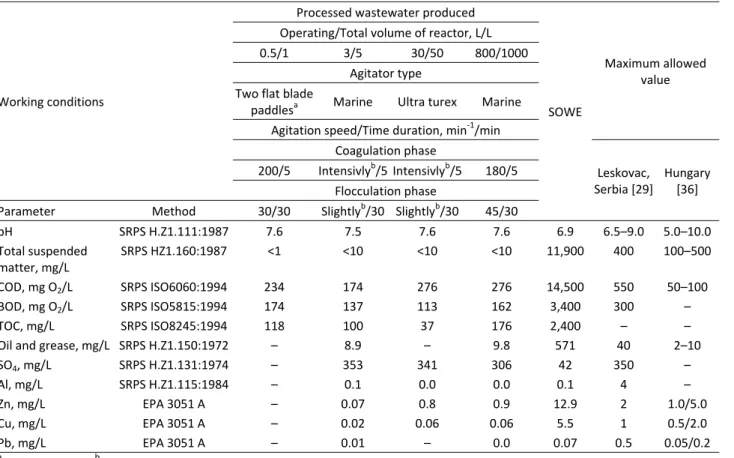
The real SOWE was poured into a coagulation/floc-culation tank, and while the SOWE was intensively agi-tated, the coagulant solution, hydrated lime and filter aid were added at doses of 1.0, 3.0 and 1.0 g/L, res-pectively. The suspension was intensively agitated for 5 min at the same agitation speed in order to enhance the coagulation. The agitation speed was then slowed down to favor the growth of the floccules formed; sawdust (3.0 g/L) was added and the agitation was continued for 30 min. The suspension was filtrated under vacuum using the Seitz K200 filter sheet to sepa-rate the solid phase (filter cake) from the purified was-tewater (filtrate). The latter was used for determining pH, total suspended substances (TSS), COD, BOD, TOC, oil and grease, sulfate, aluminum, copper, zinc and lead. Only the filter cake from the laboratory experi-ment was used for determining moisture, ash, organic load, copper, zinc and lead. The operating conditions are given in Table 2.
Table 2. Quality parameters of SOWE and processed wastewater
Working conditions
Processed wastewater produced
SOWE
Maximum allowed value Operating/Total volume of reactor, L/L
0.5/1 3/5 30/50 800/1000 Agitator type
Two flat blade
paddlesa Marine Ultra turex Marine Agitation speed/Time duration, min-1/min
Coagulation phase
Leskovac, Serbia [29]
Hungary [36] 200/5 Intensivlyb/5 Intensivlyb/5 180/5
Flocculation phase
Parameter Method 30/30 Slightlyb/30 Slightlyb/30 45/30
pH SRPS H.Z1.111:1987 7.6 7.5 7.6 7.6 6.9 6.5–9.0 5.0–10.0 Total suspended
matter, mg/L
SRPS HZ1.160:1987 <1 <10 <10 <10 11,900 400 100–500
COD, mg O2/L SRPS ISO6060:1994 234 174 276 276 14,500 550 50–100
BOD, mg O2/L SRPS ISO5815:1994 174 137 113 162 3,400 300 –
TOC, mg/L SRPS ISO8245:1994 118 100 37 176 2,400 – – Oil and grease, mg/L SRPS H.Z1.150:1972 – 8.9 – 9.8 571 40 2–10 SO4, mg/L SRPS H.Z1.131:1974 – 353 341 306 42 350 –
Al, mg/L SRPS H.Z1.115:1984 – 0.1 0.0 0.0 0.1 4 – Zn, mg/L EPA 3051 A – 0.07 0.8 0.9 12.9 2 1.0/5.0 Cu, mg/L EPA 3051 A – 0.02 0.06 0.06 5.5 1 0.5/2.0 Pb, mg/L EPA 3051 A – 0.01 – 0.0 0.07 0.5 0.05/0.2
a
Analytical methods
The quality parameters of the SOWE, the processed wastewater and the filter cake such as TSS, COD, BOD, TOC, oil and grease, sulfate, metal ions (zinc, copper, aluminum and lead), pH, moisture, ash and organic were measured by the standard methods (Tables 2 and 3). The oil concentration, coil (g/L), in model SOWEs based on mineral oils Fesol 05 and Fesol 09, was cal-culated from the measured values of COD (mg O2/L), using the following equation [21]:
oil
2393
COD= c
which is valid for coil ≤ 5 g/L. To develope the above
correlation, the COD of the OWE of different concen-trations (0.1, 0.25, 0.5, 1.0 and 5.0 g/L) was determined by the standard method. The proportionality coeffi-cient was calculated by the least squers method.
RESULTS AND DISCUSSION
Treatment of model SOWEs
Type and dose of coagulant and mineral oil, as well as time duration and speed of agitation and the pH of the solution, are expected to be among the key process factors affecting chemical treatment of model SOWEs. Since it was observed that model SOWEs were des-troyed immediately after adding the coagulant to the vigorously agitated emulsion [21], hydrated lime was not included in these experiments. Also, the type and the dose of filter aid were expected to be an influential factor for clarification and sludge filtration stages of chemical treatment of SOWEs, although it may be an adsorption agent. The presence of a Celite filter aid had a negative effect on the clarification of the suspension of flocculated particles obtained by the chemical treat-ment of SOWEs, but they had a positive effect on its filtration [24]. The usage of sawdust in the treatment of an OWE model by calcium sulfate as coagulant, oil and COD reduction efficiencies greater than 99 and 95% were achieved [10]. The use of bentonite and sawdust is highly effective for the coagulation of oil in water,
giving removal efficiency of 92% or above [25]. The above factors were optimized on the base of the re-sidual COD of the processed wastewaters.
Influence of coagulant dose
The effect of the coagulant dose in the range between 1.0 and 5.0 g/L on the COD reduction effi-ciency from two model SOWEs (i.e., water emulsions of Fesol 05 or Fesol 09, 10 g/L) can be seen in Figure 1. Independently of the mineral oil type, the residual COD in the processed wastewater decreased rapidly when the coagulant was added at its doses up to appro-xi-mately 2.0 g/L. At higher coagulant doses, however, the residual COD was reduced negligibly. Thus, once the model SOWEs were destabilized and the lowest resi-dual COD values were achieved, further addition of the coagulant did not influence emulsion destabilization. The coagulation action of aluminum sulfate could be explained by two distinct mechanisms [20]. According to the first mechanism, the coagulant reduced the elec-trostatic repulsion among oil drops, which could then coalesce, grow in size and settle if large enough. The second mechanism, known as sweep flocculation, em-phasized the role of coagulant hydrolysis in alkaline pH, which generated an amorphous aluminum hydroxide precipitate. The coagulant floccules collided and incor-porated with the majority of the oil drops, colloids and soluble organic compounds. Once the floccules had reached a size large enough, the floccules containing the oily phase quickly settled after the stirrer was switched off.
Influence of type of mineral oil
The two kinds of OWE based on two different com-mercial mineral oils – Fesol 05 and Fesol 09 – are used in different parts of the manufacturing plant, and the SOWEs containing different mineral oils are collected in a common basin. In order to test whether the type of mineral oil would affect their efficiency, the model SOWEs containing the two mineral oils (10 g/L) have been purified under the same conditions (aluminum sulfate, 5 g/L; Celite standard super-cel, 10 g/L) in
tri-Table 3. Results of chemical analysis of filter cake; means from duplicate measurements, volume of SOWE: 3 L; volume of coagulation tank: 5 L; aluminium sulfate: 1.0 g/L; Celite standard super-cel: 2.0 g/L; hydrate lime: 2.0 g/L; sawdust: 3.0 g/L
Parametar Method Content Maximum allowed concentration in
grounda, mg/kg Limiting value for sludge
b
, mg/kg % mg/kg
Moisture EN 14346:2006 48.9±0.4 – – –
Ash EN 15169:2006 33.9±0.4 – – –
Organic loadc EN 15169:2006 15.3±0.3 – – – Zn DM 0109 0.135±0.005d 910 50-140 2.500-4.000 Cu DM 0109 0.047±0.001d 320 150-300 1.000-1.750 Pb DM 0109 0.002±0.000d 13 50-300 750-1.200
pH ISO 10523:2008 11.9±0.1 – – –
a
plicate. The model SOWEs containing Fesol 05 and Fesol 09 had the initial COD of 24,650±2,120 mg O2/L and 26,145±1654 mg O2/L, respectively, while values of the residual COD after purification were 523±41 mg O2/L and 726±45 mg O2/L, respectively. The values of purification efficiency of 97.9±0.4 and 97.2±0.3% were achieved for the model SOWEs containing Fesol 05 and Fesol 09, respectively. The effect of the mineral oil type on the COD reduction efficiency was statistically tested by comparing the two means. For both mineral oils, the calculated value of to = 2.16 were lower than the t -value at a 99% confidence level and four degrees of freedom (t = 3.75), showing that there was no sig-nificant difference between the two means, i.e., the COD reduction efficiencies for the two mineral oils differed to each other by chance and not because of
their different compositions. Thus, it was expected that the COD reduction efficiency would not depend on the fractions of the two mineral oils present in the SOWE.
Influence filter aid type
In the present study, three types of diatomaceous earth of different particle size were used as filter aids, namely Celite filter-cel, Celite standard super-cel and Celite 512 (10 g/L). The model SOWE was prepared using Fesol 05 (10 g/L), and the coagulant dose was 5 g/L. Approximately the same values of the residual COD (1653±113 mg O2/L) were achieved in the purification processes in the presence of different filter aids. There-fore, in further studies, only Celite standard super-cel was used, which has been recently reported [24] to be the most efficient filter aid for treating the SOWE from the non-ferrous metal-processing plant. Figure 2 shows Figure 1. The effect of the aluminum sulfate dosage on the residual COD (model OWE, 10 g/L; agitation conditions: 3 min
at 120 rpm, and then 30 min at 30 rpm).
the influence of the filter aid (Celite standard super-cel) dose added initially to the model SOWE (Fesol 05, 10 g/L) in the range between 0 and 10 g/L on the residual COD. The coagulant dose was 5 g/L. The residual COD value decreased very slightly with increasing the filter aid amount.
Influence of time duration and speed of agitation
Figures 3 and 4 show the effect of the time duration and speed of agitation during the coagulation phase, respectively on the residual COD after the chemical treatment of a model SOWE (Fesol 05, 10 g/L). The re-sidual COD did not reduce significantly when the time duration of the agitation was increased from 1 to 8 min (Figure 3). With increasing the agitation speed in the range between 60 and 150 rpm, the residual COD re-mained constant (525±19 mg O2/L) or very slightly in-creased from 500 to 550 mg O2/L (Figure 4).
Efficiency of SOWE treatment at the laboratory level This study of the effects of the coagulant dose and the pH of the reaction mixture on the treatment effi-ciency has been carried out with real SOWEs in the jar test apparatus. In conjunction with aluminum sulfate as a coagulant, hydrated lime is often used in wastewater treatment to maintain the proper pH for most satisfac-tory coagulation conditions. Also, hydrated lime can precipitate some metal ions such as copper, zinc and lead and anions such as sulfate in the form of hydro-xides and insoluble calcium compounds (calcium sul-fate), respectively. Finally, hydrated lime can facilitate clarification and filtration on pressure filters. Both the clarification and filtration rate increased with increas-ing pH, i.e., the hydrated lime dose, while the sludge volume was reduced [24]. Also, the filtration properties of the filter cake, such as porosity and
incompres-Figure 3. The effect of the time duration of agitation in the coagulation stage on the residual COD (Fesol 05, 10 g/L; aluminum sulfate dose: 5 g/L; Celite standard super-cel: 10 g/L; agitation speed).
sibility, were significantly improved by adding sawdust to the suspension of flocculated particles before fil-tration, enhancing the filtration rate [21].
Influence of coagulant dose
The effect of the coagulant dose on the treatment efficiency was studied in the range between 0.2 and 2.0 g/L. As can be seen in Table 4, with increasing the coagulant dose, the COD, BOD, TOC and oil and grease reached a minimum and then increased, probably due to a re-stabilization of particles. The lowest values of COD, BOD, TOC, oil and grease and sulfates were achieved when the SOWE was treated at the coagulant dose of 1.0 g/L. The efficiency of COD reduction from the SOWEs was 97.4%, which was close to the effi-ciency of the model SOWE treatment (under optimal conditions about 98 to 99%). The efficiency of BOD removal was lower (about 90%). At the coagulant dose of 2.0 g/L, the residual sulfate concentration was higher than the coagulant dose of 1.0 g/L. Therefore, the co-agulant dose of 1.0 g/L was applied in further experi-ments. This optimum dose for real SOWEs treatment is even lower than the one determined for the model SOWEs, probably due to the presence of calcium ions from hydrated lime. Calcium ions contributed to the compression of the electrostatic double layer and to the reduction of electrostatic repulsion among oil drop-lets, causing their coalescence and growth, in OWEs prepared from commercial products from Spain [9,10,13].
Influence of pH
The effect of pH on the removal efficiency of co-agulation/flocculation by aluminum sulfate was studied in the range of pH between 6.3 and 9.5. Different pH values of the reaction mixture were adjusted by adding different doses of hydrated lime. The suggested pH conditions for this coagulation process are in the region of Al(OH)3 precipitation and optimum sweep floccula-tion, and the latter mechanism is dominant at pH > 6 [26]. As can be seen in Table 5, the reduction efficiency, measured via the residual COD, BOD and TOC, ap-peared to be slightly increased with increasing the pH value from 6.3 to 9.5. At these pH values, Al(OH)4– are dominantly generated, which favor the formation of the Al13 polymer [20], which are the most efficient
Al-species for organic matter removal because of their larger size and higher positive charges [27]. However, levels of the residual COD, BOD and TOC were close at different pH, and it was concluded that the pH could be adjusted in the range between 8.0 and 9.5, by adding a corresponding amount of hydrated lime (between 1.0 and 3.0 g/L), to ensure an acceptable purification effi-ciency.
Scaling-up of SOWE treatment process
To find out the possible problem related to scaling up, the chemical treatment process developed was car-ried out at four levels using the tanks for coagulation and flocculation of 1, 5, 50 and 1000 L filled with 0.5, 3, 30 and 800 L of real SOWE. The values of quality para-meters for both SOWEs and the wastewater obtained by the treatment along with the operating conditions are given in Table 2. The values of quality parameters for the filter cake from the 5 L laboratory treatment process are given in Table 3. The organic load of the SOWE was decreased by the chemical treatment. The COD, BOD, TOC and oil and grease were significantly reduced at all process levels. At the pilot level, sus-pended matters were almost completely removed (99.9%), while the reduction efficiencies of COD, BOD, TOC and oil and grease were 98.1, 95.2, 92.7 and 98.3%, respectively. The concentrations of metal ions originated from the metal processing such as zinc and copper were also reduced with the removal efficiency of 93 and 99%, respectively, by precipitation with hyd-rated lime in the form of the hydroxides. The lead ion concentration was also reduced below the maximum allowed level due to the lead hydroxide precipitation. The high metal removal efficiency was attributed to a favorable pH of about 9.0 in the coagulation/floc-culation tank. The highest efficiency of zinc, copper and lead removal from aqueous solutions by hydroxide precipitation was obtained in a range of 8.7 to 9.6, 8.1 to 11.1 and 7.8 to 8.8, respectively [28].
Regardless of the process scale, the processed was-tewater was appropriate for disposal to the public sew-age system. This provided the appropriate regulations on sanitary and technical requirements for wastewater discharge into public sewerage of the municipality of Leskovac, Serbia [29]. Furthermore, it was very impor-tant that the addition of aluminum sulfate did not
Table 4. The effect of the coagulant dose on the removal efficiency of SOWE at pH 8.0
Quality parameter of the wastewater after the treatment SOWE Coagulant, g/L
0.2 0.5 1.0 2.0
COD, mg O2/L 12,100 725 730 320 405
BOD, mg O2/L 3,100 505 520 315 388
TOC, mg/L 2,200 320 335 260 320
Oil and grease, mg/L 488 2.4 2.0 1.1 1.8
create new environmental problems related to alumi-num and sulfate ions. As it can be seen in Table 2, the sulfate concentration in the processed wastewater (al-though increased in comparison to the influent SOWE) was below the maximum allowed level for industrial wastewaters that could be disposed into the public sewage. The addition of hydrated lime contributed to the sulfate level reduction because of calcium sulfate precipitation. The aluminum ions concentration was very low because of their precipitation as aluminum hydroxide. However, the processed wastewater did not meet most standards prescribed by the relevant Hun-garian law, a country which is similar in size to Serbia; therefore, it should be subjected to further purification for disposal into rivers, lakes or groundwater.
With respect to the removal efficiency of oil and grease, the present purification technology of SOWEs from the non-ferous metal-processing plant is com-parable to the already known treatment processes in-volving coagulation followed by sedimentation applied in metal-processing industry using alminum sulfate and/or hydrated lime such as paint manufacture (alu-minum sulfate: 99%; alu(alu-minum sulfate+hydrated lime: 98%) and steel pickling (lime: 66%) (Sutton and Mishra, 1994). The treatment efficiency of coagulation/floc-culation process changes dramatically from one waste-water to another, for instance the COD reduction of 15, 40, 60, 65 and 75% were achieved by treating waste-waters from compositing plants [30], cheese whey pro-duction [31], landfills [32], slaughterhouse [33] and tanneries [34], respectively. In addition, the efficiency of oil removal from a palm oil mill effluent was higher than 95% [35], while the efficiency of TOC reduction from a waste coolant effluent was 87% [4].
The results of the physico-chemical analysis of the filter cake obtained by the laboratory treatment are shown in Table 3. Limiting values for heavy metals (zinc, copper and lead) described by the appropriate European Union directive on the protection of the soil, when sewage sludge is used in agriculture, are also presented. The cake contained about 50% of water, 15% of the organic load and 34% of ash. Zinc, copper and lead concentrations were found to be 0.13, 0.05 and 0.002% (based on ash), respectively. The aluminum concentration in the treated wastewater was very low (<0.1 mg/L), as it can be seen in Table 3, indicating that
produced sludge would contain almost all the alumi-num from the alumialumi-num sulfate dose (estimated to be 5–6 mg/kg of dry filter cake).
The dry filter cake from the SOWE treatment plant could be burnt or disposed at a landfill if it satisfies the prescribed law limitations. The zinc and copper load-ings of the dry filter cake were below the limit values for sewage sludge which could be used in agriculture, but about 3 times higher than the maximum allowable concentrations in the soil. The content of lead in the dry filter cake was far below the prescribed limits for both the soil and the sewage sludge. Due to the lack of all necessary data (flue gas composition and calorific value of dried filter cake), it was not possible to esti-mate the possibility of its incineration or use as a fuel. In addition, if the filter cake was used in this way, new environmental problems appeared – such as ash that contained toxic heavy metals and the flue gases of unknown purity. The general solution and recommen-dation could be proper disposal of the filter cake at municipal waste landfills.
CONCLUSION
The chemical treatment of model and real SOWEs using aluminum sulfate, combined with hydrated lime filter aids have been studied. The results obtained showed that treatment efficiency does not depend on the type of mineral oil (Fesol 05 or Fesol 09) and the type and amount of filter aid based on the Celite diatomaceous earth. The optimum doses of aluminum sulfate and hydrated lime must be experimentally de-termined for each batch of SOWEs, but their acceptable doses are 1.0 g/L and 1.0 to 3.0 g/L, respectively. The optimum conditions for the coagulation/flocculation process determined in the jar test are applicable at the pilot level. The process was confidently scaled-up from the laboratory to the pilot level, and the chemical en-gineering data obtained can be credibly used for de-signing the industrial SOWE treatment process com-prising a coagulation/flocculation/sedimentation se-quence.
The chemical treatment process for SOWE from non-ferrous metalworking plants should involve: equa-lization of SOWEs from different batches, secondary oil separation, SOWE destruction (coagulation/floccula-Table 5. The effect of pH on the treatment efficiency of SOWE
Quality parameter of the wastewater after the treatment SOWE Hydrated lime, g/L
1.0 2.0 3.0
pH 7.6 6.3 8.8 9.5
COD, mg O2/L 12,100 910 900 860
BOD, mg O2/L 3,100 435 405 370
tion) and heavy-metal ions precipitation, sedimentation of flocculated particles, sludge filtration, neutralization of the processed wastewater and filter cake disposal. The processed wastewater and the wet filter cake, which are 98 and 2% of the inlet SOWEs, can be safely disposed into public sewage systems and at municipal waste landfills, respectively. The purification efficiency is higher than 98% with respect to TSS, COD and oil and grease and is comparable to the known chemical treat-ment processes based on coagulation/flocculation fol-lowed by sedimentation.
Abbreviations
BOD – Biochemical oxygen demand COD – Chemical oxygen demand OWE – Oil-in-water emulsion SOWE – Spent oil-in-water emulsion TOC – Total organic carbon
TSS – Total suspended substances
REFERENCES
[1] J.S. McCoy, Introduction: Tracing the Hystorical Deve-lopment of Metalworking Fluids, in: J.P. Byers (Ed.), Metalworking Fluids, Marcel Dekker Inc., New York, 1994, pp. 1–23.
[2] J.M. Burke, Waste treatment of metalworking fluids, a comparison of three common methods, Lubr. Eng. 47
(1991) 238–246.
[3] M. Greeley, N. Rajagopalan, Impact of environmental contaminant on machining properties of metalworking fluids, Tribol. Int. 37 (2004) 327–332.
[4] N. Hilal, G. Busca, F. Talens-Alesson, B. P. Atkin, Treat-ment of waste coolants by coagulation and membrane filtration, Chem. Eng. Proc. 43 (2004) 811–821.
[5] C. Cheng, D. Phipps, R.M. Alkhaddar, Treatment of spent metalworking fluids, Water Res. 39 (2005) 4051–4063. [6] G. Gutiérrez, Á. Cambiella, J.M. Benito, C. Pazos, J. Coca,
The effect of additives on the treatment of oil-in-water emulsions by vacuum evaporation, J. Hazard. Mater.
144 (2007) 649–654.
[7] G. Gutiérrez, J.M. Benito, J. Coca, C. Pazos, Vacuum eva-poration of waste oil-in-water emulsions from a copper metalworking industry, Ind. Eng. Chem. Res. 48 (2009) 2100–2106.
[8] J.M. Benito, A. Cambiella, A. Lobo, G. Gutierrez, J. Coca, C. Pazos, Formulation, characterization and treatment of metalworking oil-in-water emulsions, Clean Techn. Environ. Pol. 12 (2010) 31–41.
[9] Á. Cambiella, J.M. Benito, C. Pazos, J. Coca, Centrifugal separation efficiency in the treatment of waste emul-sified oils, Chem. Eng. Res. Des. 84 (2006) 69–76. [10] Á. Cambiella, E. Ortea, G. Ŕıos, J. M. Benito, C. Pazos, J.
Coca, Treatment of oil-in-water emulsions: Performance of a sawdust bed filter, J. Hazard. Mater. B131 (2006) 195–199.
[11] B.R. Kim, N.R. Devi, F.Z. Jerome, L. Frank, P.V. Harvath, Biological removal of organic nitrogen and fatty acids
from metal-cutting-fluid wastewater. Water Res. 28
(1994) 1453–1461.
[12] C. Cheng, D. Phipps, R.M. Alkhaddar, Thermophilic aero-bic wastewater treatment of waste metalworking fluids, Water Environ. J. 20 (2006) 227–232.
[13] A. Lobo, Á. Cambiella, J.M. Benito, C. Pazosa, J. Coca, Effect of a previous coagulation stage on the ultrafiltra-tion of a metalworking emulsion using ceramic mem-branes, Desalination 200 (2006) 330–332.
[14] J. Benito, G. Ríos, E. Ortea, E. Fernández, A. Cambiella, C. Pazos, J. Coca, Design and construction of a modular pilot plant for the treatment of oil-containing waste-waters, Desalination 147 (2002) 5–10.
[15] Michigan Departments of Commerce and Natural Re-sources. Ten Ways to Reduce Machine Coolant Cost, Fact Sheet No. 9402, Office of Waste Reduction Ser-vices, Environmental Services Division, Michigan Depart-ments of Commerce and Natural, Resources, Lansing, 1994.
[16] G. Foltz, Treatment and disposal of used metalworking fluids. Moldmak. Technol. No. 6, 2003, http:// //www.moldmakingtechnology.com/articles/060303.html (accessed on August 06, 2011).
[17] M. Cheryan, N. Rajagopalan, Membrane processing of oily streams. Wastewater treatment and waste reduc-tion, J. Membrane Sci. 151 (1998) 13–28.
[18] J.W. Patterson, Industrial Wastewater Treatment Tech-nology, second ed., Butterwoth Publishers, Boston, 1985, pp. 273–297.
[19] P.M. Sutton, P.N. Mishra, Waste Treatment, in: J.P. Byers (Ed.), Metalworking Fluids, Marcel Dekker, Inc., New York, 1994, pp. 367–391.
[20] J. Duan, J. Gregory, Coagulation by hydrolyzing metal salts, Adv. Colloid Interface Sci. 100–102 (2003) 475– –502.
[21] V. Kovačević, Purification of spent oil-in-water emulsion from non-ferrous metal-processing plants, MSc. Thesis, University of Niš, Faculty of Technology, Leskovac, Ser-bia, 2003 (in Serbian).
[22] W.J. Eilbeck, G. Mattock, Chemical Processes in Waste-water Treatment, Ellis Horwood Limited, England, 1987. [23] V.N. Rajaković, D. Skala, Demulsification based on the
thermal treatment (cooling and heating) of W/O emul-sions, Hem. Ind. 58 (2004) 343–350 (In Serbian).
[24] V.B. Lazarević, I.M. Krstić, L.M. Takić, M.L. Lazić, V.B. Veljković, Clarification and filtration of the flocculated particles suspension from a chemical treatment of waste oil-in-water emulsions from a non-ferrous metal-working plant, Hem. Ind. 65 (2011) 53–60 (in Serbian). [25] Y. Fu, D.D.L. Chung, Coagulation of oil in water using
sawdust, bentonite and calcium hydroxide to form float-ing sheets, Appl. Clay Sci. 53 (2011) 634–641
[26] J. Bratby, Coagulation and flocculation in water and wastewater treatment, second ed., IWA Publishing, London, 2006.
[27] A. Matilainen, M. Vepsäläinen, M. Sillanpää, Natural or-ganic matter removal by coagulation during drinking water treatment: A review, Adv. Colloid Interface Sci.
[28] F.M. Pang, S.P. Teng, T.T. Teng, A.K. Mohd Omar, Heavy Metals Removal by Hydroxide Precipitation and Coagu-lation–Flocculation Methods from Aqueous Solutions, Water Qual. Res. J. Can. 44 (2009) 174–182.
[29] Official Gazzete of the Municipality of Leskovac, No. 10/93 (July 27, 1993), pp. 311–312 (in Serbian).
[30] M.A. Zazouli, Z. Yousefi, Removal of heavy metals from solid wastes leachates coagulation-flocculation process, J. Appl. Sci. 8 (2008) 2142–2147.
[31] J. Rivas, A.R. Prazeres, F. Carvalho, F. Beltrán, Treatment of cheese whey wastewater: Combined coagulation - flocculation and aerobic biodegradation, J. Agr. Food Chem. 58 (2010) 7871–7877.
[32] S. Ghafari, H. Abdul Aziz., M.J.K. Bashir, The use of poly-aluminum chloride and alum for the treatment of par-tially stabilized leachate: A comparative study, Desali-nation 257 (2010) 110–116.
[33] O.S. Amuda, A. Alade, Coagulation/flocculation process in the treatment of abattoir wastewater, Desalination
196 (2006) 22–31.
[34] S. Aber, D. Salari, M.R. Parsa, Employing the Taguchi method to obtain the optimum conditions of coagu-lation-flocculation process in tannery wastewater treat-ment, Chem. Eng. J. 162 (2010) 127–134.
[35] A.L. Ahmad, S. Sumathi, B.H. Hameed,Coagulation of residue oil and suspended solid in palm oil mill effluent by chitosan, alum and PAC, Chem. Eng. J. 118 (2006) 99– –105.
[36] B. Dalmacija, Control of water quality within the quality management, University of Novi Sad, Faculty of Scien-ces, Department of Chemistry, Novi Sad, 2000, pp. 191– –221 (in Serbian).
IZVOD
POVEĆANJE RAZMERE HEMIJSKOG PREČIŠĆAVANJA OTPADNE VODENE EMULZIJE MINERALNOG ULJA IZ FABRIKE ZA OBRADU OBOJENIH METALA
Vesna B. Lazarević1, Ivan M. Krstić2, Miodrag L. Lazić3, Dragiša S. Savić3, Dejan U. Skala4, Vlada B. Veljković3 1
Centar za preventivnu i medicinsku zaštitu, Niš, Srbija
2
Univerzitet u Nišu, Fakultet zaštite na radu, Niš, Srbija
3
Univerzitet u Nišu, Tehnološki fakultet, Leskovac, Srbija
4
Univerzitet u Beogradu, Tehnološko–metalurški fakultet, Beograd, Srbija
(Naučni rad)
Proučavano je prečišćavanje otpadne vodene emulzije mineralnog ulja (OVEMU) iz fabrike obrade obojenih metala pomoću aluminijum-sulfata i hidra-tisanog kreča radi određivanja efikasnosti prečišćavanja, optimizovanja radnih uslova i povećanja razmere procesa prečišćavanja. Efikasnost prečišćavanja je oce-njivana na osnovu poređenja sastava OVEMU i dobijene otpadne vode. Utvrđeno je da efikasnost prečišćavanja ne zavisi od vrste mineralnog ulja i pomoćnog fil-tracionog sredstva. Optimalne količine aluminijum-sulfata i hidratisanog kreča moraju biti eksperimentalno određene za svaku šaržu OVEMU, s tim što su re-zultati dobijeni na laboratorijskom nivou primenljivi na poluindustrijskom nivou. Otpadna voda, odnosno filtraciona pogača iz procesa prečišćavanja mogu se bez-bedno ispustiti u kanalizaciju, odnosno odložiti na deponiju komunalnog otpada. Efikasnost prečišćavanja je bila veća od 98% u odnosu na ukupno suspendovane
čvrste čestice, hemijsku potrošnju kiseonika i ulja i masti, a može se porediti sa efikasnošću poznatih procesa prečišćavanja baziranih na primeni koagulacije, flo-kulacije i sedimentacije.
![Table 1. Basic properties of mineral oils used [23]](https://thumb-eu.123doks.com/thumbv2/123dok_br/18380616.356359/2.892.466.806.677.757/table-basic-properties-mineral-oils-used.webp)