Proteomic Analysis of Urine Exosomes
Reveals Renal Tubule Response to Leptospiral
Colonization in Experimentally Infected Rats
Satish P. RamachandraRao1,2*, Michael A. Matthias3, Chanthel-Kokoy Mondrogon1, Eamon Aghania1, Cathleen Park1, Casey Kong1, Michelle Ishaya1, Assael Madrigal1, Jennifer Horng1, Roni Khoshaba1, Anousone Bounkhoun1, Fabrizio Basilico4†,
Antonella De Palma4, Anna Maria Agresta4, Linda Awdishu1, Robert K. Naviaux5, Joseph M. Vinetz3*, Pierluigi Mauri4,6
1University of California, San Diego Department of Medicine, Division of Nephrology-Hypertension, San Diego, California, United States of America,2University of California, San Diego Department of Pediatrics, Center for Promotion of Maternal Health and Infant Development, La Jolla, California, United States of America,3University of California, San Diego Department of Medicine, Division of Infectious Diseases, La Jolla, California, United States of America,4Proteomics and Metabolomics Laboratory (Istituto di Tecnologie Biomediche-Consiglio Nazionale delle Ricerche (ITB-CNR); Segrate (MI), Italy,5University of California, San Diego Departments of Medicine, Pediatrics and Pathology, San Diego, California, United States of America,6Institute of Life Sciences, Scuola Superiore Sant’Anna, Pisa, Italy
†Deceased.
*[email protected](SPR);[email protected](JMV)
Abstract
Background
InfectiousLeptospiracolonize the kidneys of reservoir (e.g. rats) and accidental hosts such as humans. The renal response to persistent leptospiral colonization, as measured by urinary protein biosignatures, has not been systematically studied. Urinary exosomes–
bioactive membrane-bound nanovesicles–contain cell-state specific cargo that additively reflect formation all along the nephron. We hypothesized thatLeptospira-infection will alter the content of urine exosomes, and further, that theseLeptospira-induced alterations will hold clues to unravel novel pathways related to bacterial-host interactions.
Methodology/Principal findings
Exosome protein content from 24 hour urine samples ofLeptospira-infected rats was com-pared with that of uninfected rats using SDS-PAGE and liquid chromatography/tandem mass spectrometry (LC-MS/MS). Statistical models were used to identify significantly dys-regulated proteins inLeptospira-infected and uninfected rat urine exosomes. In all, 842 pro-teins were identified by LC-MS/MS proteomics of total rat urine and 204 propro-teins associated specifically with exosomes. Multivariate analysis showed that 25 proteins significantly dis-criminated between uninfected control and infected rats. Alanyl (membrane) aminopepti-dase, also known as CD13 topped this list with the highest score, a finding we validated by Western immunoblotting. Whole urine analysis showed Tamm-Horsfall protein level
a11111
OPEN ACCESS
Citation:RamachandraRao SP, Matthias MA, Mondrogon C-K, Aghania E, Park C, Kong C, et al. (2015) Proteomic Analysis of Urine Exosomes Reveals Renal Tubule Response to Leptospiral Colonization in Experimentally Infected Rats. PLoS Negl Trop Dis 9(3): e0003640. doi:10.1371/journal. pntd.0003640
Editor:Pamela L. C. Small, University of Tennessee, UNITED STATES
Received:October 13, 2014
Accepted:February 24, 2015
Published:March 20, 2015
Copyright:© 2015 RamachandraRao et al. This is an open access article distributed under the terms of theCreative Commons Attribution License, which permits unrestricted use, distribution, and reproduction in any medium, provided the original author and source are credited.
Data Availability Statement:All relevant data are within the paper and its Supporting Information files.
G-reduction in the infected rat urine. Total urine and exosome proteins were significantly differ-ent in male vs. female infected rats.
Conclusions
We identified exosome-associated renal tubule-specific responses toLeptospirainfection in a rat chronic colonization model. Quantitative differences in infected male and female rat urine exosome proteins vs. uninfected controls suggest that urine exosome analysis identifies important differences in kidney function that may be of clinical and pathological significance.
Author Summary
Leptospirosis is a bacterial disease commonly transmitted from animals to humans. Though this disease affects more than three quarters of a million people every year and takes a disproportionate toll on the poor in in tropical regions, few virulence factors have been identified and very little is known regarding the pathogenesis of leptospirosis. Symp-toms vary from fever and fatigue to severe pulmonary hemorrhage and death. Approxi-mately 5–10% ofLeptospirainfections in humans are chronic (>1 year) and
asymptomatic (no overt signs of disease). Nonetheless, very little is known about the clini-cal significance of these infections. In this report, we show that non-invasive tools namely proteomic analysis of urinary exosomes can be used to identify differences between healthy andLeptospira-infected rat kidney and betweenLeptospira-infected male and fe-male rat kidney. In future studies, these analyses will be extended to determine clinical sig-nificance and extent of renal dysfunction in the asymptomatic human.
Introduction
Leptospirosis is among the world’s most important zoonotic infectious diseases [1,2], charac-terized by variable manifestations ranging from asymptomatic or self-resolving acute febrile ill-ness to severe disease with a combination of fever, acute kidney injury, jaundice, severe pulmonary hemorrhage syndrome, refractory shock, and aseptic meningitis [3]. Important ad-vances have been made in diverse aspects of leptospirosis including the differential host re-sponses to leptospiral infection [4–9]. Despite these advances, mechanistic details by which end organ damage develops in some individuals but not in others remain to be elucidated. Fur-ther, factors that govern host susceptibility to leptospiral infection are not well understood. A recent study by our collaborative group found that approximately 6% of randomly sampled in-dividuals in a highly endemic rural Amazonian village were chronically colonized byLeptospira
without any recent clinical evidence of infection [10]. Although renal colonization by lepto-spires may occur in humans without serological or clinical evidence of infection, the clinical relevance and functional consequences of leptospiral colonization in humans remain to be characterized. New, less invasive, less expensive and more practical tools (compared to kidney biopsy) are needed to study pathologic changes in the kidney in order to understand clinically relevant sequelae of infection. In this report, we use proteomic analysis of urine exosomes in a rat chronic colonization model as a non-invasive window to kidney function in asymptomatic leptospiral infection.
Exosomes are nanovesicles that are released from cells as a mechanism of intercellular com-munication [11]. Characterization of exosomes from different biological samples has shown
care (18094/RCC, ID 17242) and Italian MIUR for Smart Aging project (SCN00_442). The funders had no role in study design, data collection and analysis, decision to publish, or preparation of the manuscript.
the presence of common as well as cell-type specific proteins. The protein content of exosomes has been shown to be modified under pathological or stress conditions [12–14]. Since exosome contents are specifically derived from cellular components, here we tested the hypothesis that urinary exosome protein content from a rat infected withLeptospirawould be different from that of the uninfected rat, and that these differences would hold key information about the pathways mediating host responses toLeptospirainfection.
After renal colonization, persistent shedding ofLeptospirais clearly established in carrier animal hosts, especially rodents. However, they rarely develop symptoms and are not notice-ably impaired by infection of their kidneys [1,15,16]. We have recently detected chronic asymptomatic renal colonization byLeptospirain human subjects from a rural Amazonian vil-lage [10]. We reasoned that the structural and functional changes in the kidney that arise fol-lowing asymptomaticLeptospirainfection are different from symptomatic disease. These differences between the asymptomatic and symptomatic leptospirotic kidneys can be under-stood by studying the downstream products of the kidney, such as urine.
Given the nephron cell-state-specific cargo of the urinary exosome, we hypothesized that urine exosome analysis holds key information that is relevant to differences between clinically symptomatic and asymptomatic leptospirosis infection. This report is the first step towards testing this hypothesis. Here we report our preliminary findings from the exosome proteomic analyses of urines from rats infected withLeptospirausing uninfected rat urine exosome as controls. We also studied the host-response toLeptospirainfection in male and female rats separately.
Materials and Methods
Ethics statement
This work was approved by the Institutional Animal Care and Use Committee of the Universi-ty of California, San Diego.
Experimental infection of animals and study design
Three-week old Sprague Dawley rats (Charles River Laboratories, USA) (6 male rats and 6 fe-male rats) were housed in cages of 1–2 rats each, with food and water providedad libidum. Six
animals (3 males and 3 females) were inoculated intraperitoneally with 108mid-log phase L.interrogansserovarCopenhagenistrain HAI1026. Uninfected controls were inoculated ip
with sterile EMJH. To determine the health status, weight, general body condition, posture, ac-tivity, appetite food and water consumption of each animal was monitored daily. Infection was confirmed by serology (microscopic agglutination test) and quantitative polymerase chain re-action (qPCR) of weekly urines, and Warthin-Starry silver staining of kidney sections following necropsy. In order to keep the minimum number of animals for the purpose of statistical calcu-lations, we used this small number of animals. This is also discussed as a limitation of the study under discussion.
Urine sampling and processing
Genomic DNA was extracted from these weekly urines and qPCR was used to assess leptos-piruria. In addition, at necropsy, kidneys were harvested, fixed in formalin, paraffin embedded, and infection confirmed by Warthin-Starry silver stain (S1andS2Figs.).
Exosome preparation and protein resolution analysis
Exosomes from terminal urine samples from infected and uninfected rats were prepared using an in-house protocol developed based on the solvent exclusion principle using polyeth-ylene glycol (PEG)-induced precipitation. To prevent naturally occurring peptides in the exo-some from confounding post in-gel trypsinization peptide information of the full-length proteins, we conducted 1 dimensional SDS-PAGE of the exosome proteins prior to in-gel trypsinization.
Proteomic analysis
Each rat urine sample (only terminal sample) was separately analyzed, without pooling any sample. Each rat urine sample was run in a separate gel lane. Gel slices for each lane were cut to 1 mm x 1 mm cubes and destained 3 times by first washing with 100μLof 100 mM ammonium bicarbonate for 15 min, followed by addition of the same volume of acetonitrile (ACN) for 15 min [17]. The supernatant was transferred to a clean tube and samples lyophilized and re-duced by mixing with 200μL of 100 mM ammonium bicarbonate-10 mM DTT then incubated at 56°C for 30 min. The liquid was removed and 200μL of 100 mM ammonium bicarbonate-55mMiodoacetamidewas added to gel pieces, which were then incubated at room tempera-ture in the dark for 20 min. After removal of the supernatant and one wash with 100 mM ammonium bicarbonate for 15 min, an equal volume of ACN was added to dehydrate the gel pieces. The solution was then removed and samples lyophilized.
For digestion, ice-cold trypsin (0.01μg/μL) in 50 mM ammonium bicarbonate solution was added in enough amounts to cover the gel pieces and set on ice for 30 min. After complete re-hydration, the excess trypsin solution was removed, replaced with fresh 50 mM ammonium bi-carbonate, and left overnight at 37°C. The peptides were extracted twice by the addition of 50μl of 0.2% formic acid and 5% ACN and vortexed at room temperature for 30 min. The su-pernatant was removed and saved. A total of 50μL of 50% ACN-0.2% formic acid was added to the sample, which was vortexed again at room temperature for 30 min. The supernatant was removed and combined with the supernatant from the first extraction. The combined extrac-tions from all the gel slices in a lane pertaining to a single rat urine exosome sample was sepa-rately analyzed directly by liquid chromatography (LC) in combination with tandem mass spectroscopy (MS/MS) using electrospray ionization. Thus, multiple slices of gels representing a single rat urine exosome sample was used for mass spectrometry. Two replicates per rat exo-some sample were run on the MS.
Mass spectra were acquired using a QExactive mass spectrometer (Thermo Fisher Scientific, San José, CA, USA), equipped with a nanospray ionization source (Thermo Fisher). Nanospray was achieved using a coated fused silica emitter (New Objective, Woburn, MA, USA) (360μm o.d./50μm i.d.; 730μm tip i.d.) held at 1.5 kV. The ion transfer capillary was held at 220°C. Full mass spectra were recorded in positive ion mode over a 400–1600 m/z range and with a resolution setting of 70000 FWHM (@ m/z 200) with 1 microscan per sec. Each full scan was followed by 7 MS/MS events, acquired at a resolution of 17,500 FWHM, sequentially generated in a data dependent manner on the top seven most abundant isotope patterns with charge2, selected with an isolation window of 2 m/z for the survey scan, fragmented by higher energy collisional dissociation (HCD) with normalized collision energies of 30 and dynamically ex-cluded for 30 s. The maximum ion injection times for the survey scan and the MS/MS scans were 50 and 200 ms and the ion target values were set at 106and 105, respectively.
Data management
All data generated were searched using the Sequest search engine contained in the Thermo Sci-entific Proteome Discoverer software, version 1.4. The experimental MS/MS spectra were cor-related to tryptic peptide sequences by comparison with the theoretical mass spectra obtained byin silicodigestion of the Rattus norvegicusprotein database downloaded January 2013 from
the National Centre for Biotechnology Information (NCBI) website (www.ncbi.nlm.nih.gov). The following criteria were used for the identification of peptide sequences and related pro-teins: trypsin as enzyme; three missed cleavages per peptide were allowed and mass tolerances of ± 50 ppm for precursor ions and ± 0.8 Da for fragment ions were used. Validation based on separate target and decoy searches and subsequent calculation of classical score-based false dis-covery rates (FDR) were used for assessing the statistical significance of the identifications. Finally, to assign a final score to proteins, the SEQUEST output data were filtered as follows: 1,5; 2.0; 2.25 and 2.5 were chosen as minimum values of correlation score (Xcorr) for single-; double-; triple- and quadrupole-charged ions, respectively. A high stringency was guaranteed using parameters previously described [18] and the false-positive peptide ratio, calculated through a reverse database, was less than 3%. The output data, protein lists, obtained from the Sequest search were compared using an in-house software, namely, the Multidimensional Al-gorithm Protein Map (MAProMa) [19].
Normalized spectral abundance factor of the identified urine exosome
proteins
Data processing and statistical analysis
In all analyses,p0.05 was considered statistically significant. Analyses including Student’s t-tests, Partial-Least Squares Discriminant Analysis (PLS-DA) and variable importance in pro-jection (VIP) were performed with the MetaboAnalyst 2.0 web portal (www.metaboanalyst.ca) [21]. To reduce systematic variance and to improve the performance for downstream statistical analysis normalization and transformation of raw data were performed before the t-tests, PLS-DA and VIP analysis. Normalization by sum of the spectral count as mentioned previous-ly was used to overcome the variance between the anaprevious-lyzed samples. To make each feature comparable in magnitude to each other, data were transformed by taking the natural log of the concentration values of the analyzed proteins. The data were additionally auto-scaled (mean-centered and divided by the standard deviation of each variable).
Univariate analysis was used to check the differences in the concentrations of the analyzed exosome protein spectral count between the control and infected rat urine samples. The in-fected rat urines were also split into male rat and female rat categories. Paired Student’s t-test was applied to examine each variable (ratio of individual protein to total concentration in each group considered).
PLS-DA and VIP were used both for the classification and significant feature selection. A VIP plot, which is commonly used in PLS-DA, ranks proteins based on their importance in dis-crimination between the urinary exosomes from infected and the uninfected rats. The VIP score is a weighted sum of squares of the PLS loadings. The amount of explained Y-variance in each dimension influenced the weights [22]. Protein candidates with a false discovery rate (FDR) of10% were qualified for subsequent validation by Western immunoblotting.
Western immunoblotting and quantification
Antibody against alanyl aminopeptidase was purchased from Proteintech Group, Inc., (Chi-cago, IL, USA). The THP antibody was from Sigma Chemical Co (St. Louis, MO, USA). HRP-conjugated secondary antibody was from GE Life Sciences (Piscataway, NJ, USA). SDS-PAGE gels (with 10% acrylamide) were used to resolve 100μg of protein either from exosomes or total urines of male and female rats infected withL.interrogansserovar Copenhageni. After
separation the proteins were transferred to nitrocellulose paper, blocked, and incubated with primary antibody overnight before washing with Tris-buffered saline, incubation for 1 h with HRP-secondary antibody conjugate and visualized by developing as described in previous pub-lications from our laboratory [23,24]. The quantification of the Western immunoblot bands was performed using Image J software (NIH) as previously described [24], and plotted using Graphpad Prism software (San Diego, CA, USA).
Results
Urine protein content is different in Lepto-infected and uninfected control
rats
Rat urine samples were analyzed for overall protein identification by a combination of
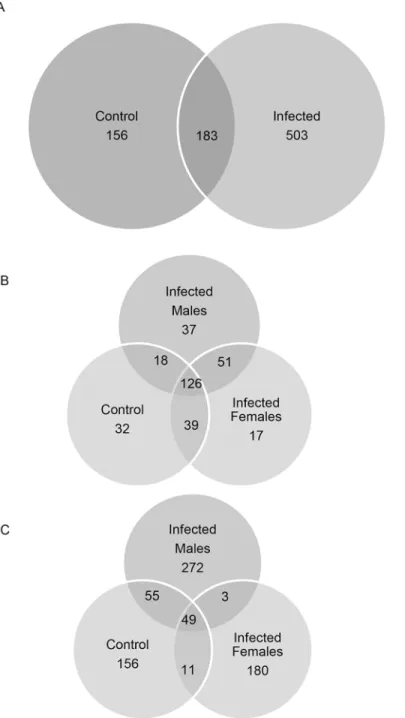
SDS-PAGE and mass-spectrometry. We found that the infected rat urine shows an overwhelm-ing increase in both quality and quantity of the protein content, as shown in Panel A ofFig. 1
Fig 1. Panel A: Venn diagram summarizing the total urine proteomics data.A total of 842 proteins were identified by LC/MS-MS of the rat urines. TheLeptospira-infected and uninfected control rat urine samples were used for generating this 2-way split between control rats and infected rats. Panel B: Venn diagram summarizing the total urine proteomics data. TheLeptospira-infected male, female and uninfected control rat urine samples were used for generating this 3-way split among control rats, infected male and infected female rats. Panel C: Venn diagram summarizing the urine exosome proteomics data. A total of 204 proteins were identified by LC/MS-MS of the rat urine exosome proteins resolved by 1-d gel electrophoresis and trypsinization of the gel slices.
Copenhageni respectively, as compared to 156 proteins unique to the uninfected rat urines. These differences in the composition and quantity of proteins from infected and uninfected rats potentially indicates the reactions induced in these animals by leptospiral infection. The identity of each of these proteins is as given inS1 Table.
Urine exosomes from Leptospira-colonized rats show different protein
constitution compared to uninfected control rats
Given that the urine exosomes reflect intracellular milieu of all types of various cells lining the nephron in kidney, and emerging evidence from literature that kidney functional alterations are induced due to leptospiral infection, we next focused on exosomes. We found that a total of 204 exosome proteins were identified classifiable into 7 different groups as noted inS2a-S2g Table
and summarized in the Venn diagram (Panel C,Fig. 1). The exosome protein constitution also showed increase in the number of proteins expressed in the exosome, viz 32 proteins uniquely present in the uninfected exosome versus 57 unique proteins in the infected rat exosome.
We further conducted the multivariate partial least squares-discriminant analysis (PLS-DA) on these proteins. The analysis depicted inFig. 2shows clear separation between uninfected and infected rat urine exosome protein content, suggesting the differences between uninfected and infected rats.
Sex-specific alteration of the rat urine exosome protein content in
relation to leptospiral colonization
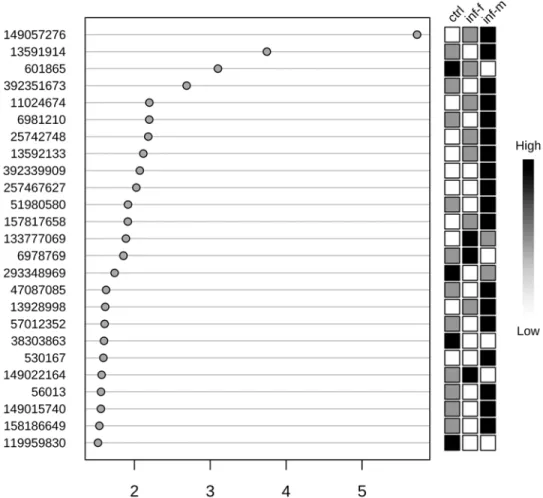
Urinary exosome proteins in male vs. female infected rat urine were different as determined by PLS-discriminant analysis (Fig. 3). Moreover, the infected male rat urine exosome contents were far more different from those of uninfected rats compared to the infected female rat urine exosome contents. The VIP (VariableImportance inProjection) score of 25 proteins was
higher than 1.5 (Fig. 4andTable 1). Qualitatively, a total of 57 proteins were present among all the infected rats. Of these, only 3 were shared between infected males and females, while 37 were unique to infected males and 17 were unique to infected females. Further, we conducted separate analyses of proteins between proteins of proteins of male infected and female infected rats.Table 2depicts male infected versus control rat urine exosome analysis. Accordingly, 11 proteins were significantly altered (p<0.05).Table 3depicts female infected versus control rat urine exoosme analysis, according to which the number of significantly dysregulated proteins was 9. In the male infected rat urine exosome, the alanyl (membrane) aminopeptidase upregu-lation not only reached the highest level of significance (p= 0.00019) but also had the lower FDR (3.22%). In the female infected rat however, although this upregulation was significant compared to the uninfected rat, the FDR did not reach the cutoff of<10% (14.37%). Thus both qualitatively and quantitatively, the protein content of exosomes showed gender specificity in infected rats.
Of interest, the top discriminator between control and infected rats, namely alanyl amino-peptidase of the membrane origin,is also known asaminopeptidaseneutral (APN) or CD13 [25,26]. Furthermore, CD13 also shows different levels of dysregulation between infected male and infected female rats (Table 1).
The urinary exosome membrane alanyl aminopeptidase or CD13 is a
marker of infection
one protein had an FDR of<10%, namely alanyl (membrane) aminopeptidase, also known as CD13. By both multivariate analysis of PLS-DA (Fig. 4) and univariate ANOVA, CD13 is sig-nificantly upregulated in the infected rat urine exosome. When the analysis was conducted without gender specificity (Table 4), only CD13 showed an FDR of<10% among these 11 dys-regulated proteins. Taking into account gender specificity (Table 2) CD13 was not only signifi-cantly upregulated, but also had an FDR of<10%. However, in females, this protein was only significantly upregulated but did not reach the FDR cutoff (Table 3).
The VIP scores of proteins identified in the rat urine exosomes shows CD13 to be a top dis-criminant between infected and uninfected rat urine exosome (Table 1). Twenty-five proteins had a VIP score of>1.5, fulfilling criteria to classify a protein as a reliable discriminant. Our analysis shows that this value 5.72 for CD13.
Fig 2. Two-dimensional (2D) partial least squares discriminant analysis separation using protein peptide count concentration-based proteomic measurements in the urine exosome of rats infected withLeptospiravs control rats withoutLeptospirainfection (n = 3).Clear separation of rat urine exosome proteins for control versus infected is observed, signified by the lack of overlap between the two groups of exosome proteins.
Further, Western immunoblotting of the protein showed that the exosome content of CD13 closely tracked the proteomic data, with a slight increase in the infected female urine exosome, and robust increase in the infected male urine exosome (Fig. 5a). The observed difference was significant (Fig. 5b).
Tamm-Horsfall Protein is significantly decreased in the infected rat urine
Given the tubular location of CD13, we tested the hypothesis that other proteins reflecting the tubular function may be affected in response to leptospiral infection. We chose to study the most abundant protein in the normal urine, namely the Tamm-Horsfall Protein (THP). West-ern immunoblotting of THP in urine of infected and uninfected rats showed robust THP
Fig 3. Two-dimensional (2D) partial least squares discriminant analysis separation using peptide count concentration-based proteomic measurements in the urine exosome of the rats infected withLeptospiravs control rats withoutLeptospirainfection (n = 3).Although clear separation between control and infected rat urine exosomes is seen, a fraction of overlap between the infected male and infected female rat urine exosome proteins is observed.
expression in the uninfected rats and significantly lower THP in infected male and female rats, supporting this hypothesis (Fig. 6).
Discussion
This proteomic analysis of urinary exosomes in a rat leptospiral colonization model identified important biomarkers of infection, including differentially regulated alanine (membrane) ami-nopeptidase (CD13) and Tamm Horsfall Protein. Further, there were important sex differences of these biomarkers of leptospiral renal tubular colonization, which is particularly provocative given the male predominance of symptomatic and severe leptospirosis universally found in human clinical studies.
In addition, this study has several other important findings. First, to our knowledge this is the first report on urinary exosome protein analysis in an animal model of leptospiral renal col-onization. Second, the overwhelming increase in protein expression quality and quantity
indicates a specific consequence of leptospiral infection of the organ of leptospiral transmission and provides an important rationale for pursuing such studies in humans that will allow for further understanding of the clinical and biological consequences of chronic renal colonization. Finally, although renal tubular involvement in leptospiral infection has been well-documented, this study is the first to report increased CD13 and decreased Tamm-Horsfall Protein in
Table 1. Top discriminators between control, infected male & infected female rat urine exosome proteins.
GI # VIP score Protein Identification Serial #
149057276 5.7252 alanyl (membrane) aminopeptidase VIP1
13591914 3.7462 aminopeptidase N precursor VIP2
601865 3.1009 aminopeptidase M VIP3
392351673 2.6881 PREDICTED: LOW QUALITY PROTEIN: uncharacterized protein LOC287750 VIP4
11024674 2.1973 Na(+)/H(+) exchange regulatory cofactor NHE-RF1 VIP5
6981210 2.1961 Neprilysin VIP6
25742748 2.1827 glutamate—cysteine ligase catalytic subunit VIP7
13592133 2.1177 actin, cytoplasmic 1 VIP8
392339909 2.0721 PREDICTED: uncharacterized protein LOC679818 VIP9
257467627 2.0255 Fc fragment of IgG binding protein-like precursor VIP10
51980580 1.9156 Meprin 1 beta VIP11
157817658 1.9135 villin-1 VIP12
133777069 1.8884 Serine (or cysteine) peptidase inhibitor, clade A, member 3K VIP13
6978769 1.8561 deoxyribonuclease-1 precursor VIP14
293348969 1.7392 PREDICTED: keratin, type II cytoskeletal 6A-like VIP15
47087085 1.6273 keratin, type I cytoskeletal 17 VIP16
13928998 1.6155 Na(+)/H(+) exchange regulatory cofactor NHE-RF3 VIP17
57012352 1.6082 keratin, type II cytoskeletal 75 VIP18
38303863 1.5999 Egf protein VIP19
530167 1.5913 ventral prostate-specific protein VIP20
149022164 1.5687 rCG26871, isoform CRA_c VIP21
56013 1.5602 CRP2 VIP22
149015740 1.5588 rCG39189, isoform CRA_b VIP23
158186649 1.5384 alpha-enolase VIP24
119959830 1.5203 beta-actin VIP25
doi:10.1371/journal.pntd.0003640.t001
Table 2. Male infected versus Control.
sl # gi # p.value FDR % FDR protein identity
1 149057276 0.00019 0.032231 3.2231 alanyl (membrane) aminopeptidase
2 13592133 0.000636 0.053409 5.3409 actin, cytoplasmic 1
3 133777069 0.000943 0.053409 5.3409 Serine (or cysteine) peptidase inhibitor, clade A, member 3K
4 32563565 0.024998 0.60267 60.267 Serine protease inhibitor
5 392339909 0.025984 0.60267 60.267 PREDICTED: uncharacterized protein LOC679818
6 257467627 0.027061 0.60267 60.267 Fc fragment of IgG binding protein-like precursor
7 149028871 0.029327 0.60267 60.267 annexin A2, isoform CRA_b
8 89573967 0.031305 0.60267 60.267 isocitrate dehydrogenase 1
9 10198602 0.032149 0.60267 60.267 collectrin precursor
10 392354923 0.037988 0.60267 60.267 PREDICTED: glyceraldehyde-3-phosphate dehydrogenase-like
11 149061924 0.041715 0.60267 60.267 rCG48611, isoform CRA_c
infection. Although apparently intuitive and in agreement with the published literature in re-gard to renal tubular involvement in leptospirosis infection, the biological and clinical signifi-cance of these findings remains to be determined further.
Leptospirosis is a globally important tropical infectious disease that takes a disproportionate toll in tropical regions [1]. Important gaps remain in translating the know how to reduce the burden of this infectious disease and its pathogenic mechanisms remain poorly understood [4].
Multiple hypothesis-driven studies as well as unbiased approaches have previously focused on unraveling leptospirosis mechanisms [5,6,27,28] [29–31] have considerably advanced our knowledge of the involvement of renal [32–39], pulmonary hemorrhage [40,41] or cardiovas-cular system components [42] in leptospirosis. However, the host renal functional changes due toLeptospirainfection are yet to be completely characterized. Given the renal failure rates [29,40,43–48] following leptospirosis, exploring these renal consequences is clinically impor-tant. In this study, we found that the infected rat urine shows an overwhelming increase in both quality and quantity of the protein content compared to the uninfected rat urine protein both at the total urine as well as the exosome level.
Importantly, urine exosome CD13 upregulation due to leptospiral infection is robust and consistent, in both male and female rats. Previous work has demonstrated expression of CD13/ APN on intestinal and kidney epithelial cell brush border [25,49–52]. CD13 is an ectoenzyme with a multitude of functions:(a). enzymatic cleavage of various peptides such as enkephalins, angiotensins or cytokines [53,54] and their biologic process regulation [55];(b). marker of
Table 3. Female infected versus Control.
sl # gi # p.value FDR % FDR protein identity
1 58865770 0.0001 0.00983 0.9837 solute carrier family 7 member 13
2 13592133 0.010362 0.1437 14.37 actin, cytoplasmic 1
3 149057276 0.010425 0.1437 14.37 alanyl (membrane) aminopeptidase
4 57012358 0.010506 0.1437 14.37 keratin, type II cytoskeletal 73
5 11024674 0.010675 0.1437 14.37 Na(+)/H(+) exchange regulatory cofactor NHE-RF1
6 57231 0.010759 0.1437 14.37 unnamed protein product
7 119959830 0.01163 0.1437 14.37 beta-actin
8 25742748 0.01173 0.1437 14.37 glutamate—cysteine ligase catalytic subunit
9 347800746 0.049478 0.34739 34.739 serine protease inhibitor A3K precursor
Proteins significantly dysregulated between exosomes from urines of control and female infected rats. doi:10.1371/journal.pntd.0003640.t003
Table 4. Proteins significantly dysregulated between exosomes from urines of control rats and infected rats.
sl # gi # p.value FDR % FDR protein identity
1 149057276 3.76E-06 0.00076 0.0767 alanyl (membrane) aminopeptidase
2 601865 0.010627 0.55605 55.605 aminopeptidase M
3 20806135 0.012682 0.55605 55.605 galectin-3-binding protein precursor
4 133777069 0.01489 0.55605 55.605 Serine (or cysteine) peptidase inhibitor, clade A, member 3K
5 119959830 0.023672 0.55605 55.605 beta-actin
6 57012358 0.037372 0.55605 55.605 keratin, type II cytoskeletal 73
7 392339909 0.038201 0.55605 55.605 PREDICTED: uncharacterized protein LOC679818
8 257467627 0.039191 0.55605 55.605 Fc fragment of IgG binding protein-like precursor
9 149028871 0.041253 0.55605 55.605 annexin A2, isoform CRA_b
10 89573967 0.043033 0.55605 55.605 isocitrate dehydrogenase 1
11 347800746 0.048623 0.55605 55.605 serine protease inhibitor A3K precursor
differentiation for multiple types of immune cells [56,57] and stem cells [58];(c). various
cellu-lar processes such as proliferation [59] and apoptosis [60], motility [61], chemotaxis [62];(d). critical role in immunogenic, inflammatory and infection pathways such as antigen processing [63,64] and presentation [65], and phagocytosis in defense against pathogens [66], viral recep-tor on the host cell surface and the subsequent endocytosis of viruses into cell interior [67–71].
Soluble CD13/APN that circulates in the serum is repeatedly reported to be upregulated at in-flammation sites [55,72]. Since CD13 represents a cellular potential for activation or inactiva-tion of inflammatory peptides, modulainactiva-tion of its expression by different agents and stimuli may affect inflammatory and immunologic responses [64,73] and antigen processing [63–65].
Recent evidence [56] shows that CD13 is a multifunctional enzyme with at least 3 different types of activities: (a) peptide cleavage, (b) endocytosis, and (c) signaling. In light of our proteo-mic data which shows robust and reproducible CD13 upregulation in response to leptospirosis infection, it is possible that either one or all three of these CD13 functionalities are employed. Future studies should further delineate how much or if these functions play a role in mediating specific components of host response to leptospirosis infection. This multifunctional property notwithstanding, so far, CD13/APN activity or its upregulation has not been described
Fig 5. A. Immunoblotting of rat urine exosome for CD13 protein.Lanes 1–3: control; lanes 4–6: lepto infected female; lanes 7–9: infected male. B. Quantification of CD13 from immunoblots in A (control, n = 3; infected, n = 6). Data are means±SEM. p<0.05 rat urine exosome CD13Leptospira- infected versus uninfected control.
specifically in the context ofLeptospirainfection. Nevertheless, relevant to our current findings, a role for the upregulation of APN expression and activity in the membrane is conceivable, and the following features / properties lend this multifunctional enzyme to potentially play a role in
Leptospirainfection/invasion: the viral receptor function of APN [52,69,74] either requires or results in its internalization [55,71]. Previously, the APN/CD13 molecule has been shown to be the predominant component of the detergent-resistant membrane (DRM) microdomains, also called lipid rafts [71]. CD13/APN is shown to play a critical role in appropriate membrane re-organization and protein distribution after a major reshuffling event [75], and is itself is shown to be localized in lipid rafts of the cell membranes [76,77] and endocytosed through physiologi-cal sorting mechanisms [57]. At the time of these reports, the concept of exosomes was not as well-established as it is now. The course taken by regular physiologic endocytosis during inter-nalization of specific viruses [69], the role of CD13/APN as the cellular receptor to facilitate this internalization [70] and its critical dependency on the early edosome-formation [71] and subsequent intracellular sub-plasma membrane molecular events bear close resemblance to the formation of exosomes in the renal tubular epithelial cell and their release into urine, the extra-cellular milieu modeled by the Knepper group [78]. Our proteomic data shows that APN is the most consistently and significantly upregulated protein molecule on the urine exosome of the infected rat. Renal tubular brush border involvement in leptospirosis infection has been well es-tablished in animal models showing leptospiral antigen expression in parallel to kidney changes both by light microscopy and electron microscopy examination [79,80]. Further rein-forcement of this view comes from the recent evidence that during phagocytosis, CD13
Fig 6. A. Immunoblotting of rat urines for Tamm-Horsfall Protein (THP).Left panel Lanes (1–3): Control Uninfected Rat urines; Right panel Lanes (1–6):Leptospira-Infected Rat urines. B. Quantification of THP from immunoblots in A (control, n = 3; infected, n = 6). Data are means±SEM. p<0.05 rat urine THP,
redistribution to phagosome and further internalization increases the efficiency of the process of phagocytosis.
In view of these previous observations and our proteomic data, mechanistically, it is plausi-ble that the host immune system is activated by leptospiral antigens presented to the host im-mune system. APN located on the plasma membrane of the renal tubular epithelium brush border would be upregulated due toLeptospirainfection; Though its exact mechanism and its details remain to be elucidated, taken together with the literature our data suggest that APN re-lease from brush border via exosomes in infectious condition, may have been part of the host immune response to leptospiral infection, since it is well-established that exosomes are generat-ed from membranes via endocytic mechanisms [81] and further, that under stress, the exosome cargo changes qualitatively [12,13]. However, if leptospiral infection directly causes increased APN packaging into exosome and its subsequent release needs to be addressed in future. It is plausible that due to the stress of leptospiral infection, renal tubular epithelium mediated exo-some packaging is qualitatively altered to include APN. We also found that female rats’ re-sponse toLeptospirainfection is markedly different from that of the male rat. This has important implications and is relevant from the viewpoint of our finding that among asymp-tomatic human carriers ofLeptospira, male and female subjects show different phenotypes [10]. However see below, details on the limitations of using or extrapolating the chronic rodent model to an acute infection or a different species such as humans.
The proteomic data also suggested that the renal functions mapping to tubular epithelium may be affected in theLeptospirainfection. Therefore we tested the hypothesis that the expres-sion of the most abundant protein in the normal healthy urine, Tamm-Horsfall Protein (THP) that is exclusively synthesized in renal tubules should be affected inLeptospirainfected rats. THP (also called uromodulin) is secreted by the epithelium of thick ascending loop of Henle and the early portion of the distal tubules [82]. One of the phenotypes that a THP knockout mouse model develops is the increased susceptibility to urinary tract infection caused by bacte-ria [83,84]. THP is a glycosylphosphatidylinositol anchored glycoprotein released from epithe-lial apical membranes (approximately 120 kDa.) into the tubule fluid by membrane associated phospholipase C [85,86]. Free (urinary) THP has a monomeric weight of approximately 85 kDa with 30% carbohydrate. Our data (Fig. 6) shows that THP expression is reduced in all infected rats. Taken together with the previous work, our data strongly indicate that the tubular epithelial component responsible for THP-synthesis and expression is severely compromised in leptospirosis.
may have had higher VIP scores by increasing the number of animals. This potentially would have increased our knowledge of what other novel pathways are selected/employed by either leptospires or the host. Finally, we used 1d gel electrophoresis to resolve the exosome proteins prior to LC/MS-MS analysis that resulted in identification of 204 proteins overall. If we had conducted direct exosome protein trypsinization instead of following this method, perhaps the number of identified proteins might have increased. In our experience, exosomes are packaged with non-full length peptides as well, and may have confounded the analysis. By following the gel electrophoresis method, we ensured that we only compare full length protein differences between animals.
In summary, we have characterized host response to leptospiral infection at proteome levels of whole urine and exosomes. Urine is perhaps the most frequently studied biological fluid for exo-some proteomics and also one of the most promising biomarker source. Work from the Knepper group shows that many important renal proteins (e.g. aquaporins, polycystins and podocyn) are shed in the urine exosome [87,88]. Our current report adds APN to this group of functionally im-portant renal proteins to be identified in urine exosomes. Our findings suggest that the host re-sponse toLeptospirainfection is gender-specific, and involves renal tubular elements. This report potentially forms the preliminary level basis for our overarching hypothesis that changes in the kidney function as a result of an external insult can be determined using urine exosome analyses.
Conclusions and future directions
Many conclusions can be drawn from this study:
1. Although the general quantity of proteins in total urine and exosome component show a similar trend, qualitatively the proteins are different based on identifications, the GI num-bers and hence the pathways they belong to.
2. Utility of exosome Analysis in characterizing a complex biochemical phenomenon such as the host-response to leptospirosis infection is very high, and has many implications:
a. Public health interest: given that nephron-cell specific cargo that urine exosome carries, pri-marily the pathway employed or dysregulated for infecting the host to bring about the infec-tion phenotype, and secondly, the response that is unique to each host studied potentially opens up the possibilities of disease-specific and severity-specific treatment to leptospirosis. b. Non-invasive: it would be ideal to biopsy every infected individual to understand the
var-ious facets of leptospirosis infection in order that our knowledge aboutLeptospira in-creases. However, it is neither practical nor ethical, given the invasive nature. Urine exosome analyses is non-invasive, highly specific and provides a window into the organ level structural or functional changes. If implemented quickly enough in a translational research setting, this specificity potentially imparts ability to move the field towards personalized medicine.
Supporting Information
S1 Text. Extended legends and references.
(DOCX)
S1 Fig. Infected tubule male rat kidney section stain.
(TIF)
S2 Fig. Infected tubule female rat kidney section stain.
(TIF)
S3 Fig. Quantitative real time PCR (qPCR) analysis.All urine samples collected were screened for the presence of pathogenic and intermediate-pathogenic Leptospira using a pub-lished qPCR TaqMan assay targeting the leptospiral 16S ribosomal gene (1); this assay has been reported in our previous work. Briefly, this was performed using an Opticon 2 real-time PCR machine (MJ Research, USA). The assay protocol was modified from the published ver-sion (2) by using the fluorescent probe at a final concentration of 0.2 mM, primers at a final concentration of 0.5 mM, and a 20 mL reaction volume (3). Standard curves for quantification were made usingLeptospira interrogansserovar Copenhageni strain M20. Standards were pre-pared as follows. Leptospires were counted using a Petroff-Hauser counting chamber (Hauser Scientific, USA) and serially diluted with sterile double-distilled H2O to 108 to 100 leptospires/ ml. Genomic DNA was subsequently prepared using the DNeasy Tissue Kit (Qiagen, USA). Standards were run in triplicate to generate a standard curve with each run. A negative result was assigned where no amplification occurred before 40 cycles. Controls lacking template were extracted and added to qPCR master mix to detect the presence of contaminating DNA. The raw data is shown inS3 Table.
(TIF)
S4 Fig. Clustering with Ward method.the PCA dendrogram cluster with Ward method was performed as summarized in S4 Fig. All female samples cluster together, and all male samples cluster together indicating the difference between the sexes. While the infected females cluster together at one end of the spectrum followed by control female rat exosomes, one of the control males and one of the infected males cluster differently. This may be due to the outbred nature of the rats wherein the level of infection could be different between animals. This condition is reflected in clinical human infection.
(TIF)
S1 Table. a: 126 proteins commonly present in urine of uninfected, infected male and in-fected female rats.b: 156 Proteins Unique to Control rat urine but absent in infected rat urine. c: 272 Proteins unique to infected male rat urine but absent in control animals and infected fe-male rat samples.
(DOCX)
S2 Table. a: Proteins commonly present in urinary exosomes uninfected, infected male and infected female rats.b: Proteins unique to control rat urine exosomes, but absent in infected rat urine exosomes. C: Proteins unique to Infected male rat urine exosomes, but absent in con-trol animals and infected female rat samples.
(DOCX)
S3 Table. Raw data ofLeptospiraqPCR of rat urine.
Acknowledgments
The authors gratefully acknowledge the technical assistance of Sarah Leonhardt for silver stain-ing of infected rat kidney slides.
This paper is dedicated to the memory of Fabrizio Basilico, who prematurely died last year after performing the proteomics experiments, the data from which are included in this manu-script: Fabrizio was a good friend and a great colleague with high scientific integrity and an indomitable spirit.
Author Contributions
Conceived and designed the experiments: SPR MAM JMV PM. Performed the experiments: SPR MAM CKM EA CP CK MI AM JH RK AB FB ADP AMA LA PM. Analyzed the data: SPR MAM RKN JMV PM. Contributed reagents/materials/analysis tools: SPR FB PM. Wrote the paper: SPR MAM JMV PM.
References
1. Bharti AR, Nally JE, Ricaldi JN, Matthias MA, Diaz MM, et al. (2003) Leptospirosis: a zoonotic disease of global importance. Lancet Infect Dis 3: 757–771. PMID:14652202
2. Pappas G, Papadimitriou P, Siozopoulou V, Christou L, Akritidis N (2008) The globalization of leptospi-rosis: worldwide incidence trends. Int J Infect Dis 12: 351–357. PMID:18055245
3. Adler B, de la Pena Moctezuma A (2010)Leptospiraand leptospirosis. Vet Microbiol 140: 287–296. doi:10.1016/j.vetmic.2009.03.012PMID:19345023
4. Ko AI, Goarant C, Picardeau M (2009)Leptospira: the dawn of the molecular genetics era for an emerg-ing zoonotic pathogen. Nat Rev Microbiol 7: 736–747. doi:10.1038/nrmicro2208PMID:19756012
5. Monahan AM, Callanan JJ, Nally JE (2008) Proteomic analysis ofLeptospirainterrogans shed in urine of chronically infected hosts. Infect Immun 76: 4952–4958. doi:10.1128/IAI.00511-08PMID: 18765721
6. Nally JE, Monahan AM, Miller IS, Bonilla-Santiago R, Souda P, et al. (2011) Comparative proteomic analysis of differentially expressed proteins in the urine of reservoir hosts of leptospirosis. PLoS One 6: e26046. doi:10.1371/journal.pone.0026046PMID:22043303
7. Ko AI, Goarant C, Picardeau M (2009)Leptospira: the dawn of the molecular genetics era for an emerg-ing zoonotic pathogen. Nature reviews Microbiology 7: 736–747. doi:10.1038/nrmicro2208PMID: 19756012
8. Chassin C, Picardeau M, Goujon JM, Bourhy P, Quellard N, et al. (2009) TLR4- and TLR2-mediated B cell responses control the clearance of the bacterial pathogen,Leptospirainterrogans. Journal of immu-nology 183: 2669–2677. doi:10.4049/jimmunol.0900506PMID:19635914
9. Murray GL, Morel V, Cerqueira GM, Croda J, Srikram A, et al. (2009) Genome-wide transposon muta-genesis in pathogenicLeptospiraspecies. Infect Immun 77: 810–816. doi:10.1128/IAI.01293-08 PMID:19047402
10. Ganoza CA, Matthias MA, Saito M, Cespedes M, Gotuzzo E, et al. (2010) Asymptomatic renal coloniza-tion of humans in the peruvian Amazon byLeptospira. PLoS Negl Trop Dis 4: e612. doi:10.1371/ journal.pntd.0000612PMID:20186328
11. Looze C, Yui D, Leung L, Ingham M, Kaler M, et al. (2009) Proteomic profiling of human plasma exo-somes identifies PPARgamma as an exosome-associated protein. Biochem Biophys Res Commun 378: 433–438. doi:10.1016/j.bbrc.2008.11.050PMID:19028452
12. Conde-Vancells J, Rodriguez-Suarez E, Embade N, Gil D, Matthiesen R, et al. (2008) Characterization and comprehensive proteome profiling of exosomes secreted by hepatocytes. J Proteome Res 7: 5157–5166. PMID:19367702
13. Lancaster GI, Febbraio MA (2005) Exosome-dependent trafficking of HSP70: a novel secretory path-way for cellular stress proteins. J Biol Chem 280: 23349–23355. PMID:15826944
14. Lancaster GI, Febbraio MA (2005) Mechanisms of stress-induced cellular HSP72 release: implications for exercise-induced increases in extracellular HSP72. Exerc Immunol Rev 11: 46–52. PMID: 16385843
15. Levett PN (2001) Leptospirosis. Clin Microbiol Rev 14: 296–326. PMID:11292640
17. Shevchenko A, Wilm M, Vorm O, Mann M (1996) Mass spectrometric sequencing of proteins silver-stained polyacrylamide gels. Anal Chem 68: 850–858. PMID:8779443
18. Brambilla F, Lavatelli F, Di Silvestre D, Valentini V, Palladini G, et al. (2013) Shotgun protein profile of human adipose tissue and its changes in relation to systemic amyloidoses. J Proteome Res 12: 5642–5655. doi:10.1021/pr400583hPMID:24083510
19. Mauri P, Deho G (2008) A proteomic approach to the analysis of RNA degradosome composition in Escherichia coli. Methods in enzymology 447: 99–117. doi:10.1016/S0076-6879(08)02206-4PMID: 19161840
20. Paoletti AC, Parmely TJ, Tomomori-Sato C, Sato S, Zhu D, et al. (2006) Quantitative proteomic analy-sis of distinct mammalian Mediator complexes using normalized spectral abundance factors. Proc Natl Acad Sci U S A 103: 18928–18933. PMID:17138671
21. Xia J, Mandal R, Sinelnikov IV, Broadhurst D, Wishart DS (2012) MetaboAnalyst 2.0—a comprehen-sive server for metabolomic data analysis. Nucleic Acids Res 40: W127–133. doi:10.1093/nar/gks374 PMID:22553367
22. Xia J, Psychogios N, Young N, Wishart DS (2009) MetaboAnalyst: a web server for metabolomic data analysis and interpretation. Nucleic acids research 37: W652–660. doi:10.1093/nar/gkp356PMID: 19429898
23. Ramachandra Rao SP, Wassell R, Shaw MA, Sharma K (2007) Profiling of human mesangial cell sub-proteomes reveals a role for calmodulin in glucose uptake. Am J Physiol Renal Physiol 292:
F1182–1189. PMID:17200159
24. RamachandraRao SP, Zhu Y, Ravasi T, McGowan TA, Toh I, et al. (2009) Pirfenidone is renoprotective in diabetic kidney disease. J Am Soc Nephrol 20: 1765–1775. doi:10.1681/ASN.2008090931PMID: 19578007
25. Riemann D, Kehlen A, Langner J (1995) Stimulation of the expression and the enzyme activity of ami-nopeptidase N/CD13 and dipeptidylpeptidase IV/CD26 on human renal cell carcinoma cells and renal tubular epithelial cells by T cell-derived cytokines, such as IL-4 and IL-13. Clin Exp Immunol 100: 277–283. PMID:7743667
26. Look AT, Ashmun RA, Shapiro LH, Peiper SC (1989) Human myeloid plasma membrane glycoprotein CD13 (gp150) is identical to aminopeptidase N. J Clin Invest 83: 1299–1307. PMID:2564851
27. Natarajaseenivasan K, Shanmughapriya S, Velineni S, Artiushin SC, Timoney JF (2011) Cloning, ex-pression, and homology modeling of GroEL protein fromLeptospirainterrogans serovar autumnalis strain N2. Genomics Proteomics Bioinformatics 9: 151–157. doi:10.1016/S1672-0229(11)60018-1 PMID:22196358
28. Vedhagiri K, Natarajaseenivasan K, Chellapandi P, Prabhakaran SG, Selvin J, et al. (2009) Evolution-ary implication of outer membrane lipoprotein-encoding genes ompL1, UpL32 and lipL41 of pathogenic Leptospiraspecies. Genomics Proteomics Bioinformatics 7: 96–106. doi:10.1016/S1672-0229(08) 60038-8PMID:19944382
29. Fanton d'Andon M, Quellard N, Fernandez B, Ratet G, Lacroix-Lamande S, et al. (2014)Leptospira Interrogans induces fibrosis in the mouse kidney through Inos-dependent, TLR- and NLR-independent signaling pathways. PLoS Negl Trop Dis 8: e2664. doi:10.1371/journal.pntd.0002664PMID: 24498450
30. Martinez SA, Hostutler RA (2014) Distal renal tubular acidosis associated with concurrent leptospirosis in a dog. J Am Anim Hosp Assoc 50: 203–208. doi:10.5326/JAAHA-MS-5993PMID:24659721
31. Cesar KR, Romero EC, de Braganca AC, Blanco RM, Abreu PA, et al. (2012) Renal involvement in lep-tospirosis: the effect of glycolipoprotein on renal water absorption. PLoS One 7: e37625. doi:10.1371/ journal.pone.0037625PMID:22701573
32. Araujo ER, Seguro AC, Spichler A, Magaldi AJ, Volpini RA, et al. (2010) Acute kidney injury in human leptospirosis: an immunohistochemical study with pathophysiological correlation. Virchows Arch 456: 367–375. doi:10.1007/s00428-010-0894-8PMID:20217429
33. Barrett-Connor E, Child CM, Carter MJ (1970) Renal failure in leptospirosis. Southern medical journal 63: 580–583. PMID:5446827
34. Hostutler RA, DiBartola SP, Eaton KA (2004) Transient proximal renal tubular acidosis and Fanconi syndrome in a dog. J Am Vet Med Assoc 224: 1611–1614, 1605. PMID:15154730
35. Khositseth S, Sudjaritjan N, Tananchai P, Ong-ajyuth S, Sitprija V, et al. (2008) Renal magnesium wast-ing and tubular dysfunction in leptospirosis. Nephrol Dial Transplant 23: 952–958. PMID:17951309
36. Kuo HL, Lin CL, Huang CC (2003) Reversible thick ascending limb dysfunction and aseptic meningitis syndrome: early manifestation in two leptospirosis patients. Ren Fail 25: 639–646. PMID:12911169
38. Yang CW, Pan MJ, Wu MS, Chen YM, Tsen YT, et al. (1997) Leptospirosis: an ignored cause of acute renal failure in Taiwan. Am J Kidney Dis 30: 840–845. PMID:9398130
39. Yang CW, Wu MS, Pan MJ (2001) Leptospirosis renal disease. Nephrol Dial Transplant 16 Suppl 5: 73–77. PMID:11509689
40. Monahan AM, Callanan JJ, Nally JE (2009) Review paper: Host-pathogen interactions in the kidney during chronic leptospirosis. Vet Pathol 46: 792–799. doi:10.1354/vp.08-VP-0265-N-REVPMID: 19429975
41. Marotto PC, Ko AI, Murta-Nascimento C, Seguro AC, Prado RR, et al. (2010) Early identification of lep-tospirosis-associated pulmonary hemorrhage syndrome by use of a validated prediction model. J Infect 60: 218–223. doi:10.1016/j.jinf.2009.12.005PMID:20026189
42. Chakurkar G, Vaideeswar P, Pandit SP, Divate SA (2008) Cardiovascular lesions in leptospirosis: an autopsy study. J Infect 56: 197–203. doi:10.1016/j.jinf.2007.12.007PMID:18262280
43. Daher Ede F, Junior Silva GB, Vieira AP, Souza JB, Falcao Fdos S, et al. (2014) Acute kidney injury in a tropical country: a cohort study of 253 patients in an infectious diseases intensive care unit. Rev Soc Bras Med Trop 47: 86–89. doi:10.1590/0037-8682-0223-2013PMID:24603743
44. Turhan V, Atasoyu EM, Solmazgul E, Evrenkaya R, Cavuslu S (2005) Anicteric leptospirosis and renal involvement. Ren Fail 27: 491–492. PMID:16060140
45. Turhan V, Polat E, Murat Atasoyu E, Ozmen N, Kucukardali Y, et al. (2006) Leptospirosis in Istanbul, Turkey: a wide spectrum in clinical course and complications. Scand J Infect Dis 38: 845–852. PMID: 17008227
46. Atasoyu EM, Turhan V, Unver S, Evrenkaya TR, Yildirim S (2005) A case of leptospirosis presenting with end-stage renal failure. Nephrol Dial Transplant 20: 2290–2292. PMID:16046514
47. Cetin BD, Harmankaya O, Hasman H, Gunduz A, Oktar M, et al. (2004) Acute renal failure: a common manifestation of leptospirosis. Ren Fail 26: 655–661. PMID:15600257
48. Herath NJ, Kularatne SA, Weerakoon KG, Wazil A, Subasinghe N, et al. (2014) Long term outcome of acute kidney injury due to leptospirosis? A longitudinal study in Sri Lanka. BMC Res Notes 7: 398. doi: 10.1186/1756-0500-7-398PMID:24964804
49. Barnes K, Kenny AJ, Turner AJ (1994) Localization of aminopeptidase N and dipeptidyl peptidase IV in pig striatum and in neuronal and glial cell cultures. Eur J Neurosci 6: 531–537. PMID:7912983
50. Semenza G (1986) Anchoring and biosynthesis of stalked brush border membrane proteins: glycosi-dases and peptiglycosi-dases of enterocytes and renal tubuli. Annu Rev Cell Biol 2: 255–313. PMID:3548768
51. Sanderink GJ, Artur Y, Siest G (1988) Human aminopeptidases: a review of the literature. J Clin Chem Clin Biochem 26: 795–807. PMID:3069949
52. Lendeckel U, Wex T, Reinhold D, Kahne T, Frank K, et al. (1996) Induction of the membrane alanyl ami-nopeptidase gene and surface expression in human T-cells by mitogenic activation. Biochem J 319 (Pt 3): 817–821. PMID:8920985
53. Hooper NM (1994) Families of zinc metalloproteases. FEBS Lett 354: 1–6. PMID:7957888
54. Hooper NM, Hesp RJ, Tieku S (1994) Metabolism of aspartame by human and pig intestinal microvillar peptidases. Biochem J 298 Pt 3: 635–639. PMID:8141778
55. Mina-Osorio P (2008) The moonlighting enzyme CD13: old and new functions to target. Trends Mol Med 14: 361–371. doi:10.1016/j.molmed.2008.06.003PMID:18603472
56. Villasenor-Cardoso MI, Frausto-Del-Rio DA, Ortega E (2013) Aminopeptidase N (CD13) is involved in phagocytic processes in human dendritic cells and macrophages. Biomed Res Int 2013: 562984. doi: 10.1155/2013/562984PMID:24063007
57. Ghosh M, McAuliffe B, Subramani J, Basu S, Shapiro LH (2012) CD13 regulates dendritic cell cross-presentation and T cell responses by inhibiting receptor-mediated antigen uptake. J Immunol 188: 5489–5499. doi:10.4049/jimmunol.1103490PMID:22544935
58. Chen L, Gao Z, Zhu J, Rodgers GP (2007) Identification of CD13+CD36+ cells as a common progenitor for erythroid and myeloid lineages in human bone marrow. Exp Hematol 35: 1047–1055. PMID: 17588473
59. Inoi K, Goto S, Nomura S, Isobe K, Nawa A, et al. (1995) Aminopeptidase inhibitor ubenimex (bestatin) inhibits the growth of human choriocarcinoma in nude mice through its direct cytostatic activity. Antican-cer Res 15: 2081–2087. PMID:8572606
61. Chang YW, Chen SC, Cheng EC, Ko YP, Lin YC, et al. (2005) CD13 (aminopeptidase N) can associate with tumor-associated antigen L6 and enhance the motility of human lung cancer cells. Int J Cancer 116: 243–252. PMID:15812828
62. Tani K, Ogushi F, Huang L, Kawano T, Tada H, et al. (2000) CD13/aminopeptidase N, a novel chemoat-tractant for T lymphocytes in pulmonary sarcoidosis. Am J Respir Crit Care Med 161: 1636–1642. PMID:10806168
63. Larsen SL, Pedersen LO, Buus S, Stryhn A (1996) T cell responses affected by aminopeptidase N (CD13)-mediated trimming of major histocompatibility complex class II-bound peptides. J Exp Med 184: 183–189. PMID:8691132
64. Gabrilovac J, Breljak D, Cupic B, Ambriovic-Ristov A (2005) Regulation of aminopeptidase N (EC 3.4.11.2; APN; CD13) by interferon-gamma on the HL-60 cell line. Life Sci 76: 2681–2697. PMID: 15792835
65. Amoscato AA, Prenovitz DA, Lotze MT (1998) Rapid extracellular degradation of synthetic class I pep-tides by human dendritic cells. J Immunol 161: 4023–4032. PMID:9780172
66. Tokuda N, Levy RB (1996) 1,25-dihydroxyvitamin D3 stimulates phagocytosis but suppresses HLA-DR and CD13 antigen expression in human mononuclear phagocytes. Proc Soc Exp Biol Med 211: 244–250. PMID:8633104
67. Soderberg C, Giugni TD, Zaia JA, Larsson S, Wahlberg JM, et al. (1993) CD13 (human aminopeptidase N) mediates human cytomegalovirus infection. J Virol 67: 6576–6585. PMID:8105105
68. Soderberg C, Larsson S, Bergstedt-Lindqvist S, Moller E (1993) Definition of a subset of human periph-eral blood mononuclear cells that are permissive to human cytomegalovirus infection. J Virol 67: 3166–3175. PMID:7684461
69. Yeager CL, Ashmun RA, Williams RK, Cardellichio CB, Shapiro LH, et al. (1992) Human aminopepti-dase N is a receptor for human coronavirus 229E. Nature 357: 420–422. PMID:1350662
70. Hansen GH, Delmas B, Besnardeau L, Vogel LK, Laude H, et al. (1998) The coronavirus transmissible gastroenteritis virus causes infection after receptor-mediated endocytosis and acid-dependent fusion with an intracellular compartment. J Virol 72: 527–534. PMID:9420255
71. Nomura R, Kiyota A, Suzaki E, Kataoka K, Ohe Y, et al. (2004) Human coronavirus 229E binds to CD13 in rafts and enters the cell through caveolae. J Virol 78: 8701–8708. PMID:15280478
72. van Hensbergen Y, Broxterman HJ, Hanemaaijer R, Jorna AS, van Lent NA, et al. (2002) Soluble ami-nopeptidase N/CD13 in malignant and nonmalignant effusions and intratumoral fluid. Clin Cancer Res 8: 3747–3754. PMID:12473585
73. van Hal PT, Hopstaken-Broos JP, Prins A, Favaloro EJ, Huijbens RJ, et al. (1994) Potential indirect anti-inflammatory effects of IL-4. Stimulation of human monocytes, macrophages, and endothelial cells by IL-4 increases aminopeptidase-N activity (CD13; EC 3.4.11.2). J Immunol 153: 2718–2728. PMID: 7915741
74. Delmas B, Gelfi J, L'Haridon R, Vogel LK, Sjostrom H, et al. (1992) Aminopeptidase N is a major recep-tor for the entero-pathogenic coronavirus TGEV. Nature 357: 417–420. PMID:1350661
75. Petrovic N, Schacke W, Gahagan JR, O'Conor CA, Winnicka B, et al. (2007) CD13/APN regulates en-dothelial invasion and filopodia formation. Blood 110: 142–150. PMID:17363739
76. Navarrete Santos A, Roentsch J, Danielsen EM, Langner J, Riemann D (2000) Aminopeptidase N/ CD13 is associated with raft membrane microdomains in monocytes. Biochem Biophys Res Commun 269: 143–148. PMID:10694491
77. Riemann D, Hansen GH, Niels-Christiansen L, Thorsen E, Immerdal L, et al. (2001) Caveolae/lipid rafts in fibroblast-like synoviocytes: ectopeptidase-rich membrane microdomains. Biochem J 354: 47–55. PMID:11171078
78. van Balkom BW, Pisitkun T, Verhaar MC, Knepper MA (2011) Exosomes and the kidney: prospects for diagnosis and therapy of renal diseases. Kidney Int 80: 1138–1145. doi:10.1038/ki.2011.292PMID: 21881557
79. Cheville NF, Huhn R, Cutlip RC (1980) Ultrastructure of renal lesions in pigs with acute leptospirosis caused byLeptospirapomona. Vet Pathol 17: 338–351. PMID:7368526
80. Alves VA, Gayotto LC, Yasuda PH, Wakamatsu A, Kanamura CT, et al. (1991) Leptospiral antigens (L. interrogans serogroup ictero-haemorrhagiae) in the kidney of experimentally infected guinea pigs and their relation to the pathogenesis of the renal injury. Exp Pathol 42: 81–93. PMID:1879516
81. Lasser C, Eldh M, Lotvall J (2012) Isolation and characterization of RNA-containing exosomes. J Vis Exp: e3037. doi:10.3791/3037PMID:22257828
83. Mo L, Zhu XH, Huang HY, Shapiro E, Hasty DL, et al. (2004) Ablation of the Tamm-Horsfall protein gene increases susceptibility of mice to bladder colonization by type 1-fimbriated Escherichia coli. Am J Physiol Renal Physiol 286: F795–802. PMID:14665435
84. Saemann MD, Weichhart T, Horl WH, Zlabinger GJ (2005) Tamm-Horsfall protein: a multilayered de-fence molecule against urinary tract infection. Eur J Clin Invest 35: 227–235. PMID:15816991
85. Cavallone D, Malagolini N, Serafini-Cessi F (2001) Mechanism of release of urinary Tamm-Horsfall gly-coprotein from the kidney GPI-anchored counterpart. Biochem Biophys Res Commun 280: 110–114. PMID:11162486
86. Fukuoka S, Freedman SD, Yu H, Sukhatme VP, Scheele GA (1992) GP-2/THP gene family encodes self-binding glycosylphosphatidylinositol-anchored proteins in apical secretory compartments of pan-creas and kidney. Proc Natl Acad Sci U S A 89: 1189–1193. PMID:1531535
87. Pisitkun T, Shen RF, Knepper MA (2004) Identification and proteomic profiling of exosomes in human urine. Proc Natl Acad Sci U S A 101: 13368–13373. PMID:15326289