○ ○ ○ ○ ○ ○ ○ ○ ○ ○ ○ ○ ABSTRACT○ ○ ○ ○ ○ ○ ○
Shor
t Communication
○ ○ ○ ○ ○ ○ ○ ○ ○ ○ ○ ○ ○ ○ ○ ○ ○ ○ ○ ○ INTRODUCTION
In the State of Rio de Janeiro, more than 1,000 rape cases are brought to the atten-tion of official investigators per year.1 Rape
is the crime of forced sexual intercourse, against the victim’s will. There are many rea-sons why rape victims may not able to iden-tify the perpetrator. On the other hand, in a small number of cases, the victim can iden-tify the offender, but the suspect can easily refute the accusation. In the light of this, analysis of the evidence from crimes of sexual assault can lead to vital information in the process of identifying the assailant.
Techniques for individual identification have now been developed on the basis of DNA analysis, with high discrimination potential and sensitivity.2 DNA typing should therefore
be conducted to identify the offender(s) from among the indicated suspects.
Before applying the human DNA typing methodology, swabs taken from the victim are smeared onto glass slides for sperm cell screen-ing via optical microscopy. The presentation of vaginal smears on glass slides is not a rou-tine procedure for DNA typing purposes in rape cases. Thus, additional swabs should be collected from the victim as the possible source of the suspect’s biological material.3
In spite of this recommendation, we have faced the challenge of obtaining DNA in high quality and enough quantity from cells on vaginal smear slides since 1999, when DNA analysis was employed for the first time in the State of Rio de Janeiro to solve criminal cases.4
Multiplex autosomal short tandem repeats (STRs) at present represent the most popular
approach to forensic DNA analysis. Short tan-dem repeat loci consist of three to seven base pair sequences, repeated in tandem.5They
pro-vide a rich source of polymorphic markers re-sulting from variation in the number of cop-ies of the repeat motif. STRs are usually genotyped via the polymerase chain reaction (PCR), a technique that amplifies DNA by means of a series of thermal cycles. Genotypes may be detected simply by silver staining af-ter gel electrophoresis of the PCR product or via fluorescence technologies.6
In this report, we describe two forensic cases solved at the DNA Diagnostic Labora-tory of Universidade Estadual do Rio de Ja-neiro, using DNA extracted from vaginal smear slides. In order to obtain sufficient quantity of epithelial and sperm cells, we used a methodology that represents an improve-ment on the standard protocols used for DNA extraction from biological material fixed on glass slides.7-9
○ ○ ○ ○ ○ ○ ○ ○ ○ ○ ○ ○ ○ ○ ○ ○ ○ ○ ○ ○ METHODS
Initially, the smear slides were immersed in xylene at 56° C, for 30 minutes, and then in absolute ethanol for five minutes, 70% etha-nol/1 mM Tris HCl pH 7.4 for five minutes, and sterile phosphate buffer saline (2.7 mM
KCl; 137 mM NaCl; 1.5 mM KH2PO4/
Na2HPO4; pH 7.4) for ten minutes.
Follow-ing this, biological material representFollow-ing half of the vaginal smear slide was transferred to a 1.5-ml microcentrifuge tube and centrifuged at 12,000 G, at room temperature, for five minutes. The cell pellet was resuspended in 20µl of phosphate buffer saline.
DNA typing from
vaginal smear slides in
suspected rape cases
DNA Diagnostic Laboratory, Biology Institute, Universidade Estadual
do Rio de Janeiro, Rio de Janeiro, Brazil
In an investigation of suspected rape, proof of sexual assault with penetration is required. In view of this, detailed descriptions of the geni-talia, the thighs and pubic region are made within the forensic medical service. In addi-tion, vaginal swabs are taken from the rape victim and some of the biological material col-lected is then transferred to glass slides. In this report, we describe two rape cases solved using DNA typing from cells recovered from vaginal smear slides.
In 1999, two young women informed the Rio de Janeiro Police Department that they had been victims of sexual assaults. A suspect was arrested and the victims identified him as the offender. The suspect maintained that he was innocent. In order to elucidate these crimes, vaginal smear slides were sent to the DNA Diagnostic Laboratory for DNA analysis three months after the crimes, as unique forensic evidence. To get enough epithelial and sperm cells to perform DNA analysis, we used protocols modified from the previously stand-ard protocols used for DNA extraction from biological material fixed on glass slides. The quantity of cells was sufficient to perform hu-man DNA typing using nine short tandem re-peat (STR) loci. It was 3.3 billion times more probable that it was the examined suspect who had left sperm cells in the victims, rather than any other individual in the population of Rio de Janeiro.
KEY WORDS: DNA Profile. Rape. Forensic sci-ences. Vaginal smears.
• Dayse Aparecida da Silva
• Andréa Carla de Souza Góes
• Jorge José de Carvalho
• Elizeu Fagundes de Carvalho
São Paulo Medical Journal — Revista Paulista de Medicina
71
The isolation of sperm DNA from the mixture of spermatozoa and vaginal epithe-lial cells was based on differential lysis.10The
DNA of the male and female fractions was purified using phenol-chloroform-isoamyl al-cohol (25:24:1) (Life Technologies) and con-centrated by ultra filtration using 100,000 mo-lecular weight cutoff filters (Microcon 100, Amicon). The DNA pellet was resuspended
in 10 µl TE (1 mM TrisHCl, 0.5 mM EDTA).
DNA was extracted from blood and saliva samples by organic extraction methods and ethanol precipitation according to Comey et
al.10 DNA quantification was carried out by
measuring optical densities at 260 nm. 2 ng of template DNA were added to a
25-µl amplification reaction using primers
that were set to nine short tandem repeat loci
(Table 1), which were included in the multi-plex silver-staining systems from Promega
Corporation.11
Electrophoretic analysis of the polymer-ase chain reaction products was performed using a 4% polyacrylamide denaturing gel. Gels underwent electrophoresis for 1.5 hours at constant power (30 W). Following electrophoresis, the analytical gel was
sub-mitted to silver staining.6A data bank for
the population of the State of Rio de Ja-neiro was utilized.12
○ ○ ○ ○ ○ ○ ○ ○ ○ ○ ○ ○ ○ ○ ○ ○ ○ ○ ○ ○ RESULTS
The results for the CSF1PO, TPOX and
TH01loci are shown in Figure 1. It can be
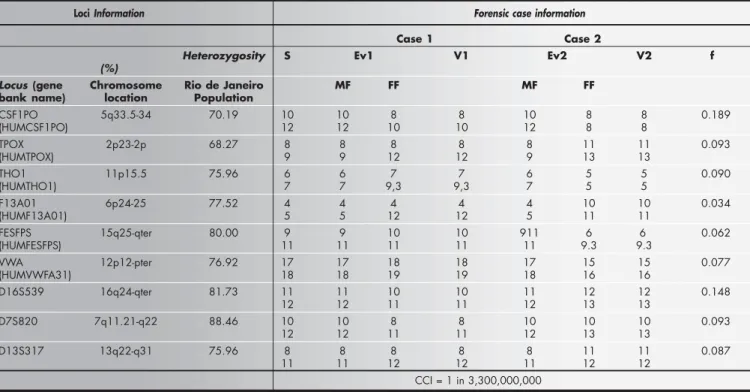
seen that the DNA profiles obtained for the male and female fractions from the vaginal smear slides correspond to those from the sus-pect and victim, ressus-pectively. In addition to the CSF1PO, TPOX and TH01 typed alleles, DNA profiling for the six short tandem
re-peat loci (D16S539, D7S820, D13S317,
F13A01, FESFPS and vWA) and the statis-tics for each case are summarized in Table 1.
The DNA profiles observed for the sper-matic DNA fractions from the vaginal smear slides from both victims were identical, thereby indicating that the rapes were com-mitted by a single person. The spermatozoa DNA profile also matched that of the suspect. With regard to the statistics, on the basis of
DNA analysis for nine STR loci, it was 3.3
billion times more probable that it was the examined suspect who had left sperm cells in the victims, rather than any other individual in the population.
○ ○ ○ ○ ○ ○ ○ ○ ○ ○ ○ ○ ○ ○ ○ ○ ○ ○ ○ ○ DISCUSSION
In the investigation of cases of sexual as-sault, the collection of additional swabs for
Table 1. Features of individual short tandem repeat (STR) loci and forensic case genotype information
LociInformation Forensic case information
Case 1 Case 2
Heterozygosity S Ev1 V1 Ev2 V2 f
(%)
Locus (gene Chromosome Rio de Janeiro MF FF MF FF
bank name) location Population
CSF1PO 5q33.5-34 70.19 10 10 8 8 10 8 8 0.189
(HUMCSF1PO) 12 12 10 10 12 8 8
TPOX 2p23-2p 68.27 8 8 8 8 8 11 11 0.093
(HUMTPOX) 9 9 12 12 9 13 13
THO1 11p15.5 75.96 6 6 7 7 6 5 5 0.090
(HUMTHO1) 7 7 9,3 9,3 7 5 5
F13A01 6p24-25 77.52 4 4 4 4 4 10 10 0.034
(HUMF13A01) 5 5 12 12 5 11 11
FESFPS 15q25-qter 80.00 9 9 10 10 911 6 6 0.062
(HUMFESFPS) 11 11 11 11 11 9.3 9.3
VWA 12p12-pter 76.92 17 17 18 18 17 15 15 0.077
(HUMVWFA31) 18 18 19 19 18 16 16
D16S539 16q24-qter 81.73 11 11 10 10 11 12 12 0.148
12 12 11 11 12 13 13
D7S820 7q11.21-q22 88.46 10 10 8 8 10 10 10 0.093
12 12 11 11 12 13 13
D13S317 13q22-q31 75.96 8 8 8 8 8 11 11 0.087
11 11 12 12 11 12 12
CCI = 1 in 3,300,000,000
S: suspect’s DNA profile for nine STR loci;Ev1 (MF/FF): male and female fraction profiles from vaginal smear slide cells (Ev1: biological evidence from Case 1); V1: victim’s DNA profile for nine STR loci (Case 1); Ev2 (MF/FF):
Male and female profiles from vaginal smear slide cells (Ev2: biological evidence from Case 2); V2: victim’s DNA profile for nine STR loci (Case 2); f: suspect’s genotype frequency; CCI: cumulative concordance index (matching probability): the average number of individuals that would have to be surveyed to find a match among randomly selected individuals. The CCI calculation was done using a Rio de Janeiro population genotype data bank (Universidade Estadual do Rio de Janeiro/DNA Diagnostic Laboratory).
Figure 1. DNA profiling in Case 1. The amplification products for the CTT (CSF1PO, TPOX and TH01) multiplex in polymerase chain reactions carried out using
DNA from the suspect and victim. Male and female
frac-tions from vaginal smear slides underwent electrophoresis in a 4% polyacrylamide denaturing gel. Alleles were detected
by silver stain analysis. Lane L: STR DNA marker ladder; lane S: suspect’s saliva DNA; lane MF: vaginal swab (male fraction); lane FF: vaginal swab (female fraction); lane V1:
victim’s blood DNA.
São Paulo Medical Journal — Revista Paulista de Medicina
72
Tipagem de DNA extraído de lâmina de esfregaço vaginal em casos suspeitos de es-tupro
Na suspeita de casos de estupro, é necessária a realização de exames para constatar a práti-ca do abuso sexual com penetração. Com esse objetivo, nos serviços de medicina legal, é realizada, entre outros exames, a feitura de esfregaços vaginais com a transferência do material biológico para lâmina. Neste traba-lho, são descritos dois casos forenses, elucidados pela tipagem de DNA realizada a partir de células de esfregaço vaginal. Em 1999, duas jovens relataram ao Departa-mento de Polícia do Rio de Janeiro que havi-am sido vítimas de abuso sexual. Um suspei-to foi detido e apontado pelas vítimas como o agressor. Apesar das acusações, o suspeito alegou sua inocência. Com objetivo de
elu-○ ○ ○ ○ ○ ○ ○ ○ ○ ○ ○ ○ ○ ○ ○ ○ ○ ○ ○ ○ ○ ○ ○ ○ ○ ○ ○ ○ ○ ○ ○ ○ ○ ○ ○ ○ ○ ○ ○ ○ ○ ○ RESUMO
Dayse Aparecida da Silva, MSc. DNA Diagnostic Labo-ratory, Biology Institute, Universidade Estadual do Rio de Janeiro, Rio de Janeiro, Brazil.
Andréa Carla de Souza Góes, MSc. DNA Diagnostic Laboratory, Biology Institute, Universidade Estadual do Rio de Janeiro, Rio de Janeiro, Brazil.
Jorge José de Carvalho, PhD. Histology and Embryol-ogy Department, BiolEmbryol-ogy Institute, Universidade Estadual do Rio de Janeiro, Rio de Janeiro, Brazil.
Elizeu Fagundes de Carvalho, PhD. DNA Diagnostic Laboratory Director, Biology Institute, Universidade Estadual do Rio de Janeiro, Rio de Janeiro, Brazil.
Sources of funding: Faperj - grant no. E26-170.412/99
Conflict of interest: Not declared
Date of first submission: February 26, 2003
Last received: August 29, 2003
Accepted:October 30, 2003
Address for correspondence:
Laboratório de Diagnósticos por DNA Instituto de Biologia
Universidade Estadual do Rio de Janeiro R. São Francisco Xavier, 524
Rio de Janeiro/RJ — Brasil — CEP 20550-013 Tel. (+55 21) 2587-7662
Fax (+55 21) 2587-7902 E-mail: [email protected]
COPYRIGHT © 2004, Associação Paulista de Medicina
○ ○ Publishing information○ ○ ○ ○ ○ ○ ○ ○ ○ ○ ○ ○ ○ ○ ○ ○ ○ ○
cidar os fatos, lâminas de esfregaço vaginal representando as únicas evidências biológi-cas dos suspeitosos biológi-casos de estupro foram enviadas ao Laboratório de Diagnósticos por DNA três meses após o crime. Os protocolos utilizados para recuperação celular e extração de DNA baseiam-se em técnicas preexis-tentes, porém adaptadas para se obter quan-tidade de DNA suficiente para realização das análises. A quantidade de células foi sufici-ente para a utilização da técnica de extração diferencial de DNA e sua tipagem por meio de 9 loci “short tandem repeats” (STR). A análise estatística mostrou ser 3,3 bilhões de vezes mais provável que o relatado suspeito seja o doador das células espermáticas encon-tradas no material biológico coletado das ví-timas que qualquer outro indivíduo na po-pulação do Rio de Janeiro.
PALAVRAS CHAVES: Estupro. Esfregaço vaginal. 1. NuSeSP – Núcleo de Pesquisa em Justiça Criminal e Segurança
Pública. Secretaria de Estado de Segurança Pública. Instituto de Segurança Pública – ISP. Rio de Janeiro, 2003. 2. Gill P, Jeffreys AJ, Werrett DJ. Forensic application of DNA
“fingerprints”. Nature. 1985;318(6046):577-9.
3. Young W, Bracken AC, Goddard MA, Matheson S. Sexual assault: review of a national model protocol for forensic and medical evalu-ation. New Hampshire Sexual Assault Medical Examination Pro-tocol Project Committee. Obstet Gynecol. 1992;80(5):878-83. 4. Góes AC, Silva DA, Domingues CS, Sobrinho JM, Carvalho
EF. Identification of a criminal by DNA typing in a rape case in Rio de Janeiro, Brazil. São Paulo Med J. 2002;120(3):77-9. 5. Edwards A, Civitello A, Hammond HA, Caskey CT. DNA
typ-ing and genetic mapptyp-ing with trimeric and tetrameric tandem
○ ○ ○ ○ ○ ○ ○ ○ ○ ○ ○ ○ ○ ○ ○ ○ ○ ○ ○ ○ ○ ○ ○ ○ ○ ○ ○ ○ ○ ○ ○ ○ ○ ○ ○ ○ ○ ○ ○ ○ ○ ○ ○ ○ ○ ○ ○ ○ ○ ○ ○ ○ ○ ○ ○ ○ ○ ○ ○ ○ ○ ○ ○ ○ REFERENCES
repeats. Am J Hum Genet. 1991;49(4):746-56. 6. Lins AM, Sprecher CJ, Puers C, Schumm JW. Multiplex sets for
the amplification of polymorphic short tandem repeat loci-silver stain and fluorescent detection. Biotechniques. 1996;20(5):882-9. 7. Roy R, Reynolds R. AmpliType PM and HLA DQ alpha typ-ing from pap smear, semen smear and postcoital slides. J Foren-sic Sci. 1995;40(2):266-9.
8. Dimo-Simonin N, Grange F, Brandt-Casadevall C. PCR-based forensic testing of. DNA from stained cytological smears. J Fo-rensic Sci. 1997;42(3):506-9.
9. Poljak M, Barlic J. Rapid, simple method of extracting DNA from archival Papanicolaou-stained cervical smears. Acta Cytol. 1996;40(2):374-5.
10. Comey CT, Koons BW, Presley KW, Smerick JB, Sobieralski
CA, Stanley DM, et al. DNA Extraction strategies for ampli-fied fragment length polymorphism analysis. J Forensic Sci. 1994;39(5):1254-69.
11. Promega Corporation. User Guide. Madison: Promega Corpo-ration; 1998.
12. Levadokou EN, Freeman DA, Budzynski MJ, et al. Allele fre-quencies for fourteen STR loci of the PowerPlex 1.1 and 2.1 multiplex systems and Penta D locus in Caucasians, African-Americans, Hispanics, and other populations of the United States of America and Brazil. J Forensic Sci. 2001;46(3):736-61. 13. Hochmeister MN, Whelan M, Borer UV, Gehrig C, et al.
Ef-fects of toluidine blue and destaining reagents used in sexual assault examinations on the ability to obtain DNA profiles from postcoital vaginal swabs. J Forensic Sci. 1997;42(2):316-9.
performing DNA analysis is strongly recom-mended. Unfortunately, in Brazilian forensic medical services, vaginal or oral swabs are not routinely taken for DNA analysis. Thus, only the biological evidence fixed on glass slides is available for investigations using DNA typ-ing technology for identifytyp-ing suspects’ DNA profiles.
The biological material collected from victims’ anal and vaginal cavities is usually
fixed on slides by alcohol, stained using the Shorr technique and mounted with cover slide using balsamic resins (Canada balsam). For DNA analysis, the cover slip and balsamic resin must first of all be taken away, in order to gain access to the biological material. This can be achieved using xylene. In addition, it is strongly recommended that all traces of xy-lene and dyes should then be removed. It has been reported that dyes coextracted with the
DNA can reduce the efficiency of the polymer-ase chain reaction.13
With regard to these two rape cases, it has been shown that the DNA obtained from the vaginal smear slides, using the methodology described in this work, was adequate for per-forming human DNA typing with confidence, thereby allowing reliable and interpretable re-sults to be applied during routine forensic analysis.