1 Universidade de São Paulo, Escola de Enfermagem, São Paulo, SP, Brazil. 2 Universidade de São Paulo, Hospital Universitário, Centro Cirúrgico, São Paulo, SP, Brazil.
3 Instituto de Terapia Integrada e Oriental, São Paulo, SP, Brazil.
4 Universidade de São Paulo, Escola de Enfermagem, Departamento de Enfermagem Médico-Cirúrgica, São Paulo, SP, Brazil.
ABSTRACT
Aromatherapy is a Practical or Complementary Health herapy that uses volatile concentrates extracted from plants called essential oils, in order to improve physical, mental and emotional well-being. Aromatherapy has been practiced historically and worldwide by nurses and, as in Brazil is supported by the Federal Nursing Council, it is relevant to discuss this practice in the context of Nursing through heories of Nursing. his study of theoretical relection, exploratory and descriptive, aims to discuss the pharmacognosy of essential oils, the historical trajectory of Aromatherapy in Nursing and the conceptions to support Aromatherapy in light of eight Nursing heorists (Florence Nightingale, Myra Levine, Hildegard Peplau, Martha Rogers, Callista Roy, Wanda Horta, Jean Watson and Katharine Kolcaba), contributing to its inclusion as a nursing care practice.
DESCRIPTORS
Aromatherapy; Complementary herapies; Oils, Volatile; Nursing; Nursing heory.
Aromatherapy and nursing: historical and theoretical conception
Aromaterapia e enfermagem: concepção histórico-teórica Aromaterapia y enfermería: concepción histórico-teórica
Juliana Rizzo Gnatta1,2, Leonice Fumiko Sato Kurebayashi1,3, Ruth Natalia Teresa Turrini4, Maria Júlia Paes da Silva4
How to cite this article:
Gnatta JR, Kurebayashi LFS, Turrini RNT, Silva MJP. Aromatherapy and nursing: historical and theoretical conception. Rev Esc Enferm USP. 2016;50(1):127-33. DOI: http://dx.doi.org/10.1590/S0080-623420160000100017
Received: 05/25/2015 Approved: 08/29/2015
THEORETICAL STUDY DOI: http://dx.doi.org/10.1590/S0080-623420160000100017
Corresponding author:
Juliana Rizzo Gnatta Av. Prof. Lineu Prestes, 2565 Cidade Universitária
Aromatherapy and nursing: historical and theoretical conception
INTRODUCTION
Alternative and complementary therapies of health are deined as any medical system, practice or product that are not part of conventional medical care(1). Under that
dei-nition, aromatherapy can be included. he term “comple-mentary” is used when the practice is associated with the traditional medicine of the Occident, complementing the treatment, while the term “alternative” applies when the therapy completely replaces the conventional treatment(1).
From the 1960s, before there was any oicial use of the term “alternative or complementary health practices”, in the counterculture movement there has been increased inter-est of the Occident population for these practices. he hip-pie and rock movements in the United States and Europe,
which later came to Latin America, proposed trends to get closer to nature and Orientalism(2).
he World Health Organization (WHO) used the term “Alternative Medicine” to describe a wide range of health care practices that are not part of the country’s own tradi-tion and are not integrated into the local health system(3). In
2002, WHO deined the Strategic Plan for 2002-2005 to “Traditional Medicine” as any health practice that is consid-ered traditional in one place and that acted as a subsidy to the theory of medicine used in that country(4). In the latest
document released by WHO, entitled “Traditional Medi-cine Strategy 2014-2023”, it is described that there should be a re-evaluation of achievements and the development of national policy proposals to ensure people access, quality and safety with respect to health care, especially in relation to Traditional and Complementary Medicine(5).
Since 2006, the application of the term “integrative practices” has emphasized in health. here are diferent terminologies that are used worldwide to describe what would be the Integrative and Complementary Practices(6).
he term “Integrative and Complementary Practices” was irst used in Brazil, by the Ministry of Health in 2006, in the document that approved the National Policy on In-tegrative and Complementary Practices (Política Nacional de Práticas Integrativas e Complementares – PNPIC) in the
Uniied Health System, replacing other already existing terms: Non-conventional Medicines(7), Alternative
hera-pies and Popular Practices(8) and Natural Medicine(9). It is
noteworthy that Ordinance No. 971 established some health
practices as multidisciplinary specialties, namely, Homeopa-thy, Acupuncture, Medicinal Plants and Herbal Medicine, Social Hydrotherapy and Crenotherapy. However, Aroma-therapy, Floral herapy and other techniques were not cov-ered with such determination(6).
he National Center for Complementary and Integra-tive Health (NCCIH), one of the centers of the National Institute of Health (NIH) of the United States of America, proposed a classiication to integrative therapies into ive diferent categories: 1) mind-body therapies, which are techniques dealing with these interactions, such as medita-tion, yoga, music therapy, prayer, biofeedback, tai chi chuan, art therapy, among others; 2) biological-based practices, which use substances found in nature, such as vegetable
oils (aromatherapy), herbs (herbal medicine), diet therapy, among others; 3) manipulative and body-based practices, those which comprise the physical interaction, such as massage therapy, chiropractic, among others; 4) energy medicine, which work with energetic interactions, such as therapeutic touch, Reiki, among others; and 5) whole medical systems: Traditional Chinese Medicine and Ay-urvedic medicine(1).
Aromatherapy can be deined as the intentional use of Essential Oils (EO) to promote or improve health, well-be-ing and hygiene(10). he term “Aromatherapy” was irst used
in 1928 by French perfumer Rene Maurice Gattefossé. We found reports in the literature that in his initial studies with EO for perfumes, Gattefossé would have gone through a working incident. After a burn in his hands during a distil-lation process in the laboratory, feeling pain, he plunged the afected area in the near jar containing lavender oil. He perceived that in addition to the almost immediate relief from painful sensation, the wound healed quickly, almost without any scars left(11).
Overall, aromatherapy has established itself as a science in England and France. For the French, it is considered a medical specialty, while the British understand them as In-tegrative and Complementary Practices (ICP). his practice is also used in the United States and Australia as comple-mentary, and, culturally, used in Eastern countries as part of Traditional Medicine(11).
In Brazil, Aromatherapy is not regulated as an ICP and do not have any supervisory body. However, there is a Law Project in the Senate, which is iled, in order to regulate the exercise of therapies in general, among them, Aromatherapy, and intends to create Federal and Regional Councils of herapists(12).
Nursing, as a profession, has recognized health ICP by means of Resolution No. 197 of 1997 of the Federal Nursing
Council (Conselho Federal de Enfermagem – COFEN) as a
specialty of this professional area, requiring professionals to complete a course in the speciic area in a recognized teach-ing institution with minimum workload of 360 hours(13).
he Holistic Complementary herapies are reairmed as nursing specialties by Resolution No. 389 of COFEN(14),
ensuring the security and support for the professional to develop research in the area of the ICP in general and hence Aromatherapy. hrough the support ofered by the regula-tory body of the profession, Aromatherapy arouses the in-terest of Nursing to represent a complementary tool to the care process, contributing to a comprehensive and holistic approach to health.
Aromatherapy, historically and worldwide, has been practiced by nurses and, given that in Brazil this category has the support of COFEN for such professional activities, it is important that it is grounded in the principles of Nursing. As the development of heories in Nursing relects a move-ment in the profession towards the autonomy and delimita-tion of its acdelimita-tions(15), it is necessary to be based according to
the rebalancing both in the emotional and physical well-being of the individual(16), with the possibility of intervention,
representing the application of heories in care practice. his study is a theoretical, exploratory and descriptive relection, aiming to briely discuss the pharmacognosy of essential oils, the historical trajectory of Aromatherapy in Nursing and support ICP in light of eight Nursing heories possible of being correlated with Aromatherapy, three al-ready correlated by other authors in previous publications(17)
and six other theories proposed by this study, in order to sup-port the inclusion of Aromatherapy in Nursing care practice.
PHARMACOGNOSY OF ESSENTIAL OILS
Aromatherapy is a ICP which uses volatile concentrates extracted from plants, called Essential Oils (EO), which are natural chemical compounds, complex and highly volatile characterized by a strong aroma and produced as secondary metabolites of aromatic plants(18).
EO are substances with unique chemical properties due to the characteristic of being made of numerous sub-stances, which give them peculiarities that cannot be re-placed by other synthetic substances, despite the olfactory similarity. Synthetic products are called “essences” and act in a restricted manner in the body by the fact they have a particular chemical composition, while the EO act more comprehensively(19).
he action of an essential oil in the body will depend on the pathways by which the molecules are administered, which can occur through inhalation, ingestion or cutane-ous pathways. When contact is made through inhalation, the molecules of EO stimulate the olfactory nerves which, in turn, have a direct link to the Limbic System(11),
respon-sible for emotions, feelings and motivational impulses. he “olfactory memory” results from an identiication olfactory process, a speciic aroma associating it with any memories triggered by the Limbic System.
Although the physiological mechanism of action of es-sential oils, and thus of Aromatherapy, is not well estab-lished, it is inferred that these molecules produce a system capable of releasing neurotransmitters stimulus, such as en-cephalin and endorphins, which generate an analgesic efect and produce a sense of wellness and relaxation(20). Researches
indicate that the olfactory stimulation produces immediate changes in physiological parameters such as blood pressure, pulse rate, muscle tension, pupil dilation, body temperature, blood low, electrodermal activities and cerebral activities. However, the efects of aromatherapy of essential oils are not well supported through scientiic clinical studies(21).
When an essential oil molecule is inhaled, it crosses the upper respiratory tract, reaching the lower airways where it is absorbed by the pulmonary blood vessels and spread in the body through the bloodstream to organs and tissues(10).
When administered it through the skin, the molecules pen-etrate the skin or mucous membranes, where they are ab-sorbed and distributed throughout the body tissues via the bloodstream. When ingested, their molecules penetrate the intestinal mucosa, reach the bloodstream and are distrib-uted in the body(10).
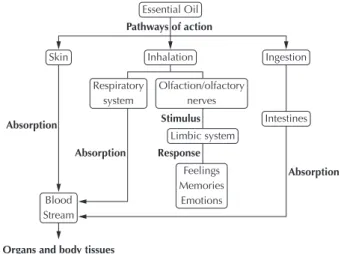
In the last two mentioned activities pathways, there is the action of the active ingredient present in the essential oil, in addition to nervous and sensory stimulation. As shown in Figure 1, even if it is administered by a pathway other than inhalation, always some oil molecules are released into the environment due to its low molecular weight, which will cause an olfactory stimulus and action on the respiratory system.
Essential Oil
Pathways of action
Inhalation
Skin Ingestion
Respiratory system
Stimulus
Limbic system
Feelings Memories
Emotions
Intestines
Absorption
Absorption Absorption
Blood Stream
Organs and body tissues
Response
Olfaction/olfactory nerves
Figure 1 – Flowchart demonstrating the potential of HI perfor-mance pathways in the body – São Paulo, 2015.
Some essential oils also have antimicrobial efect, prob-ably for its role in the cell wall structure of the microorgan-ism, denaturing and coagulating proteins. he action would occur because it would alter the permeability of the cytoplas-mic membrane due to its lipophilic characteristic, interrupt-ing the vital processes of the cell, such as electron transport, translocation of protein phosphorylation and other enzyme-dependent reactions, and such actions would result in loss of chemiosmosis control of the afected cell, destroying it(22).
Studies have been conducted with energetic measure-ments of essential oils using Raman spectroscopy(23-24),
which is based on the incidence of a monochromatic light source which, upon reaching the oil in question undergoes scattering of light, allowing researchers to obtain infor-mation about the chemical compound indicating that the components show energy bands. hese studies support the existence of energy in essential oils, proposing that the use of these plant concentrates can act in line or changing en-ergy patterns of an organism.
AROMATHERAPY IN NURSING: HISTORICAL CONCEPT
Florence Nightingale was a pioneer in Nursing when he introduced EO in the care process. She was responsible for indicating the application of essential oil of lavender ( La-vandula angustifolia) in the frontal region of the wounded
soldiers during the Crimean War in order to calm them(25).
Although Nightingale was the irst nurse to use EO in Nursing care, the irst aromatherapist Nurse was Margue-rite Maury, currently seen as an icon of modern Aroma-therapy(19). Maury was born in Austria in 1895, she
Aromatherapy and nursing: historical and theoretical conception
1930s, she met Dr. Maury, a doctor who was interested in natural therapies, and together they began to study the ICP. Marguerite is recognized as a reference in Aromatherapy because she integrated the principles of holistic Nursing the preparation of individual therapeutic prescriptions EO massage(26) and developing the idea that a blend (mixture)
of single EO could be developed for each person(17).
With her studies, Marguerite Maury attempted to dem-onstrate the performance of EO on the nervous system, es-pecially in the Limbic System, and taught courses and lec-tures throughout Europe on the EO mechanisms of action. She opened the irst aromatherapy clinic in London(26) and,
later, others in France and Switzerland. Because Marguerite has developed studies on the action of EO in the body, she has become best known as a biochemist than a Nurse.
AROMATHERAPY IN NURSING: THEORETIC FRAMEWORK
Using EO is in accordance with the practical philosophy of the theories and the ethical principles that composes Nurs-ing, allowing the integration of Aromatherapy to the values of the profession. Due to the emphasis on individual choice and uniqueness, choosing an essential oil, the Nurse must focus her/his attention in particular interaction with each person, acting as a partner with her/his customer, developing a treatment plan aimed at health promotion and well-being(17).
Authors have already proposed the theoretical frame-work of Aromatherapy according to three Nursing heo-ries(17). he irst correlation made was from the perspective
of the model of Florence Nightingale Nursing care, which is grounded in attention to aspects of the environment. he environment plays an important role and contributes as a facilitator to natural healing and restoration of the patient. For this reason, Florence indicated the use of lavender es-sential oil in the frontal region of wounded ighters(25), with
the intention of providing comfort and relief, making a suit-able environment to allow the recovery process. Aromather-apy can permeate three environmental aspects: ventilation and cleanliness, rest and relaxation, and changes in environ-mental conditions. In relation to ventilation and cleanliness, intervention can be accomplished through environmental difusion of EO with antiseptic properties, diluted with dis-tilled water such as eucalyptus (Eucalyptus globulus), lemon
(Citrus limonum) or tea tree (Melaleuca alternifolia)(17).
Some EO contribute to relaxation and improved sleep. Lavender oils (Lavandula angustifolia) or chamomile ( An-themis nobilis) can be directly applied to the skin by means
of massage, diluted in a carrier oil such as almond or jojoba oil, or even inhaled. Applying a drop of lavender oil ( La-vandula angustifolia), chamomile (Anthemis nobilis) or sweet
marjoram (Origanum marjorana) on a cotton ball placed
in-side the pillow can help increase relaxation and sleep(17).
he oppressive and monotonous environments of hospi-tals and health care centers can be changed through a sensory olfactory variation by using EO. he happy notes of orange (Citrus sinensis) or grapefruit (Citrus paradisi), geranium ( Pel-argonium graveolens) or rose (Rosa damascena), or refreshing
rosemary lavor (Rosmarinus oicinalis), or basil (Ocimum
basi-licum) can be dispersed in the environment through the use
of a difuser as change the perception of patients regarding the environment where they are living in. Because the scents stimulate olfactory memory, the Nurse may involve the client in choosing scents that evoke memories and good feelings(17).
According to some authors, the second heory of Nurs-ing that may be relected in the light of Aromatherapy is Jean Watson’s theory(17). his theorist deines that healing
is enhanced by transpersonal care, and in that sense, aro-matherapy can be ofered in conjunction with the touch, massage or through the gentle application directly to the skin. hus, the human connection by touch is stated as part of the practice of Aromatherapy. For Watson, health is con-ceptualized as an integral harmony in the interrelationship person-environment, and EO can create a sense of harmony with the environment because they are organic elements that work in harmony with the body(17).
In Watson’s heory care is holistic, interactive and based on the transpersonal service, which consists of the unitary ield of consciousness and energy, transcending time, space and physicality, translating into an energetic interaction that occurs between Nurse and patient. he healing process, which should not be only understood as a cure but also as restoration/rebuilding of being, is inserted in a non-invasive environmental energy ield(27), in this sense, Aromatherapy
its well as Nursing intervention, since it is a holistic ICP with grounds which may be used environmentally or in a non-invasive way. EO may have a normalizing action – in the case of hyssop (Hyssopus oicinalis), which is suggested
as a pressure regulator for both hyper and for hypotension, and ylang ylang (Cananga odorata), which can be applied
in states of depression or increased activity or agitation(17).
In the light of the third heory proposed by other au-thors(17), according to Martha Rogers, Nursing is considered
a humanistic and humanitarian science, focused on the de-scription and explanation of the human being as a whole synergistic. he principles of this theory are based on inte-grality, resonance and helicity and address the concepts of energy ields in constant exchange, like open systems, it is not possible to separate the human from the environment where they live in(27). Given this assumption, Aromatherapy
relects the interrelationship between plants and people, since the energy pattern of the people exerts a dynamic exchange with the energy pattern of the plant, which is en-coded in the essential oil. Each essential oil may be seen as a pattern of single vibrational frequencies, in the same manner that each individual is considered a unique pattern of energy frequencies, as proposed by Rogers.
he process of change must be produced by the active participation of the Nurse and the patient. In partnership, both can select EO to act as facilitators in this process, based on personal choices and experiences. Patchouli oil (Pogostemom patchouli), for example, helps to connect with
In addition to the aforementioned three theories that have been related by other authors(17), it is possible to
iden-tify rational-theoretical aspects of the Aromatherapy in ive other theories and assist with this understanding: Myra Levine, Hildegard Peplau, Callista Roy, Wanda Horta and Katharine Kolcaba. Aromatherapy can be used as a device for restoring the individual with the environment they live in, helping to improve the body’s response to stress agents. It is proposed by Myra Levine that the nurse should be aware of the dependence and interaction between the indi-vidual and the environment, helping in the process of per-sonal transformation and preventing the stress caused by an imbalance among the operating standards of the human body, which promotes its integrity(27).
Using EO contributes to the maintenance of the four conservation principles proposed by Levine. he principle of energy conservation, for example, using the essential oil of rosemary (Rosmarinus oicinalis) to provide more
disposi-tion(17); the principle of conservation of structural integrity,
with the use of lavender or tea tree oil to promote epithelial healing. he essential tea tree oil has been shown to be a promising agent in the nursing ield, especially in stoma-therapy. Nurses conducted a study demonstrating that it can assist in the healing of infected wounds(28). he principle
of conservation of personal integrity is given through aid in decision making, and if so, it can use Patchouli to bring security(17). An essential oil can be used in order to promote
increased social interaction, converging with the principle of conservation of social integrity, which can be aforded by the environmental use of orange oil(10).
In the heory of Interpersonal Relations, developed by Hildegard Peplau, Nursing should focus on support to interpersonal relationships for the care situations that can be turned into learning experiences and personal growth, which are shared by the Nurse and the patient(27). To assist
the patient in coping with stressful situations, the Nursing intervention can be accomplished through the use of Melis-sa oil (Melissa oicinalis), which contributes to the handling
of situations that generate emotional trauma(10).
Callista Roy proposes a model in which the person is understood as a system capable of creating changes to adapt themselves to the environment in which the individual’s adaptation level depends on the skill and mobilization abil-ity to make changes. In this case, Aromatherapy can be a
tool to assist in the adaptation process and coping(27). An
example would be the use of geranium oil (Pelargonium graveolens), which may be used to stabilize emotions events
caused by traumas(17). For orthopedic patients who have lost
autonomy and sufer from low self-esteem, the ylang ylang and rose oils (Rosa Damascena) help to deal with the
emo-tional trauma and improve self-esteem(10,16).
Supported by the Nursing heories, Aromatherapy can act as an instrument to assist in restoring balance, as proposed by the Brazilian theorist Wanda Horta(27). In this sense,
ber-gamot essential oil (Citrus bergamia) could be used as an
en-vironmental difuser or during bath in order to reduce anxiety and improve depressive and sadness states, besides providing a refreshing sensation, contributing to restoring the balance(10).
Finally, the heory likely to relate to the Aromatherapy is the Comfort heory, described by Katharine Kolcaba. For this theorist, the Nurse should assess and identify the pa-tient’s comfort needs in physical, psycho-emotional, social spheres and environmental context, which are not being met by proposing an intervention that includes meeting the individual needs holistically(29). In this sense,
Aroma-therapy can act as a Nursing intervention to improve patient comfort of their family or community, both in the man-agement of psycho-physical, emotional, and environmental areas, promoting relief, tranquility and transcendence which result in a state of well-being. Physical pain can be allevi-ated through the environment use of clove oil (Syzygium aromaticum), for example, which also has antiseptic
prop-erties. Anxiety states can be reduced using lavender oil in the bath or massage. Recently, a study conducted by Nurses has pointed out that Aromatherapy, applied through mas-sage with lavender oil, has proven to be efective in relieving anxiety in patients with personality disorder in psychiatric hospitalization, which could be observed by reduction in heart rate and respiratory participants(30).
Social interactions can be encouraged by using citrus oils, which give an appearance of lightness and joy to the environment.
Aromatherapy, based on Nursing heories, should fol-low the assumption that the EO must support the har-monious integration in the human-environment relation-ship(17). From the foregoing, we propose a Summary Chart
(Chart 1), supporting Aromatherapy in the theoretical con-cepts proposed by the aforementioned Nursing theorists.
Chart 1 – Aromatherapy grounds according to the theoretical concepts proposed by the Nursing theories – São Paulo, 2015. Author/Theorist Nursing theories Association of theoretical principles with Aromatherapy
Florence Nightingale
(1820-1910) Environmentalist Theory
Promotes environmental cleaning, relaxation and acts on variations of environmental sensations as a stimulus
Myra Estrin Levine (1967) Holistic Theory
Assists in the individual transformation process, preventing the stress caused by an imbalance change in the harmonious functioning of the body, promoting its integrity
Hildegard Peplau (1952) Theory of Interpersonal Relations Acts as a support to interpersonal relationships
Martha Rogers (1970)
Theory of Human unit – conceptual model of Mankind
Associated with care, assist individuals to reach their maximum health potential, both physical and emotional scope
Sister Callista Roy (1970) Adaptation Theory Assisting instrument in the adaptation process inherent to life changes
Aromatherapy and nursing: historical and theoretical conception
Based on Chart 1 and on the premise that Aromather-apy can be a device applied in order to change an energetic pattern of an individual, helping to improve their emotional state, it can be said that ICP is likely to be based in Nursing heories. hus, it is proposed that this practice is used as a nursing intervention instrument, as EO provide physical and psycho-emotional action.
FINAL CONSIDERATIONS
he interfaces found between the applicability of
Aro-matherapy and Nursing heories contribute to the dissemi-nation and implementation of this therapy in the context of Nursing care. Humanistic and holistic principles, guided in interpersonal relationships and in the integral approach of the human being is discussed in the current context of Nursing, ind accordance with complementary practices such as Aromatherapy, contributing to the expansion of care towards ofering an approach that reaches not only the physical, but mental, emotional and spiritual well-being of the patients.
...continuation
Author/Theorist Nursing theories Association of theoretical principles with Aromatherapy
Wanda de Aguiar Horta (1970) Theory of Basic Human Needs Instrument able to restore balance to meet human needs
Katharine Kolcaba (2003) Comfort Theory Instrument able to promote patient comfort in physical, psycho-emotional,
social and environmental context
Jean Watson (2005) Theory of Transpersonal Care Promotion and restoration of health through changes in the patient’s energy ield of the interrelationship with the environment standards
RESUMO
A Aromaterapia é uma Prática ou Terapia Complementar de saúde que utiliza concentrados voláteis extraídos de plantas, os chamados óleos essenciais, com a inalidade de melhorar o bem-estar físico, mental e emocional. A Aromaterapia tem sido praticada histórica e mundialmente por Enfermeiros e, visto que no Brasil sua utilização possui respaldo pelo Conselho Federal de Enfermagem, torna-se relevante discutir essa prática no contexto da Enfermagem por meio das Teorias da Enfermagem. O presente estudo de relexão teórica, exploratório e descritivo, tem como objetivo discorrer sobre a farmacognosia dos óleos essenciais, a trajetória histórica da Aromaterapia na Enfermagem e fundamentar a Aromaterapia à luz de oito Teoristas de Enfermagem (Florence Nightingale, Myra Levine, Hildegard Peplau, Martha Rogers, Callista Roy, Wanda Horta, Jean Watson e Katharine Kolcaba), contribuindo para a sua inserção como prática assistencial da proissão.
DESCRITORES
Aromaterapia; Terapias Complementares, Óleos Voláteis; Enfermagem; Teoria de Enfermagem.
RESUMEN
La Aromaterapia es una Práctica o Terapia Complementaria de salud que utiliza concentrados volátiles extraídos de plantas, los llamados aceites esenciales, con el in de mejorar el bienestar físico, mental y emocional. La Aromaterapia ha sido practicada histórica y mundialmente por Enfermeros y, a la vista de que su empleo en Brasil tiene respaldo del Consejo Federal de Enfermería, se hace relevante discutir dicha práctica en el marco de la Enfermería mediante las Teorías de la Enfermería. El presente estudio de relexión teórica, exploratorio y descriptivo tiene como objetivo discurrir acerca de la farmacognosia de los aceites esenciales, la trayectoria de la Aromaterapia en la Enfermería y fundamentar la Aromaterapia a la luz de ocho Teóricos de la Enfermería (Florence Nightingale, Myra Levine, Hildegard Peplau, Martha Rogers, Callista Roy, Wanda Horta, Jean Watson y Katharine Kolcaba), contribuyendo a su inserción como práctica asistencial de la profesión.
DESCRIPTORES
Aromaterapia; Terapias Complementarias; Aceites Volátiles; Enfermería; Teoría de Enfermería.
REFERENCES
1. National Center for Complementary and Alternative Medicine. Complementary, alternative, or integrative health: what’s in a name? [Internet]. Bethesda; 2008 [cited 2014 July 21]. Available from: http://nccam.nih.gov/health/whatiscam
2. Luz MT. Novos saberes e práticas em saúde coletiva: estudo sobre racionalidades médicas e atividades corporais. 3ª ed. São Paulo: Hucitec; 2007.
3. World Health Organization. General guidelines for methodologies on research and evaluation of traditional medicine. Geneva: WHO; 2000.
4. World Health Organization. WHO traditional medicine strategy: 2002-2005. Geneva: WHO; 2002.
5. World Health Organization. WHO traditional medicine strategy: 2014-2023. Geneva: WHO; 2014.
6. Brasil. Ministério da Saúde. Portaria n. 971/2006. Aprova a Política Nacional de Práticas Integrativas e Complementares (PNPIC) no Sistema Único de Saúde. Diário Oicial da União, Brasília, 4 maio 2006. Seção 1, p. 20-5.
7. Brasil. Ministério da Saúde. Portaria n. 2.543/1995. Regulamenta a formação do Grupo Assessor Técnico-Cientíico em Medicinas
8. Brasil. Ministério da Saúde. Relatório inal da 10ª Conferência Nacional de Saúde, Brasília-DF, de 2 a 6 de setembro de 1996. Brasília: Conselho Nacional de Saúde; 1998.
9. Brasil. Ministério da Saúde. Política Nacional de Medicina Natural e Práticas Complementares (PNMNPC). Brasília; 2005.
10. Tisserand R. The art of aromatherapy. 2nd ed. Saffron Walden: CW Daniel; 2004.
11. Walters C. Illustrated elements of aromatherapy. New York: Metro Books; 1998.
12. Brasil. Senado Federal. Projeto de Lei n. 64 de 2009. Dispõe sobre a regulamentação do exercício das atividades de terapias, a criação do
Conselho Federal de Terapeutas e dos Conselhos Regionais de Terapeutas, suas atribuições e responsabilidades, e dá outras providências [Internet]. Brasília; 2009 [citado 2015 jul. 21]. Disponível em: http://www.senado.leg.br/atividade/materia/getTexto.asp?t=61207
13. Conselho Federal de Enfermagem (COFEN). Resolução COFEN 197/1997. Estabelece e reconhece as Terapias Alternativas como
especialidade e/ou qualiicação do proissional de Enfermagem [Internet]. Brasília; 1977 [citado 2015 jul. 21]. Disponível em: http:// www.cofen.gov.br/resoluo-cofen-1971997_4253.html
14. Conselho Federal de Enfermagem (COFEN). Resolução COFEN 389/2011. Atualiza, no âmbito do sistema COFEN/Conselhos Regionais de
Enfermagem, os procedimentos para registro de títulos de pós-graduação lato e stricto sensu concedidos a Enfermeiros e lista especialidades [Internet]. Brasília; 2011 [citado 2015 jul. 21]. Disponível em: http://www.cofen.gov.br/resoluo-cofen-n-3892011_8036.html
15. Almeida VCF, Lopes MVO, Damasceno MMC. Teoria das relações interpessoais de Peplau: análise pautada em Barnaum. Rev Esc Enferm
USP. 2005;39(2):202-10.
16. Gnatta JR, Zotelli MFM, Carmo DRB, Lopes CLBC, Rogenski NM, Silva MJP. The use of aromatherapy to improve self-esteem. Rev Esc Enferm USP [Internet]. 2011 [cited 2015 July 21];45(5):1113-20. Available from: http://www.scielo.br/pdf/reeusp/v45n5/en_v45n5a12.pdf
17. Smith MC, Kyle L. Holistic foundations of aromatherapy for nursing. Holist Nurs Pract. 2008;22(1):3-9.
18. Bakkali F, Averbeck S, Averbeck D, Idaomar M. Biological effects of essential oils – a review. Food Chem Toxicol. 2008;46(2):446-75.
19. Corazza S. Aromacologia: uma ciência de muitos cheiros. São Paulo: SENAC; 2002.
20. Potts J. Aromatherapy in nursing practice. Aust Nurs J. 2009;16(11):55.
21. Kamkaen N, Ruangrungsi N, Patalung NN, Watthanachaiyingcharoen R. Physiological and psychological effects of lemongrass and sweet almond massage oil. J Health Res. 2015;29(2):85-91.
22. Dorman HJ, Deans SG. Antimicrobial agents from plants: antibacterial activity of plant volatile oils. J Appl Microbiol. 2000; 88(2):308-16.
23. Baranska M, Schulz H, Reitzenstein S, Uhlemann U, Strehle MA, Krüger H et al. Vibrational spectroscopic studies to acquire a quality
control method of Eucalyptus essential oils. Biopolymers. 2005;78(5):237-48.
24. Schulz H, Baranska M, Quilitzsch R, Schütze W, Lösing G. Characterization of peppercorn, pepper oil, and pepper oleoresin by vibrational
spectroscopy methods. J Agric Food Chem. 2005;53(9):3358-63.
25. McDowell B. Nontraditional therapies for PICU. J Pediatr Nurs. 2005;10(1):29-32.
26. Andrei P, Del Comune AP. Aromaterapia e suas aplicações. Centro Universitário São Camilo. 2005; 11(4):57-68.
27. McEwen M, Wills E M. Bases teóricas para enfermagem. Porto Alegre: Artmed; 2009.
28. Chin KB, Cordell B. The effect of tea tree oil (Melaleuca alternifolia) on wound healing using a dressing model. J Altern Complement Med. 2013;19(12):942-5.
29. Kocalba K. Comfort theory and practice: a vision for holistic health care and research. New York: Springer; 2003.