http://dx.doi.org/10.1590/0104-530X1683-14
Resumo: O processo produtivo das indústrias cada vez mais ganha importante participação na construção de benefícios competitivos às empresas. Considerando a importância da Estratégia de Produção alinhada às operações como prioridade para a conquista de resultados positivos, uma relexão teórica por meio de pesquisa exploratória e bibliográica busca analisar a Manufatura Enxuta como uma Estratégia viável às operações, e uma segunda etapa objetiva a identiicação da Estratégia de Produção Enxuta adotada pelas empresas nos vários segmentos de atuação. A problemática está em identiicar e, possivelmente, airmar que a Manufatura Enxuta aborda e pode ser o modelo viável para a realização da Estratégia no processo de manufatura para as organizações e para as usinas de açúcar e etanol do segmento sucroenergético.
Palavras-chave: Estratégia de Operações; Produção Enxuta; Usina de açúcar e etanol.
Abstract: The production process of industries has been increasingly gaining an important role in building competitive beneits for companies. Considering the importance of production strategy aligned to operations as a priority for the achievement of positive results, a theoretical relection through exploratory and bibliographic research seeks to analyze the Lean Manufacturing as a viable operations strategy; a second step aims to identify the Lean Production Strategy adopted by companies in the various segments. The problem lies in identifying and possibly stating that Lean Manufacturing approaches and it can be a viable model for the realization of strategy in the manufacturing process for organizations and sugar and ethanol plants from the sugarcane segment.
Keywords: Operations Strategy; Lean Production; Sugar and ethanol plant.
Systematic literature review with bibliometric
analysis on Lean Strategy and manufacturing
in industry segments
Revisão sistemática da literatura com análise bibliométrica sobre estratégia e Manufatura Enxuta em segmentos da indústria
Manoel Gonçales Filho1 Fernando Celso de Campos1 Maria Rita Pontes Assumpção1
1 Universidade Metodista de Piracicaba – UNIMEP, Rodovia Luis Ometto, Km 24, SP 306, CEP 13451-900, Santa Bárbara d’Oeste, SP, Brazil, e-mail: [email protected]; [email protected]; [email protected]
Received Aug. 21, 2014 - Accepted Mar. 21, 2016
Financial support: This work was carried out with support from the Higher Education Personnel Improvement Coordination - CAPES - Brazil.
1 Introdução
The current global economic environment demand for organizations that have in their everyday dynamic
culture of seeking continuous improvement, eliminate waste and develop skills and competencies in human capital (Gonçales et al., 2014). Votto & Fernandes (2014) reinforces this context when he mentions that companies exposed to adverse market conditions, have
sought modern strategies production management
to improve the production flow and minimize inconveniences inherent in their production systems.
Conducting research to identify the exploitation of scientiic papers in the ields of industries related
to the application of lean manufacturing strategy
(LMS) is necessary to diagnose what gaps need attention and future developments. In this sense, the problem is in identifying which industry segments underexplored by LMS.
This study aims to identify segments in industries most
worked by the LMS. A theoretical relection through
bibliographical research sample up quantitative data
of scientiic recognition. In other words, consider the
lean manufacturing as a strategy to operations, and a
second step identiies LMS adopted by companies in
comparison to the sugar mill and ethanol sugarcane
segment. In this sense, the problem is in identifying
viable model for the realization of the strategy in the
manufacturing process for this segment.
2 Theoretical framework
In this section are presented the main concepts and features of business strategy and strategy of lean
production, by way of an initial literature review.
2.1 Business strategy
Strategy is a word of Greek origin, whose current
meaning is derived from the French language designating
a maneuver or military Fireworks (Houaiss, 2001; Macedo et al., 2012). It is the art of organizing and
conducting a series of preventive military operations to coordinate the action of the armed forces in the
theatre of operations until they are in contact with the enemy, or part of military science that deals with
the coordination of armed forces (integrating the
political, logistical and economic) in the conduct of a war or in the organization of the defense of a nation, a coalition (CNRTL, 2010; Macedo et al., 2012).
From this observation, it appears that there was
a transposition of the original meaning to its use
in the ield of administration. The transposition of the strategy of the military ield for the ield of administration took place in the second half of the 20th century, in the United States. Organizations need to plan its operations to survive in a world full of dynamic transformations. Ansoff (1977) is appointed
as one of the pioneers of the study of the strategy,
to analyze the importance of markets and products for the organization.
For Skinner (1974), in his work, the classic about the manufacture with the company’s strategy, reports
that manufacturing management is ignored in the
company’s strategy, even though it is a function that represents active worthy and can be a tool to gain competitive advantage. The technical vision and were important for the machine. As for the concept of production Strategy is deined as a set of plans and
policies of the company in order to gain advantage over competitors, including plans for the products
and for the marketing of these products.
The strategy has undergone an extraordinary
turbulence in the period of the industrial revolution
circa 1880. The irst industrial entrepreneurs have
devoted most of their energies to the creation of modern production technology, setting around her
organizational technology (Ansoff, 1993).
Porter (1986) introduces the types of strategies
gathered from the core business of the Organization,
noting his location, distinction, development, extension and recognition. And deines how competitive
strategy, offensive or defensive actions to create a
defensible position in an industry, to face successfully the competitive forces and thus obtain a greater
return on investment. Slack (1993) also focuses on the strategic importance of production, when points out that competitiveness issues are within the ield of production. They are: quality, speed, introduction of new products and lexibility.
The capitalist mode of production search new forms
of organization of production and many companies
in the sugar sector are also seeking, through the
productive and organizational restructuring, action
strategies to stand out to the different market situations that have been submitted.
In this sense, to Silva (2006), globalization brought to the enterprises a possibility of expansion of its consumer market, but at the same time forced them to compete with each other, resulting in a ceaseless search for lower costs, higher quality products and services. And boosted the development of productive processes more adapted to this reality. In search of
competitive advantage, organizations have invested in productive processes that aim to better meet the
expectations of its customers.
For Brito (2002) the origins of this method of production to the present day, new concepts were aggregated, such as intelligence networks
and information technology, providing a better
understanding of this management system, as well
as, made it possible to understand the magnitude of the impacts caused in organizations from the adoption
of the same. In this context, Amato (2009) argues
that many organizations have been engaged in the implementation of transformation processes based
on the philosophy of Lean Manufacturing (LM),
on principles of systematization and adaptation of
Japanese production techniques, with reference to the Toyota Production System (TPS).
Neely (1999), Veiga et al. (2008) provide that the
development in industrial processes, formatting is
based particularly on changes in production systems.
The Japanese model based on the Toyota Production
System, has revolutionized the way people conceive a company operations. Thus, the strategic importance of the LM model.
2.2 Lean Manufacturing Strategy (LMS) Womack & Jones (1996), o LM is dry because it is a way to do more and more with less and less – less
human effort, less equipment, less time, less movement
and less space, eliminating waste and creating wealth through activities that only add value to the inal product, giving customers exactly what they want.
As Liker (2005) the key to LMS whose origin is in the TPS and what makes it stand out is not any
gathered as a system put into practice every day
in a very systematic way-not alone. According to
the author, the success derives from the balance of the role of people in an organizational culture that
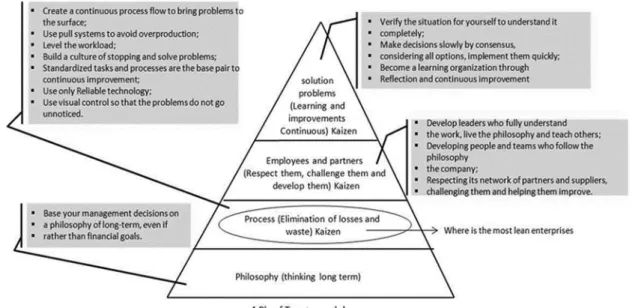
expects and values your continuous improvement, with a technical system focused on the stream of high added value. There are four sections representing the success of TPS: (i) Long-term philosophy. Get serious thinking long-term. Organizations to be successful must become learning companies, (ii) The right process will produce certain results. Process-oriented company. The low is the key to obtaining the best quality at less cost with high security and disposal.
In Toyota focusing on process is part of the DNA of
the company, (iii) Add value to the organization by developing your people and partners. The vision is that build people and not just cars, (iv) The continuous
solution of basic problems drives organizational
learning. Identify the causes of the problems and prevent them from occurring.
In this way, the four sections are presented below
by Figure 1, as synthesized by the 4 p’s of LMS
based on TPS, whose goal is to make work more satisfying by creating continuous low production, enabling immediate feedback on efforts to transform waste into value.
The key of the TPS is not only on tools and
techniques such as just in time, but on the commitment
of a company with the permanent investment in your
people and the promotion of a culture of continuous
improvement (Liker, 2005).
Second Oprime et al. (2010), This practice then known was that provided by mass production,
i.e. manufacturing in high volumes of standardized products to a market of large dimensions. So, for Toyota, the solution was to how to produce competitively a greater variety of models in small quantities. That way, the problem was to achieve eficiency and cost
reduction is no longer based on economies of scale,
but in other elements of manufacturing production. According to Davenport (1994), the construction
of the LMS serves as an “umbrella” to cover all the methodologies that are based on the reduction of
waste in the environment, no matter how different
they may be in the form and content of current and
of their culture in the company. For Bhasin (2012) each company must ind its own path to the LMS. Managers had dificulties with the techniques when
attempting to implement isolated parts of a lean Strategy
without understanding the whole. A reliable guide for implementation action is on the ive principles of lean thinking, (i) determine precisely the value for speciic product; (ii) identify the value chain for each product; (iii) make value low without interruptions; (iv) leave the customer pull value from the producer; (v) seek perfection.
Therefore, adopting the LMS as a philosophy and adhering the Lean Tools, possibly good results can
be achieved. As Womack & Jones (1996) eliminate waste and create wealth. The companies lost sight of the value and how to create value for the customer. Create waste. Need of lean thinking to help companies specify value correctly. Align all activities that create value for a speciic product along a value chain and make value low according to customer requirements, in search of perfection and of continuous improvement.
Muda (Japanese word) that means waste, activities
that do not create value, errors that require correction,
producing items that nobody wants, accumulation of goods in stock. Processing steps that are actually not necessary. Movement of staff and goods transport from one place to another without purpose, a subsequent activity which is waiting because a previous activity was not performed in due time, in short: goods and services that do not meet customer needs. All teams from a company that follows the LMS can measure precisely the waiting time and continuously improve the own design methodology.
With the adoption of the LMS many companies have achieved superior performance across multiple
dimensions that were considered, such as: low cost, high quality, speed and lexibility. Competitive priorities can reinforce each other (Porter, 1986).
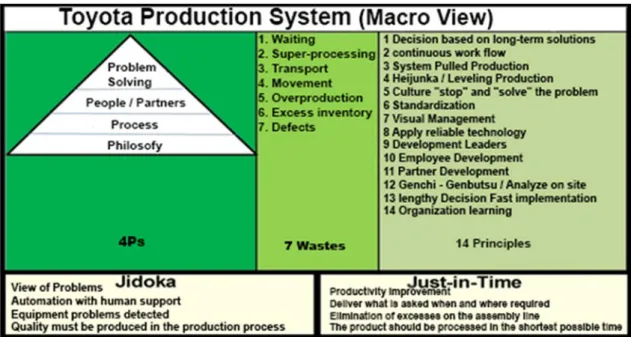
The Industrial Management consulting irm epitomizes all that theoretical-conceptual Lean on following Figure 2.
However, where conlicting goals remain and which can be reduced or eliminated with the implementation of LMS? Are questions that must be made when fetching their use this strategic perspective.
In this sense, the knowledge generated by the
authors referenced is that the implementation of LMSE is a process of continuous improvement, in
which learning must be used to manage the change. Hayes (1981), Veiga et al. (2008) put that Japanese
success is due to the use of futuristic techniques, but
the attention to the basic aspects of manufacture.
All stages of the manufacturing process, from
product development to distribution, are equally
important. They work constantly improving the
equipment design, inventory control system and
the ability of workers through cooperation at all levels. In addition, each worker is trained to solve
small problems that appear on a daily basis, conduct
regular preventive maintenance, and to seek ways to
eliminate potential interruptions continuously and
to improve the effectiveness. The consistency and
discipline in the manufacturing operations of the
Japanese. Muitas empresas vêm utilizando as melhores práticas enxutas como base de suas estratégias de manufatura. The best practice approach involves the
philosophy of world class manufacturing (WCM),
and of benchmarking, and is based on the argument
that the continuous improvement of best practices in all areas of organization leads to superior performance improving organizational learning and competitiveness
(Voss, 1995; Veiga et al., 2008).
In this way, it can be considered that the practices,
regarded as the best, cover the content of this paradigm
of LMS. And benchmarking represents your process and learning.
2.3 Plant sugarcane
The plant, in a generic, is a company that produces sugar, hydrated and anhydrous ethanol fuel for vehicles, fertilizer from the vinasse, distilled alcoholic and energy production from sugarcane bagasse, among
other derivatives (Piacente, 2005).
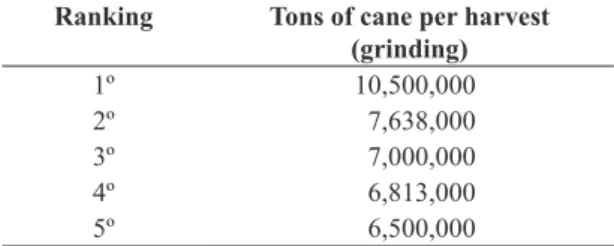
Currently, there are 342 active Plants installed in the national territory, and other 46 are inactive.
Among them, the largest producers processing, on
average, 7,690,200 tons of sugar cane per harvest (2013-2014) as shown in Table 1.
The industrial unit is known mainly by ive divisions as shown in Table 2.
3 Methodology
The methodological approach of this research
is characterized as exploratory, descriptive and documentary (Gil, 2008), When using the deductive method (Cruz & Ribeiro, 2003). As for the outline, the
bibliographical research and survey sampling, using technological resources of search as a tool to run the
search (Gil, 2008), in this case, the foundations of the CAPES – Coordination and Improvement of Higher.
Journals consulted have their articles available for
consultation on-line, Thus, the survey data.
To survey and analysis conducted in this study
was done a systematic review of the literature (SRL) followed by Bibliometrics based on the following steps: i) Search term – selection of journals, ii) reading of titles, abstracts, keywords of articles returned; III) Reading
of the methodology and results of the articles returned;
IV) tab and data evaluation found; v) identiication of the articles segment and vi) Suggestions for the implementation of future work in segments with little scientiic exploration. The selection of journals on the basis of the CAPES portal started by means of the key words: strategy + lean + industry. The ilters have been implemented and thus were selected
journals, approaching its content to the topic under
study. For ilters, the reinement of key word via the searched terms and temporality. Deined databases, document type, only works in the area of engineering III and the classiication Web-Qualis. These were the criteria for inclusion and exclusion of articles found, which resulted in a Bibliometric analysis presented by the deinition of the 18 articles on strategy that paved the way to research.
The selection of 18 articles by publication date, by
the Qualis-Capes (engineering III) of all periodicals. And inally, if you read all the titles, abstracts, keywords,
goals, their research methodologies, relevant aspects,
analysis of results and conclusions.
At the end of these steps of sorting and reading
articles, so for the last phase: the tabulation and
evaluation of its characteristics, the results are
presented and discussed below.
4 Results
The analysis and implementation of LM can be
done through the strategic decisions in various areas. The Strategy process found in the existing literature shows consistent with the deinition of LM as a
basically emerging Strategy for many organizations,
whose actions are outlined by the consistency of
behavior afforded by continuous improvement and
learning generated. The LM can be characterized as a
set of best practices, but the analysis of the feasibility
of adopting any technique cannot be neglected. However, it has been seen that the LM is a strategy that reduces waste and provides better results for the manufacturing processes.
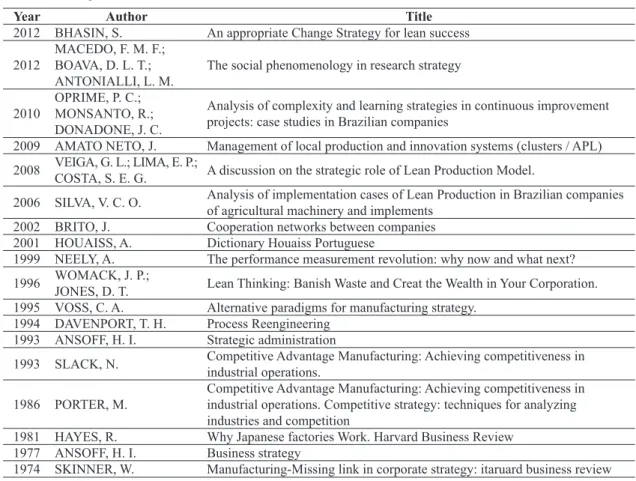
For this irst stage of the research the 18 surveyed work form the basis for identifying the Strategy theme with the lean manufacturing process, and this is conirmed when it scans the titles of the works of these authors. Chosen works that focused on the themes and LM Strategy in the years 1974/77/81/86/93/84/95/96/99 and 2001/02/06/08/10/9/12 in an attempt to obtain the
evolution of this approach and see through of these authors, the LM may be the methodology becomes
consistent with the strategy. They met in the word strategy in 53% of the publications and the words linked to LM in 42%, and if found in 100% of the work the two words correlated. In the Table 3 there researched authors in chronological order and the
titles of his works.
In Table 4 we can observe the authors surveyed and the evolution of the strategic objectives and
production.
Note that the focus of the goals with regard to the words eficiency, low cost, higher return and
the recovery of manufacturing aspects are present
in all periods, with greater attention to planning, competitiveness and quality arises from the works of Porter, Slack, Ansoff and waste reduction, the quest for superior performance, world-class organization,
development of industrial processes, understand the
Table 1. The ive largest plants in milling capacity.
Ranking Tons of cane per harvest (grinding)
1º 10,500,000
2º 7,638,000
3º 7,000,000
4º 6,813,000
5º 6,500,000
Source: Novacana (2015).
Table 2. To from an industrial unit.
# Divisions
1 Reception/preparation/grinding
2 Juice treatment
3 Sugar factory
4 Ethanol distillery
5 Storage of products
Table 3. Year of publication of the works of the authors.
Year Author Title
2012 BHASIN, S. An appropriate Change Strategy for lean success
2012
MACEDO, F. M. F.; BOAVA, D. L. T.;
ANTONIALLI, L. M. The social phenomenology in research strategy
2010
OPRIME, P. C.; MONSANTO, R.; DONADONE, J. C.
Analysis of complexity and learning strategies in continuous improvement projects: case studies in Brazilian companies
2009 AMATO NETO, J. Management of local production and innovation systems (clusters / APL) 2008 VEIGA, G. L.; LIMA, E. P.;
COSTA, S. E. G. A discussion on the strategic role of Lean Production Model.
2006 SILVA, V. C. O. Analysis of implementation cases of Lean Production in Brazilian companies of agricultural machinery and implements
2002 BRITO, J. Cooperation networks between companies 2001 HOUAISS, A. Dictionary Houaiss Portuguese
1999 NEELY, A. The performance measurement revolution: why now and what next? 1996 WOMACK, J. P.; JONES, D. T. Lean Thinking: Banish Waste and Creat the Wealth in Your Corporation. 1995 VOSS, C. A. Alternative paradigms for manufacturing strategy.
1994 DAVENPORT, T. H. Process Reengineering 1993 ANSOFF, H. I. Strategic administration
1993 SLACK, N. Competitive Advantage Manufacturing: Achieving competitiveness in industrial operations.
1986 PORTER, M. Competitive Advantage Manufacturing: Achieving competitiveness in industrial operations. Competitive strategy: techniques for analyzing industries and competition
1981 HAYES, R. Why Japanese factories Work. Harvard Business Review 1977 ANSOFF, H. I. Business strategy
1974 SKINNER, W. Manufacturing-Missing link in corporate strategy: itaruard business review Source: elaborated by the authors.
Table 4. The objectives of the authors.
Year Author Objective
2012 BHASIN, S. Implementation of Lean
2012 MACEDO, F. M. F.; BOAVA, D. L. T.;
ANTONIALLI, L. M. Organization defense
2010 OPRIME, P. C.; MONSANTO, R.;
DONADONE, J. C. Competitively produce a wider range of models in small amounts 2009 AMATO NETO, J. Implementation of transformation processes
2008 VEIGA, G. L.; LIMA, E. P.;
COSTA, S. E. G. Pursuit of superior performance enhancing competitiveness
2006 SILVA, V. C. O. Lower costs
2002 BRITO, J. Understanding the impacts on the organization
2001 HOUAISS, A. Defense organization
1999 NEELY, A. Development of industrial processes
1996 WOMACK, J. P.; JONES, D. T. Be a viable and eficient company in automobile manufacturing 1995 VOSS, C. A. Pursuit of superior performance enhancing competitiveness
1994 DAVENPORT, T. H. Reduce waste
1993 ANSOFF, H. I. Plan their operations to survive in a dynamic world full of changes
1993 SLACK, N. Improve the quality and delivery time
1986 PORTER, M. Successfully face the competitive forces and thus get a higher return on investment. 1981 HAYES, R. Appreciation of all aspects of manufacturing
1977 ANSOFF, H. I. Plan their operations to survive in a dynamic world full of changes
impacts on organizations and the implementation of lean as a viable Strategy organizations are added by
later works.
It is observed that initially there was some concern with the LMS that was ignored by the administration.
The value of production as competitive function
leaving the restricted vision that was only focused on technique and importance of machine would be.
The concept that the LMS is a powerful competitive tool of development was incorporated and happened
to have a broader vision that goes from product to
distribution with equal weights and other functions were recognized and developed as an integral system to enhance competitiveness.
Therefore, in addition to the production function,
the marketing function, Comptroller (inance), human
resources, research and development and quality are
strategically composed, was until the manufacturing
policies and recognize the economic, technological
and logistical factors.
Currently, it is considered the EPE, the location, and competitive forces. Adopted best practices and benchmarking, value cultural aspects and if is another vision about waste and about the networking
concepts, technology, production and cost reduction as a competitive factor that can provide higher
quality of products and services. In Table 5 we can
observe the authors searched relevant aspects and
the contribution of his works.
Table 5. Relevant aspects and contribution of the works of the authors.
Author Appearance relevant Contribution
BHASIN, S. LM implementation covering the whole: the value chain, low, pull production and perfection
Guide to Implementation
MACEDO, F. M. F.; BOAVA, D. L. T.; ANTONIALLI, L. M.
Strategy as a maneuver or military
device Political, logistical and economic
OPRIME, P. C.; MONSANTO, R.;
DONADONE, J. C. Eficiency and cost reduction
Achieving eficiency in other aspects of ME - Lean Manufacturing beyond the mass production
AMATO NETO, J. Techniques LM - Lean Production Development of processes through TL - Thinking Lean
VEIGA, G. L.; LIMA, E. P.;
COSTA, S. E. G. Lean practices is the basis for the manufacturing strategy
Best practice involves the philosophy of WCM (world class manufacturing) and benchmarking
SILVA, V. C. O. Highest quality products and services Development of production processes to better meet customer expectations
BRITO, J. Search for a better understanding of the system LP - lean production and new concepts of network and information technology
HOUAISS, A. Strategy as a maneuver or military device Political, logistical and economic
NEELY, A. Formatting of industrial processes Strategic importance of LP model - Lean Production
WOMACK, J. P.;
JONES, D. T. A philosophy: waste disposal, pull production, lean thinking Dissemination of the base of the production process employed by Toyota
VOSS, C. A. Lean practices is the basis for the manufacturing strategy
Best practice involves the philosophy of WCM (world class manufacturing) and benchmarking
DAVENPORT, T. H. Cultural aspects Join the Lean tools
ANSOFF, H. I. Importance of markets and products to the organization. The implementation of the military ield strategy for the ield of administration SLACK, N. Strategic Importance of Production Search to competitiveness in production PORTER, M. It is considered location, distinction, development, extension and recognition Types of competitive strategy, offensive or
defensive actions
HAYES, R. Training and capacity building - inventory control system, and the ability of workers
Product development to distribution, are equally important
ANSOFF, H. I. Organizational technology Creation of modern production technology
SKINNER, W. Manufacturing management is ignored in the company’s strategy Manufacturing management is a function that represents a valuable asset and can be tool to obtain competitive advantage
In order to achieve the second objective proposed,
researched the scientiic works developed in enterprises and their respective segments, and the irst given to be computed was the total number of items available
that you can see in Figure 3 below:
Using the key words: strategy + lean + industry met 20150 available articles, and those articles, peer-reviewed totaled 13222 units, and this was home-based work. Continuing the selections were added the topics, namely, the words searched to
bring the contents of the articles to the topic to be
developed as shown in Figure 4.
Found 240 articles with the topic Lean Production which represents a 23% share of the total of the selected terms. It may be noted that the second most signiicant contribution was the topic Strategy Planning (Business) with 20%, and a total of 205, followed by the topic Automobile Industry which contained 148 journals and the topic Human Resource Management 135 journals. For the Automotive Industry
topics, Lean Manufacturing and Performance results
209 periodicals as stratiied participation by Figure 4.
It was later made a tab with the goal of meeting the databases that were participating in the production of articles.
Figure 5 shows the amount of periodicals that are published in the bases.
It is observed that the higher occurrence of publications
appears mainly in the periodical OneFile (Gale) with 450 publications and a 46% share, followed by the journal Scopus (Elsevier) with 386 publications and a slice of 40%, the base SciVerse Science Direct (Elsevier) has 138 publications and contains 14% of magazines.
Figure 6 shows the resource used, and the focus
given to the document type applied in this research. For the resource type used, note that was in unanimity worked articles, deleted-if this work every other resource types, all reviews, textual resources, proceedings of conferences and journal articles. Other
data presented and that contributes to the selection
of items is the publication date as shown in Figure 7. Highlights that the temporal position considered only those years where there were publications and
from 2003 until the present day, read year 2014, more
precisely until may 2014. Therefore, we have 44% of the sample between 2009 and 2014. Other information
parsed and represented in Figure 8, subsequently was
the Qualis-Capes stratum of all periodicals. It was noticed that more than half of the journals do not have engineering III classiication and other areas such as: computer science, biological sciences
I, administration, accounting, agriculture and tourism, interdisciplinary, medicine, psychology, biology II,
among others. However, 10 journals in the area of engineering III have qualiication (A1) and nine
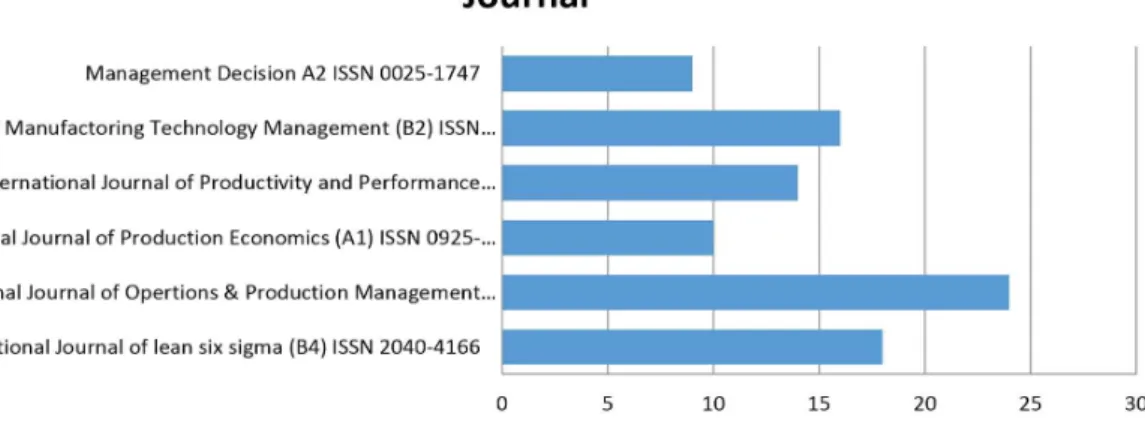
journals are (A2). It was realized that periodic 24 have classiication B1 and B2 are 30, and 18 to B4 and that no journal for B3 and B5 or for other classes, that is, we have no qualiications in this work in
Figure 3. Numbers of articles published in the period.
Figure 4. Amount of topics selected for the study area.
Figure 5. Number of articles per database.
of Manufacturing Technology Management and
Management Decision, add up to 49 publications and a 54% share of the total that accumulate on average less than 13.5% incidence for each magazine. However,
there is also high participation to the International
Journal of Lean six sigma with the amount of 18 articles of the area and a slice of 20%, others: International
Journal of Production Economics, The International Journal of Productivity and Performance Management, Journal of Manufacturing Technology Management
and Management Decision, add up to 49 publications and a 54% share of the total that accumulate on average less than 13.5% incidence for each magazine.
Was also made a tab in order to see the languages in
which the international articles were written. Figure 10
shows what percentage of the total number of items and their respective language.
It is observed that the amount of publications in English is surprisingly larger than the publications in other languages, especially the Portuguese, Spanish
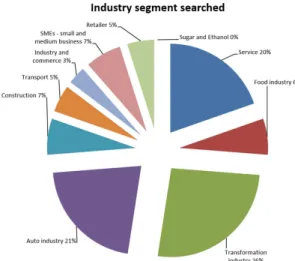
and German, for these do not participate with any publication on this work. Until here reached in articles 91 and sought to ind the segment of industries worked within these selected articles, for this achievement was to read all their titles, abstracts, keywords, their
research methodologies and conclusions are presented in Figure 11.
It is observed that the manufacturing industry has
the highest participation with 26% totaling 16 items
developed in this segment, the auto industry and has
similar services, the irst with 21% and 13 articles and, consequently, the second with 20% and 12 works,
the food industry, construction, transport, small and
medium-sized businesses, retailer, and industry and Commerce combined, they have 36 jobs and a share of 59% and the average between the latter not 33% and total 20 published works and there are no scientiic articles for the sugar industry and ethanol in the sugar/energy segment.
magazines C1, C2, C3, and so on. Then we analyzed the participation of journals on the subject and who
are represented in Figure 9.
The International Journal of Operations Production
Management has 41 & incidence, i.e. 23% of the publications were found. However, there is also high
participation to the International Journal of Lean
six sigma with the amount of 18 articles of the area and a slice of 20%, others: International Journal of
Production Economics, The International Journal of Productivity and Performance Management, Journal
Figure 7. Date of publication of the articles.
Figure 8. The Qualis-Capes.
up an analytical overview of the scientiic literature on the subject in LMS available journals. The articles
found through the established parameters, do not address the sugar industry and the sugarcane industry
ethanol. So, here we have an opportunity to work and further research to be explored, so that they can contribute to the knowledge within the production
process of this segment registered as the increased
need for scientiic production.
The results show that the LMS is on the rise
internationally and is the methodology found in
referenced journals. Scientiic production around the
subject is predominantly done by a single magazine
or a single industry segment, showing an open space for those wishing to deepen and, in particular,
sugar and ethanol segment, as this is presented as
the greater opportunity of development work and scientiic research.
References
Amato, J. No. (2009). Gestão de sistemas locais de produção e inovação (clusters/APL). São Paulo: Atlas.
Ansoff, H. I. (1977). Estratégia empresarial. São Paulo: McGraw-Hill.
Ansoff, H. I. (1993). Administração estratégica. São Paulo: Atlas.
Bhasin, S. (2012). An appropriate Change Strategy for lean success. Management Decision, 50(3), 439-458. http:// dx.doi.org/10.1108/00251741211216223.
Brito, J. (2002). Redes de cooperação entre empresas. In: D. Kupfer, Economia industrial: fundamentos teóricos e práticos no Brasil. Rio de Janeiro: Campus. Centre National de Ressources Textuelles et Lexicales –
CNRTL. (2010). Laboratoire d’analyse et de traitement informatique de la langue française. Nancy: CNRS. Recuperado em 14 de abril de 2014, de http://www. cnrtl.fr/definition/strat%C3%A9gie.
Cruz, C., & Ribeiro, U. (2003). Metodologia cientíica: teoria e prática. Rio de Janeiro: Axcel Books. Davenport, T. H. (1994). Reengenharia de processos. Rio
de Janeiro: Campus.
Gestão Industrial. (2013). Lean manufacturing: reduzindo custos e ganhando eiciência. Recuperado em 23 de abril de 2013, de http://gestaoindustrial.com/ leanmanufacturing.htm.
Gil, A. C. (2008). Como elaborar projetos de pesquisa. São Paulo: Atlas.
Gonçales, M. Fo., Prado, A. E., & Campos, F. C. (2014). Logística, cadeia de suprimentos e pensamento enxuto nas organizações: uma análise bibliométrica. Espacios, 35(13), 13.
5 Conclusion
The lean manufacturing can be considered as a viable strategy because it have short and long
term planning. The literature itself reports that the LM’s practices in the pursuit of improvement and
development of production processes is not easy
and can take long periods to reach maturity. These
manufacturing processes are critical to facilitate and leverage the results set out in the strategy by
the directors and shareholders. With LMS seeks to achieve superior performance, world-class, and continuous improvement.
The philosophy of world class manufacturing (WCM) and benchmarking, is associated with the LMS and, with continuous improvement of best
practices in all areas of the organization, leads to superior performance in order to improve the
competitiveness of enterprises.
With the LMS adoption many companies can achieve superior performance in several dimensions
that were considered, such as: low cost, high quality, speed and lexibility. Competitive priorities can reinforce each other.
Porter, M. (1986). Estratégia competitiva: técnicas para análise de indústrias e da concorrência. Rio de Janeiro: Campus.
Silva, V. C. O. (2006). Análise de casos de implementação de Produção Enxuta em empresas brasileiras de máquinas e implementos agrícolas (Dissertação de Mestrado). Escola de Engenharia de São Carlos, Universidade de São Paulo, São Carlos.
Skinner, W. (1974). Manufacturing-missing link in corporate strategy. Harvard Business Review, 52(3), 136-145. Slack, N. (1993). Vantagem competitiva em manufatura:
atingindo competitividade nas operações industriais. São Paulo: Atlas.
Veiga, G. L., Lima, E. P., & Costa, S. E. G. (2008). Uma discussão sobre o papel estratégico do Modelo de Produção Enxuta. Sistemas & Gestão, 3(2), 92-113. Voss, C. A. (1995). Alternative paradigms for manufacturing
strategy. International Journal of Operations & Production Management, 15(4), 5-16. http://dx.doi. org/10.1108/01443579510083587.
Votto, R. G., & Fernandes, F. C. F. (2014). Produção enxuta e teoria das restrições: proposta de um método para implantação conjunta na Indústria de Bens de Capital sob Encomenda. Gestão & Produção, 21(1), 45-63. Womack, J. P., & Jones, D. T. (1996). Lean thinking: banish
waste and create the wealth in your corporation. New York: Simon and Schuster.
Hayes, R. (1981). Why Japanese factories work. Harvard Business Review, (Jul/Aug), 56-66.
Houaiss, A. (2001). Dicionário Houaiss da língua portuguesa. Rio de Janeiro: Objetiva.
Liker, J. K. (2005). O modelo Toyota: 14 princípios de gestão do maior fabricante do mundo. Porto Alegre: The Bookman.
Macedo, F. M. F., Boava, D. L. T. & Antonialli, L. M. (2012). A fenomenologia social na pesquisa em estratégia. Revista de Administração Mackenzie, 13(5).
Neely, A. (1999). The performance measurement revolution: why now and what next? International Journal of Operations & Production Management, 19(2), 205-228. http://dx.doi.org/10.1108/01443579910247437. Novacana. (2015). Como é feito o processamento da
cana-de-açúcar nas usinas. Recuperado em 07 de abril de 2015, de http://www.novacana.com/usina/como-e-feito-processamento-cana-de-acucar.