RESUmo
Este estudo metodológico teve como ob-jeivos descrever o processo de tradução e adaptação cultural do instrumento Percei-ved Sigmaizaion Quesionnaire (PSQ) e analisar a consistência interna dos itens na etapa do pré-teste. O PSQ foi desenvolvido para avaliação da percepção de comporta-mentos esigmaizantes de víimas de quei-maduras. O processo de adaptação foi reali-zado de agosto de 2012 a fevereiro de 2013, compreendendo as etapas preconizadas na literatura. Como parte desse processo, foi realizado o pré-teste com 30 adultos víimas de queimaduras. Todos os paricipantes dessa etapa reportaram compreender os itens do instrumento e a escala de respos-tas. Não houve sugestões ou alterações na versão testada. O valor do alfa de Cronbach no pré-teste foi de 0,87. A contribuição do estudo reside em descrever a operacionali-zação de cada uma das etapas desse proces-so metodológico e mostrar a consistência interna dos itens no pré-teste.
dEScRiToRES Queimaduras Estereoipagem Estudos de validação Comparação transcultural Tradução
Translation and cultural adaptation of the
Perceived Stigmatization Questionnaire for
burn victims in Brazil
*O
riginal
a
rticle
ABSTRAcT
This methodological study aimed to de-scribe the process of translaion and cul-tural adaptaion of the Perceived sigma-izaion Quesionnaire (PSQ) and analyze the internal consistency of the items in the step of pre-tesing. The PSQ was developed to evaluate the percepion of sigmaizing behaviors of burn vicims. The adaptaion process was carried out from August 2012 to February 2013, comprising the steps outlined in the literature. As part of this process, the pre-test with 30 adult burn vicims was held. All paricipants at this step reported to understand the instru-ment items and the scale of responses. There were no suggesions or changes in the tested version. The value of Cronbach’s alpha at pre-test was 0.87. The contribu-ion of this study is to describe the opera-ion of each of the steps of this method-ological process and show the internal con-sistency of the items in the pre-test.
dEScRiPToRS Burns
Stereotyping Validaion studies Cross-cultural comparison Translaing
RESUmEn
Este estudio tuvo como objeivos describir el proceso de traducción y adaptación cul-tural del instrumento Perceived Sigmaiza-ion QuesSigmaiza-ionnaire (PSQ) y analizar la con-sistencia interna de los ítems en la etapa del pre-test. El PSQ fue desarrollado para la evaluación de la percepción de los com-portamientos esigmaizantes de vícimas de quemaduras. El proceso de adaptación fue realizado de agosto del 2012 a febrero del 2013, incluyendo las etapas preconi-zadas en la literatura. Como parte de ese proceso, fue realizado el pre-test con 30 adultos vícimas de quemaduras. Todos los paricipantes de esa etapa informaron comprender los ítems del instrumento y la escala de respuesta. No hubo sugerencias o cambios en la versión probada. El valor del alfa de Cronbach en el pre-test fue de 0,87. La contribución del estudio está en la descripción de la operacionalización de cada una de las etapas de ese proceso me-todológico y demuestra la consistencia in-terna de los ítems en el pre-test.
dEScRiPToRES Quemaduras Estereoipo
Estudios de validación Comparación transcultural Traducción
noélle de oliveira Freitas1, marina Paes caltran2, Rosana Aparecida Spadoti dantas3, Lidia Aparecida Rossi4
TRADUÇÃO E ADAPTAÇÃO TRANSCULTURAL DO PERCEIVED STIGMATIZATION
QUESTIONNAIRE PARA VÍTIMAS DE QUEIMADURAS NO BRASIL
TRADUCCIÓN Y ADAPTACIÓN TRANSCULTURAL DEL PERCEIVED STIGMATIZATION
QUESTIONNAIRE PARA VÍCTIMAS DE QUEMADURAS EN EL BRASIL
* Project of the Research Group on Rehabilitation and Quality of Life, Ribeirão Preto College of Nursing, University of São Paulo. Ribeirão Preto, SP, Brazil. 1 Nurse. PhD student, Interunits Doctoral Program in Nursing, Ribeirão Preto College of Nursing, University of São Paulo. Ribeirão Preto, SP,
Brazil. [email protected] 2 Nurse. Master’s student of the Fundamental Nursing Graduate Program, Ribeirão Preto College of Nursing, University
of São Paulo. Ribeirão Preto, SP, Brazil. [email protected] 3 Associate Professor, Ribeirão Preto College of Nursing, University of São Paulo.
[email protected] 4 Full Professor, Ribeirão Preto College of Nursing, University of São Paulo. [email protected]
inTRodUcTion
Burn is a trauma that afects people’s lives and cause changes in body image that can cause psychological dam-age to the individual(1). The disigurement is an efect of
the change in appearance of the burn trauma, which can be considered outside of the expected social standards and lead to rejecion and social isolaion, decreased self-esteem, sigmaizaion, anxiety and depression(2-3).
Sigmaizaion is the process or the individual’s situa-ion that prevents full social acceptance. To be recognized by society as someone who does not have expected pat-terns, who presents a health problem or other sigmaiz-ing situaion, the individual is oten labeled, avoided, ridi-culed and degraded by people(4).
People burned reported that there are two criical points associated to the percepion of changes in their bodies: when they see their own image in the mirror and when they noice how others see them. Ater hospital dis-charge, burned individuals with changes in appearance and funcion of body parts start to sufer the shock from contact with people in social life(5). Thus, we emphasize
the importance of assessing individuals when they come in contact with the view of society, outside the context of a Burns Unit.
In recent years, measurement instruments have been developed to assess psychosocial factors for various types of medical condiions and rehabilitaion, including burn vicims. However, most of these instruments were originally developed in English and therefore, they need to be translated and cross-culturally adapted for use in other countries(6-7).
The cross-cultural adaptaion process comprises the translaion and cultural adaptaion of the instrument to the populaion where it will be applied and has the pur-pose of maintaining the semanic equivalence of the origi-nal to the adapted version. Thus, we atempted to ensure the psychometric properies of the items through validity and reliability(7). The validity evidence whether what is
be-ing measured is what the researcher is intendbe-ing to mea-sure, and reliability of the instrument assesses the degree of consistency with which the instrument measures the proposed atribute(8-9). However, if any item is not
under-stood by the new populaion, it must be carefully modi-ied. So, the instrument may change and new staisical tests should be performed ater the last translaion(7).
The use of instruments has been favoring the com-municaion between healthcare professionals and service users, contribuing to the rapid ideniicaion of problems and priority needs, as well as for decision making in search of improving care(10).
In the naional literature, no speciic instruments have been ideniied for assessment of sigmaizaion in pa-ients who sufered burns that has been adapted for use
in Brazil. In the internaional literature, we ideniied Per-ceived Sigmaizaion Quesionnaire (PSQ), developed in English to assess sigmaizing behaviors commonly report-ed by children, adolescents and adults who have suferreport-ed burns in the United States(11-12), and an adaptaion for use
with children in Germany(13).
If it is valid for the Brazilian populaion, it may allow comparison of research indings across countries and ef-fects of intervenions in Brazilian paients with burn vic-ims in other countries. It can be used to assess the ef-fects of support systems and other intervenions aimed at minimizing the impact with aestheic procedures such as cosmeics makeup. Thus, it becomes necessary to per-form the adaptaion process of the instrument to Brazil.
The objecives of the study were to translate and cul-turally adapt the Perceived sigmaizaion Quesionnaire (PSQ) to the Brazilian Portuguese for use of burn vicims and analyze the internal consistency of the items in the pre-test step.
mETHod
Methodological study performed in a Burn Unit of a teaching hospital located in the countryside of the state of Sao Paulo.
Inclusion criteria
We selected for the pre-test step, individuals who met the following inclusion criteria: age over 18 years, Brazil-ians, regardless of gender, race and ethnicity, who were discharged between two and 12 months, had an outpa-ient appointment in the Burn Unit and who were await-ing reconstrucive surgeries ater hospital discharge.
Individuals with prior psychiatric diagnoses (registered in paients charts) or cogniive diiculies that prevented them from answering the quesions of the instruments (assessed by the ability to indicate the address where they lived, day of week and month, and age or date of birth) were excluded, who were serving ime in prison in a closed regime or burned in suicide atempt.
Ethical aspects
The study was approved by the Ethics Commitee of the Ribeirão Preto College of Nursing, University of São Paulo under protocol No. 243/2012. All paricipants of the steps of the study, the individuals and experts, received verbal and writen informaion about the study and agreed to paricipate by signing the Consent Form. Ano-nymity was preserved by idenifying the quesionnaire with numbers and the interviews were held in a private environment.
Instruments
burned. The quesionnaire was based on behavior re-ported by people with changes in appearance, consider-ing that certain types of emoions give space to speciic behaviors that may be ofensive or not, i.e., the behav-ioral manifestaion of sigma may difer depending on the type of emoion caused(14). Sigmaizing behaviors
that underlie the construcion of the quesionnaire were ideniied by the authors in the literature review and were organized into six categories: improper atenion and stare, avoidance behavior, confuse behavior, rude and provocaive behavior, bullying and external pressure to change their appearance(12).
The PSQ consists of 21 items divided into three do-mains: Absence of friendly behavior (items 1, 5, 7, 9, 12, 15, 17 and 20), confused/staring behavior (items 3, 4, 6, 10, 13, 14, 19 and 21) and hosile behavior (item 2, 8, 11, 16 and 18). The individual must indicate how oten experiences such behavior on a scale with response al-ternaives 1-5 (never, almost never, someimes, oten, always). The scores of the items of the domain Absence of friendly behavior should be reversed prior to staisi-cal analyzes(12).
The PSQ total score must be calculated by summing the items and dividing by the number of items in the in-strument. The same procedure must be performed to calculate the score of each domain, by dividing the num-ber of items in the respecive domain. The results of the PSQ are expressed by mean scores on the same metric scale of frequency response (1-5 points) so that the scale scores are comparable and easily interpretable. Higher scores indicate greater percepion of sigmaizing behav-ior. The internal consistency of the original instrument was assessed by Cronbach’s alpha and the value of 0.93 was obtained(12).
Together with the PSQ, we used a quesionnaire to collect sociodemographic data of subjects in the pre-test, such as gender, marital status, years of educaion and age.
Procedures for cross-cultural adaptaion
The authorizaion for cross-cultural adaptaion of the PSQ in Brazil was granted by the original author via email. The adaptaion process was conducted according to the steps outlined in the literature described below(6-7,15-16):
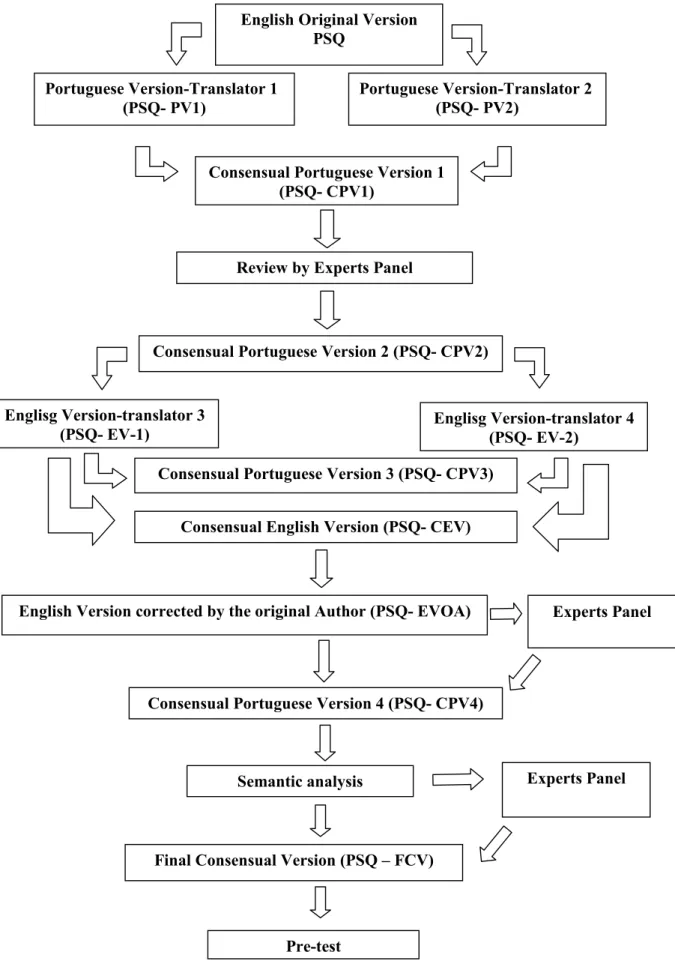
• Instrument translation: performed by two indepen-dent translators, Brazilians, with English language and culture expertise and knowledge of the objec-tives of the study, however, they did not know the original English version of the instrument, resulting in the Portuguese version of each translator (PV1 and PV2).
• Obtaining the irst consensus of Portuguese versions:
for the synthesis of translaions and obtaining the irst consensus of the translated version, a meeing
between the researchers and translators was per-formed. The two versions in Portuguese, along with the original English versions were evaluated with the objecive to compare them and rank the items that kept the semanic equivalence with the original instru-ment. This step resulted in the consensus of Portu-guese version 1 (CPV1) of PSQ.
• Evaluaion by Experts Panel: consensual Portuguese version was submited for review by a panel consist-ing of ive experts. The experts who were selected to paricipate in the Panel met at least two of the follow-ing criteria: have knowledge about burn individuals, know Portuguese and English languages and research methodology. Ater selecion, a meeing was con-ducted to evaluate the semanic, idiomaic, cultural and conceptual of items from consensual version of the Portuguese instrument and compared with the original version in English. When any member of the Panel disagreed with any term of the translated ver-sion, suggesions were proposed, analyzed and jusi-ied in order to achieve beter understandability of in-struments and equivalence with Brazilian culture. The approval of the changes occurred when 80% of the Panel members agreed with the proposal(16). In this step, we evaluated the face and content validity of the instrument by the Panel members and at its end, we obtained the consensus Portuguese version 2 (CPV2). • Back-translaion: step characterized by the back
trans-laion of the original language of the instrument, Eng-lish. It was performed by two independent translators, foreign, luent in English, Portuguese and who had knowledge of the Brazilian culture. The translators did not know the research objecives and the original in-strument. The objecive of this step was to determine whether the Portuguese version relect the original content. This step resulted in the English version of each translator (EV1 and EV2)
• Obtaining the consensus of versions in English and compared with the original English version:
Once the back-translation was completed, we held a meeting between the researchers and translators in order to compare the translated, back-translated and original English version to verify the possible semantic differences in order to reach a consensus on equivalent terms to the original version. Thus, the consensus Portuguese version 3 (CPV3) of the instrument was defined and the consensual English version (CEV).
• Evaluaion of the instrument by the original author:
• Semanic analysis of the items: consensus Portugue-se version 3 of the instrument underwent Portugue-semanic evaluaion of four paients, who were selected by convenience, according to the inclusion and exclu-sion criteria of the study, during the outpaient cli-nic hospitalizaion of the Burns Unit, from January 17th to 23rd 2013. The semanic evaluaion aims to assess whether all terms of each item of the instru-ment are understandable to the populaion which is intended(16). The author suggested this step should
be performed with four subjects(16). The step was
performed by applying a quesionnaire to seman-ic analysis(17), adapted for use with Brazilian(18) and
for this study. The quesionnaire is divided into two parts, Part A, related to the general impression of the adapted version of the PSQ and Part B, with speci-ic quesions about the importance and dispeci-iculies of understanding each PSQ item. An interview with ea-ch subject was conducted by reading the instrument and the semanic analysis form.
• Pre-test: we selected a consecuive sample for con-venience of 30 paients who were atended at the Burns Unit, from January 24th to February 26th 2013. Paients were invited to paricipate in the study ater evaluaion of one of the researchers on the inclusion and exclusion criteria. The adapted version of the PSQ was applied by researcher interview, which con-ducted the joint reading of each item. The reading of each item could be held up to three imes, and ater these atempts, if the paient had not understand it, the item would be let blank. The subject was asked about the diiculies and comprehensibility of the adapted version of the PSQ. The number of parici-pants in the pre-test step was deined according to suggested in the literature for this step (30-40 indivi-duals). In this step, the instrument is applied so that we could check their understanding and acceptance of the instrument as a whole, of each item and res-ponse scale. Psychometric analyzes are not recom-mended, such as construct validity and reliability, in the pre-test step(7).
The inal result of the methodological process of cul-tural adaptaion of the instrument is shown in Figure 1. Data were analyzed using the Staisical Package for Social Science (SPSS) version 20.0. Descripive analyzes were performed on all variables. We calculated mea-sures of dispersion (standard deviaion, minimum and maximum) and central tendency (mean and median) for coninuous variables and single frequency for categori-cal variables were categori-calculated. To determine the internal consistency of items, Cronbach’s alpha was calculated, considering that values above 0.70 relect high degree of internal consistency(8). For analysis of the values of
the correlaion coeicients proposed in the literature, in which correlaions with values below 0.30 are consid-ered weak, between 0.30 and 0.50 they are considconsid-ered moderate and above 0.50 they are considered strong(19).
RESULTS
Ater translaion, CPV1 was obtained, subsequently eval-uated by an experts panel, whose members proposed chang-es in relaion to the semanics of the items and the prchang-esenta- presenta-ion of the scale by insering the answer choices in the table. These suggested modiicaions are presented in Chart 1.
At the meeing between researchers and translators who performed the back translaion, they obtained consen-sus among the English versions to compare with the origi-nal, being held changes in CPV2 that are united in Chart 2.
The translators have suggested the inclusion of the word bullying in item 16 so that the populaion may bet-ter understand the quesion, explaining that most Brazil-ians know the term due to the approach of the media on this issue.
Ater evaluaion of the inal version of back-transla-ion and comparison with the original, translators and researchers had the need to assess and amend certain terms of the Portuguese version, although this procedure was not described in the method.
In response scale, the English opion Oten was trans-lated and unchanged in the step of the expert Panel and subsequently the back-translaion, with the inal version of the translaion for Many imes.
Chart 1 - Comparison between Consensus Portuguese Version 1
(CPV1) and Consensus Portuguese version 2 (CPV2) of the PSQ, after review by the Experts Panel.
Item PSQ - VCP1 PSQ - VCP2
9 People feel free around me. People feel free in presence. my
13 People do not know how to act around me. People do not know how to act in my presence.
14 People turn around to look at me.look at me and then People around to look at me.look at me or turn
19 People who I do not know look at me ixedly. People who I do not know stare at me.
21 People seem to be with my appearance.scared People seem to be fortable with my appear- uncom-ance.
Note: the changes were highlighted in bold.
Chart 2 - Comparison between Consensus Portuguese Version 2
(CPV2) and Consensus Portuguese version 3 (CPV3) of the PSQ, after back translation, considering the items that have changed.
Item PSQ - VCP2 PSQ - VCP3
2 People offend me. People curse me.
11 People laugh at me. People implicate with me (picking on me).
16 People threat me. People threat me (bullying).
English Original Version PSQ
Portuguese Version-Translator 2 (PSQ- PV2)
Portuguese Version-Translator 1 (PSQ- PV1)
Consensual Portuguese Version 1 (PSQ- CPV1)
Review by Experts Panel
Consensual Portuguese Version 2 (PSQ- CPV2)
Englisg Version-translator 3
(PSQ- EV-1) Englisg Version-translator 4 (PSQ- EV-2)
Consensual Portuguese Version 3 (PSQ- CPV3)
English Version corrected by the original Author (PSQ- EVOA) Experts Panel
Consensual Portuguese Version 4 (PSQ- CPV4)
Semantic analysis
Final Consensual Version (PSQ – FCV)
Experts Panel
Pre-test
Consensual English Version (PSQ- CEV)
The English version of the PSQ was sent to the original au-thor who had always demonstrated availability and respond-ed quickly to emails, suggesing alteraions in four items. So we reconvened the experts panel to analyze the author’s suggesions. This step was not iniially foreseen in the meth-odology. Panel expert members agreed with the suggesions of the original author, correcions being made in the English and Portuguese version, resuling in consensual Portuguese version 4 (CPV4 ). The modiicaions are shown in Chart 3.
Chart 3 - Comparison of the English version corrected by the
pri-mary author (PSQ- EVOA) and Portuguese inal version (PFV4), considering the items that have changed.
Item PSQ - VCAP PSQ - VCP4
4 People I don’t know are sur-prised or startled when they see me.
People who I don’t know are
scared or surprised when they see me.
7 People I don't know say me. Hi to People who I don’t know say Hi to me.
14 People turn around to look at me. People look at me and turn to look at me.
21 People seem to feel able in my presenceuncomfort-People seem to be able with my presence.
uncomfort-Note: the chances were highlighted in bold.
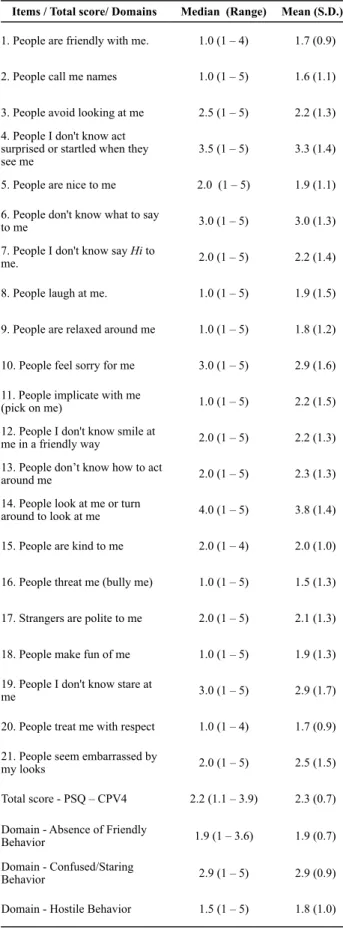
Table 1- Descriptive analysis of the responses to the items, total
score and domains of the PSQ in pretest step - Ribeirão Preto, SP, 2013
Items / Total score/ Domains Median (Range) Mean (S.D.)*
1. People are friendly with me. 1.0 (1 – 4) 1.7 (0.9)
2. People call me names 1.0 (1 – 5) 1.6 (1.1)
3. People avoid looking at me 2.5 (1 – 5) 2.2 (1.3) 4. People I don't know act
surprised or startled when they
see me 3.5 (1 – 5) 3.3 (1.4)
5. People are nice to me 2.0 (1 – 5) 1.9 (1.1)
6. People don't know what to say
to me 3.0 (1 – 5) 3.0 (1.3)
7. People I don't know say Hi to
me. 2.0 (1 – 5) 2.2 (1.4)
8. People laugh at me. 1.0 (1 – 5) 1.9 (1.5)
9. People are relaxed around me 1.0 (1 – 5) 1.8 (1.2)
10. People feel sorry for me 3.0 (1 – 5) 2.9 (1.6)
11. People implicate with me
(pick on me) 1.0 (1 – 5) 2.2 (1.5)
12. People I don't know smile at
me in a friendly way 2.0 (1 – 5) 2.2 (1.3)
13. People don’t know how to act
around me 2.0 (1 – 5) 2.3 (1.3)
14. People look at me or turn
around to look at me 4.0 (1 – 5) 3.8 (1.4)
15. People are kind to me 2.0 (1 – 4) 2.0 (1.0)
16. People threat me (bully me) 1.0 (1 – 5) 1.5 (1.3)
17. Strangers are polite to me 2.0 (1 – 5) 2.1 (1.3)
18. People make fun of me 1.0 (1 – 5) 1.9 (1.3)
19. People I don't know stare at
me 3.0 (1 – 5) 2.9 (1.7)
20. People treat me with respect 1.0 (1 – 4) 1.7 (0.9)
21. People seem embarrassed by
my looks 2.0 (1 – 5) 2.5 (1.5)
Total score - PSQ – CPV4 2.2 (1.1 – 3.9) 2.3 (0.7)
Domain - Absence of Friendly
Behavior 1.9 (1 – 3.6) 1.9 (0.7)
Domain - Confused/Staring
Behavior 2.9 (1 – 5) 2.9 (0.9)
Domain - Hostile Behavior 1.5 (1 – 5) 1.8 (1.0)
Note: (n=30) *S.D. = Standard deviation
The step of semanic analysis was performed on four paients. The mean age of paricipants was 37.8 years, equally distributed between the genders. Educaion of four paients evaluated in years had a mean of 7.3 years (range: 3-11, SD = 3.5 years).
In quesionnaire of the general impression on instrument, four paricipants rated the instrument as good and easy ques-ions to be understood. In the speciic analysis of the PSQ quesionnaire, no paricipant failed to answer any quesion. Most of the items were understood except for item 1 The people are friendly to me and Item 2 People call me names which were not understood by 25% of individuals. However, no suggesions to change the items were made. Items 2 Peo-ple call me names and 8 People laugh at me were not rele-vant to 50% of individuals. Regarding the presentaion of the scale, two individuals suggested the distribuion of items and responses in diferent columns and each item in a row due to the diiculty to view and respond the instrument.
The suggested changes were discussed among re-searchers and a member of the Expert Panel, who all agreed with the suggesions of the paricipants, resuling in the inal consensus version (PSQ - FCV).
The inal step of cultural adaptaion consisted of the pre-tesing of the inal consensus version of PSQ with 30 individuals through interviews. The mean ime to answer the instrument was three minutes.
For the total score, Cronbach’s alpha obtained for 30 paricipants in the pre-test was 0.87. Cronbach’s alpha was 0.80 for the domain Absence of friendly behavior, 0.79 for confused/staring behavior and 0.84 for hosile be-havior domain. Table 2 presents the results of the coei-cient of item-total correlaion and Cronbach’s alpha if the item was excluded.
As the subjects who paricipated in the pretest dem-onstrated understanding and acceptance of Scale, no changes were performed in PCV4 of the instrument, which resulted in the PSQ – inal Portuguese version.
diScUSSion
This study aimed to describe the process of transla-ion, cultural adaptaion and pre-tesing an instrument that evaluates the percepion of sigmaizing behavior for use in Brazil with individuals who have sufered burns. The step of cultural adaptaion was performed according to the methodology suggested in the literature(6-7,15-16). These
steps were adopted for validaion study of instruments of burn paients in Brazil(20).
The review by the Experts Panel was characterized as an important step to idenify terms that could not be under-stood by the target populaion, allowing them to be changed before the back-translaion, as suggested by the authors(15).
The experience of the members of the Expert Panel is considered important on the themaic of the instrument(6),
in this case burns, as well as the knowledge of socioeco-nomic aspects showing the general proile of Brazilian burned paients. This is an important point, because it can inluence the understanding of the Brazilian popula-ion adapted instruments from another culture. Study conducted in a burn unit ideniied that the majority of individuals refers to a low level of educaion, which has proven to be a common feature of paients hospitalized to the burn unit in Brazil(21).
The review conducted by researchers and translators of the Portuguese version of the PSQ, ater obtaining the consent of the back-translated version, considering the English expressions that could not have a precise match with Portuguese, helped to maintain the semanic equiva-lence of versions. The diiculies in translaing expressions of the English language and maintenance of semanics ac-cording to the cultural context were observed in all steps of translaion and review Panel.
One of the strengths of the translaion process was sending the instrument ater back-translaion into English for review by the original author. This step was feasible due to the availability of the author who constantly an-swered emails promptly. It was possible to perform it as proposed by the authors(7).
The second evaluaion by the Expert Panel, to ana-lyze the suggesion of the original author, not iniially intended, allowed the assessment and modiicaion of the terms suggested by the original author. This step fol-lowed the same procedure of the translaion synthesis
Table 2- Presentation of the coeficients of item-total correlation of the adapted version of the PSQ and the values of Cronbach’s alpha
if item is excluded, the pretest step - Ribeirao Preto, SP, 2013
PSQ (α total=0,87) Item-total correlation coeficient Cronbach α if item are excluded Items
1. People are friendly with me. 0.423 0.866
2. People call me names 0.531 0.863
3. People avoid looking at me 0.347 0.869
4. People I don’t know act surprised or startled when they see me 0.35 0.869
5. People are nice to me 0.604 0.861
6. People don’t know what to say to me 0.471 0.865
7. People I don’t know say Hi to me. 0.201 0.874
8. People laugh at me. 0.673 0.857
9. People are relaxed around me 0.593 0.861
10. People feel sorry for me 0.365 0.869
11. People implicate with me (pick on me) 0.413 0.867
12. People I don’t know smile at me in a friendly way 0.343 0.869
13. People don’t know how to act around me 0.466 0.865
14. People look at me or turn around to look at me 0.414 0.867
15. People are kind to me 0.606 0.862
16. People threat me (bully me) 0.593 0.86
17. Strangers are polite to me -0.05 0.881
18. People make fun of me 0.764 0.854
19. People I don't know stare at me 0.424 0.867
20. People treat me with respect 0.57 0.863
21. People seem embarrassed by my looks 0.751 0.853
and was carried out for obtaining consensus between versions translated and then back-translated(7). At this
step, there was no involvement of translators, it would be advisable to review the suggesions of the author and translate them.
The analysis of item-total correlaion coeicient, most items showed correlaion values of moderate to strong, but in item 17 (Strangers are polite with me) we ideniied a weak and negaive correlaion. The evaluaion was con-ducted with a small sample and, considering this to be an item that evaluates the percepion of sigmaizing behav-ior by burned paient when they ind themselves in front of strangers, we intend to evaluate in the future the psy-chometric properies of the instrument in a larger sample.
For descripive analyzes, the values obtained for the total score and for the PSQ domains in this study with 30 subjects, we were close to the original study(12). Likewise,
the values obtained in the internal consistency of the full instrument and from the domains were saisfactory even with a small step in the pre-test sample. In the validaion of the original version of the PSQ, the author of the in-strument obtained Cronbach’s alpha of 0.93 for the total instrument, 0.91 for the domain Absence of friendly be-havior, 0.92 for the domain confused/staring behavior and 0.88 for hosile behavior(8-12), similar to data obtained
in the present invesigaion.
Other tests are needed to conirm the reliability and validity of this instrument for use with Brazilians who suf-fered burns. However, considering the accuracy of the values of Cronbach’s alpha is dependent on the number of subjects in the sample, the values obtained in the pre-test may be underesimated, since there is a very small number of subjects in this study than recommended for analysis of reliability(22).
Therefore, the adapted version of the PSQ will be sub-mited for construct analysis and reliability in a represen-taive sample of burn vicims in Brazil, which may conirm or not whether the psychometric properies of the origi-nal version remained in the adapted version.
concLUSion
Methodological studies with the aim of adaping in-struments must be designed to keep seeking the idiom-aic, semanic and conceptual equivalence of the adapt-ed version in relaion to the original. This study showadapt-ed the importance of the inclusion of a new step of expert panel evaluaion on the presence of two translators to undertake the review of the suggesions from the origi-nal author.
The cultural adaptaion and pre-tesing steps are im-portant so that the equivalences are analyzed and accep-tance of the items may be iniially observed in the target populaion. Considering that Cronbach’s alpha values de-pend on the number of items in the instrument and in the number of individuals, the values obtained in the pre-test may be underesimated.
It is noteworthy that the process of validaion of the PSQ for burn vicims in Brazil is in progress. In the future, ater the validaion of the PSQ, it will be possible to ob-tain data to evaluate the percepion of sigmaizaion of the burned paient with regard to the impact of scars on the social interacion and comparison with results from other studies.
This methodological study contributes to teaching and research, it describes in detail each step and its implica-ions for the process of cross-cultural adaptaion of instru-ments to assess subjecive constructs.
6. Guillemin F, Bombardier C, Beaton DE. Cross-cultural adapta-ion of health related quality of life measures: literature review and proposed guidelines. J Clin Epidemiol. 1993;46(12):1417-32.
7. Beaton DE, Bombardier C, Guillemin F, Ferraz MB. Guidelines for the process of cross-cultural adaptaion of self report me-asures. Spine. 2000;25(24):3186-91.
8. Fayers PM, Machin D. Quality of life: assessment, analysis and interpretaion. Chichester, England: John Wiley & Sons; 2007. Scores and measurements: validity, reliability, sensiivity; p. 43-71.
9. Pasquali L. Psychometrics. Rev da Esc Enferm USP [Internet]. 2009 [cited 2013 May 16];43(n.spe):992-9. Available from: htp://www.scielo.br/pdf/reeusp/v43nspe/en_a02v43ns.pdf REFEREncES
1. Carlucci VDS, Rossi LA, Ficher AMFT, Ferreira E, Carvalho EC. A experiência da queimadura na perspeciva do paciente. Rev Esc Enferm USP. 2007;41(1):21-8.
2. Bernstein NR, Breslau AJ, Graham JA. Coping strategies for burn survivors and their families. New York: Hardcover; 1988.
3. Lansdown R, Rumsey N, Bradbury E, Carr T, Partridge J. Visibly diferent: coping with disigurement. Oxford: Buterworth-Heineman; 1997.
4. Gofmman E. Esigma: notas sobre a manipulação da ideni-dade deteriorada. 4ª ed. Rio de Janeiro: Jorge Zahar; 1982.
10. Higginson IJ, Carr AJ. Measuring quality of life: us-ing quality of life measures in the clinical seus-ing. BMJ. 2001;322(7297):1297-300.
11. Lawrence JW, Rosenberg L, Rimmer RB, Thombs BD. Per-ceived sigmaizaion and social comfort: validaing the con-structs and their measurement among pediatric burn survi-vors. Rehabil Psychol. 2010;55(4):360-71.
12. Lawrence JW, Fauerbach JA, Heinberg LJ, Doctor M, Thombs BD. The reliability and validity of the Perceived Sigmaiza-ion QuesSigmaiza-ionnaire (PSQ) and the Social Comfort QuesSigmaiza-ion- Quesion-naire (SCQ) among an adult burn survivor sample. Psychol Assess. 2006; 18(1):106-11.
13. Masnari O, Landolt MA, Roessler J, Weingaertner SK, Neu-haus K, Meuli M, et al. Self-and parent-perceived sigma-isaion in children and adolescents with congenital or acquired facial diferences. J Plast Reconstr Aesthet Surg. 2012;65(12):1664-70.
14. Mackie DM, Devos T, Smith ER. Intergroup emoions: ex-plaining ofensive acion tendencies in an intergroup con-text. J Pers Soc Psychol. 2000;79(4):602-16.
15. Ferrer M, Alonso J, Prieto L, Plaza V, Monsó E, Marrades R, et al. Validity and reliability of the St George’s Respiratory Ques-ionnaire ater adaptaion to a diferent language and culture: the Spanish example. Eur Respir J. 1996;9(6):1160-6.
16. Pasquali L. Instrumentos psicológicos: manual práico de elaboração. Brasília: LabPAM/IBAPP; 1999.
17. DISABKIDS Group. DISABKIDS translaion and validaion pro-cedure. Guidelines and documentaion form. Hamburgo: The Disabkids Group Europe; 2004.
18. Fegadolli C, Reis RA, Tortelboom S, Bullinger M, Santos SB. Adaptação do módulo genérico DISABKIDS® para crianças e adolescentes brasileiros com condições crônicas. Rev Bras Saúde Matern Infant. 2010;10(1):95-105.
19. Ajzen I, Fishben M. Overview: understanding aitudes and predicing social behavior. New Jersey: Prenice Hall; 1998.
20. Ferreira E, Dantas RAS, Rossi LA, Ciol MA. The cultural ad-aptaion and validaion of the Burn Speciic Health Scale-Revised (BSHS-R): version for Brazilian burn vicims. Burns. 2008;34(7):994-1001.
21. Rossi LA, Costa MCS, Dantas RAS, Cioi-Silva CL, Lopes LM. Cultural meaning of quality of life: perspecives of Brazilian burn paients. Disabil Rehabil. 2009;31(9):712-9.
22. Charter RA. Study samples are too small to produce suf-iciently precise reliability coeicients. J Gen Psychol. 2003;130(2):117-29.
Aknowledgements