RESUMo
A crescente demanda, o volume de aten-dimento ambulatorial em oncologia, assim como a complexidade do tratamento tem causado impacto sobre a carga de trabalho dos enfermeiros. Este estudo teve como objeivos mensurar a carga de trabalho e a produividade de enfermeiros em um am-bulatório de oncologia. Estudo de natureza observacional, uilizando técnica de amos-tragem de trabalho, foi conduzido em um ambulatório de oncologia na região sudes-te do Brasil, sudes-tendo como paricipansudes-tes sesudes-te enfermeiros. Obteve-se 1.487 amostras de intervenções ou aividades. Observou-se que 43,2% do tempo dos enfermeiros foi consumido em cuidados indiretos, 33,2% em cuidados diretos, 11,6% em aividades associadas e 12% em aividades pessoais. A produividade média correspondeu a 88,0%. Os achados permiiram concluir que os enfermeiros do ambulatório de oncolo-gia consumiram a maior parte de seu tem-po em aividades de cuidados indiretos. Revelou ainda um índice de produividade acima dos recomendados na literatura.
dEScRitoRES Enfermagem oncológica Carga de trabalho Ambulatório hospitalar Gerenciamento do tempo Recursos humanos de enfermagem
Measurement of nurses’ workload in
an oncology outpatient clinic
*O
riginal
a
rticle
AbStRAct
The growing demand and the degree of paient care in oncological outpaient ser-vices, as well as the complexity of treat-ment have had an impact on the workload of nurses. This study aimed at measuring the workload and producivity of nurses in an oncological outpaient service. An observaional study using a work sampling technique was conducted and included seven nurses working in an oncological outpaient service in the south-eastern re-gion of Brazil. A total of 1,487 intervenion or acivity samples were obtained. Nurses used 43.2% of their ime on indirect care, 33.2% on direct care, 11.6% on associated aciviies, and 12% on personal aciviies. Their mean producivity was 88.0%. The indings showed that nurses in this service spend most of their ime in indirect care aciviies. Moreover, the producivity index in this study was above that recommended in the literature.
dEScRiPtoRS Oncologic nursing Workload
Outpaient clinics, hospital Time management Nursing staf
RESUMEn
La creciente demanda y el volumen de atención en los consultorios externos de oncología, así como la complejidad del tra-tamiento han causado impacto en la carga de trabajo de los enfermeros. Este estudio tuvo como objeivo medir la carga de tra-bajo y la producividad de los enfermeros en un consultorio externo de oncología. Estudio observacional, uilizando la técnica de muestreo de trabajo, fue realizado en un servicio de consultorio externo de onco-logía en la región sur-este de Brasil, donde pariciparon siete enfermeros. Fueron re-colectadas 1.487 muestras de intervencio-nes o acividades. Se observó que el 43,2% del iempo de los enfermeros fue consumi-do en cuidaconsumi-dos indirectos, 33,2% en cuida-dos directos, 11,6% en acividades asocia-das y 12,0% en acividades personales. La producividad promedio correspondió al 88,0%. Los hallazgos permiieron concluir que los enfermeros del servicio de consul-torios externos de oncología consumieron la mayor parte de su iempo en acividades de cuidados indirectos. Reveló, además, un índice de producividad superior a aquellos recomendados en la literatura.
dEScRiPtoRES Enfermería oncológica Carga de trabajo
Servicio ambulatorio en hospital Administración del iempo Personal de enfermería
célia Alves de Souza1, Marli de carvalho Jericó2, Marcia Galan Perroca3
MENSURAÇÃO DE CARGA DE TRABALHO DE ENFERMEIROS EM AMBULATÓRIO DE ONCOLOGIA
MEDICIÓN DE LA CARGA DE TRABAJO DE LOS ENFERMEROS EN CONSULTORIOS EXTERNOS DE ONCOLOGÍA
* Extracted from the master dissertation “Measurement of nursing workload of nurses in chemotherapy center”, Faculty of Medicine of São José do Rio Preto,
2012. 1 RN, MSc, Docent, Department of Nursing, Faculty of Medicine of São José do Rio Preto, SP, Brazil. [email protected] 2 RN, MSc, PhD,
Docent, Department of Nursing, Faculty of Medicine of São José do Rio Preto, SP, Brazil. 3 RN, MSc, PhD, Docent, Department of Nursing, Faculty of
intRodUction
Malignant neoplasms are a public health problem given their increasing importance as a cause of morbid-ity and mortalmorbid-ity. It is esimated that by 2020, the annual number of new cases will be 15 million worldwide with approximately 60% occurring in developing countries(1).
By the end of 2005 in Brazil, there were 251 public ser-vices providing high-complexity chemotherapy in oncology registered in the Naional Health Service (SUS)(2). The costs
of these services totaled approximately US $442,608,439 (900 Brazilian million reals) for administering 1.6 mil-lion chemotherapy procedures, most of which were per-formed in state and municipal insituions.
São Paulo is the state with the highest populaion in Brazil and is the third most populous administraive region in South America. It has 76 state and various private insitu-ions for cancer paient care(2). In 2010, 34,690 new cases of
cancer were reported in São Paulo State public services and 25,900 chemotherapy sessions were conducted(2).
In recent decades, most of the chemotherapy drug ad-ministraion has been transferred from the hospital set-ing to the outpaient clinic(3). According to the Naional
Center for Health Staisics of the United States, 19 of 23 million annual chemotherapy sessions occur in outpaient clinics(4). This higher paient low combined with
treat-ment complexity has contributed to a signiicant increase in the workload of nurses(5). Another aspect to be
con-sidered is that technological advances of pharmaceuical industries are producing research that aims to increase the eiciency of chemotherapy drugs while decreasing side efects, which requires nurses to have a beter under-standing of the use of this technology to provide beter cancer paient care(6).
Theoreical reference
Evaluaion of the workload of nurses is of fundamental importance in the development of work opimizaion pro-tocols for nursing professionals. To idenify this variable, it is necessary to measure the ime that nurses spend to provide both direct and indirect care to paients (7).
As-sessment of their workload is also used in an atempt to predict the ime and skill required to provide care(8).
How-ever, measuring the ime spent on nursing care in an on-cology outpaient clinic is a major challenge because of the unpredictability of the populaion served(5). Thus, it
can be seen that evaluaion of the work ime of nurses is a factor that determines quality and worker producivity, regardless of what the task is.
The literature describes few instruments to measure the workload of nurses in ambulatory care seings as compared with hospital seings(9). In oncology outpaient
clinics, problems related to the planning, allocaion, and evaluaion of human resources in nursing are greater be-cause of, among other things, the dynamics of the work
in the units, the diferent procedures, and the number of paients(10). Thus, the ambulatory nursing workload is
in-luenced by the complexity of the care (paient classiica-ion system), role of nursing (aciviies), and the number of paients requiring care(9).
Since the 1980s, several studies have been undertaken to analyze the workload of outpaient nursing. One inves-igaion(8) described a process to idenify care aciviies
by measuring the ime taken by the aciviies; another study(11) used categorizaion of chemotherapy drugs as a
measure of the ime taken for nursing care. An important milestone in the literature occurred with the studies re-suling in the classiicaion of outpaient aciviies as di-rect care, indidi-rect care, and administraive aciviies(12).
In the decades that followed, other invesigaions were conducted on this theme. An instrument to determine the funcions and workload of nurses in radiotherapy units and oncology hematology was developed in an Australian study(13) using a work sampling methodology. A prototype
scale based on the complexity of oncology outpaient care classiied paients into ive levels, with care duraion vary-ing from less than 30 min to more than 4 h(5). A paient
classiicaion system that associated chemotherapy drugs with the complexity of care required for their administra-ion categorized the ime required into three levels: I = 30 min, II = 60 min, and III = 90 min(3).
Although there are internaional publicaions that measure ime use and workload of nurses in outpaient clinics, in Brazil there are no studies that speciically ad-dress this issue in cancer clinics (chemotherapy). Thus, this research aims to evaluate the workload and produc-ivity of nurses working in an oncology outpaient clinic.
MEtHod
This was an observaional study using the work sam-pling technique, i.e., samples of aciviies were collected at systemaic ime intervals. With this technique, the total ime spent on an acivity is inferred on the basis of the percentage of observaions related to that acivity(14).
This study proposed to answer the following ques-ions: What is the ime spent by nurses on aciviies in an oncology outpaient clinic during the care process? How is ime spent distributed between direct care, indirect care, personal aciviies, and associated aciviies?
Seing and paricipants
nurse), seven nursing technicians, ive nursing assis-tants, and ive pharmacists.
Seven nurses who worked in the clinic during the pe-riod from March 14, 2011, to March 29, 2011, paricipat-ed in the study. The professionals were primarily female, had a mean age of 29 years [standard deviaion (SD) = 5.7 years; range = 24–41 years], had worked as nurses on av-erage for 5.3 years (SD = 4.9 years; range = 1–14 years) and in chemotherapy for a mean ime of 2.3 years (SD = 1.6 years; range = 1–5 years). Five of the paricipants were oncology ceriied nurses, and the others were studying for ceriicaion.
Instrument
An instrument was created to idenify the aciviies performed by nurses during ambulatory chemotherapy sessions using triangulaion of data combining three sources of informaion: a semi-structured interview, doc-ument analysis, and a quesionnaire. The aciviies were categorized according to the standard language of the Nursing Intervenion Classiicaion (NIC)(15) and
subse-quently submited to content validaion(16) to check that
the mapped aciviies were relevant and representaive of the health care pracice of nurses in chemotherapy cancer clinics.
The adaptation and validation of the instrument occurred in two meetings with the nurses that par-ticipated in the study. The objective was to assess the adequacy of the items proposed in the instrument by arriving at a consensus on their relevance and to elu-cidate doubts related to the designation of some ac-tivities. Therefore, interventions/activities that were agreed upon by everyone were considered valid. The validated instrument entailed a list of 35 interventions and 48 nursing activities(17).
Interventions/activities were classified into the fol-lowing four categories: direct care, indirect care, (ac-cording to the NIC(15)), associated work, and personal
ac-tivities(18). Direct care referred to treatment performed
through interactions with the patient, including nursing activities in physiological and psychosocial settings and practical and support measures and counseling about life. Interventions/activities performed at a distance, but for the benefit of the patient, including manage-ment of the care setting and interdisciplinary collabora-tion were named indirect care(15). Associated work
en-compassed non-nursing activities, i.e., tasks that do not need to be performed by nursing staff, and personal ac-tivities were breaks from work for physiological needs and rest(18).
A pilot study using the instrument was conducted to collect 1000 samples during 4 consecutive days, at which time a need to add some extra activities to the list was identified. The final list included 38 interven-tions and 88 activities, with 70 being categorized as
di-rect and indidi-rect care. Observations were performed by two research assistants, nurses who were familiar with the routine of the unit. To verify that the observers un-derstood and recorded activities equally, the reliability of assessment was tested; inter-observer agreement was calculated at 88.5%.
Determinaion of the sample
The sample size was statistically determined consid-ering the probability of the occurrence of activities was greater than 0.1%, i.e., p = 1/1000 with a 95% confi-dence interval, α = 0.05, and 10-min intervals between observations. The average working day in the outpa-tient clinic lasted 540 min in addition to a 60-min meal break. The average number of nurses (five) who worked each day was used to calculate the workflow. There-fore, 3.7 days of observation would be required to ob-tain 1,080 work activities. To increase the safety margin of the research, the observations were conducted over 5 non-consecutive days.
Ideniicaion of the distribuion of the nurses’ ime
By idenifying the proporion of ime that the nurses spent on each acivity, it was possible to sum the percent-ages of aciviies categorized under the same ion, thereby obtaining the percentage of each interven-ion. The proporion of ime nurses spent on direct care, indirect care, associated work, and personal aciviies was obtained from the sum of the proporions of ime these professionals spent on all intervenions/aciviies.
Ethical aspects
The study was approved by the Research Ethics Com-mitee of the insituion (# 290/2010), and all paricipants signed informed consent forms.
Data collecion procedure
The inal instrument, ater adding the newly ideniied aciviies, was employed with the same nurses who were assessed during the pilot study. Each observer accompa-nied two nurses at a ime, for approximately 8 h a day and made a note of the ime of the aciviies performed using a stopwatch. One of the researchers was present through-out the data collecion process to answer any doubts.
Data analysis
Producivity was calculated from the sum of the pro-porions of ime spent providing direct care, indirect care, and associated work by subtracing the ime used for per-sonal aciviies. The formula used was:
P = (DC + IC + AW) - PA
Where P = producivity, DC = direct care, IC = indirect care, AW = associated work and PA = personal aciviies.
RESULtS
A total of 1,890 samples were obtained. Of the 38 in-tervenions originally included, three were not observed during the data collecion period and thus excluded. Therefore, the sample comprised 35 intervenions and 85
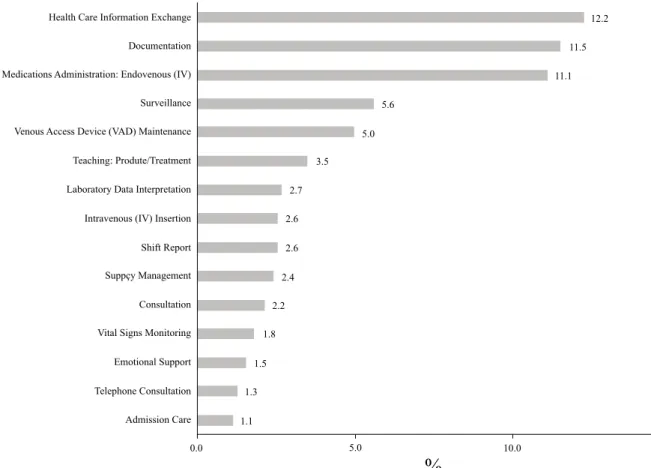
aciviies. Of the intervenions ideniied, the most com-mon were the exchange of informaion on health care (12.2%), documentaion (11.5%), and administraion of Endovenous medicaions (11.1%), (Figure 1). Indirect care aciviies accounted for 40.2% of the total intervenions/ aciviies, and direct care aciviies for 33.6%.
Chart 1 - Mean time of principal interventions performed by nurses in an oncology outpatient clinic – Brazil, 2012
Classiication NIC Nursing interventions/activities t (min) 95% CI
Direct Care
7910 Consultation 23.1 17.4-28.8
2240 Chemotherapy Management 8.3 4.2-12.5
1400 Pain Management 8.3 4.2-12.5
6200 Emergency Care 7.5 4.8-10.2
4238 Phlebotomy: Venous Blood Sample 7.5 4.8-10.2
2317 Subcutaneous Medication Administration 6.7 2.4-11.0
2312 Intramuscular Medication Administration 6.5 4.3-8.8
2380 Medication Management 6.4 2.9-9.9
7640 Critical Path Development 6.3 3.3-9.2
5270 Emotional Support 6.3 4.8-7.8
4190 Intravenous (IV) Insertion 6.3 5.0-7.7
Figure 1 - Mean daily frequencies of the main interventions/activities performed by nurses in an oncology outpatient clinic
Health Care Information Exchange
Documentation
Medications Administration: Endovenous (IV)
Surveillance
Venous Access Device (VAD) Maintenance
Teaching: Produte/Treatment
Laboratory Data Interpretation
Intravenous (IV) Insertion
Shift Report
Suppçy Management
Consultation
Vital Signs Monitoring
Emotional Support
Telephone Consultation
Admission Care
F
R
E
Q
U
E
N
C
Y
12.2
11.5
11.1
5.6
5.0
3.5
2.7
2.6
2.6
2.4
2.2
1.8
1.5
1.3
1.1
0.0 5.0 10.0
%
15.0Calculation of the mean time for interventions showed that the nurses spent more time on direct and indirect care such as: staff supervision = 27.2 min (range: 8.1–46.4 min), emergency cart checking = 23.3 min (range: 0.9–45.8 min), and consultations = 23.1 min (range: 17.4–28.8 min). Interventions that required less time (an average of 5 min) were admission care (range = 4.1–5.9 min); environmental management:
comfort (range = 3.9–6.1 min); medication adminis-tration: oral (range = 2.3–7.7 min), transport (range = 2.9–7.1 min), quality monitoring (range = 0.9–9.1 min), and consultation by telephone (Chart 1). It was not pos-sible to calculate the mean time for five interventions: gastrointestinal intubation, enteral tube feeding, physi-cian support, staff development, and routing and refer-ral because of insufficient samples.
diScUSSion
The indings of this study show that the nurses in the oncology outpaient clinic performed more indirect care intervenions/aciviies (40.2%) and spent more ime on these aciviies (43.2%). The predominance of ime spent on these aciviies has also been reported by other re-searchers, e.g., 47.3% (medical ward)(19), 72.5% (oncol-ogy hematol(oncol-ogy clinic)(13), and 39.1% (ambulatory care)(20).
However, it is diicult to compare results because these invesigaions used diferent methods and classiicaions.
The indirect care aciviies that required most ime in the oncology clinic were: staf supervision, emergency cart checking, and laboratory data interpretaion. The nurses spent 27.2 min on supervision; this is more than the 12.5 min observed in a Brazilian study performed in an emergency unit(7). Many protocols on the infusion of
chemotherapy drugs, paricularly invesigaional medi-cines, require more monitoring by nursing staf to control paients’ possible reacions(21). Thus, supervision is
essen-ial as a management tool to idenify strategies for team cooperaion to increase the efeciveness of care.
Emergency cart checking took 23 min on average. This is part of the daily rouine of the nurse who is responsible
for providing, organizing and maintaining materials, and equipment for emergency situaions(22). It is important to
stress that this acivity could be delegated to other pro-fessionals in the team so that nurses could prioriize their ime for value-added aciviies.
In the oncology outpaient clinic, the role of nurses in interpreing the paients’ laboratory data is to prevent or miigate complicaions arising from possible adverse ef-fects of chemotherapy drugs(21), including neutropenia,
which is indicaive of the risk of infecion. The interpre-taion of laboratory results took, on average, 19 min, and this is more than the ime used in emergency units (10 min)(7). It is important to menion that in the
outpa-ient clinic used in this study, nurses have autonomy to decide whether to administer anineoplasic drugs or not, depending on the interpretaion of paients’ blood results.
Direct care accounted for 33.2% of the ime of nurses, a percentage similar to other studies, i.e., 30% (surgical ward)(23), 35% (emergency department)(7), and 37%
(am-bulatory care)(24). However, other researchers found
high-er phigh-ercentages of 44% in a prevenive health unit(25).
The most common intervenions/aciviies performed were not those that demanded the most ime from nurses
Table 1 - Frequency, time, and percentage of time of interventions/activities performed by nurses in an oncology outpatient clinic – Brazil, 2012
Intervention/Activity Quantity t (min) %
Indirect care 598 4610 43.2
Direct care 499 3545 33.2
Associated 208 1240 11.6
Personal 182 1280 12.0
Total 1487 10675 100
Classiication NIC Nursing interventions/activities t (min) 95% CI
Direct Care
2314 Endovenous Medication Administration 6.2 5.6-6.8
2440 Venous Access Device (VAD) Maintenance 5.8 5.2-6.4
5618 Teaching: Procedure/Treatment 5.6 4.7-6.4
6680 Vital Signs Monitoring 5.4 4.6-6.1
7310 Admission Care 5.0 4.1-5.9
6482 Environmental Management: Comfort 5.0 3.9-6.1
2304 Oral Medication Administration 5.0 2.3-7.7
960 Transport 5.0 2.9-7.1
Indirect Care
7830 Staff Supervision 27.2 8.1-46.4
7660 Emergency Cart Checking 23.3 0.9-45.8
7690 Laboratory Data Interpretation 19.0 13.0-25.0
7840 Supply Management 8.1 5.9-10.2
7980 Incident Reporting 7.5 3.6-11.4
7960 Health Care Information Exchange 6.9 6.1-7.7
6650 Surveillance 6.2 5.4-7.0
8140 Shift Report 6.1 5.0-7.1
7920 Documentation 5.8 5.4-6.3
7800 Quality Monitoring 5.0 0.9-9.1
8180 Consultation by Telephone 5.0 5.0-5.0
Associated work 6.0 5.4-6.5
Personal activities 7.0 6.1-8.0
More ime was spent by nurses on the diferent
indi-rect care intervenions or aciviies (43.2%). Because 12% of the ime of nurses was spent on personal aciviies, the mean producivity was calculated at 88% (Table 1).
REFEREncES
1. Word Health Organizaion. Who global acion against cancer. Updated ediion, 2005 [Internet]. Geneva; 2005 [cited 2013 July 10]. Available from: htp://www.who.int/cancer/media/ en/GlobalAcionCancerEnglfull.pdf
2. Fundação Oncocentro de São Paulo. Atendimento oncológico do SUS [Internet]. São Paulo; 2012 [citado 2013 jul. 10]. Dis-ponível em: htp://www.fosp.saude.sp.gov.br/epidemiologia/ atendimento_sus.html
3. Chabot G, Fox M. The creaion of a paient-classiicaion sys-tem in an outpaient infusion center seing. Oncol Nurs Fo-rum. 2005;32(3):535-8.
4. Kamimura A, Schneider K, Lee CS, Crawford SD, Friese CR. Pracice environments of nurses in ambulatory oncology set-ings: a themaic analysis. Cancer Nurs. 2012;35(1):E1-7.
5. Cusack G, Jones-Wells A, Chisholm L. Paient intensity in an ambulatory oncology research center: a step forward for the ield of ambulatory care. Nurs Econ. 2004; 22(2):58-63.
such as health care informaion exchange (12%, 6.9 min) and documentaion (11.5%, 5.8 min). The direct care in-tervenions/aciviies that demanded the most ime were consultaions (23 min), chemotherapy management (8.3 min), and pain management (8.3 min). An esimated ime of 30–60 min was reported in a study that included con-sultaions as one acivity in a complexity raing system of oncology outpaient clinics(5).
Chemotherapy management was second in the rank-ing of direct care intervenions that demanded the most ime from nurses. One acivity related to this intervenion was informing the paient/family about the mechanism of acion of anineoplasic agents. Nurses working in on-cology areas play an important role in educaing paients about chemotherapy treatment(6). An Australian study
performed in an oncology hematology center(13) showed
that nurses in the unit needed approximately 13 min per paient for counseling and educaion.
Pain management is an important factor in the manage-ment of cancer-related symptoms. The cancer nurse cares for paients iniially by assessing their pain and subsequently by providing informaion on the best use of medicaions for pain control(21). The ime spent on this intervenion in the
ou-tpaient clinic for this study was 8.3 min and thus, similar to another invesigaion in an emergency room (10 min)(7).
Personal aciviies took up 12% of the shit of nurses, and this was similar to the indings of other researchers who reported 13.5% (medical ward)(19) and 14% (outpaient
clinic)(24); this was less ime compared with the reports of
other researchers such as 16% (Prevenive health unit)(25),
18% (emergency room)(7), and 19.9% (outpaient clinic)(20).
Associated work corresponded to 11.6% of the ime of the nurses, similar to that in an emergency room 12%(7), and
in other Brazilian publicaions, this was 7% (Prevenive heal-th unit)(25). These associated work aciviies included making
phone calls, requesing paient records and chemotherapy medicaions from the pharmacy, and escoring paients to other units.
The reasons why nurses perform aciviies that could be performed by other professionals have been quesioned. So-me hypotheses include because nurses feel safer performing
simpler aciviies perhaps as a mechanism of escaping from the pressures of caring for paients(26) and because other
professionals do not perform the tasks correctly(27). Another
reason is related to bureaucraic decisions of health care ins-ituions where the nursing team needs to accept certain res-ponsibiliies in response to policies to reduce support servi-ces and costs(26). Measurement of the ime spent performing
associated work enables insituions to review and redesign work processes(23) to minimize the ime spent on
non-nur-sing aciviies(28) and ensuring beter collaboraion between
ancillary team members and the nursing staf. Producivity takes on an important role because it supports decisions re-lated to personnel management and resource allocaion(8).
Producivity levels below 80% indicate a greater like-lihood that nurses are saisied with their work and there is reduced absenteeism(29), while levels above 80% lead to
increased costs and reducions in the quality of care(30).
Therefore, these study indings indicate work overload and deserve atenion by nursing managers to adopt stra-tegies to ensure the safety of paients and workers alike.
concLUSion
The indings of this study show that nurses in an out-paient oncology clinic (chemotherapy) spent most of their ime on indirect care aciviies. The producivity of these nurses is above that recorded in the literature.
Study limitaions
This study took place in a single insituion, thereby making generalizaion of the indings diicult. In addiion, only the mean ime and percentage of ime spent by nurs-es in performing intervenions/aciviinurs-es were calculated, and this provides only a parial view of the worklow and producivity of the nursing team.
Implicaions for nursing pracice
Funding source
Financial support by a Scholarship Assistance Grant to the researcher (BAP), Medicine School in São José do Rio Preto (FAMERP - process nº4331/2010).
6. Quinn A. Expanding the role of the oncology nurse. Biomed Imaging Interv J. 2008;4(3):e34.
7. Garcia EA, Fugulin FMT. Nurses’work ime distribuion at emergency service. Rev Esc Enferm USP [Internet]. 2010 [ci-ted 2013 July 10];44(4):1032-8. Available from: htp://www. scielo.br/pdf/reeusp/v44n4/en_25.pdf
8. Medvec BR. Producivity and workload mensurement in am-bulatory oncology. Semin Oncol Nurs. 1994;10(4):288-95.
9. Swan BA, Griin KF. Measuring nursing workload in ambula-tory care. Nurs Econ. 2005;23(5):253-60.
10. DeLisle J. Designing an acuity tool for an ambulatory oncolo-gy seing. Clin J Oncol Nurs. 2009;13(1):45-50.
11. Campbell S, Hallgren L, Kamitomo V, Catedral C. Chemothe-rapy drug administraion: a beginning survey of chemothe-rapy as a workload index. Cancer Nurs. 1984;7(3):213-20.
12. Verran JA. Paient classiicaion in ambulatory care. Nurs Econ. 1986;4(5):247-51.
13. Blay N, Cairns J, Chisholm J, O’Baugh J. Research into the workload and roles of oncology nurses within an outpaient oncology unit. Eur J Oncol Nurs. 2002;6(1):6-12.
14. Finkler SA, Knickman JR, Hendrickson G, Lipkin M Jr, Thomp-son WG. A compariThomp-son of work-sampling and ime-and-moion techniques for studies in health services research. Health Serv Res. 1993;28(5):577-97.
15. Dochterman JM, Bulechek GM. Classiicação das Interven-ções de Enfermagem (NIC). Porto Alegre: Artmed; 2008.
16. Polit DF, Hungler BP, Beck CT. Nursing research: principles and methods. Philadelphia: Lippincot Williams & Wilkins; 2011. Measurement and data collecion; p. 315-37.
17. Souza CA, Perroca MG, Jericó MC. Mapping the nurses in-tervenions and aciviies in a Chemotherapy Center: a tool for assessing the workload. Rev Laino Am Enferm. 2013;21(2):492-9.
18. Hurst K. Selecing and applying methods for esimaing the size and mix of nursing teams: a systemaic review of litera-ture commissioned by the Department of Health [Internet]. 2002 [cited 2013 July 10]. Available from: htp://www.who. int/hrh/documents/hurst_mainreport.pdf
19. Chaboyer W, Wallis M, Duield C, Courtney M, Seaton P, Hol-zhauser K, et al. A comparison of aciviies undertaken by en-rolled and registered nurses on medical wards in Australia: an observaional study. Int J Nurs Stud. 2008;45(9):1274-84.
20. Mayer GG. Work sampling in ambulatory care nursing. Nurs Manage. 1992;23(9):52-6.
21. Mick J. Factors afecing the evoluion of oncology nursing care. Clin J Oncol Nurs. 2008;12(2):307-13.
22. Gabbot D, Smith G, Mitchell S, Colquhoun M, Nolan J, Soar J, et al.; Royal College of Anaestheists; Royal College of Physi-cians of London; Intensive Care Society; Resuscitaion Coun-cil Cardiopulmonary resuscitaion standards for clinical prac-ice and training in the UK. Resuscitaion. 2005;64(1):13-9.
23. Upenieks VV. Work sampling: assessing nursing eiciency. Nurs Manage. 1998;29(4):27-9.
24. Urden LD, Roode JL. Work sampling: a decision-making tool for determining resources and work redesign. J Nurs Adm. 1997;27(9):34-41.
25. Bonim D, Gaidzinski RR, Santos FM, Gonçales CS, Fugulin FMT. The ideniicaion of nursing intervenions in Primary Health Care: a parameter for personnel staing. Rev Esc En-ferm USP [Internet]. 2012 [cited 2013 July 10];46(6):1462-70. Available from: htp://www.scielo.br/pdf/reeusp/ v46n6/en_25.pdf
26. Wejr P. Non-nursing duies [Internet]. 2010 [cited 2013 July 10]. Available from: htp://www.thinknursing.ca/sites/ thinknursing.ca/iles/Non_Nursing_Duies.pdf
27. Prescot PA, Phillips CY, Ryan JW, Thompson KO. Chan-ging how nurses spend their ime. Image J Nurs Scholarsh. 1991;23(1):23-8.
28. Thompson P, Stanowski A. Maximizing nursing producivity: the beneits of improved collaboraion between nursing and support services: building a stronger collaboraion between nurses and support services personnel can have posiive i-nancial and quality implicaions for hospitals. Healthc Financ Manage. 2009;63(1):76-85.
29. O’ Brien-Pallas L, Thomson D, Hall LM, Pink G, Kerr M, Wang S, et al. Evidence-based standards for measuring nurse sta-ing and performance. Report for the Canadian Health Ser-vices Research Foundaion, 2003. Otawa: Canadian Health Services Research Foundaion; 2004.