Supplemental nursing staff´s experiences at a
Spanish hospital: Qualitative phenomenology
research
O
riginal
a
r
ticle
Yolanda Raquel Lapeña-Moñux1, Luis Cibanal-Juan2, Mª Isabel Orts-Cortés3, Mª Loreto Maciá-Soler4, Domingo Palacios-Ceña5
A experiênciA dAs enfermeirAs de turno num hospitAl espAnhol: estudo quAlitAtivo-fenomenológico
lA experienciA de lAs enfermerAs “de Apoyo” en un hospitAl espAñol: estudio cuAlitAtivo fenomenológico
1 phd, Assistant lecturer of the department of nursing, university Jaume i, castellón de la plana, spain. 2 phd, professor of the department of nursing,
university of Alicante, Alicante, spain. 3 phd, professor and director of the department of nursing, university Jaume i, castellón de la plana, spain. 4 phd,
professor of the department of nursing, university of Alicante, Alicante, spain. 5 phd, professor of the department of physical therapy, occupational
doi: 10.1590/s0080-623420140000800010
ReSuMO
O propósito deste estudo é descrever a experiência das enfermeiras de turno nas diferentes unidades hospitalares. Seguiu--se um enfoque fenomenológico e
qualita-ivo. Realizamos uma amostragem teórica
com o pessoal de enfermagem de turno do Hospital Santa Bárbara de Soria (Espanha),
com a inalidade de obter uma compreen -são mais profunda do fenômeno. Os dados foram coletados a través de entrevistas e de diário de campo. Os dados foram ana-lisados usando a proposta de Giorgi. 21 enfermeiros de turno com uma média de idade de 46 anos foram incluídos. Três te-mas principais, que descrevem a experiên-cia das enfermeiras, emergiram dos dados: construindo o primeiro contato, buscando um espaço e estabelecendo relações
inter-proissionais/interpressoais. Concluimos
que a experiência de acolher as enfermei-ras de turno em ambientes clínicos mutá-veis está condicionada por diferentes
fato-res. É preciso estabelecer objeivos claros a
respeito do papel das enfermeiras de turno nas unidades por parte de enfermeiras e gestores.
DeSCRItOReS
Enfermagem Enfermeiras de turno Administração Hospitalar Hospitais
Pesquisa Qualitaiva
AbStRACt
The objecive of this study was to describe the Supplemental Nursing Staf´s experi
-ences at diferent hospital units. A qualita
-ive phenomenological approach was con
-ducted; a purposeful and theoreical sam
-pling was implemented with supplemental nursing staf at Santa Barbara Hospital of
Soria (Spain), to gain a more in-depth un-derstanding of the Supplemental Nursing
Staf ´s experience. Data were collected by in-depth interviews and through a ield notebook. Data were analyzed using the Giorgi proposal. Twenty-one nurses with a mean age of 46 years were included. Three main topics emerged from the data analy
-sis: building the irst contact, carving out a niche and establishing interprofessional/ interpersonal relaionships. We conclude that the experience of hosing the supple
-mental nursing staf in changing clinical en
-vironments is condiioned by various fac
-tors. It is necessary for nurses and hospital managers to establish clear objecives with regard to the supplemental nursing staf´s
role in the units.
DeSCRIPtORS
Nursing
Supplemental Nursing Staf
Organizaion and Administraion hospital
Hospitals
Qualitaive Research
ReSuMen
El propósito de este estudio es describir la
experiencia de las enfermeras “de apoyo” en las diferentes unidades de hospitaliza -ción. Seguimos un enfoque
fenomenológi-co cualitaivo. Realizamos un muestreo por propósito y teórico de dicho personal del
Hospital Santa Bárbara de Soria (España),
con el in de obtener una comprensión más
profunda del fenómeno. Los datos fueron recolectados a través de entrevistas en
profundidad y diario de campo. Los datos fueron analizados usando la propuesta de Giorgi. Veiniuna enfermeras “de apoyo”
con una media de edad de 46 años fueron incluidos. Tres temas principales que des-criben la experiencia de los enfermeros
emergieron de los datos: construyendo el primer contacto, buscando un hueco y es
-tableciendo relaciones interprofesionales/ interpersonales. Concluimos que la expe -riencia de acoger dichas enfermeras en entornos clínicos cambiantes esta condi-cionada por diferentes factores. Es preciso
establecer objeivos claros respecto al rol
de las mismas en las unidades por
enfer-meras y gestores.
DeSCRIPtOReS
Enfermería Enfermeras volantes
Organización hospitalaria
Hospitales
IntRODuCtIOn
Nowadays, hospitals must adapt to the coninuous changes that exist in everyday clinical care. These changes lead to the need for nursing staing for various reasons
(absence of permanent nurses (PN), workload, etc.)(1,2).
Health centres shall pay atenion to the management
of human resources, focusing on professional skills(3,4),
avoid the mismatch between nurses’ training and the
skills required for the job, and encourage nurses’ post
-graduate coninuing educaion(5,6).
Variability in nursing staing and job rotaions has se
-rious implicaions for the workload, the quality of care
and the increase in the cost of care(7). Therefore, the
same staf should be kept in the diferent units to allow
these to gain experience and training in the manage-ment of care.
Other studies have shown advantages of job rotaion such as learning new skills and techniques, eliminaing the
faigue caused by rouine work and facilitaing the knowl
-edge of other units; which, ulimately, improve job sais
-facion and organizaional commitment(2,8).
In Spain, the average number of nurses per 1000
in-patients is 5.28, well below the average of OECD coun
-tries (8´7)(9). This means that there is a low nursing cov
-erage in the Spanish health system, which might cause a significant impact on the population’s health with
regard to nursing care in health promotion, disease prevention and the clinical care provided in healthcare
institutions. This nursing shortage is covered by pro
-fessional nurses called “Supplemental Nursing Staff” (SNS). SNS belong to the same workplace, depend on
the Nursing Management Team (NMT), don’t have a
fixed allocation unit and rotate throughout the various
hospital units depending on the organization of work
and usually have less professional experience but simi
-lar training(1,2).
In USA, some authors explain how supplemental nurses are used to strengthen staing in the short term. These may
belong to the same centre or come from an outside agency(10).
Most of the studies conducted internaionally focus on
the evaluaion of adverse events in paient care associat
-ed with the presence of SNS(1,2,10). Other results show how
hospitals with a greater number of SNS have worse health
outcomes (greater number of falls, readmissions, etc.) in
relaion to their educaion level, as most of them hold a
high school or GCE diploma(1). Likewise, other authors de
-scribe how staing shortage covered by SNS involves an
increase in the risk of nosocomial infecions within surgi
-cal units(2).
This is the first research study in Spain that aims to understand the SNS’s experiences. The aim of this
study was to describe the SNS´s experiences at a Span
-ish hospital.
MetHOD
Design: A phenomenological qualitative research
based on Giorgi’s analysis was conducted(11). Qualitative
studies are used to achieve a deeper understanding
of, and find explanations for people’s behaviour under
specific circumstances, such as disease or social exclu-sion(12). The main characteristic of this qualitative
meth-odology is that the researcher is intimately involved in data collection and analysis; data collection requires the researcher to interact with the study participants and their social context, which allows some degree of
mutual influence. Phenomenological studies tend to
understand how individuals construct their worldview.
Therefore, the qualitative design uses first-person nar-ratives from the SNS(11).
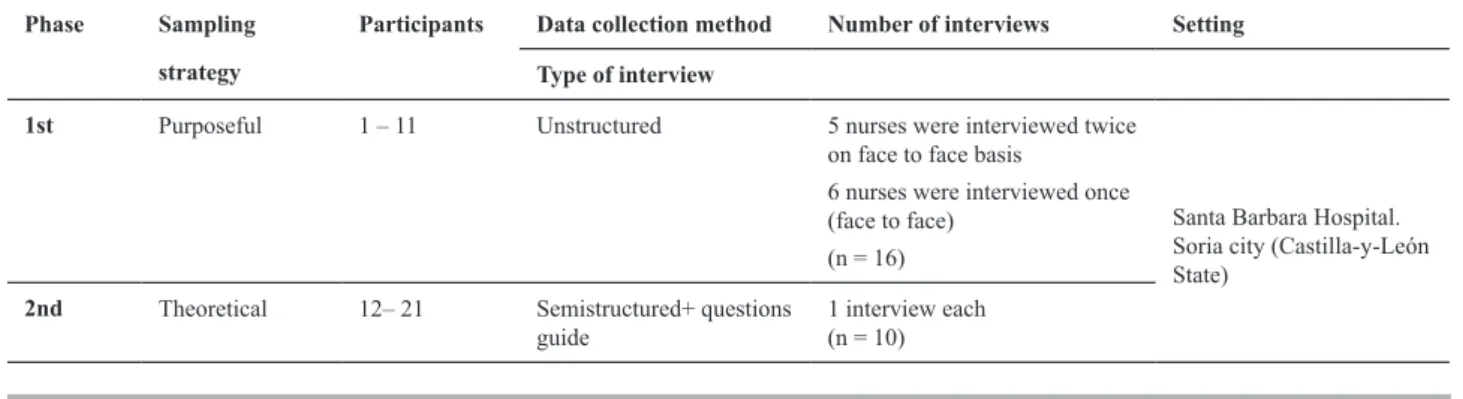
Sampling strategies: A two-phase sampling strategy
was employed. The irst phase involved purposeful sam
-pling to gather informaion from nurses themselves. The purposeful sampling was performed within the various
clinical units to enhance the wealth of informaion(13). The
second phase involved theoreical or in-depth sampling
of the remaining nurses to gain a deeper understanding
of speciic aspects of the informaion retrieved during the irst phase(12) (Table 1).
Table 1 - Sampling strategies and data collection method.
Phase Sampling
strategy
Participants Data collection method Number of interviews Setting
Type of interview
1st Purposeful 1 – 11 Unstructured 5 nurses were interviewed twice
on face to face basis
6 nurses were interviewed once (face to face)
(n = 16)
Santa Barbara Hospital. Soria city (Castilla-y-León State)
2nd Theoretical 12– 21 Semistructured+ questions
guide
Paricipants:Inclusion criteria consisted of: SNS from
Santa Barbara city Hospital in Soria (Casilla-y-León State, Spain); having been working in the hospital during the
ime the research study was conducted, and having be
-longed to the group of SNS for at least 1 year. Twenty-one
nurses with a mean age of 46 were included; no one with
-drew from the study. Paricipants coninued to be includ
-ed in the study unil no new informaion was obtain-ed. Nurses were not excluded on the basis of their gender or the king of services of units where they were worked.
Procedure: Researchers made an iniial contact with
the nurses through the Nurse Manager in each unit. Re
-searchers explained the purpose and design of the study to the nurses on a irst face-to-face contact. A two-week period was then allowed for nurses to decide whether or not they wished to paricipate. At the second face-to-face contact, they were asked to give informed consent and
permission to tape the interviews if they wished to parici
-pate in the study. Following this, data was collected and the interview was completed.
Data collecion method:Data was collected over a pe
-riod of 1.5 years, from February 2010 to June 2011.Data
collecion methodology followed the sampling methods
as outlined in Table 1. The irst phase consisted of unstruc
-tured interviews(14), beginning with the following ques
-ion: What is your experience as SNS?; the aim was to look
for emerging themes and topics that could be further
ex-panded upon during the second phase of the study.
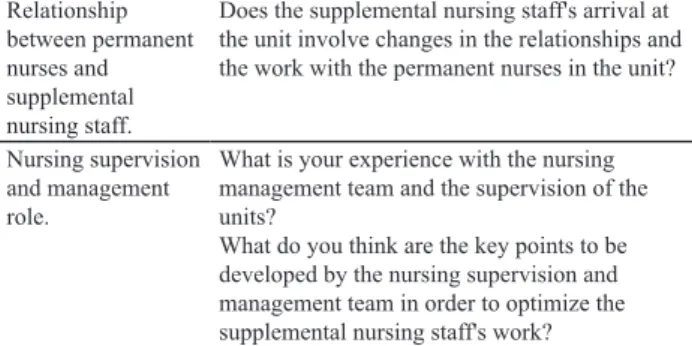
The second phase consisted of semi-structured
in-terviews based on a quesions guide (Table 2) aimed at eliciing further informaion regarding speciic themes and topics of interest which had emerged from the irst round of interviews. The quesion guide was developed ater reviewing the nurses’ accounts obtained during the purposeful sampling and following a literature review. It consisted of direct, open quesions to allow nurses to share their own experiences. The interviews were tape-recorded and transcribed verbaim.
Table 2 - Questions guide for the semi-structured interview.
Research topics Questions asked
Work organization within the unit.
Does the supplemental nursing staff's arrival at a unit at a time of great workload affect the normal development of this work?
How do you adapt to the different units? What is your experience with the distribution and organization of work in the different units? Integration of
supplemental nursing staff.
How do you perceive your reception when you
irst arrive at a unit?
What was your experience like when arriving at a new unit on other occasions?
What do you think is the most important aspect in the supplemental nursing staff's reception?
...continuation
Relationship between permanent nurses and supplemental nursing staff.
Does the supplemental nursing staff's arrival at the unit involve changes in the relationships and the work with the permanent nurses in the unit?
Nursing supervision and management role.
What is your experience with the nursing management team and the supervision of the units?
What do you think are the key points to be developed by the nursing supervision and management team in order to optimize the supplemental nursing staff's work?
During the interview, the researcher made notes inclu
-ding environment descripion, nurses’ non-verbal respon
-ses to quesions, the use of metaphors in their narraives and other relevant points raised by the interviewed nurse.
A total of 26 interviews involving 21 nurses were con
-ducted: 11 were unstructured interviews (phase 1), and 10 were semi-structured interviews (phase 2). The interviews
produced recordings totalling 1988.78 minutes (33.14
hours). Documentaion of approximately 14-16 pages was produced from each of the interviews. All interviews were
conducted at the Hospital.
Data analysis:Texts were collated to allow qualitaive
analysis to be performed(11). The Giorgi method, which
consists of 4 essenial steps, was used to implement quali
-taive analysis of data(15): a) The enire descripion is read
over in order to get a general sense of the whole statement;
b) Once the sense of the whole has been grasped, the re
-searcher goes back to the beginning and reads through
the text once more with the speciic aim of discriminaing
`meaning units´ from within the perspecive and with fo
-cus on the phenomenon being researched; c) Once
`mean-ing units´ have been delineated, the researcher then goes
through all of the meaning units and express the insight
contained in them more directly; d) Finally, the researcher
synthesizes all of the transformed meaning units into a con
-sistent statement regarding the subject´s experience.
Quality consideraions: Guidelines for conducing
qualitaive studies established by the Consolidated Cri
-teria for Reporing Qualitaive Research (COREQ)(16) were
followed.
The data reliability method consisted of: a) cross-trian
-gulaion by the researcher, which included session planning
where the cases analysed by each team member were pre
-sented in order to reach consensus; b) audiing the material obtained from 10 randomly selected cases by an external
researcher(17); and c) nurse veriicaion(11,17). The nurse´s ver
-iicaion was carried out in two steps: post-interview and post-analysis. To allow transferability, researchers provided suicient detail on the context of the ieldwork for the
-applied to the other seing. Details of the context are: the number of paricipants involved in the ieldwork; the data
collecion method employed; the number of the data col
-lecion sessions; and the length of the study.
This study was reviewed and approved by the Health Research Unit in Soria (Spain), the insituion in which the study was conducted and which gave its approval on April
27, 2010. Special atenion was given to the ethical con
-sideraions related to the data collecion tools used (in
-terviews and researcher ield notes), and to the treatment
and management of personal data. Permission to record
the interviews was always sought prior to their being per
-formed. Informed consent was obtained beforehand and
in the event of any emoional response during the inter
-views, the paricipant was ofered the possibility to either suspend the interview or withdraw the study. All personal
data and informaion that might idenify nurses was re
-placed with a numerical code.
ReSuLtS
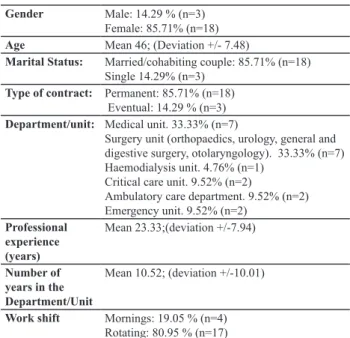
Table 3 shows details of the socio-demographic data for the 21 nurses included in the study. The length of duty in Hospital was variable and ranged between 1 and 59 years, with a mean of 10.52 years. Most nurses worked at
medical and surgical units (66.66%).
Table 3 - Sociodemographic data.
Gender Male: 14.29 % (n=3) Female: 85.71% (n=18)
Age Mean 46; (Deviation +/- 7.48)
Marital Status: Married/cohabiting couple: 85.71% (n=18) Single 14.29% (n=3)
Type of contract: Permanent: 85.71% (n=18) Eventual: 14.29 % (n=3) Department/unit: Medical unit. 33.33% (n=7)
Surgery unit (orthopaedics, urology, general and digestive surgery, otolaryngology). 33.33% (n=7) Haemodialysis unit. 4.76% (n=1)
Critical care unit. 9.52% (n=2)
Ambulatory care department. 9.52% (n=2) Emergency unit. 9.52% (n=2)
Professional experience (years)
Mean 23.33;(deviation +/-7.94)
Number of years in the Department/Unit
Mean 10.52; (deviation +/-10.01)
Work shift Mornings: 19.05 % (n=4) Rotating: 80.95 % (n=17)
The themes that represent the SNS´s experiences at a Spanish hospital were extracted from the interviews. Three speciic themes emerged from the analyzed material: a)
building the irst contact, b) carving out a niche, and c) es
-tablishing interprofessional/interpersonal relaionships.
Building the irst contact
This refers to every element that facilitates and/or hin
-ders the establishment of a irst contact between the SNS and the PNs who work in diferent units.
The SNS highlight the key importance of the irst con
-tact with the PNs for the efeciveness of work and work
-ing relaionships. Dur-ing this, the PN shall develop skills such as acive listening and empathy in order to reassure
and guide the SNS.
“How you feel when you are welcomed the irst time is going to inluence the development of all your work. If you
are well welcomed, you’ll be willing to help and you’ll do your best to get the job done ... “(nurse8-interview)
In their accounts, the SNS described their feeling
uncertain, nervous and stressed when they arrived at
the unit.Some of them felt fear, panic to new things,
especially to sounds and alarms, which usually coin
-cide with their going to units such as the intensive
care unit.
“There are certain units you get to with real fear, and I am terriied of the devices I’ll ind there and I’ll have no idea how to use”. (Nurse15-interview)
Similarly, some nurses described their sufering at cer
-tain imes.
“Being hired as sns has caused me much stress. i feel safer if i’m in the same job position every day because i
know how it works. I’m in control.” (Nurse8-interview).
Carving out a niche
This theme refers to how the SNS should work within
a changing clinical environment, in the absence of a
refer-ence unit, with unknown paients and an adverse environ
-ment, where they must “ind their place”.
The SNS’s main role is to deal with any unexpected medical care within the hospital during any shit. This makes them feel like “hospital ire-ighters”.
“I hardly ever know where I’m going to work. I accept I extinguish ires anywhere in the hospital. When I get to my shift, I am told where I have to go to work. There is no
programming.” (nurse8-interview)
The excessive mobility to which SNS are subjected, even within the same work shit, is considered by them as one of the greatest diiculies.
“... i came in the morning and i was sent to a unit, but that
very morning I worked in three different places...”. (Nur -se12-interview)
This group of professionals is afected by the inability to achieve experise and/or gain certain skills and abiliies
related to their job specializaion due to their constant ro
“the worst thing is that you don’t get to control things you have to do because you’re constantly changing and of course this affects the quality of care.” (nurse18-interview)
“...you don’t have a physical department to which you
be-long, which involves drawbacks such as the lack of loca
-tion, materials, techniques, treatments and speciic care of
the unit, the inability to specialize in a particular area ...” (nurse17-interview).
Establishing interprofessional/interpersonal relaionships
This theme focuses on how SNS establish interprofes
-sional and interpersonal relaionships with nurses from
other units and other professionals such as doctors, nurse
assistant, laboratory technicians, etc.
SNS feel that when they happen to meet other nurses who have carried out this very role, they ind it easy to empathize.
“there are colleagues who don’t empathize with us, they
just don’t care. I’ve met other nurses who have worked as SNS like me and they treat me better, they help me with
the protocols used ... i wonder: “if they had to spend a day in a certain unit and the next in a different one and start from scratch, how would they feel?” (nurse4-interview)
Some paricipants consider the PNs and the NMT’s aitude towards the SNS and their work in the unit as a key element to develop a good working environment and good relaionships. Nurses describe how the PNs judge the SNS and their ability to work, without considering their situaion, just as the nursing
management team does not consider or control the
environ-ment the SNS face when they arrive at the new units.
“We feel unhappy, but unit nurses feel the same way, and
that affects the quality of our care. in this regard, the ma-nagement team should be more responsible, we are not a number ... “. (nurse10-interview)
“... the nursing management team leaves us to the unit
nurses’ fate and good mood, who seldom ask about your
preferences and experiences or the way you feel when you are given a destination” (nurse5 -interview).
DISCuSSIOn
Building the irst contact
The SNS usually work in diferent units even in the same work shit and establish relaionships with muliple
professionals.
Generally, the arrival at a new unit makes the new professional perceive both environmental (shit rotaions,
high job demand, inability to reach physicians) and profes
-sional simuli (role ambiguity, lack of knowledge and skills)
that cause them a sensory overload(18).
In our research study, supplemental nurses empha
-well as the PNs’ aitude in their recepion. According to
various research studies(19,20), a posiive feedback from
an experienced professional to a novel professional may result in the improvement of their recepion, recogniion
and learning opportunity. Likewise, the experienced per
-manent staf’s empathic abilityhelps the newly hired staf
to atain the objecives set in each unit(21).
The SNS’s aitude upon their arrival at the new unit
will condiion their socializaion process during their work
-day. Consistent with our results, previous studies show how SNS experience diferent feelings about the rotaion
process throughout the various units: funcional impair
-ment, communicaion problems and inability to take re
-sponsibility, stress related to the workload, interpersonal relaionships and lack of support, afecing their physical
and mental health(22,23).
These feelings are strengthened when the work is
carried out at special units such as intensive care units
(ICU). In this regard, some authors show that most nurs
-es who rotate through the ICU feel they must constantly prove their knowledge and skills to be accepted by their
colleagues(20). Consistent with our results, other authors
show that the conidence gained when doing things well,
mastering the tasks carried out within the unit and enjoy
-ing work command contribute to enhance the adaptaion
to the frequent changes throughout the units(24). In Spain,
one research show that 36% of the SNS disagreed on ro
-taing to other units for fear of criicism, and 31% did not
want to be SNS for fear of not being accepted(7).
Carving out a niche
Every ime NSN are sent to a paricular unit and must adapt to its working reality. Therefore, these professionals
must have suicient ime to adapt to the new team’s cul
-ture. In this regard, it is highly important for these rotaing professionals to be accepted in the team, which also means
their having found a “niche”(25). In our study, it can be ob
-served that SNS don’t know the unit they are to work in un
-il they start their workday. This means they have a certain period of ime to adapt and this will afect their ability to establish social bonds with the rest of the team.
In this line, according to other researches, no nurses
de-scribed posiive experiences when were changed to a dif
-ferent unit in the rotaion process established by the hospi
-tal. Instead, they showed high levels of stress, anxiety and uncertainty towards the new locaion. Similar results are
obtained from our paricipants’ accounts(26). However, ac
-cording to these, some of the interviewed nurses described their having to rotate to up to three diferent units in the same working day, which made them feel out of control.
On the other hand, Benner describes the process of clinical judgment and skill development at 5 levels of
pro-iciency: Novice, advanced beginner, competent, proi
Previous studies show how feeling part of the team facili
-tate achieving a level of expert, which can only be obtained once you’ve been working at least one year in the same unit(18).
Establishing interprofessional/interpersonal relaionships
The presence of new nurses implies a work overload for the rest of nurses and involves a diicult relaionship
with the most experienced staf(18).
In our results, nurses report their feeling understood
by the PN who had belonged to the group of “SNS”. Not
so for those PNs that are not able to understand the
newcomers’ insecuriies, as they believe these shall go
through all the stages, as they did in their day(26).
Therefore, when there is a rejecion from the PNs towards the SNS, isolaion and marginalizaion occurs,
staring the vicious circle of rejecion-isolaion-lack of re
-laionships-poor quality of work. Likewise, when there is a mutual respecful relaionship between all professionals
results in a greater work efeciveness and mutual learn
-ing, which is posiive for everyone(28).
The unit supervisor and the hospital NMT’s aitude condiion the SNS’s recepion in the units throughout which they rotate. Thus, a study show most new nurses
stated having received an unprofessional behaviour on the part of their experienced colleagues in both the
tran-siion and integraion process. Furthermore, unit supervi
-sors did not know exactly about the new nurses’ behav
-iour at the diferent units(23).
Other authors describe how the unit assigning process carried out by the managers shall aim at building experise
in order to provide an outstanding care(7). Thus, the NMT
should assign the units based on the SNS’s experience and training, facilitate friendship between equals, especially in the irst months of employment, as well as try to ind the
balance between the hospital and these professionals’ ex
-pectaions(29). In our study, nurses state that their prefer
-ences are not heard when being assigned a hospital unit.
In this line, other study state that nearly 70% of new nurses undergo an adaptaion program in their irst days of employment, in which they were assigned a clinical unit of their choice, allowing them to assimilate the challenges of the new environment and gain more responsibility and knowledge(25).
In Spain, other researches show that the SNS’s dispersion among diferent workspaces hinders the establishment of
stable relaionships with paients, colleagues and work(30).
Limitaions
There are some limitaions in the current study. Firstly,
some nurses stated their being concerned about
express-ing their opinion, as they were afraid their job provision might change as a result of this. However, to counter this,
nurses were reassured that all the researchers were sepa
-rate from the manager team, and all discussions would be conidenial. Finally, since this is a qualitaive research conducted within a speciic context, that of a country in the South Europe, similar qualitaive studies should be
carried out in muliple environments to gain a beter un
-derstanding of the phenomenon.
COnCLuSIOnS
The PNs’ aitude and involvement of PN and NMT in
-luences the SNS’s adapive capacity to the units and the
establishment of interprofesssional relaionships. It is ne
-cessary to avoid frequent changes of units and assign a PN
to guide and support the SNS.
The results of this study can be used by the hospital MT to improve the SNS’s daily work. Understanding the
PNs’ percepion can help develop more realisic environ
-ments within clinical seings. SNS’s integraion programs need to be developed within the units. Introducing joint acion protocols will improve the SNS’s work efeciveness and ensure a greater quality of care.
ReFeRenCeS
1. Aiken LH, Shang J, Xue Y, Sloane DM. Hospital Use of Agency
--Employed Supplemental Nurses and Paient Mortality and Failure to Rescue. Health Serv Res.2013;48(3):931-48.
2. Xue Y, Smith J, Freund DA, Aiken LH. Supplemental nurses
are just as educated, slightly less experienced, and more di
-verse compared to permanent nurses. Health Af (Millwood).
2012;31(11):2510-7.
3. Aiken LH, Sloane DM, Bruyneel L, Van den Heede K, Sermeus
W; RN4CAST Consorium. 2013. Nurses´s reports of working condiions and hospital quality of care in 12 countries in Euro -pe. Int J Nurs Stud. 2013;50(2):143-53.
4. Sermeus W, Aiken LH, Van den Heede K, Raferty AM, Griiths P, Moreno-Casbas MT, Busse R, Lindqvist R, Scot AP, Bruy
-neel L, Brzostek T, Kinnunen J,Schubert M, Schoonhoven L,
Zikos D; RN4CAST Consorium. Nurse forecasing in Europe
(RN4CAST): Raionale, design and methodology. BMC Nurs. 2011;(10):6. doi: 10.1186/1472-6955-10-6.
5. Fuentelsaz C, Moreno T, López D, Gómez T, González E; Con
-sorcio RN4CAST-España. 2012. Percepción del entorno labo -ral de las enfermeras españolas en los hospitales del Sistema
Nacional de Salud. Proyecto RN4CAST-España. Enferm Clin.
6. Aiken LH, Cimioi JP, Sloane DM, Smith HL, Flynn L, Nef
DF. Efects of nurse staing and nurse educaion on paient deaths in hospitals with diferent nurse work environments. J
Nurs Adm. 2012;42(10 Suppl):S10-6.
7. Gracia R, Mendoza L, Acosta, MO. Acitud del personal de en
-fermería ante el proceso administraivo de rotación por los servicios hospitalarios. Rev Enferm IMSS. 2003;11(1):35-42.
8. Wen H, Ching C, Ying S, Rong L. Efects of job rotaion and role
stress among nurses on job saisfacion and organizaional commitment. BMC Health Serv Res. 2009;9:8.
9. OECD Spain, The Organisaion for Economic Co-operaion and
Development. htp://www.oecd.org/spain/. Updated May 2, 2013. Accessed February 12, 2014.
10. Aiken LH, Xue Y, Clarke SP, Sloane DM. Supplemental Nurse
Staing in Hospitals and Quality of Care. J Nurs Adm.
2007;37(7-8):335-342.
11. Giorgi AP. The theory, pracice and evaluaion of the phe
-nomenological method as a qualitaive research procedure. J Phenomenol Psychol. 1997;28(2):235-260.
12. Kuper A, Reeves S, Levinson W. An introducion to reading
and appraising qualitaive research. BMJ. 2008;(337):a288.
doi: 10.1136/bmj.a288.
13. Green J, Thorogood N. Qualitaive Methods for Health Re -search. London, Sage; 2009.
14. Murray SA, Kendall M, Carduf E, Worth A, Harris FM, Lloyd
A, Cavers D, Grant L, Sheikh A. Use of serial qualitaive in
-terviews to understand paients’ evolving experiences and needs. BMJ. 2009;(339):b3702. doi: 10.1136/bmj.b3702.
15. Giorgi AP. Concerning the Applicaion of Phenomenology to
Caring Research. Scand J Caring Sci. 2000;14(1):11-5.
16. Tong A, Sainsbury P, Craig J. Consolidated criteria for reporing
qualitaive research (COREQ): a 32-item checklist for interviews and focus groups. Int J Qual Health Care.2007;19(6):349-57.
17. Cohen DJ, Crabtree BF. Evaluaive criteria for qualitaive re
-search in health care: controversies and recommendaions. Ann Fam Med. 2008;6(4):331-9.
18. Feng RF, Tsai YF. Socialisaion of new graduate nurses to
pracising nurses. J Clin Nurs. 2012;21(13-14):2064-71.
19. Phillips C, Kenny A, Esterman A, Smith C. A secondary data
analysis examining the needs of graduate nurses in their tran
-siion to a new role. Nurse Educ Pract. 2014;14(2):106-111.
20. Saghai F, Hardy J, Hillege S. New graduate nurses’ experi
-ences of interacions in the criical care unit. Contemp
Nurse. 2012;42(1):20-7.
21. Ito M, Lambert V.A. Communicaion efeciveness of nurses
working in a variety of seings within one large university tea
-ching hospital in western Japan. Nurs Health Sci.2002;4:149-53.
22. Hezaveh MS, Raii F, Seyedfatemi N. Novice nurses’ experi
-ences of unpreparedness at the beginning of the work. Glob J Health Sci. 2013;6(1):215-22.
23. Walker A, Earl C, Costa B, Cuddihy L. Graduate nurses’ transi
-ion and integra-ion into the workplace: a qualitaive com
-parison of graduate nurses’ and Nurse Unit Managers’ per
-specives. Nurse Educ Today. 2013;33(3):291-6.
24. Beecrot PC, Dorey F, Wenten M. Turnover intenion in
new graduate nurses: a mulivariate analysis. J Adv Nurs.
2008;62(1):41-52.
25. Cubit KA, Ryan B. Tailoring a graduate nurse program to
meet the needs of our next generaion nurses. Nurse Educ
Today. 2011;31(1):65-71.
26. Kelly J, Ahern K. Preparing nurses for pracice: a phenome
-nological study of the new graduate in Australia. J Clin Nurs.
2009;18(6):910-18.
27. Benner P. From novice to expert. Am J Nurs. 1982;82(3):402-7.
28. Hoare KJ, Mills J, Francis K. New graduate nurses as knowl
-edge brokers in general pracice in New Zealand: a con
-strucivist grounded theory. Health Soc Care Community.
2013;21(4):423-31.
29. Cleary M, Horsfall J, Jackson D, Muthulakshmi P, Hunt GE.
Recent graduate nurse views of nursing, work and leader
-ship. J Clin Nurs. 2013;22(19-20):2904-11.
30. Lozano T, Gómez JA, Romero EM, Peral B. Disertación sobre
el Roing de Enfermería. ¿Equipo de segunda o pieza clave de benchmarking? Telesa. 2010;7. htp://www.index-f.com/