Chronic Disease in the Elderly: Spirituality and
Coping
*O
riginal
a
r
ticle
Ana Carolina Albiero Leandro da Rocha1, Suely Itsuko Ciosak2
Doença CrôniCa no iDoso: espiritualiDaDe e enfrentamento
enfermeDaD CróniCa en el anCiano: espiritualiDaD y afrontamiento
* research extracted from the master’s Dissertation “spirituality in the management of Chronic Disease” presented to obtain the title of master of science at the Graduate program in nursing in 2011. 1 master of science, school of nursing, university of são paulo, Graduate program in nursing. 2 associate Doi: 10.1590/s0080-623420140000800014
ReSumo
Trata-se de um estudo exploratório, com
metodologia qualitaiva que teve como objeivo ideniicar e compreender o papel da espiritualidade no manejo da doença crônica do idoso. A análise dos discursos resultou nos seguintes temas centrais: im
-pacto mulidimensional da doença crônica, enfrentamento e expectaivas dos idosos. Com relação ao enfrentamento da doença crônica, foram analisados o enfrentamen
-to individual, o suporte social e a espiri
-tualidade/religiosidade/fé. Os resultados evidenciaram as mudanças trazidas pelo diagnósico da doença crônica e suas im
-plicações na adaptação ao novo modo de vida. O manejo destas alterações é comple
-xo e diversos fatores inluenciam posiiva
-mente e negaiva-mente no modo de lidar com a nova condição. Os resultados mos -traram que a espiritualidade/religiosidade/
fé interfere de maneira posiiva no enfren
-tamento dos obstáculos e diiculdades da vida, fortalece a resiliência do paciente, melhorando assim, sua qualidade de vida.
deSCRItoReS
Espiritualidade
Doença crônica
Idoso
Adaptação psicológica AbStRACt
This is an exploratory study using a quali
-taive methodology which aims to idenify and understand the role of spirituality in the management of the chronic disease in the elderly. The analysis revealed the following central themes: mulidimensional impact of chronic illness, coping and expectaions of the elderly. Regarding coping with chronic illness, the individual coping, social sup
-port and religiosity / spirituality / faith were analyzed. The results showed the changes brought about by the diagnosis of chronic disease and its implicaions for the adap
-taion to the new way of life. The manage
-ment of these changes is complex and many factors inluence posiively and negaively in order to deal with the new condiion. The results showed that religiosity/spirituality/ faith interferes posiively in addressing the obstacles and diiculies of life, strengthen
-ing the resilience of the paient, thus im
-proving their quality of life.
deSCRIptoRS Spirituality Chronic disease Elderly
Adaptaion psychological
ReSumen
Se trata de un estudio exploratorio uilizan
-do una meto-dología cualitaiva que iene como objeivo ideniicar y comprender el papel de la espiritualidad en la gesión de las enfermedades crónicas en los ancianos. El análisis reveló los siguientes temas cen
-trales: el impacto mulidimensional de la enfermedad crónica, afrontamiento y ex
-pectaivas de las personas mayores. En lo que respecta a hacer frente a las enferme
-dades crónicas, el duelo individual, el apoyo social y la religiosidad / espiritualidad / fe fueron analizados. Los resultados mostraron los cambios introducidos por el diagnósico de la enfermedad crónica y sus implicacio
-nes para la adaptación a la nueva forma de vida. La gesión de estos cambios es com
-pleja y muchos factores inluyen posiiva y negaivamente con el in de hacer frente a la nueva condición. Los resultados mostraron que la religiosidad/espiritualidad/fe inter
-iere posiivamente en el tratamiento de los obstáculos y las diicultades de la vida, for
-talecendo la capacidad de recuperación del paciente, mejorando así su calidad de vida.
deSCRIptoReS
Espiritualidad
Enfermedad crónica Anciano
IntRoduCtIon
Aging and spirituality are areas of mulidisciplinary in
-terest, therefore, topics for discussion are found in several areas. Beliefs and personal spirituality, as components of health are old concepts, but at the same ime, these are new and unfamiliar topics to the health team on daily health care.(1)
Concepts such as spirituality, religiosity, hope and so
-cial support end up overlapping each other and despite daily use, religiosity and spirituality are not synonymous, thus religion is a form of expression of spirituality.
The mechanism by which spirituality inluences health and well-being is unclear and the relaionship between
spirituality and chronic disease is not well understood, al
-though researchers and clinicians believe that spirituality and health have important connecions. What is known is that chronic diseases interrupts many areas of one’s life,
which can lead to depression, irritability and loss of hope.(2)
Spirituality can be used as a coping strategy for criical situaions of people’s lives, since it can increase the sense of purpose and meaning of life, which are associated with
greater resistance to stress, which is related to diseases.(3)
Personal beliefs give meaning to situaions of sufering in life, for example, chronic diseases is referred to as both
a “spiritual encounter” as a physical and emoional expe
-rience. The search for a purpose in life and the experience of connecion with God and with others, seems to be an
important way to cope with chronic disease.(4)
Considering spirituality as part of the concept of hu
-man health and its impact on living with chronic diseases, the present study aimed to idenify and understand the role of spirituality in the management of chronic disease in the elderly.
method
This is an exploratory study, with a qualitaive charac
-ter. A qualitaive methodology was needed to understand
the subjecive results found in the research. The nonran
-dom sample consisted of 20 elderly paients from a mul
-idisciplinary consultaion in a specialized insitute in the care for the elderly in São Paulo, Brazil, in the year 2011. Inclusion criteria were: age greater or equal to 60 years, being aware and informed to have chronic disease, being
able to communicate verbally and comply with study par
-icipaion, regardless of gender.
For data collecion, a form was elaborated which con
-sisted of a semi-structured interview developed with the goal of understanding the mechanism of spirituality in the process of coping with chronic disease.
All study paricipants were informed of the research
objecives, agreed with the recording of the interviews,
conideniality and anonymity was guaranteed. The par
-icipaion occurred from signing the Consent Form. The study was approved by the Ethics Commitee of the
School of Nursing at University of São Paulo, the insitu
-ion sponsoring the study, thus obeying the regula-ions of Decree 196/96 of the Brazilian Naional Health Council,
which recommends principles for the development of re
-search involving human beings.
ReSuLtS
From discourses resuling from interviews and their repeated readings, content analysis emerged, classiied
into three central themes that revealed the mulidimen
-sional impact of chronic diseases, coping and expecta
-ions of the paricipants, these topics were adopted as
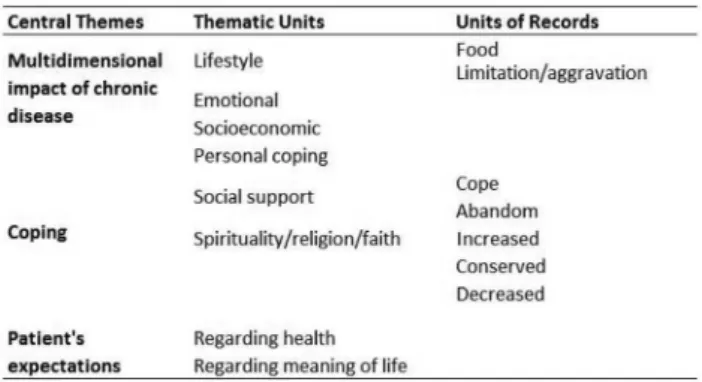
objects of analysis. From each central themes, themaic units emerged and units of record that can be viewed in Table 1.
Table 1 - Distribution of units of record, thematic units and
cen-tral themes identiied. São paulo, 2011.
The most prevalent chronic disease in the elderly in
-terviewed was hypertension, being menioned by 45% of paricipants, followed by diabetes mellitus reported by 35% of the elderly interviewed. For 30% of the study paricipants, changes in food impacted the lifestyle ater diagnosis of the chronic disease.
For 65%, of the elderly, chronic disease represented much more than decrease in physical acivity, increased
dependence to perform various funcions, even basic ac
-iviies of daily living. For paients who reported enjoying
going out, walking and travelling, have “goten sick” rep
-resented an important limitaion, as they come to rely on family members for these aciviies.
In 65% of the discourses there were demonstraions of anxiety anguish and sadness arising from the changes caused by the disease. In the present study sample, 70%
of subjects were completely independent and held vari
dISCuSSIon
MULTIDIMENSIONAL IMPACT OF CHRONIC DISEASE
Receiving the diagnosis of chronic disease and adapt
-ing their lives to disease and treatment require strength
of willpower and determinaion of the paient.(5)
By analyzing the discourses in this light, three themaic
units emerged: Lifestyle, emoional impact and socioeco
-nomic impact.
For some paricipants, when asked, responded that chronic disease did not cause changes in their lives. These discourses demonstrate the acive adaptability of human adversity and brings to light the concept of resilience.
Individuals who, during their life, experience diicul
-ies and barriers, develop this ability to deal with the psy
-chological impact caused by criical moments and aging consequently increase their resilience.
For 80% of elderly of this research, their children,
grandchild and partners were responsible for giving mean
-ing to life and also the main source of strength to cope with chronic diseases and its treatment. For the elderly study paricipants, family members were responsible for helping with the needs and care of their pathologies, but mostly for supplying their afecive needs. In 20% of the discourses, paricipants reported litle or no contact with their family members, given the distance or lack of interest.
Some study paricipants (45%) reported being inserted
into the religious community, atending with regular fre
-quency masses, church meeings, etc., while others who have a declared religion, paricipated in religious aciviies of other religions, showing the Brazilian religious syncreism.
Lifestyle
This themaic unit ideniied two units of record: food and limitaions/aggravaion.
a) Food
The control of sodium intake is one of the measures necessary to maintain blood pressure levels within the normal range.(6)
Eaing habits directly depend on the culture of people,
for many paients, food rich in sodium and fat is consid
-ered adequate food, food “that sustains” and that the diet required for the control of chronic disease is “poor food” that sickens. Making it diicult for health professionals to achieve adherence to a healthier eaing lifestyle, which is necessary for the control and treatment of diseases such as diabetes, hypertension and dyslipidemia.
The cultural aspect should be considered in the care planning in order to minimize resistance to the new di
-etary counseling of the paient and facilitate the creaion of alternaives for a dietary reeducaion.
b) Limitaions/Aggravaion
Regular physical acivity is important for the preven
-ion of chronic non-communicable diseases, but also for
the prevenion of aggravaion resuling from these condi
-ions to promote health and quality of life during the ag
-ing process.(7)
According to a research conducted in Brazil, it is es
-imated that 10% of people over 65 years need help to
perform some basic self-care aciviies, and 40% of Brazil
-ians with this age depend on help to perform instrumental aciviies of daily living.(8,9)
Elderly who experienced the decline in their ability to self-care, relying on family members caused a negaive impact on quality of life, being a factor that generated anxiety and other negaive feelings.
Emoional impact
Chronic disease and the limitaions brought by disease also brought negaive feelings and emoional distress for the elderly paricipants.
Chronic diseases and decreased funcionality signii
-cantly afected the quality of life of the elderly, as break
-ing the coninuity of lifestyle and requir-ing the use of cop
-ing methods.(10)
Limitaions brought by chronic diseases tend to com
-promise the self-evaluaion, reducing their potenial to
experience life in a posiive way.(11)
For 30% of elderly paricipants, chronic diseases led to
growing dependence and signiicant reducion of auton
-omy in basic and complex aciviies of daily living, it was always reported in the context of psychological sufering, anguish and consequent decline in quality of life.
Socioeconomic Impact
Receiving a diagnosis of a chronic disease and adapt
-ing one’s life to it can interfere with the family’s inancial situaion negaively.
For some study paricipants, chronic disease led to
early reirement and other elderly inancial situaions pre
-vent the performance of leisure aciviies such as tours and trips.
Reirement represents a decrease in the standard of living
due to salary reducions. Medicine expenses and medical ex
-penses may become burdensome for the elderly. In Brazil, it is esimated that half of the elderly have less than or equal to the minimum wage as personal income and average monthly spending on medicaions of about a quarter of the income (23%) from half of the elderly Brazilian populaion.(12,13)
COPING
In this central theme, three themaic units were de
-ined: personal coping, social support and spirituality. Sev
-eral paricipants in the study reported more than one cop
-ing strategy, which is expected when fac-ing some serious health aggravaion, but they are presented separately in this study, for beter visualizaion and analysis.
Personal coping
This themaic unit analyzed the discourses that show
the strength of individual will and belief in yourself, under
-stood in this study as personal coping.
Several paricipants reported criical life experiences in which their own willpower led them to overcome barriers.
It is important to appreciate the inner strength and re
-silience of the elderly and in chronically ill paients in gen
-eral. Health professionals should idenify potenial deicits of individual coping with their paients and understand that resilience is key to beter management of chronic disease and its consequences. Thinking beyond chronic diseases, those who are more resilient are more prepared
to face any crisis that can happen in life of every individ
-ual and hence have a beter q-uality of life, irrespecive of diseases, impairment and other situaions that generate stress and negaive feelings.
Social Support
a) Support
In pursuit of greater coverage of spirituality, an ap
-proach was about “the meaning of life” and the most re
-current answer was family.
In the current context of high prevalence of chronic diseases and the epidemiological transiion, families are increasingly taking responsibility for the health care of the elderly with chronic condiions, supporing the care unil
full recovery or when this does not happen, with the dis
-ease and its sequels.(16-18)
Aging and chronic disease cause many losses to the el
-derly, such as loss of autonomy and reduced quality of life.
The social support of the elderly is very important to fa
-cilitate their adaptaion of this coping process. The social resources help protect the elderly from negaive feelings, depression and stress.(19-21)
The feeling of belonging to individuals within the fam
-ily environment is important for good psychological health and quality of life.
Aside from family, social support can be ofered by friends and colleagues of acivity as groups of seniors and promotes posiive feelings, also establishing a coping strategy.(22)
Unfortunately, many elderly do not have a network of
minimal social support, and end up sufering from aban
-donment and distance from family.
b) Abandonment
The family is the irst reference of socializaion of the
elderly when there is an absence or disrupion of this in
-serion, the elderly feels ignored, devalued, excluded. This
relaion depends primarily on the bonds that were estab
-lished during the life and strength of these relaionships.(23)
Spirituality
Spirituality is manifested in the life of human beings in ininite ways that vary according to age, religion, culture
and health state. In order to understand the role of spiri
-tuality in the lives of elderly paricipants, all reports were considered in their integrality, not restricing the analysis only to health issues.
The concept of spirituality used in this research was
spirituality as the meaning of life.(24) Paricipants answered
the quesion: What gives meaning to your life? And from these responses we analyzed the content and deined the units of record as the following.
For the analysis of this central theme, three units of re
-cord were deined: increased spirituality, conserved spiri
-tuality and decreased spiri-tuality: a) Increased spirituality
In the discourses resulted from the interviews, spiri
-tuality appeared in criical situaions of health problems, helping the individual to have serenity and opimism. In moments like the death of a loved one, breakup, illnesses and limitaions, spirituality contributes to the growth and
maturaion of the human being.(22,25)
In case of illness, pain and terminal illness, other ques
-ions are made by paients, such as “why me?”, “What happens ater my death?”, and it is through their personal beliefs that the individual can ind serenity to deal with the absence of answers, hope and opimism to face the disease. For paricipants in this study, these beliefs were generaing feelings of relief.(26,27)
Spirituality is a way of meaning loss, and thus personal beliefs help in coping with grief and acceptance of death. Having a “good relaionship” with God or higher enity,
regardless of the religion praciced by the individual, pro
-motes understanding of human sufering.(28,29)
Spirituality has great potenial to alleviate sufering
from conlict as reported by paients in this study, not al
-ways the relaionship between physical and emoional health, and individuals’ beliefs is ideniied and valued by
health professionals in everyday pracice, despite numer
-ous beneits that have been discussed in the scieniic ield. b) Spirituality
-ality among elderly who reported faith in God and spiritu
-ality in the meaning of their lives and did not seek it only in criical moments.
The impact of coping with criical situaions happen
when the spirituality of the individual is part of their val
-ues, ideals and most inimate beliefs, and thus it is applied to their daily lives.
Apart from spirituality, the act of praying may mobi
-lize posiive energies for the process of coping and disease management. The pracice of praying is beneicial in many
ways, as well as requests to God, oten prayers of thanks
-giving are made, generaing feelings of graitude for life, health, family and etc.(30)
Regardless of reported religion, elderly who have a good relaionship with a “higher enity” also have greater resilience to face life’s barriers and situaions of sufering, seeing life more posiively and opimisically.
c) Decreased Spirituality
Spirituality and religiosity are not necessarily present in people’s lives, beliefs, values and ideals are very ini
-mate aspects and depend on each individual’s percepion of his/her life and the environment around him/her.
In the present study sample, there were no paricipants who did not belong to any religion or who did not believe in God’s existence. Nevertheless, there were discourses in which faith was not cited as a posiive mechanism to face diiculty and did not confer beneits to their faith.
EXPECTATIONS
When we talked about the sense of hope and opi
-mism generated by coping mechanisms discussed above, it was observed, as a result of this study, that expectaions
regarding the treatment and family and personal saisfac
-ion are part of the management of chronic disease for the elderly paricipants.
Expectaions regarding health
Expectaions of improvement with treatment, and hope to coninue living were present in the discourses of the paricipants. For one of the paricipants, believing that God would heal him meant that he did not have to adhere to the prescribed surgical treatment. For several
other paricipants, improvements resuling from treat
-ment for pathology were beter reasons for saisfacion with life.
Enhancing the treatment and the improvements is important to the person with chronic disease, so that
he/she has a good adherence to lifestyle changes neces
-sary to control the disease.(22) Experiencing the improve
-ment of symptoms such as pain, for example, is one of the main factors favoring adherence of paient to drug treatment.
Expectaions regarding the meaning of life
In the discourse of some paricipants (15%), expecta
-ions that the elderly had, were cited as the meaning of their lives. For many of them, seeing the success of their children was great saisfacion in life.
The family life cycle is permeated by diferent expec
-taions, it is expected that parents have expectaions for their children’s future. Occasionally, and depending on
the emoional structure of the family, chronic disease neg
-aively afects these plans.
For some study paricipants, the act of helping family, neighbor, doing charity and volunteer work was referred
to as part of the meaning of life and important expecta
-ion for the future.
Deining spirituality as “what gives meaning to life”
opens up a range of meanings for what the individual con
-siders important to their existence and where they can ind moivaion to move on. For some study paricipants, expectaions for the future were responsible for giving meaning to life, and were expectaions of helping families and individuals in need.(30)
In countless ways spirituality/religiousness/faith inter
-fere posiively in addressing the barriers and diiculies of life and strengthen the resilience, improving their quality
of life and control of their chronic disease. Health profes
-sionals should be alert in order to encourage and promote educaion and accountability measures of treatment.
fInAL ConSIdeRAtIonS
For professionals working in public health to obtain the paient’s adherence to treatment and re-educate them to a healthy lifestyle is a constant challenge. Brazil is a country of coninental dimensions, where migraions are intense
and, consequently, the culture becomes mixed, as its popu
-laion. The cultural context of the chronic paient interferes directly in relaion with the disease and treatment.
The cultural context, beliefs and values inluence pa
-ient adherence or non-adherence to treatment for chron
-ic disease. The chron-ic disease causes signi-icant impact on the lifestyle of the paient and requires an acive efort so that the management of this new condiion is efecive. In this study, subjecivity present in the impact of the diagnosis of chronic disease and ways of coping used by paients became evident.
Numerous contents of the discourses of the parici
-pants emerged, but despite its classiicaion as central themes, themaic units and units of record, all categories
are interrelated when reported by the elderly, highlight
-ing the subjecive nature of the topic, in which feel-ings,
expectaions and anxieies mix in the context of the par
Having a chronic disease changed the lifestyle of
study paricipants, requiring changes in diet and bring
-ing limitaions and aggravaion that have undermined the autonomy of the elderly, implying negaive feelings in performing basic and instrumental aciviies of daily living. This impact on independence of paients related to the emoional aspect of these elderly, because for most of them, dealing with the limitaions resuling from chronic diseases was a factor that generated sufering, anguish and sadness, having signiicant negaive impact on quality of life.
The main aspect to be considered is coping with limi
-taions and control of chronic disease. The data revealed an individual way of coping, in which the inner strength of paients simulates self-care and accountability for the management of pathology.
From the perspecive of the concept of spirituality as giving “meaning to life”, the family was reported as the meaning of existence for many paricipants in the study, highlighing the importance of the presence of family members in the social context of the elderly, paients with or without chronic disease.
Social support from family and friends favors paients when facing diiculies, because it is inding meaning to
life that the elderly overcome criical moments and with
-out this kind of belief, sufering and existence does not make sense. Unfortunately, elderly do not always have this kind of family support and end up sufering from abandonment.
Following the idea of “meaning of life”, the analysis of conserved spirituality, we considered the elderly who reported their beliefs as the meaning of their existence and have not sought faith or just more intensely in imes
of diiculies. Paricipants who reported regular parici
-paion at Masses, worship and religious gatherings also obtained beneits of social support received by living in these environments.
Beyond spirituality, praying mobilizes posiive energies for the coping process, prayers of thanksgiving promote feelings of graitude for life and generate posiive feelings
of well-being and relaxaion. Belonging to a paricular reli
-gion is not what deines the beneits or losses of spiritual
-ity, while having a “good relaionship with a Higher enity of their belief is what strengthens the resilience of the elderly.
Although all paricipants declare themselves belong
-ing to a religion, for some study paricipants, faith ofered
no beneits in coping, and religious pracice did not pro
-mote social interacions and social support.
Regarding expectations in health, God appears with
the health provider and He is cited as the most impor
-tant aspect of life. For these patients, faith helps in treatment adherence and practice of self-care. The act of helping families, helping others, to practice charity and volunteer work have also been referred to as part of the meaning of life, and important expectation for the future.
Health teams engaged in assising elderly people with chronic diseases should have the sensiivity to understand
the elderly within their cultural context and facilitate un
-derstanding and accountability of the paient and their condiion.
The definitions of spirituality become large when analyzing the subject in this light, broad approaches
regarding this theme may also be conducted by nurs
-ing and the health professional in general. Studies with spirituality in Brazil are gaining ground in scientific field and should be taken into clinical practice in order to
ensure a holistic care to our patients, regardless of dis
-ease, chronic or acute, and regardless of age, from chil
-dren to elderly.
RefeRenCeS
1. Craig C, Weinert C, Walton J, Derwinski-Robinson B. Spi
-rituality, Chronic Illness, and Rural Life. J Holist Nurs. 2006;24(1):27-35.
2. Oman D, Thoresen CE. Does religion cause Health? Dife
-ring interpretaions and diverse meanings. J Health Psychol. 2002;7(4):365-380.
3. Panzini RG, Rocha NS, Bandeira DR, Fleck MPA. Qualidade de vida e espiritualidade. Rev Psiq Clin. 2007;34(1):105-155.
4. Koenig HG. Suicide in the elderly: Case Discussion. South Med. 2006;99(10):1188.
5. Marins LM, França APD, Kimura, M. Qualidade de vida de pesso
-as com doença crônica. Rev Lat Am Enfermagem. 1996;4(3):5-18.
6. Molina MCB, Cunha RS, Herkenhof LF, Mill JG. Hipertensão arterial e consumo de sal em população urbana. Rev Saude Pública. 2003;37(6):743-50.
7. Matsudo SM, Matsudo VKR, Neto TLB. Aividade ísica e enve
-lhecimento: aspectos epidemiológicos. Rev Bras Med Esporte. 2001;7(1):2-13.
8. Barros MBA, César CLG, Carandina L, Torre GD. Desigualda
9. Karsh UM. Idosos dependentes: famílias e cuidadores. Cad Saúde Pública. 2003;19(3):861-866.
10. Rabelo DF, Neri AL. Recursos psicológicos e ajustamento pessoal frente a incapacidade funcional na velhice. Psicol Estud. 2005;10(3):403-412.
11. Smith J, Borchelt M, Maier H, Jopp D. Health and well
--being in the young and oldest old. Journal of Social Issues. 2002;58(4):715-732.
12. IBGE. Fundação Insituto Brasileiro de Geograia e Estaísi
-ca, 1998. Pesquisa Nacional por Amostra de Domicílios. Rio de Janeiro: IBGE.
13. Lima-Costa MF, Barreto SM, Giai L. Condições de saúde, capacidade funcional, uso de serviços de saúde e gastos com medicamentos da população idosa brasileira: um estu
-do descriivo basea-do na Pesquisa Nacional por Amostra de Domicílios. Cad Saúde Pública. 2003;19(3):735-743.
14. Antoniazzi AS, Dell’Aglio DD, Bandeira DR. O conceito de coping: uma revisão teórica. Estudos de Psicologia. 1998;3(2):273-294.
15. Savoia MG. Escala de eventos vitais e estratégias de enfren
-tamento (Coping). Revista de Psiquiatria Clínica. 1999;26(2).
16. Marcon SS, Radovanovic CAT, Waidman MAP, Oliveira MLF, Sales CA. Vivências e relexões de um grupo de estudos jun
-to às famílias que enfrentam a situação crônica de saúde. Texto Contexto Enferm. 2005;14(Esp):116-124.
17. Oliveira TC, Araújo TL. Mecanismos desenvolvidos por ido
-sos para enfrentar a hipertensão arterial. Rev Esc Enferm USP. 2002;36(3):276-281.
18. Silva, LF, Guedes, MVC, Moreira, RP, Souza, ACC. Doen
-ça Crônica, o enfrentamento pela família. Acta Paul Enf. 2002;15(1):40-47.
19. Guedes MTD, Albuquerque FJB, Tróccoli BT, Noriega JAV, Seabra MAB, Guedea RLD. Relação do bem-estar subjeivo, estratégias de enfrentamento e apoio social em idosos. Psi
-cologia: Relexão e Críica. 2006;19(2):301-308.
20. Gomes-Villas Boas, LC. Apoio social, adesão ao tratamento e controle metabólico de pessoas com diabetes mellitus ipo 2 [dissertação]. Ribeirão Preto: Escola de Enfermagem de Ri
-beirão Preto, Universidade de São Paulo; 2009.
21. Sena RR, Silva KL, Rates HF, Vivas KL, Queiroz CM, Barreto FO. O coidiano da cuidadora no domicílio: desaios de um fazer solitário. Cogitare Enferm. 2006;11(2):124-132.
22. Trenini M, Silva SH, Valle ML, Hammersdmidt KSA. Enfren
-tamento de situações adversas e favoráveis por pessoas ido
-sas em condições crônicas. Rev. Lat. Am. Enfermagem. 2005; 13(1):38-45.
23. Herédia VBM, Cortellei IA, Casara MB. Abandono na velhi
-ce. Textos Envelhecimento 8(3), 2005.
24. Hunter JC. O monge e o execuivo. Rio de Janeiro: Sextante, 2004.
25. Baista PSS. A espiritualidade na práica do cuidar do usuário do Programa Saúde da Família, com ênfase na educação po
-pular em saúde. Revista APS. 2007;10(1):74-80.
26. Nascimento LC, Rocha SMM, Hayes VH, Lima AG. Crian
-ças com câncer e suas famílias. Rev. Esc. Enferm. USP. 2005;39(4):469-474.
27. Puchalski C. Spirituality in health: the role of spirituality in criical care. Crit Care Clin. 2004;20:487-504.
28. Araújo MMT. Quando “uma palavra de carinho conforta mais que um medicamento”: necessidades e expectaivas de pacientes sob cuidados paliaivos [dissertação]. São Pau
-lo: Escola de Enfermagem. Universidade de São Paulo; 2006.
29. Elias ACA, Giglio JS. Sonhos e vivências de natureza espiri
-tual relacionados à fase terminal. Mudanças – Psicologia da Saúde. 2002;10(17):83-106.