A computer simulation designed for problem-based learning*
A Rendas, P Rosado Pinto & T Gamboa
Objectives As problem-based learning is increasingly used in medical education, there is a growing need to capture the diversity of the events occurring during problem-based learning sessions in order to understand the way in which students learn. The computer simu-lation described attempts to analyse a posteriori how students reason and learn during such sessions.
DesignA computer simulation was designed to perform a detailed analysis of the following features: pattern of information searched, formulation of working hypoth-esis and identi®cation of learning issues. The program, which has been running successfully for 2 years, was developed using local resources and accepts any clinical problem, provided it is written in a suitable text ®le format. The program has been applied in the discipline of pathophysiology.
SettingFaculty of Medical Sciences of Lisbon, Portugal.
SubjectsMedical students.
Results An example is presented of how prints were analysed in order to evaluate the `progression pro®le' of the students, and a comparison is made with other similar instruments.
Conclusions The program improved understanding of the relationships between the inquiry strategy and hy-pothesis formulation and also of how self-learning (triggered by learning issues) in¯uenced further analysis of the cases.
Keywords *Computer simulation; education, medical; educational measurement; problem-based learning.
Medical Education 1999 33 047±054
Introduction
This work describes the development and application of a clinical computer simulation designed according to the problem-based learning (PBL) methodology de-scribed by Barrows1, which provides a detailed record of all the steps followed during the process in an at-tempt to analyse a posteriorihow students reason and learn throughout the sessions.
The widespread use of PBL in medical schools around the world2-5has been accompanied by a large number of research studies on PBL processes and outcomes. Broadly, two main areas of research on PBL can be identi®ed: (1) comparison with conventional curricula regarding acquired knowledge, diagnostic reasoning skills, motivation and attitudes towards learning6-8 and (2) the evaluation of students'
satis-faction with and perspectives on learning using the method9,10. Growing concern about the measurable outcomes of PBL was expressed in a recent paper11, in which some possible methods of improving PBL were suggested, such as the organization of internationally accepted curricula and psychometrically validated methods of evaluation, the fostering of attitudes among students and tutors to facilitate cooperative PBL teamwork and the teaching of group process diagnostic skills.
However, most of these points concern the outcomes of the method and not the processes that mediate and moderate its relationships with the learning process. This may be partly due to the extreme diversity of the learning environments created during the PBL sessions, which cannot easily be captured by the tutor or even by an observer. In order to overcome this dif®culty some groups have analysed written records or videotapes of the session11-13. Recently, a new methodology has been developed in an attempt to obtain a temporal record of the events `that mark the group's reasoning'13, ob-servable in a video registration of the PBL sessions.
On the other hand, although clinical computer sim-ulations are widely used in PBL settings, they are yet to be fully accepted as a research tool for examining
Department of Pathophysiology and Department of Medical Educa-tion, Faculty of Medical Sciences of Lisbon, Lisbon, Portugal
speci®c aspects of the learning process at any of the stages of medical education ± from pre±clinical to postgraduate. However, application of the new infor-mation technologies to teaching and to evaluation of students14,15can provide useful `experimental' research models. Advantages are that the same teaching material can be presented to the students, assuring uniformity of criteria used to access the information, each working group or individual can evolve their own strategy of moving through a case, there is no emotional reaction of the computer to incorrect responses, and the records of the students' work can be easily recovered and ana-lysed16,17. Finally, computer-based learning materials create, in general, stimulating learning environments18, provide clear educational objectives and promote ef-fective use of information technology19.
The purpose of this article is to describe the steps involved in the development of a computer-based learning simulation based on the traditional PBL module (PBLM)20, illustrating how it was applied in the discipline of pathophysiology and how it can be used to analyse the learning strategies employed by the students in a PBL context.
Materials and methods
Development of the PBLS
The main objective of pathophysiology teaching is to improve the students' understanding of the mechanism of disease as a physiological dysfunction of the various systems of the body at a stage at which they have very little contact with patients21. In this context it was considered relevant to introduce the PBL methodology with the following objectives: to motivate learning, to structure knowledge in a clinical context and to develop self-learning skills. We have recently reported our ex-perience22 using the paper simulations, PBLMs, pro-duced by the Department of Medical Education of Southern Illinois University School of Medicine20.
The development of the problem-based learning sys-tem (PBLS) began in 1992, involving a team composed of experts in pathophysiology, who identi®ed and trans-lated the PBLMs and designed the core framework of the simulation, a computer programmer and a specialist in medical education. The computer programmer wrote the program, designed the screen layout and produced the scanned images that were included, while the edu-cationalist designed questionnaires to evaluate the stu-dents' satisfaction with the PBLS and collaborated in the tutor training programmes.
The PBLS was ®rst evaluated by the members of the Department, in 1993, and a few corrections were made
to improve the structure of the program. During the academic year of 1994±95, all the students of patho-physiology used the program in two sessions as an in-troduction to the PBL methodology. This initial expe-rience allowed the detection of errors and the formulation of suggestions, which enhanced and sim-pli®ed the program interface with the users. The PBLS was used for the ®rst time by all the students in the academic year of 1995±96.
During this preparatory period we also developed written support materials to help the students during the tutorials: a manual for the PBLS and a guide to the PBLS sessions. Thirty-six clinical problems were also translated into Portuguese and are now available in the PBLS format, covering the speci®c objectives of the discipline.
General structure
The program (PBLS) was designed in the Visual Basic compiler and runs in Windows 3á11 or Windows 95. The PBLS is an `open' program, since it allows the conversion and the updating of any clinical problem, provided it is written in a suitable text ®le format, and the inclusion of digitized images. Each problem needs less than 1 Mb of hard disk space, if no images are included. Linked to this program is another (GEST), which allows the selection of the problems to be used and access, step by step, to the reports on the work performed by the students.
The PBLS starts with general information about its content and speci®c instructions about how to use the program.
analysis of the case and the learning resources to be used.
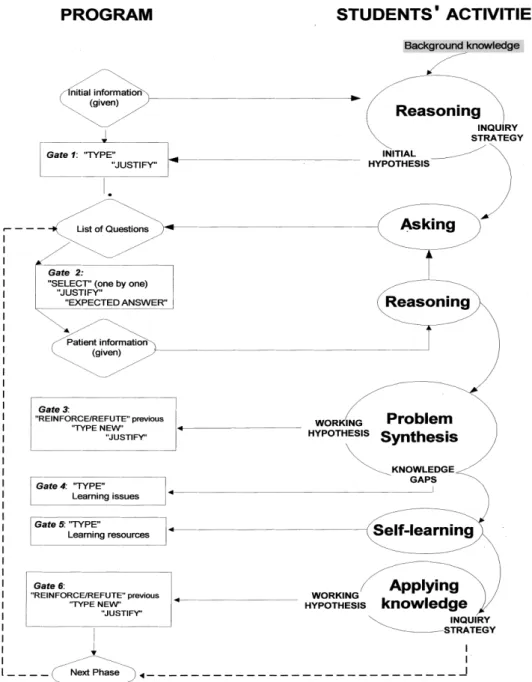
Access to the clinical information provided by the PBLS in a textual format is `gated' after each question by the introduction of free text in spaces, where the program `asks' in sequence for justi®cation of the question and the expected answer. It is only afterwards that speci®c clinical information is given (Fig. 1). For each phase the students can ask all the questions
available which cover the clinical information about the patient.
The transition between the different phases of the problem is also `gated' by the introduction, in similar spaces, of the working hypothesis, learning issues and learning resources (Fig. 1).
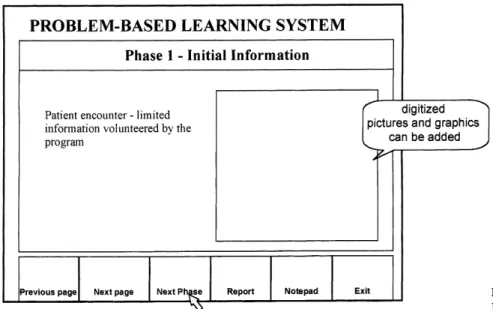
After reading the initial information, the ®rst `gate' (Fig. 1) appears when the students select `Next Phase' in a button placed in the lower part of the screen Figure 1 Relationship between the steps of the PBLS and PBL skills.einformation given by the PBLS;h`gates' (students' tasks);
(Fig. 2), by clicking the mouse. At that stage a `window' appears on the screen asking the students to type the initial working hypothesis. For each hypothesis intro-duced, the program asks for the corresponding justi®-cation and it is only then that the next one can be typed. When all the hypotheses have been put forward and justi®ed, another window appears on the screen asking the students to type in a blank space the learning issues identi®ed which need to be studied in order to further analyse the case. A ®nal window appears and the stu-dents have to type the learning sources that will be used. Students cannot progress to the following phase until they have reviewed the previous working hypothesis, which they can `maintain', `reinforce' or `refute', or `new ones' can be introduced. Then the program con-tinues to the next phase as previously described.
It is possible to view at any given moment the in-formation already obtained from the PBLS, as well as all the text that has been typed. The program also provides a notepad, which can freely be used as a notebook to take notes or type comments.
This whole process is saved on the hard disk, and cannot be modi®ed. So, it is possible to analyse after-wards the sequence of the working hypotheses and of the questions, with the corresponding justi®cations, learning issues and learning resources, produced in each session up to the end of the case.
Presently, the students tackle each case in groups of two or three per computer, in sessions lasting around 2 hours. Each case is usually analysed during ®ve sessions with the assistance of a tutor who acts in a similar way as in the traditional PBL session, that is, as a facilitator
of the learning process and not as an expert providing answers to the doubts raised by the students23.
Results
Since the purpose of this article is to describe the de-velopment of the program, it was considered appro-priate to present the analysis of a problem in the PBLS format, giving examples of the methodology than can be used to analyse the data generated by the students. The prints were obtained in the last session of each problem, and the following features were considered for analysis: pattern of questioning, hypotheses generated and learning issues identi®ed. Analysis of the prints provided the data to evaluate the `progression pro®le' of the hypothesis and learning issues in each case. It was also possible to analyse the sequence of the questions asked by the students and the corresponding justi®ca-tions and expected answers.
The sequence of the data available on the prints is exactly the same as that followed by the students in each phase, and so it was also possible to identify the factual basis of each hypothesis by relating it to the selected questions and to the information received.
The pattern of hypothesis evolution shown in Fig. 3, which is taken from a case with the initial information `40-year-old woman with fatigue and dizziness', is typical of the majority of the problems analysed by our third-year students. The hypotheses generated in the early phases were maintained or reinforced up to the ®nal phases. It was only then that they were able to reject some and focus on the `key' hypothesis.
It is also possible to relate the nature of the questions asked during the different phases of the program to the process of formulation of an hypothesis until its rejec-tion or con®rmarejec-tion. The example taken from the same case illustrates (Fig. 4) this relationship using one of the hypotheses generated by the students ± heart failure (HF). In this particular case, the initial hypothesis HF was based on two very non-speci®c symptoms, `fatigue' and `dizziness', freely provided by the program as initial information. During phases 3 and 4, the questions se-lected were more speci®c to HF, but two of the pa-tient's signs (cyanosis and oedema) differed from the students' expected results. Despite these facts and the reinforcement of other hypotheses, HF was not rejected
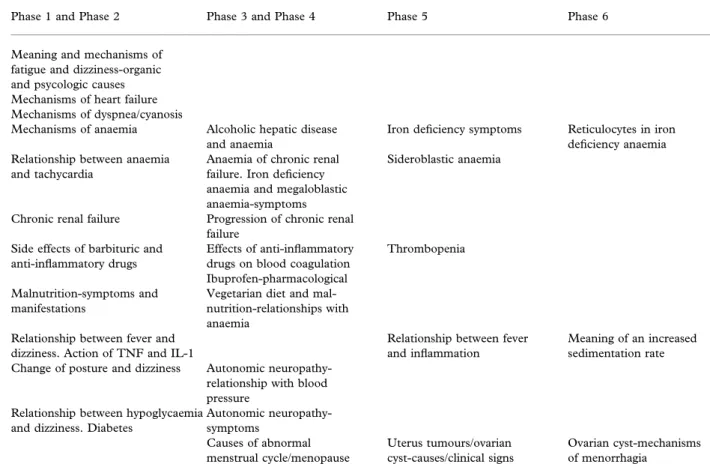
until phase 5. This sequence demonstrated that the group needed additional information and knowledge before being con®dent enough to reject the hypothesis. From the analysis of the list of the learning issues covered in the initial phases (Fig. 5), we could con-clude that, during phases 1 and 2, the students identi-®ed `gaps' in their previous knowledge about HF mechanisms and manifestations, and that the greater speci®city of the questionnaire found in subsequent phases was related to the knowledge acquired during the self-learning period.
The sequential lists of the learning issues (Fig. 5) showed that in the ®rst phases of the problem (phases 1 and 2) the students identi®ed gaps of knowledge in a
Phases 1 and 2 Phases 3 and 4 Phase 5 Phase 6
Heart failure !
" " "
Anaemia Menorrhagia-menopause iron de®ciency?
Iron de®ciency? Iron de®ciency anaemia
Renal failure (uraemia) !
! !
Drug side-effects on CNS Barbituric/anti-in¯ammatory intoxication
Anti-in¯ammatory side-effects
Malnutrition " " "
Iron, folic acid, B12 vitamin de®ciency
Iron de®ciency
In¯ammatroy reaction ! !
Hypoglycaemia Uterine tumour
Cyst of the ovary
Figure 3Working hypothesis-evolution pro®le.!maintained;"reinforced; rejected.
Figure 4Analysis of the relationships between clinical information and one working hypothesis.)absent/negative; + present/positive;
broad range of subjects. By the end of the second ses-sion, which corresponds to phases 3 and 4, the learning issues became much more oriented to a deeper under-standing of speci®c mechanisms. In the last two ses-sions (phases 5 and 6), the gaps in their knowledge were clearly related to the mechanisms of anaemia, which were the main learning objectives of this speci®c problem. On the other hand, they also studied a large number of other themes `triggered' by the analysis of the case.
An open questionnaire was applied at the end of the PBLS sessions in order to evaluate the students' satis-faction with the method and dif®culties in the interac-tion with the computer or with the PBLS. Analysis of the students' opinions revealed that even those with little computing experience found it user-friendly and easy to use, that they considered the practical sessions with the PBLS highly motivating.
Discussion
PBLS was designed taking into account pedagogical and research objectives. Our ®rst concern was to assure
that the program provided a user-friendly interface and a structure as close as possible to the PBLM format we used previously, assuming that the students followed the central steps of the PBL methodology. Therefore, the PBLS was divided into the same phases as the written simulations and its contents were essentially the PBLM lists of questions and corresponding answers, allowing the students to establish, within each phase, a free inquiry strategy. The `gates' acted as challenges (triggers) to recall and apply knowledge relevant to the problem, to formulate and justify a working hypothesis, and to identify learning issues needed to fully under-stand the problem16,24.
PBLS is a very simple clinical simulation which provides information about a patient problem mainly in a text format and registers, in free text, the students' performance. In its general conception PBLS can be compared to the Integrated Case Studies (ICS) devel-oped for medical decision making18. Although the PBLS does not actually include a signi®cant number of images or charts, which was considered one of the ad-vantages of ICS over traditional PBL, our students' opinions about the program were also very favourable.
Phase 1 and Phase 2 Phase 3 and Phase 4 Phase 5 Phase 6
Meaning and mechanisms of fatigue and dizziness-organic and psycologic causes Mechanisms of heart failure Mechanisms of dyspnea/cyanosis
Mechanisms of anaemia Alcoholic hepatic disease and anaemia
Iron de®ciency symptoms Reticulocytes in iron de®ciency anaemia Relationship between anaemia
and tachycardia
Anaemia of chronic renal failure. Iron de®ciency anaemia and megaloblastic anaemia-symptoms
Sideroblastic anaemia
Chronic renal failure Progression of chronic renal failure
Side effects of barbituric and anti-in¯ammatory drugs
Effects of anti-in¯ammatory drugs on blood coagulation Ibuprofen-pharmacological
Thrombopenia
Malnutrition-symptoms and manifestations
Vegetarian diet and mal-nutrition-relationships with anaemia
Relationship between fever and dizziness. Action of TNF and IL-1
Relationship between fever and in¯ammation
Meaning of an increased sedimentation rate Change of posture and dizziness Autonomic
neuropathy-relationship with blood pressure
Relationship between hypoglycaemia and dizziness. Diabetes
Autonomic neuropathy-symptoms
Causes of abnormal menstrual cycle/menopause
Uterus tumours/ovarian cyst-causes/clinical signs
Ovarian cyst-mechanisms of menorrhagia
The two programs have similar methods to access and provide information in a textual format, have `gating' rules to progress through the case, display `windows' in which students introduce free text and provide a record of all the work performed by the students.
In addition to the ICS, the PBLS provides real-time registration of the question selected, its corresponding justi®cations and its expected answers. It also registers the working hypothesis, the learning issues and re-sources formulated in each phase. These elements can be easily recovered from records on the hard disk and analysed after the sessions by the tutors, the students or experts in education.
The simulation chosen as an example in this article showed that it was possible to identify the relationships established between facts and working hypotheses, and illustrated how the inquiry strategies were modi®ed after the periods of self-learning. The learning issues identi®ed by our students were oriented to basic sci-ences, mainly pathophysiology, a pattern similar to that identi®ed by others12.
The information obtained from the analysis of the prints at the end of each session can be compared to the recently reported `inquiry trace' methodology13. Both methods allowed the `rebuilding' of a temporal se-quence of events from which it was possible to repre-sent the PBL process but not the students' reasoning. However, PBLS further provides written justi®cations for questions and hypotheses and the expected answers, data that can be dif®cult to fully recover by observation, due to the dynamics of the conventional PBL sessions. In this particular aspect, we think that PBLS can be a useful tool for those who wish to investigate learning processes occurring during the PBL sessions.
A practical feature of this methodology is that a complete clinical problem, fully analysed by the stu-dents in 4±5 sessions, can be printed in a few minutes or directly displayed on the computer screen, which is much less time-consuming than the video methods of registration. Finally, the elements to be evaluated are already written and so the same data can be evaluated by different experts, without previous interpretation.
PBLS was the ®rst original clinical computer simu-lation designed for PBL teaching in Portuguese medical schools and its implementation in the discipline of pathophysiology occurred without major problems, being easily accepted by the students and the teaching staff. We think that a major factor leading to such an outcome was the long period of planning, development and testing of the program by a multidisciplinary team19. Being home-made, it has the advantage of en-abling new material to be added to that already existing
and the conversion of new clinical problems to the PBLS format.
Furthermore, the PBLS can be used to give feedback to both students and tutors about their performance, thus improving the overall quality of the PBL process.
References
1 Barrows HS. How to design a problem-based curriculum for the pre-clinical years.New York: Springer Publishing Com-pany; 1985.
2 Barrows HS, Mitchell OM. An innovative course in under-graduate neuroscience. An experiment in problem-based learning with `problem boxes'.Br J Med Educ1975;9:223±30. 3 Barrows HS, Tamblyn RM. Problem-based learning. An
ap-proach to medical education. New York: Springer-Verlag; 1980.
4 Pales J, Gual A. Active and problem-based learning: two years' experience in physiology at Medical School of the University of Barcelona.Med Educ1992;26:466±72.
5 Bernard GR, Black JR. Problem-based learning as an educa-tional strategy - methods for learning gross anatomy. In: Bouhuijs PAJ, Schmidt HG, van Berkel HJM, editors. Nine years' experience in a totally problem-based curriculum. Ma-astricht: Network Publications; 1993.
6 Patel VL, Groen GJ, Norman GR. Effects of conventional and problem-based curricula on problem-solving.Acad Med
1991;66:380±9.
7 Albanese MA, Mitchell S. Problem-based learning: a review of literature on its outcomes and implementation issues.Acad Med1993;68:52±81.
8 Kaufman DM, Mann KV. Basic sciences in problem-based learning and conventional curricula: students' attitudes.Med Educ1997;31:177±80.
9 Kaufman DM, Meng ED, Mann KV. Comparing students' attitudes in problem-based and conventional curricula.Acad Med1996;71:1096±9.
10 Caplow JA, Donaldson JF, Kardash CA, Hosokawa M. Learning in a problem-based medical curriculum: students' conceptions.Med Educ1997;31:440±7.
11 Thomas RE. Problem-based learning: measurable outcomes.
Med Educ1997;31:320±9.
12 Kennedy SW, Wilkerson L. Topics for discussion reported by the students using clinical cases in problem-based tutorial in basic science course.Acad Med1993;6:S31±S33.
13 Conlee M, Koshmann T. Representations of clinical reasoning in PBL meetings: the inquiry trace.Teach Learn Med
1997;9:51±5.
14 Costello WJ, Mann DD, Dane PB. Computer case simula-tions for student evaluation in a PBL track.Acad Med
1997;72:416.
15 Farnsworth CC. Measuring the effects of problem-based learning on the development of veterinary students' clinical expertise.Acad Med1997;72:552±4.
16 Friedman CP. Anatomy of clinical simulation.Acad Med
17 Prentice JW, Kenny GN. Microcomputers in medical educa-tion.Med Teach1996;8:9±18.
18 Schor NF, Troen P, Adler S, Williams JG, Kanter SL, Mah-ling DE, Sorrows B, Skogseid I, Bernier GM. Integrated case studies and medical decision making: a novel, computer-as-sisted bridge from the basic sciences to the clinics.Acad Med
1995;70:814±7.
19 Mooney GA, Bligh JG. Computer-based learning materials for medical education: a model production.Med Educ
1997;31:197±201.
20 Distlehorst LH, Barrows HS. The problem-based learning module: a new tool from problem-based, self directed learn-ing.J Med Educ1992;57:486±8.
21 Guzek JW. Teaching pathophysiology to medical students: present status and prospects.Pathophysiol1994;1:73±7. 22 Rendas A, Rosado Pinto P, Gamboa T. Problem-based
learning in Pathophysiology: report of a project and its out-come.Teach Learn Med1998;10:34±9.
23 Barrows HS. The tutorial process. Spring®eld: Southern Illi-nois School of Medicine; 1988.
24 Barrows HS. A taxonomy of problem-based learning methods.
Med Education1986;20:481±6.
Received5January1998;editorial comments to authors6April1998;