Submerged fermentation of
Lactobacillus rhamnosus
YS9
for
g
-aminobutyric acid (GABA) production
Qian Lin
School of Life Science and Technology, Yulin Normal University, Yulin, Guangxi, P.R. China.
Submitted: July 4, 2010; Approved: July 2, 2012.
Abstract
g-Aminobutyric acid (GABA) is a major inhibitory neurotransmitter in central nervous system, and its application in drugs and functional foods has attracted great attention. To enhance production of
g-aminobutyric acid,Lactobacillus rhamnosusYS9, a strain isolated from Chinese traditional fer-mented food pickled vegetable, was grown under submerged fermentation. Its cultivation conditions were investigated. When culture pH condition was adjusted to the optimal pH of glutamate decarbox-ylase activity, culture ofLb. rhamnosusYS9 in medium supplemented with 200 mM of monosodium glutamate and 200mM of pyridoxal phosphate (PLP), produced 187 mM of GABA.
Key words: Lactobacillus rhamnosus, g-aminobutyric acid (GABA), glutamate decarboxylase (GAD).
Introduction
g-aminobutyric acid (GABA), a ubiquitous non-pro-tein amino acid, functions as a major depressive neuro-transmitter in animals (Mody et al., 1994) and plays an important role in cardiovascular function (DeFeudis, 1983). Other physiological functions of GABA include in-duction of hypotensive, diuretic effects, tranquilizer effects and prevention of diabetic conditions (Jakobset al., 1993; Wonget al., 2003). Dut to its multiple functions, GABA can be applied to production of many drugs and functional foods.
Currently, production of fermented food containing high level of GABA is actively pursued. Some microorgan-isms with high GABA-producing ability have been iso-lated, such asMonascus(Kono and Himeno, 2000; Suet al., 2003), Rhizopus (Aoki et al., 2003), Lactobacillus paracasei(Komatsuzakiet al., 2005),Lactobacillus brevis
(Li et al., 2010; Park and Oh, 2007; Yokoyama et al., 2002),Lactococcus lactis(Nomuraet al., 1998), Strepto-coccus thermophilus(Yanget al., 2008). Glutamate decar-boxylase (GAD) is responsible for GABA synthesis in microorganisms. Using lactic acid bacteria (LAB) harbor-ing GAD to produce GABA-enriched food has attracted
great attention since they are safe and recognized as pro-biotics.
Lactobacillus rhamnosusis an important industrial LAB for its ability to produce high level of lactic acid. In addition, it is a promising probiotic bacterium because it has been reported to persist in the colon and modify the co-lonic environment with potential positive health effects (Goldinet al., 1992; Linget al., 1994), andLb. rhamnosus
has been commercially used as starter of yoghourt produc-tion. However, there has been no investigation on fermen-tation ofLb. rhamnosusfor GABA production. In previous work,Lb. rhamnosusYS9 was isolated from Chinese tradi-tional fermented food pickled vegetable, and it appeared to produce high yield of GABA. The culture conditions for this strain to produce high level of GABA were firstly in-vestigated in this study.
Materials and Methods
Strain, medium and culture conditions
Lactobacillus rhamnosusYS9, a strain isolated from Chinese traditional fermented food pickled vegetable, was used throughout this study. The stock culture of Lb. rhamnosusYS9 was reactivated by two or three successive
Send correspondence to: Q. Lin. School of Life Science and Technology, Yulin Normal University, 537000 Yulin, Guangxi, P.R. China. E-mail: [email protected].
transfers in 12% (w/v) sterilized skim milk. For GABA pro-duction, the culture was subsequently inoculated into 1 L of flask containing 400 mL of nutrient medium, which con-sisted of following compositions (per liter): 20 g of glucose, 10 g of peptone, 10 g of beef extract, 5 g of yeast extract, 2 g of ammonium dibasic citrate, 2 g of sodium acetate, 2 g of K2HPO4, 0.2 g of MgSO47H2O, 0.05 g of MnSO4H2O, 1 mL of tween 80, 100 mM of pyridoxal 5’-phosphate (PLP), pH6.5. Unless otherwise stated, the strain was grown at 37 °C. Monosodium glutamate (MSG) was added to broth at concentrations indicated in figure legends. In pH-regulated cultivation, pH was adjusted every 12 h by adding NaOH or HCl during cultivation.
Analysis of GABA and GAD activity assay
Extracellular and intracellular GABA analysis and GAD activity assay were carried out as previously de-scribed (Yanget al., 2008). One unit of GAD activity was defined as the amount of enzyme that produced 1mmol of GABA in 1 min.
Results and Discussion
Time course study of extracellular and intracellular GABA content
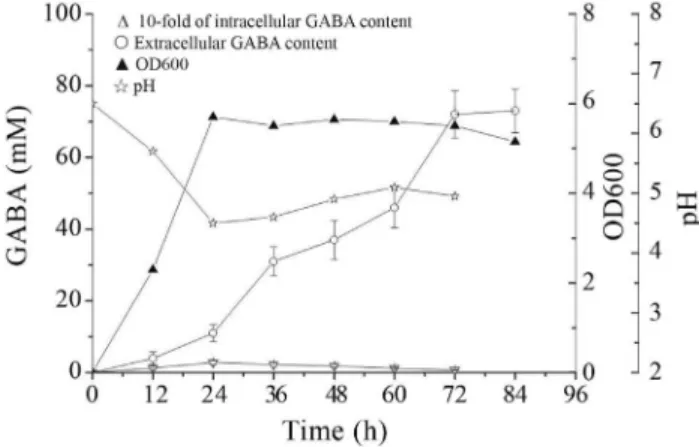
A time course analysis of intracellular and extra-cellular GABA content in culture medium was conducted to assess the GABA-producing ability ofL. rhamnosus YS9. Figure 1 shows the difference between extracellular and intracellular GABA content. Extracellular GABA was far higher than intracellular GABA, and the former peak ap-peared later than the latter. The reason for the phenomenon was that synthesis of GABA occurred intracellularly and GABA was secreted, accumulated extracellularly, which was consistent with the localization of GAD in cytoplasm of
Lactobacillus(Higuchi et al., 1997). The peak of GABA production was much later than that of cell growth, which
might reflect that the enzyme responsible for GABA synthe-sis, glutamate decarboxylase (GAD), was induced by envi-ronmental stress. During growth, the decreased pH might be resulted from the strain’s acid-producing ability which was well known as an important characteristic of LAB.
Effect of MSG concentration and cultivation temperature on GABA production and cell growth
For high level of GABA production by Lb. rhamnosusYS9, optimal MSG concentration and cultiva-tion termperature were determined by analysis of GABA content and cell optical density at various MSG concentra-tions and temperatures. Increasing concentration of MSG led to increasing GABA content (Figure 2) and the highest extracellular GABA yield was observed with 200 mM of MSG, although cell growth rate seemed to be mildly inhib-ited (Figure 3). So it can be deduced that the GABA pro-duction may be improved with increased concentration of MSG added to the culture medium, and the MSG concen-tration above a certain level would inhibit cell growth. As forL. rhamnosusYS9, MSG concentration should be lim-ited to 200 mM.
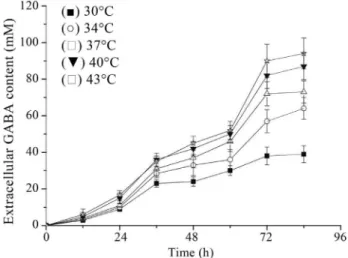
The relation of culture temperature and GABA pro-duction was examined (Figures 4 and 5). Within the range of test temperatures, cultivation at 43 °C led to the highest GABA yield and cell growth. So the optimal cultivation temperature ofLb. rhamnosusYS9 for GABA production was 43 °C, which would drastically inhibit other LAB’s growth rate, such as Lb. paracaseiNFRI 7415 (Komat-suzakiet al., 2005). This might be due to different physio-logical and enzymatic characteristics between different GABA-producing LAB strains.
Effect of PLP addition on extracellular GABA production
GAD belonged to PLP-dependent decarboxylase, which would form Schiff’s base with substrate, thus as a
Figure 1- Changes in extracellular and intracellular GABA content pro-duced byLb. rhamnosusYS9 grown in the medium containing 100 mM of monosodium glutamate at 37 °C. The results were expressed as mean±SD from three independent experiments.
coenzyme, PLP was essential to the enzyme activity. So it might be hypothesized that addition of PLP to the culture medium would improve GABA production. The effect of PLP addition was examined by analysis of extracellular GABA content in culture broth ofL. rhamnosusYS9 with PLP at different concentrations. Figure 6 shows that the higher the concentration of PLP was, the higher level of extracellular GABA the strain would produce. In this study, PLP was added at initial cultivation, and the enhancement effect of GABA production was similar to that of L. paracaseiNFRI 7415 (Komatsuzakiet al., 2005), but dif-ferent from that ofS. thermophilusY2 (Yanget al., 2008). So the optimal concentration of PLP added to culture me-dium was 200mM.
Effect of pH regulation of culture medium on extracellular GABA production
Many reports on bacterial GAD suggested that pH played an important role in the enzyme activity and GABA production. Since GABA synthesis was dependent on GAD, the highest yield of GABA might be obtained when the cultivation conditions were the same as that of enzyme catalysis. For the GAD ofLb. rhamnosus YS9, the opti-mal pH was determined by measurement of enzyme activ-ity in cells under various pH conditions. GAD activactiv-ity dramatically decreased at pH 4.0 and pH > 4.8 (Figure 7).
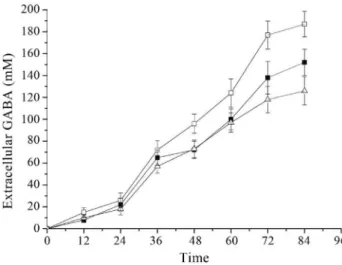
Lb. rhamnosusYS9 did not show high GAD activity at low pH, although it was believed that bacterial GAD plays a major role in acid-resistance mechanism. As Figure 7 shows, the optimum pH for GAD activity was 4.4. Accord-ingly, GABA production was measured by cultivation of
Lb. rhamnosusYS9 under pH-regulated conditions. Figu-re 8 shows that under pH-Figu-regulated conditions and other optimized conditions (43 °C, 200mM PLP, 200 mM MSG),
Lb. rhamnosus YS9 produced higher level of GABA,
Figure 6- Effect of PLP addition on extracellular GABA production.L. rhamnosusYS9 was grown at 37 °C for 84 h in medium containing PLP at different concentrations and 100 mM of MSG. The results were expressed as mean±SD from three independent experiments.
Figure 5- Effect of culture temperature on cell growth.L. rhamnosusYS9 was grown in medium containing 100 mM of MSG.
Figure 4- Effect of culture temperature on extracellular GABA produc-tion.Lb. rhamnosusYS9 was grown in medium containing 100 mM of MSG. The results were expressed as mean±SD from three independent experiments.
187 mM, at pH4.4 than those at both pH 4 and pH4.8, which might be due to the pH condition consistent with the opti-mal pH for GAD activity.
In summary, a strain ofLb. rhamnosuswas examined for its ability to produce GABA. Generally, bacterial gluta-mate decarboxylases are located in cytoplasm, whereas glutamate and GABA can be transported through mem-brane and exchanged, which results in the extracellular ac-cumulation of GABA. So production of GABA can be achieved by cultivation of LAB under the GAD optimal re-action conditions. In this paper, by adjusting the culture conditions ofLb. rhamnosusYS9 to achieve the GAD max-imum activity, GABA production was enhanced dramati-cally. The yield ofLb. rhamnosusYS9, 187 mM, was at an intermediate level compared with those ofLb. brevisIFO
12005, 10.18 mM (Yokoyama et al., 2002), Lb. brevis
NCL912, 345.83 mM (Liet al., 2010),Lb. paracaseiNFRI 7415, 302 mM (Komatsuzakiet al., 2005), and Streptococ-cus thermophilusY2, 77 mM (Yanget al., 2008). Though
Lb. rhamnosushas been used widely for production of fer-mented foods, there is no investigation on its GABA-pro-ducing ability before. The strain’s potential for functional food production was worthy of further exploration.
Acknowledgments
This work was supported by a grant from Research Foundation for Advanced Talents of Yulin Normal Univer-sity (No. G2009042), Guangxi Natural Science Foundation (No. 2011GXNSFB018046), Guangxi Feature Specialty and Curriculum Integration Project (No. GXTSZY220, GXTSZY022).
References
Aoki H, Uda I, Tagami K, Furuya Y, Endo Y, Fujimoto K (2003) The production of a new tempeh-like fermented soybean containing a high level ofg-aminobutyric acid by anaerobic incubation with Rhizopus. Biosci. Biotechnol Biochem 67:1018-1023.
DeFeudis FV (1983) g-Aminobutyric acid and cardiovascular function. Cell Mol Life Sci 39:845-849.
Goldin BR, Gorbach SL, Saxelin M, Barakat S, Gualtieri L, Salminen S (1992) Survival ofLactobacillusspecies (strain GG) in human gastrointestinal tract. Dig Dis Sci 37:121-128.
Higuchi T, Hayashi H, Abe K (1997) Exchange of glutamate and
g-aminobutyrate in a Lactobacillus strain. J Bacteriol 179:3362-3364.
Jakobs C, Jaeken J, Gibson KM (1993) Inherited disorders of GABA metabolism. J Inher Metab Dis 16:704-715. Komatsuzaki N, Shima J, Kawamoto S, Momose H, Kimura T
(2005) Production of g–aminobutyric acid (GABA) by
Lactobacillus paracaseiisolated from traditional fermented foods. Food Microbiol 22:497-504.
Kono I, Himeno, K. (2000). Changes ing-aminobutyric acid con-tent duringbeni-kojimaking. Biosci Biotechnol Biochem 64:617-619.
Li H, Qiu T, Cao Y, Yang J, Huang Z (2010) Medium optimiza-tion of gamma-aminobutyric acid byLactobacillus brevis
NCL912. Amino Acids 38:1439-1445.
Ling WH, Korpela R, Mykkanen H, Salminen S, Hanninen O (1994)Lactobacillusstrain GG supplementation decreases colonic hydrolytic and reductive enzyme activities in healthy female adults. J Nutr 124:18-23.
Mody I, De Koninck Y, Otis TS, Soltesz I (1994) Bridging the cleft at GABA synapses in the brain. Trends Neurosci 17:517-525.
Nomura M, Kimoto H, Someya Y, Furukawa S, Suzuki I (1998) Production ofg-aminobutyric acid by cheese starter during cheese ripening. J Dairy Sci 81:1486-1491.
Park KB, Oh SH (2007) Production of yogurt with enhanced lev-els of gamma-aminobutyric acid and valuable nutrients us-ing lactic acid bacteria and germinated soybean extract. Bioresource Technol 98:1675-1679.
Figure 7- Effect of pH on GAD activity in biotransformation of cells. GAD activity was measured at different pH and 43 °C for 1 h. The data were expressed as mean from two independent experiments.
Su YC, Wang JJ, Lin TT, Pan TM (2003) Production of the sec-ondary metabolitesg-aminobutyric acid and monacolin K by
Monascus. J Ind Microbiol Biotechnol 30:41-46.
Wong CG, Bottiglieri T, Snead OC (2003) GABA,g -hydroxy-butyric acid, and neurological disease. Ann Neurol 54:S3-S12.
Yang SY, Lü FX, Lu ZX, Bie XM, Jiao Y, Sun LJ, Yu B (2008) Production of g-aminobutyric acid by Streptococcus
salivarius subsp. thermophilus Y2 under submerged fer-mentation. Amino Acids 34:473-478.
Yokoyama S, Hiramatsu J, Hayakawa K (2002) Production of
g-aminobutyric acid from alcohol distillery lees by
Lactobacillus brevis IFO-12005. J Biosci Bioeng 93:95-97.