Bioconversion of
R-
(+)-limonene to perillic acid by the yeast
Yarrowia lipolytica
Maria Antonieta Ferrara
1, Débora S. Almeida
1, Antonio C. Siani
1, Leonardo Lucchetti
1,
Paulo S.B. Lacerda
1, André Freitas
1, Marcelo R.R. Tappin
1, Elba P.S. Bon
21
Instituto de Tecnologia em Fármacos, Fundação Oswaldo Cruz, Rio de Janeiro, RJ, Brazil. 2
Instituto de Química, Universidade Federal do Rio de Janeiro, Ilha do Fundão, Rio de Janeiro, RJ, Brazil.
Submitted: January 2, 2012; Approved: April 4, 2013.
Abstract
Perillyl derivatives are increasingly important due to their flavouring and antimicrobial properties as well as their potential as anticancer agents. These terpenoid species, which are present in limited amounts in plants, may be obtained via bioconversion of selected monoterpene hydrocarbons. In this study, seventeen yeast strains were screened for their ability to oxidize the exocyclic methyl group in thep-menthene moiety of limonene into perillic acid. Of the yeast tested, the highest efficiency was observed forYarrowia lipolyticaATCC 18942. The conversion ofR(+)-limonene byY. lipolytica
was evaluated by varying the pH (3 to 8) and the temperature (25 to 30 °C) in a reaction medium con-taining 0.5% v/v limonene and 10 g/L of stationary phase cells (dry weight). The best results, corre-sponding to 564 mg/L of perillic acid, were obtained in buffered medium at pH 7.1 that was incubated at 25 °C for 48 h. The stepwise addition of limonene increased the perillic acid concentration by over 50%, reaching 855 mg/L, whereas the addition of glucose or surfactant to the reaction medium did not improve the bioconversion process. The use ofY. lipolyticashowed promise for ease of further downstream processing, as perillic acid was the sole oxidised product of the bioconversion reaction. Moreover, bioprocesses using safe and easy to cultivate yeast cells have been favoured in industry.
Key words:Yarrowia lipolytica, bioconversion, limonene, perillic acid.
Introduction
The introduction of new and innovative medicines based on small-molecule candidates remains a focus of the pharmaceutical industry (Bucklandet al., 2000). Within this context, biotransformation processes offer a plethora of possibilities for obtaining regioselective and stereoselec-tive molecules of industrial interest (Krings and Berger, 1998; Lieseet al., 2006; Pollard and Woodley, 2007). The biotechnological generation of these compounds via bio-conversion with isolated enzymes, microorganisms or plant cells has been increasingly used as a tool to explore new and cost-effective methods of biocatalysis using selected metabolic pathways from cells. Moreover, “green proces-ses”, in which gentle conditions are employed, are mostly based on biotransformation reactions (Matsuyama et al., 2002; Persidis, 1997).
The microbial transformation of terpenes has been widely studied for the production of an array of molecules.
Within this context, the oxidative pathways leading to regioselective products are dependent on the metabolic characteristics of the selected cell systems and the external reaction conditions (Van der Werfet al., 1997). Examples include transformation by bacteria, fungi and yeasts of compounds such as linalool (Madyastha et al., 1977), cineole anda-pinene (Trudgill, 1990) and limonene (Try-tek and Fiedurek, 2005) to their respective epoxides, alco-hols and diols, aldehydes, ketones and acids (Duetzet al., 2003; Tan and Day, 1998).
Because of the abundant availability of isomeric
R-(+)-limonene from industrial citrus residues, the micro-bial bioconversion of this compound has been extensively explored to establish cost-effective methods for the produc-tion of aromatics (e.g., a-terpineol) (Bicas et al., 2009; Cadwalladeret al., 1989; Tan and Day, 1998) and poten-tially pharmacologically active derivatives, such as perillyl alcohol and perillic acid (Cadwalladeret al., 1989; Mirata
Send correspondence to M.A. Ferrara. Instituto de Tecnologia em Fármacos, Fundação Oswaldo Cruz, R. Sizenando Nabuco 100, Manguinhos, 21041-250 Rio de Janeiro, RJ, Brazil. E-mail: [email protected].
et al., 2009; Speelmanset al., 1998), which have been stud-ied as antimicrobial and anticancer drugs (Da Fonsecaet al., 2011; Yeruvaet al., 2007).
The selective oxidation of theR-(+)-limonene exo-cyclic methyl group produces various perillyl derivatives, a transformation that has been accomplished using bacteria (e.g., the Pseudomonas species Bacillus stearothermo-phylusandMycobacteriumsp.) (Duetzet al., 2003; Mirata
et al., 2009; Van Beilen et al., 2005), fungi (e.g.,
Aspergillusspecies) (Duetzet al., 2003) and yeasts (e.g.,
Yarrowia lipolyticaandArxula adeninivorans) (Van Rens-burg et al., 1997). The use of safe and easy to cultivate yeasts, such as the two mentioned above (Fickers et al., 2005; Gellissenet al., 2005), for the production of poten-tially non-toxic anticancer agents has driven increasing in-terest in this specific bioconversion route.
The present study screened yeasts for their ability to convert (R)-(+)-limonene to perillic acid. A strain of Yarro-wia lipolytica(ATCC 18942) was shown to successfully produce perillic acid as the sole oxidised terpene product from limonene. Several parameters for the bioconversion were investigated to improve the perillic acid yield and to better understand the oxidative enzymatic system involved in the reaction.
Materials and Methods
Materials and equipment
Commercial standards of R-(+)-limonene 96% (art. 62120), S-(-)-limonene 95% (art. 62130) and (+)-peril-laldehyde 98% (art. 77301) were purchased from Fluka (Buchs, Switzerland). (-)-Perillyl alcohol 96% (art. 218391) was obtained from Aldrich (Steinheim, Germany). (S)-(-)-Perillic acid 95% (art. 218359) and anisaldehyde were obtained from Aldrich (St. Louis, MO, USA). Thin layer chromatography (TLC) was performed on silica gel 60 F254plates obtained from Merck (Darmstadt, Germany). Solvents for TLC elution were obtained from Vetec (Rio de Janeiro, Brazil). Yeast nitrogen base without amino acids and ammonium sulphate (YNB) was obtained from Difco 0335-15 (Detroit, MI, USA). Bioprocess flasks were stirred on a rotary shaker (Scientific/Innova 4340, New Brunswick Scientific. Edison, NJ, USA). The pH was measured using a BeckmanF560 pH meter. The optical density was ob-tained with a Shimadzu-UV 1601 spectrophotometer (Kyo-to, Japan) operating at 600 nm.
Microorganisms
The yeast strains Arxula adeninivorans ATCC (Ame-rican Type Culture Collection) 76597, Candida famata
ATCC 62894,C. glabrata ATCC 2001, C. inconspicua
ATCC 16783,C. kruseiATCC 34135,C. lusitaniaeATCC 34449, C. stellata ATCC 10673, C. tropicalis ATCC 13803, C. guilliermondi ATCC 6260, C. parapsilosis
ATCC 22019, Kodamaea ohmeri ATCC 46053,
Komagataella pastoris ATCC 28485, Pichia angusta
ATCC 28485,P. anomalaATCC 16763,Saccharomyces cerevisiae ATCC 9080 and Yarrowia lipolytica ATCC 18942 (strain A) were used in this study and were obtained from the Brazilian National Institute for Quality Control in Health.Y. lipolyticastrain B was isolated from a polluted estuary of Guanabara Bay by Dr. Allen Hagler and depos-ited in the yeast collection of the Microbiology Institute of the Federal University of Rio de Janeiro under no. 50678.
Screening procedure
The microorganisms were cultivated in 250 mL Er-lenmeyer flasks containing 50 mL of YMB medium (10 g/L glucose, 3.0 g/L yeast extract, 3.0 g/L malt extract and 5.0 g/L peptone) on a rotary shaker (250 rpm) at 25 °C for 48 h. For the standard biotransformation assay, the grown cells were centrifuged and re-suspended at a final optical density at 600 nm (OD600) of 20 in 25 mL of 50 mM phos-phate buffer (pH 7.0) containing 100 mM glucose and 0.5% v/vR-(+)-limonene. The reaction mixture was incubated at 25 °C with shaking at 250 rpm. Aliquots were withdrawn at 24 and 48 h, and cells were removed by centrifugation at 3000 g. The supernatant was assayed forR-(+)-limonene conversion without further processing.
Effect of carbon and nitrogen sources on cell growth and product profile
The selected yeast strainsC. parapsilosisandY. lipo-lyticaATCC 18942 were grown in growth media contain-ing either glucose, glycerol or ethanol (20 g/L) as the carbon source, either ammonium sulphate or urea (2 g/L) as the nitrogen source and YNB (2 g/L). Cells were incubated at 28 °C with shaking at 250 rpm. Samples were withdrawn at 4, 8, 24 and 48 h and assayed for the conversion of
R-(+)-limonene using the standard method described abo-ve. In control experiments, cells were grown in YMB me-dium.
Limonene toxicity toY. lipolyticacell growth
The selected strain Y. lipolytica ATCC 18942 was grown in the YMB medium supplemented with 0.5 or 0.1% limonene. Cells were also grown in YMB medium in which glucose was substituted by 0.5% limonene. Cell growth was monitored by OD600.
Preliminary assessments of theY. lipolytica
bioconversion pathway
limonene bioconversion reaction was accomplished by adding inhibitors of alcohol oxidase and alcohol dehy-drogenase (22): Cu2+ (5 mM CuSO4•5H2O), Zn2+ (2 mM ZnSO4•7H2O), Ni2+ (2 mM NiSO4•6H2O), Ag1+ (5 mM AgNO3), Hg2+(5mM HgCl2), Cu2+(5 mM CuSO4•5H2O), Zn2+ (2 mM ZnSO4•7H2O), Ni2+ (2 mM NiSO4•6H2O), Ag1+(5mM AgNO3), Hg2+(5mM HgCl2), ketoconazole (5, 10 and 15mM), cysteine (5 mM), EDTA (5 nM), DMSO (5 mM), oxidised glutathione (4 mM), or reduced gluta-thione (5 mM). Samples were taken out at 24 and 48 h and analysed for the production of perillic compounds.
Bioconversion assays usingY. lipolyticaATCC 18942
Cell mass for biotransformation reactions using Y. lipolyticaATCC 18942 was obtained as described in the screening procedure. The bioconversion assays were per-formed in the following conditions unless otherwise stated: a cell mass concentration of 10 g/L, a pH of 7.0 (50 mM phosphate buffer), 0.5% (v/v)R-(+)-limonene and a tem-perature of 25 °C. The reaction mixtures (25 mL in a 250 mL Erlenmeyer flask) were incubated with shaking at 250 rpm for 48 h. Reaction conditions for the limonene bioconversion to perillyl derivatives assay were as follows: (i) temperatures of 20, 25, 28 and 30 °C; (ii) pH from 5.0 to 8.0 in phosphate buffer (50 mM) and from 3.0 to 4.0 in phosphate-citrate buffer (50 mM); (iii) presence or absence of glucose (100 mM) and phosphate buffer (50 mM) at pH 7.0; (iv) addition of tween 20 or tween 80 (0.1%); (v) direct addition of limonene (0.5%) to the 48 h YMB grown cell culture whose pH was adjusted to 7.0 (vi) and the stepwise addition of limonene (0.5% distributed in 6 dosages). Testing of conditions (i) and (ii) was performed in the pres-ence of 100 mM glucose.
Biomass quantification
The cell mass concentration was determined at OD600 with reference to a calibration curve. One OD600unit corre-sponded to a dry cell concentration of 0.444 g/L of Y. lipolytica.
Identification and quantification of perillic derivatives
The production of perillic derivatives was monitored by TLC. For this purpose, commercial standards of perillic acid, perillaldehyde, perillyl alcohol (1mL from a 10 mM solution in ethanol) and the culture supernatant (5mL) were directly spotted on silica plates (5 x 6.5 cm), run with ethyl acetate:n-hexane (1:1) and stained with acidic p-anisal-dehyde in ethanol. The retention values for perillic acid, perillaldehyde and perillyl alcohol were 0.36, 0.63 and 0.48, respectively.
Perillic acid was quantified by gas chromatography with flame ionisation detection (GC-FID). An aliquot (1 mL) of the culture supernatant was transferred to a
cen-trifuge tube and 50mL of 0.6 M HCl was added to induce precipitation. After centrifugation at 10,000 rpm for 10 min, the precipitate was dissolved in 2 mL of ethyl ace-tate. Analyses were performed on an HP gas chromato-graph model 6890N Network with an HP-Innowax capil-lary column (30 m x 0.25 mm x 0.25 mm film thickness), a flow rate of 2.0 mL/min and a 1/15-split ratio mode (split/splitless injector). The temperature program was as follows: inicial temperature of 50 °C held for 2 min, final temperature of 250 °C held for 8 min and a heating rate of 10 °C/min. Helium was used as the carrier gas. The injector temperature was set to 270 °C. Detection was performed with a flame ionization detector (FID) at 270 °C. A calibra-tion curve was built using a concentracalibra-tion range of com-mercial perillic acid of 160-1000mg/mL with the determi-nation coefficient R2 = 0.9997. The method of sample preparation was evaluated using an artificial preparation of commercial perillic acid. The result was a 98.1% of recov-ery from the ethyl acetate extraction.
The formation of perillic acid was confirmed by gas chromatography-mass spectrometry (GC-MS). Analyses were performed at the same conditions used in the FID analysis, except for the use of an HP-5 MS column. Perillic acid was eluted from the column at 13.03 min and showed a mass fragmentation pattern identical to the commercial standard [m/z166 (M+), 121 (M+- CO2H), 105, 93, 79, 68].
Results and Discussion
Yeast strain selection
Acccording to TLC analysis, of the seventeen yeast strains evaluated, A. adeninivorans, C. parapsilosis and both Y. lipolytica strains were able to convert
(R)-(+)-limonene to perillic acid. Conversion efficiencies varied, withA. adeninivoranseffecting poor conversion, in agreement with the literature (Van Rensburget al., 1997). A slightly better result was obtained withC. parapsilosis. Far better results were observed for Y. lipolyticaATCC 18942, as a single very strong spot was observed upon reac-tion of the TLC plate withp-anisaldehyde. This result was confirmed by GC-MS analysis, demonstrating the potential of this yeast for the selective oxidation of limonene to perillic acid.
Effect of culture medium on cell grow and the product profile
results were also shown by urea-grown cells. TLC data demonstrated that Y. lipolytica was far better than C. parapsilosisat limonene bioconversion. Amongst all possi-ble oxidised perillyl derivatives, perillic acid was the only one produced, regardless of the reaction conditions. There-fore,Y. lipolyticaATCC 18942 was chosen for the continu-ation of the study.
Limonene toxicity to cell growth
Y. lipolyticacell growth was fully inhibited when glu-cose in the YMB medium was substituted by 0.5% limo-nene or when 0.1% or 0.5% limolimo-nene was added to the complete YMB medium immediately after cell inoculation, indicating the toxicity of limonene to Y. lipolyticacells. However, the presence of 0.5% (R)-limonene in the bio-transformation reaction mixtures did not impair the ability of the resting yeast cells to perform the bioconversion reac-tion.
Preliminary assessments of the bioconversion pathway
According to Mirata et al. (2009), limonene bio-conversion to perillic acid performed by the bacterium
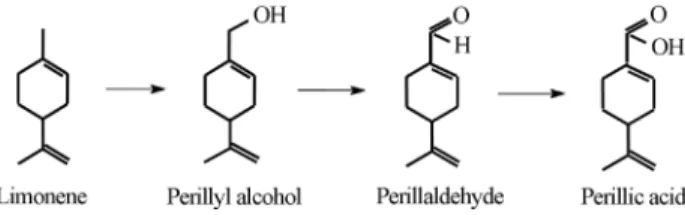
Pseudomonas putida involves three oxidation steps catalysed by a monooxygenase, an alcohol dehydrogenase and an aldehyde dehydrogenase, leading in series to perillyl alcohol, perillaldehyde and perillic acid (Figure 1). In My-cobacteriumsp. strain HXN-1500, the production of peril-lyl alcohol via limonene oxidation was accomplished by a multi-component electron transfer chain containing cyto-chrome P450 (P450), a ferredoxin and a ferredoxin reductase (Van Beilenet al., 2005). ThisMycobacterium
strain was selected in a screening program that showed a positive correlation between alkane degrading bacteria and the ability to hydroxylate limonene. Furthermore, accord-ing to the authors, the physiological function of the P450 responsible for limonene oxidation was the hydroxylation of alkanes.
The oxidative steps required for limonene biocon-version by yeasts have not yet been identified, with the ex-ception, according to the literature, that the process is initi-ated by P450 monooxygenases (Duetz et al., 2003). Notably,Y. lipolyticais an alkane-assimilating yeast. The primary alkane oxidation involves a terminal hydroxylation catalysed by a P450-dependent alkane monooxygenase system. This is followed by the action of alcohol-oxidising enzymes (alcohol oxidases or alcohol dehydrogenases) and
aldehyde dehydrogenases, resulting in the corresponding acid (Fickerset al., 2005). Therefore, it would be reason-able to assume that the P450 system would be responsible for the oxidation of limonene by this yeast.
To better understand the limonene biotransformation process carried out byY. lipolytica, intermediates of the ox-idative reaction were assayed for their conversion.Y. lipo-lyticawas able to recognize perillyl alcohol as a substrate, which was then oxidized to perillaldehyde and perillic acid. It was also able to recognize perillaldehyde, which was transformed into perillic acid, as shown by TLC analysis. In the absence of O2, only perillaldehyde reacted and was re-duced to perillyl alcohol. These results collectively suggest that limonene oxidation to perillic acid is a stepwise and multi-enzymatic oxidative pathway. Moreover, as the alco-hol and aldehyde intermediates were not detected in all of the limonene bioconversion conditions tested, the first oxi-dation step,i.e., the oxidation of limonene to perillyl alco-hol, would be the pacemaker reaction.
Inhibitors of the enzymes alcohol oxidase and alcohol dehydrogenase (White and White, 1997) were added to the limonene bioconversion medium in an attempt to trap the alcohol intermediate. The addition of zinc sulphate, keto-conazole, EDTA, cysteine or DMSO did not have any ef-fect on the oxidation of limonene to perillic acid. Although dimercury dichloride, nickel(II) sulphate and oxidised or reduced glutathione decreased the formation of perillic acid, this was still the sole product of the reaction, and as such, the selective inhibition of the limonene oxidative steps was not observed. Copper(II) sulphate and silver ni-trate completely inhibited the conversion, possibly by inter-fering with the relevant oxidative system.
The oxidation to perillic acid took place with either (R)- or (S)-limonene, although the later afforded a lower yield, as was qualitatively indicated by TLC analysis. The enantiomeric properties of the products were not deter-mined.
Bioconversion assays
According to GC-FID analysis, the bioconversion of limonene at 25, 28 and 30 °C resulted in the formation of 564, 442 and 338 mg/L of perillic acid, respectively. The decreasing yield pattern observed with the temperature in-crease might be related either to a higher evaporation rate of the volatile limonene from the reaction medium or to the ef-fect of the temperature on the enzymatic system involved in the reaction.
The effect of the initial pH of the culture on limonene bioconversion was evaluated by assaying the reaction at pH values in the range of 3.0 to 8.0. TLC analysis showed that bioconversion at pH 3.0 and 4.0 (phosphate-citrate buffer 50 mM) resulted in poor perillic acid formation in compari-son to results at higher pH values (data not shown). Conver-sions within the pH range 5.7 to 7.4 (phosphate buffer 50 mM) showed that 7.1 was the best pH for bioconversion,
as determined using GC-FID analysis, resulting in the for-mation of 562 mg/L of perillic acid (Table 1).
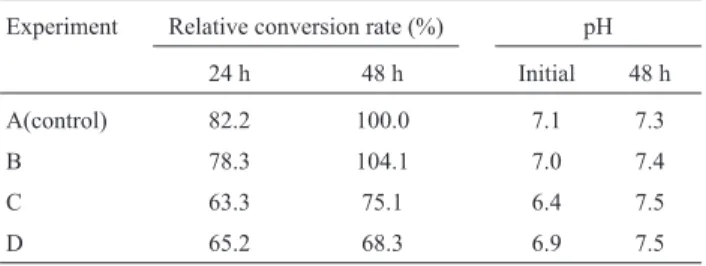
Table 2 shows the relative conversion of limonene to perillic acid in the presence or absence of glucose (100 mM) and phosphate buffer (50 mM). Yeast cells did not consume the sugar, the concentration of which re-mained constant throughout the 48 hours reaction time, demonstrating that the use of glucose in the reaction me-dium to reduce co-factors was not necessary for biocon-version. However, the production of the oxidised limonene derivative was reduced by 20% after 24 h and 30% after 48 h in non-buffered media, demonstrating that phosphate is required for efficient bioconversion. In all four experi-ments, slight increases in the final pH were observed (Ta-ble 2), indicating that the decrease in the reaction yields in the non-buffered medium was not related to pH variation.
Addition of 0.1% tween 20 or tween 80 led to a 22% and 8.5% decrease in the production of perillic acid, respec-tively. The direct addition of 0.5% (v/v) limonene to the stationary-phase yeast culture (48 h) without previously centrifuging the cells decreased product formation by 25%. The stepwise addition of limonene to the bioconversion medium (6 doses distributed over 48 h) resulted in a 50% increase in perillic acid concentration, reaching 855 mg/L, compared to the usual one-step addition at the beginning of the experiment (data not shown). In summary, the reaction
conditions that promoted the highest limonene conversion (16.7%) after a 48 h reaction time were as follows: a tem-perature of 25 °C, a pH of 7.1 (50 mM phosphate buffer) and gradual addition of limonene (0.5% distributed in 6 dosages over 48 h).
As described by Mirataet al.(2009), growing cells of
P. putidaDSM 12264 (using 5 g/L glycerol as a co-subs-trate) produced up to 3.0 g/L of perillic acid from 20.4 g/L limonene in a 120 h batch culture. This corresponded to a 12% limonene conversion. Upon process optimization in fed-batch culture, 10.6 g/L of perillic acid was achieved. A method forin situproduct recovery resulted in a cumulative perillic acid concentration of 31 g/L after 7 days.
There are few articles that address the oxidation of limonene mediated by yeast. Although the process of con-verting limonene to perillic acid usingY. lipolyticahas been reported, the reaction has not yet been characterized (Van Rensburget al., 1997). Although the identification of the relevant metabolic pathway that performs the reaction in yeast cells and its location in the cell structure is still an open issue, the results presented here are a step forward in understanding the parameters that affect limonene bio-oxi-dation to perillic acid and the involvement of P450 as the enzymatic oxidative system. It should also be emphasised that the use ofY. lipolyticaallows the formation of a single, stable, excreted product. These initial studies on the oxida-tion of limonene by this yeast will be expanded via experi-mental bioprocess optimization and the improvement of cell catalytic abilities to achieve higher conversion yields and productivity. The development of general processes us-ing this yeast, which is known for its highly efficient me-tabolism of hydrophobic substrates and whose genome has already been sequenced, would help to establish a ceutically safe microorganism that can synthesize pharma-cologically important molecules.
Acknowledgments
The present study was supported by the Brazilian agencies Conselho Nacional de Desenvolvimento Cien-tífico e Tecnológico (CNPq) and Fundação de Amparo à Pesquisa do Estado do Rio de Janeiro (FAPERJ).
References
Bicas JL, Dionísio AP, Pastore GM (2009) Bio-oxidation of terpenes: An approach for the flavor industry. Chem Rev 109:4518-4531.
Buckland BC, Robinson DK, Chartrain M (2000) Biocatalysis for pharmaceuticals – status and prospects for a key technology. Metab Eng 2:42-48.
Cadwallader KR, Braddock RJ, Parish ME, Higgins DP (1989) Bioconversion of d-limonene by Pseudomonas gladioli. J Food Sci 54:1241-1245.
Da Fonseca CO, Simão M, Lins I R, Caetano R O, Futuro D, Quirico-Santos T (2011) Efficacy of monoterpene perillyl
Table 1- Influence of pH on limonene bioconversion to perillic acid byY. lipolytica. Measured by GC-FID. Assays were performed at 25 °C, 200 rpm and the reaction mixtures contained 0.5% v/v initial
R-(+)-limonene, 50 mM phosphate buffer at the desired pH, and 10 g/L cell mass.
Initial pH Perillic acid (mg/L)
24 h 48 h
5.7 316.7 406.1
6.4 387.6 525.6
7.1 419.0 562.0
7.4 391.2 478.4
Table 2- Influence of glucose and/or buffer addition on limonene bio-conversion to perillic acid byY. lipolytica. Measured by GC-FID. A: addi-tion of 100 mM glucose and 50 mM pH 7.0 phosphate buffer; B: addiaddi-tion of 50 mM pH 7.0 phosphate buffer, no glucose; C: addition of 100 mM glucose no buffer; D: no glucose, no buffer. Assays were performed at 25 °C, 200 rpm and the reaction mixtures contained 0.5% v/v initial
R-(+)-limonene and 10 g/L cell mass.
Experiment Relative conversion rate (%) pH
24 h 48 h Initial 48 h
A(control) 82.2 100.0 7.1 7.3
B 78.3 104.1 7.0 7.4
C 63.3 75.1 6.4 7.5
alcohol upon survival rate of patients with recurrent glio-blastoma. J Cancer Res Clin Oncol 137:287-293.
Duetz WA, Bouwmeester H, Van Beilen JB, Witholt B (2003) Biotransformation of limonene by bacteria, fungi, yeasts, and plants. Appl Microbiol Biotechnol 61:269-277. Fickers P, Benetti PH, Wache Y, Marty A, Mauersberger S, Smit
MS, Nicaud JM (2005) Hydrophobic substrate utilisation by the yeastYarrowia lipolytica, and its potential applications. FEMS Yeast Res 5:527-543.
Gellissen G, Kunze G, Gaillardin C, Cregg JM, Berardi E, Vee-nhuis M, Van der Klei I (2005) New yeast expression plat-forms based on methylotrophicHansenula polymorphaand Pichia pastorisand on dimorphicArxula adeninivoransand Yarrowia lipolytica – A comparison. FEMS Yeast Res 5:1079-1096.
Krings U, Berger RG (1998) Biotechnological production of fla-vours and fragrance. Appl Microbiol Biotechnol 49:1-8. Liese A, Seelbach K, Wandrey C (2006) Industrial
Biotrans-formations. Wiley-VCH, Weinheim.
Madyastha KM, Bhattacharyya PK, Vaidyanathan CS (1977) Me-tabolism of a monoterpene alcohol, linalool, by a soil pseu-domonad. Can J Microbiol 23:231-238.
Matsuyama A, Yamamoto H, Kobayashi Y (2002) Practical appli-cation of recombinant whole-cell biocatalysts for the manu-facturing of pharmaceutical intermediates such as chiral al-cohols. Org Proc Res & Develop 6:558-561.
Mirata MA, Heerd D, Schrader J (2009) Integrated bioprocess for the oxidation of limonene to perillic acid withPseudomonas putidaDSM 12264. Process Biochem 44:764-771. Persidis A (1997) Chiral-based therapeutics. Nat Biotechnol
15:594-595.
Pollard DJ., Woodley JM (2007) Biocatalysis for pharmaceutical intermediates, the future is now. Trends Biotechnol 25:66-73.
Speelmans G, Bijlsma A, Eggink G (1998) Limonene bioconver-sion to high concentrations of a single and stable product, perillic acid, by a solvent-resistant Pseudomonas putida strain. Appl Microbiol Biotechnol 50:538-544.
Tan Q, Day DF (1998) Bioconversion of limonene to alphater-pineol by immobilizedPenicillium digitatum. Appl Micro-biol Biotechnol 49:96-101.
Trudgill PW (1990) Microbial metabolism of monoterpenes - Re-cent developments. Biodegradation 1:93-105.
Trytek M, Fiedurek J (2005) A novel psychrotrophic fungus, Mortierella minutissima, for D-limonene biotransformation. Biotechnol Lett 27:149-153.
Van Beilen JB, Holtackers R, Lüscher D, Bauer U, Witholt B, Duetz WA (2005) Biocatalytic production of perillyl alcohol from limonene by using a novel Mycobacterium sp. cytochrome P450 alkane hydroxylase expressed in Pseudo-monas putida. Appl Environ Microbiol 71:1737-1744. Van der Werf MJ, De Bont JAM, Leak DJ (1997) Opportunities in
microbial biotransformation of monoterpenes. Adv Biochem Eng Biotechnol 55:147-177.
Van Rensburg E, Molekeli N, Van der Walt JP, Botes PJ, Van Dyk MS (1997) Biotransformation of (+) limonene and (-) piperitone by yeasts and yeast-like fungi. Biotechnol Lett 19:779-782.
White JS, White DC (1997) Source Book of Enzymes. CRC Press, Boca Raton.
Yeruva, L, Pierre KJ, Elegbede A, Wang RC, Carper SW (2007) Perillyl alcohol and perillic acid induced cell cycle and apoptosis in non small cell lung cancer. Cancer Letters 257:216-226.