Association study of folate-related enzymes (MTHFR, MTR, MTRR) genetic
variants with non-obstructive male infertility in a Polish population
Mateusz Kurzawski
1, Anna Wajda
1, Damian Malinowski
2, Anna Kazienko
3, Rafal Kurzawa
3and Marek Drozdzik
11
Department of Experimental and Clinical Pharmacology, Pomeranian Medical University, Szczecin,
Poland.
2
Department of Pharmacokinetics and Therapeutic Drug Monitoring, Pomeranian Medical University,
Szczecin, Poland.
3Department of Reproductive Medicine and Gynecology, Pomeranian Medical University, Szczecin, Poland.
Abstract
Spermatogenesis is a process where an important contribution of genes involved in folate-mediated one-carbon me-tabolism is observed. The aim of the present study was to investigate the association between male infertility and the MTHFR (677C > T; 1298A > C), MTR (2756A > G) and MTRR (66A > G) polymorphisms in a Polish population. No significant differences in genotype or allele frequencies were detected between the groups of 284 infertile men and of 352 fertile controls. These results demonstrate that common polymorphisms in folate pathway genes are not major risk factors for non-obstructive male infertility in the Polish population.
Keywords: MTHFR, MTR, MTRR, polymorphism, infertility.
Received: June 12, 2014; Accepted: October 10, 2014.
Spermatogenesis is a multistep developmental pro-cess coordinated by sequential expression of various genes, with an important contribution of genes involved in folate-mediated one-carbon metabolism. This pathway is manda-tory for thymidylate and purine biosynthesis, thus provid-ing substrates for DNA synthesis in rapidly dividprovid-ing male germ cells. Via involvement in homocysteine metabolism, folates participate in DNA, RNA and histone methylation reactions, taking part in regulation of transcription. The key enzymes implicated in the above mentioned metabolic pathways are: 5,10-methylenetetrahydrofolate reductase (MTHFR), methionine synthase (MTR) and methionine synthase reductase (MTRR). It was found that polymor-phisms defined within the coding sequences of these genes may affect metabolic pathways controlled by the enzymes.
Within theMTHFRgene, two functional single nu-cleotide polymorphisms (SNPs) were characterized. The
MTHFR677C > T variant (rs1801133) encodes a thermo-labile protein variant with enzymatic activity decreased by 35% in heterozygotes and by 70% in the homozygous state. TheMTHFR1298A > C polymorphism (rs1801131) is as-sociated with a 30% decrease in enzymatic activity. The
MTHFR677C > T andMTHFR1298A > C SNPs were also
shown to be associated with DNA hypomethylation (Wei-neret al., 2014). In theMTRgene, an adenine to guanine transition at position 2756 (A > G, rs1805087) results in substitution of aspartic acid with glycine in codon 919 of the protein and is related to alterations in the folate meta-bolic pathway. The Asp919Gly substitution in the MTR en-zyme results in its higher activity, leading to more effective homocysteine remethylation and methionine production (Ravelet al., 2009). TheMTRRgene includes a polymor-phic locusMTRR66A > G (rs1801394), which was shown to slightly reduce enzymatic activity, but was associated with decreased plasma homocysteine concentrations (Park
et al., 2005).
The available information on associations of the above mentioned SNPs inMTHFR,MTRandMTRRgenes with male infertility reported from various populations is not consistent, and mostly evaluateMTHFRgene. Most of the studies available are from Asian populations (Leeet al., 2006; Aet al., 2007; Parket al., 2009), with some data from Caucasians: Italian (Stuppiaet al., 2003), Dutch (Ebischet al., 2003), Swedish (Murphyet al., 2011), French (Ravelet al., 2009; Montjeanet al., 2011), German (Bezoldet al., 2001), Spanish (Camprubiet al., 2013) and only one from an East European (i.e. Slavic) population, from Russia (Weineret al., 2014). The results are still debatable, and the observed differences may not only depend on ethnic differ-ences but also on environmental factors,i.e.folate intake,
Send correspondence to Mateusz Kurzawski. Department of Ex-perimental and Clinical Pharmacology, Pomeranian Medical Uni-versity, Powstanców Wlkp. 72, 70-111 Szczecin, Poland. E-mail: [email protected].
which in turn can influence DNA methylation and semen quality. The present study aimed at definition of associa-tions of the commonMTHFR,MTRandMTRR polymor-phisms with male infertility in a Polish (i.e. Slavic) population.
The study was carried out in 284 consecutive, other-wise healthy male patients (aged 22-49 years, mean 32.7±
4.7) without any chromosomal abnormalities, undergoing semen analysis due to infertility workup. The inclusion cri-teria were as follow: no children from current or previous relations with at least a year history of at least a year of reg-ular (2-3 weekly), unprotected sexual activity without con-ception; female partners aged up to 35 years with regular menstrual bleedings and/or progesterone levels in the luteal phase of the cycle > 10 ng/mL, normal transvaginal ultra-sound examination, negative testing for Chlamydia trachomatisinfection, without history of pelvic inflamma-tory disease or abdominal operations. Subjects were ex-cluded from the study if semen analysis and clinical picture suggested obstructive azoospermia or testicular, epidi-dymal, or accessory gland infection. Also, subjects with known systemic disease, BMI³30 kg/m2, varicocele, his-tory of mumps, testicular torsio or maldescence, trauma, as well as occupational hazards (exposure to solvents, pesti-cides, painting materials, heavy metals or radiation) were not taken into consideration.
The control group consisted of 352 healthy males (aged 21-56 years, mean 34.7±8.7) recruited among con-secutive men accompanying their female partners at term labor in the University Department of Feto-Maternal Medi-cine. Paternity was confirmed by women; however the pos-sible paternal discrepancy was additionally checked based on blood group verification. Both the men undergoing in-fertility examination, as well as the fertile controls were Caucasians of Polish origin, recruited within the same geo-graphical region. The study was approved by the local eth-ics committee and written informed consent was obtained from all subjects.
Genomic DNA was extracted from blood samples us-ing GeneMATRIX Blood DNA Purification Kit (EURx, Poland). Pre-validated allelic discrimination TaqMan real-time PCR assays (Life Technologies, USA) were used for detection of the respective SNPs inMTHFR(rs1801131, rs1801133), MTR (rs1805087) and MTRR (rs1801394) genes. Amplification was performed in a 7500 Fast Real-Time PCR System with incorporated SDS software for SNP genotyping (Applied Biosystems, USA) using TaqMan GTXpress Master Mix (Life Technologies, USA).
Fluorescence data was captured after 40 PCR cycles.
Allele and genotype frequencies were determined by direct counting of alleles. Concordance of genotype distri-bution with Hardy-Weinberg equilibrium was calculated usingc2test. Genotype and allele frequencies between the study groups were compared by means of Fisher’s exact test. The effect of each polymorphism was tested in both a
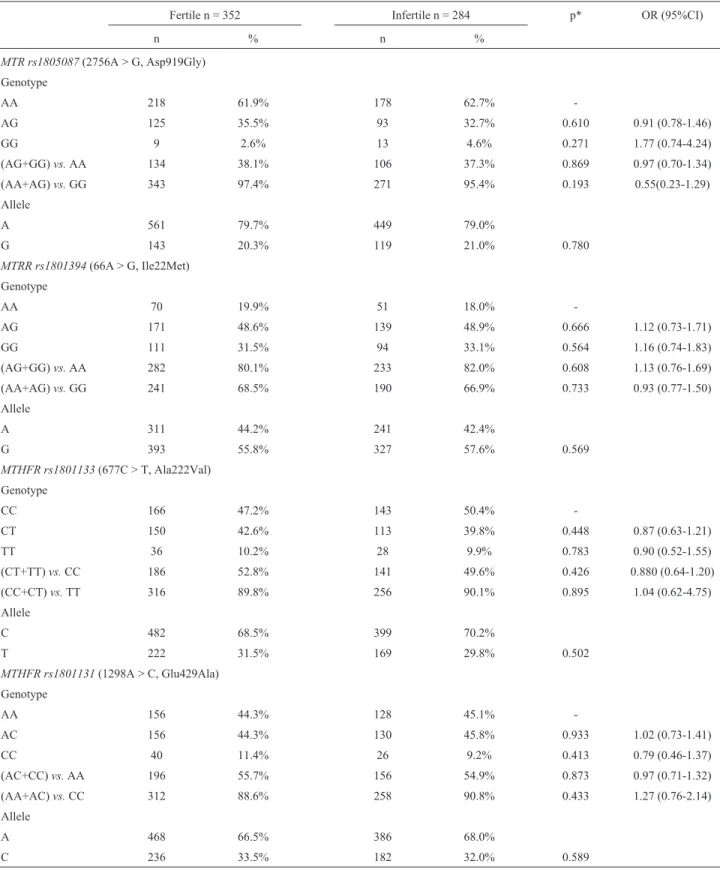
dominant and recessive model. All genotypes were distrib-uted in concordance with Hardy-Weinberg equilibrium, both in infertile patients and control subjects. No signifi-cant differences between the study groups were noted, nei-ther in genotype distribution, nor in allele frequencies. All genotyping results are given in Table 1.
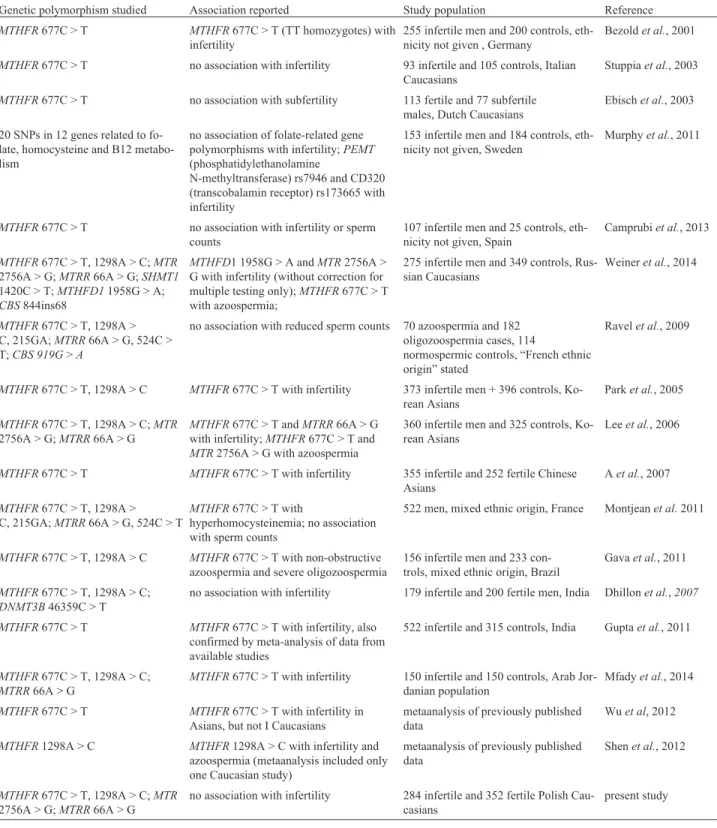
No significant impact of the studied polymorphisms on male infertility was revealed in the present study. The original concept of the impact ofMTHFRvariants on male reproduction and initial positive association of the thermo-labile 677T variant with infertility came from the German study of Bezold et al. (2001), who reported significant overrepresentation of TT homozygotes among male pa-tients seeking fertility evaluation compared with control group (18.8vs.9.5%). This preliminary report, without de-tailed characterization of neither male infertility nor control subjects, has been subsequently followed by several studies in Caucasian populations,i.e.Dutch (Ebischet al., 2003), Italian (Stuppia et al., 2003), Swedish (Murphy et al., 2011), and Spanish (Camprubiet al., 2013). Contrary to the original report, the results of all aforementioned studies were negative. It should be noted that most of them simply lacked sufficient power to verify the existence of the inves-tigated association, as numbers of participants were low (Table 2). Nonetheless negative association results were accompanied by findings on a potential relationship of
MTHFRgenotype and sperm counts, but only in some stud-ies. Ravelet al.(2009) did not find any association between
MTHFR(677C > T, 1298A > C and 215GA - rs2066472) genetic variants and sperm counts in French infertile men, which was later confirmed by Montjeanet al.(2011) in a larger cohort of mixed ethnicity. Similarly, none of the ge-notypes was associated with neither standard seminogram parameters nor presence of sperm DNA hypomethylation (Camprubiet al., 2013). Finally, in the recent report from an East European population in Russia, Weiner et al.
(2014) have observed the association ofMTHFRgenotype with azooospermia, but found no general impact of
MTHFR677C > T andMTHFR1298A > C polymorphisms on male infertility. Summarizing the observations from Caucasian studies, including the present Polish one, it seems that MTHFR 677C > T and MTHFR 1298A > C polymorphisms are not associated with male infertility.
Arabic population,i.e.Jordanians, by Mfadyet al.(2014), a Brazilian report on males of mixed ethnicity by Gavaet al. (2011), or by Guptaet al.(2011) from India. However,
nega-tive data for Indians, for both MTHFR 677C > T and
MTHFR 1298A > C, were also reported (Dhillon et al., 2007). Such impact of ethnic differences is also reflected in
Table 1- Distribution ofMTR,MTRRandFluorescence data after 40 PCR cyclesMTHFRgene variants in infertile patients and control group.
Fertile n = 352 Infertile n = 284 p* OR (95%CI)
n % n %
MTR rs1805087(2756A > G, Asp919Gly)
Genotype
AA 218 61.9% 178 62.7%
-AG 125 35.5% 93 32.7% 0.610 0.91 (0.78-1.46)
GG 9 2.6% 13 4.6% 0.271 1.77 (0.74-4.24)
(AG+GG)vs.AA 134 38.1% 106 37.3% 0.869 0.97 (0.70-1.34)
(AA+AG)vs.GG 343 97.4% 271 95.4% 0.193 0.55(0.23-1.29)
Allele
A 561 79.7% 449 79.0%
G 143 20.3% 119 21.0% 0.780
MTRR rs1801394(66A > G, Ile22Met)
Genotype
AA 70 19.9% 51 18.0%
-AG 171 48.6% 139 48.9% 0.666 1.12 (0.73-1.71)
GG 111 31.5% 94 33.1% 0.564 1.16 (0.74-1.83)
(AG+GG)vs.AA 282 80.1% 233 82.0% 0.608 1.13 (0.76-1.69)
(AA+AG)vs.GG 241 68.5% 190 66.9% 0.733 0.93 (0.77-1.50)
Allele
A 311 44.2% 241 42.4%
G 393 55.8% 327 57.6% 0.569
MTHFR rs1801133(677C > T, Ala222Val)
Genotype
CC 166 47.2% 143 50.4%
-CT 150 42.6% 113 39.8% 0.448 0.87 (0.63-1.21)
TT 36 10.2% 28 9.9% 0.783 0.90 (0.52-1.55)
(CT+TT)vs.CC 186 52.8% 141 49.6% 0.426 0.880 (0.64-1.20)
(CC+CT)vs.TT 316 89.8% 256 90.1% 0.895 1.04 (0.62-4.75)
Allele
C 482 68.5% 399 70.2%
T 222 31.5% 169 29.8% 0.502
MTHFR rs1801131(1298A > C, Glu429Ala)
Genotype
AA 156 44.3% 128 45.1%
-AC 156 44.3% 130 45.8% 0.933 1.02 (0.73-1.41)
CC 40 11.4% 26 9.2% 0.413 0.79 (0.46-1.37)
(AC+CC)vs.AA 196 55.7% 156 54.9% 0.873 0.97 (0.71-1.32)
(AA+AC)vs.CC 312 88.6% 258 90.8% 0.433 1.27 (0.76-2.14)
Allele
A 468 66.5% 386 68.0%
C 236 33.5% 182 32.0% 0.589
meta-analyses. A stratified analysis by Wu et al. (2012) showed that a significant association betweenMTHFR677C > T polymorphism and male infertility was present only in Asians (OR = 1.79 for two copies of T allele and OR = 1.42 for T allele carriers), but not in Caucasians. A meta-analysis published by Shenet al.(2012) on theMTHFR1298A > C variant gave similar results. However, the authors joined
ge-netically distinctethnicgroups for the analysis (Korean and Indian) as “Asians”, which does not seem to be fully justi-fied. These meta-analyses also are in accordance with the negative observations from the present study in a Pol-ish-Caucasian population.
There is scarce data on two other polymorphisms evaluated in the present study,i.e. MTRandMTRR. The
Table 2- Previous studies on genes of folate-mediated one-carbon metabolism pathway in relation to male infertility.
Genetic polymorphism studied Association reported Study population Reference
MTHFR677C > T MTHFR677C > T (TT homozygotes) with infertility
255 infertile men and 200 controls, eth-nicity not given , Germany
Bezoldet al., 2001
MTHFR677C > T no association with infertility 93 infertile and 105 controls, Italian Caucasians
Stuppiaet al., 2003
MTHFR677C > T no association with subfertility 113 fertile and 77 subfertile males, Dutch Caucasians
Ebischet al., 2003
20 SNPs in 12 genes related to fo-late, homocysteine and B12 metabo-lism
no association of folate-related gene polymorphisms with infertility;PEMT
(phosphatidylethanolamine
N-methyltransferase) rs7946 and CD320 (transcobalamin receptor) rs173665 with infertility
153 infertile men and 184 controls, eth-nicity not given, Sweden
Murphyet al., 2011
MTHFR677C > T no association with infertility or sperm counts
107 infertile men and 25 controls, eth-nicity not given, Spain
Camprubiet al., 2013
MTHFR677C > T, 1298A > C;MTR
2756A > G;MTRR66A > G;SHMT1
1420C > T;MTHFD11958G > A;
CBS844ins68
MTHFD1 1958G > A andMTR2756A > G with infertility (without correction for multiple testing only);MTHFR677C > T with azoospermia;
275 infertile men and 349 controls, Rus-sian CaucaRus-sians
Weineret al., 2014
MTHFR677C > T, 1298A > C, 215GA;MTRR66A > G, 524C > T;CBS 919G>A
no association with reduced sperm counts 70 azoospermia and 182 oligozoospermia cases, 114
normospermic controls, “French ethnic origin” stated
Ravelet al., 2009
MTHFR677C > T, 1298A > C MTHFR677C > T with infertility 373 infertile men + 396 controls, Ko-rean Asians
Parket al., 2005
MTHFR677C > T, 1298A > C;MTR
2756A > G;MTRR66A > G
MTHFR677C > T andMTRR66A > G with infertility;MTHFR677C > T and
MTR2756A > G with azoospermia
360 infertile men and 325 controls, Ko-rean Asians
Leeet al., 2006
MTHFR677C > T MTHFR677C > T with infertility 355 infertile and 252 fertile Chinese Asians
Aet al., 2007
MTHFR677C > T, 1298A > C, 215GA;MTRR66A > G, 524C > T
MTHFR677C > T with
hyperhomocysteinemia; no association with sperm counts
522 men, mixed ethnic origin, France Montjeanet al.2011
MTHFR677C > T, 1298A > C MTHFR677C > T with non-obstructive azoospermia and severe oligozoospermia
156 infertile men and 233 con-trols, mixed ethnic origin, Brazil
Gavaet al., 2011
MTHFR677C > T, 1298A > C;
DNMT3B46359C > T
no association with infertility 179 infertile and 200 fertile men, India Dhillonet al.,2007
MTHFR677C > T MTHFR677C > T with infertility, also confirmed by meta-analysis of data from available studies
522 infertile and 315 controls, India Guptaet al., 2011
MTHFR677C > T, 1298A > C;
MTRR66A > G
MTHFR677C > T with infertility 150 infertile and 150 controls, Arab Jor-danian population
Mfadyet al., 2014
MTHFR677C > T MTHFR677C > T with infertility in Asians, but not I Caucasians
metaanalysis of previously published data
Wuet al, 2012
MTHFR1298A > C MTHFR1298A > C with infertility and azoospermia (metaanalysis included only one Caucasian study)
metaanalysis of previously published data
Shenet al., 2012
MTHFR677C > T, 1298A > C;MTR
2756A > G;MTRR66A > G
no association with infertility 284 infertile and 352 fertile Polish Cau-casians
MTR2756A > G polymorphism was not associated with male infertility in the aforementioned Korean (Leeet al., 2006), Russian (Weineret al., 2014), as well as the Swedish studies (Murphyet al., 2011). Our study does support these observations, as no impact of theMTR 2756A > G poly-morphism on infertility in Polish males was found. How-ever, the Korean study by Lee et al. (2006) found an association between MTR 2756GG genotype and an in-creased risk of azoospermia.
Similarly to theMTHFRpolymorphism, theMTRR
66A > G polymorphism was found to impact male infertil-ity in the Asian population. Leeet al.(2006) documented that theMTRR66GG genotype promoted development of male infertility. Contrary to this, the Russian (Weineret al., 2014) and French (Ravelet al., 2009) studies did not sup-port the findings from the Korean population. Likewise, data from a Middle Eastern Arabic population demon-strated that theMTRR66A > G genotype distribution was not different in fertile and infertile groups (Mfadyet al., 2014). Our results from a non-Russian, Slavic population did not reveal an association between theMTRR66A > G polymorphism and male infertility. In conclusion, the pres-ent study did not reveal a significant association of the
MTHFR, MTR, MTRR gene polymorphisms with non-obstructive male infertility in a Polish population.
Nonetheless, the observed discrepancy between the results of studies conducted in different populations may result from both genetic determinants and environmental factors, including differences in folate consumption in dif-ferent regions. Reduced folate levels can result from muta-tions in folate pathway genes, as well as insufficient dietary intake. Folate deficiency affects spermatogenesis by pro-ducing DNA hypomethylation and resultant gene expres-sion changes, as well as inducing uracil misincorporation in the course of DNA synthesis, and thus errors in DNA re-pair, strand breakage and chromosomal abnormalities (Ra-velet al., 2009). Deficiency of folates is also related with hyperhomocysteinemia, a risk factor for male infertility (Leeet al., 2006). Hyperhomocysteinemia may not only re-sult from low folate consumption, but also from genetic variants in genes of the folate pathway (Bialeckaet al., 2012). It was also demonstrated that folate treatment im-proved semen parameters, such as an increase in spermato-zoa number and motility, as well as total normal sperm count.
Acknowledgments
The study was supported in part from National Sci-ence Centre grant (UMO-2011/01/B/NZ5/04235).
References
Zhou-Cun A, Yuan Y, Si-Zhong Z, Na L and Wei Z (2017) Single nucleotide polymorphism C677T in the methyl-enetetrahydrofolate reductase gene might be a genetic risk
factor for infertility for Chinese men with azoospermia or severe oligozoospermia. Asian J Androl 9:57-62.
Bezold G, Lange M and Peter RU (2001) Homozygous methyl-enetetrahydrofolate reductase C677T mutation and male in-fertility. N Engl J Med 344:1172-1173.
Bialecka M, Kurzawski M, Roszmann A, Robowski P, Sitek EJ, Honczarenko K, Gorzkowska A, Budrewicz S, Mak M, Jarosz M,et al.(2012) Association of COMT, MTHFR, and SLC19A1(RFC-1) polymorphisms with homocysteine blood levels and cognitive impairment in Parkinson’s dis-ease. Pharmacogenet Genomics 22:716-724.
Camprubí C, Pladevall M, Grossmann M, Garrido N, Pons MC and Blanco JJ (2013) Lack of association of MTHFR rs1801133 polymorphism and CTCFL mutations with sperm methylation errors in infertile patients. J Assist Reprod Genet 30:1125-1131.
Dhillon VS, Shahid M and Husain SA (2007) Associations of MTHFR DNMT3b 4977 bp deletion in mtDNA and GSTM1 deletion, and aberrant CpG island hypermethylation of GSTM1 in non-obstructive infertility in Indian men. Mol Hum Reprod 13:213-222.
Ebisch IMW, Van Heerde WL, Thomas CMG, Van der Put N, Wong WY and Steegers-Theunissen RPM (2003) C677T methylenetetrahydrofolate reductase polymorphism inter-feres with the effects of folic acid and zinc sulfate on sperm concentration. Fertil Steril 80:1190-1194.
Gava MM, Chagas Ede O, Bianco B, Christofolini DM, Pompeo AC, Glina and Barbosa CP (2011) Methylenetetra-hydrofolate reductase polymorphisms are related to male in-fertility in Brazilian men. Genet Test Mol Biomarkers 15:153-157.
Gupta N, Gupta S, Dama M, David A, Khanna G, Khanna A and Rajender S (2011) Strong association of 677 C > T substitu-tion in the MTHFR gene with male infertility - A study on an Indian population and a meta-analysis. PLoS One 6:e22277. Lee HC, Jeong YM, Lee SH, Cha KY, Song SH, Kim NK, Lee
KW and Lee S (2006) Association study of four poly-morphisms in three folate-related enzyme genes with non-obstructive male infertility. Hum Reprod 21:3162-3170.
Mfady DS, Sadiq MF, Khabour OF, Fararjeh AS, Abu-Awad A and Khader Y (2014) Associations of variants in MTHFR and MTRR genes with male infertility in the Jordanian pop-ulation. Gene 536:40-44.
Montjean D, Benkhalifa M, Dessolle L, Cohen-Bacrie P, Belloc S, Siffroi JP, Ravel C, Bashamboo A and McElreavey K (2011) Polymorphisms in MTHFR and MTRR genes associ-ated with blood plasma homocysteine concentration and sperm counts. Fertil Steril 95:635-640.
Murphy LE, Mills JL, Molloy AM, Qian C, Carter TC, Strevens H, Wide-Swensson D, Giwercman A and Levine RJ (2011) Folate and vitamin B12 in idiopathic male infertility. Asian J Androl 13:856-861.
Park JH, Lee HC, Jeong YM, Chung TG, Kim HJ, Kim NK, Lee SH and Lee S (2005) MTHFR C677T polymorphism associ-ates with unexplained infertile male factors. J Assist Reprod Genet 22:361-368.
metabo-lism and unexplained reduced sperm counts. PLoS One 4:e6540.
Shen O, Liu R, Wu W, Yu L and Wang X (2012) Association of the methylenetetrahydrofolate reductase gene A1298C polymorphism with male infertility: A meta-analysis. Ann Hum Genet 76:25-32.
Stuppia L, Gatta V, Scarciolla O, Colosimo A, Guanciali-Franchi P, Calabrese G and Palka G. (2003) The methylenetethra-hydrofolate reductase (MTHFR) C677T polymorphism and male infertility in Italy. J Endocrinol Invest 26:620-622. Weiner AS, Boyarskikh UA, Voronina EN, Tupikin AE,
Korol-kova OV, Morozov IV and Filipenko ML (2014)
Poly-morphisms in folate-metabolizing genes and risk of idio-pathic male infertility: a study on a Russian population and a meta-analysis. Fertil Steril 101:87-94.
Wu W, Shen O, Qin Y, Lu J, Niu X, Zhou Z, Lu C, Xia Y, Wang S and Wang X (2012) Methylenetetrahydrofolate reductase C677T polymorphism and the risk of male infertility: A meta-analysis. Int JAndrol 35:18-24.
Associate Editor: Angela M. Vianna-Morgante