Non-adaptive territory selection by a bird
with exceptionally long parental care
Rados1aw W1odarczyk and Piotr Minias
Department of Biodiversity Studies and Bioeducation, University ofqo´dz´,qo´dz´, Poland
ABSTRACT
High-quality territories are expected to provide greater fitness return for breeding individuals and, thus, are likely to have higher long-term occupation rate in comparison to low-quality territories. However, if environmental and ecological cues used for territory selection cannot reliably predict true territory quality, a mismatch between preferences and fitness may occur. We suggest that this kind of non-adaptive territory selection is more likely in species with long reproductive cycles, as a long time interval between territory establishment and young fledgling should reduce predictability of conditions during the critical stages of brood care. In this study, we investigated adaptiveness of territory selection in a migratory bird with exceptionally long parental care, the mute swan Cygnus olor, which requires over four months to complete the entire reproductive cycle from egg laying to young fledging. For this purpose, we collected information on the long-term (10–19 years) occupancy of 222 swan breeding territories and correlated it with reproductive performance (n = 1,345 breeding attempts) and body condition of breeding adults. We found that long-term occupancy positively correlated with the timing of breeding, suggesting that individuals settled earlier in the attractive, frequently occupied territories. By contrast, we found no relationship between territory occupancy and reproductive output (hatching and fledging success) or adult body condition. The results indicate that at the time of territory selection swans might not be able to reliably assess territory quality, likely due to: (1) exceptionally long period of parental care, which reduces temporal correlation between the conditions at the time of territory selection and conditions during chick rearing; and (2) unpredictability of human-related activities that had a major impact on reproductive output of swan pairs in our population.
Subjects Animal Behavior, Biogeography, Ecology
Keywords Territory selection, Mute swan, Cygnus olor, Reproductive success, Body condition, Occupancy
INTRODUCTION
Resources, such as food or nest sites, are usually unevenly distributed in space, which forces organisms to judge habitat quality while making settlement decisions (Chalfoun & Martin, 2007). This is especially important during the process of breeding territory choice, as the quality of breeding habitat to a large extent determines individual fitness. Since high-quality territories are likely to enhance breeding success (Morris, 2003), they should be occupied earlier in the breeding season by high-quality, dominant individuals (Currie, Thompson & Burke, 2000;Forstmeier, 2002). Also, high-quality territories are
Submitted21 January 2016
Accepted6 March 2016
Published24 March 2016
Corresponding author
Rados1aw W1odarczyk, [email protected]
Academic editor
Donald Kramer
Additional Information and Declarations can be found on page 11
DOI10.7717/peerj.1852
Copyright
2016 W1odarczyk & Minias
Distributed under
expected to have a higher probability of being occupied in any given season, so they should have a higher long-term occupation rate in comparison to low-quality, suboptimal territories (Janiszewski, Minias & Wojciechowski, 2013). However, these predictions may only be valid providing that organisms are able to appropriately judge habitat quality (Martin, 1998).
Settlement decisions can rarely be based on direct assessment of fitness return (Storch & Frynta, 1999). Thus, territory selection often depends on actual environmental and ecological characteristics that can impact fitness, including food resources, nest site availability, predation pressure, or landscape structure (Martin, 1987;Aebischer et al., 1996;Eggers et al., 2005;Thomson et al., 2006;Farrell et al., 2012;Janiszewski et al., 2014a). Reliable environmental cues should reflect territory quality not only during settlement but also later on, when breeding is advanced (Chalfoun & Martin, 2007). This seems to be especially important for species with long reproductive cycles, in which families stay within breeding sites for several months. However, appropriate assessment of temporal environmental cues can be difficult in migratory species, which usually have a narrow time window to collect information on territory quality following their arrival on breeding grounds (Siikama¨ki, 1998). Assessment of territory quality may be additionally hampered in anthropogenic landscape, where natural environmental cues at the time of settlement may be unreliable due to unpredictability of human activities (Kokko & Sutherland, 2001;Robertson & Hutto, 2006). In such conditions, individuals may not be able to make optimal settlement decisions.
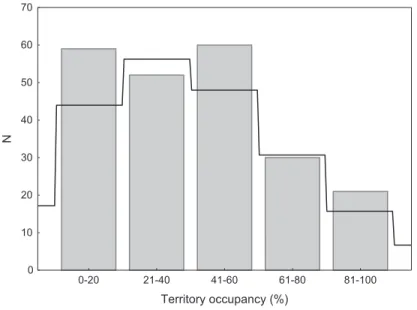
territory choice), we compared the distribution of swan territory occupancy to the Poisson distribution, which assumes a pattern of random territory selection (Sergio & Newton, 2003).
MATERIAL AND METHODS
Study area and species
Territory occupancy by mute swans was assessed over the period of 19 years (1997–2015) within an area of 8,800 km2in central Poland (Fig. 1). Swans from the local breeding population occupy habitats characterized by a varying degree of anthropogenic pressure. Most pairs nest at artificial reservoirs, mainly fishponds with intensive carp production, small ponds used for recreation, and dam reservoirs. Occupation of natural nesting-sites, such as peat bogs, oxbow lakes and flooded meadows is much less frequent (17% of all territories). All breeding birds leave their territories for winter (Włodarczyk et al., 2013), although their average migration distance is very short (81 ± 9.5 [SE] km, n = 186). The size of the study population was 70–100 pairs (Fig. 1) and it did not show considerable fluctuations among years (Włodarczyk & Janiszewski, 2007), which is consistent with the general stable population trend in Poland (Fig. S1). The majority of pairs nested solitarily on isolated waterbodies (79.3%). Up to 12 pairs nested at large dam reservoirs (max. 42.3 km2of water surface), but even in such situations each pair occupied a distinct territory defended from conspecifics. Semi-colonial nesting reported for other populations (Wieloch, Włodarczyk & Czapulak, 2004) has not been recorded.
Territory occupancy
Occupancy was assessed for 271 breeding swan territories. Due to the relatively low abundance of potential nesting sites (waterbodies) in the study area, we were confident to detect over 90% of all territories in our study area. Each territory was classified as occupied in a given year if a nest was recorded. Only territories that were continuously visited during at least 10 years (max. 19 years) were used in the analysis (n = 222). Occupation rate was calculated as the proportion of years when swans occupied the territory to the number of years when the territory was available for breeding. Some territories were unavailable for swans for a part of the study period, mainly due to human activity (e.g. drained or devoid of reed vegetation). For the purpose of some analyses (comparison to the random Poisson distribution) and presentation, territory occupancy was grouped into five categories: (1) very low occupancy (1–20% of years), (2) low occupancy (21–40% of years), (3) medium occupancy (41–60% of years), (4) high occupancy (61–80% of years), and (5) very high occupancy (81–100% of years).
territories characterized by high occupation rate were independently chosen by
multiple pairs/individuals throughout the study period. Territories characterized by an over 10-year occupancy were occupied by marked individuals for an average of 35.6 ± 0.035 [SE]% of years, suggesting that each territory changed an owner ca. two times during the study period (Fig. S2B).
Reproductive performance
Information on the reproductive performance of swans was collected since 1998. Each year, field observations started in late March, when pairs established territories, and finished in September, when first pairs left their territories with fledglings. Each occupied territory was visited at least four times during each breeding season. During these visits we collected data on the timing of laying, clutch size, and reproductive success (number of young fledged). The timing of laying for each pair was determined either by visiting the nest during laying or by a water-test developed for the mute swan, where
the incubation stage is established with ±5 day accuracy by the way the egg floats in water (Czapulak, 2002). In total, reproductive data were collected for 1,345 breeding attempts of swans.
Adult condition
We also captured adult birds within breeding territories to collect information on their body condition. Catching, ringing and handling of birds was performed under the licence of the Polish Academy of Sciences, with an approval of the Ministry of the Environment in Poland (DLP-VIII-6713-21/29762/14/RN). In total, we captured 123 individuals (64 males and 59 females) occupying 75 different territories. All birds were sexed with cloacal examination as described byBaker (1993). We measured total forearm length with ±1 mm accuracy and weighed birds using balance scale with an accuracy of 100 g (0.8–1.0% of average body mass of the mute swan). We used body mass adjusted for structural size (mass-size residuals) as the condition index of breeding birds. To obtain this estimate, we extracted residuals from a full-factorial model of sex and forearm length regressed against body mass (R2= 0.67,F3,119= 83.30, p< 0.001).
Statistical analyses
To test whether occupancy of territories was random we compared distribution of occupation rate with the Poisson distribution using2test. Occupancy pattern would
be similar to the Poisson distribution, if the territories were occupied randomly and independently of their previous history (Krebs, 1989). Relationship of territory occupancy with egg laying date and clutch size were analysed with the General Linear Mixed Models (GLMMs). As reproductive success was highly zero-inflated, we used the generalized linear mixed model with binomial distribution and logit link function to analyse the probability of successful reproduction (at least one fledgling raised vs. no fledglings) and we used GLMM to analyse reproductive success for successful pairs only. The identity of territory was entered as a random effect in each model to avoid pseudoreplication resulting from repeated measures of the same pairs breeding repeatedly in the same place. The effect of year was also entered as a random factor and laying date was entered as a covariate in the analyses of clutch size and reproductive success. GLMM with territory identity included as a random factor was also used to analyse relationship between occupation rate and size-adjusted body mass of swans. In this model we entered the date of capture as a covariate, but due to the low sample size of captured birds in some years we did not control for between-seasonal variation. All GLMMs were analysed with JMP 12.1 (SAS Institute Inc., Cary, NC, USA). All values are presented as means ± SE.
RESULTS
We found that territories were randomly occupied by swans, as the distribution of occupation rate did not differ significantly from the expected Poisson distribution (2= 4.36,p= 0.22;Fig. 2). Consistent with the Poisson distribution, territories with
or very high occupancy (49.8% vs. 22.9%;G= 17.76,p< 0.001;Fig. 2). There were no differences in occupancy between natural and artificial breeding sites (t= 1.26, df= 220,p= 0.20).
We found that the onset of egg laying was significantly related with territory occupancy, as birds bred earlier in the territories with higher occupancy (F1,715= 6.96,p= 0.009,
Fig. 3). On average, swans bred 3–5 days earlier in territories with high or very high (60–100%) occupancy when compared with territories characterized by low or very low
0-20 21-40 41-60 61-80 81-100
Territory occupancy (%) 0
10 20 30 40 50 60 70
N
Figure 2 Distribution of territory occupancy by the mute swan. Expected random occupancy (according to the Poisson distribution) is marked with a black line.
0-20 21-40 41-60 61-80 81-100
Territory occupancy (%) 13-Apr
15-Apr 17-Apr 19-Apr 21-Apr 23-Apr
Laying date
72 (47)
157 (49)
209 (30) 209 (21) 293 (59)
(0–40%) occupancy (Fig. 3). While controlling for laying date, we did not find any significant relationship between occupation rate and clutch size (F1,706= 2.79,p= 0.096).
Although we found a significant relationship between territory occupancy and the probability of successful reproduction (2= 4.64,df= 682,p= 0.031), this was due to
0-20 21-40 41-60 61-80 81-100
Territory occupancy (%) 3.7
3.9 4.1 4.3 4.5 4.7 4.9
Number of fledglings
47 (35)
113 (48)
210 (56)
159 (30) 159 (21) No young fledged At least one young fledged
Probability of successful reproduction 2.9
3.0 3.1 3.2 3.3 3.4 3.5 3.6
Territory occupancy (years)
217 (122)
688 (190)
a
b
the differences in laying date between territories of different occupancy. After accounting for the effect of laying date in the model the relationship lost significance (2= 2.98,
df= 681,p= 0.08;Fig. 4A). Territory occupancy was not related with reproductive success of successful pairs, either while controlling for the confounding effect of laying date (F1,681= 0.02,p= 0.87;Fig. 4B) or while excluding laying date from the model
(F1,682= 0.55,p= 0.46). After controlling for the date of capture (p< 0.05), we did
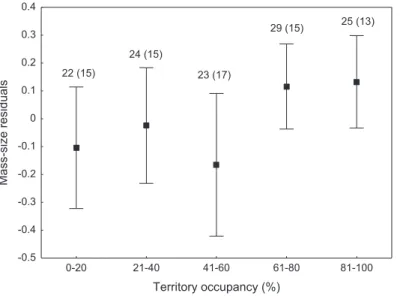
not find any relationship between territory occupancy and condition of adult birds measured with mass-size residuals (F1,47= 0.54,p= 0.48;Fig. 5).
DISCUSSION
In this study we provided empirical evidence for a random and non-adaptive pattern of territory selection in the mute swan. We recorded relatively few territories which were occupied continuously throughout the study period, and there was a large proportion of territories that were occupied ephemerally, which was consistent with the assumption of random territory selection. Although swans settled slightly earlier in territories with high occupation rate, confirming their larger attractiveness, we found that reproductive success of swans did not vary with territory occupancy. Non-adaptive territory selection suggests that at the time of territory selection swans might not be able to reliably assess the fitness return associated with preferred territories.
In birds, territory occupancy has often been associated with direct and indirect measures of habitat quality and, thus, was suggested to reflect habitat selection (Arlt & Pa¨rt, 2007). Most studies on territory occupancy have indicated non-random patterns of territory selection, where certain territories (usually high-quality ones) were preferred, while others were avoided (e.g.Sergio & Newton, 2003). Under this pattern, the frequency of territories with high occupation rate should be higher than expected from the random Poisson distribution, and such a situation has been reported for a variety of species,
0-20 21-40 41-60 61-80 81-100
Territory occupancy (%) -0.5
-0.4 -0.3 -0.2 -0.1 0 0.1 0.2 0.3 0.4
Mass-size residuals
25 (13) 29 (15)
23 (17) 24 (15)
22 (15)
e.g. eagle owlBubo bubo(Marchesi, Sergio & Pedrini, 2002), black kiteMilvus migrans (Sergio & Newton, 2003), and white storkCiconia ciconia(Janiszewski, Minias & Wojciechowski, 2013). By contrast, we found that territory occupancy in the mute swan conformed to the Poisson distribution, indicating a random pattern of territory selection. We observed a higher number of territories occupied ephemerally compared to territories occupied regularly. This implies that birds did not show strong preferences towards certain territories, which were likely to provide the highest fitness payoff.
The laying date was the only reproductive trait that was related to territory occupancy in our population of the mute swan and we found that swans bred earlier in the territories characterized by higher occupancy. In many migratory species of birds, there is a phenotype-dependent competition for early arrival at breeding grounds (Møller, 1994). High-quality individuals are usually able to prepare more quickly for spring migration, migrate at a higher speed, and consequently, arrive at breeding grounds earlier than poor-quality conspecifics (Aebischer et al., 1996;Hotker, 2002;Elmberg et al., 2005; Janiszewski, Minias & Wojciechowski, 2014b). As many territories are not yet occupied early in spring, first-arriving individuals are able to choose the most attractive sites and initiate breeding earlier, which may provide additional reproductive benefits. Thus, a positive correlation between laying date and territory occupancy is expected, as both these measures should be rather treated as proxies of preferences towards certain territories, rather than of adaptiveness of territory selection.
characteristics also explained the mismatch between habitat preferences and both reproductive performance and survival in the northern wheatearOenanthe oenanthe (Arlt & Pa¨rt, 2007). Although all these passerine species have short reproductive cycles (ca. one month), the uncoupling of preference and habitat quality has been attributed to rapid habitat alterations. For example, short field layer at the time of young rearing was critical for the northern wheatear to achieve high reproductive success, but ca. 50% of preferred sites with a short field layer at the time of selection grew a tall field layer at the time when nestlings were being fed (Arlt & Pa¨rt, 2007). Although habitat alterations within mute swan territories might not be so rapid, it is likely that
exceptionally long parental care may considerably reduce temporal correlation between the conditions at the time of territory establishment and conditions during the critical stages of brood care.
Non-adaptive territory choice by the mute swan was also supported by the lack of relationship between territory occupancy and body condition of breeding adults. Nutritional condition of breeding pairs or their offspring primarily depends on the availability of food supply within territories (Rotenberry & Wiens, 1998;Solonen, 2011). High quality territories should guarantee rich food resources that allow territory owners to maintain their body in good condition throughout the entire breeding season. Our results suggest that environmental cues used for territory selection by mute swans could poorly predict not only brood safety, but also feeding conditions on the later stages of reproduction. Mute swans preferably feed on submerged vegetation, which starts to develop after their arrival at the breeding grounds and availability of this food source during late spring and early summer months might be difficult to predict at the time of territory establishment (Wieloch, Włodarczyk & Czapulak, 2004). Owing to their large body size and considerable energetic demands, swans can also cause severe depletion of water plants due to overgrazing (Wood et al., 2012). This can be a serious problem, especially at the sites where flocks of non-breeding swans gather for moult before reproductive activities of breeding pairs are concluded.
reproductive success has been produced by redistribution of predators (mainly snakes) due to anthropogenic landscape-level changes (Misenhelter & Rotenberry, 2000). We suggest that unpredictable human-related activities may strongly determine reproductive output in our mute swan population. Water level in fish ponds is adjusted to the needs of carp production and we have recorded cases where ponds were intentionally drained during the breeding season, causing extensive losses of swan broods. Some attractive territories characterized by high occupation rate were repeatedly drained in successive breeding seasons, resulting in zero reproductive success of swan pairs, which were unable to predict these rapid habitat alterations. Other pairs were subject to strong disturbance associated with human recreation, but these activities intensified in early summer and were virtually unpredictable for birds during territory establishment. We have also recorded acts of vandalism, where adults or their offspring were deliberately killed, or the nests were destroyed by humans. Other unpredictable human-related causes of adult mortality and consequent brood losses included collisions with electricity wires and cars, predation by dogs, fish-line entanglement or fish-hook swallowing, and lead poisoning.
In conclusion, our study demonstrated a non-adaptive territory selection in a central-Polish mute swan population, where territory preferences measured with a long-term territory occupancy mismatched reproductive success and body condition of birds. We suggest that inability of swans to reliably assess territory quality was primarily caused by: 1) exceptionally long period of parental care, which reduces temporal correlation between the conditions at the time of territory selection and conditions during the critical stages of brood care; and 2) unpredictability of human-related activities that had a major impact on reproductive output of swan pairs in our population.
ACKNOWLEDGEMENTS
We thank Tomasz Iciek, Adam Kalinski, and members of the Student’s Ornithological Section University ofqo´dz´ who helped during fieldwork. We also thank two anonymous reviewers for helpful comments on the earlier draft of the manuscript.
ADDITIONAL INFORMATION AND DECLARATIONS
Funding
The authors received no funding for this work.
Competing Interests
The authors declare that they have no competing interests.
Author Contributions
Rados1aw W1odarczyk conceived and designed the experiments, performed the
experiments, analyzed the data, contributed reagents/materials/analysis tools, wrote the paper, prepared figures and/or tables, reviewed drafts of the paper.
Animal Ethics
The following information was supplied relating to ethical approvals (i.e., approving body and any reference numbers):
Ringing licence (Ministry of the Environment): DLP-VIII-6713-21/29762/14/RN.
Data Deposition
The following information was supplied regarding data availability: The raw data has been supplied as a Supplemental Dataset.
Supplemental Information
Supplemental information for this article can be found online athttp://dx.doi.org/ 10.7717/peerj.1852#supplemental-information.
REFERENCES
Aebischer A, Perrin N, Krieg M, Studer J, Meyer D. 1996.The role of territory choice, mate
choice and arrival date on breeding success in the Savi’s WarblerLocustella luscinioides.
Journal of Avian Biology27(2):143–152DOI 10.2307/3677143.
Arlt D, Pa¨rt T. 2007.Nonideal breeding habitat selection: a mismatch between preferences
and fitness.Ecology88(3):792–801DOI 10.1890/06-0574.
Baker K. 1993.Identification guide to European non-passerines.BTO Guide,vol. 24. Thetford:
British Trust for Ornithology.
Bollmann K, Reyer H-U, Brodmann PA. 1997.Territory quality and reproductive success:
can water pipitsAnthus spinolettaassess the relationship reliably?Ardea85(1):83–98
DOI 10.5167/uzh-168.
Chalfoun AD, Martin TE. 2007.Assessments of habitat preferences and quality depend on
spatial scale and metrics of fitness.Journal of Applied Ecology44(5):983–992
DOI 10.1111/j.1365-2664.2007.01352.x.
Currie D, Thompson DBA, Burke T. 2000.Patterns of territory settlement and consequences
for breeding success in the wheatearOenanthe oenanthe.Ibis142(3):389–398
DOI 10.1111/j.1474-919X.2000.tb04435.x.
Czapulak A. 2002.Egg size variation in mute swan: its influence on egg hatchability, cygnet
body size and cygnet survival.Waterbirds25(Special Publication 1):250–257.
Eggers S, Griesser M, Anderson T, Ekman J. 2005.Nest predation and habitat change
interaction to influence Siberian jay numbers.Oikos111(1):150–158
DOI 10.1111/j.0030-1299.2005.13802.x.
Elmberg J, Nummi P, Po¨ysa¨ H, Gunnarsson G, Sjo¨berg K. 2005.Early breeding tealAnas
creccause the best lakes and have the highest reproductive success.Annales Zoologici Fennici
42(1):37–43.
Farrell SL, Morrison ML, Campomizzi AJ, Wilkins RN. 2012.Conspecific cues and
breeding habitat selection in as endangered woodland warbler.Journal of Animal Ecology
81(5):1056–1064DOI 10.1111/j.1365-2656.2012.01995.x.
Forstmeier W. 2002.Benefits of early arrival at breeding grounds vary between males.
Journal of Animal Ecology71(1):1–9DOI 10.1046/j.0021-8790.2001.00569.x.
Galbraith H. 1989.Arrival and habitat use by lapwingsVanellus vanellusin the early
Hollander FA, Van Dyck H, San Martin G, Titeux N. 2011.Maladaptive habitat selection of a migratory passerine bird in a human-modified landscape.PLoS ONE6(9):e25703
DOI 10.1371/journal.pone.0025703.
Hotker H. 2002.Arrival of pied avocetsRecurvirostra avosettaat the breeding site: effects of
winter quarters and consequences for reproductive success.Ardea90:379–387.
Janiszewski T, Minias P, Wojciechowski Z. 2013.Occupancy reliably reflects territory quality
in a long-lived migratory bird, the white stork.Journal of Zoology291(3):178–184
DOI 10.1111/jzo.12059.
Janiszewski T, Minias P, Wojciechowski Z, Podlaszczuk P. 2014a.Habitat selection by white
storks breeding in a mosaic agricultural landscape of central Poland.The Wilson Journal of Ornithology126(3):591–599DOI 10.1676/13-219.1.
Janiszewski T, Minias P, Wojciechowski Z. 2014b.Timing of arrival at breeding grounds
determines spatial patterns of productivity within the population of white stork (Ciconia ciconia).Population Ecology56(1):217–225DOI 10.1007/s10144-013-0406-1.
Kokko H, Sutherland WJ. 2001.Ecological traps in changing environments: ecological and
evolutionary consequences of a behaviourally mediated Allee effect.Evolutionary Ecology Research3:537–551.
Krebs CJ. 1989.Ecological Methodology. New York: Harper Collins.
Marchesi L, Sergio F, Pedrini P. 2002.Costs and benefits of breeding in human-altered
landscapes for the eagle owlBubo bubo.Ibis144(4):164–177
DOI 10.1046/j.1474-919X.2002.t01-2-00094_2.x.
Martin TE. 1987.Food as a limit of breeding birds: a life-history perspective.Annual Review
of Ecology and Systematics18:453–487DOI 10.1146/annurev.es.18.110187.002321.
Martin TE. 1998. Are microhabitat preferences of coexisting species under selection and
adaptive?Ecology79(2):656–670DOI 10.1890/0012-9658(1998)079[0656:AMPOCS]2.0.CO;2.
Misenhelter MD, Rotenberry JT. 2000.Choices and consequences of habitat occupancy
and nest site selection in sage sparrows.Ecology81(10):2892–2901
DOI 10.1890/0012-9658(2000)081[2892:CACOHO]2.0.CO;2.
Morris DW. 2003.Towards an ecological synthesis: a case for habitat selection.Oecologia
136(1):1–13DOI 10.1007/s00442-003-1241-4.
Møller AP. 1994.Phenotype-dependent arrival and its consequences in a migratory bird.
Behavioral Ecology and Sociobiology35(2):115–122DOI 10.1007/BF00171501.
Rees EC, Lievesley P, Pettifor RA, Perrins CH. 1996.Mate fidelity in swans: an interspecific
comparison. In: Black J, ed.Partnerships in Birds: The Study of Monogamy. Oxford: Oxford University Press, 118–138.
Rotenberry JT, Wiens JA. 1998.Foraging patch selection by shrubsteppe sparrows.Ecology
79(4):1160–1173DOI 10.1890/0012-9658(1998)079[1160:FPSBSS]2.0.CO;2.
Robertson BA, Hutto RL. 2006.A framework for understanding ecological traps
and an evaluation of existing evidence.Ecology87(5):1075–1085
DOI 10.1890/0012-9658(2006)87[1075:AFFUET]2.0.CO;2.
Sergio F, Newton I. 2003.Occupancy as a measure of territory quality.Journal of Animal Ecology
72(5):857–865DOI 10.1046/j.1365-2656.2003.00758.x.
Siikama¨ki P. 1998.Limitation of reproductive success by food availability and breeding time
in pied flycatchers.Ecology79(5):1789–1796DOI 10.2307/176797.
Solonen T. 2011.Effects of variable food supply on the body condition of breeding Tawny Owls
Storch D, Frynta D. 1999.Evolution of habitat selection: stochastic acquisition of cognitive clues?
Evolutionary Ecology13(6):591–600DOI 10.1023/A:1006765422475.
Thomson RL, Forsman JT, Sarda´-Palomera F, Mo¨nkko¨nen M. 2006.Fear factor: prey habitat
selection and its consequences in a predation risk landscape.Ecography29(4):507–514
DOI 10.1111/j.0906-7590.2006.04568.x.
Wieloch M, W1odarczyk R, Czapulak A. 2004.Cygnus olormute swan.BWP Update6:1–38.
W1odarczyk R, Janiszewski T. 2007.Abundance and distribution of the mute swanCygnus olor
in theqo´dz´ region.Notatki Ornitologiczne48:82–91 (in Polish with English summary).
W1odarczyk R, Wieloch M, Czyz˙ S, Dolata PT, Minias P. 2013.Natal and breeding dispersal
in the mute swanCygnus olor–influence of sex, mate-changing and reproductive success.
Acta Ornithologica48(2):237–244DOI 10.3161/000164513X678874.
Wood KA, Stillman RA, Clarke RT, Daunt F, O’Hare MT. 2012.Can sacrificial feeding areas