
Thermal Distributions in Stellar Plasmas,
Nuclear Reactions and Solar Neutrinos
M. Coraddu
1;2;
, G. Kaniadakis
3;y
, A. Lavagno
3;4;z
, M. Lissia
2;1; x , G. Mezzorani1
;2;{
, and P. Quarati3 ;2; k
,
1Dipartimento di Fisica, Universita di Cagliari, I-09042 Monserrato, Italy 2
Istituto Nazionale di Fisica Nucleare, Sezione di Cagliari, I-09042 Monserrato, Italy
3
Dipartimento di Fisica and INFM, Politecnico di Torino, I-10129 Torino, Italy
4
Istituto Nazionale di Fisica Nucleare, Sezione di Torino, I-10125 Torino, Italy Received 23 November, 1998
The physics of nuclear reactions in stellar plasma is reviewed with special emphasis on the impor-tance of the velocity distribution of ions. Then the properties (density and temperature) of the weak-coupled solar plasma are analysed, showing that the ion velocities should deviate from the Maxwellian distribution and could be better described by a weakly-nonexstensive (jq,1j<0:02) Tsallis' distribution. We discuss concrete physical frameworks for calculating this deviation: the in-troduction of higher-order corrections to the diusion and friction coecients in the Fokker-Planck equation, the inuence of the electric-microeld stochastic distribution on the particle dynamics, a velocity correlation function with long-time memory arising from the coupling of the collective and individual degrees of freedom. Finally, we study the eects of such deviations on stellar nu-clear rates, on the solar neutrino uxes, and on theppneutrino energy spectrum, and analyse the consequences for the solar neutrino problem.
I Introduction
Thermonuclear reactions are of enormous importance for the physics of stars and of our Sun. The general formalism that describes these reactions exists since a long time and there is a wide consensus about our good understanding of the relevant physics [1, 2, 3].
However, quantitative calculations of specic reac-tion rates need experimental inputs and theoretical as-sumptions. Cross sections must be known. In the best cases, they can be directly measured at the relevant energies; other cross sections can be only measured at higher energies and need to be extrapolated; in some situations only theoretical predictions exist (for a re-cent review of the cross sections relevant to the Sun see Ref. [4]). In addition, rates depend on weighted
ther-mal averages of the cross sections; therefore, knowledge aboutthe thermal distribution is also needed.
Because many nuclear reactions in the stellar burn-ing core proceed by way of quantum penetration of a high Coulomb barrier, their cross sections grow expo-nentially with energy. Therefore, thermal averages do not probe the average energy of the distribution (k T), but its high-energy tail. Consequently,rates are sensi-tive to a relasensi-tively small part of the distribution.
The ion velocity distribution in stellar calculations is always assumed Maxwellian1. In fact, it is almost universally accepted as a fact that physical conditions in the solar interior (density and temperature) lead to an equilibrium velocity distribution that is Maxwellian. In this article we review the assumptions underlying Electronic address: [email protected]
yElectronic address: [email protected] zElectronic address: [email protected] xElectronic address: [email protected] {Electronic address: [email protected] kElectronic address: [email protected]
1We consider situationswhere quantumeects are negligible,
e.g., in the solar plasma small quantumcorrectionsto the statistics exist
this general statement, discuss why they are only ap-proximately true, and argue that the consequent small corrections to the distribution have signicant eects on the rates.
The dynamics of the solar plasmais not trivial, since at such densities and temperatures there is no clear scale separation between collective and individual de-grees of freedom [5]. The presence of more than just one energy scale (k T) in the relevant range of energies results in deviations from the pure exponential behav-ior, exp(,E=k T), which is determined only byk T. We have tried several new approaches to this strongly in-teracting many-body system for which a realistic mi-croscopic calculation does not exist yet.
In one approach [6, 7] we exploit the knowledge that the distribution in the solar interior cannot be too much dierent from the Maxwellian one and add small cor-rections (higher-order terms in a derivative expansion) to the coecients of the standard Fokker-Planck equa-tion. Tsallis' [9, 10] and Druyvenstein-like distributions are immediately generated.
A second approach [8] focuses on the electric mi-croelds that have been shown to exists in plasmas and tries to link their distribution and the connected eec-tive cross sections with deviations from the Maxwellian distribution. Dierent classes of microelds distribu-tions and eective cross secdistribu-tions yield several non-Maxwellian distributions among which we again nd Tsallis and Druyvenstein-like distributions.
The third approach has been just started and aims to connect the distribution of collective variables [11] to memory eects and long-time correlations between ve-locities. There should exist solutions compatible with the Tsallis' distribution and/or other non-Maxwellian distributions.
These three approaches are not exhaustive and not necessary alternative. Nevertheless, it is suggestive that all of them point in the same direction: the Maxwell-Boltzmann distribution of velocity should have small but nonnegligible corrections in the solar plasma and the Tsallis' distribution could provide a better description.
Nowadays solar modeling seems to have reached a satisfactory stage [1, 3, 12]. The inclusion in the lat-est models of higher-order eects, such as the diusion of heavy elements, brings the theoretical predictions in good agreement even with the detailed
helioseismolog-ical data [13, 14]. However, there still exist a discrep-ancy between the solar neutrino experiments and the predicted neutrino uxes [15]. In this context, there has been a considerable amount of work devoted to answer-ing questions such as: how large are the uncertainties of the solar model input parameters? Has something been left out of standard solar models? How does this aects predictions for the uxes and the status of solar neutrino problem (SNP) [16, 17, 18, 19, 20, 21]?
Therefore, we nd extremely important to assess the consequences of the possible small deviations from the standard statistics on the solar model and, in particu-lar, on the neutrino uxes. At least two eects should be considered: changes of the total rates caused by the dierent thermal average and modications of the shape of the energy spectra. The eect on the rates was already considered by Clayton [22, 23] two decades ago. New experimental data, better solar models and a considerable better understanding of nonstandard dis-tributions and of how they can arise in solar plasmas convinced us of the necessity of reconsider this earlier suggestion. Even if experimental detection of small modications of the neutrino spectra might appear still far from being possible, it is useful to have a clear as-sessment of what the signal would be.
Our paper is organized as follows. In Sec. II we review the physics of subbarrier thermonuclear tions and how the velocity distribution inuences reac-tion rates. Secreac-tion III, which is dedicated to the solar plasma, contains the central part of our work: three ap-proaches to velocity distribution calculation and the re-sulting nonstandard distributions. In Sec. IV we calcu-late the reaction rates with the modied distributions, while we obtain the neutrino spectrum from the pp re-action in the presence of Tsallis' statistics and compare it to the standard one in Sec. V. The solar neutrino problem is analysed in the light of our results on non-standard velocity distributions in Sec. VI, and Sec. VII is reserved to our conclusions.
II Thermonuclear reaction
ra-tes
understand-ing of the structure and evolution of stars. In fact, while the overall stellar structure is rather robust, changes of some of the rates by few percent can produce detectable discrepancies, when precise measurements are possible, e.g., in the case of the solar photon and neutrino lumi-nosity, and mechanical eigenfrequencies [24].
In this Section, we review the basic physics under-lying thermonuclear reactions and the main ingredients of their calculation [1].
A. Introduction
Let us consider a gas withn
1particles of type 1 and n
2 particles of type 2 per cubic centimeter and relative velocityv; the reaction ratesr(the number of reactions per unit volume and unit time) is given by
r= (1 + 12)
,1 n
1 n
2
hv i ; (1)
where = (v) is the nuclear cross section of the re-action. The reaction rate per particle pair is dened as
hv i= Z
1 0
f(v) vdv; (2) where the particles distribution function f(v) is a local function of the temperature.
Therefore, the reaction rate per particle pair hv i is determined by the specic cross section and by the velocity distribution function of the incoming particles. In general, cross sections do not have very strong depen-dence on the energy, when no energy barrier is present and away from resonances. Therefore, most of the con-tribution to hv i comes from particles with energy of the order of k T, and the dependence on the specic form off(v) is weak. We shall see that the situation is very dierent in the presence of the Coulomb barrier.
B. Subbarrier reactions
Most of the nuclear reactions that power the stars are between charged particles. These particle must pen-etrate a Coulomb barrier that is very large in units of k T. The penetration probability is proportional to the Gamow factor exp[,2 (E)], where (E) = Z
1 Z
2
p c
2
=2Eis the Sommerfeld parameter,is the ne structure constant andis the reduced mass; this factor can be also written as exp[,
p E
G
=E], dening
the Gamow energy E G = 2
c 2(
Z 1
Z 2
)
2. This expo-nentially small probability makes the cross section grow extremely fast with the energy; therefore, one usually denes the astrophysicalSfactor, whose energy depen-dence is weaker
(E) = S(E)
E e
,2 (E)= S(E)
E e
, p
EG=E
: (3) This reaction mechanism has at least two main con-sequences for the study of stellar structure.
(1) Since the bulk of particles in the stellar plasma have thermal energies of the order ofk T, which is far below the Coulomb barrier, only a small number of par-ticles in the high-energy tail of the distribution has a chance of reacting: this high-energy tail plays a crucial r^ole for the reaction rates, which becomes very sensitive to small changes of the distribution.
(2) The cross sections of some of the reactions,e.g., weak reactions with Coulomb barrier such as p+p! d+e
++
, are extremely small at the low energies rele-vant to stellar physics (of the order of tens of keV for re-actions in the Sun). Therefore, some of them have only been calculated theoretically, others have only been measured at higher energies and then extrapolated to the lower thermal energies of the stellar interiors.
Both these two facts lead to considerable uncertain-ties in the reaction rates. The second point has been extensively discussed, and it is common opinion that the present standard theory of stars, and in particular of the Sun [21, 4], has already taken properly into account the uncertainties in the cross sections. On the contrary, the rst point, the possibility that small changes of the particle energy distribution could strongly aect reac-tion rates, has received little attenreac-tion [22, 25, 26, 5], or dismissed on the ground that the energy distribu-tion in stars is allegedly well-know [3]. In this paper, we shall discuss mainly this point, the energy distribu-tion in stellar plasmas and its implicadistribu-tion for nuclear rates.
C. Maxwell distribution and the Gamow peak
Maxwell-Boltzmann distribution, without much ques-tioning.
However, derivations of the ubiquitous Maxwell-Boltzmann distribution are based on several assump-tions [5]. In a kinetical approach, one assumes (1) that the collision time be much smaller than the mean time between collisions, (2) that the interaction be suciently local, (3) that the velocities of two parti-cles at the same point are not correlated (Boltzmann's Stosszahlansatz), and (4) that energy is locally con-served when using only the degrees of freedom of the colliding particles (no signicant amount of energy is transferred to collective variables and elds). In the equilibrium statistical mechanics approach, one uses the assumption that the velocity probabilities of dier-ent particles are independdier-ent, corresponding to (3), and that the total energy of the system could be expressed as the sum of a term quadratic in the momentum of the particle and independent of the other variables, and a term independent of momentum, but if (1) and (2) are not valid the resulting eective two-body interaction is not local and depends on the momentum and energy of the particles. Finally, even when the one-particle dis-tribution is Maxwellian, additional assumptions about correlations between particles are necessary to deduce that the relative-velocity distribution, which is the rel-evant quantity for rate calculations, is also Maxwellian. At least in one limit the MB distribution can be rigorously derived: systems that are dilute in the ap-propriate variables, whose residual interaction is small compared to the one-body energies. In spite of the fact that the eects of the residual interaction cannot be neglected, as a good rst approximation the solar inte-rior can be studied in this dilute limit; therefore, it is reasonable to suppose that the velocity distribution in the Sun is not too far from the Maxwellian one. This fact is consistent with the many successes of the stan-dard treatment and suggests that we start discussing the standard results and improve them later.
In the ordinary treatment, the single particle energy distribution for protons and other ions is taken as
f MB D(
E) = 2 p
p E (k T)
3=2 e
,E=k T
: (4)
When this distribution and a cross section of the form of Eq. (3) are inserted in Eq. (2), the resulting inte-grand goes to zero both at large energies, because of
the exponentially small number of particles, see Eq. (4), and also at small energies, because of the exponentially small probability of barrier penetration, see Eq. (3). In fact, the integrand has a maximumat the temperature-dependent energy
E 0=
E
G( k T)
2 4
1=3
=k T; (5)
which it is called the most eective energy [1], since most of the particles that react have energies close to E
0; we have dened the adimensional parameter =E
0
=k T = [E G
=(4k T)] 1=3.
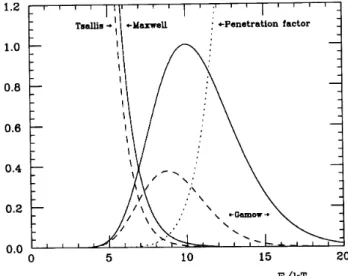
Figure 1. The Gamow peak for the Maxwellian and the Tsallis' distribution. The exponentially decreasing solid (dashed) curve labeled Maxwell (Tsallis) shows the Maxwellian (Tsallis with q = 0:98) energy distribution. Both the energy distributions have been normalized to a huge 400 at E=k T = 0, to emphasize their tiny dierence (the part of the distributions shown contains only about 0.3% of the total area). The rapidly increasing dotted curve shows the behavior of the penetration factor exp,
p EG=E withEG= 4000k T corresponding to =E0=k T = 10; the normalization is arbitrary. The solid (dashed) peak shows the product of Maxwellian (Tsallis) distribution function times the penetration factor.
Fig. 1 gives a pictorial demonstration of how the Gamow peak originates. The exponentially decreas-ing function (solid curve labeled \Maxwell") is the Maxwellian factor exp(,E=k T) multiplied times 400 to emphasize the tail of the distribution. The rapidly growing function (dotted curve labeled \Penetration factor") is the factor exp,
p E
G
=E with the choice of E
G = 4000
k T, which corresponds to a most ef-fective energy E
0 = ( E
G( k T)
2 =4)
1=3 = 10
been arbitrarily normalized such that it is equal to 400 at E = 20k T. The product of the two functions yields the Gamow peak (solid curve labeled Gamow), which has been normalized to one at its maximum (E = E
0 = 10
k T). It is important to notice that the area under the Maxwellian curve for energies larger than about 6k T (where one nds most of the contribu-tion to the peak) is less then 0.3% of the total area.
In this framework, one performs the integral in Eq. (2) using the saddle-point asymptotic expansion around the maximumE
0of the Gamow peak and nds that the reaction rate per particle pair is, apart for small calculable corrections,
hv i 12=
8 p
3 12
c Z 1
Z 2
S(E 0)
2 12
e ,3
12
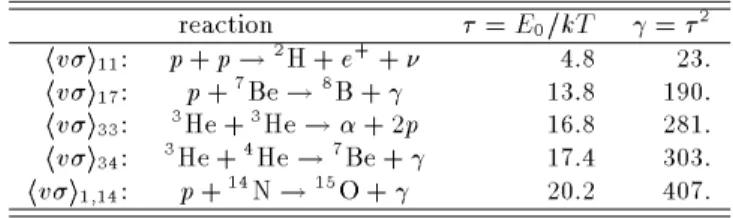
: (6) Table 1. Most eective energies for thermonuclear reac-tions and exponents that characterize the change of the thermal average hv i to the leading order in , when the energy distribution changes by a factor expf,(E=k T)
2 g: hv i=hv i0expf, g.
reaction =E0=k T =
2 hv i11: p+p!
2H + e
++
4.8 23.
hv i 17:
p+ 7Be
! 8B +
13.8 190.
hv i33:
3He +3He
!+ 2p 16.8 281.
hv i 34:
3He +4He !
7Be +
17.4 303.
hv i1;14: p+ 14N
! 15O +
20.2 407.
Table 1 reports the values ofE
0 in units of k T () for several reactions. We notice that E
0 can be much larger thank T and, therefore, only a very small number of particles in the far tail of the distribution contributes to the rate,e.g., for the
3He +3He reaction the most ef-fective energy is about 17k T: there are less than about 40 particles out of a million that have energies so large or larger. It is not sucient anymore to know that the Maxwellian distribution is good approximation, we must be sure that there are no corrections to a very high accuracy.
III Velocity distributions in
nonideal plasmas
As discussed in Sec. II, several subtle points must be as-sumed in the derivation of the often-taken-for-granted Maxwellian velocity distribution. Likewise, one often
assumes that the solar core could be treated as an ideal (Debye) plasma. However, there are physical conditions and/or specic applications that needs higher accuracy for which becomes necessary to take into account mod-ications of the standard plasma theory.
In this Section we discuss how the physics of non-ideal plasmas, and in particular of the solar interior, can result in equilibrium velocity distributions that de-viate from the \standard" one. In addition, we present specic physical frameworks where non-Maxwellian dis-tributions arise and microscopic mechanisms that allow a reliable estimation of the size of deviations.
A. Ideal and nonideal plasma
In literature, a plasma is characterized by the value of the plasma parameter ,
, = (Ze) 2 ak T
; (7)
wherea=n
,1=3is of the order of the interparticle aver-age distance (nis the average density). The plasma pa-rameter is a measure of the ratio of the mean (Coulomb) potential energy and the mean kinetic (thermal) energy. Depending on the value of the plasma parameter, we can distinguish three regimes that are characterized by dierent eective interactions and require dierent theoretical approaches.
, 1. The plasma is described by the Debye-Huckel mean-eld theory as a dilute weakly inter-acting gas. The screening Debye length
R D=
s
k T 4 e
2 P
i Z
2 i
n i
; (8)
is much greater than the average interparticle dis-tance a, hence there is a large number of par-ticles in the Debye sphere (N
D
(4 =3)R 3 D). Collective degrees of freedom are present (plasma waves), but they are weakly coupled to the in-dividual degrees of freedom (ions and electrons) and, therefore, do not aect their distribution. Binary collisions through screened forces produce the standard velocity distribution.
and the screening length RD
a. It is not pos-sible to clearly separate individual and collective degrees of freedom. The presence of at least two dierent scales of energies of the same rough size produces deviations from the standard statistics which describes the system in terms of a single scale, kT.
, > 1. This is a high-density/low-temperature plasma where the Coulomb interaction and quan-tum eects start to dominate and determine the structure of the system.
B. Thesolarinterior
In the solar interior the plasma parameter is , 0:1; therefore, the solar core is a weakly nonideal plasma where the Debye-Huckel conditions are only approxi-mately veried. Similar behaviors are expected in other astrophysical systems characterized by plasma param-eters in the range 0:1 , 1; examples are brown dwarfs, the Jupiter core and stellar atmospheres.
Studies of systems with this intermediate values of , are the most dicult; it is possible to use/combine several dierent approaches none of which, however, is completely justied.
The reaction time necessary to build up screening after a hard collision can be estimated from the inverse solar plasma frequency tpl = !
,1 pl =
p
m=(4ne2) 10,17 sec, and it is comparable to the collision time tcoll =
hvni ,1
10
,17 sec. Therefore, several col-lisions are likely necessary before the particle looses memory of the initial state and the scattering process can not be considered Markovian. In addition, screen-ing starts to become dynamical: the time necessary to build up again the screening after hard collisions is not negligible any more.
C. Three roads towards nonstandard distribu-tions
For concreteness we consider three possible ap-proaches to weakly-noninteracting plasmas that yield nonstandard distributions. These approaches are not alternative, but they could perhaps be seen as dier-ent and partial descriptions of the same complicated
physical problem. The main purpose of their presenta-tion is to give concrete examples of how nonstandard statistics arises. However, they are not by any mean the last word on the topic: we must still develop their full potentiality and alternative approaches must also be pursued.
1. Fokker-Planck
In the Fokker-Planck context it is possible to intro-duce corrections (i) to the lowest order friction coe-cient J(v), and (ii) to the lowest order diusion coef-cient D(v) [6, 7, 5]. Similar corrections have already been shown to exist in hydrodynamic systems.
We assume that the system is not too far from the standard regime that leads to the MB distribution, so that an expansion starting from the usual formalism makes sense. The Fokker-Planck equation, given in the Landau form, is
@
@tf(t;v) = @v@
J(v)f(t;v) + @@vD(v)f(t;v)
; (9) where f(t;v) is the distribution probability of parti-cles with velocity v at time t and J(v) and D(v) are the dynamical friction and diusion coecients. The stationary distributions are the asymptotic solutions of the above equation. To lowest order J(v) = v= and D(v) = =, where the constant > 0 has dimension of time (m= is the friction constant) and p
has di-mension of a velocity ( = kT=m for Brownian motion). At equilibrium one obtains the well-known Maxwellian distribution
f(v) lim t!1
f(t;v)exp
, v2 2
= exp ,
mv2 2kT
: (10) We can generalize the standard Brownian kinet-ics considering the expressions of the quantities J(v) and D(v) to the next order in the velocity variable: J(v) = v= (1 + 1v
2=) and D(v) = = (1 + 1v
2=); these higher derivative terms can be interpreted as sig-nals of nonlocality in the Fokker-Planck equation.
If 1= 0 and 1
6
= 0 we nd the Tsallis' distribution f(v) =
1 + (q,1)mv 2 2kT
1=(1,q )
1 + (q,1)mv 2 2kT
; (11) where q,1 = 2
parameter q is smaller than 1 (,1=2 <
1< 0), this dis-tribution has a upper cut-o: mv2=2
kT=(1,q) (the tail is depleted). The distribution correctly reduces to the exponential Maxwell-Boltzmann distribution in the limit q!1 (
1
!0). When the parameter q is greater than 1 (1> 0), there is no cut-o and the (power-law) decay is slower than exponential (the tail is enhanced).
If 1
6
= 0 and 1 = 0, we nd a Druyvenstein-like distribution:
f(v)exp (
, v2 2,
1
v2 2
2
)
; (12)
which has also the functional form suggested by Clay-ton [23] to parameterize a small deviation (depletion) from the Maxwellian statistics.
2. Random elds
Each particle is aected by the total electric eld distribution due to the other charges in the plasma. If external elds and large scale internal elds due to collective modes are subtracted from the total electric eld, the single particle see the remaining eld as a rel-ative small random component. The density of these random electric microelds has been studied [27, 28] and it is often expressed in terms of the dimensionless parameter F ashE
2
i= (F e=a
2)2, where 4a3=3 = 1=n; the distribution of F in plasmas depends on the value of , [28]. These microelds have in general long time correlations, and can generate anomalous diusion.
The total (micro)eld can be decomposed into three main components.
(i) A slow-varying (relative to the collision time) com-ponent due to collective plasma oscillations, which the particle sees as an almost constant external mean eld E over several collisions.
(ii) A fast random component due to particles within a few Debye radii, whose eect can be described by an elastic diusive cross section 1
v
,1. When only this cross section is present, the distribution remains Maxwellian even in presence of the slow mean eld E. (iii) A short-range two-body strong Coulomb eective interaction, that can be described by the ion sphere model [29]. The strict enforcement of this model as im-plemented by Ichimaru [29] yields the elastic cross sec-tion 0= 2
2a2, where a is the interparticle distance, an adimensional parameter whose order of magnitude
can be inferred from the parameter F that character-izes the microelds, F
,2. Since F2
3=, 40, for , = 0:07, one can estimate 0:4 < < 1. In the present model, it is this component of the electric eld that turns out to be mainlyresponsible of the correction factor exp [,^(E=kT)
2].
In this framework, the stationary solution of the ki-netic equation valid for small deviations from the MB distribution can be shown to be the Druyvenstein dis-tribution:
f(E)exp "
,^' E kT ,^
E kT
2
#
; (13)
where
^' = '1 + ' ' = 92
nkT ZeE
2
h 2 1
i; (14) ^ =
3h 2 1 i 2
0 + 1
,1
= ' 2 0 3h 2 1 i
; (15) = 2mamb=(ma+ mb)
2 is the elastic energy-transfer coecient between two particles a and b, and is pro-portional to the square of the ratio of the energy den-sities of the electric eld and of the thermal motion.
In the small correction limit, relevant to the solar interior, ^' = 1 and the ^ parameter is:
j^j 2
0 3h 2 1 i
= 124,2
1: (16)
From Eq. (13), we see that the presence of elec-tric microelds implies a deviation from the Maxwell-Boltzmann distribution and that the entity of this devi-ation depends on the value of the plasma parameter. As already mentioned, in the solar core ,
0:1, hence, the order of magnitude of the deviation parameter ^ is about 0:01 and in this intermediate region long-range and memory eects take place.
3. Memory eects and collective variables
As already discussed, in the solar core collective ef-fects have time scales comparable to the average time between collisions (e.g., compare the inverse plasma fre-quency with the average collision time !,1
pl t
coll) and it is not possible a description that separates the col-lective and the individual degrees of freedom.
Hamiltonianthat explicitly contains collective and indi-vidual degrees of freedom and their mutualinteractions. Our scope is more modest: we want to give a concrete example where memory eects (long-time correlations) are important.
The authors of Ref. [30, 11] introduce the collective variables
k(t) = N X
j
exp(,ikx
j(t)) ; (17) and describe these collective variables as harmonic os-cillator variables weakly coupled to the individual de-grees of freedom, which, therefore, act as a thermostat for the collective variables.
Generalizing this approach, we write down a gener-alized Langevin equation for the collective variables
k = ,!
2 k
k+ Z
t 0
K(t,) _
k()d + F(t) ; (18) where K(t,) is the memory friction kernel, which takes into account the long-time tail of the correlations in the solar interior, and F(t) is the stochastic uctuat-ing thermal force due to the interactions with the indi-vidual degrees of freedom. In weakly nonideal plasmas, the longitudinalwaves have the followingdispersion law
!2 k= !
2
pl(1 + 3R 2 Dk
2) : (19)
The two functions K(t , ) and F(t) are not independent but related by the second uctuation-dissipation theorem
hF(t 1)F(t2)
i= 2kT m K(t1
,t
2) : (20) In the limit of negligible memory eects, the memory kernel becomes a -function, that is, K(t) = (t), where is the eective friction coecient, which can be written in terms of the Landau (L) and collisional (c) damping [11].
The explicit form of the memory kernel depends on the specic system and, in principle, should be deduced from a microscopic calculation. At the moment, we have been able to verify that, in the framework of Tsal-lis nonextensive statistics, the memory kernel can be written, for q1, as
K(t) = (t) + (1,q) 2
1 + 2t + 2t2 2
: (21)
The above expression is consistent with the prescrip-tion of the nonextensive statistics and implies anoma-lous subdiusion for q < 1 and superdiusion for q > 1. A more complete analysis of this possibility is still un-der way; it is also important to study the eects of such a memory kernel for the collective modes on the individual degrees of freedom.
At the moment, we can speculate that such correla-tions among the collective modes could lead to a long-time asymptotical behavior of the velocity-correlation of the ions of the kind hv(0)v(t)i t
,(1+). If 1, i.e., the correlation decays suciently fast, the diu-sion process is no qualitative dierent from the delta-function case: hx
2(t)
i t. In this case, one can show [31, 32] that if 0 < < 1 and 0 <R
hv(0)v(t)i < 1, the standard distribution of velocity is still valid. However, if 0 < < 1 and R
hv(0)v(t)i = 0 (or very small), or if ,1 < 0, the diusion is anomalous hx
2(t) it
1+ (
tlogt, if = 0). Indeed, Tsallis [33] shows that the generalized entropy quite naturally gen-erate both anomalous diusion (hx
2(t) it
1+) and the non-Maxwellian probability distribution for the veloci-ties of Eq. (11).
D. Summary
In this Section we have presented theoretical argu-ments that the velocity distribution in the solar core should deviate from the standard one and, in particular, that it could follow Tsallis' distribution [9, 10] shown in Eq. (11). We have also estimated the deviation from the standard statistics from the known microeld dis-tribution. If we use the parameterization suggested by Clayton [22, 23] (Druyvenstein distribution)
f(E)(kT)
,3=2e,E=k T, ^ (E=k T)
2
; (22)
IV Reaction rates and modied
thermal distribution
Both from general considerations about the successes of the standard approach and from the estimates and calculations that we have shown, it should be clear that the deviations from the Maxwellian distribution in the Sun are small. Therefore, it is completely general to make an asymptotic expansion of the following kind:
f(E)(k T) ,3=2
e
,E=k T, (E=k T) 2
; (23)
where we have disregarded terms with powers higher than (E=k T)
2in the exponent and all other power cor-rections outside the exponential, apart the ones (not shown) needed to correctly normalize the distribution. This result becomes the more accurate the more is small. Note that the exponential can not be expanded. This same kind of parameterization was already considered by Clayton [23]. One can easily convince oneself that the distributions previously discussed can be put in this form in the limit of small deviations. We have seen that the the Tsallis' distribution plays a spe-cial r^ole: it can be also approximated to rst order in (1,q) by Clayton's form with = (1,q)=2 and a renormalized temperatureT
0=
T+T(1,q). In Sec. II we performed a saddle point expansion of the integral over the velocity distribution with the introduction of the most eective energy, E
0, and approximating the integrand around the maximum E
0 with a Gaussian function (Gamow peak). The same kind of asymptotic expansion can be repeated for this modied distribu-tion yielding the following analytical expression for the change of the rate:
hv i
i hv
i i
0 =e
, (E (i) 0
=k T) 2
e , i
; (24)
where E
0is the most eective energy of Eq. (5) E
0 k T
5:64
Z 2 1 Z
2 2
A 1
A 2 A
1+ A
2 T
c T
1=3
; (25) which depends on the reactioni, through the chargesZ and weights Aof the ions, and on the relevant average temperatureT (T
c = 1
:36 keV is the temperature at the center of the Sun), and where hv
i i
0 is the expression in Eq. (6).
We shall use the expression in Eq. (24) to discuss the eects of modied statistics on the solar thermonu-clear rates: it has a sucient numerical accuracy for
this situation and it is physically more transparent. However, we perform the integral over the distribution numerically in physical situations where stronger devi-ations from the Maxwellian distribution are expected, and when we want to check whether the asymptotic expansion is suciently accurate.
The dramatic eect of small deviations from the Maxwellian distribution on the rate can be appreci-ated by looking at Fig.1. The steep decreasing dashed curve shows the high-energy tail of the Tsallis' distri-bution [1+(q,1)E=k T]
1=(1,q )with
q= 0:98 compared with the corresponding Maxwellian distribution (solid curve). The tails of the two distributions shown in Fig.1 contain about 0.30% (Maxwell) and 0.26% (Tsallis) of their total area and have been multiplied times a factor 400 to make their small dierence more visible. The product of each of these two very similar distributions times the same penetration factor (dotted curve) yields two very dierent Gamow peaks. The peak correspond-ing to the Tsallis distribution (dashed curve) is not only shifted at lower energy by more than one unit of k T compared to the Maxwellian peak (solid curve), but it is also much lower: a tiny change of the distribution tail (410
,4 less probability in the tail) makes the
proba-bility in the peak smaller by a factor of about 0.3!
V Thermal eects on the
neu-trino energy spectrum
Because of their small interaction cross section, neutri-nos that reach the earth have not interacted with the solar matter and carry direct information from the so-lar core. One might hope that their energy spectrum could tell us something about the particle velocity dis-tribution in the Sun.
The reaction
p + p!d + e ++
e (26)
releases an excess energy of Q = 2mp,md ,me = 2938:272,1875:613,0:511 = 0:420 MeV, which is shared among the kinetic energies of the outgoing particles. Note the the total energy released by the reaction is 1:442 MeV, since the positron annihilation gives additional 1:022 MeV; this energy, however, does
not contribute to the kinetic energy of the neutrino (this should be contrasted to the more rare reaction p + p + e!d + e).
Since there are three particles in the nal state, the neutrino energy in the center of mass has a known prob-ability distribution. For simplicity, we report only the result that disregards the recoil energy (a relative cor-rection of the order of 210
,4) c
PK(E) E 2
(K + Q + me,E) p
(K + Q,E)(K + Q + 2me,E)F(E) = E2
EepeF(E): (27)
The neutrino energy goes from zero to to the maximal energy Emax = (K + Q)
1,
K + Q 4mp+ 2K
K + Q; (28)
where K is the relative kinetic energy of the incoming protons, the approximate equality disregards the recoil energy consistently with Eq. (27), and where F is the Fermi function
F(E) = exp [2E2Eee=p=pee]
,1
= 2(K + Q + me,E)[(K + Q,E)(K + Q + 2me,E)] ,1=2 exph
2(K + Q + me,E)[(K + Q,E)(K + Q + 2me,E)] ,1=2
i ,1
; (29)
which takes into account the Coulomb repulsion of positron and deuteron in the nal state.
d The neutrino energy spectrum is obtained by convo-luting this result with the distribution for K: S(E) R
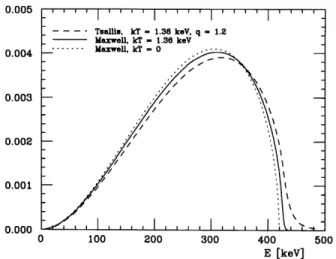
dKPK(E)f(K). In Fig.2, we show the energy distri-bution of the neutrinos from the pp reaction for three cases: (1) T = 0 (dotted curve), (2) T = 1:36 keV with a Maxwellian distribution (solid curve) and (3) T = 1:36 keV with a q = 1:2 Tsallis' distribution (dashed curve).
Note that relative large value of jq,1j 0:1 are necessary in order that the eect on the spectrum of having a dierent distribution be of the same order of magnitude of the standard thermal eect.
In principle, precise measurements of the neutrino spectrum give information on the thermal distribution of the proton kinetic energies f(K). Let us estimate the necessary accuracy. The central temperature of the Sun
ex-periments are not expected to be feasible in the near future.
Figure 2. The spectrum of solar neutrinos produced by the pp reaction. The solid line shows the spectrum at k T = 1:36 keV (about the solar central temperature) with the Maxwellian distribution for the proton relative energy, the dashed line the spectrum with the Tsallis' distribu-tion at the same temperature. For comparison the dotted line shows the spectrum with a Maxwellian distribution at T = 0.
Figure 3. The solar neutrino spectrum. For continu-ous sources, the dierential ux is in cm,2s,1 MeV,1. For the lines, the total ux is in cm,2s,1. There are also indicated the thresholds of the three kinds of present experiments. The radiochemical experiment at Homes-take [37, 48] that uses the reaction
e+ 37Cl
!
37Ar (Chlo-rine) has the threshold 0.814 MeV. The radiochemical ex-periments Gallex [38, 46] and SAGE [39, 47] that use the reaction e+
71Ga !
71Ge (Gallium) have the threshold 0.2332 MeV. The thresholds of the Kamiokande and Su-perkamiokande experiments [35, 44, 45], which detect the Cherencov light emitted by the scattered electrons in water (Water Cherenkov) are chosen between 5.5 and 8 MeV.
VI Solar neutrino experiments
and the solar neutrino
prob-lem
A. The solar neutrino problem
The solar neutrino problem is one of the most inter-esting long standing puzzle of the modern physics. The combined results from the solar neutrino experiments (Homestake, GALLEX, SAGE, Kamiokande and Su-perKamiokande) cannot be reconciled with the predic-tions of the standard solar models (SSM). Since SSMs have been very successful in predicting the stellar struc-ture and have given excellent descriptions of measure-ments as detailed and accurate as the helioseismic ones, the neutrino experiments have suggested that the min-imal standard electroweak model should be extended and include small neutrino masses and lepton avor nonconservation [15, 21]. Neutrino oscillation theory would have far-reaching consequences for both particle physics and cosmology: therefore, it is of great impor-tance to ask whether the solar neutrino problem can be solved, or at least alleviated, in the framework of the conventional physics [34].
The problem can be more precisely appreciated with the help of Fig. 3 and Table 3. Fig. 3 shows the energy spectrum of the main neutrino uxes coming out of the Sun. The same gure shows also the part of the spectrum that contributes to each of the three present neutrino measures. The energy dependence of each sin-gle ux depends practically only on nuclear physics and it is independent of the SSM (see the discussion about the pp spectrum in the Sec. V). However, the inte-grated uxes, which are reported in the rst column of Table 3, and, therefore, the relative weight of the dierent components of the spectrum, depend on the SSM.
One should compare these predictions with the ex-perimental data (last column of Table 3).
Only one experiment, the one performed by Kamiokande and SuperKamiokande, (detection of the Cherencov light emitted in water by electrons that are elastically scattered by solar neutrinos, for the latest updated results see Ref. [35]) measures neutrinos from a single solar reaction (8B
! 2+e ++
is too high to see any of the other lower energy neutri-nos. Therefore, its determination of the boron ux is solar-model independent; its present result corresponds to less than one half of the predicted ux. This ex-periment has measured also the energy spectrum of the boron neutrinos conrming the expected shape apart for same discrepancy for energies greater than about 14 MeV, discrepancy that could be interpreted as evi-dence for oscillations [36].
The other two kinds of (radiochemical) experi-ments [37, 38, 39] have lower thresholds and, since they do not have energy information, measure a combina-tion of several neutrino uxes. Their interpretacombina-tion in terms of individual uxes partially depends on the rel-ative weight of the uxes in the solar model. However, they also show lower signals than predicted. For a re-view on the SNP see Refs. [15, 21].
B. Standard attempts of astrophysical solutions
The SSM ux predictions have ranges of variabil-ity, whose magnitudes mostly depend on their impor-tance in the energy production mechanism. The pp ux is almost independent of the SSM (a few percent uncertainty), the7Be is fairly stable (about 10% uncer-tainty), while the boron ux, which is produced in a marginal chain of the energy production, has a larger (more than 30%) uncertainty. The ranges of predic-tions of the SSM uxes come mainly from the exper-imental/theoretical uncertainties in the input parame-ters (nuclear cross sections, photon opacities and initial contents).
The have been numerous attempts of reconciling so-lar models and neutrinos experiments by allowing all theoretical inputs to vary within and also considerably outside their uncertainties. Others have assumed ar-bitrary changes of the internal structure of the models (scaling of the temperature prole, fast element mix-ing, etc.). This approach to the SNP is called the \astrophysical solution" (references could be found in Ref. [21]).
The most radical astrophysical solution consists in leaving the neutrino uxes as free parameters (no so-lar model) with the only constraint that the produced energy should match the solar luminosity. Neverthe-less, there remains a discrepancy at about the 3{4
level (the central predictions of the SSM are more than 10's from the experimental results) [18, 40, 41, 21, 42].
C. Nonstandard velocity distributions
A dierent velocity distribution yields a dierent hv i, as discussed in Sec. IV, and, therefore, a dierent solar model and dierent neutrino uxes.
In principle, the same variation ofhv i that is ob-tained by a dierent velocity distribution can also be obtained by an appropriate change of the cross section, for instance by means of the astrophysical factor S in Eq. (3). Therefore, allowing a modied velocity distri-bution does not span a dierent set of neutrino uxes than the arbitrary variation of all the astrophysical fac-tors. In particular, one cannot hope to achieve a better agreement with the data than the one achieved by leav-ing the uxes themselves as free parameters.
In practice, however, arbitrary large variations of the astrophysical factors contrast with our theoretical understanding of the nuclear reactions and often with experimental measurements. Allowing generous, but not arbitrary, ranges for the input parameters, implies a much more restricted values of the possible neutrino uxes.
On the contrary, small changes of the velocity dis-tribution can give huge changes of hv i. Therefore, changing the velocity distribution has several motiva-tions. (1) When one is able to calculated the velocity distribution from the microscopic physics, it gives a pre-dictions forhv i. (2) Even when one can only estimate the size of the deviation, it gives a physical mechanism to justify large and correlated changes of hv i. (3) In any case, a given uncertainty in the form of the distri-bution yields calculable greater ranges of solar model predictions compared to the ones of the SSM, which assumes the distribution function known to high accu-racy.
depen-dences
R j
j (0)
j
=Y
i
hv i
i hv
i i
0
j i =e
, P
i iij i
; (30) for the uxes j =
7Be, 8B, 13N and 15O, and us-ing the solar luminosity constraint [21] to determine the pp ux, R
pp = 1 + 0
:087(1,RBe) + 0:010 (1,RN) + 0:009(1,RO), and keeping xed the
ratio
pep =
pp = 2
:3610
,3. The exponents
ij = @ln
j
=@lnhv i
i (see Table 2) have been taken from Ref. [21], where it is also discussed why solar mod-els depend only on the combination hv i
34 =
p hv i
33 and why it is a good approximation to keep the ratio constant.
Table 2. The rst four rows show ij =
@ln j
=@lnhv i
i, the logarithmic partial derivative of neutrino uxes with respect to the parameter shown at the left of the row. These numbers are discussed in Ref. [21]. The last three rows show
j, Be
j and He
j , the logarithmic partial derivative of the uxes with respect to the parameters 's; as discussed in the text, they are linear combinations of the 's weighted by the factors of Table 1.
7Be 8B CNO
hv i
11 -1.0 -2.7 -2.7
hv i 34
= p
hv i
33 +0.86 +0.92 -0.04 hv i
17 0 1 0
hv i
1;14 0 0 1
j 117 277 338.5
Be
j 0 190 0
He
j 140 150 -6.5
Table 3. The rst three columns show the predicted uxes, and the predicted gallium and chlorine signals in the SSM [12] and in the two models with nonstandard distribution described in the text. The last column shows the present experimental results. For the three models is also given the
2 resulting by the comparison with the experimental data.
Models
SSM case I case II Experiment
(= 0) ( = 0:005) (Be =,0:018,He = 0:030) [109cm,2s,1]
pp 59.1 62.2 63.7
7Be 5.15 2.87 0.08
13N 0.62 0.11 0.75
15O 0.55 0.10 0.67
[106cm,2s,1]
8B 6.62 1.65 2.25 2
:550:21 2 [SNU]
gallium 137.0 100 97 755
3
chlorine 9.3 2.84 3.34 2:540:20
4
2 74 35 20
A direct microscopic calculation would determine that could be dierent for every reaction ( !
i). The energy distribution can be inuenced by the specic properties of the ion (charge and mass) and by the dif-ferent conditions of the environment in those parts of the Sun where each of the reactions mostly takes place.
model assumes that only the p+
7Be and 3He + 4He relative energy distributions are nonstandard and intro-duces
(17) and
(34)to parameterize their deviations. In the rst case, one nds by substituting Eq. (24) into Eq. (30) that
j (0)
j =e
, j
; (31)
where j =
P i
ji
i are reported in Table 2. This de-pendence of the uxes on is in good agreement with Clayton's numerical calculation [23]. Using the model of Ref. [12] as reference model and the experimental re-sults up to the end of 1997 (see Table 3), we obtain the best t for= 0:005 with a
2= 35.
In the second case, we proceed similarly, but we use
(17)for the reaction p+
7Be and
(34)for the reaction 3He +4He: the corresponding
(17)
j =
P i=17
ji
iand
(34)
j =
P i=34
j;34(
34
,
33) are also reported in Ta-ble 2. As shown in TaTa-ble 3 the best t is obtained for
(17)=
,0:018 (negative corresponds to an enhanced tail, q > 1 in Tsallis' distribution) and
(34) = 0 :030 with a
2= 20.
As expected from the discussion in the rst parts of this Section, this result is not a solution to the SNP, in the sense of providing a model to t the experimen-tal results within one (afew) sigma. However, we have shown that deviations from standard statistics corre-sponding to values of of about 1% can change the neutrino uxes of factors comparable to those that con-stitute the SNP. Perhaps, the actual values of the neu-trino uxes coming out of the Sun could result from the interplay of several mechanisms that are disregarded in the standard picture [34].
Moreover, it is clear that the uncertainties of the neutrino uxes are considerably underestimated by not considering the possibility of nonextensive distribu-tions.
D. Helioseismic constraints
Helioseismology provides very detailed and precise information on the solar structure. The extremely pre-cise measurements of a tremendous number of frequen-cies give the possibility of extracting values of the sound speed even near the solar core where the energy is gen-erated. In addition, several properties of the convective envelope are accurately determined.
It is important to verify that nonstandard distribu-tions do not contrast with such data. This study has been done for the velocity distribution of protons [43] if is within with following limits
,4:910 ,3
< pp
<2:310
,3 (32)
there is no incompatibility between helioseismic data and nonstandard statistics.
As we have seen, even such small values of have very important consequences for the neutrino uxes; in addition, this limit does not automatically apply to the distribution of other ions.
VII Conclusion
The solar core, where its energy is produced, is a weakly nonideal plasma.
Many approaches are possible to such systems. The standard Debye-Huckel theory is very successful, but it is not sucient to give an accurate description when one needs to calculate the energy (velocity) distribution function to a high accuracy.
We have tried several new approaches to this com-plex problem. In particular, we have considered cor-rections to the Fokker-Planck equations, the known stochastic distribution of electric microelds, and mem-ory eects arising from the interaction of individual and collective variables.
All our attempts indicate that the velocity distribu-tion of ions in the plasma could be dierent from the Maxwellian one, and should be well described by a Tsal-lis' distribution slightly nonextensive (jq,1j0:01).
Such small deviations from the standard statistics produce eects on the energy dependence of the neu-trino spectra or on the helioseismic observables that are not in contrast with present data.
However, even such small deviations of the energy distribution produce dramatic eects on those nuclear rates whose main contributions come from the high-energy tail of the distribution, as it is best exemplied by Fig. 1.
[1] D. D. Clayton,Principles of stellar evolutions and nu-cleosynthesis(The University of Chicago Press, 1968). [2] C. E. Rolfs and W. S. Rodney, Couldrons in the
Cos-mos(The University of Chicago Press, 1988).
[3] J. N. Bahcall,Neutrino Astrophysics(Cambridge Uni-versity Press, 1989).
[4] E. G. Adelberger et al., Rev. Mod. Phys. 70, 1265 (1998).
[5] G. Kaniadakis, A. Lavagno, M. Lissia and P. Quarati, preprint astro-ph/9710173, Physica A261, 359 (1998). [6] G. Kaniadakis and P. Quarati, Physica A 192, 677
(1993).
[7] G. Kaniadakis and P. Quarati, Physica A 237, 299 (1997).
[8] G. Gervino,et al., preprint physics/9809001, to appear in the Proceedings of Nuclei in the Cosmos V. [9] C. Tsallis, J. Stat. Phys.52, 479 (1988).
[10] E. M. F. Curado and C. Tsallis, J. Phys. A 24, L69 (1991); ibid. 24, 3187(E) (1991); ibid. 25, 1019(E) (1992).
[11] A. Valuev, A. Kaklyugin, G. Norman, Journ. of Exp. Theor. Phys.86, 480 (1998).
[12] J. N. Bahcall and M. H. Pinsonneault, Rev. Mod. Phys. 67, 781 (1995).
[13] J N. Bahcall, M. H. Pinsonneault, S. Basu and J. Christensen-Dalsgaard, Phys. Rev. Lett. 78, 171 (1997).
[14] B. Ricci, V. Berezinsky, S. Degl'Innocenti, W. A. Dziembowski, G. Fiorentini, Phys. Lett. B407, 155 (1997).
[15] J. N. Bahcall, R. Davis, Jr., P. Parker, A. Smirnov and R. K Ulrich (editors),Solar Neutrino: The First Thirty Years(Addison Wesley, 1995).
[16] L. M. Krauss, E. Gates, and M. White, Phys. Lett. B 299, 94 (1993).
[17] G. L. Fogli and E. Lisi, Astropart. Phys.2, 91 (1994). [18] N. Hata and P. Langacker, Phys. Rev. D 50, 632
(1994).
[19] G. L. Fogli and E. Lisi, Astropart. Phys.3, 185 (1995). [20] J. N. Bahcall and P. I. Krastev, Phys. Rev. D53, 4211
(1996).
[21] V. Castellani et al., Phys. Rep.281, 309 (1997). [22] D. D. Clayton, Nature249, 131 (1974).
[23] D. D. Clayton, E. Eliahu, M. J. Newman, and R. J. Tal-bot, Jr., Astrophys. J.199, 494 (1975).
[24] S. Degl'Innocenti, G. Fiorentini, and B. Ricci, Phys. Lett. B416, 365 (1998).
[25] H. Haubold and A. M. Mathai, Astrophys. Space Sci. 228, 77 (1995);ibid.228, 113 (1995).
[26] G. Kaniadakis, A. Lavagno, and P. Quarati, Phys. Lett. B369, 308 (1996).
[27] C. Iglesias, J. Lebowitz, D. Mac Gowan, Phys. Rev. A 28, 1667 (1983).
[28] M. Romanovsky and W. Ebeling, Physica A 252, 488 (1998).
[29] X.-Z. Yan, S. Ichimaru, Phys. Rev. A 34, 2167 (1986). [30] D. Bohm, General Theory of Collective Variables,
Moscow, Mir, 1964.
[31] R. Muralidhar, D. Ramkrishna, H. Nakanishi, and D. Jacobs, Physica A167, 539 (1990).
[32] K. G. Wang, Phys. Rev. A45, 833 (1992).
[33] C. Tsallis,et al., Phys. Rev. Lett.75, 3589 (1995);ibid. 77, 5442(E) (1996).
[34] A. Dar and G. Shaviv, Ap. J.468, 933 (1996); A. Dar, astro-ph/9707015.
[35] Y. Suzuki (SuperKamiokande Coll.), in : Neutrino 98, Proceedings of the XVIII International Conference on Neutrino Physics and Astrophysics, Takayama, Japan, 4-9 June 1998, Y. Suzuki and Y. Totsuka eds. To be published in Nucl. Phys. B (Proc. Suppl.).
[36] V. Berezinsky, G. Fiorentini, and M. Lissia, hep-ph/9811352 (1998).
[37] K. Lande, in : Neutrino 98, Proceedings of the XVIII International Conference on Neutrino Physics and As-trophysics, Takayama, Japan, 4-9 June 1998, Y. Suzuki and Y. Totsuka eds. To be published in Nucl. Phys. B (Proc. Suppl.).
[38] T. Kirsten, in : Neutrino 98, Proceedings of the XVIII International Conference on Neutrino Physics and As-trophysics, Takayama, Japan, 4-9 June 1998, Y. Suzuki and Y. Totsuka eds. To be published in Nucl. Phys. B (Proc. Suppl.).
[39] V. N. Gavrin (SAGE Coll.), in : Neutrino 98, Proceed-ings of the XVIII International Conference on Neutrino Physics and Astrophysics, Takayama, Japan, 4-9 June 1998, Y. Suzuki and Y. Totsuka eds. To be published in Nucl. Phys. B (Proc. Suppl.).
[40] K. M. Heeger and R. G. H. Robertson, Phys. Rev. Lett. 77, 3720 (1996).
[42] J. N. Bahcall, P. I. Krastev, and A. Yu. Smirnov, preprint hep-ph/9807216 4211 (1998).
[43] S. Degl'Innocenti, G. Fiorentini, M. Lissia, P. Quarati, and B. Ricci, preprint astro-ph/980707, Phys. Lett. B 441, 291 (1998).
[44] Y. Fukuda et al. (Kamiokande Collaboration), Phys. Rev. Lett.77, 1683 (1996).
[45] K. Inoue (Super-Kamiokande Collaboration), prelimi-nary result presented at Int. Workshop TAUP97, Sept. 7{11, 1997, Laboratori Nazionali del Gran Sasso, As-sergi (Italy).
[46] Preliminary result presented at TAUP97, Sept. 7{11, 1997, Laboratori Nazionali del Gran Sasso, Assergi (Italy).
[47] V. Gavrin et al. (SAGE Collaboration), in Neutrino 96,Proceedingsofthe17thInternationalConferenceon NeutrinoPhysicsandAstrophysics,Helsinki,Finland, 13{19June1996, edited by K. Huitu, K/ Enqvist, and J. Maalampi (World Scientic, Singapore, in press). [48] K. Lande, in Proc.of Neutrino96, edited by K.
![Table 3. The rst three columns show the predicted uxes, and the predicted gallium and chlorine signals in the SSM [12] and in the two models with nonstandard distribution described in the text](https://thumb-eu.123doks.com/thumbv2/123dok_br/18978708.456235/13.918.178.746.653.914/columns-predicted-predicted-gallium-chlorine-nonstandard-distribution-described.webp)
