Minimally invasive lift of the middle third of the face
using musculoaponeurotic suspension with periosteal
ixation technique: a review of 50 cases
Suspensão musculoaponeurótica com ixação periostal minimamente invasiva do
terço médio da face: revisão de 50 casos
Study conducted at Surface Cosmetic Anti-Aging Clinic, Charleston, WV, USA, and in the Health Institute of the Woman, Belo Horizonte, MG, Brazil.
Submitted to SGP (Sistema de Gestão de Publicações/Manager Publications System) of RBCP (Revista Brasileira de Cirurgia Plástica/Brazilian Journal of Plastic Surgery).
Received: December 3, 2010 Accepted: August 13, 2011
1. Plastic Surgeon, Chairman of the Skin & Wound Healing Services at Roane General Hospital, Spencer, WV, USA, and Clinical Director of the Surface
Cosmetic Anti-Aging Clinic, Charleston, WV, USA.
2. Plastic surgeon, specialist member of the Brazilian Society for Plastic Surgery, and member Clinical Staff of the Health Institute of the Woman, Belo
Horizonte, MG, Brazil. ALEXANDRE SILVEIRA TIMÓTEO
DE SOUZA1
JOÃO CARLOS CISNEIROS
GUEDESDE ANDRADE JÚNIOR2
ABSTRACT
Background: At present, demanding workplaces in our society cause patients to search for less invasive procedures with diminished morbidity and more rapid healing to meet their cosmetic requi
-rements. A combination of several new noninvasive procedures allows signiicant facial changes,
achieving a youthful and healthy appearance without traditional surgical procedures. Objective:
The purpose of this study is to describe the minimally invasive lift of the middle third of the face
using a musculoaponeurotic suspension with periosteal ixation technique. Methods: Fifty patients
(age, 39 to 68 years; all female) who underwent an operation from December 2008 to June 2010 were enrolled in this study. The patients underwent a minimally invasive facelift technique for
the middle third of the face, based on a thread lift of the temporal region and musculoaponeurotic
suspension with periosteal ixation, inside the hairline. Results: During the follow-up period of up to 18 months after the procedure, satisfactory results were observed. The patient satisfaction degree, especially in the irst 6 months after the procedure, was extremely high (88%). Conclu-sions: The procedure offers good and immediate results, without incisions or a recovery period. The association of this procedure with other procedures is a good option for patients who cannot undergo or do not want to undergo traditional surgical procedures. The procedure is very different
from current techniques that use threads because the suspension is musculoaponeurotic and does not invade the face. Therefore, morbidity and recovery time are decreased.
Keywords: Face/surgery. Surgical procedures, minimally invasive. Rejuvenation.
RESUMO
Introdução: Na sociedade atual, em decorrência das demandas proissionais, os pacientes cada vez mais procuram por procedimentos menos invasivos, com baixa morbidade, rápida recuperação, e que atendam a suas preocupações estéticas. Uma combinação de vários novos procedimentos não-invasivos permite mudanças faciais signiicativas e aparência jovem e saudável, sem a utilização de
procedimentos cirúrgicos tradicionais. Objetivo: O objetivo deste estudo é a descrição de técnica de suspensão musculoaponeurótica com ixação periostal minimamente invasiva do terço médio
da face. Método: Foram incluídos nesse estudo 50 pacientes, com idades entre 39 anos e 68 anos, todos do sexo feminino, operados no period de dezembro de 2008 a junho de 2010. As pacientes foram submetidas à realização de facelift minimamente invasivo do terço médio da face, com sus
-pensão musculoaponeurótica com ixação periostal, baseado na tração com io passado na região
temporal, dentro da área do cabelo. Resultados: No acompanhamento das pacientes, até 18 meses após a realização do procedimento, veriicaram-se resultados satisfatórios. O grau de satisfação das
pacientes com os resultados obtidos, principalmente nos primeiros seis meses após a realização do
procedimento, foi extremamente alto (88%). Conclusões: O procedimento ofereceu bons e imediatos resultados, sem incisões ou período de recuperação. Associado a outros procedimentos de
rejuve-nescimento facial, trata-se de boa opção a pacientes que não podem ou não querem se submeter a procedimentos cirúrgicos tradicionais. O procedimento difere signiicativamente das técnicas atuais que usam ios, pois a suspensão é musculoaponeurótica e não invade a área da face, o que diminui
a morbidade e o período de recuperação.
INTRODUCTION
The appearance of the face is fundamental to human inter-personal perception and often undergoes the aging process. Classically, the causes of aging are divided into biological
(intrinsic) and extrinsic factors, such as sun and environ
-mental exposures. The clinical outcome of the aging process is skin sagging, deepening of expression lines, dryness and lattening of the dermoepidermal junction, with signiicant changes in color, texture, and quality of the skin1,2.
The American Society for Plastic Surgery has estimated
that more than 117,000 facelift procedures are performed
each year in the United States3.
In his book “Handbuch der Kosmetik” (1912), Hollander
described a procedure very similar to the facelift that is
performed today. Hollander may have performed the irst facelift on an aristocrat in the year 19014. In 1906, Lexer
reported facial surgery performed on an actress. The proce-dure and its results were considered revolutionary5.
Because of the workplace demands in today’s society, patients are increasingly looking for less invasive procedures
that have low morbidity, rapid recovery time, and meet their esthetic concerns6. The combined use of several new
non-invasive procedures allows signiicant facial changes that
result in a healthy and younger appearance, without the use of traditional surgical procedures.
The use of suspension procedures and suspension threads on the face is not recent7. However, the combined use of these
techniques with modern solutions, such as monopolar radio
-frequency, botulinum toxin, and illers8, can lead to results that are very similar to those obtained with classic surgical
treatments (facelift), with less hassles and without the risks
of the operation.
The treatment is based on two important points: the diag
-nosis of the facial requirements and the combination of two or more minimally invasive techniques to obtain the desired result. This paper describes the suspension thread as a key
element in achieving these results. To treat the problems found on the face, there is a combination of therapies, in
which suspension plays a prominent role. This technique allows recovery of a younger facial anatomy. The technique is a modiication of endoscopic suspension9, promoting trac-tion of the midface through dermomuscular interactrac-tion. It is a minimally invasive procedure performed on an outpatient basis under local anesthesia, with low morbidity and rapid recovery, allowing patients to return to their daily activities almost immediately after the procedure.
METHODS
The study included 50 female patients aged 39 to 68 years who were operated on between December 2008 and June 2010.
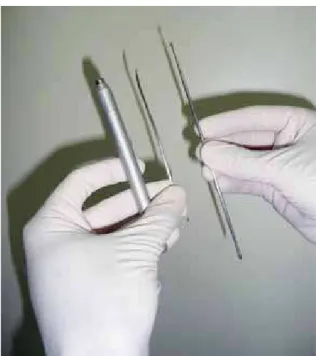
Surgical materials developed by the authors of this work
were used to carry out musculoaponeurotic suspensionwith
minimally invasive periosteal ixation of the middle third
of the face. These materials include needles that can be
sterilized in an autoclave. The needles have speciic tips for
each passage of the thread, depending on the surgical plan,
and a center hole for driving the thread (Figure 1). These
characteristics are necessary for performing the procedure.
Polypropylene suture with a resistance index 0 or 1, usually
available in the hospital environment, is used. This type of suture has the advantages of being non-absorbable and easily accessible in case removal is necessary.
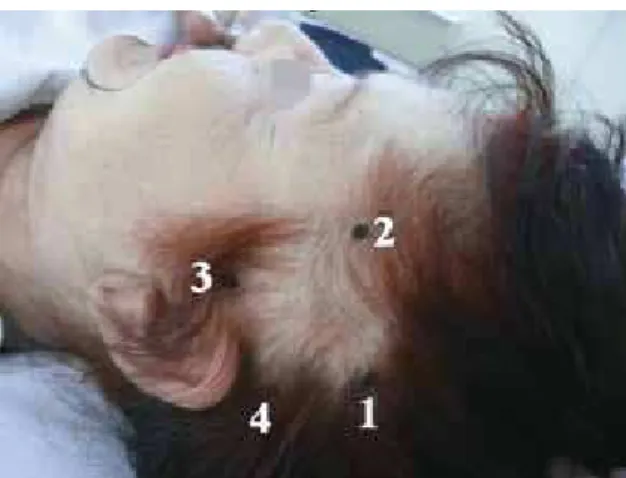
Initially, the insertion points of the temporalis muscle on
the skull are identiied. These are points 1 and 2, which are
the points of support of the suspension. These points are
loca-lized by asking the patient to tighten the lower jaw against the
upper jaw (biting with a shut mouth), allowing the observer
to see the contraction of the temporalis muscle. In the next step, point 3, the largest suspension point of the face, and point 4, the anchor point, are identiied. Importantly, these points should be parallel to produce maximum suspension (Figure 2). Subsequently, asepsis of this region is achieved using povidone-iodine antiseptic detergent or 70% alcohol, followed by local anesthesia between points by injecting 5 ml of 2% xylocaine combined with a adrenaline as a vasocons
-trictor. With the aid of a 40 × 12 needle, small holes are made
in the locations, which are then dilated with a blunt needle. The passage of the thread starts intramuscularly at point
1, using a blunt needle, moving in a zigzag pattern toward
the second point. At this point, the needle moves outward
(Figures 3 to 5). Between points 2 and 3, the blunt needle
and thread pass through the subdermal plane, causing more
traction and lifting the middle third of the face (Figure 6). Between points 3 and 4, the thread is passed in a zigzag
pattern through the intramuscular plane, avoiding the
super-icial temporal artery, which is exteriorized. Finally, between points 4 and 1, the blunt needle is replaced by a lat-tipped
needle, which passes through the subperiosteal plane, serving
as a reference for traction. Figures 7 and 8 illustrate the
dissected region and the passage of the thread (in cadavers).
After passing the thread, traction is carried out up to the point where progression of tissue is possible, with a minimum of
5 or 6 knots. A synthetic monoilament thread is suitable for
this application. The result is obtained immediately, and it is not a rare practice to show the difference between treated and untreated sides to the patient, with the aid of a mirror
(Figure 9).
The same procedure is performed contralaterally, and the
average time required to complete both sides is 30 minutes.
In the end, the holes should be inspected to ensure that no hair has been included in the needle insertion sites, because
this increases the risk of developing local granulomas. Gentle pressure is applied over the region for 5 minutes to prevent
bleeding. Some increased volume is usually reported in the
hair area, and this resolves within 40 days after the procedure. During this period, arrangement of tissues also occurs. The
patient can return to his daily activities on the same day of the procedure. Some suspension procedures are performed
Figure 2 – Reference points in the temporal region, as described in the text.
Figure 3 – Needle with the thread passing between points 1 and 2 (right side).
Figure 4 – Needle with the thread passing between points 1 and 2 (left side).
separately, others using a combination of different techniques and minimally invasive treatments, such as botulinum toxin, illers, monopolar radiofrequency, and peeling.
The degree of patient satisfaction with the procedure used
in this study was assessed with the aid of a questionnaire.
RESULTS
During the 18-month follow-up period, the results were
satisfactory. The degree of patient satisfaction with the
results, especially in the irst six months after the procedure, was extremely high and exceeded the authors’ expectations. In the questionnaire, answered by 50 patients, 88% rated the result as good/excellent, a result superior to the authors’ evaluation of the results of this study (78%).
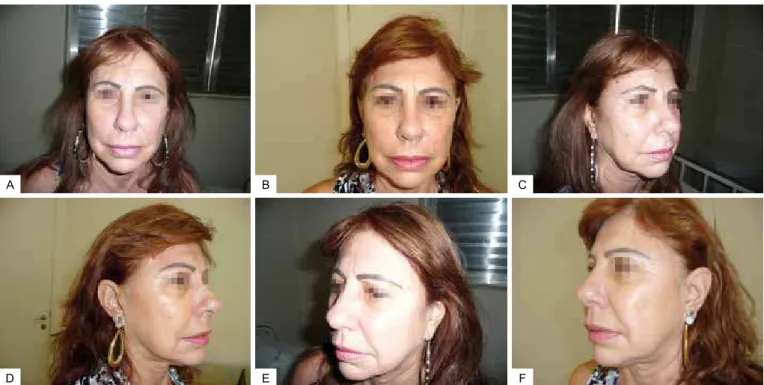
There was a signiicant reduction in the aging signs on the midface, which exhibited a natural aspect.
Serious complications were observed in this series of
patients. A small area of alopecia, which looked like a band,
was observed on the path of the thread in one patient, and it vanished spontaneously later. Another patient, with a history
of migraine, had severe pain in the irst three days after the
procedure. Pain was controlled with analgesics, and thread removal was not necessary. Two patients had granuloma in
the hole connecting the thread to point 1. Mild local irritation
associated with elevation of the hair area was reported in most of the patients. This did not interfere with routine functions and
resolved spontaneously within 40 days (Figures 10 and 11).
DISCUSSION
In modern society, people are increasingly looking for well-being and quality of life. Within this concept, facial
appearance occupies an important role in the impressions made on personal contacts.
Traditional surgical procedures performed on the face,
especially surgical facelifts, produce exceptional results
when properly indicated and performed. However, in most cases, these procedures are associated with high cost,
tempo-rary cessation of activities, and inherent risks of the surgical
procedure. Moreover, very impressive results on the face are
not desired by many patients who seek natural rejuvenation
without substantially changing their features.
Based on these premises, minimally invasive procedures have gained much attention in facial rejuvenation involving
the skin, muscles, and connective tissue. The ability to offer patients a low-risk procedure at lower cost with less radical,
gradual results and without a long recovery period has caught the attention of a large percentage of physicians. Prospective patients are usually very active, with busy social and
profes-sional lives, and seek attenuation of the signs of facial aging to improve quality of life.
Figure 6 – Needle passing between points 2 and 3 (right side).
Figure 7 – Picture of a cadaver showing the skin of the retailed temporal region.
Traction of the midface with a thread, as described in this article, fits into the concept of minimally invasive cosmetic procedures and represents another therapeutic option for doctors. This option is especially well suited for patients who do not want or cannot undergo a tradi-tional lift. Combined with other procedures, such as use
of botulinum toxin, fillers, and peeling, the technique
described in this study produces results very close to those of the traditional facelift, with the advantage of an almost immediate recovery.
The execution of the procedure is relatively simple and
relies on the use of appropriate materials and environment. Preoperative preparation of the patient is not necessary, and the procedure can be performed in an outpatient clinic (level I surgery).
Regarding the results, there is greater enthusiasm for this procedure among patients than among doctors. This may be because patients have, in addition to improved esthetics, a feeling of tension in their face, described by patients as more
irmness in the tissues of the middle third of the face.
A B C
Figure 9 - In A, front view of a patient who underwent placement of a thread on the right side (left side not yet treated). In B, right lateral
view of a patient before suspension with the thread. In C, right lateral view of a patient immediately after suspension with the thread.
A B C
D E F
Figure 10 – In A, front view of a patient before suspension with the thread. In B, frontal view of a patient three months after suspension with thread. In C, right lateral view of a patient before suspension with the thread. In D, right lateral
A B C
F E
D
H G
Figure 11 - In A, front view of a patient before suspension with thread. In B, frontal view of a patient six months after suspension with the
thread. In C, right lateral view of a patient before suspension with thread. In D, right lateral view of a patient six months after suspension with thread. In E, left lateral view of a patient before suspension with thread. In F, left lateral view of a patient six months after suspension with thread. G, right proile of a patient before suspension with thread. H, right proile of a patient six months after suspension with thread.
As observed for the traditional facelift, the proposed
procedure works better when conducted on thin individuals
and individuals with long faces, described as patients with
a light middle third facial lap. Patients with shorter or full
faces present more inconspicuous results.
The postoperative follow-up of patients in this study
showed maintenance of the results for a period of 18 months, which is quite reasonable for a minimally invasive procedure.
The complication rate was very low in this series, merely a case of traction-related alopecia with spontaneous recovery, a case of migraine controlled with analgesics, and two cases
with small granulomas in the region of point 1, which showed
resolution on medical treatment (antibiotics and topical
treatment with zinc oxide). One patient underwent removal
of the thread from the right side, with subsequent placement
of another thread in the same place, without compromising the result.
CONCLUSION
With the combined use of minimally invasive procedures on the face and a suspension thread for the middle third of the face as the most relevant element, it may be possible to achieve results that are very similar to those of the traditional facelift, with all the advantages already mentioned. In the
future, facelift techniques will move toward non-surgical
allowing patients to return to their daily activities almost
immediately. This technique has advantages over current techniques that use thread, since it does not invade the area of
the face. The musculoaponeurotic suspension with periosteal
ixation technique signiicantly increases the duration of the
outcome and reduces morbidity and recovery time. Finally,
unlike traditional techniques, the procedure can be fully reversed by simply removing the thread. This technique is
not intended to replace conventional rhytidoplasty but seems to be a very useful tool in patients who do not want or cannot
undergo conventional rhytidoplasty. This technique may
also be very useful for improving the outcome of traditional rhytidoplasties and blepharoplasties.
REFERENCES
1. Obagi ZE. Restauração e rejuvenescimento da pele. Trad. De Souza AST. Rio de Janeiro: Revinter; 2004. p.45-51.
2. Obagi ZE. Obagi skin health restoration and rejuvenation. Nova York: Spring-Verlag; 1998. p.11-3.
3. De Souza A. Antiaging, beleza e juventude em qualquer idade. São Paulo: Alaude; 2010. p.74.
4. Williams EF 3rd, Smith SP Jr. Minimally invasive midfacial
rejuvena-tion: combining thread-lift and lipotransfer. Facial Plast Surg Clin North Am. 2007;15(2):209-19.
5. Sulamanidze MA, Fournier PF, Paikidze TG, Sulamanidze GM. Re
-moval of facial soft tissue ptosis with special threads. Dermatol Surg. 2002;28(5):367-71.
6. De Souza A. Christiansen C, Jamie S. The use of salicylic acid in a new
delivery system as a co-adjuvant topical treatment for acne vulgaris.
Aesthet Surg J. 2005;25(1):40-3.
7. Doshi SN, Alster TS. Combination radiofrequency and diode laser for treatment of facial rhytides and skin laxity. J Cosmet Laser Ther. 2005;7(1):11-5.
8. Gold MH, Goldman MP. 5-aminolevulinic acid photodynamic the
-rapy: where we have been and where we are going. Dermatol Surg. 2004;30(8):1077-83.
9. De Souza A, Tai PL. Novos princípios em cirurgia plástica não
invasiva e medicina anti-aging. São Paulo: Santos Editora; 2010.
p.89-98.
Correspondence to: João Carlos Cisneiros Guedes de Andrade Júnior