Left-right judgment of haptic stimuli representing the human hand
Maria Luiza Rangel
1, Sabrina Guimarães-Silva
2, Andrea Laudares Marques
1, Lucia Riggio
3,
Antonio Pereira
4, Allan Pablo Lameira
5, Luiz G. Gawryszewski
11- Universidade Federal Fluminense, Niterói, RJ, Brazil
2- Universidade Estácio de Sá, Rio de Janeiro, RJ, Brazil
3- Universitá Degli Studi di Parma, PR, Italy
4- Universidade Federal do Rio Grande do Norte, Natal, RN, Brazil
5- Escola Superior da Amazônia, Belém, PA, Brazil
Abstract
The handedness recognition of visually perceived body parts engages motor representations that are constrained by the same biomechanical factors that limit the execution of real movements. In the present study, we used small plastic cutouts that represented the human hand to investigate the properties of mental images generated during their haptic exploration. Our working hypothesis was that any handedness recognition task that involves body parts depends on motor imagery. Forty-four blindfolded, right-handed volunteers participated in a
handedness evaluation experiment using their index inger to explore either the back or palm view of a haptic stimulus that represented the
human hand. The stimuli were presented in four different orientations, and we measured the subjects’ response times. Our results showed that
stimulus conigurations that resemble awkward positions of the human hand are associated with longer response times (p < .006), indicating that the haptic exploration of stimuli that represent body parts also leads to motor imagery that is constrained by biomechanical factors.
Keywords: haptic exploration, motor imagery, handedness recognition, mirror neurons, mental rotation.
Received 12 November 2010; received in revised form 12 December 2010; accepted 14 October 2010. Available on line 28 December 2010
Maria Luiza Rangel, Andrea Laudares Marques, and Luiz G. Gawryszewski, Departamento de Neurobiologia, Universidade Federal Fluminense, Niterói, RJ, Brazil. Sabrina Guimaraes-Silva, Universidade Estácio de Sá, Rio de Janeiro, RJ, Brazil. Lucia Riggio, Universitá Degli Studi di Parma, PR, Italy. Antonio Pereira, Edmond and Lily Safra International Institute of Neuroscience of Natal, Universidade Federal do Rio Grande do Norte, Natal, RN, Brazil. Allan Pablo Lameira, ESAMAZ - CPÓS: Escola Superior da Amazônia, Centro de Pós-graduação, Belém, PA, Brazil. Correspondence regarding this article should be directed to: Maria Luiza Rangel, Universidade Federal Fluminense, Departamento de Neurobiologia - PPG em Neurociências. - Campus Valonguinho, Centro, Niterói - RJ CEP 24210-130. Tel: +55-21-2629-2271. Fax: + 55-21-26292303. E-mail: [email protected]
Introduction
Mental rotation was irst demonstrated by Shepard and Metzler (1971). Subjects had to decide whether a pair
of three-dimensional drawings of objects, in which the right picture was rotated a certain amount from the left picture, were identical or mirror images of each other. The
main inding was that manual reaction times rose linearly
with increased angular disparity between the two objects, suggesting that objects are rotated in the mind similarly to
the physical rotation (Shepard & Metzler, 1971).
When judging the handedness1 of drawings that represent
the human hand presented in several orientations, however,
this linear association between angle and reaction time disappears. This is because biomechanical constraints that normally restrict the actual movement of body parts
also inluence their implicit movement (Parsons, 1987, 1994; Petit, Pegna, Mayer, & Hauert, 2003). Movements that are dificult to execute, for example, are also dificult
to be mentally simulated and lead to longer reaction
times (Gawryszewski, Silva-dos-Santos, Santos-Silva, Lameira, & Pereira, 2007; Lameira, Guimarães Silva, Werneck-Galvão, Pereira, & Gawryszewski, 2008a;
Parsons, 1987, 1994).
The mental rotation of objects perceived haptically
has been investigated previously (for review, see Prather & Sathian, 2002). Numerous tactile stimuli have been
used in such studies, including raised dot patterns that
represent abstract forms (Dellantonio & Spagnollo, 1990), alphanumeric stimuli (Rösler, Röder, Heil, & Hennighausen, 1993), cutout letters (Prather & Sathian, 2002; Hunt, Janssen, Dagostino, & Gruber, 1989), and geometric shapes (Marmor & Zaback, 1976). For
inanimate objects, manual reaction time depends only
on angular disparity (or the angular deviation from
1
the canonical orientation; Marmor & Zaback, 1976; Dellantonio & Spagnollo, 1990; Hunt et al., 1989).
Few studies have examined the haptic exploration
of stimuli that represent body parts (Kilgour & Lederman 2002, 2006; Kitada, Johnsrude, Kochiyama, & Lederman, 2009; Kitada, Dijkerman, Soo, &
Lederman, 2010). Additionally, none of these studies
investigated speciically motor simulation evoked
by the handedness recognition task, but rather the
dynamics of the haptic identiication of body parts.
Object recognition that relies exclusively on the haptic system is sequential by nature and consequently
more feature-based than coniguration-based (Lakatos & Marks, 1999). Vision, in contrast, depends on both feature and coniguration processing of object properties (James, James, Humphrey, & Goodale, 2005). The corollary of these indings is that handedness
recognition that depends only on haptic inputs should
require more time than multimodal situations (i.e.,
when visual and haptic information is available) or
when only vision is used (Norman, Norman, Clayton, Lianekhammy, & Zielke, 2004).
The present study used a mental chronometry paradigm to evaluate whether the covert brain processes engaged during a handedness judgment task are independent of stimulus modality. Our experimental subjects were blindfolded and instructed to use haptic exploration to determine the handedness of small cutouts that represented the human hand. Our hypothesis was that response time varies as a function
of igure orientation, demonstrating that motor imagery
is implicitly evoked during the task.
Methods
Experiment 1: Palm view
Participants
This experiment involved 22 right-handed (Oldield, 1971) volunteers (13 females and 9 males, 17-24 years
old, mean = 19.73; standard deviation = 0.37), whom were all naive about the purposes of the experiment. A written informed consent was obtained from all volunteers. The study was approved by our institution’s Ethics Committee.
Apparatus and procedure
Small plastic cutouts that represented either the
left or right hand (0.5 mm height, 4.0 cm width,
5.5 cm length) were presented in four distinct orientations to the subjects in a semi-random order in the horizontal plane. In the 0º orientation, the fingers were positioned away from the subject. The
other orientations were 90º lateral (90ºL, fingers
positioned away from the subject’s midline), 180º,
and 90º medial (90ºM, fingers positioned toward the
midline; see Figure 1).
The experiment was divided into two sessions conducted on different days. Each session had 24
training and 40 experimental trials. The irst session
was considered a practice session and was not included
in the statistical analysis. Half of the volunteers (11 subjects) used the left hand in the irst session and the right hand in the second session (Right Hand Group), whereas the other half (11 subjects) did the reverse (Left Hand Group).
The volunteers were blindfolded and seated with
their arms resting in a prone posture (palms down).
They were instructed to consider the stimulus as the
palm view of a human hand. Their index inger was
gently positioned to contact the thumb representation
of the stimulus (start point). After pressing a microswitch located underneath the igure, the
volunteer began the haptic exploration. The subjects then announced their decisions about the handedness of the stimulus to the experimenter, who immediately
pressed either key 1 (for left) or 2 (for right), on a
keyboard. Depending on whether the subject’s answer was correct or incorrect, the computer emitted either
a high (2000 Hz) or low (200 Hz) frequency warning
sound, respectively. MEL 2.0 software was used to measure and record response times.
Experiment 2: Back view
The purpose of Experiment 2 was to investigate the mental properties of the haptic representation of
the back view of a hand. Parsons (1994) showed that
the mental simulation involved in a visual handedness recognition task for the back view of a hand differs from the palm view. Thus, we expected that a similar pattern would be observed in the haptic handedness
test (i.e., an absence of a difference in response times
for 90ºL and 90ºM when the backs of the hands are
explored haptically). A difference between these two orientations may indicate that the properties of visual and tactile mental imagery are not congruent.
Participants
This experiment involved 22 volunteers (13
females and 9 males, 18-26 years old, mean = 20.14;
standard deviation = 0.54), classiied as right-handed (Oldield, 1971) and naive about the purposes of the
experiment. A written informed consent was obtained from all volunteers.
Apparatus and procedure
The only difference between Experiments 1 and 2 were the instructions given to the volunteers. In Experiment 2, the volunteers were told that the stimuli represented the back of a human hand.
Results
Performance accuracy
Experiment 1: Palm view
A three-way analysis of variance (ANOVA) with one between-subjects factor (Hand Group;
haptic task performed with left or right index finger, with two levels) and two within-subjects factors
(Stimulus, with two levels; Angle, with four levels)
was performed with the number of correct responses as the dependent variable. During the experiment, each condition was performed five times for a total of 40 trials. We found a significant two-way
interaction between Stimulus and Angle (F[3, 60] = 3.00; p < .0377) and a three-way interaction between
Hand Group, Stimulus, and Angle (F[3, 60] = 5.11;
p < .0032). The three-way interaction led us to run
separate ANOVAs for each Hand Group, with two within-subjects factors (Stimulus, with two levels; Angle, with four levels). The results for the Left Hand Group (haptic task performed with left hand) showed no significant effect. The analysis of the Right Hand Group (haptic task performed with right hand) showed
a significant interaction between Stimulus and Angle
(F[3, 60] = 4.51; p < .0100), with the right 90ºM stimulus producing lower performance accuracy than the left 90ºM stimulus and than the right 0º stimulus. Overall, no accuracy differences were found among
the stimulus orientations (Table 1).
Experiment 2: Back view
We performed a three-way ANOVA with one
between-subjects factor (Hand Group, with two levels) and two within-subjects factors (Stimulus, with two levels; Angle,
with four levels) with the number of correct responses as
the dependent variable. The analysis showed no signiicant
main effect or interaction. See Table 1 for direct comparisons between angles and performance accuracy.
Response time analysis
The mean values of correct response times for
each view (palm or back) were subjected to an ANOVA with one between-subjects factor (Hand Group; haptic task performed with left or right index inger) and two within-subjects factors (Stimulus, left or right hand;
Angle, 0º, 90ºL, 180º, 90ºM).
Experiment 1: Palm view
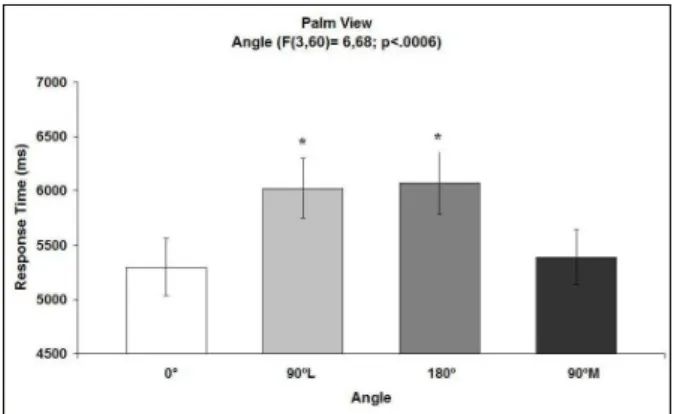
A signiicant effect of Angle was observed on response time (F[3, 60] = 6.68; p< .0006; see Figure 2). No other
factor and no interaction between factors had signiicant
effects on response time. The post hoc comparisons with
the Newman-Keuls method showed that the response time for a stimulus oriented at 0º (5299 ± 263 ms) was faster than a stimulus oriented at either 90ºL (6025 ± 278 ms) or 180º (6073 ± 289 ms; p < .05), but not for a
stimulus oriented at 90ºM (5387 ± 255 ms). Additionally, the response time for a stimulus oriented at 90ºM (5387 ± 255 ms) was faster (p < .05) than stimuli oriented at 90ºL
(6025 ± 278 ms) and 180º (6073 ± 289 ms).
View 0º 90º lateral 180º 90º medial
Palm 98.2 ± 1.09 97.7 ± 1.17 96.8 ± 1.12 97.3 ± 1.23
Back 99.5 ± 0.45 99.1 ± 0.64 96.8 ± 1.29 97.7 ± 0.97
Table 1. Mean (± SEM) percentage of correct responses as a function of angle. No signiicant difference was observed in
performance across the stimulus orientations.
These results show that response time is constrained by the same biomechanical limitations of real movements, suggesting that the mental simulation of implicit hand movements is necessary for the handedness evaluation of a haptic stimulus that represents a body
part (i.e., hand). More speciically, response time varies
according to the orientation of the object and is slower for both the 90ºL and 180º orientations than for the 0º
and 90ºM orientations. A signiicant difference was
observed between response times for the 90ºL and
90ºM orientations. Similar to the visual task (Parsons,
1987, 1994), longer response times are associated with the awkwardness of the implicit movement, indicating that the object is processed as a body part and not as an external object and that implicit movements of the right or the left hand are necessary for handedness
discrimination. The main factor Stimulus (right/left) did not reach signiicance (p = .88), indicating that the response times for recognizing stimuli that represented the left hand did not differ from the response times that represented the right hand.
Experiment 2: Back view
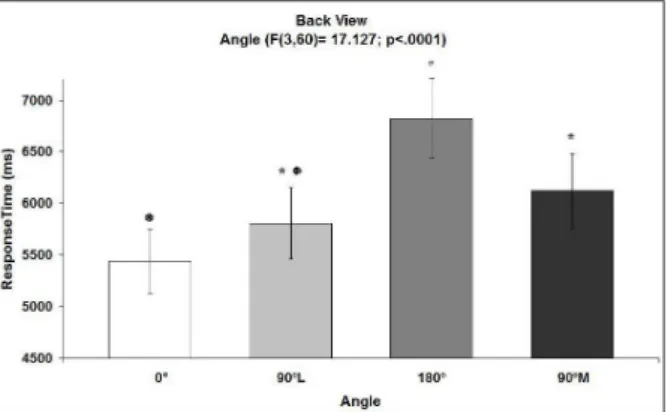
A signiicant effect of Angle was observed on response time (F[3, 20] = 17.13; p < .0001; see Figure
3), with a signiicant interaction between Group and Stimulus (F[3, 20]= 7.44; p < .013; see Figure 4). For the factor Angle, the post hoc comparison using the
Newman-Keuls method showed that the response time for the 0º orientation (5438 ± 312 ms) was faster than both the 180º (6822 ± 388 ms) and 90ºM (6124 ± 361 ms) orientations (p < .05), but not faster than the 90ºL
orientation (5806 ± 345 ms). The response time for the 180º orientation (6822 ± 388 ms) was slower than both the 90ºL (5806 ± 345 ms) and 90ºM (6124 ± 361 ms) orientations (p < .05). Finally, no signiicant difference
was found between the response times for 90ºL (5806 ± 345 ms) and 90ºM (6124 ± 361 ms) orientations.
Our main finding was that the handedness recognition of haptic stimuli that represent the back of a human hand depends on orientation of the stimuli, similar to what happens with visually perceived body parts. The response times were slower for the 180º than
for the 0º, 90ºL, and 90ºM orientations, and a signiicant
difference was observed between the response times for
the 0º and 90ºM orientations. However, no signiicant
difference was found between the response times for
the 90ºL (5806 ± 345 ms) and 90ºM (6124 ± 361 ms)
orientations. The longer response times observed for the 180º orientation may be attributable to the awkwardness of the associated implicit movement, indicating that the stimulus object is processed as a body part and not as an external object and that implicit movements of the right or the left hand are required for handedness
discrimination. The main factor Stimulus (right/left) did not reach signiicance (p = .82), indicating that the response times for recognizing stimuli that represent the left hand did not differ from the right hand.
The interaction between Hand Group and Stimulus (F[3, 20] = 7.44; p < .013; see Figure 4) indicates that
when volunteers used the left index inger to explore the
test object, the response time was faster when recognizing a right hand stimulus than a left hand stimulus. The
inverse occurred with the right index inger. The use
of orthogonal planned comparisons showed that when the task was executed with the right hand, the responses
were faster for the left hand stimulus (5747 ± 353ms) than the right hand stimulus (6109 ± 309ms) (p < .05). Similar results were observed when the left index was
used for exploring the stimuli: there is a trend (p < .092) for faster responses for recognizing a right hand
stimulus (6014 ± 284ms) than for recognizing a left hand stimulus (6321 ± 342ms). These results showed
unexpected interference between motor commands issued to the exploring hand and the mental simulation involved in handedness judgment. We suggest that this is further evidence of somatomotor involvement in the haptic handedness discrimination task.
Figure 3. Response time (± SEM) as a function of the orientation of the haptic stimulus that represented the back of a human hand. The response times for the 0° and 90ºL orientations did not differ but were shorter than the 180°
orientation. No signiicant difference was observed between
the responses times for the 90ºL and 90ºM orientations.
Figure 4. Response time (± SEM) as a function of the
Discussion
We used a handedness recognition task to show that the mental simulation of hand movements can be initiated by haptic exploration. The handedness recognition paradigm is known to depend on implicit
motor simulation (Jeannerod, 2001) and has been used mostly with visual stimuli (Parsons, 1994;
Gawryszewski et al., 2007; Lameira et al., 2008a;
Lameira et al., 2008b). The present work is the irst to
investigate the haptic properties of motor simulation in a handedness recognition task.
The mentally simulated movements used for handedness recognition in visual tasks have been shown to activate cortical areas involved in motor control. For example, a PET study showed that Brodmann areas 44, 46, and 4 in the left hemisphere and Brodmann areas 6, 7, and 37 in the right hemisphere are involved in both
motor imagery and handedness recognition (Parsons & Fox, 1998). Some of these areas are also associated with the mirror neuron system, and this inding suggests
the participation of mirror neurons in handedness
recognition, which was proposed by Parsons (1994) and Gawryszewski et al. (2007). The haptic identiication of body parts activates speciic areas on the occipito-temporal complex, the Haptic Face Area and the Haptic
Body Area for face and non-face body parts, respectively
(Kitada et al., 2009). These areas partially overlap with those activated by the visual identiication of human faces (Fusiform Face Area) and other (Extrastriate Body Area) body parts (Peelen & Downing, 2007).
Compared with vision, haptic object recognition is considerably slower, mostly because of the time necessary to extract localized information and integrate them into a coherent perception. The longer it takes to reach the perceptual threshold that allows a reasonable inference about the object’s identity, the more demand is placed on the integration of spatial and temporal aspects of the stimulus, working memory, and attention
(Loomis, Klatzky, & Lederman, 1991; Lederman & Klatzky, 2004; James et al., 2005; Scocchia, Stucchi, & Loomis., 2009). The two-dimensional nature of
the stimuli we used forced the subjects to use a rather
stereotyped pattern of exploratory inger movements (i.e., the contour-following strategy), which is usually
used when the form is the principal feature of the object and is characterized by a dynamic and time-consuming exploratory procedure in which the hand maintains
contact with the object’s contours (Lederman & Klatzky,
1987). As expected, the response times we measured were relatively longer than the ones measured in visually
based handedness recognition tasks (Parsons, 1994). Humans recognize common nonbiological objects
very effectively using haptic and visual recognition
(Klatzky, Lederman, & Metzger, 1985). Recent studies have shown that human body parts, such as faces (Kilgour
& Lederman, 2002, 2006), hands, and feet (Kitada et
al., 2009, 2010), and the facial expression of emotion
(Lederman et al., 2007) can also be identiied haptically.
Despite the differences in the dynamics of haptic and visual object exploration, our results indicate that both processes rely on similar motor imagery
mechanisms for handedness identiication. More speciically, the identical proile of response time
variation as a function of stimulus orientation suggests that the same biomechanical constraints are enforced for both haptically and visually elicited motor imagery. Sensorimotor representations can be thought of as generic entities that can be recalled to help recognize the handedness of body parts, independent of the sensory modality used to categorize them and understand other motor actions.
Acknowledgements
We wish to thank CAPES, CNPq, FAPERJ,
PIBIC-UFF/CNPq, and PROPP – UFF for inancial support and Prof. Dr. Claudia D. Vargas (IBCCF-UFRJ) and Professor John Findlay (University of Durham, UK) for their wise and
very helpful criticisms and suggestions on the manuscript.
References
Dellantonio, A., & Spagnolo, F. (1990). Mental rotation of tactual
stimuli. Acta Psychologica, 73, 245-257.
Gawryszewski, L.G., Silva-dos-Santos, C.F., Santos-Silva, J.C.,
Lameira, A.P., & Pereira, A., Jr. (2007). Mental rotation of
anthropoid hands: a chronometric study. Brazilian Journal of Medical and Biological Research, 40, 377-381.
Hunt, L.J., Janssen, M., Dagostino, J., & Gruber, B. (1989). Haptic identiication of rotated letters using the left or right hand. Perceptual and Motor Skills, 68, 899-906.
James, T.W., James, K.H., Humphrey, G.K., & Goodale, M.A. (2005).
Do visual and tactile object representations share the same neural
substrate? In M.A. Heller, & S. Ballesteros (Eds.), Touch and Blindness: Psychology and Neuroscience (pp. 139-157). Mahwah,
NJ: Lawrence Erlbaum.
Jeannerod, M. (2001). Neural simulation of action: a unifying
mechanism for motor cognition. Neuroimage, 14, S103-S109.
Kilgour, A., & Lederman, S.J. (2002). Face recognition by hand. Perception and Psychophysics, 64, 339-352.
Kilgour, A.R., & Lederman, S.J. (2006). A haptic face-inversion
effect. Perception, 35, 921-931.
Kitada, R., Johnsrude, I.S., Kochiyama, T., & Lederman, S.J. (2009).
Functional specialization and convergence in the occipito-temporal
cortex supporting haptic and visual identiication of human faces
and body parts: an fMRI study. Journal of Cognitive Neuroscience
, 21, 2027-2045.
Kitada, R., Dijkerman, H.C., Soo, G., & Lederman, S.J. (2010). Representing human hands haptically or visually from irst-person
versus third-person perspectives. Perception, 39, 236-254.
Klatzky R.L., Lederman S .J., & Metzger, V.A. (1985). Identifying
objects by touch: an “expert system.” Perception and Psychophysics,
37, 299-302.
Lakatos, S., & Marks, L.E. (1999). Haptic form perception: relative
salience of local and global features. Perception and Psychophysics,
61, 895-908.
Lameira, A.P., Guimarães Silva, S., Werneck-Galvão, C., Pereira, A.
Jr., & Gawryszewski, L.G. (2008a). Recognition of hand shape
drawings on vertical and horizontal display. Psychology and Neuroscience, 1, 35-40.
Lameira, A.P., Guimarães Silva, S., Ferreira, F.M., Lima, L.V.,
motor imagery: a body part recognition study. Brazilian Journal of Physical Therapy, 12, 379-385.
Lederman, S.J., & Klatzky, R.L. (1987). Hand movements: a window
into haptic object recognition. Cognitive Psychology, 19, 342-368.
Lederman, S.J., & Klatzky, R.L. (2004). Haptic identiication of
common objects: effects of constraining the manual exploration process. Perception and Psychophysics, 66, 618-628.
Lederman, S.J., Klatzky, R.L., Abramowicz, A., Salsman, K., Kitada, R., & Hamilton, C. (2007). Haptic recognition of static and dynamic expressions
of emotion in the live face. Psychological Science, 18, 158-164.
Loomis, J.M., Klatzky, R.L., & Lederman, S.J. (1991). Similarity of tactual and visual picture recognition with limited ield of view. Perception, 20, 167-177.
Marmor, G.S., & Zaback, L.A. (1976) Mental rotation by the blind: does
mental rotation depend on visual imagery? Journal of Experimental Psychology: Human Perception and Performance, 2, 515-521.
Norman, J.F., Norman, H.F., Clayton, A.M., Lianekhammy, J., & Zielke, G. (2004). The visual and haptic perception of natural
object shape. Perception and Psychophysics, 66, 342-351.
Oldield, R.C.(1971). The assessment and analysis of handedness: the
Edinburgh inventory. Neuropsychologia, 9, 97-113.
Parsons, L.M. (1987). Imagined transformation of one’s hands and
feet. Cognitive Psychology, 19, 178-241.
Parsons, L.M. (1994). Temporal and kinematic properties of motor behavior relected in mentally simulated action. Journal of Experimental Psychology: Human Perception and Performance,
20, 709-730.
Parsons, L.M., & Fox, P.T. (1998). The neural basis of implicit
movements used in recognizing hand shape. Cognitive Neuropsychology, 15, 583-615.
Peelen, M.V., & Downing, P.E. (2007). The neural basis of visual
body perception. Nature Reviews Neuroscience, 8, 636-648.
Petit, L.S., Pegna, A.J., Mayer, E., & Hauert, C.A. (2003).
Representation of anatomical constraints in motor imagery: mental rotation of a body segment. Brain and Cognition, 51, 95-101.
Prather, S.C., & Sathian, K. (2002). Mental rotation of tactile stimuli. Cognitive Brain Research, 14, 91-98.
Rösler, F., Röder, B., Heil, M., & Hennighausen, E. (1993).
Topographic differences of slow event-related brain potentials in blind and sighted adult human subjects during haptic mental rotation. Cognitive Brain Research, 1, 145-159.
Scocchia, L., Stucchi, N., & Loomis, J.M. (2009). The inluence of facing direction on the haptic identiication of two dimensional
raised pictures.Perception, 38, 606-612.
Shepard, R.N., & Metzler, J. (1971). Mental rotation of