Ionization Potentials, Dissociation Energies and Statistical Fragmentation of
Neutral and Positively Charged Small Carbon Clusters
S. D´ıaz-Tendero1, G. S´anchez1, P.-A. Hervieux2, M. Alcam´ı1, and F. Mart´ın1 1Departamento de Qu´ımica, C-9, Universidad Aut´onoma de Madrid, 28049 Madrid, Spain
2Institut de Physique et Chimie des Mat´eriaux de Strasbourg,
GONLO, 23 rue du Loess, 67034 Strasbourg, France
Received on 29 July, 2005
Dissociation energies, ionization potentials and fragmentation dynamics of neutral, singly- and doubly charged small carbon clusters have been theoretically studied with a combination of the density functional theory, the coupled cluster method and the the statistical model microcanonical Metropolis Monte Carlo. The second ionization potential decreases with the cluster size and is larger than the first one, which also decreases with the size showing oscillations. Dissociation energies also oscillate with the cluster size, being those with an odd number of atoms more stable. C3cluster has the largest dissociation energy. The combination of a sta-tistical treatment for the cluster fragmentation with experimental results has allowed us to evaluate the energy distribution in collisions experiments.
Keywords: Carbon clusters; Fragmentation; Dissociation energy and ionization potential
I. INTRODUCTION
The decay of excited small carbon clusters has been experi-mentally widely studied [1–19]. In these experiments, the loss of neutral C3has been found to be the dominant dissociation process for both charged and neutral clusters. Understanding the deexcitation processes observed in clusters collision ex-periments implies the knowledge of dissociation energies and ionization potentials of the evaporated fragments. The aim of this paper is to provide these values for small Cqn+carbon clus-ters (n=2−12 andq=0−2). A large number of theoretical
studies focussing on the structural properties of these systems can be found in the literature (see the reviews [20, 21] and references therein), but there is no theoretical work that treats all the clusters at the same level of theory. In order to obtain the energetic properties presented in this work, we have con-sistently evaluated neutral, singly- and doubly-charged small carbon clusters at the same level of theory. In addition, a sta-tistical treatment of the fragmentation process has been car-ried out. These simulations have allowed us to have a direct comparison with recent fragmentation experiments [19] and the evaluation of energetic properties as a function of the clus-ter charge and size. The paper is organized as follows. In sec-tion II, we briefly summarize the computasec-tional methods em-ployed. Dissociation energies, ionization potentials and frag-mentation properties of Cqn+ clusters are presented and dis-cussed in section III. We summarize our results in section IV.
II. COMPUTATIONAL DETAILS
The statistical fragmentation has been carried out with the microcanonical Metropolis Monte Carlo (MMMC) method as described in reference [22]. In this method, one moves in phase space until a region with maximum statistical weight is found. A physical observable is then evaluated as a sta-tistical average in this region of maximum probability. The
statistical weight measures the number of physically acces-sible states at a fixed energy and is entirely determined by the microscopic properties of the fragments. These properties (geometries, harmonic frequencies, rotational constants and binding energies) have been evaluated with standard quan-tum chemistry calculations. In particular, we have applied the density functional theory (DFT) with the B3LYP func-tional for exchange and correlation. This funcfunc-tional combines the Becke’s three parameter nonlocal hybrid exchange poten-tial [23] with the nonlocal correlation functional of Lee, Yang and Parr [24]. The geometries have been optimized by us-ing the 6-311+G(3df) basis set (B3LYP/6-311+G(3df)). The B3LYP functional has been proved to be a good choice for the description of carbon clusters [25]. In the case of small carbon clusters, the calculated geometries and the vibrational frequencies are very close to those obtained at higher levels of calculations [26–28]. More accurate values of electronic and binding energies have been obtained with the coupled cluster theory CCSD(T)/6-311+G(3df), which includes all single and double excitations, as well as triple excitations in a perturba-tive way [29], and made use of the B3LYP optimized geom-etry. The electronic energies obtained at this level of theory have been corrected with the zero point energy (ZPE) obtained from DFT vibrational analysis. All structure calculations have been performed with the Gaussian-98 program package [30].
III. RESULTS
0
2
4
6
8
10
12
Cluster size, n
6
9
12
15
18
21
24
27
Ionization potential (eV)
1
st
IP
2
nd
IP
FIG. 1: First and second ionization potentials (in eV) for Cn clus-ters as a function of the size. Circles: B3LYP/6-311+G(3df) level. Squares: CCSD(T)/6-311+G(3df)//B3LYP/6-311+G(3df) level. Ex-perimental values are also included: Diamonds (Ref. [31]), up tri-angles (Ref. [32]), stars (Ref. [33]), open diamonds (Ref. [34]), crosses (Ref. [35]), down triangles (Ref. [36]), open squares (Ref. [37]), open circles (Ref. [38]).
the most stable isomer for each cluster size and charge, i.e., they are adiabatic energies.
A. Ionization potentials
We first present the results obtained for the adiabatic ion-ization potentials. Fig. 1 shows the first and second ioniza-tion potentials as a funcioniza-tion of the cluster size evaluated at both B3LYP and CCSD(T) levels of theory. Differences be-tween both methods in the first ionization potentials are never larger than 0.5 eV. Although for the second ionization poten-tials the differences are larger, they never exceed 1 eV. As a general trend, first IP slowly decreases with cluster size, but this decrease is not monotonic and present some oscillations. The first ionization potencial has been measured by different authors [31–39] and theoretically calculated by Giuffredaet al. [40]. We have also included in Fig. 1 the available ex-perimental data. Our results agree reasonably well with the experimental measurements and those reported in ref. [40]. Second IP decreases with cluster size showing a stabilization for n=8−10. The observed behavior is quite predictable:
the second IP is larger than the first IP and the difference be-tween them is larger the smaller the system due to the ability of the larger cluster to accommodate multiple charges. Except for atomic C, we are not aware of any experimental determi-nation of the second ionization potential to compare with.
2 4 6 8 10 12
Cluster size, n 4
5 6 7 8
Dissociation Energy (eV)
Cn→ Cn-1 + C
Cn→ Cn-2 + C2
Cn→ Cn-3 + C3
C
n→ Cn-4 + C4
Cn→ Cn-5 + C5
FIG. 2: Dissociation energies (in eV) of the process Cn→Cn−x+Cx evaluated at the B3LYP/6-311+G(3df) level of theory.x=1: circles,
x=2: squares,x=3: diamonds,x=4: triangles up,x=5: triangles down.
2 4 6 8 10 12
Cluster size, n
4 5 6 7 8 9 10 11 12
Dissociation energy (eV)
2 4 6 8 10 12
Cluster size, n Cn+→Cn-1+ + C
Cn+→Cn-2+ + C2
Cn
+ →
Cn-3
+ + C
3
C
n +
→
C
n-4
+
+ C
4
Cn+→Cn-1 + C+
C
n +
→
C
n-2
+ C
2 +
Cn+→Cn-3 + C3+
C
n +
→
C
n-4
+ C
4 +
C
n +
→
C
n-5
+
+ C
5
C
n +
→
C
n-5
+ C
5 +
(a) (b)
FIG. 3: Dissociation energies (in eV) of the processes (a) C+
n →
C+
n−x+Cx and (b) C +
n →Cn−x+C+x evaluated at the B3LYP/6-311+G(3df) level of theory. x=1: circles,x=2: squares,x=3: diamonds,x=4: triangles up,x=5: triangles down.
B. Dissociation energies
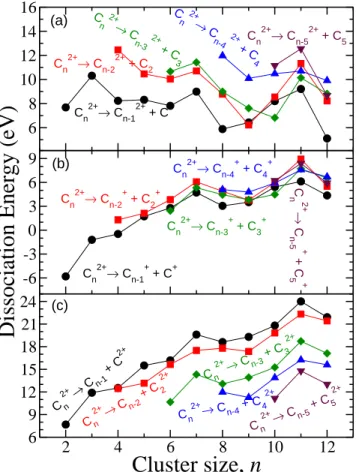
The results for the dissociation energies of neutral, singly-and doubly-charged carbon clusters are presented in Figs. 2, 3 and 4 respectively. In these figures results of evaporation of C (circles), C2(squares), C3(diamonds), C4(triangles up) and C5(triangles down) are depicted.
In neutral clusters (Fig. 2) the lowest dissociation energy channels are Cn−3/C3and Cn−5/C5. Alternation in
dissocia-tion energy is shown as a funcdissocia-tion of the cluster size. The oscillating behavior is more pronounced in the dissociation energy of channels corresponding to the evaporation of C and C3and C5.
For singly charged C+
dissoci-6
8
10
12
14
16
-6
-3
0
3
6
9
Dissociation Energy (eV)
2
4
6
8
10
12
Cluster size, n
6
9
12
15
18
21
24
Cn2+→ Cn-12+ + C
Cn2+→ Cn-22+ + C2 C
n 2+
→ C n-3 2+ + C
3 C
n 2+→
C
n-4 2+ + C
4
C
n 2+
→ C
n-1 +
+ C+
Cn2+→ Cn-2+ + C2+
C
n 2+
→ C
n-3 + + C 3 + C n 2+
→ C
n-4 + + C 4 + Cn 2+→ C
n-1
+ C
2+
Cn
2+→ Cn-2
+ C2
2+ Cn
2+→ Cn-3
+ C3
2+
Cn2+→ Cn-4 + C4 2+ (b)
(c) (a)
Cn 2+→ Cn-5
+ C5 2+ Cn2+→ Cn-52+ + C5
C n 2+ → C n-5 + + C 5 +
FIG. 4: Dissociation energies (in eV) of the processes (a) C2+
n →
C2n+−x+Cx, (b) C
2+
n →C+n−x+C +
x and (c) C2n+→Cn−x+C2x+ eval-uated at the B3LYP/6-311+G(3df) level of theory. x=1: circles,
x=2: squares,x=3: diamonds,x=4: triangles up,x=5: triangles down.
ation energy channel is Cn−1/C+forn=2, 3 and 4; C+n−3/C3
forn=6; C+
n−2/C2forn=5 and 10 and C
+
n−1/C forn=7, 8, 11
and 12. In Fig. 3 alternation in the dissociation energy as a function of the cluster size is also shown but in this case it is less pronounced than for the neutral species.
For the smallest doubly charged carbon clusters (C2+
n , with n=2, 3 and 4) the dissociation energy of channel C+
n−1/C
+
is smaller than zero, i.e., they are metastable. These results are in agreement with calculations of the potential energy surface evaluated with multireference methods (MR-DCI) [41, 42]. The smallest doubly charged cluster that is stable against Coulomb explosion is C2+
5 [28, 43]. The lowest dissociation energy of this molecule corresponds to channel C+
4/C +
. It is worth mentioning that in the experimental work of Chabotet al.[15] they found that this channel is the dominant one in the fragmentation of C2+
5 . In addition, the dissociation energy of this channel is∼1 eV smaller than the required for the C+3/C
+ 2 channel.
The lowest dissociation energy channel for C2+
n corre-sponds to C+
n−1/C
+
, except for C2+ 6 and C
2+
10, closely followed by C+n−3/C+3, which is the energetically most favorable for C26+ and C2+
10. As a general trend, the channels in which the charge
2 4 6 8 10 12
Cluster size, n -6 -4 -2 0 2 4 6 8
Lowest Dissociation Energy (eV)
FIG. 5: Lowest dissociation energy (in eV) for the Cqn+clusters. Cir-cles: neutral clusters; squares: singly charged clusters; diamonds: doubly charged clusters; filled symbols and full lines: B3LYP re-sults; open symbols and dashed lines: CCSD(T) results.
is shared by both fragments (C+
n/C
+
n−k) present lower
dissoci-ation energy. In Fig. 4 alterndissoci-ations in the dissocidissoci-ation energy as a function of the cluster size are also shown, but in a lower degree as in neutral or cationic species.
A summary of the results obtained for dissociation energies is found in Fig. 5. In this figure we have plotted the lowest dissociation energy as a function of the cluster size at both levels of theory employed. One can see that differences be-tween B3LYP and CCSD(T) predictions are rarely larger than 1 eV, being in most of the cases close to each other. Clus-ters with an odd number of carbon clusClus-ters are more stable: a larger dissociation energy is required to break these mole-cules. In particular, C3presents the larger dissociation energy (∼8 eV). Forn=9 the dissociation of the cation becomes
similar to that of the neutral, forn>11 these dissociation
en-ergies become similar.
C. Fragmentation
mi-0 5 10 15 20 25 30 35 40 45
Cluster excitation energy (eV)
0 20 40 60 80 100
Probability (%)
C
4/C3
C5/C2
2C3/C
C3/2C2
C3/C2/2C
3C2/C
2C2/3C
C3/4C C
7
C2
/5C
7C
FIG. 6: Theoretical branching ratios as functions of the cluster exci-tation energy. Dashed line: cluster energy distribution multiplied by ten.
Fragmentation Channel
-10 0 10 20 30 40 50 60 70 80 90 100
Branching Ratios (%)
C7 C6
/C
C4
/C
3
2C
3
/C
C3
/2C
2
C5
/C
2
C5
/2C
C4
/C
2
/C
C4
/3C
C3
/C
2
/2C
3C
2
/C
C3
/4C
2C
2
/3C
C2 /5C 7C
FIG. 7: Branching ratios for deexcitation of C7cluster. Full circles: experiment; empty squares: convolution of the theoretical branching ratios with the energy distribution shown by a dashed line in Fig. 6.
crocanonical Metropolis Monte Carlo (MMMC) presented in [22] to have a direct comparison with the experimental mea-surements.
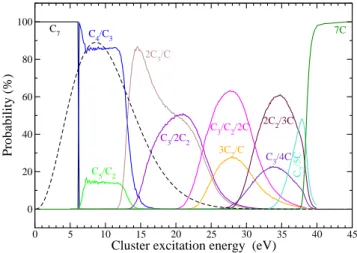
As an example, Fig. 6 shows the theoretical branching ra-tios as functions of the cluster excitation energy obtained in a MMMC simulation of C7. The results show that the branching ratios present variations when the excitation energy is close to the dissociation thresholds. In addition, competition between different channels for a given excitation energy is also ob-served. The dominant channels are those presenting a C3 clus-ter. To compare the theoretical results with the experimental measurements one has to convolute the calculated branching
ratios with the collisional energy deposit distribution. Fol-lowing a similar procedure than the presented in ref. [19] we have obtained the energy distribution function shown in Fig. 6 (dashed line). Comparison of the theoretical results obtained with the experimental measurements is shown in Fig. 7. A good agreement is shown between our prediction and the ex-perimental data. By far, the dominant channel is C4/C3. The rest of the channels have a BR below 20%.
Thus, the presented procedure (combination of experimen-tal branching ratios and MMMC simulations) allows us to ex-tract the energy deposit just before the cluster fragmentation, i.e., in the collision process. This information is not avail-able only from the theoretical point of view neither from the experimental one itself.
IV. CONCLUSIONS AND PERSPECTIVES
We have presented a theoretical study of the ionization po-tentials, dissociation energies and fragmentation of neutral and positively charged small carbon clusters. In compari-son with the more expensive CCSD(T) calculations, the DFT approach has been shown to be extremely useful in predict-ing accurate dissociation energies and ionization potentials. While first IP varies with the cluster size, showing a slow decrease, second IP is larger than the first one and decrease monotonically with n. Dissociation energies show alterna-tion with the cluster size. As a general trend channels evap-orating a cluster with an odd number of atoms (in particular C3) are more favorable. C25+is the smallest doubly charged cluster which is thermodynamically stable against dissocia-tion (C2+
3 and C2 +
4 are metastable). In the fragmentation dy-namics we have observed competition between different dis-sociation channels for a given excitation energy. Comparison of our results with experimental measurements of C+
n+He col-lisions has allowed us to determine the energy distribution of the clusters just after the collision. Application of the MMMC method to charged species (C+
n,n=5−8) and larger clusters (C60and C+60) will be also considered. For these systems dis-sociation energies and ionization potentials has been reported elsewhere [25].
Acknowledgments
We thank theCentro de Computaci´on Cient´ıfica de la Uni-versidad Aut´onoma de Madrid(CCC-UAM) for allocation of computer time. Work partially supported by the DGI project Nos. BFM2003-00194, BQU2003-00894 and CTQ2004-00039/BQU, and the CAM project No. GR/MAT/0083/2004.
[1] P. P. Radi, M. E. Rincon, M. T. Hsu, J. Brodbelt-Lustig, P. R. Kemper, and M. T. Bowers, J. Chem. Phys.92, 4817 (1990). [2] P. P. Radi, G. V. Helden, M. T. Hsu, P. R. Kemper, and M. T.
Bowers, Int. J. Mass Spectrom. Ion Proc.109, 49 (1991).
[3] M. E. Geusic, T. J. McIlrath, M. F. Jarrold, L. A. Bloomfield, R. R. Freeman, and W. L. Brown, J. Chem. Phys.84, 2421 (1986).
R. R. Freeman, and W. L. Brown, Z. Phys. D3, 309 (1986). [5] M. E. Geusic, M. F. Jarrold, T. J. McIlrath, R. R. Freeman, and
W. L. Brown, J. Chem. Phys.86, 3862 (1987).
[6] R. Bouyer, F. R. Monchicourt, M. Perdix, and P. Pradel, J. Chem. Phys.100, 8912 (1994).
[7] K. B. Shelimov, J. M. Hunter, and M. F. Jarrold, Int. J. Mass Spectrom. Ion Proc.138, 17 (1994).
[8] M. B. Sowa, P. A. Hinz, and S. L. Anderson, J. Chem. Phys.95, 4719 (1991).
[9] C. Lifshitz, T. Peres, S. Kababia, and I. Agranat, Int. J. Mass Spectrom. Ion Proc.82, 193 (1988).
[10] C. Lifshitz, T. Peres, and I. Agranat, Int. J. Mass Spectrom. Ion Proc.93, 149 (1989).
[11] C. Lifshitz, H. F. G. P. Sandler, J. Sun, T. Weiske, and H. Schwart, J. Phys. Chem.97, 6592 (1993).
[12] S. W. McElvany, Int. J. Mass Spectrom. Ion Proc. 102, 81 (1990).
[13] Y. Tai, J. Murakami, Y. Maruyama, W. Yamaguchi, T. Mizota, K. Igarashi, and S. Tanemura, J. Phys. Chem. B 103, 5500 (1999).
[14] H. Choi, R. T. Bise, A. A. Hoops, D. H. Mordaunt, and D. M. Neumark, J. Phys. Chem.104, 2025 (2000).
[15] M. Chabot, K. Wohrer, J. P. Rozet, D. Gard`es, D. Vernhet, D. Jacquet, S. DellaNegra, A. Brunelle, M. Nectoux, M. Pau-trat, et al., Phys. Scr.T73, 282 (1997).
[16] M. Chabot, R. Foss´e, K. Wohrer, D. Gard´es, G. Maynard, F. Ravilloud, and F. Spiegelman, Eur. Phys. J. D14, 5 (2001). [17] M. Chabot, S. D. Negra, L. Lavergne, G. Martinet, K. Wohrer,
R. Sellem, R. Daniel, J. L. Bris, G. Lalu, D. Gard´es, et al., Nucl. INucl. Instrum. Methods B197, 155 (2002).
[18] G. Martinet, M. Chabot, K. Wohrer, S. D. Negra, D. Gardes, J. A. Scarpaci, P. Desesquelles, V. Lima, S. D´ıaz-Tendero, M. Alcam´ı, et al., Eur. Phys. J. D24, 149 (2003).
[19] G. Martinet, S. D´ıaz-Tendero, M. Chabot, K. Wohrer, S. D. Ne-gra, F. Mezdari, H. Hamrita, P. D´esesquelles, A. L. Padellec, D. Gard´es, et al., Phys. Rev. Lett.93, 063401 (2004).
[20] W. Weltner and R. J. V. Zee, Chem. Rev.89, 1713 (1989). [21] A. V. Orden and R. J. Saykally, Chem. Rev.98, 2313 (1998). [22] S. D´ıaz-Tendero, P.-A. Hervieux, M. Alcam´ı, and F. Mart´ın,
Phys. Rev. A71, 033202 (2005).
[23] A. D. Becke, J. Chem. Phys.98, 5648 (1993).
[24] C. Lee, W. Yang, and R. G. Parr, Phys. Rev. B37, 785 (1988). [25] S. D´ıaz-Tendero, M. Alcam´ı, and F. Mart´ın, J. Chem. Phys.119,
5545 (2003).
[26] J. M. L. Martin, J. El-Yazal, and J. P. Franc¸ois, Chem. Phys. Lett.242, 570 (1995).
[27] J. M. L. Martin, J. El-Yazal, and J. P. Franc¸ois, Chem. Phys. Lett.252, 9 (1996).
[28] S. D´ıaz-Tendero, F. Mart´ın, and M. Alcam´ı, J. Phys. Chem. A 106, 10782 (2002).
[29] R. J. Barlett, Recent Advances in Coupled-Cluster Methods
(World Scientific, Singapore, 1997).
[30] M. J. Frisch, G. W. Trucks, H. B. Schlegel, G. E. Scuseria, M. A. Robb, J. R. Cheeseman, V. G. Zakrzewski, J. A. M. Jr., R. E. Stratmann, J. C. Burant, et al.,Gaussian 98, Revision A.11
(Gaussian, Inc., Pittsburgh PA, 2001).
[31] R. Ramanathan and J. A. Zimmerman, J. Chem. Phys.98, 7838 (1993).
[32] J. Drowart, R. P. Burns, G. DeMaria, and M. G. Inghram, J. Chem. Phys.31, 1131 (1959).
[33] F. J. Kohl and C. A. Stearns, J. Chem. Phys.52, 6310 (1970). [34] S. B. Bach and J. R. Eyler, J. Chem. Phys.92, 358 (1990). [35] C. Reid, J. A. Ballantine, S. R. Andrews, and F. M. Harris,
Chem. Phys.190, 113 (1995).
[36] K. P. Huber and G. Herzberg,Molecular Spectra and Molecular Structure, 4: Constants of Diatomic Molecules(Van Nostrand, New York, 1979).
[37] D. R. Lide, Handbook of chemistry and physics, 77th ed.
(1996).
[38] R. L. Kelly, J. Phys. Chem. Ref. Data, Suppl.91, 161 (1987). [39] S. J. Blanksby, D. Schroder, S. Dua, J. H. Bowie, and
H. Schwarz, J. Am. Chem. Soc.122, 7105 (2000).
[40] M. G. Giuffreda, M. S. Deleuze, and J. P. Franc¸ois, J. Phys. Chem. A103, 5137 (1999).
[41] H. Hogreve, J. Chem. Phys.102, 3281 (1995).