Brazilian Journal of Physics, vol. 36, no. 2B, June, 2006 546
Multiple Ionization Effects in X-Ray Emission Induced by Heavy Ions
M. Czarnota, M. Pajek, D. Bana´s,
Institute of Physics, ´Swie¸tokrzyska Academy, 25-406 Kielce, Poland
J.-Cl. Dousse, Y.-P. Maillard, O. Mauron, P. A. Raboud, M. Berset, Physics Department, University of Fribourg, CH-1700 Fribourg, Switzerland
D. Chmielewska, J. Rzadkiewicz, Z. Sujkowski, Sołtan Institute for Nuclear Studies, 05-400 Otwock- ´Swierk, Poland
J. Hoszowska,
European Synchrotron Radiation Facility (ESRF), F-38043 Grenoble, France
K. Słabkowska, and M. Polasik
Faculty of Chemistry, Nicholas Copernicus University, 87-100 Toru ´n, Poland
Received on 29 July, 2005
The x-ray satellite structure of Pd Lα1,2(L3M4,5) transition excited by an impact of O7+and Ne6+ions with
energies 279 and 178 MeV, respectively, which were measured using a high-resolution von Hamos crystal spec-trometer, is discussed in terms of the multi-configuration Dirac-Fock (MCDF) calculations. We demonstrate, by using the arguments of the general central limit theorem (GCLT), that a structure of complex M-shell satellites of Pd Lα1,2(M−m) transitions for a higher number of spectator vacancies (m>4), which consists of hundreds
of thousands of individual x-ray transitions as obtained from the MCDF calculations, can be well described by a single Voigtian profile. The Lorentzian width of such Voigtian line can be well modeled by using the results of the MCDF calculations for simpler configurations with a number of vacanciesm≤4 . This method allows one to describe realistically a complex structure of M-shell satellites, thus extending the applicability of the MCDF calculations, which are limited by an increasing complexity of numerical calculations.
Keywords: Multiple ionization; X-ray satellite structure; MCDF calculations
I. INTRODUCTION
The x-rays emitted from atoms multiply ionized by heavy ions exhibit, apart from the well known x-ray diagram lines, the satellite structure corresponding to different multi-vacancy configurations present at the moment of the x-ray emission. High-resolution measurements of excited x-ray satellites give thus access to study the structure of multi-vacancy config-urations in atoms. However, in order to extract from such complicated spectra the ray transitions the structure of x-ray multiplets and their Lorentzian widths for a given multi-vacancy configuration as well as the experimental Gaussian broadening have to be known. This results from the fact that for heavy ion impact the x-ray spectra, containing x-ray satel-lites with up to several spectator vacancies in the inner-shells, become extremely complex and, consequently, cannot be fit-ted uniquely without performing the MCDF calculations of the structure of individual x-ray multiplets and realistic mod-elling of their widths. In this paper we discuss a new method of analysis of complex x-ray spectra which, using the general central limit theorem arguments, describes the complex x-ray satellites as the smooth Vogtian profile having known mean value and width, which can be obtained from MCDF calcula-tions. This method, which is based on our earlier works [1, 2], is presently extended to high-resolution spectroscopy. An al-ternative approach of analysis of x-ray spectra emitted from multiply ionized atoms can be found in a recent work by
Hor-vat et al. [3].
Brazilian Journal of Physics, vol. 36, no. 2B, June, 2006 547
FIG. 1: Measured x-ray satellite structure for Lα1,2transition in
pal-ladium excited by 279 MeV O7+ions. The data are compared with the predictions of the MCDF calculations including up tom=4 spec-tator vacancies in the M- and N-shells. The individual components of the calculated spectrum are marked in the figure.
II. EXPERIMENT
The high-resolution measurements of the M- and N-shell satellites of Pd Lα1,2(L3M4,5) x-ray transitions excited by fast O7+ and Ne6+ ions have been performed [8] at the Philips cyclotron in the Paul Scherrer Institute (PSI) in Villigen, Switzerland, using a von Hamos high-resolution diffraction spectrometer [5]. The x-ray spectra of Lα1,2(L3M4,5) transi-tions were excited by O7+ and Ne6+ ion beams of energies 279 and 178 MeV, respectively, bombarding thin metallic pal-ladium foils. The x-rays were measured by means of a high-resolution von Hamos spectrometer [5] with a precision of about 1 eV for studied Pd L-x-rays (∼3 keV), including an experimental Gaussian resolution of about 0.7 eV. The von Hamos spectrometer was equipped with a quartz (111) crystal curved with a radius of 25.4 cm. The x-rays were measured with the CCD detector covering in one setting the x-ray energy range of about 50 eV. Consequently, the x-ray spectra of Pd Lα1,2(L3M4,5) transitions were measured for several settings of the spectrometer. The energy calibration of the spectrom-eter has been performed by measuring well resolved Kα1,2 x-ray lines of vanadium excited by photons from x-ray tube with Cr anode.
III. RESULTS AND DISCUSSION
In order to interpret quantitatively the measured x-ray satel-lite structure of Pd Lα1,2(L3M4,5) transitions excited by Ne6+ ions of energy 178 MeV, MCDF calculations involving up to seven M-shell spectator vacancies are needed. However, the MCDF calculations for multi-vacancy Pd Lα1,2(M−m)
con-FIG. 2: Measured x-ray satellite structure for Lα1,2transition in
pal-ladium excited by 178 MeV Ne6+ions. The data are compared with the predictions of the MCDF calculations including up tom=4 spec-tator vacancies in the M- and N-shells and the average MCDF bino-mial model indicating the importance of configurations with up to
m=8 vacancies in the M-shell as well as the L-shell hypersatellite structure.
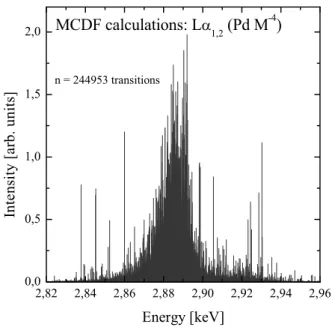
figurations become, in practice, numerically intractable for m>4. For instance, the MCDF calculations for palladium for M−4configuration contain 244953 transitions (see Fig. 3) and for mixed M−1N−2 configuration 268210 transitions. Such numerical limitation of the applicability of the MCDF calcu-lations asks for developing of alternative approximate meth-ods to treat the complex satellite structures of x-rays excited in ion-atom collisions.
Following the idea presented in our earlier works (see Refs. [1] and [2]) on multiple ionization effects in ion-induced ray spectra we suggest that the ray profile for complex x-ray transitions can be well approximated by an effective sin-gle profile resulting from a convolution of natural Lorentzian and experimental Gaussian widths applied to the calculated MCDF x-ray multiplets consisting of large number of transi-tions. This observation is based on the firm ground of the gen-eral central limit theorem (see Ref. [7]) suggesting a Voigtian type profile as the limiting distribution in our case.
In order to verify this idea, the calculated MCDF structure of x-ray transitions for Pd Lα1,2(M−m) configuration, convo-luted with natural Lorentzian widths ofindividual transitions, assumed to scale approximately with a number of spectator vacanciesmas Γ(m) =Γ(0) +2Γspec·m, and experimental
Gaussian widths of about 0.7 eV, are shown in Fig. 4. The effective widths of theresultingVoigtian profiles for complex x-ray multiplets are expected to follow approximately a sim-ple scaling rule, namely,
Γ(m) =ΓM(0) +αm+β√m (1)
calcu-Brazilian Journal of Physics, vol. 36, no. 2B, June, 2006 548
FIG. 3: The structure of Pd Lα1,2(M−4) x-ray transitions obtained
by using the MCDF calculations.
FIG. 4: A profile of Lα1,2(M−4) x-ray transitions, as obtained by
convolution of calculated MCDF transitions with natural Lorentzian (see text) and experimental Gaussian widths, fitted by a single Voigtian profile. Note the smooth shape of the calculated (MCDF) profile and the reasonable good fit by a Voigtian.
lated MCDF configuration with a smaller number of spectator vacancies,m≤4 in our case. This formula, which uses once more the arguments of the GCLT theorem, has been derived by summing up the natural widthΓ(m)of the Lorentzian dis-tribution of x-ray transition energy and the width of the bi-nomial distribution of a number of vacancies randomly dis-tributed in the M-shell. In fact, the variance of the binomial distribution σ2(m) =N
MpM(1−pM), where NM is a
num-ber of electrons in the M-shell, scales for pM =m/M ≪1
asσ2(m)∝myielding the following approximate estimate for a width:Γbin(m)∝√m.
The fitted effective widths of x-ray transitions for M−m
configurations, shown in Fig. 5, fully justify the model as-sumed. Consequently, such a parameterization of Voigtian widths for complex multi-vacancy configurations, combined with a known linear parameterization of their mean energies adopted in the average MCDF binomial model (Ref. [6]) of x-ray satellite structure, allows one to describe in a realistic way the complex x-ray spectra excited by heavy ions, which include much more spectator vacancies than can be treated numerically in an exact way using the MCDF calculations.
The present findings open a possibility to describe a com-plex satellite structure of Pd Lα1,2(L3M4,5) transitions such as in the discussed x-ray spectra excited by Ne6+ions of energy 178 MeV exhibiting M- and N-shell satellites. However, a fi-nal interpretation of such x-ray spectra needs further MCDF calculations for the observed L-shell hypersatellite structure overlapping with M-shell satellites. Such MCDF calculations of L-shell hypersatellites are in progress.
IV. CONCLUSIONS
A novel approximate description of x-ray spectra for com-plex multi-vacancy M−m configurations has been proposed,
which is based on the general central limit theorem. The cal-culated profiles of Lα1,2(M−m) x-ray transitions in palladium are well described by the proposed model. Complex multi-vacancy configurations, involving up to about ten spectator
FIG. 5: Fitted effective Lorentzian widths of Pd Lα1,2(M−m) MCDF
Brazilian Journal of Physics, vol. 36, no. 2B, June, 2006 549
vacancies, can be treated within this approach, which signifi-cantly extends the applicability of the MCDF calculations for describing multiple ionization effects in x-ray spectra excited by heavy ions.
Acknowledgments
This work was supported by the Polish State Committee for Scientific Research under the Grant No. 1P0301326 and the Swiss National Science Foundation.
[1] D. Bana´set al., Nucl. Instrum. and Methods B195, 233 (2002). [2] M. Pajek, D. Ban´as, J. Semaniak, J. Braziewiczet al., Phys. Rev.
A68, 022705 (2003).
[3] V. Horvatet al., Phys. Rev. A71, 062709 (2005).
[4] M. Czarnota et al., Nucl. Instrum. and Methods B 205, 133(2003).
[5] J. Hoszowska et al., Nucl. Instrum. and Methods A 376, 129
(1996).
[6] M. Polasik, Phys. Rev. A52, 227 (1995).
[7] G. Samorodnitsky and M.S. Taqqu,Stable Non-Gaussian Ran-dom Processes, Chapman&Hall, New York, 1994.