Phase Diagrams of the Blume-Emery-Griffiths thin Films
H. Ez-Zahraouy, L. Bahmad, and A. Benyoussef Facult´e des Sciences, D´epartement de Physique, Laboratoire de Magn´etisme et Physique des Hautes Energies.
B.P. 1014, Rabat, Morocco
Received on 11 November, 2005
We study the spin-1 Blume-Emery-Griffiths model with bilinear and biquadratic exchange interactions and single-ion crystal field, using the mean field theory. In addition to the four usual phases: The disordered phase
D, the ferromagnetic phaseF, the staggered quadrupolar phaseSQand The ferrimagnetic phaseI, we found two new phases, in the case of a thin magnetic film, namely: the sublattice (A or B) non magnetic phaseNMand the global non magnetic phaseG. These phases are studied, for each layer of the film in the temperature-crystal field plane(T/J,∆/J)for different film thicknesses. It is found that the ferrimagnetic and sublattice phases are absent for a monolayer film. Whereas, these phases appear for increasing film thicknesssesN≥2. On the other hand, the thermal behaviour of the layer quadrupolar momentsqA,qB and layer magnetisationsmA,mB
are investigated for negative values of the biquadratic coupling and crystal field. It is also shown that for fixed values of the biquadratic coupling, the temperature and the crystal field, each layer of the film can belong to a different phase. To illustrate this situation, an example is given ford/J=−1.5,∆/J=−3.0 andT/J=1.3.
Keywords: Two-sublattice BEG model; Thin films; Staggered quadrupolar phase; Phase diagrams; Multicritical behaviour
I. INTRODUCTION
The study of ultra-thin magnetic films, with only few atomic layers thick, is recently subject of modern experimen-tal methods such as the molecular beam epithaxy technique. Very little work has been done in the case of the spin-1 model also called the Blume-Emery-Griffiths BEG. This model was originally introduced [1] in order to explain the phase sepa-ration and superfluidity in the 3He-4He mixtures, as well as to describe other multi-component physical systems, such as metamagnets, liquid crystal mixtures, microemulsions, semi-conductor allows, ... etc. The critical properties of this model, for positive values of both the bilinear and biquadratic couplings, were established by different approximation tech-niques [1–4]. The staggered quadrupolar phase, also called staggered quadrupollar phase, was predicted and investigated on the square lattice by means of mean-field approximation (MFA) and by Monte Carlo (MC) simulations [5]. The tran-sition from the staggered quadrupolar phase to the ferromag-netic phase was established on a three-dimensional cubic lat-tice [6–8]. The global MFA analysis [6] on this latlat-tice showed a number of other remarkable features such as doubly re-entrant behaviour and a ferrimagnetic phase which appears between the staggered quadrupolar phase and the ferromag-netic phase. Latter investigations [8–12] mainly confirmed these results. Using exact solution on the Bethe lattice [13] have constructed the full set of phase diagrams for spin-1 Ising model for both positive and negative biquadratic coupling. The diagrams showed doubly-reentrant behaviour, staggered quadrupolar and ferrimagnetic phases, but the phase diagrams change when changing the coordination number. Extending the biquadratic coupling constant to negative values [14], de-tailed phase diagrams of the bulk BEG model were estab-lished.
On the other hand, the usual phases of the BEG model are found in Ref. [15], in the case of negative biquadratic
cou-pling, using the cluster variational theory in the pair approx-imation but only for a bilayer film with five-fold coordina-tion. The temperature dependey on the order parameters of the Blume-Emery-Griffiths model with repulsive biquadratic coupling on a body centered cubic lattice has been estab-lished, using the pair approximation and the path probability method with pair distribution [16]. The metastable and unsta-ble branches of the order parameters and phase transitions of these branches have been established. On the other hand, the effect of an external magnetic field on the multicritical behav-iour of the antiferromagnetic Blume-Emery-Griffiths model with repulsive biquadratic coupling has been studied [17] us-ing the lowest approximation of the cluster variation method. This study showed the existence of five topologies of the phase diagrams. When applying the linear chain approximation to establish the Blume-Emery-Griffiths phase diagrams in three different planes, it has been shown [18] that the system ex-hibits two different behaviours: a first and second order tran-sitions depending on the parameter values.
In the Sect. 2 we define the model and the used method. Re-sulting phase diagrams are presented and discussed in Sect. 3. The final Sect. 4. is devoted to conclusions.
II. MODEL AND METHOD
The Blume-Emery-Griffiths model, with spinssi=0,±1,
is characterized by two order parameters: magnetization m and quadrupolar moment q, defined respectively by:
m=hsii, q=hs2ii (1)
The case we are studying is a bipartite lattice, i.e. the lattice is divided on two sublattices A and B, such that every site belonging to A is surrounded only by sites belonging to B and vice versa. To account the two-sublattice structure we need four order parameters:mA,B=hsiiA,BandqA,B=hs2iiA,B,
where A, B denotes sublattices.
The Hamiltonian describing the model is defined by:
H
=−J∑
<i j>
sisj−d
∑
<i j>
s2is2j+
∑
∆is2i (2)wheresi takes the values 0,±1,at each lattice site, hi ji
de-notes a summation over all nearest-neighbour pairs,Jandd are, respectively, the correspondingly bilinear and biquadratic
interaction couplings. ∆iis the crystal field applied on each
site′i′of the layerkof the film formed withNlayers, so that:
∆i=∆k=∆/kα (3)
In all the following we will be limited to the caseα=1, and a bilinear coupling valueJ=1.
From the Hamiltonian Eq.(2), the magnetisation and quadrupolar moment of each layerk, of the film formed with Nlayers, are given for each sublatticeA(or B) respectively, by:
mAk(B)=Tr(s A(B)
k exp(−β
H
0))Tr(exp(−β
H
0)) (4) andqAk(B)=Tr[s A(B)
k ]2exp(−β
H
0)Tr(exp(−β
H
0)) , (5)where the spin variables sAk(B) belong to the layer k (k= 1, ...,N)and the sublatticeA (resp. B). In the above equa-tions the traceTr is performed using the global Hamiltonian
H
0which is the sum of each layer termH
0kso that:H
0k=−[4.sBk+sBk−1+sBk+1]sAk−[4.sAk+sAk−1+sAk+1]sBk−d.[4.(sBk)2+ (sB k−1)2+(sBk+1)2](sAk)2−d.[4.(sAk)2+ (sAk−1)2+ (sAk+1)2](sBk)2+∆[(sAk)2+ (sBk)2] (6)
with the free boundary conditions: mA0(B) =mNA(+B1)=0 and q0A(B)=qNA(+B1)=0.
LetZ0=exp(−β
H
0)be the partition function of the system;the global free energy is defined as:
F
=F
0+<H
−H
0>0with:
F
0=−1βLog(Z0).
The average spin configuration < ... >0 is performed using
the global Hamiltonian
H
0defined as:H
0= N∑
k
H
0k (7)Hence, the global free energy can be written as:
F
=−1βLog(Z0) +
N
∑
k=1[J 4m
A
k(4.mBk+mkB−1+mBk+1) +
d 4q
A
k(4.qBk+qkB−1+qBk+1)
+J 4m
B
k(4.mAk+mkA−1+mAk+1) +
d 4q
B
k(4.qAk+qkA−1+qAk+1)] (8)
whereβ=1/kBT: T stands for the absolute temperature and
kBthe Boltzmann constant.
The equations(4)and(5)are solved numerically using the
The parameters defining the different phases of the BEG model are:
1. The ferromagnetic phaseF: mA=mB6=0, qA=qB
2. The ferrimagnetic phaseI: 06=mA6=mB6=0, qA6=qB
3. The staggered quadrupolar phaseSQ: mA=mB=0, qA6=qB
4. The disordered phaseD: mA=mB=0, qA=qB6=0
5. The global non magnetic phaseG: mA=0 mB=0, qA=0 qB=0
6. The sublattice (A or B) non magnetic phaseNMis defined either
½
by: mA=0 mB6=0, qA=0 qB6=0
or : mA6=0 mB=0, qA6=0 qB=0
III. RESULTS AND DISCUSSIONS
In order to investigate the existing phases of a BEG mono-layer film we plot in Fig. 1 the corresponding phase diagram in the plane(T/J,∆/J). This diagram shows that the disor-dered phaseDis reached at higher temperatures terminating respectively, the ferromagnetic phaseFfor negative and large values of the crystal field∆/J, the staggered quadrupolarSQ phase for∆/J≈0 and theGphase for∆/J≥1. In addition, the disordered phaseDappears also at very low temperatures for positive values of the crystal field ∆/J≈0.5 while the phaseSQreplaces the phaseNMat very low temperature val-ues. It worth to note that the phases I andNMare absent for a monolayer BEG film. Hence we investigate the phase evolutions in a BEG bilayer film. As it is shown in Fig. 2a corresponding to the first layerk=1, and a biquadratic cou-pling constant valued/J=−1.5. The phase diagram in the plane(T/J,∆/J), shows that the ferrimagnetic phaseIis ab-sent for a monolayer film. This phase is found only for low temperatures between the phasesFandSQ. The other phases, DandG, found for a monolayer film are still present. The phaseDappears forT/J≥0.5 and disappears for lower tem-peratures where the phaseGtakes place for positive values of the crystal field. In addition the phaseSQreplaces the phase NMexisting at very low temperatures. The disordered phase Dappears also at very low temperatures for positive values of the crystal field when∆/J≈0.5. Concerning a deeper layer k=2 of this bilayer film, Fig. 2b, we found that in compari-son with the first layer, there is two important regions: (i) The phaseIis still present and (ii) the phaseDis found even for T/J≤0.5 provided that the crystal field is kept with positive values. The other phases: F,SQandGare also present for this layer.
In order to envisage the film thickness effect on different phase, we consider a thin film formed with N =5 layers. Keeping the biquadratic coupling at a constant and negative valued/J=−1.5 we study the behaviour of each layer un-der the temperature and crystal field effects. The phase
dia--4 -2 0 2 4
0.5 1.0 1.5 2.0 2.5
G SQ
D
F
T / J
∆ / J
N = 1 d = -1.5
FIG. 1: Phase diagram of the BEG monolayer film N= 1 in
(T/J,∆/J)plane ford/J=−1.5. The phaseDis reached at higher temperatures surrounding the phasesFandGwhen increasing tem-perature values. The phases: ferrimagneticIand sublattice non mag-neticNMare absent for a monolayer. Solid lines are first order tran-sitions, whereas dashed lines are second order transitions.
(a)
-8 -6 -4 -2 0 2 4 6 8
0.5 1.0 1.5 2.0 2.5 3.0
G SQ
I
D
F
T / J
∆ / J
N = 2 d = -1.5 k = 1
(b)
-8 -6 -4 -2 0 2 4 6 8 10
0.5 1.0 1.5 2.0 2.5 3.0
G SQ
I F
D
T / J
∆ / J
N = 2 d = -1.5 k = 2
FIG. 2: Phase diagrams of a BEG bilayer filmN=2 ford/J=−1.5 in(T/J,∆/J)plane: (a) For the first layer k=1: the ferrimagnetic phaseIappears for low temperatures between the phasesFandSQ. It is worth to note that the phases: DandG, found for a monolayer film, are still present for the bilayer film case. (b) For the second layerk=2 one can note two important points: (i) the region of the ferrimagnetic phaseIis greater than that one of the first layer and (ii) the phaseDis found even forT/J≤0.5 provided that the crystal field is kept with positive values. The other phases:F,SQandGare still present for this layer.
the layer order. Moreover the phaseD appears even at low temperatures for the last layerk=Nof the film.
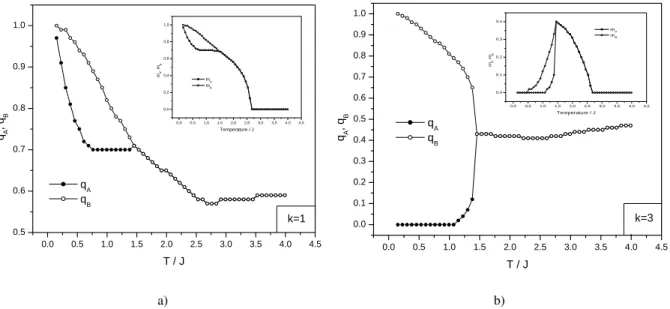
To complete this study, we investigate the thermal depen-dence of the magnetisationsmA,mBand quadrupolar moments
qA, qB for a BEG thin film formed with N =5 layers, for
d/J=−1.5 and∆/J=−3.0. Indeed, we found that concern-ing the first layer, see Fig. 4a, the three phasesI,SQandD shown in Fig. 3a when∆/J=−3.0, are well illustrated in this figure, when increasing temperatures. The phaseIfound at very low temperature is followed by the phaseFand the phase Dis reached at high temperatures. Regarding a deeper layer,
(a)
-25 -20 -15 -10 -5 0 5 10
0.5 1.0 1.5 2.0 2.5 3.0
G SQ
I F
D D
T / J
∆ / J
N = 5 d = -1.5 k = 1
(b)
-20 -10 0 10
0.5 1.0 1.5 2.0 2.5 3.0
D
G SQ
NM I F D
T / J
∆ / J
N = 5 d = -1.5 k = 3
FIG. 3: Phase diagrams of a BEG thin film withN=5 layers for d/J=−1.5 in(T/J,∆/J)plane: (a) The properties of the bilayer film still exist for the first layerk=1 of this thin film, but its phase diagram shows that not only the ferrimagnetic phaseIis reached at higher temperaturesT/J≈1.5 but also that the phaseG emerges rapidly even for small and positive values of the crystal field∆/J. (b) For a deeper layers,k=3 for example, the phases: IandNM
persist and some regions of the phaseIare detached from each other leaving the place to the phaseNM. The phaseGis found for positive and increasing values of the crystal field∆/Jand low temperature values.
0.0 0.5 1.0 1.5 2.0 2.5 3.0 3.5 4.0 4.5 0.5
0.6 0.7 0.8 0.9 1.0
k=1
0,0 0,5 1,0 1,5 2,0 2,5 3,0 3,5 4,0 4,5 0,0
0,2 0,4 0,6 0,8 1,0
mA
mB
mA
, m
B
Temperature / J
qA q
B
qA
, q
B
T / J
0.0 0.5 1.0 1.5 2.0 2.5 3.0 3.5 4.0 4.5
0.0 0.1 0.2 0.3 0.4 0.5 0.6 0.7 0.8 0.9 1.0
k=3
0,0 0,5 1,0 1,5 2,0 2,5 3,0 3,5 4,0 4,5 0,0
0,1 0,2 0,3 0,4
mA
mB
mA
, m
B
Temperature / J
qA qB qA
, q
B
T / J
a) b)
FIG. 4: Thermal dependence of the magnetisationsmA,mBand quadrupolar momentsqA,qBfor a BEG thin film withN=5 layers,d/J=−1.5
and∆/J=−3.0. (a) For the first layerk=1, the three phases:I,SQandDshown in Fig. 3a, are well illustrated in this figure, for increasing temperatures. The phaseIfound at very low temperature is followed by the phaseFand the phaseDis reached at high temperatures. (b) For a deeper layerk=3, the phaseNMappears at a very low temperature followed by the phaseI, then the phases: FandDare reached, respectively.
IV. CONCLUSION
In this work we have studied the phase evolutions in the BEG spin-1 film with biquadratic exchange interactions and single-ion crystal field, using the mean field theory. We showed that in addition to the four usual phases: disorderedD, ferromagneticF, staggered quadrupolarSQand ferrimagnetic I, some new phases are present in the case of a thin magnetic film, namely: the sublattice A (or B) non magnetic phaseNM
and the global non magnetic phase G. All these phases are studied for a monolayer, bilayer and thin film, for each layer of the film in the temperature-crystal field plane. Moreover, the thermal behaviour of each layer quadrupolar momentsqA,qB
and magnetisationsmA,mBare investigated for fixed values of
the biquadratic coupling and crystal field. It is also shown that for fixed values of the biquadratic couplingd/J, temperature T/Jand the crystal field∆/J, the different layers of the film exhibit different phases.
[1] M. Blume, V. J. Emery, and R. B. Griffiths, Phys. Rev. A4, 1071 (1971).
[2] D. Mukamel and M. Blume, Phys. Rev. A10, 619 (1974). [3] D. Furman, S. Dattagupta, and R. B. Griffiths, Phys. Rev. B15,
441 (1977).
[4] A. N. Berker and M. Wortis, Phys. Rev. B14, 4946 (1976). [5] M. Tanaka and T. Kawabe, J. Phys. Soc. Jpn.54, 2194, (1985). [6] W. Hoston and A. N. Berker, Phys. Rev. Lett.67, 1027 (1991). [7] W. Hoston and A. N. Berker, J. Appl. Phys.70, 6101 (1991). [8] K. Kasono and I. Ono, Z. Phys. B88, 205 (1992).
[9] R. R. Netz, Europhys. Lett.17(4), 373 (1992).
[10] R.R. Netz and A. N. Berker, Phys. Rev B47, 15019 (1993). [11] A. Rosengren and S. Lapinskas, Phys. Rev. Lett71, 165 (1993). [12] S. Lapinskas and A. Rosengren, Phys. Rev. B49, 15190 (1994).
[13] A. Z. Akheyan and N. S. Ananikian, J. Phys. A25, 3111 (1992). [14] W. Hoston and A. Nihat Berker, Pyhs. Rev. Lett. 67, 1027
(1992).
[15] J. W. Tucker, T. Balcerzak, M. Gzik, and A. Sukienniki, J. Magn. Magn. Mater. A187, 381 (1998).
[16] M. Keskin and A. Erdin , J. Magn. Magn. Mater.283, 392 (2004).
[17] A. Erdin, O. Canko, and M. Keskin, J. Magn. Magn. Mater.in press(2005).
[18] E. Albayrak and M. Keskin, J. Magn. Magn. Mater.203, 201 (2000).