Urinary EN-2 to predict prostate cancer: Systematic review
and meta-analysis
MARIA INÊSDA ROSA1,2,3*, EDUARDO RONCONI DONDOSSOLA1, MARIA CECILIA MANENTI ALEXANDRE1, KRISTIAN MADEIRA1,
FLORENTINODE ARAÚJO CARDOSO4, ANTONIO JOSÉ GRANDE1,2
1Epidemiology Laboratory, Universidade do Extremo Sul Catarinense (Unesc), Criciúma, SC, Brazil 2Graduate Studies Program in Collective Health, Unesc, Criciúma, SC, Brazil
3Graduate Studies Program in Health Sciences, Unesc, Criciúma, SC, Brazil 4President of the Brazilian Medical Association
S
UMMARYStudy conducted at Laboratory of Epidemiology, Universidade do Extremo Sul Catarinense (Unesc), Criciúma, SC, Brazil
Article received: 12/9/2016
Accepted for publication: 12/19/2016
*Correspondence:
Address: Rua Cruz e Souza, 510 Criciúma, SC – Brazil Postal code: 88811-550 [email protected]
http://dx.doi.org/10.1590/1806-9282.63.07.656
Introduction: Prostate cancer is the second type of cancer diagnosed and the ifth cause of death in men worldwide. Early diagnosis helps to control disease progression. Currently, prostate speciic antigen is the standard biomarker, as it has a broad scope of identiication and, thus, new and more speciic biomarkers must be studied.
Objective: To evaluate the accuracy of engrailed-2 protein (EN2) in urine as a prostate cancer biomarker.
Method: A comprehensive search was conducted in the period from January 2005 to July 2016 using the following electronic databases: Medline (PubMed), Embase, Cochrane Library and Lilacs. The keywords used in the databases were: “engrailed-2,” “EN2,” “prostatic neoplasms.” The search was limited to humans and there was no language restriction. Critical appraisal of the included studies was performed according to Quadas-2. Statistical analysis was performed using Meta-DiSc® and RevMan 5.3 softwares.
Results: A total of 248 studies were identiied. After title and abstract screening, 231 studies were removed. A total of 17 studies were read in full and two studies were included in the meta-analysis. The pooled sensitivity was 66% (95CI 0.56-0.75) and speciicity was 89% (95CI 0.86-0.92). The DOR was 15.08 (95CI 8.43-26.97).
Conclusion: The EN2 test showed high speciicity (89%) and low sensitivity (66%).
Keywords: prostatic neoplasms, biomarker, EN2, systematic review, meta-analysis.
I
NTRODUCTIONProstate cancer (PCa) is the ifth most frequent type of cancer in the world and the second most diagnosed non-cutaneous cancer in men in the United States according
to the International Agency for Cancer Research.1
The disease has good prognosis when diagnosed at an early stage, since it is responsive to various treatments. Patients diagnosed with PCa at stage I, II, or III have a high 5-year survival rate; however, patients with stage IV cancer have a low 5-year survival rate of < 27%,
highlight-ing the importance of early detection.2
Early stage PCa is often asymptomatic and the gold standard test is prostate biopsy, which is usually indi-cated in case of one or more of the following factors: fam-ily history, abnormal lumps within the prostate by
phys-ical digital rectal examination, or an elevated serum
prostate-speciic antigen (PSA).3
PSA started to be used 30 years ago, and it is the most common biomarker to diagnose and manage PCa. Despite being used globally, it is important to mention that the blood levels of PSA are often high in men with prostatic
benign conditions as well.4
A recent systematic review of randomized controlled trials of PSA screening for PCa concluded that screening did not signiicantly decrease PCa-speciic or overall mor-tality, and showed that PSA can result in a high number of false-positives, leading to overdiagnosis and
overtreat-ment.5 Low speciicity of PSA and unnecessary biopsies
Recently, engrailed-2 (EN2), a protein found in the urine of patients with PCa, proved to be a potential
bio-marker for the diagnosis of PCa compared to ELISA.7
The identiication of cancer biomarkers that can be measured in a noninvasive way should improve the spec-iicity of PSA in the detection of PCa. Thus, we performed a systematic review and meta-analysis to verify the ac-curacy of EN2 as a potential biomarker of PCa.
M
ETHODData sources and searches
The study protocol was registered at PROSPERO 35417 and included a systematic review according to protocol and
PRISMA-statement guidelines.8
We searched the Medline (PubMed), Embase, Co-chrane Central Register of Controlled Trials, Ibecs, Bio-sis, Web of Science, Scopus, Conference Abstracts and Grey Literature (Google Scholar; British Library) data-bases from January 2005 to July 2016. We used the fol-lowing terms, both as text words, Medical Subjects Head-ing (MeSH) or equivalent subject headHead-ing/thesaurus terms: “Prostate cancer” and “prostatic neoplasms.” These terms were combined with “engrailed-2.” The search had no language restrictions. The reference list of all available primary studies was reviewed to identify additional rel-evant studies. A copy of the complete search strategy is available on request.
For this review, we used the deinitions: Index test – The diagnostic test consisted of the urine EN2 analysis
and Reference standard – The diagnostic reference was
the result of the histological analysis of standard parafin--embedded sections.
The inclusion criteria for this systematic review were: studies measuring EN2 levels in at least two histological diagnoses comparing with PCa, benign or normal pros-tate tissue.
Study selection
The abstracts/titles identified from the search were screened by two reviewers (E.R.D. and M.C.M.A.). Dis-agreements about the inclusion or exclusion of studies were resolved by consensus, and, if consensus was not possible, disagreements were resolved by a third reviewer (M.I.R). The inal inclusion or exclusion of a study was made with a standard checklist. We included case-control and cohort studies, both prospective and retrospective.
Data extraction and quality assessment
We extracted data in duplicate (E.R.D. and M.C.M.A) with a standard form. We extracted information about study
design, participants’ description, index test description, reference test description, and total number of participants. A 2x2 table was created for each study comparing EN2 levels and the histologic diagnosis.
The eligibility criteria of all articles were assessed us-ing Quality Assessment of Diagnostic Accuracy Studies (Quadas-2). This tool comprises four domains: patient selection, index test, reference standard, and low and timing. Each domain is assessed in terms of the risk of bias, and the irst three domains are also assessed in terms of concerns regarding applicability. Signaling questions
are included to help judge the risk of bias.9 The quality
assessment of the studies was independently performed by two authors (E.R.D. and M.C.M.A). Any disagreement was resolved by consensus.
Data synthesis and statistical analysis
For each study, 2x2 contingency tables were constructed
so that all cases were classiied as PCa or benign lesions.
We calculated the true-positive rate (TPR; sensitivity), speciicity, and false-positive rate (FPR; 1 – speciicity). Bivariate analysis was used to calculate the pooled esti-mates of sensitivity, and speciicity with 95% conidence
intervals (95CI) for the summary estimates.10 The
diag-nostic odds ratio (DOR) can relate to different combina-tions of sensitivity and speciicity. The DOR describes the odds of positive test results in participants with disease compared with the odds of positive test results in those without disease.
Statistical analysis was performed using Meta-DiSc® (Clinical Biostatistics Unit, Ramón y Cajal Hospital, Madrid,
Spain) (version 1.4) and RevMan 5.3 software.11,12
R
ESULTSThe searches identiied a total of 248 studies, of which 17 were potentially relevant after initial assessment. Of these, 15 full-text studies were excluded. Two primary
studies(Morgan et al. and Killick et al.)7,13 involving 597
participants met the criteria for inclusion and were analyzed (Figure 1).
The main characteristics of the included studies are shown in Table 1. Both were conducted in the UK and used ELISA assay for diagnosis.
Methodological quality of included studies
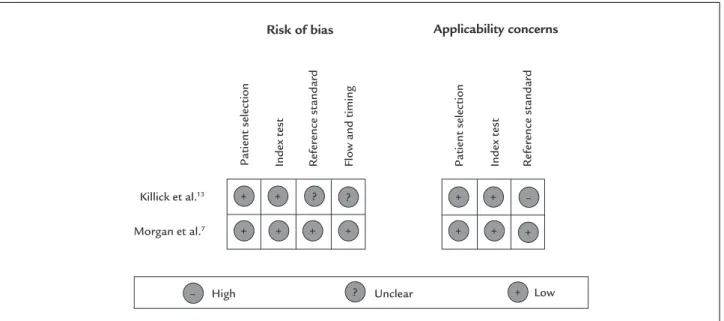
Killick et al.13 showed unclear risk of bias to the reference standard (prostate biopsy), since it is unclear whether all participants underwent prostate biopsy, low and time (patient low and time between the completion of the EN2 test and biopsy). These criteria resulted in a high risk of bias for the reference standard, with respect to applicability criteria.
EN2 test vs. biopsy
The two studies had a combined sensitivity (Figure 3A) of 66% (95CI 56-75) and a combined speciicity (Figure
3B) of 89% (95CI 86-92). The DOR (Figure 3C) was 15.082 (95CI 8.432-26.977).
Begg’s funnel plot and Egger’s test were not performed to assess the publication bias of the literature in all com-parison models since only two studies were included.
D
ISCUSSIONPCa is becoming a public health concern worldwide and PSA test is not being recommended by its own creator, Profes-sor Richard J. Ablin, who always say “PSA testing cannot detect prostate cancer.” This is the irst systematic review
TABLE 1 Characteristics of primary diagnostic studies on prostate cancer measuring urinary levels of EN2.
Author/ Year
Mean age Age control
Design and settings
N Control
N PCa Sensibility (%)
Speciicity (%)
TP FP FN TN EN2 cut-off
(µg/L)
Morgan et al.7
67 (44-83) 63 (42-86) Case-control 102 82 66 88.2 54 12 28 90 42.5
Killick et al.13 53 (40-69) 54.3
(40-69)
Cross-sectional 392 21 66.7 89.3 14 42 7 350 42.5
PCa: prostate cancer; TP: true positive; FP: false positive; FN: false negative; TN: true negative.
FIGURE 1 Flow diagram of the study selection process.
Identiied through records database (n=248)
Full text articles evaluated for eligibility (n=17)
Studies that did not meet the inclusion criteria based on title/abstract (n=231)
Full papers excluded, with reasons (n=15)
Studies included in the quantitative synthesis (meta-analysis) (n=2)
Identiication
Eligibility
FIGURE 2 Results of the evaluation of each study according to Quadas-2. Patient selection Inde
x t
est
Ref
er
ence st
andard
Flow and timing Patient selection Inde
x t
est
Ref
er
ence st
andard
Risk of bias
Killick et al.13
Morgan et al.7
Applicability concerns
–
? ?
+ +
+
+ + +
+ +
+
+ +
High Unclear Low
– ? +
FIGURE 3 Florest plot showing of sensitivity (A), speciicity (B) and odds ratio diagnostic (C).
Sensitivity (95CI) 0.66 (0.55-0.76) 0.67 (0.43-0.85)
Pooled sensitivity = 0.66 (0.56 to 0.75) Chi-square = 0.00; df = 1 (p=0.9440) Inconsistency (I-square) = 0.0% Morgan et al.7
Killick et al.13
Sensitivity
A
0 0.2 0.4 0.6 0.8 1
Speciicity (95CI) 0.88 (0.80-0.94) 0.89 (0.86-0.92)
Pooled speciicity = 0.89 (0.86 to 0.92) Chi-square = 0.09; df = 1 (p=0.7638) Inconsistency (I-square) = 0.0% Morgan et al.7
Killick et al.13
Speciicity
B
0 0.2 0.4 0.6 0.8 1
Diagnostic OR (95CI) 14.46 (6.79-30.80) 16.67 (6.37-43.62)
Fixed effects model
Pooled diagnostic odds ratio = 15.08 (8.43 to 26.98) Cochran-Q = 0.05; df = 1 (p=0.8176)
Inconsistency (I-square) = 0.0%
Morgan et al.7
Killick et al.13
Diagnostic odds ratio
C
1
and meta-analysis to speciically investigate and compare EN2 as a possible biomarker for PCa.
According to Pandha et al.,14 EN2 test can lead to
faster diagnosis, saving thousands of lives, and has the potential to reduce the cost of disease. However, it has the disadvantage of not providing disease progression or predicting tumor recurrence.
To date, the PSA is the most widely used tumor bio-marker to detect, track and monitor PCa. In the literature, there are still differences regarding the use of PSA in-dicative of biopsy to conirm cancer. There is a lack of consensus among the authors on the ideal point. This contributes substantially to the great heterogeneity
be-tween the studies.15
Interestingly, there are few published studies assessing EN2 protein in PCa because it is a relatively new subject. It is thus necessary to conduct further studies so that we can understand the actual link between the EN2 protein and PCa, as well as in other types of neoplasias, such as breast cancer. Certainly, the development of new studies on this subject is essential to come up with a fast, accurate and primary diagnosis in cancer evaluation.
Considering the high speciicity of EN2 and the high sensitivity of PSA, we hypothesize that using both tests together would increase the likelihood of PCa diagnosis. Thus, we suggest future studies to investigate if this oc-curs in the practice.
We used the GRADE approach to assess the quality of the evidence produced in this study, classifying it as low, which means that “further research is very likely to have an important impact on our conidence in the estimate of effect and is likely to change the estimate or any estimate of effect is very uncertain.” The evidence was downgraded due to risk of bias (limitations in the study design and execution) and indirectness (differences in patients, time and low of tests) across the included studies.
A limitation of this study is that some of the includ-ed control patients did not undergo prostate biopsy. The study protocol includes annual PSA screening for 5 years, at which point recruits are offered an optional prostate biopsy; approximately half of the 392 individuals with PSA 3.0 ng/mL will undergo prostate biopsy. However, we decided to include this study because all PCa patients included were diagnosed by biopsy and did not present heterogeneity between the studies.
C
ONCLUSIONThe low sensitivity and high speciicity must be analyzed carefully, since there are few studies analyzing EN2 and
the quality of evidence is low. It is too early to recommend EN2 for detection and/or screening of PCa.
C
ONFLICT OF INTERESTThe authors declare no conlict of interest.
R
ESUMOProteína EN2 urinária no diagnóstico do câncer de prósta-ta: revisão sistemática e metanálise
Introdução: O câncer de próstata é o segundo tipo de câncer diagnosticado e a quinta causa de morte em ho-mens em todo o mundo. O diagnóstico precoce é funda-mental para o prognóstico da doença. Atualmente, o antígeno especíico da próstata (PSA) é o biomarcador mais utilizado; porém, biomarcadores mais especíicos devem ser estudados.
Objetivo: Avaliar a acurácia da proteína engrenada-2 (EN2) na urina como biomarcador de câncer de próstata.
Método: Foi realizada uma busca abrangente no período de janeiro de 2005 a julho de 2016, utilizando as seguintes bases de dados eletrônicas: Medline (PubMed), Embase, Cochrane Library e Lilacs. As palavras-chave utilizadas foram: “engrailed-2”, “EN2”, “prostatic neoplasms”. A bus-ca foi limitada a humanos e não houve restrição de idioma. A avaliação da qualidade dos estudos incluídos foi
realiza-da de acordo com Quarealiza-das-2. A análise estatística foi reali-zada usando o software Meta-DiSc® e RevMan 5.3.
Resultados: Foram identiicados 248 estudos. Após a triagem dos títulos e resumos, foram excluídos 231. Um total de 17 foram lidos na íntegra e dois, incluídos na metanálise. A sensibilidade combinada foi de 66% (IC95% 0,56-0,75). A especiicidade foi de 89% (IC95% 0,86-0,92). O DOR foi de 15,08 (IC95% 8,43-26,97).
Conclusão: O teste EN2 mostrou alta especiicidade (89%) e baixa sensibilidade (66%).
Palavras-chave: câncer de próstata, biomarcador, EN2, revisão sistemática, metanálise.
R
EFERENCES1. Siegel RL, Miller KD, Jemal A. Cancer statistics, 2015. CA Cancer J Clin. 2015; 65(1):5-29.
2. Humphrey PA. Gleason grading and prognostic factors in carcinoma of the prostate. Mod Pathol. 2004; 17(3):292-306.
3. Sarkar S, Das S. A review of imaging methods for prostate cancer detection. Biomed Eng Comput Biol. 2016; 7(Suppl 1):1-15.
5. Ilic D, Neuberger MM, Djulbegovic M, Dahm P. Screening for prostate cancer. Cochrane Database Syst Rev. 2013; (1):CD004720.
6. Hugosson J, Carlsson S, Aus G, Bergdahl S, Khatami A, Lodding P, et al. Mortality results from the Göteborg randomised population-based prostate-cancer screening trial. Lancet Oncol. 2010; 11(8):725-32.
7. Morgan R, Boxall A, Bhatt A, Bailey M, Hindley R, Langley S, et al. Engrailed-2 (EN2): a tumor speciic urinary biomarker for the early diagnosis of prostate cancer. Clin Cancer Res. 2011; 17(5):1090-8.
8. Liberati A, Altman DG, Tetzlaff J, Mulrow C, Gøtzsche PC, Ioannidis JP, et al. The PRISMA statement for reporting systematic reviews and meta-analysis of studies that evaluate healthcare interventions: explanation and elaboration. BMJ. 2009; 339:b2700.
9. Whiting PF, Rutjes AW, Westwood ME, Mallett S, Deeks JJ, Reitsma JB, et al.; Quadas-2 Group. Quadas-2: a revised tool for the quality assess-ment of diagnostic accuracy studies. Ann Intern Med. 2011; 155(8):529-36.
10. Altman DG. Some common problems in medical research. In: Altman DG, editor. Practical statistics for medical research. 9. ed. London: Chapman; 1999. p. 396-439.
11. Review Manager (RevMan) [Computer program]. Version 5.3. Copenhagen: The Nordic Cochrane Centre, The Cochrane Collaboration.
12. Zamora J, Abraira V, Muriel A, Khan KS, Coomarasamy A. Meta-DiSc: a software for meta-analysis of test accuracy data. BMC Med Res Methodol. 2006; 6:31. 13. Killick E, Morgan R, Launchbury F, Bancroft E, Page E, Castro E, et al. Role
of Engrailed-2 (EN2) as a prostate cancer detection biomarker in genetically high risk men. Sci Rep. 2013; 3:2059.
14. Pandha H, Sorensen KD, Orntoft TF, Langley S, Hoyer S, Borre M, et al. Uri-nary engrailed-2 (EN2) levels predict tumour volume in men undergoing rad-ical prostatectomy for prostate cancer. BJU Int. 2012; 110(6 Pt B ):287-92. 15. Santos CL, Lamounier TAC. Aspectos clínicos e laboratoriais do câncer de