SUMMARY
Objective: To evaluate serum concentrations of CA-125 and soluble CD-23 and to correlate them with clinical symptoms, localization and stage of pelvic endometriosis and histological classiication of the disease. Methods: Blood samples were collected from 44 women with endometriosis and 58 without endometriosis, during the irst three days (1st sample) and dur-ing the 7th, 8th and 9th day (2nd sample) of the menstrual cycle. Measurements of CA-125 and soluble CD-23 were performed by ELISA. Mann-Whitney U test was used for age, pain evaluations (visual analog scale) and biomarkers concentrations. Results: Serum levels of CA-125 were higher in endometriosis patients when compared to the control group during both periods of the menstrual cycle evaluated in the study. his marker was also elevated in women with chronic pelvic pain, deep dyspareunia (2nd sample), dysmenorrhea (both samples) and painful defecation during the menstrual low (2nd sample). CA-125 concentration was higher in advanced stages of the disease in both samples and also in women with ovarian endo-metrioma. Concerning CD-23, no statistically signiicant diferences were observed between groups. Conclusion: he concentrations of CA-125 were higher in patients with endometrio-sis than in patients without the disease. No signiicantly diferences were observed for soluble CD-23 levels between groups.
Keywords: Endometriosis; biological markers; symptoms; CA-125 antigen.
©2012 Elsevier Editora Ltda. All rights reserved.
RESUMO
Avaliação do CA-125 e CD-23 solúvel em pacientes com endometriose pélvica: estudo de caso-controle
Objetivo: Avaliar as concentrações séricas de CA-125 e CD-23 solúvel e correlacioná-los com sintomas clínicos, localização e estádio da endometriose pélvica e classiicação histológica da doença. Métodos: Amostras de sangue foram coletadas de 44 mulheres com endometriose e 58 sem endometriose durante os primeiros três dias (1ª amostra) e durante o sétimo, o oitavo e o nono dia (2ª amostra) do ciclo menstrual. As dosagens de CA-125 e CD-23 solúvel foram realizadas por ELISA. O teste U de Mann-Whitney foi usado para idade, avaliação de dor (escala analógica visual) e para a concentração dos biomarcadores. Resultados: Os níveis sé-ricos de CA-125 foram mais altos nas pacientes com endometriose do que no grupo-controle quando avaliados em ambos os períodos do ciclo menstrual, assim como apresentaram-se elevados nessas mulheres quando referiam dor pélvica crônica, dispareunia de profundidade (coleta na 2ª amostra), dismenorreia (ambas as amostras) e dor ao evacuar durante o luxo menstrual (coleta na 2ª amostra). A concentração de CA-125 foi mais alta no estádio avan-çado em ambas as amostras, assim como em mulheres com endometriomas ovarianos. Em relação ao CD-23 solúvel, nenhuma diferença estatisticamente signiicativa foi observada en-tre os grupos. Conclusão: As concentrações de CA-125 foram mais altas em pacientes com endometriose do que em pacientes sem a doença. Nenhuma diferença estatisticamente signi-icativa foi observada para CD-23 solúvel entre os grupos.
Unitermos: Endometriose; marcadores biológicos; sintomas; antígeno Ca-125.
©2012 Elsevier Editora Ltda. Todos os direitos reservados.
Study conducted at Endometriosis Division, Obstetrics and Gynecology Department, Universidade de São Paulo (USP), São Paulo, SP, Brazil
Submitted on: 06/22/2011 Approved on: 11/01/2011
Correspondence to:
Sérgio Podgaec Departamento de Ginecologia e
Obstetrícia (HC-FMUSP) Av. Dr. Enéas de Carvalho, 255
(HC-FMUSP), 10° andar sala 10.166 CEP: 05403-000 São Paulo, SP, Brazil [email protected]
Conflict of interest: None.
Evaluation of CA-125 and soluble CD-23 in patients with pelvic
endometriosis: a case-control study
IVANA MARIADE LUNA RAMOS1, SÉRGIO PODGAEC2, MAURÍCIO SIMÕES ABRÃO2, RICARDODE OLIVEIRA3, EDMUND CHADA BARACAT2
1MD, Endometriosis Division, Obstetrics and Gynecology Department, Universidade de São Paulo (USP), São Paulo, SP, Brazil
2 MD, PhD, Endometriosis Division, Obstetrics and Gynecology Department, USP, São Paulo, SP, Brazil
INTRODUCTION
he most accurate procedure for diagnosis of endo-metriosis is laparoscopy, an invasive surgical method. he deinitive diagnosis is based on the visualization of the characteristic lesions and on histological conirmation. he identiication of less invasive and more accessible markers of the disease is suitable. Several studies have reported that CA-125, a glycoprotein of epithelial origin found in normal cells, has high serum concentrations in patients with endometriosis, mainly when evaluated dur-ing the menstrual low1-3.
Another biomarker of interest to this study was sol-uble CD-23, a protein that is expressed on the surface of cell membrane, commonly identiied as the low ainity IgE receptor on B cells, eosinophils, monocytes, dendritic cells, epithelial Langerhans cells and platelets4.
Based on the evidence of increased concentrations of soluble CD-23 in peritoneal luid of women with endo-metriosis, it was suggested that the disease would acti-vate B cells, which would promote the release of higher
concentrations of soluble CD-235,6. his hypothesis was
strengthened by the identiication that women treated with danazol had a greater reduction in the concentration of CD-23 when compared to patients treated with leupro-lide acetate. If danazol could suppress humoral and cell-mediated immune responses and could alter macrophage function, by a signiicant increase of soluble leukocyte an-tigen class I and class II (HLA-I and HLA-II), due to the release of these antigens from intracellular stores, it could also promote the reduction of inlammatory process in endometriosis. It would activate anti-inlammatory cyto-kines, similar to what occurs in normal pregnancy, creat-ing an inhospitable environment for the establishment of ectopic endometrium. Based on these arguments, it was suggested that changes in the levels of HLA by danazol may relect the immune competence and the function
of macrophages in endometriosis7,8. hus, the
hypoth-esis stated by Odukoya et al.9 has reinforced that soluble
CD-23 may be involved in the development and mainte-nance of endometriosis and may serve as a possible bio-logical marker.
he presence of soluble CD-23 in patients with endo-metriosis could occur because the endometrial cells that, by relux, reach the peritoneal cavity are presented by macrophages and other antigen presenting cells to CD4+ T cells that become activated by cytokines, as 4 and IL-10. Recently, our group reported that these cytokines are increased in patients with endometriosis and promote the
release of CD-23 by B cells and monocytes10. hus, CD-23
concentration could also be elevated as a consequence of increased concentration of cytokines.
he aim of this study was to determine serum concen-trations of CA-125 and soluble CD-23 in patients with and without endometriosis, in two phases of the menstrual
cycle: 1st, 2nd or 3th day and 8th, 9th or 10th day. We also
compared the concentrations of CA-125 and CD-23 with clinical symptoms, stage and site of the lesions and histo-logical classiication of the disease.
METHODS PATIENTS
his study was approved by the Ethics in Research Com-mittee of Hospital das Clínicas da Faculdade de Medicina da Universidade de São Paulo. From June 2007 to Oc-tober 2010, the following inclusion criteria were applied to 1,920 consecutive patients complaining of infertility, pelvic pain or desire for family planning by tubal ligation: age between 18 and 45 years, absence of hormone therapy within three months prior to consultation, absence of au-toimmune diseases conirmed by history and laboratory tests, when necessary; evidence of ovarian function and laparoscopy examination for the investigation of infertil-ity or pelvic pain refractory to clinical therapy, based on complaints and on gynecological examination or imag-ing indimag-ings, consistent with endometriosis.
One hundred and four patients met inclusion criteria and were invited to participate in the study, ater having been informed about the research objectives. Patients underwent medical history, to investigate the presence of six symptoms most commonly associated with endo-metriosis: dysmenorrheal, chronic pelvic pain, deep dys-pareunia, infertility, bowel and urinary cyclic symptoms. he intensity of chronic pelvic pain and dyspareunia was evaluated using a visual analogue scale of 10 points. Pel-vic examination was the next step, searching for retro-uterine nodules, thickening of the uterosacral ligament or pelvic masses. Patients with endometriosis clinical suspicion was submitted to pelvic and transvaginal ultra-sound and, when necessary, to pelvic MRI. Laparoscopy was indicated in the presence of pain even ater clinical treatment or if the image exams showed ovarian endome-trioma and/or deep iniltrative lesions afecting retrocer-vical region, vagina, bowel, bladder or ureter.
Up to three months before laparoscopy, ater eight hours fasting, all patients had a venipuncture to col-lect 5 mL of blood sample that was stored in a dry tube. he irst sampling occurred between the 1st, 2nd or 3th day
of the menstrual cycle and the second at the 8th, 9th or
10th day. he samples were sent to a freezer, maintained at
–20°C, at the laboratory and the analysis was performed
ater the collection of all samples.
control group, of 58 patients. In the case group, the dis-ease was classiied according to American Society for
Re-productive Medicine11 stages and location of the disease.
In the histological analysis of excised tissues, we followed the classiication pattern proposed by Abrão et al.12.
LABORATORYANALYSIS
he determination of serum CA-125 levels was per-formed using a sandwich technique of a commercial
ELI-SA kit (Elecsys
®
, Roche — NY, USA) and the dosage ofserum soluble CD-23 was also performed with a ELISA
kit (Bender MedSystems, Vienna, Austria) according to
manufacturers instructions. he analyte range of CA-125 and soluble CD-23 is 25-35 IU/mL and 10-91 U/mL, re-spectively.
STATISTICALANALYSIS
Statistical analysis was performed to compare Ca-125 and CD-23 concentrations with case and control groups regarding the presence and intensity of clinical com-plaints related to endometriosis, site of disease, staging according to the ASRM and histopathological analysis. We compared means using a Mann-Whitney U test, with 5% signiicance level.
RESULTS
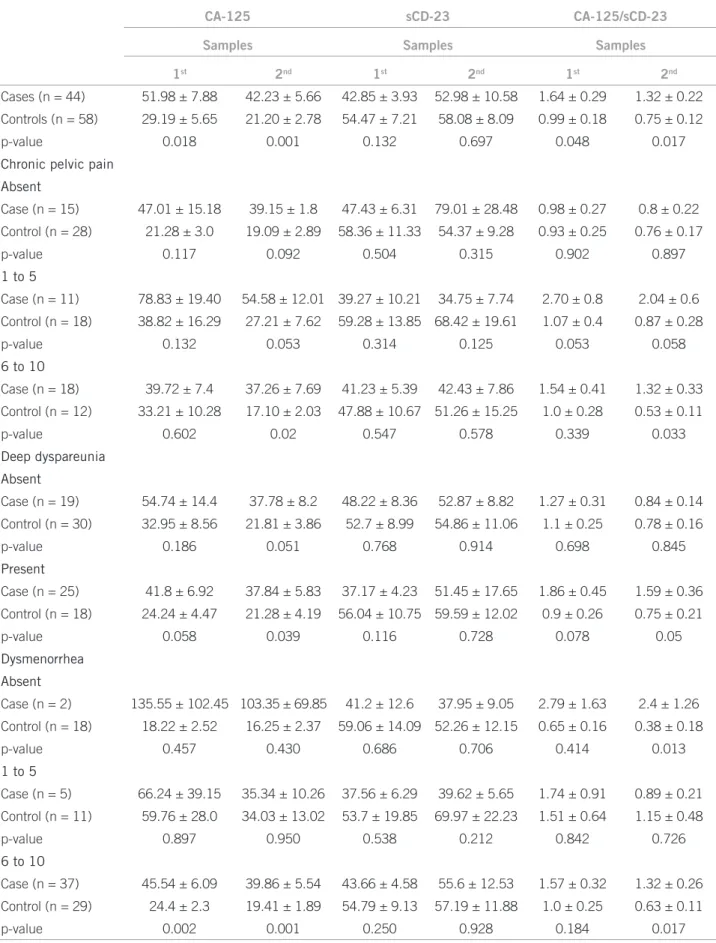
We found that CA-125 average concentrations were sig-niicantly higher in cases when compared to controls, both at irst and second periods of collection, and soluble CD-23 average concentrations of cases were lower when compared to the control group, but it did not reach sta-tistical signiicance (Table 1). It was identiied that the average concentration of CA-125 in the second collection allowed diferentiating cases from controls with chronic pelvic pain (VAS > 6), as well as the presence of deep dyspareunia. he diferentiation of patients with intense chronic pelvic pain was also possible by CA-125/soluble CD-23 ratios, in the second collection (Table 1).
As for dysmenorrhea, we found that CA-125 average concentrations, in both collections, diferentiated cases and controls when the complaint of infertility was ab-sent and when the intensity of dysmenorrhea was high (VAS > 6). his diferentiation was also possible by bio-markers ratio, in the second collection (Table 1). Re-garding the presence of intestinal symptoms, cases and controls were diferentiated by mean concentrations of CA-125, soluble CD-23 and CA-125/soluble CD-23 ra-tios, also in the second collection (Table 2).
Concerning the lesions sites, it was observed that patients with endometriosis in all sites had higher CA-125 mean concentrations when compared to the con-trol group, in both blood collections. he same was not observed in terms of average concentrations of soluble CD-23 (Table 3).
In advanced endometriosis (stage III or IV), the mean concentrations of CA-125, in both collections, were higher than in initial endometriosis (stage I or II) and in absence of endometriosis (Table 3).
DISCUSSION
In the present study, serum levels of CA-125 were higher in endometriosis patients when compared to the control group during both periods of the menstrual cycle evalu-ated in the study. CA-125 concentration was higher in ad-vanced stages of the disease in both samples and also in women with ovarian endometrioma. Concerning CD-23, no statistically signiicant diferences were observed be-tween groups.
CA-125 has been extensively studied and is considered a useful tool for clinical diagnosis of endometriosis2-4,13,14-16.
High CD-23 concentrations have been observed in peri-toneal luid of women with endometriosis, suggesting the activation of B cells and a possible imbalance of humoral immune system in endometriosis6-8,17.
he decision to evaluate these markers in two stages of the menstrual cycle was taken from studies that showed luctuations in their concentrations, especially CA-125 during the menstrual cycle. Kafali et al.2 identiied in wom-
en without endometriosis an increase of CA-125 concen-tration of 22% during menstruation, compared to other
days of the cycle. Abrão et al.3 demonstrated that during
the irst three days of the menstrual cycle, CA-125 con-centrations were greater than the eighth and tenth day of the cycle.
Our study is the irst one that evaluates both mark-ers (CA-125 and CD-23) in patients with endometriosis. Although there is no direct relationship between markers CA-125 and CD-23, both participate in the pathophysiol-ogy of endometriosis (proliferation and epithelial cellular inlammatory response/immune, respectively), justifying the assessment of these two markers in the same cohort of patients with and without endometriosis. Moreover, as panel markers evaluation has been previously published and still no satisfactory results were found, we thought that the association of these two markers could improve the auxiliary value of laboratory tests in predicting endo-metriosis using a non-invasive diagnosis method.
In the present study, the average concentrations of CA-125, higher in the case group than in the control group, reinforced the assertion that this marker may be useful as an auxiliary diagnosis and management of endometrio-sis. Analyzing our results, we found that the average con-centrations of CA-125 in the irst collection (on the irst, second or third day of the menstrual cycle) were always higher than in the second (eighth, ninth or tenth day of the cycle), both in cases and controls. Abrão et al.3,18
Table 1 – CA-125, sCD-23 and CA-125/sCD-23 levels in cases and control samples according to chronic pelvic pain, deep dyspareunia and dysmenorrhea
CA-125 sCD-23 CA-125/sCD-23
Samples Samples Samples
1st 2nd 1st 2nd 1st 2nd
Cases (n = 44) 51.98 ± 7.88 42.23 ± 5.66 42.85 ± 3.93 52.98 ± 10.58 1.64 ± 0.29 1.32 ± 0.22
Controls (n = 58) 29.19 ± 5.65 21.20 ± 2.78 54.47 ± 7.21 58.08 ± 8.09 0.99 ± 0.18 0.75 ± 0.12
p-value 0.018 0.001 0.132 0.697 0.048 0.017
Chronic pelvic pain
Absent
Case (n = 15) 47.01 ± 15.18 39.15 ± 1.8 47.43 ± 6.31 79.01 ± 28.48 0.98 ± 0.27 0.8 ± 0.22
Control (n = 28) 21.28 ± 3.0 19.09 ± 2.89 58.36 ± 11.33 54.37 ± 9.28 0.93 ± 0.25 0.76 ± 0.17
p-value 0.117 0.092 0.504 0.315 0.902 0.897
1 to 5
Case (n = 11) 78.83 ± 19.40 54.58 ± 12.01 39.27 ± 10.21 34.75 ± 7.74 2.70 ± 0.8 2.04 ± 0.6
Control (n = 18) 38.82 ± 16.29 27.21 ± 7.62 59.28 ± 13.85 68.42 ± 19.61 1.07 ± 0.4 0.87 ± 0.28
p-value 0.132 0.053 0.314 0.125 0.053 0.058
6 to 10
Case (n = 18) 39.72 ± 7.4 37.26 ± 7.69 41.23 ± 5.39 42.43 ± 7.86 1.54 ± 0.41 1.32 ± 0.33
Control (n = 12) 33.21 ± 10.28 17.10 ± 2.03 47.88 ± 10.67 51.26 ± 15.25 1.0 ± 0.28 0.53 ± 0.11
p-value 0.602 0.02 0.547 0.578 0.339 0.033
Deep dyspareunia
Absent
Case (n = 19) 54.74 ± 14.4 37.78 ± 8.2 48.22 ± 8.36 52.87 ± 8.82 1.27 ± 0.31 0.84 ± 0.14
Control (n = 30) 32.95 ± 8.56 21.81 ± 3.86 52.7 ± 8.99 54.86 ± 11.06 1.1 ± 0.25 0.78 ± 0.16
p-value 0.186 0.051 0.768 0.914 0.698 0.845
Present
Case (n = 25) 41.8 ± 6.92 37.84 ± 5.83 37.17 ± 4.23 51.45 ± 17.65 1.86 ± 0.45 1.59 ± 0.36
Control (n = 18) 24.24 ± 4.47 21.28 ± 4.19 56.04 ± 10.75 59.59 ± 12.02 0.9 ± 0.26 0.75 ± 0.21
p-value 0.058 0.039 0.116 0.728 0.078 0.05
Dysmenorrhea
Absent
Case (n = 2) 135.55 ± 102.45 103.35 ± 69.85 41.2 ± 12.6 37.95 ± 9.05 2.79 ± 1.63 2.4 ± 1.26
Control (n = 18) 18.22 ± 2.52 16.25 ± 2.37 59.06 ± 14.09 52.26 ± 12.15 0.65 ± 0.16 0.38 ± 0.18
p-value 0.457 0.430 0.686 0.706 0.414 0.013
1 to 5
Case (n = 5) 66.24 ± 39.15 35.34 ± 10.26 37.56 ± 6.29 39.62 ± 5.65 1.74 ± 0.91 0.89 ± 0.21
Control (n = 11) 59.76 ± 28.0 34.03 ± 13.02 53.7 ± 19.85 69.97 ± 22.23 1.51 ± 0.64 1.15 ± 0.48
p-value 0.897 0.950 0.538 0.212 0.842 0.726
6 to 10
Case (n = 37) 45.54 ± 6.09 39.86 ± 5.54 43.66 ± 4.58 55.6 ± 12.53 1.57 ± 0.32 1.32 ± 0.26
Control (n = 29) 24.4 ± 2.3 19.41 ± 1.89 54.79 ± 9.13 57.19 ± 11.88 1.0 ± 0.25 0.63 ± 0.11
p-value 0.002 0.001 0.250 0.928 0.184 0.017
sCD-23, soluble CD-23; case, patients with endometriosis; control, patients without endometriosis; 1st, second or third day of the menstrual
cycle and on day 8, 9 or 10 of the cycle and compared to stage of the disease. he advanced stage of the disease was also associated with high levels of CA-125. It could also be noted that the average concentrations of CA-125 dif-ferentiate patients with stromal or well didif-ferentiated glan-dular pattern from those without the disease only in the second sampling. his detailed analysis between concen-trations of CA-125 and histological classiication (stromal and glandular pattern) of pelvic endometriosis was not yet reported in the literature, which hindered the discussion of our indings. Also, in terms of stages of endometriosis,
Mihalyi et al.19 reported diferences in the concentration
of CA-125 between cases and controls. It is noteworthy that these authors made this statement not only by using the CA-125 as complementary diagnostic biomarker, but they associated it with CA-19-9, IL-6, IL-8, high sensitivity C-reactive protein and tumor necrosis factor alpha, which seems to justify a greater sensitivity and speciicity.
he average concentration of CA-125 allowed us to diferentiate cases and controls in the second collec-tion, in the presence of chronic pelvic pain and dys-menorrheal, deep dyspareunia and intestinal symptoms as well as intense dysmenorrhea, in the irst collection.
hese indings agreed with Barbosa et al.14, who reported
Table 2 – CA-125, sCD-23 and CA-125/sCD-23 levels in cases and control samples according to infertility, urinary and
intestinal symptoms
CA-125 sCD-23 CA-125/sCD-23
Samples Samples Samples
1st 2nd 1st 2nd 1st 2nd
Infertility
Absent
Case (n = 18) 45.67 ± 8.07 44.04 ± 7.51 43.8 ± 5.4 42.05 ± 5.75 1.4 ± 0.3 1.42 ± 0.3
Control (n = 30) 21.89 ± 2.11 17.93 ± 1.83 53.94 ± 10.09 54.73 ± 12.92 0.76 ± 0.15 0.64 ± .12
p-value 0.01 0.003 0.464 0.444 0.035 0.028
Present
Case (n = 16) 46.1 ± 13.59 30.63 ± 7.64 40.38 ± 7.87 65.68 ± 27.41 1.55 ± 0.47 0.8 ± 0.17
Control (n = 17) 29.91 ± 8.15 21.1 ± 4.39 58.18 ± 12.97 66.94 ± 15.92 1.14 ± 0.39 0.74 ± 0.21
p-value 0.308 0.281 0.257 0.968 0.503 0.813
Never tried
Case (n = 10) 72.78 ± 23.03 57.53 ± 16.61 45.1 ± 7.65 52.34 ± 13.54 20.21 ± 0.89 1.99 ± 0.74
Control (n = 11) 47.97 ± 26.65 30.26 ± 12.14 60.75 ± 18.37 53.54 ± 12.1 1.4 ± 0.64 1.04 ± 0.44
p-value 0.494 0.195 0.457 0.948 0.463 0.275
Cyclical intestinal symptoms
Absent
Case (n = 26) 56.71 ± 11.6 43.55 ± 7.66 47.56 ± 4.63 64.69 ± 17.03 1.39 ± 0.27 1.0 ± 0.16
Control (n = 35) 31.32 ± 8.65 23.87 ± 4.38 52.72 ± 9.33 47.50 ± 7.4 1.06 ± 0.24 0.93 ± 0.18
p-value 0.078 0.031 0.657 0.315 0.365 0.790
Present
Case (n = 18) 45.16 ± 9.67 40.33 ± 8.57 36.04 ± 6.74 36.07 ± 6.88 2.0 ± 0.59 1.79 ± 0.48
Control (n = 23) 25.94 ± 5.65 17.14 ± 2.09 62.19 ± 11.52 74.19 ± 16.7 0.89 ± 0.29 0.46 ± 0.1
p-value 0.079 0.017 0.058 0.044 0.098 0.014
Cyclical urinary symptoms
Absent
Case (n = 44) 51.98 ± 7.88 42.23 ± 5.66 42.85 ± 3.93 52.98 ± 10.57 1.64 ± 0.29 1.32 ± 0.22
Control (n = 54) 30.19 ± 6.04 21.82 ± 2.97 54.12 ± 7.2 56.32 ± 8.34 1.02 ± 0.19 0.77 ± 0.13
p-value 0.031 0.002 0.173 0.802 0.065 0.034
sCD-23, soluble CD-23; case, patients with endometriosis; control, patients without endometriosis; 1st, second or third day of the menstrual
that the presence of endometriotic lesions in symptom-atic patients remained correlated with the expression of CA-125. Some authors suggest a correlation between lev-els of CA-125 and the proliferative activity of epithelial cells in the lesions of endometriosis, because the disease is an inlammatory process associated with a change in
immune cell functions20,21. For some patients, the
gyne-cologic examination may be normal as well as the symp-toms may be absent, especially for those with supericial
peritoneal disease22. By comparing patients without
en-dometriosis to those with enen-dometriosis according to location of the ectopic implants, we concluded that the concentrations of CA-125 difered from the cases with ovarian endometriosis, which may be due to increased blood supply in that location, which would determine higher expression of the marker by epitheliocytes23.
Concerning soluble CD-23, there are few studies in the literature which correlate this marker with
endo-metriosis5-7,9. he comparison of average concentrations
between cases and controls failed to distinguish the presence or absence of endometriosis. By analyzing the relationship between the symptoms of endometriosis and the concentrations of soluble CD-23, our results demon-strated that, in the second collection, there was a signii-cant diference between cases and controls with intestinal symptoms.
he most relevant indings of our study were the con-irmation of CA-125 as an auxiliary biological marker able to diferentiate cases and controls. High CA-125 levels were associated with clinical symptoms such as chronic pelvic pain, dysmenorrhea, deep dyspareunia, bowel symptoms, and contribute to the diagnosis of
ovar-CA-125 sCD-23 CA-125/sCD-23
Samples Samples Samples
1st 2nd 1st 2nd 1st 2nd
Localization
Control (n = 58) 29.19 ± 5.65 21.20 ± 2.78 56.48 ± 7.21 58.08 ± 8.09 0.99 ± 0.18 0.75 ± 0.12
Ovarian (n = 9) 92.37 ± 26.88 64.86 ± 15.40 44.71 ± 5.3 46.31 ± 4.49 2.28 ± 0.63 1.5 ± 0.35
p-value 0.048 0.022 0.528 0.208 0.079 0.029
Control (n = 58) 29.19 ± 5.65 21.20 ± 2.78 56.48 ± 7.21 58.08 ± 8.09 0.99 ± 0.18 0.75 ± 0.12
Peritoneal (n = 20) 41.04 ± 8.52 32.09 ± 6.67 38.02 ± 6.77 59.04 ± 22.5 1.82 ± 0.53 1.48 ± 0.44
p-value 0.278 0.144 0.158 0.960 0.148 0.121
Control (n = 58) 29.19 ± 5.65 21.20 ± 2.78 56.48 ± 7.21 58.08 ± 8.09 0.99 ± 0.18 0.75 ± 0.12
Deep (n = 15) 42.34 ± 9.62 42.18 ± 9.77 48.18 ± 6.5 48.91 ± 8.83 1.02 ± 0.25 1.02 ± 0.23
p-value 0.283 0.055 0.572 0.582 0.939 0.306
p inter-localizations 0.03 0.092 0.518 0.874 0.256 0.628
ASRM classiication
I-II (n = 19) 41.79 ± 8.94 32.59 ± 7.01 37.86 ± 7.13 60.16 ± 23.69 1.89 ± 0.55 1.52 ± .46
III-IV (n = 25) 59.73 ± 12.02 49.56 ± 8.24 46.64 ± 4.28 47.53 ± 5.47 1.46 ± 0.29 1.18 ± 0.19
p-value 0.265 0.14 0.274 0.56 0.468 0.446
Histological classiication
Control (n = 58) 29.19 ± 5.65 21.20 ± 2.78 56.48 ± 7.21 58.08 ± 8.09 0.99 ± 0.18 0.75 ± 0.12
Stromal (n = 11) 55.22 ± 17.94 38.6 ± 7.09 46.72 ± 3.06 47.65 ± 3.36 1.21 ± 0.42 0.82 ± 0.14
Glandular well differentiated
(n = 27) 48.66 ± 7.84 41.22 ± 7.11 42.42 ± 6.18 43.73 ± 6.89 1.87 ± 0.42 1.48 ± 0.33
Glandular undifferentiated
(n = 2) 35.9 ± 6.8 33.3 ± 10.0 39.05 ± 12.35 32.65 ± 10.85 1.08 ± 0.52 1.26 ± 0.72
Mixed glandular (n = 4) 73.58 ± 54.84 63.52 ± 37.98 37.02 ± 7.7 140.25 ± 109.12 1.57 ± 0.95 1.69 ± 0.84
p-value 0.807 0.692 0.926 0.07 0.78 0.627
sCD-23, soluble CD-23; control, patients without endometriosis; 1st, second or third day of the menstrual cycle; 2nd, eight, ninth or tenth day of the menstrual cycle.
Table 3 – CA-125, sCD-23 and CA-125/sCD-23 levels according to the site of the disease, ASRM staging and histolological
ian endometriosis. Moreover, it was possible to identify an association between the presence of intestinal symp-toms and the average concentration of soluble CD-23 in the second collection.
Furthermore, one limitation of this study is the small number of samples in some of the groups evaluated. It may have contributed to the lack of association between the markers and some parameters analyzed in this study. A greater number of samples could contribute to a better accuracy of the parameters evaluated.
CONCLUSION
Our results do not invalidate the warning that for some patients physical examination may be normal as well as symptoms may be absent, especially for those with super-icial peritoneal disease. he ratio of the markers allows us to diferentiate cases and controls with severe chronic pelvic pain (ranging from 6 to 10 – VAS), presence of severe dysmenorrhea, infertility absence, presence and absence of intestinal symptoms of urinary symptoms.
hus, this study conirms that the noninvasive diag-nosis of endometriosis remains a challenge despite the increase in diagnostic possibilities, represented by mea-surement of CA-125 and soluble CD-23.
REFERENCES
1. McLeod BS, Retzlof MG. Epidemiology of endometriosis: an assessment of risk factors. Clin Obstet Gynecol. 2010;53:389-96.
2. Kafali H, Artuc H, Demir N. Use of CA-125 luctuation during the menstrual cycle as a tool in the clinical diagnosis of endometriosis; a preliminary re-port. Eur J Obstet Gynecol. 2004;116:85-8.
3. Abrão MS, Podgaec S, Martorelli Filho B, Ramos LO, Pinotti JA, Oliveira RM. he use of biochemical markers in the diagnosis of pelvic endometrio-sis. Human Reprod. 1997;12:2523-7.
4. Hassa H, Tanir MH, Teckin B, Kirilmaz SD, Matlu FS. Cytokine and immune cell levels in peritoneal luid and peripheral blood of women with early-and late-staged endometriosis. Arch Gynecol Obstet. 2009;279:891-5.
5. Odukoya OA, Bansal A, Wilson P, Lim K, Weetman AP, Cooke ID. Serum soluble CD 23 in patients with endometriosis and the efect of treatment with danazol and leuprolide acetate depot injection. Hum Reprod. 1995;10:942-6. 6. Odukoya OA, Bansal A, Cooke ID. Serum endometrial IgG antibodies and
soluble CD 23 concentrations in patients with endometriosis. Acta Obstet Gynecol Scand. 1996;75:927-31.
7. Matalliotakis IM, Neonaki MA, Koumantaki Y, Goumenou AG, Kyriakou DS, Koumantakis EE. A randomized comparison of danazol and leuprolide acetate suppression of serum-soluble CD-23 levels in endometriosis. Obstet Gynecol. 2000;95:810-13.
8. Matalliotakis IM, Athanassakis I, Goumenou AG, Neonaki MA, Koumantakis EE, Vassiliadis S, et al. he possible anti-inlammatory role of circulating human leukocyte antigen levels in women with danazol and leuprorelin acetate depot. Mediators Inlamm. 2001;10:75-80.
9. Odukoya OA, Bansal A, Wilson P, Lim K, Weetman AP, Cooke ID. Soluble CD-23 protein in the peritoneal luid of patient with endometriosis. Hum Reprod. 1996;11:2018-21.
10. Podgaec S, Abrão MS, Dias Jr JA, Rizzo LV, Oliveira RM, Baracat EC. En-dometriosis: an inlammatory disease with a h2 immune response compo-nent. Hum Reprod. 2007;22:1373-9.
11. ASRM. American Society for Reproductive Medicine. Revised American So-ciety for Reproductive Medicine classiication of endometriosis. Fertil Steril. 1997;67:817-821.
12. Abrão MS, Nerme RM, Carvalho FM, Aldrighi JM, Pinotti JA. Histological classiication of endometriosis as a predictor of response to treatment. Int J Gynecol Obstet. 2003;82:31-41.
13. Ghaemmaghami F, Zarchi MK, Hamedi B. High levels of CA125 (over 1,000 IU/ml) in patients with gynecologic disease and no malignant conditions: three cases and literature review. Arch Gynecol Obstet. 2007;276:559-61. 14. Barbosa CP, Souza AMB, Bianco B, Christofolini D, Bach FAM, Lima GR.
Frequency of endometriotic lesions in peritoneum samples from asymp-tomatic fertile women and correlation with CA125 values. São Paulo Med J. 2009;127:342-5.
15. Bellelis P, Dias Jr JA, Podgaec S, Gonzales M, Baracat EC, Abrão MS. Epi-demiological and clinical aspects of pelvic endometriosis-a case series. Rev Assoc Med Bras. 2010;56:467-71.
16. Petta CA, Matos AM, Bahamondes L, Faúndes D. Current practice in the management of symptoms of endometriosis: a survey of Brazilian gynecolo-gists. Rev Assoc Med Bras. 2007;53:525-9.
17. Podgaec S, Dias Junior JA, Chapron C, Oliveira RM, Baracat EC, Abrão MS. h1 and h2 ummune responses related to pelvic endometriosis. Rev Assoc Med Bras. 2010;56:92-8.
18. Abrão MS, Podgaec S, Pinotti JA, Oliveira RM. Tumor markers in endome-triosis. Int J Gynaecol Obstet. 1999;66:19-22.
19. Mihalyi A, Gevaert O, Kyama CM, Simsa P, Pochet N, De Smet F, et al. Non-invasive diagnosis of endometriosis based on a combined analysis of six plasma biomarkers. Hum Reprod. 2010;25:654-64.
20. Agic A, Xu H, Finas D, Banz C, Diedrich K, Hornung D. Is endometriosis associated with systemic subclinical inlammation? Gynecol Obstet Invest. 2006;62:139-47.
21. Cho S, Cho H, Nam A, Kim HY, Choi YS, Park KH, et al. Neutrophil-to-lymphocyte ratio as an adjunct to CA-125 for the diagnosis of endometriosis. Fertil Steril 2008;90:2073-9.
22. Abrão MS, Gonçalves MOC, Dias Jr JA, Podgaec S, Chamie LP, Blasbalg R. Comparison between clinical examination, transvaginal sonography and magnetic resonance imaging for the diagnosis of deep endometriosis. Hum Reprod. 2007;22:3092-7.