Weather parameters and
nosocomial bloodstream
infection: a case-referent study
Parâmetros meteorológicos e
infecção hospitalar de corrente
sanguínea: estudo caso-referência
I Departamento de Doenças Tropicais. Faculdade de Medicina de Botucatu. Universidade Estadual Paulista. Botucatu, São Paulo, Brasil
II Departamento de Enfermagem. Faculdade de Medicina de Botucatu. Universidade Estadual Paulista. Botucatu, São Paulo, Brasil
III Departamento de Solos e Recursos Ambientais. Faculdade de Ciências Agronômicas. Universidade Estadual Paulista. Botucatu, São Paulo, Brasil Correspondence:
Carlos Magno Castelo Branco Fortaleza Departamento de Doenças Tropicais - UNESP Distrito de Rubião Junior, s/n
18618-970 Botucatu, SP, Brasil E-mail: [email protected] Received: 3/9/2014
Approved: 10/20/2014
Article available from: www.scielo.br/rsp
ABSTRACT
OBJECTIVE:To evaluate if temperature and humidity inluenced the etiology of bloodstream infections in a hospital from 2005 to 2010.
METHODS: The study had a case-referent design. Individual cases of bloodstream infections caused by specific groups or pathogens were compared with several references. In the irst analysis, average temperature and humidity values for the seven days preceding collection of blood cultures were compared with an overall “seven-days moving average” for the study period. The second analysis included only patients with bloodstream infections. Several logistic regression models were used to compare different pathogens and groups with respect to the immediate weather parameters, adjusting for demographics, time, and unit of admission.
RESULTS:Higher temperatures and humidity were related to the recovery
of bacteria as a whole (versus fungi) and of gram-negative bacilli. In the multivariable models, temperature was positively associated with the recovery of gram-negative bacilli (OR = 1.14; 95%CI 1.10;1.19)
or Acinetobacter baumannii (OR = 1.26; 95%CI 1.16;1.37), even after adjustment for demographic and admission data. An inverse association was identiied for humidity.
CONCLUSIONS: The study documented the impact of temperature
and humidity on the incidence and etiology of bloodstream infections. The results correspond with those from ecological studies, indicating a higher incidence of gram-negative bacilli during warm seasons. These indings should guide policies directed at preventing and controlling healthcare-associated infections.
DESCRIPTORS: Cross Infection, etiology. Temperature. Humidity.
Bacterial Infections and Mycoses, microbiology.
Silvia Maria CaldeiraI,II
Antonio Ribeiro da CunhaIII
Renata Tamie AkazawaI
Rayana Gonçalves MoreiraI
Lenice do Rosário de SouzaI
Healthcare-associated infections (HAI) pose a threat to hospitalized patients worldwide.20 Their incidence
is higher in developing countries, where problems with human resources, technical expertise, and laboratory support hinder infection control policies.1 Traditionally,
the occurrence of HAI has been attributed to patient fragilities, invasive procedures, use of antimicrobials, and other work processes.5 However, recent studies
indicate the role of climate and weather as additional epidemiological determinants of HAI incidence and etiology.16,20 This novel approach may include those
infections in the wide group of seasonal diseases, along-side dengue fever and inluenza.10
Summer peaks of gram-negative bacilli (GNB) infec-tions in healthcare settings have been reported in devel-oped countries with temperate climates.9,14,19 These
countries have well-deined seasons, and hospitals are artiicially climatized.22,24 On the other hand, data on the
seasonality of HAI pathogens in developing countries,
RESUMO
OBJETIVO: Avaliar se temperatura e umidade inluenciam a etiologia das
infecções na corrente sanguínea em hospital, no período de 2005 a 2010.
MÉTODOS: O estudo teve delineamento caso-referência. Casos individuais
de infecções de corrente sanguínea por patógenos ou grupos de interesse foram comparados com diferentes referências. Na primeira etapa, valores médios de temperatura e umidade, para os sete dias que precederam a coleta de culturas de sangue, foram comparados com a “média-móvel de ordem 7” para todos os dias do período do estudo. A segunda etapa incluiu somente os casos com culturas positivas. Foram realizadas análises por regressão logística para avaliar a inluência dos parâmetros meteorológicos imediatos sobre a etiologia dessas infecções, ajustando os resultados para dados demográicos, tempo e unidade de internação.
RESULTADOS: Temperatura e umidade mais elevadas foram associadas
às infecções de corrente sanguínea causadas por bactérias como um todo (versus fungos) e por bacilos Gram-negativos. Nos modelos multivariados, a temperatura foi positivamente associada com o isolamento nas culturas de bacilos Gram-negativos (OR = 1,14; IC95% 1,10;1,19) ou A. baumannii (OR = 1,26; IC95% 1,16;1,37), mesmo após ajuste para dados demográicos e de internação. Associação inversa foi identiicada por umidade.
CONCLUSÕES: O estudo documentou o impacto de temperatura e umidade
sobre incidência e etiologia de infecções da corrente sanguínea. Os resultados são coerentes com os relatados em estudos ecológicos, apontando para maior incidência de bacilos Gram-negativos durante as estações quentes. Esses achados devem orientar as estratégias direcionadas à prevenção e controle de infecções relacionadas à assistência à saúde.
DESCRITORES: Infecção Hospitalar, etiologia. Temperatura Ambiente.
Umidade. Infecções Bacterianas e Micoses, microbiologia.
INTRODUCTION
which generally lack those characteristics, are scarce.21
In a previous study conducted in a Brazilian hospital, seasonality was identiied in the incidence of blood-stream infections caused by overall GNB and speciic pathogens such as Acinetobacter baumannii.11 In all the above mentioned studies, an ecolog-ical approach was applied and aggregate data were analyzed. Therefore, it remains to be identiied how and to what extent does the weather inluence the likelihood of acquiring HAI on an individual basis.
This study was aimed at evaluating if temperature and humidity inluence the etiology of bloodstream infec-tions (BSI) in a hospital from 2005 to 2010.
METHODS
This study was conducted at the Hospital das Clínicas
The hospital is located in a semi-urban area in the city of Botucatu, Sao Paulo State, Brazil (22°53′09″S, 48°26′42″W). The hospital has 450 beds, 90.0% of which are distributed among non-climatized units. There are several balconies, large windows, and wide corridors with openings to the external environment. HCFMB is a teaching hospital for medical and nursing graduate students as well as for interns, residents, and postgraduates. It is also a facility for tertiary care for several municipalities in the surrounding area, which comprises a million inhabitants.
The hospital has its own microbiology laboratory and an infection control committee, constituted in accor-dance with Brazilian sanitary regulations.
The study had a case-referent design, and its sample group consisted of subjects who had a laboratory-conirmed, healthcare-associated BSI (HA-BSI) from 2005 to 2010. For typical bacterial pathogens (e.g., Staphylococcus aureus, Enterococci, Klebsiella spp., A. baumannii) or fungi, a single positive blood culture deined BSI. For coagulase-negative Staphylococci (CoNS), posi-tivity in two blood cultures from the same day was required.13 As recommended by the Society for
Healthcare Epidemiology of America,3 in association
with healthcare, the three-midnight rule was applied, i.e., only BSI diagnosed based on culture collection after the third day of admission were deined as HA-BSI. All cultures were collected based on the attending physicians’ request. Although there was no strict deci-sion-making protocol for requesting microbiological tests, doctors were encouraged to collect blood cultures from patients with suspected HAI. This was in accor-dance with the United States Centers for Diseases Control and Prevention (CDC) diagnostic guidelines in effect during the study period, including their most recent version.13 For the purposes of the present study,
primary or catheter-related BSI were not differentiated from those secondary to other sites of infection. Data from positive cultures were obtained in iles from the microbiology laboratory in HCFMB. A database for HA-BSI was created based on the deinitions described above. Duplications, deined as positive cultures for the same pathogen in the same subject within a 30-day period, were excluded. All other patient data such as sex, age, hospital unit, and length of stay were recov-ered from administrative iles. Data on temperature and humidity for the city of Botucatu were obtained in the Department of Soil Science and Natural Resources from
the Faculdade de Agronomia de Botucatu.
Average temperature and humidity data from the seven days preceding the collection of cultures (comprising the day of collection and the six previous days) were calculated for each case subject. An overall reference was obtained from the moving average of the seventh
order of daily weather parameters (i.e., the average for every seven-day period) for the whole study period. In the irst phase of this study, the parameters for subjects groups were compared based on etiology [fungi, bacteria, Gram-positive cocci (GPC), GNB,
or A. baumannii] with the period reference, using the Student’s t-test. The second study phase consisted of the itting of logistic regression models, including HA-BSI subjects. The outcomes of interest were etiological agents: bacteria (versus fungi), GNB (versus GPC),
and A. baumannii (versus other GNB). The imme-diate seven-day weather parameters were analyzed in an initial non-adjusted (univariate) step, in multivari-able models adjusting temperature and humidity for each other, as well as for subject demographics (age, sex, etc.) and admission data (unit of admission and length of stay previous to BSI diagnosis). All tests, models and graphics were performed or built with SPSS 19.0 (IBM, Armonk, NY, USA). The level of signii-cance was p < 0.05.
The study was approved by the Committee for Ethics in Human Research of Faculdade de Medicina de Botucatu, Brazil, Process 15949613.6.0000.5411, approved in 5/7/2013.
RESULTS
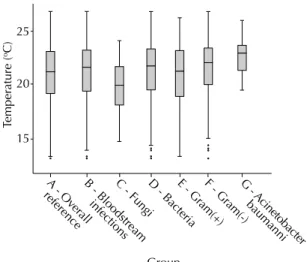
A total of 1,619 HA-BSI were included in the study. Of these, 1,417 had bacterial etiology (55.8% GNB, 44.2% GPC). Among GNB infections, 22.4% were caused by A. baumannii. When all groups were compared to the overall period reference (Table 1, Figures 1 and 2), higher temperature parameters were found for bacteria GNB and A. baumannii, whereas fungi were associ-ated with lower temperatures. Humidity parameters were higher than the reference for bacteria and GPC and lower for fungi and A. baumannii. On the other hand, lower temperatures were identiied in the days preceding HA-BSI of fungal etiology.
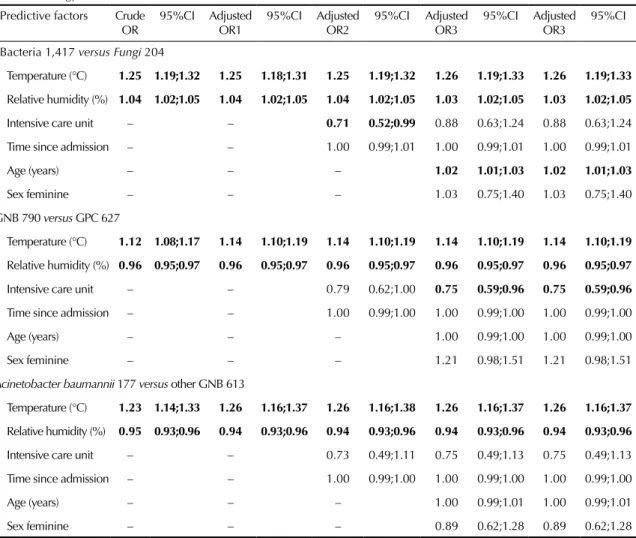
Table 2 presents the results from logistic regression models aimed at identifying weather predictors of HA-BSI etiology. Temperature was positively asso-ciated with bacterial etiology as well as with infec-tions caused by GNB as a whole or A. baumannii. The recovery of overall bacteria was likely to occur in periods of greater relative humidity. However, humidity was negatively associated with GNB and A. baumannii. These results were unaffected by the adjustment for subject demographics and admission parameters.
DISCUSSION
Table 1. Comparison of the immediate meteorological parameters preceding the diagnosis of bloodstream infection with overall data from the study period. Hospital das Clínicas from Faculdade de Medicina de Botucatu. January 2005 – December 2010.
Category Number of observations Temperature (°C) Relative humidity (%)
Average Standard error Average Standard error
Overall data (reference) 2,815 20.99 2.66 70.20 10.76
Fungi 204 19.66 2.34 66.74 12.37
Bacteria 1,417 21.84 2.74 71.29 10.27
Gram-positive cocci 627 20.93 2.83 73.40 8.55
Gram-negative bacilli 790 21.76 2.51 69.91 11.18
Acinetobacter baumannii 177 22.99 2.62 63.82 10.23
Note: For the purpose of this study, immediate parameters indicate temperature and relative humidity for the seven days preceding the collection of blood cultures. The overall data consisted of the moving average to seventh order for each day of the study period.
Bold values indicate statistical significance.
Table 2. Univariate and multivariable logistic regression models for the association of immediate meteorological parameters
and the etiology of bloodstream infections.
Predictive factors Crude OR
95%CI Adjusted OR1
95%CI Adjusted OR2
95%CI Adjusted OR3
95%CI Adjusted OR3
95%CI
Bacteria 1,417 versus Fungi 204
Temperature (°C) 1.25 1.19;1.32 1.25 1.18;1.31 1.25 1.19;1.32 1.26 1.19;1.33 1.26 1.19;1.33
Relative humidity (%) 1.04 1.02;1.05 1.04 1.02;1.05 1.04 1.02;1.05 1.03 1.02;1.05 1.03 1.02;1.05
Intensive care unit – – 0.71 0.52;0.99 0.88 0.63;1.24 0.88 0.63;1.24
Time since admission – – 1.00 0.99;1.01 1.00 0.99;1.01 1.00 0.99;1.01
Age (years) – – – 1.02 1.01;1.03 1.02 1.01;1.03
Sex feminine – – – 1.03 0.75;1.40 1.03 0.75;1.40
GNB 790 versus GPC 627
Temperature (°C) 1.12 1.08;1.17 1.14 1.10;1.19 1.14 1.10;1.19 1.14 1.10;1.19 1.14 1.10;1.19
Relative humidity (%) 0.96 0.95;0.97 0.96 0.95;0.97 0.96 0.95;0.97 0.96 0.95;0.97 0.96 0.95;0.97
Intensive care unit – – 0.79 0.62;1.00 0.75 0.59;0.96 0.75 0.59;0.96
Time since admission – – 1.00 0.99;1.00 1.00 0.99;1.00 1.00 0.99;1.00
Age (years) – – – 1.00 0.99;1.00 1.00 0.99;1.00
Sex feminine – – – 1.21 0.98;1.51 1.21 0.98;1.51
Acinetobacter baumannii 177 versus otherGNB 613
Temperature (°C) 1.23 1.14;1.33 1.26 1.16;1.37 1.26 1.16;1.38 1.26 1.16;1.37 1.26 1.16;1.37
Relative humidity (%) 0.95 0.93;0.96 0.94 0.93;0.96 0.94 0.93;0.96 0.94 0.93;0.96 0.94 0.93;0.96
Intensive care unit – – 0.73 0.49;1.11 0.75 0.49;1.13 0.75 0.49;1.13
Time since admission – – 1.00 0.99;1.00 1.00 0.99;1.00 1.00 0.99;1.00
Age (years) – – – 1.00 0.99;1.01 1.00 0.99;1.01
Sex feminine – – – 0.89 0.62;1.28 0.89 0.62;1.28
GNB: Gram-negative bacilli; GPC: Gram-positive cocci
Note: For the purpose of this study, immediate parameters indicate temperature and relative humidity for the seven days preceding the collection of blood cultures. The number of cases in each category is stated in parenthesis. Crude odds ratio (OR) refers to univariate analysis. The following columns present the adjusted OR in multivariable models, including, the meteorological parameters, admission data, and demographics of cases, in a cumulative fashion.
by an analysis conducted on an individual basis. This is an important strategy to address the “ecological fallacy”, i.e., the possibility that indings that are valid for aggregated data do not relect relations on the indi-vidual level.8 In epidemiological studies, the
assess-ment of ecological fallacy is of practical importance for the recommendation of interventions targeting both the collectivity and individuals. This study focused on individual outcomes as a means of reducing bias that could arise from ecological fallacy.11
Our indings generally corresponded with those from previous ecological studies; higher immediate tempera-ture values were associated with gram-negative etiology. Even higher temperatures were found in the days preceding HA-BSI caused by A. baumannii. These ind-ings echo results from the ecological analysis performed previously. In that analysis, increases of 4.0% and 13.0% were identiied in monthly incidences of GNB and A. baumannii HA-BSI for each additional centigrade degree of average temperature.11 Data concerning A. baumannii
is of utmost interest. Those agents are particularly common in regions with a tropical climate.2,7 They are
widely disseminated among hospitals in Brazil, and recent reports describe an increase in both overall prevalence and resistance to antimicrobials.18,23 In addition, they are the
nosocomial pathogen for which most evidence of season-ality has been accumulated.4,17,24 Hence, A. baumannii was
highlighted, and a separate analysis of weather determi-nants was included for HA-BSI caused by this agent. The results, together with those from previous studies, strongly suggest that infection control policies aimed at controlling the dissemination of A. baumannii within hospitals should give special attention to the increase in its prevalence during warm months.
Although the recognition of seasonality in human diseases dates back to Hippocrates, the mechanisms underlying this epidemiological behavior are not completely understood. Small changes in seasonal behavior of either the pathogen or its host may give rise to signiicant luctuations in the incidence of infectious diseases.10 It can be presumed that a similar
phenom-enon accounts for seasonality of healthcare-associated GNB infections.
Previous studies raised interesting explanatory hypoth-eses. First, the ability of GNB to invade human tissues may increase in response to temperature because of the expression of virulence factors.9 Second, the increase in
bacterial growth in inanimate reservoirs. These indings correspond with the recent recognition of the impor-tance of environmental contamination in the epide-miology of HAI.25 They are also consistent with the
impact of weather in hospitals from tropical countries, including our study hospital. These hospitals generally lack artiicial climatization and have several openings to the external environment. However, the indings fail to explain why seasonality of GNB has been reported even in climatized units.22
In our study hospitals, the 24 wards varied widely with respect to location, contact with the external environ-ment, and climatization (which exists only in intensive care units). However, the association of temperature and humidity with the etiology of HA-BSI was not affected when data on the admission ward was included in the multivariable model. Although a more reined subgroup analysis and longer time span of data collection are necessary to clarify this issue, it seems that GNB preva-lence increased throughout the hospital in warm periods.
Group
A - Ov
erall
reference B - Bloodstream infections
C - FungiD - BacteriaE - Gr
am(+) F - Gr
am(-) G
- A cin
etoba cter baumanni
100
60
40
Humidity (%)
20 80
Note: All cases with positive cultures for either bacteria or fungi were grouped under the term “bloodstream infections”.
Figure 2. Boxplot of seven-day average relative humidity
parameters for the overall period and all study groups. Group
A - Ov
er all
reference B - Bloodstream infections
C - FungiD - BacteriaE - Gr
am(+) F - Gr
am(-)
25
20
15
Temper
ature (
oC)
G - A
cineto ba
cter baumanni
Note: All cases with positive cultures for either bacteria or fungi were grouped under the term “bloodstream infections”.
Figure 1. Boxplot of seven-day average temperature
Studies have suggested that environmental reservoirs outside the hospital increase during summer months. According to this hypothesis, healthcare workers are responsible for the introduction of seasonal GNB into the wards.22 Some authors reported that A. baumannii recovered from clinical cultures during warm months are likely to be multidrug susceptible and/or present a polyclonal proile on strain typing methods.4,12 While these indings strengthen the
hypoth-esis of a community-associated origin, other studies found a signiicant increase in infections caused by multidrug-resistant isolates of both A. baumannii and
Pseudomonas aeruginosa during periods of higher temperature.9 Because multidrug-resistance is a proxy
of nosocomial origin, those results point to an increased spread of GNB within hospital units.
A particularly puzzling inding from the present study was the negative association between humidity and GNB or A. baumannii etiology. The association was not found in the previous ecological study conducted in the same hospital.11 This aspect of the result emphasizes the
differences in the analysis of aggregate and individual data. They may also be due to the paradoxical relation of temperature and humidity during very short time spans.15 Interestingly, the results did not change when
the analysis was repeated using only temperature and humidity values from the day of collection of cultures instead of the seven-day average (data not shown). Finally, another hypothesis that has been raised to explain the summer peaks in GNB infections within hospitals is related to understafing. Summer vaca-tions can decrease the nurse/patient ratio, thus increasing workload and failure to comply with infection control rules.22 Although understafing has
been consistently associated with an increased risk of HAI,6 no studies have focused on the association
between understafing and seasonal increases of GNB infections in hospitals. Furthermore, in HCFMB, as in many healthcare services in developing coun-tries, understafing is a phenomenon that persists throughout the entire year.
This study has some limitations. First, it has a retrospec-tive design, and we analyzed data from administraretrospec-tive and microbiology iles. Thus, many risk factors for HAI, such as invasive procedures (including central venous catheter) and severity of illness, were not addressed. Second, possible seasonal changes in patient proiles
(e.g., demographics, admission diagnosis) or physician behavior were not addressed. Therefore, the selection bias in the study cannot be completely ruled.
However, these analyses were beyond the scope of our objectives, which focused speciically on the impact of environmental factors, including spatial distribution, time of exposure to the hospital environ-ment, and weather data. We did not analyze clonality or antimicrobial resistance among HA-BSI agents. Finally, it was not possible to completely rule out ecological fallacy because the data regarding expo-sure to weather conditions was meaexpo-sured for the whole city and does not represent the temperature and humidity in each patient room. However, the analysis of individual outcomes increases the consistency of previous purely ecological analyses.11 This study
also has strengths, including the number of HA-BSI subjects and the stability of risk factors in all steps of the multivariable analysis.
The results raise new questions regarding GNB season-ality in tropical healthcare settings: what is the relation between seasonality and resistance to antimicrobials? Do speciic risk factors (severity of illness, proce-dures, antimicrobial use, etc.) vary among patients who acquired HAI in different seasons? Is seasonality equal among hospitals located in different regions? We intend to address these questions in future studies.
In conclusion, we found that high temperatures in the seven days preceding the collection of blood cultures were associated with the recovery of bacteria rather than fungi and GNB rather than GPC. Among gram-nega-tives, higher immediate temperature values were associ-ated with HA-BSI caused by A. baumannii. These ind-ings not only relect a change in the relative incidence among different pathogens but also result (as shown
in previous analyses11) from an absolute increase in
the incidence of GNB and A. baumannii during warm seasons, which contrasted with the stability in the occurrence of other pathogens. Together, these ind-ings suggest that infection control policies should be reinforced during periods of high temperature. In addi-tion, guidelines for empirical antimicrobial therapy should consider the higher risk for GNB infections during those periods. Moreover, these indings pose new questions for research to contribute to the eluci-dation of the complex association between climate, weather and HAI.
1. Allegranzi B, Bagheri Nejad S, Combescure C, Graafmans W, Attar H, Donaldson L, et al. Burden of endemic health-care-associated infection in developing countries: systematic review and meta-analysis. Lancet.
2011;377(9761):228-41. DOI: 10.1016/S0140-6736(10)61458-4
2. Chim H, Tan BH, Song C. Five-year review of infections in a burn intensive care unit: High incidence of Acinetobacter baumannii in a tropical climate. Burns. 2007;33(8):1008-14. DOI:10.1016/j.burns.2007.03.003
Based on the doctoral thesis of Silvia Maria Caldeira titled: “Impacto das condições climáticas sobre a etiologia das bacteremias nosocomiais no Hospital das Clínicas da Faculdade de Medicina de Botucatu-UNESP”, presented to the Postgraduate Program in Tropical Diseases of the Faculdade de Medicina de Botucatu, in 2013.
The authors declare no conflict of interests.
3. Cohen AL, Calfee D, Fridkin SK, Huang SS, Jernigan JA, Lautenbach E, et al. Society for Healthcare Epidemiology of America and the Healthcare Infection Control Practices Advisory Committee. Recommendations for metrics for multidrug-resistant organisms in healthcare settings: SHEA/HICPAC Position paper. Infect Control Hosp Epidemiol.
2008;29(10):901-3. DOI:10.1086/591741
4. Christie C, Mazon D, Hierholzer Jr W, Patterson JE. Molecular heterogeneity of Acinetobacter baumanii isolates during seasonal increase in prevalence.
Infect Control Hosp Epidemiol. 1995;16(10):590-4. DOI:10.2307/30141099
5. Curtis LT. Prevention of hospital-acquired infections: review of non-pharmacological interventions. J Hosp Infect. 2008;69(3):204-19. DOI:10.1016/j.jhin.2008.03.018
6. Daud-Gallotti RM, Costa SF, Guimarães T, Padilha KG, Inoue EN, Vasconcelos TN, et al. Nursing workload as a risk factor for healthcare associated infections in ICU: a prospective study. PLoS One. 2012;7(12):e52342. DOI:10.1371/journal.pone.0052342
7. Doughari HJ1, Ndakidemi PA, Human IS, Benade S. The ecology, biology and pathogenesis of Acinetobacter spp: an overview. Microbes Environ.
2011;26(2):101-12. DOI:10.1264/jsme2.ME10179
8. Dufault B, Klar N. The quality of modern cross-sectional ecologic studies: a bibliometric review. Am J Epidemiol.
2011;174(10):1101-7. DOI:10.1093/aje/kwr241
9. Eber MR, Shardell M, Schweizer ML, Laxminarayan R, Perencevich EN. Seasonal and temperature-associated increases in gram-negative bacterial bloodstream infections among hospitalized patients. PLoS One. 2011;6(9):e25298. DOI:10.1371/journal.pone.0025298
10. Fisman DN. Seasonality of infectious diseases.
Annu Rev Public Health. 2007;28:127-43. DOI:10.1146/annurev.publhealth.28.021406.144128
11. Fortaleza CM, Caldeira SM, Moreira RG, Akazawa RT, Corrente JE, Souza LR, et al. Tropical healthcare epidemiology: weather determinants of the etiology of bloodstream infections in a Brazilian hospital.
Infect Control Hosp Epidemiol. 2014;35(1):85-8. DOI:10.1086/674392
12. Fukuta Y, Clarke LG, Shields RK, Wagener MM, Pasculle AW, Doi Y. Lack of seasonality in the occurrence of multidrug-resistant Acinectobacter baumannii complex. Infect Control Hosp Epidemiol.
2012;33(10):1051-2. DOI:10.1086/667741
13. Horan TC, Andrus M, Dudeck MA. CDC/NHSN surveillance definition of health care-associated infection and criteria for specific types of infections in the acute care setting. Am J Infect Control.
2008;36(5):309-32. DOI:10.1016/j.ajic.2008.03.002
14. Kaier K, Frank U, Conrad A, Meyer E. Seasonal and ascending trends in the incidence of carriage of extended-spectrum ß-lactamase-producing Escherichia coli and Klebsiella species in 2 German hospitals.
Infect Control Hosp Epidemiol. 2010:31(11):1154-9. DOI:10.1086/656748
15. Kimball JS, Running SW, Nemani R. An improved method for estimating surface humidity from daily minimum temperature. Agric Forest Meteorol. 1997;85(1):87-98. DOI:10.1016/S0168-1923(96)02366-0
16. Leekha S, Diekema DJ, Perencevich EN. Seasonality of staphylococcal infections.
Clin Microbiol Infect. 2012;18(10):927-33. DOI:10.1111/j.1469-0691.2012.03955.x
17. McDonald LC, Banerjee SN, Jarvis WR. Seasonal variation of Acinetobacter infections: 1987-1996. Nosocomial Infections Surveillance System. Clin Infect Dis. 1999;29(5):1133-7. DOI:10.1086/313441
18. Padoveze MC, Assis DB, Freire MP, Madalosso G, Ferreira SA, Valente MG, et al. Surveillance Programme for Healthcare Associated Infections in the State of São Paulo, Brazil. Implementation and the first three years’ results. J Hosp Infect. 2010;76(4):311-5. DOI:10.1016/j.jhin.2010.07.005
19. Perencevich EN, McGregor JC, Shardell M, Furuno JP, Harris AD, Morris JG, et al. Summer Peaks in the incidences of gram-negative bacterial infection among hospitalized patients. Infect Control Hosp Epidemiol.
2008;29(12):1124-31. DOI:10.1086/592698
20. Pittet D, Allegranzi B, Storr J, Bagheri Nejad S, Dziekan G, Leotsakos A, et al. Infection control as a major World Health Organization priority for developing countries. J Hosp Infect. 2008;68(4):285-92. DOI:10.1016/j.jhin.2007.12.013
21. Ramos GP, Rocha JL, Tuon FF. Seasonal humidity may influence Pseudomonas aeruginosa hospital-acquired infection rates. Int J Infect Dis. 2013;17(9):e757-61. DOI:10.1016/j.ijid.2013.03.002
22. Richet H. Seasonality in gram-negative and healthcare-associated infections. Clin Microbiol Infect. 2012;18(10):934-40. DOI:10.1111/j.1469-0691.2012.03954.x
23. Rossi F. The challenges of antimicrobial resistance in Brazil. Clin Infect Dis. 2011;52(9):1138-43. DOI:10.1093/cid/cir120
24. Schwab F, Gastmeier P, Meyer E. The warmer the weather, the more gram-negative bacteria - impact of temperature on clinical isolates in intensive care units. Plos One.
2014;9(3):e91105. DOI:10.1371/journal.pone.0091105