165
ABSTRACT
BACKGROUND AND OBJECTIVES:his study was devel-oped to investigate anesthesia-related discomfort during dental procedures. his procedure often generates major anxiety, which increases pain. Fear of injection has been reported as a determin-ing factor for not lookdetermin-ing for dental treatment. his study aimed at comparing the level of pain during perforation, penetration and anesthetic solution deposition during inferior alveolar block by the Direct and Vazirani-Akinosi techniques.
METHODS: Randomized, crossover, double-blind clinical trial involving 30 patients seen by the Dentistry Department of the Federal University of Sergipe (DOD-UFS) who needed dental treatment and were submitted to bilateral inferior alveolar nerve block. Patients were asked about pain intensity during the fol-lowing stages: perforation, penetration and local anesthetic de-position. Pain intensity was measured by the 10-cm visual analog scale (VAS), without predeined marks. Data were tabulated and submitted to statistical Friedman and Wilcoxon tests with statis-tical signiicance of 5%.
RESULTS:Data have not shown statistically signiicant dif-ferences (Wilcoxon, p > 0.05) between VAS values of both an-esthetic techniques in all operatory moments. For both tech-niques, penetration-induced pain was higher (Friedman, p < 0.05) as compared to pain induced by the two other operatory moments, being the absolute majority for both techniques clas-siied as mild pain.
CONCLUSION:Vazirani-Akinosi and Direct techniques had levels of pain sensitivity characterized as mild during the three anesthetic stages, being the second stage, penetration, the most painful as compared to remaining stages.
Keywords:Anesthesia, Block, Pain, Technique.
Comparison of pain intensity during inferior alveolar nerve block*
Comparação da intensidade de dor em bloqueios do nervo alveolar inferior
Felippe Almeida Costa1, Liane Maciel de Almeida Souza1, Francisco Groppo2
*Received from the Dentistry Department, Federal University of Sergipe (UFS). Aracaju, SE.
1. Federal University of Sergipe. Aracaju, SE, Brazil.
2. State University of Campinas, School of Dentistry. Piracicaba, SP, Brazil.
Submitted in March 06, 2013.
Accepted for publication in August 15, 2013. Conlict of interests: None.
Correspondence to: Felippe Almeida Costa
Rua Cláudio Batista s/n. Hospital Universitário – Sanatório 49060-100 Aracaju, SE.
E-mail: [email protected]
RESUMO
JUSTIFICATIVA E OBJETIVOS: Este estudo foi idealizado para investigar o desconforto dos procedimentos odontológicos associados à anestesia. Este procedimento frequentemente gera uma grande ansiedade, o que aumenta a dor. O medo da injeção tem sido relatado como sendo um fator determinante à não pro-cura do tratamento dental. O presente estudo teve como objetivo comparar o nível de dor na perfuração, penetração e deposição da solução anestésica no bloqueio do nervo alveolar inferior nas Técnicas Direta e Vazirani-Akinosi.
MÉTODOS: Estudo clínico randomizado, cruzado e dupla-mente encoberto envolvendo 30 pacientes atendidos no Depar-tamento de Odontologia da Universidade Federal de Sergipe (DOD-UFS) que necessitaram de tratamento odontológico e que se submeteram a bloqueio bilateral do nervo alveolar infe-rior. Estes foram interrogados a respeito da intensidade de dor durante as seguintes etapas: perfuração, penetração e deposição do anestésico local. A mensuração da intensidade dolorosa foi realizada através da escala analógica visual (EAV) com compri-mento de 10 cm, sem a existência de marcações pré-deinidas. Os dados obtidos foram tabulados e submetidos aos testes es-tatísticos de Friedman e Wilcoxon com índice de signiicância estatística de 5%.
RESULTADOS: A análise dos dados revelou que não houve diferenças estatisticamente signiicantes (Wilcoxon, p > 0,05) entre os valores de EAV das duas técnicas anestésicas em ne-nhum dos momentos operatórios. Para ambas as técnicas, a dor induzida pela penetração foi maior (Friedman, p < 0,05) do que a dor induzida nos dois outros momentos operatórios, sendo a maioria absoluta, nas duas técnicas, classiicadas como dor leve.
CONCLUSÃO: As técnicas de Vazirani-Akinosi e Direta apre-sentaram níveis de sensibilidade álgica caracterizada como leve nos três estágios da anestesia, sendo o segundo estágio, a penetra-ção, o mais doloroso se comparado com os demais.
Descritores: Anestesia, Bloqueio, Dor, Técnica.
INTRODUCTION
Among the actions of a dentist, drug administration to prevent pain during dental treatment is extremely important. However, the simple action of administering local anesthetics often brings major anxiety and is associated with pain. Local anesthetic injec-tion may not only generate pain and fear, but also be a triggering factor related to medical emergencies in dental oices, with
va-Rev Dor. São Paulo, 2013 jul-set;14(3):165-8
© Sociedade Brasileira para o Estudo da Dor
166
Costa FA, Souza LMA and Groppo F
Rev Dor. São Paulo, 2013 jul-set;14(3):165-8
sodepressor syncope and hyperventilation as major psychogenic reactions1.
Anxiety is reported as a barrier for dental treatment, being con-cern with dental treatment one of the primary reasons, in addi-tion to fear of pain and also several factors such as the area to be anesthetized2,3.
Local anesthetic injection very often is the only painful sensation perceived by patients, and fear associated to injection has been reported as a determining factor for not looking for dental treat-ment4. So, the association of anesthetic agents and techniques has been used to decrease nociceptive impulses in surgical stages, thus decreasing morbidity5.
It is known that pain is the perception of an aversive and un-pleasant sensation, primary manifestation of distress, informing the nervous system about some external or internal conditions incompatible with people’s morphological or functional integ-rity6. In case of inferior alveolar nerve block (IANB), which is induced by the most popular, and possibly the most important dentistry technique7, it is paramount to evaluate pain during an-esthetic induction.
IANB has three stages: initial needle insertion, needle penetra-tion to the destinapenetra-tion site and anesthetic solupenetra-tion deposipenetra-tion. hese procedures have been associated with pain and discomfort. A technique was developed in the 1970s for patients unable to open their mouths. For such, patients’ mouth should be partially closed without occlusal contact. his provides cheek muscles re-laxation in addition to giving better visualization of the area and decreasing minor needle insertion trauma8. However, there was a very similar technique described by Vazirani in 1960, and so the name Vazirani-Akinosi mandibular block was adopted in recog-nition to both professionals1.
Studies regarding pain during anesthesia are described by the sci-entiic community9-11. For the anesthetic solution deposition in the destination site, authors reported that the incidence of mod-erate to severe pain varies from 20% to 40%9. A diferent study9 has evaluated the Direct and Vazirani-Akinosi techniques and, as result, there has been no signiicant diference between pain dur-ing needle insertion and durdur-ing anesthetic solution deposition. A study11 to compare IANB, Direct technique and Vazirani-Akinosi technique has shown that among patients anesthetized with this technique, 19% had no pain, 65% mild discomfort and 16% moderate pain.
he establishment of pain levels of both anesthetic techniques is highly important to decrease pain, making procedures less trau-matic, as shown by a research12 with students and employees of a university. When asked about dental prevention and fear of dental injections, more than 25% of respondents have reported fear of injections. Almost one out of every 20 respondents has reported avoiding, cancelling or not attending the dental visit for fear of dental anesthesia. Factors such as pain at injection, as well as possible injuries caused by the act are the two most common causes of fear of anesthesia.
Another important study13 has reported that fear of anesthesia is related to oral health worsening due to lack of treatment, to decreased number of dental assistances and to increased stress of the dentist during treatment.
In light of the above, this study aimed at measuring pain inten-sity during IANB with Direct and Vazirani-Akinosi techniques.
METHODS
his was a randomized, crossover and double blind clinical trial carried out by 3 investigators, being 2 interrogators and 1 ex-ecutor of the anesthetic techniques. Each investigator had a re-stricted and unique function not being allowed the exchange of investigators throughout the experiment. Sample was made up of 30 adult patients of both genders, aged between 18 and 45 years, with indication of lower third molar extraction and with-out associated pain.
Patients were included in the study according to the order of arrival to the dental department of the Dentistry Course of the Federal University of Sergipe.
After agreeing to participate in the research by signing the Free and Informed Consent Term, patients were submitted to history and clinical evaluation to identify conditions electing or preventing them of participating in the study. Exclusion criteria were alcoholic patients and those using drugs, anti-histamines, antidepressants, cimetidine or any other drug and physical status that could interfere with patients’ sensitivity to pain. Patients with systemic disorders, such as diabetics, hy-pertensive, cardiac, allergic to any component of the formula or to sulfa and pregnant women, odontophobics and children were also excluded.
After meeting inclusion criteria, patients were referred to the irst examiner who has raled order and side of anesthetic procedures. After this procedure, patients were referred to the surgeon, who induced IANB.
With the patient comfortably accommodated on the den-tal chair, in supine position, the experimenden-tal procedure was started. Patient was asked to mouthwash with 5 mL of 0.12% chlorhexidine for approximately one minute for oral antisepsis. Before the anesthetic technique itself, topic anesthetic was ap-plied to the region corresponding to needle puncture, respecting the protocol described in the literature1. After topic anesthesia, one of the anesthetic techniques was adopted according to the raled technique.
In the Direct technique, the long 27G needle penetrated the mucosa between the internal oblique branch and the pterigo-mandibular raphe and was advanced until contact with the bone. Syringe was supported by lower premolars of the opposite side. No anesthetic solution was deposited until the needle reached the target area. Aspiration was performed before the deposition of 1.8 mL of solution.
In the Vazirani-Akinosi technique, long 27G needle was intro-duced in the mandibular branch adjacent to the maxillary tu-berosity at the height of the mucogingival junction. hen, it penetrated 25 mm in the tissue to deposit 1.8 mL of anesthetic solution.
All patients were anesthetized in both tested techniques with 2% lidocaine hydrochloride, with 1:100.000 epinephrine, preceded by negative aspiration.
167
Comparison of pain intensity during inferior alveolar nerve block Rev Dor. São Paulo, 2013 jul-set;14(3):165-8those starting the procedure with the Direct technique have re-ceived the Vazirani-Akinosi technique in the second moment, and vice-versa.
After needle removal, volunteers were asked by the third exam-iner about discomfort associated to the procedure in the follow-ing stages: perforation, penetration and deposition, by means of a 10-cm pain visual analog scale (VAS) with parameters such as 0 cm (no pain) and 10 cm (unbearable pain), without preexisting marks in the scale.
Participants received VAS and were oriented to mark pain in-tensity in one point of each of the three straight lines, related to the corresponding anesthesia stage, being that scores could vary from 0 to 10 and were obtained by measuring, in millimeters, the distance between the extremity anchored by the words no pain and the point marked by the participant. Such scale has the advantage of being easy to apply14. In this study, preexist-ing marks, traditionally represented in VAS, were removed to avoid bias during patients’ demarcations, thus preventing data distortions.
After anesthesia, the dental treatment was performed according to patients’ treatment plan recorded in their clinical charts. Af-ter collection, data were tabulated and submitted to statistical Wilcoxon and Friedman tests with statistical signiicance of 5%. his study was approved by the Ethics and Research Com-mittee, Federal University of Sergipe (UFS), protocol CAAE 03259912.6.0000.5546-2012.
RESULTS
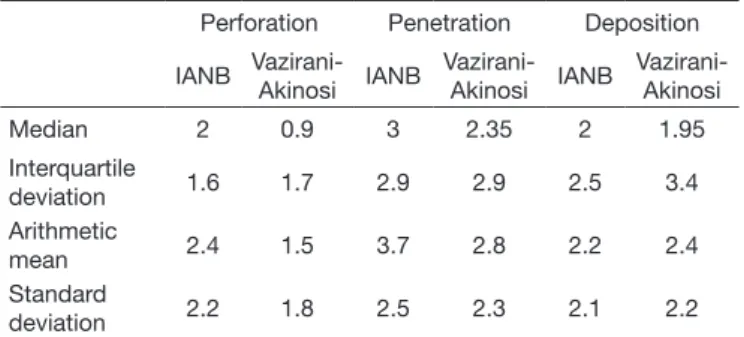
Participated in this study 14 females with mean age of 26.7 ± 9.3 years and 16 males with mean age of 23.4 ± 2.6 years. here has been no statistically signiicant diferences (Wilcoxon, p = 0.2635) between genders with regard to age. Figure 1 and table 1 show pain measured by VAS, as a function of measurement time (perforation, penetration or solution deposition).
Data analysis has shown no statistically signiicant diferences (Wilcoxon, p > 0.05) between VAS values for both anesthetic techniques in all surgical moments. For both techniques, pain induced by penetration was higher (Friedman, p < 0.05) as com-pared to pain induced by the other two surgical moments.
Abso-lute majority of pain reported in numbers in all situations may be considered mild, based on pain classiication15.
Table 2 shows absolute distribution of volunteers according to their pain classiication.
Table 2 – Absolute distribution of volunteers.
Pain intensity
Mild Moderate Severe
Perforation IANB 24 3 3
Vazirani-Akinosi 28 0 2
Penetration IANB 16 8 6
Vazirani-Akinosi 19 8 3
Deposition IANB 25 2 3
Vazirani-Akinosi 20 6 4
IANB = inferior alveolar nerve block.
Considering the total of volunteers with severe/moderate pain and those with mild pain, it could be observed that there have been no statistically signiicant diferences (Fisher Exact test, p > 0.05) in the prevalence of mild or severe/moderate pain in all moments.
DISCUSSION
his study aimed at comparing the level of pain sensitivity in three IANB moments, namely perforation, penetration and an-esthetic deposition, using two techniques. As described in the literature8, there has been signiicant variation between genders in the three IANB stages by the Direct technique, which is in disagreement with this study which has not evidenced statisti-cally signiicant data during blockade stages.
With regard to puncture, which involves the moment when the needle perforates the mucosa, study results10 indicate that pain induced in this stage was higher with the Direct technique as compared to Vazirani-Akinosi technique, as opposed to our study which has shown no statistically signiicant diference be-tween both techniques. It is known that in the closed mouth technique, at perforation, there is further tissue relaxation in this zone as compared to the other technique, thus inducing less pain in the irst anesthetic stage7.
Figure 1 – Measurement (median-interquartile deviation).
IANB = inferior alveolar nerve block. V-A = Vazirani-Akinosi.
V
AS
(i
n
cm)
10
8
6,0
3,2
1,5
0
Perforation
Severe pain
Moderate pain
Mild pain
IANB IANB IANB
Penetration
V-A V-A V-A
Deposition
Table 1 – Pain intensity measured by visual analog scale, as a function of measurement moment.
Perforation Penetration Deposition
IANB Vazirani-
Akinosi IANB
Vazirani-
Akinosi IANB
Vazirani- Akinosi
Median 2 0.9 3 2.35 2 1.95
Interquartile
deviation 1.6 1.7 2.9 2.9 2.5 3.4
Arithmetic
mean 2.4 1.5 3.7 2.8 2.2 2.4
Standard
deviation 2.2 1.8 2.5 2.3 2.1 2.2
168
Costa FA, Souza LMA and Groppo F
Rev Dor. São Paulo, 2013 jul-set;14(3):165-8
Another relevant data observed by this research was the pres-ence of pain in all patients during perforation; in a diferent study10, 19 patients have reported no pain during perforation by the Vazirani-Akinosi technique. Previous studies have evaluated other factors which might be involved with pain during anesthe-sia, such as tissue distensibility, injection speed, patient’s psycho-logical characteristics, temperature of injected solution3, needle gage2 and the use of local anesthetics16,17. Aiming at minimizing such discomfort, topic anesthesia is recommended before needle penetration1.
In this study, there have been no statistically signiicant difer-ences in pain during perforation as compared to other stages in both techniques. However, this has been the most painful stage as compared to penetration and anesthetic deposition. Such data are in disagreement with our results where penetration was the most painful moment.
However, a diferent study8 has shown that penetration was the most painful IANB stage, in line with our indings.
A paper reported in the literature9 comparing anesthetic efec-tiveness of Direct, Vazirani-Akonosi and Gow-Gates techniques at the level of pulpal anesthesia, has shown no signiicant difer-ence in mild, moderate and severe pain scores described by forty patients for pain induced by perforation and anesthetic solution deposition, thus conirming the indings of our study.
In this same study, the incidence of severe pain during IANB tissue puncture by the Direct technique was 0% to 2%; how-ever, another author8 has found incidence of 57% to 89% of moderate to severe pain in 102 cases of IANB by the Direct technique. Our study has identiied incidence varying from 7% to 47% of cases.
IANB may be considered as mild pain, with a peak of pain last-ing few seconds, however previous blockade experiences, level of anxiety and fear of pain and injection are factors afecting pain intensity reported by patients. Higher levels of anxiety, as well as previous painful experiences end up exacerbating the actual pain felt by patients, as reported by studies where patients with less anxiety have reported lower pain levels and duration as com-pared to more anxious patients18,19. Similar studies, with previous analysis of anxiety levels and a questionnaire about the history of previous unpleasant anesthetic experiences should be carried out aiming at decreasing possible variables which may afect data found in the research.
CONCLUSION
Direct and Vazirani-Akinosi techniques have not shown signii-cant diferences in pain reported by patients in the three stages (perforation, penetration and anesthetic deposition) during IANB, being the absolute majority mild pain; however, more extensive studies should be carried out to minimize the negative efects, such as pain felt by patients during the procedure.
REFERENCES
1. Reed KL, Malamed SF, Fonner AM. Local anesthesia part 2: technical considerations. Anesth Prog. 2012;59(3):127-36.
2. Meechan JG, Howlett PC, Smith BD. Factors inluencing the discomfort of intraoral needle penetration. Anesth Prog. 2005;52(5):91-4.
3. Glassman P, Peltier B. Guidelines for the administration of local anesthesia in fearful dental patients. J Calif Dent Assoc. 1995;23(9):23-6.
4. Kaufman E, Epstein JB, Naveh E, et al. A survey of pain, pressure, and dis-comfort induced by commonly used oral local anesthesia injections. Anesth Prog. 2005;52(5):122-7.
5. Schnaier TB, Vieira AM, Castilho DG, et al. Analgesia em procedimentos cirúrgicos de câncer de mama com bloqueio interpleural. Rev Dor. 2010;11(1):5-11. 6. Pereira KS, Carneiro NM, Gil JN. Estudo do uso da acupuntura como analgesia
pre-emptiva para pacientes de cirurgia de terceiros molares inferiores com osteotomia. Rev Dor. 2008;9(3):1283-9.
7. Malamed SF, Falkel M. Advances in local anesthetics: pH bufering and dissolved CO2. Dent Today. 2012;31(5):88-93.
8. Akinosi JO. A new approach the mandibular nerve block. Br J Oral Surg. 1977;78(15):83-7.
9. Mccartney M, Reader A, Beck M. Injection pain of the inferior alveolar nerve block in patients with irreversible pulpitis. Oral Surg Oral Med Oral Pathol Oral Radiol Endod. 2007;104(4):571-5.
10. Goldberg S, Reader A, Drum M, et al. Comparison of the anesthetic eicacy of the conventional inferior alveolar, gow-gates, and vazirani-akinosi techniques. J Endod. 2008;34(11):1306-11.
11. Martínez-González JM, Peña BB, Cáliz FF, et al. Estudio comparativo entre el blo-queo mandibular directo y la técnica de Akinosi. Med Oral. 2003;8(9):143-9. 12. Milgrom P, Coldwell SE, Getz T, et al. Four dimensions of fear of dental injections. J
Am Dent Assoc. 1997;128(6):756-66.
13. Armiield JM, Milgrom P. A clinician guide to patients afraid of dental injections and numbness. SAAD Dig. 2011;27:33-9.
14. Pereira LV, Sousa FAEF. Mensuração e avaliação da dor pós-operatória: uma breve revisão. Rev Lat-Am Enfermagem. 1998;6(1):77-84.
15. Collins SL, Moore RA, McQuay HJ. he visual analogue pain intensity scale: what is moderate pain in millimetres? Pain. 1997;72(1-2):95-7.
16. Vickers ER, Punnia-Moorthy, A. A clinical evaluation of three topical anaesthetic agents. Aust Dent J. 1992;37(4):267-70.
17. Nusstein JM, Beck M. Efectiveness of 20% benzocaine as a topical anesthetic for intraoral injections. Anesth Prog. 2003;50(4):159-63.
18. van Wijk AJ, Hoogstraten J. Anxiety and pain during dental injections. J Dent. 2009;37(9):700-4.