ABSTRACT
BACKGROUND AND OBJECTIVES: Postoperative pain is foreseeable however it is still undermanaged. Multimodal man-agement decreases side-efects and provides adequate pain con-trol. Lidocaine, local anesthetic used for more than ive decades, is being intravenously administered aiming at managing pain in diferent types of surgeries with promising results. his study aimed at reviewing the use of intravenous lidocaine to manage postoperative pain, and its action mechanism.
CONTENTS: his article addresses the use of intravenous lidocaine to manage postoperative pain, its action mechanism and its appli-cability for diferent types of surgeries. An active search was carried out in the following databases: Medline via Pubmed (1974-2013), Cochrane Library (1990-2010) and LILACS (1974-2013). Search was adjusted to identify articles addressing postoperative intrave-nous lidocaine action mechanism and postoperative analgesia. As to language, articles in Portuguese and English were selected.
CONCLUSION: Intravenous lidocaine, due to its low cost, opioid-sparing action and minimum side-efects is an adequate option to manage postoperative pain.
Keywords: Intravenous lidocaine, Multimodal management, Postoperative analgesia, Postoperative pain.
RESUMO
JUSTIFICATIVA E OBJETIVOS: A dor pós-operatória é pre-visível, no entanto continua sendo inadequadamente tratada. O tratamento multimodal diminui os efeitos colaterais e propicia adequado alivio da dor. A lidocaína, anestésico local utilizado há
Intravenous lidocaine to treat postoperative pain*
Lidocaína intravenosa no tratamento da dor pós-operatória
Tânia Cursino de Menezes Couceiro1, Luciana Cavalcanti Lima2, Léa Menezes Couceiro3,Marcelo Moraes Valença4
*Received from Institute of Integral Medicine Professor Fernando Figueira, Recife, PE, Brazil.
1. Federal University of Pernambuco, Institute of Integral Medicine Professor Fernando Figueira, Recife, PE, Brazil.
2. Institute of Integral Medicine Professor Fernando Figueira, School of Helath of Pernam-buco, Recife, PE, Brazil.
3. Institute of Integral Medicine Professor Fernando Figueira, Recife, PE, Brazil. 4. Federal University of Pernambuco, Recife, PE, Brazil.
Submitted in July 17, 2013.
Accepted for publication in January 24, 2014. Conlict of interests: none.
Correspondence to:
Tânia Cursino de Menezes Couceiro
Rua Jornalista Guerra de Holanda, 158/1602 – Casa Forte 52061-010 Recife, PE, Brasil.
E-mail: [email protected]
© Sociedade Brasileira para o Estudo da Dor
mais de cinco décadas, vem sendo empregada por via intravenosa com o objetivo de tratar a dor em diversos tipos de operação com resultados promissores. O objetivo deste estudo foi fazer uma revisão sobre o uso da lidocaína intravenosa no tratamento da dor pós-operatória e seu mecanismo de ação.
CONTEÚDO:Este artigo aborda o emprego da lidocaína in-travenosa no manuseio da dor pós-operatória, seu mecanismo de ação e a aplicabilidade em diversos tipos de procedimentos cirúrgicos. Realizada busca ativa através das seguintes bases de dados: Medline via Pubmed (1974-2013), Cochrane Library (1990-2010), LILACS (1974-2013). A busca foi ajustada visan-do identiicar os artigos que pesquisaram o mecanismo de ação e a analgesia pós-operatória da lidocaína intravenosa. Quanto à limitação do idioma, foram selecionados artigos nas línguas Por-tuguesa e Inglesa.
CONCLUSÃO: A lidocaína intravenosa, pelo baixo custo, ação poupadora de opioides e mínimos efeitos colaterais, tem se mostrado adequada opção no tratamento da dor pós-operatória. Descritores: Analgesia pós-operatória, Dor pós-operatória, Li-docaína, intravenosa, Tratamento multimodal.
INTRODUCTION
Assuring adequate pain management should be part of the perioperative approach to surgical patients, and anesthesiolo-gists may use diferent available drugs for intravenous infusion, matching their pharmacodynamic features to diferent types of surgical procedures and to the particularities of each patient. Among drugs to manage postoperative pain POP), intravenous lidocaine is gaining importance1. his local anesthetic was in-travenously used for the irst time to promote postoperative an-algesia during the 1960’s and recent studies have proven such analgesic efect especially in abdominal surgeries1.
However, notwithstanding the practicality of administering in-travenous lidocaine as part of multimodal pain management2, its action mechanism is still not totally understood, especially with regard to analgesia duration.
An active search was carried out in the following databases: Med-line via Pubmed (1974-2013), Cochrane Library (2000-2010) and LILACS (1974-2013). Search was adjusted to identify arti-cles studying intravenous lidocaine action mechanism and post-operative analgesia. As to language, articles in Portuguese and English were selected.
his study aimed at reviewing the use of intravenous lidocaine to manage POP and at discussing possible action mechanisms of this analgesic drug.
POSTOPERATIVE PAIN
POP is a foreseeable and well-known type of acute pain and its management decreases postoperative morbidity, provides adequate incision healing and decreases costs2,3. In addition, it promotes less postoperative cognitive changes and decreases the risk of chronic or persistent postoperative pain4,5. How-ever, more than 50% of patients submitted to surgical pro-cedures experience moderate to severe pain6 indicating that, notwithstanding the development of new drugs and the use of new analgesic techniques, POP is still undermanaged7,8. Pos-sible justiications for its high prevalence might be: individual sensitivity and inadequate choice of drugs and doses9.
PHARMACOLOGICAL ASPECTS OF INTRAVE-NOUS LIDOCAINE
Intravenous lidocaine in the perioperative period promotes important postoperative analgesia resulting in less pain inten-sity and use of opioids10-12. Recent studies have proven that intravenous lidocaine promotes fast return of intestinal tran-sit in patients submitted to colonic surgeries12 and decreases cytokines production and release13-16. Lidocaine analgesic ef-fect on surgical trauma is due to neuronal transmission block at the injury site, to its intrinsic systemic anti-inlammatory property and, depending on the dose, it may decrease cyto-kine-induced cell injury through mechanisms involving mito-chondrial potassium channels sensitive to adenosine triphos-phate (ATP)4,16,17.
It is important to stress that its analgesic property persists even after plasma levels are decreased, thus favoring the the-ory of nervous conduction block14. On the other hand, even in low doses, it suppresses C ibers evoked potential resulting in analgesia18-21.
Among the advantages of this drug, one may highlight low cost and good efectiveness18 (Table 1). It is important to stress that doses used to manage acute or chronic pain are in general based on patients’ weight, which is not diferent with lidocaine. However, there is dissociation between analgesic ef-fect and plasma concentration of lidocaine and of its active metabolite22.
Table 1. Advantages of intravenous lidocaine for postoperative pain
Low cost
Effective in abdominal surgeries Decreases opioid consumption Minimizes ileus
Decreases hospital stay and nausea and vomiting Decreases the incidence of postoperative chronic pain
Lidocaine is metabolized in the liver by the microsmal enzyme system (cytochrome P450), with clearance rate of 0.85L/kg/h. It is converted by oxidation into monoethylglycinexylidine, part of which is hydrolyzed to glycinexylidine. Such
metabo-lites are active and have been implied in cases of intoxication after repeated doses and continuous intravenous infusion. It is excreted by the kidneys, with a fast excretion phase of 8 to 17 minutes and a slow phase of 87 to 108 minutes22. Less than 10% of lidocaine is found unaltered in the urine22-26.
here is a question about lidocaine metabolites: would they also be responsible for the analgesic action of this drug? Pos-sibly not, because lidocaine-induced analgesia goes beyond the half-life of such metabolites.
Intravenous lidocaine has been used in diferent surgical pro-cedures1,12,27. When intravenously administered, it is initially distributed to richly perfused organs, such as skin, skeletal muscle and fat. It has a large distribution volume (91L/kg), its oil/water partition coeicient is 366 and its potency is intermediate. Approximately 60% of its molecules bind to plasma proteins, especially to acid alpha1-glycoprotein22. Ap-proximately 40% of intravenous lidocaine is temporarily ex-tracted during its irst passage through the lungs where pH is lower as compared to plasma. Lidocaine protein binding associated to pulmonary extraction decreases the chances of systemic intoxication.
Lidocaine action mechanism
Voltage-dependent sodium channels (Nav) are classic lido-caine action targets and nine diferent forms (isoforms) of subunits have already been identiied in voltage-dependent sodium channels of mammals (Nav 1.1 to 1.9), being that some of them are related to neuropathic pain (Nav 1.3, 1.7, 1.8 and 1.9) and others to inlammatory pain (Nav 1.7, 1.8 and 1.9)28. After crossing the neural membrane, under the ac-tion of intracellular pH there is the conversion of lidocaine to its ionized form and this acts reversibly in the portion S6 of the domain 4 of the alpha subunit within voltage-dependent sodium channels25,28.
As the anesthetic action is developed, the threshold for elec-tric excitability is gradually increased and action potential peak decreases neuronal impulse conduction. Lidocaine af-inity for sodium channels varies with the channel position being higher when the channel is open (activated or inactive) and lower when the channel is closed (turned of or at rest). So, the higher the frequency of neuronal stimulation, more ionized lidocaine molecules have access to action sites and the higher is the blockade level (use-dependent or frequency-dependent block)18.
Lidocaine also acts on voltage-dependent potassium and calcium channels, however with less ainity as compared to blockade produced in sodium channels. his calcium chan-nel inhibition in pre-synaptic nervous terminals is highly in-volved with the release of neurotransmitters and, as a conse-quence, interferes with painful impulse propagation34. With regard to potassium channels, it is supposed that acting on such channels, lidocaine decreases cell injury secondary to tissue ischemia18, decreases inlammatory response and pro-motes pain intensity decrease.
Intravenous lidocaine adverse efects and contraindications Lidocaine-triggered toxic manifestations seem to occur when plasma concentrations of 5μg/mL are reached. However, in the clinical practice, doses vary from 2 to 5mg/kg, resulting in plasma concentration of 2μg/mL, that is, below toxic doses, promoting a safety window for lidocaine administration. his safety allows the drug to be used in diferent forms for pain management (solution, eye drops and cream) and by diferent administration routes (epidural, spinal, intrapleural, muscu-lar, intra-articumuscu-lar, topic and intravenous)22,25, each one with its established indication.
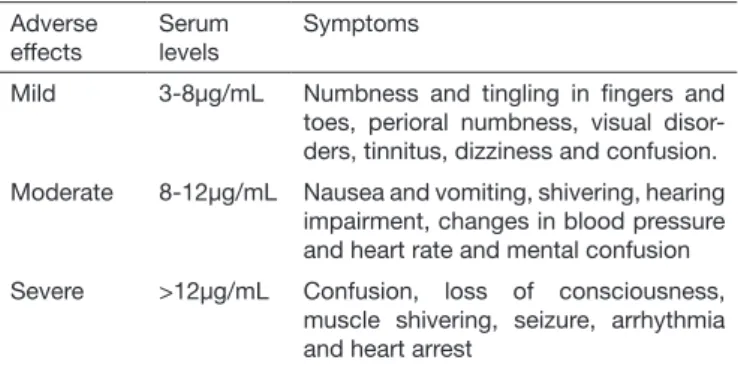
Adverse efects intensity depends on the dose, velocity and site of administration, as well as on patients’ general status with regard to age, clinical conditions and pregnancy25. As lidocaine concentration increases in systemic circulation sev-eral signs and symptoms appear especially in systems: central nervous system (CNS) and cardiovascular system. When se-rum levels are below 5µg/mL there is analgesia and cortical motoneurons are inhibited, which explains its anticonvulsant activity24. When serum levels go beyond 5µg/mL symptoms are variable and severity depends on lidocaine blood concen-tration25 (Table 2).
Table 2. Adverse effects according to serum levels2,22,26
Adverse effects
Serum levels
Symptoms
Mild 3-8μg/mL Numbness and tingling in ingers and toes, perioral numbness, visual disor-ders, tinnitus, dizziness and confusion. Moderate 8-12μg/mL Nausea and vomiting, shivering, hearing
impairment, changes in blood pressure and heart rate and mental confusion Severe >12μg/mL Confusion, loss of consciousness,
muscle shivering, seizure, arrhythmia and heart arrest
With regard to CNS, seizure might be the irst indication of severe intoxication26 and may be caused by the inhibition of inhibitory neurons through GABA receptors (gamma-amino-butyric acid) in the amygdala25,27. In general, there is seizure with plasma concentrations above 8µg/mL but it may be seen with lower serum levels in the presence of hypercarbia23. As to cardiovascular toxicity, there might be bradycardia, increased PR interval and QRS complex enlargement25. Finally, one should not forget allergy to amino-amine derivatives, how-ever this is an extremely uncommon event being estimated in
less than 1% of recorded reactions25.
Intravenous lidocaine should not be used in patients with ar-rhythmia, heart failure, coronary disease, Adams-Strokes or heart block and may be used with caution in patients with liver failure, sinusoidal bradycardia and incomplete branch block29. Most common side-efects are in general mild and related to CNS22. Patients may present with: sleepiness, dizziness, metal taste, headache, blurred vision, paresthesia, dysarthria, euphoria and nausea22,29. Higher doses rapidly administered may cause tinnitus, shivering and agitation. Cardiovascular changes are in general minimal with usual doses (Table 1). In the presence of lidocaine intoxication, management should involve support measures with oxygenation, hydration, va-sopressors, inotropics, anticonvulsants and anti-arrhythmic drugs. For non-responsive cases, intravenous lipid infusion should be considered in initial dose of 1.5mL/kg of 20% solu-tion, which may be repeated every 3-5 minutes to the maxi-mum dose of 8mL/kg29,30.
Intravenous lidocaine analgesic action
Intravenous lidocaine analgesic action is peripheral and cen-tral by the following mechanisms: sodium and potassium channels block, glycinergic action, NMDA receptors block and decreased substance P18. In low concentrations, lido-caine inhibits abnormal activity in primary aferent ibers, especially C ibers, promotes sympathetic block, vasodila-tion and decreases painful stimulavasodila-tion18. On the other hand, sodium channels block results in inhibition of spontaneous and evoked neuronal activity9,25, as well as decreases neuronal activity, resulting in pain relief31. In therapeutic concentra-tions, lidocaine decreases hyperexcitability without afecting nervous conduction. Intravenous lidocaine promotes medul-lar sensitivity decrease31, decreasing medullar neurons activity and also decreasing NMDA receptors-mediated post-synaptic depolarization32.
Higher susceptibility of hyperexcitable neurons to lidocaine may be explained by changes in sodium channels expression when there is nervous injury. his change makes these chan-nels subject to blockade by lidocaine and results in ectopic discharges suppression33, with consequent decrease in hyper-algesia, mechanical alodynia4,33, paroxysmal and dysestesic pain34,35, fact which explains intravenous lidocaine analgesic action on neuropathic pain.
It is also important to highlight that preferential blockade for inactivated sodium channels promoted by lidocaine assures that only hyperexcitable neuron channels are blocked, such as those with post-nervous injury ectopic activity35. However, for nociceptive pain results are in disagreement with regard to such preferential block36,37,39.
concentra-tion below 5µg/mL) attenuate pain induced by diferent inju-ries without interfering with normal nervous conduction and with low incidence of adverse efects16,37,38.
he efective lidocaine dose to manage POP has not yet been deined38 and this is possibly due to diferences in central and peripheral sensitization of diferent surgical types and sites38. Its analgesic efects are more pronounced when infusion is started in the preoperative period39 and continued for days or weeks29,38. his particularity suggests that intravenous lido-caine acts on other targets diferent from voltage-dependent sodium channels.
With regard to analgesia, it has been reported that intrave-nous lidocaine produces three diferent pain relief stages: the irst is during infusion and 30 to 60 minutes after its end; the second is a transient stage approximately 6h after infusion; and the third stage appears 24 to 48h after infusion and con-tinues for 21 to 47 days29.
Intravenous lidocaine analgesic efect may be evaluated in surgeries by diferent routes. In videolaparoscopic cholecys-tectomy there has been additive efect on POP and a synergis-tic efect on intestinal transit recovery when 3mg/kg/h were compared to 40mg muscular dextromethorphan39.
here has been postoperative pain and morphine consump-tion decrease after abdominal surgeries with possible pre-vention of central hyperalgesia when intravenous lidocaine (1.5mg/kg bolus followed by 1.5mg/kg/h infusion) was ad-ministered before surgical incision and continued to up to 60 minutes after skin suture completion, especially in the 36th postoperative hour10.
For conventional cholecystectomies 2mg/kg bolus intrave-nous lidocaine before incision and 3mg/kg/h infusion until surgery completion have promoted major pain relief and faster return of intestinal function, have decreased volatile anesthetic and opioids consumption and have attenuated the production of interleukins-1 AR (receptor antagonist), 6 and 8 (IL-1AR, IL-6 and IL-8) for a period of 72h12. Similarly, its analgesic efect has also been shown in patients submitted to videolaparoscopic colectomy41. On the other hand, intra-venous lidocaine in 1.5mg/kg bolus and intraoperative infu-sion of 1.5mg/kg/h up to 60 minutes after surgical wound suture has not produced analgesic improvement and has also not changed pain thresholds secondary to touch and pressure after total hip arthroplasty41.
In breast cancer surgeries, authors have observed that this peri-operative lidocaine infusion regimen has decreased the area of hyperalgesia as compared to placebo, but postoperative analge-sia at rest was superior only in the 4th postoperative hour42. An-other author using the same lidocaine dose, however limiting end of infusion to skin closure in male patients submitted to subtotal gastrectomy, has observed no diference in analgesia in the irst 3 postoperative days as compared to placebo43. Based on the above, some questions arise: which is the ideal dose to obtain postoperative analgesia? Is continuous infu-sion better than bolus injection? Which is the best time to start lidocaine infusion before incision? For how long should lidocaine infusion be maintained? Would less need for intra
and postoperative opioids decrease the incidence of persistent POP in patients using lidocaine? Would lidocaine analgesia be more prominent for visceral pain as compared to somatic pain? Is lidocaine plasma dosage mandatory?
Some studies tried to answer such questions10,11,23,36,39,40. With regard to intravenous lidocaine dose as part of multimodal POP management, one may mention the dose suggested by Pasero44, which is 4mg/mL solution (0.4% solution) without preservative, prepared in the hospital pharmacy with 2g in 500mL of diluent solution. A 1.5mg/kg bolus is initially ad-ministered followed by continuous infusion of 1.33mg/kg/h in the PACU and for more 24h. It is worth stressing that oth-er infusion rules using slightly highoth-er doses (1.5mg/kg/h and perioperative infusion of 1.5mg/kg/h up to 60 minutes after wound suture) are unable to produce postoperative analgesia diferent from placebo. he diference between both protocols is that Pasero44 maintains lidocaine infusion for 24h and its maintenance during the irst postoperative day seems to be the diferential because voltage-dependent calcium channels block is maintained and neurotransmitters release and inlam-matory responses are inhibited.
A meta-analysis45 on the use of intravenous lidocaine in ab-dominal surgeries reports that with regard to infusion dose, beginning and duration there is still not a consensus. In studying postoperative opioid consumption, recent studies have evaluated the prevalence of post-mastectomy painful syndrome (PMPS) in patients submitted to breast surgeries and have found association between higher perioperative opi-oid consumption and the presence of such syndrome46,47. A study on post-surgical chronic pain (PSCP) has identiied48 a relationship between POP intensity and the presence of PSCP in diferent types of surgeries. So, pharmacological strategies (such as intravenous lidocaine) that decrease perioperative pain intensity and opioid consumption may decrease the in-cidence of chronic pain.
To answer the question about lidocaine action on visceral and somatic pain, since both have nociceptive origin, it was to be expected that the analgesic action of the drug would be similar. However, studies on POP have shown that in sur-geries with visceral pain (colectomies, cholecystectomies)12, analgesic results are promising, what is not true for surgeries resulting in somatic pain (arthroplasties and mastectomies). A study on palliative care32 has observed that lidocaine is able to promote analgesia regardless of the etiology of pain.
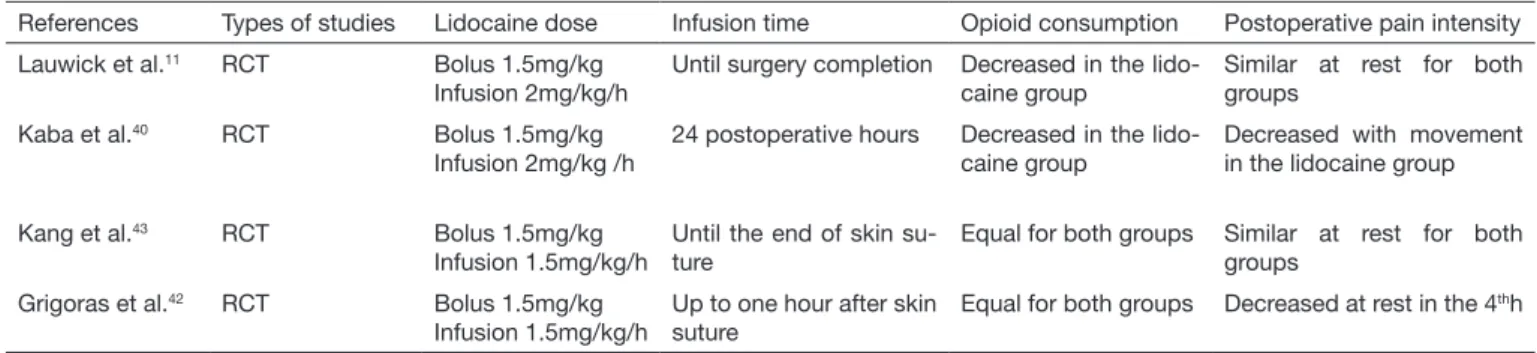
So, clinical studies using the same doses and the same infu-sion regimen are needed to evaluate the postoperative anal-gesic action of lidocaine in diferent types of pain (Table 3). As to lidocaine systematic plasma dosage, a recent study evaluating 15 patients submitted to initial dose of 1.5mg/kg followed by 2mg/kg/h continuous infusion has shown con-centrations below 4.6µg/mL 24h after drug infusion41. his plasma concentration is related to the presence of mild and tolerable symptoms (Table 1)16,30,37,38.
CONCLUSION
Intravenous lidocaine with analgesic purposes in the periop-erative period is a promising possibility. However, placebo-controlled studies are needed to evaluate its safety, its ability to promote POP relief for somatic and visceral pain as well as its ability to prevent chronic pain.
REFERENCES
1. Vigneault L, Turgeon AF, Côté D, Lauzier F, Zarychanski R, Moore L, et al. Periope-rative intravenous lidocaine infusion for postopePeriope-rative pain control: a meta-analysis of randomized controlled trials. Can J Anaesth. 2011; 58(1):22-37.
2. Joshi GP, Bonnet F, Kehlet H; PROSPECT collaboration. Evidence-based posto-perative pain management after laparoscopic colorectal surgery. Colorectal Dis. 2013;15(2):146-55.
3. Oderda GM, Gan TJ, Johnson BH, Robinson SB. Efect of opioid-related adverse events on outcomes in selected surgical patients. J Pain Palliat Care Pharmacother. 2013;27(1):62-70.
4. Lamacraf G. he link between acute postoperative pain and chronic pain syndromes. South Afr J Anaesth Analg. 2012;18(1):45-50.
5. Gottschalk A, Raja SN. Severing the link between acute and chronic pain: the anesthesiologist’s role in preventive medicine. Anesthesiology. 2004;101(5):1063-5. 6. Couceiro TC, Valença MM, Lima LC, de Menezes TC, Raposo MC. Prevalence and
inluence of gender, age, and type of surgery on postoperative pain. Rev Bras Aneste-siol. 2009;59(3):314-20 (English, Portuguese).
7. Pavlin DJ, Chen C, Penaloza DA, Polissar NL, Buckley FP. Pain as a factor complicating recovery and discharge after ambulatory surgery. Anesth Analg. 2002;95(3):627-34.
8. Apfelbaum JL, Chen C, Mehta SS, Gan TJ. Postoperative pain experience: results from a national survey suggest postoperative pain continues to be undermanaged. Anesth Analg. 2003;97(2):534-40.
9. White PF, Kehlet H. Improving postoperative pain management: what are the unre-solved issues? Anesthesiology. 2010;112(1):220-5.
10. De Oliveira GS Jr, Fitzgerald P, Streicher LF, Marcus RJ, McCarthy RJ. Systemic lidocaine to improve postoperative quality of recovery after ambulatory laparoscopic surgery. Anesth Analg. 2012;115(2):262-7.
11. Lauwick S, Kim do J, Muchelagnoli G, Mistraletti G, Feldman L, Fried G, at al. Intra-operative infusion of lidocaine reduces postIntra-operative fentanyl requirements in patients undergoing laparoscopic cholecystectomy. Can J Anaesth. 2008;55(11):754-60. 12. Marret E, Rolin M, Beaussier M, Bonnet F. Meta-analysis of intravenous
li-docaine and postoperative recovery after abdominal surgery. Br J Surg. 2008;95(11):1331-8.
13. Kuo CP, Jao SW, Chen KM, Wong CS, Yeh CC, Sheen MJ, et al. Comparison of the efects of thoracic epidural analgesia and i.v infusion with lidocaine on cytokine res-ponse, postoperative pain and bowel function in patients undergoing colonic surgery. Br J Anaesth. 2006;97(5):640-6.
14. Okada S, Hagan JB, Kato M, Bankers-Fulbright JL, Hunt LW, Gleich GJ, et al. Li-docaine and its analogues inhibit IL-5-mediated survival and activation of human eosinophils. J Immunol. 1998;160(8):4010-7.
15. Lahav M, Levite M, Bassani L, Lang A, Fidder H, Tal R, et al. Lidocaine inhibits secretion of IL-8 and IL-1beta and stimulates secretion of IL-1 receptor antagonist by epithelial cells. Clin Exp Immunol. 2002;127(2):226-33.
16. Wasiak J, Cleland H. Lidocaine for pain relief in burn injured patients. Cochrane Database Syst Rev. 2007; 18(3):CD005622.
17. de Klaver MJ, Buckingham MG, Rich GF. Lidocaine attenuates
cytokine-indu-ced cell injury in endothelial and vascular smooth muscle cells. Anesth Analg. 2003;97(2):465-70.
18. Lauretti GR. Mechanisms of analgesia of intravenous lidocaine. Rev Bras Anestesiol. 2008;58(3):280-6.
19. Light AR, Trevino DL, Perl ER. Morphological features of functionally deined neu-rons in the marginal zone and substantia gelatinosa of the spinal dorsal horn. J Comp Neurol. 1979;186(2):151-71.
20. Olschewski A, Schnoebel-Ehehalt R, Li Y, Tang B, Bräu ME, Wolf M. Mexileti-ne and lidocaiMexileti-ne suppress the excitability of dorsal horn Mexileti-neurons. AMexileti-nesth Analg. 2009;109(1):258-64.
21. Abelson KS, Höglund AU. Intravenously administered lidocaine in therapeu-tic doses increases the intraspinal release of acetylcholine in rats. Neurosci Lett. 2002;317(2):93-6.
22. Catterall WA, Mackie K. Local anesthetics. In: Brunton LL, Lazo JS, Parker KL, (editors). Goodman and Gilman’s the Pharmacological Basis of herapeutics. 11th ed.
New York: McGraw-Hill; 2006. 369-85p.
23. Becker DE, Reed KL. Essentials of local anesthetic pharmacology. Anesth Prog. 2006;53(3):98-109.
24. Lui KC, Chow YF, Safe use of local anaesthetics: prevention and management of sys-temic toxicity. Hong Kong Med J. 2010;16(6):470-5.
25. DeToledo JC. Lidocaine and seizures. her Drug Monit. 2000;22(3):320-2. 26. Kindler CH, Yost CS. Two-pore domain potassium channels: new sites of local
anes-thetic action and toxicity. Reg Anesth Pain Med. 2005;30(3):260-74.
27. Clarke C, McConachie I, Banner R. Lidocaine infusion as a rescue analgesic in the perioperative setting. Pain Res Manag. 2008;13(5):421-3.
28. Sheets MF, Hanck DA. Molecular action of lidocaine on the voltage sensors of sodium channels. J Gen Physiol. 2003;121(2):163-75.
29. Moldovan M, Alvarez S, Romer Rosberg M, Krarup C. Axonal voltage-gated ion channels as pharmacological targets for pain. Eur J Pharmacol. 2013;708(1-3):105-12. [Erratum in: Eur J Pharmacol. 2013;716(1-3):77]
30. Bourne E, Wright C, Royse C. A review of local anesthetic cardiotoxicity and treat-ment with lipid emulsion. Local Reg Anesth. 2010;3(1)11-9.
31. Amir R, Argof CE, Bennett GJ, Cummins TR, Durieux ME, Gerner P, et al. he role of sodium channels in chronic inlammatory and neuropathic pain. J Pain. 2006;7(5 Suppl 3):S1-29.
32. McCleane G. Intravenous lidocaine: an outdated or underutilized treatment for pain? J Palliat Med. 2007;10(3):798-805.
33. Strichartz GR. Novel ideas of local anaesthetic actions on various ion channels to ameliorate postoperative pain. Br J Anaesth. 2008;101(1):45-7.
34. Petrenko AB, Yamakura T, Baba H, Shimoji K. he role of N-methyl-D-aspartate (NMDA) receptors in pain: a review. Anesth Analg. 2003;97(4):1108-16. 35. Abram SE, Yaksh TL. Systemic lidocaine blocks nerve injury-induced
hype-ralgesia and nociceptor-driven spinal sensitization in the rat. Anesthesiology. 1994;80(2):383-91.
36. Hahnenkamp K, Durieux ME, Hahnenkamp A, Schauerte SK, Hoenemann CW, Vegh V, et al. Local anaesthetics inhibit signaling of human NMDA receptors recom-binantly expressed in Xenopus laevis oocytes: role of protein kinase. C. Br J Anaesth. 2006;96(1):77-87.
37. Minami K, Uezono Y. he recent progress in research on efects of anesthetics and analgesics on G protein-coupled receptors. J Anesth. 2013;27:(2):284-92. 38. Keiichi O. Intravenous lidocaine to treat postoperative pain management: novel
stra-tegy with a long-established drug. Anesthesiol. 2007;106(1):5-6.
39. Vather R, Trivedi S, Bissett I. Deining postoperative Ileus: results of a systematic review and global survey. J Gastrointest Surg. 2013;17(5):962-72.
40. Kaba A, Laurent SR, Detroz BJ, Sessler DI, Durieux ME, Lamy ML, et al. Intrave-nous lidocaine infusion facilitates acute rehabilitation after laparoscopic colectomy. Anesthesiology. 2007;106(1):11-8.
41. Martin F, Cherif K, Gentili ME, Enel D, Abe E, Alvarez JC, et al. Lack of impact of intravenous lidocaine on analgesia, functional recovery, and nociceptive pain threshold after total hip arthroplasty. Anesthesiology. 2008;109(1)118-23.
Table 3. Lidocaine dose and infusion time, its relationship with opioid consumption and postoperative pain intensity.
References Types of studies Lidocaine dose Infusion time Opioid consumption Postoperative pain intensity Lauwick et al.11 RCT Bolus 1.5mg/kg
Infusion 2mg/kg/h
Until surgery completion Decreased in the lido-caine group
Similar at rest for both groups
Kaba et al.40 RCT Bolus 1.5mg/kg
Infusion 2mg/kg /h
24 postoperative hours Decreased in the lido-caine group
Decreased with movement in the lidocaine group
Kang et al.43 RCT Bolus 1.5mg/kg
Infusion 1.5mg/kg/h
Until the end of skin su-ture
Equal for both groups Similar at rest for both groups
Grigoras et al.42 RCT Bolus 1.5mg/kg
Infusion 1.5mg/kg/h
Up to one hour after skin suture
Equal for both groups Decreased at rest in the 4thh
42. Grigoras A, Lee P, Sattar F, Shorten G. Perioperative intravenous lidocaine decreases the incidence of persistent pain after breast surgery. Clin J Pain. 2012;28(7):567-72. 43. Kang JG, Kim MH, Kim EH, Lee SH. Intraoperative intravenous lidocaine reduces
hospital length of stay following open gastrectomy for stomach cancer in men. J Clin Anesth. 2012;24(6):465-70.
44. Pasero C. Intravenous lidocaine for acute pain treatment. J Perianesth Nurs. 2011;26(3):166-9.
45. McCarthy GC, Megalla SA, Habib AS. Impact of Intravenous lidocaine Infusion on postoperative analgesia and recovery from surgery: a systematic review of randomized
controlled trials. Drugs. 2010;70(9):1149-63.
46. Hickey OT, Nugent NF, Burke SM, Hafeez P, Mudrakouski AL, Shorten GD. Persis-tent pain after mastectomy with reconstruction. J Clin Anesth. 2011;23(6):482-8. 47. Iohom G, Abdalla H, O’Brien J, Szarvas S, Larney V, Buckley E, et al. he
associa-tions between severity of early postoperative pain, chronic postsurgical pain and plas-ma concentration of stable nitric oxide products after breast surgery. Anesth Analg. 2006;103(4):995-1000.