Contexto Internacional vol. 39(3) Sep/Dec 2017 http://dx.doi.org/10.1590/S0102-8529.2017390300008
War Zone Acapulco: Urban Drug
Trafficking in the Americas
Thiago Rodrigues* Mariana Kalil** Roberto Zepeda *** Jonathan D Rosen****
Abstract: Acapulco epitomises the (in)security of urban zones in the Americas whose geographical, political and economic divisions are exacerbated by the political economy and geopolitics of drug traicking, as well as by militarised attempts to ight it. Various geographic, political, and economic factors in the Acapulco Metropolitan Zone (AMZ) have impacted drug traicking and organised crime and contributed to high levels of violence. As a result, Acapulco now ranks among the 50 most violent cities in the world. his article analyses the trends in drug traicking and organised crime in the AMZ, and highlights the lessons for scholars and policy-makers.
Keywords: Drug Traicking; Urbanisation; Militarisation; Acapulco; Mexico; Criminology; Other-ness.
Introduction
Mexico’s ‘war on drugs’ began in 2006 when President Felipe Calderón launched a mili-tary campaign against drug traicking and organised crime. he results have been under-whelming; in the subsequent decade, the ‘war on drugs’1 has resulted in about 200,000
vio-lent deaths, 60% of which are linked to narcos (drug dealers) or organised crime (Rosen and Zepeda 2016).
Literature about the Mexican war on drugs usually focuses on drug traicking or-ganisations (DTOs), corrupt police forces, the militarisation of public safety, the so-called
* Fluminense Federal University (UFF), Niteroi–RJ, Brazil; [email protected]. ORCID iD 0000-0002-0962-0391.
** University of Brasilia (UnB), Brasilia–DF; Brazil; [email protected]. ORCID iD 0000-0003-1302-8339.
*** National Autonomous University of Mexico (UNAM), Mexico City, Mexico; zepeda_roberto@hotmail. com. ORCID iD 0000-0001-5811-8296..
drug cartels, and Mexico’s role in the political economy of drug traicking in the Americas (Rosen and Zepeda 2016; Langton 2013; Marcy 2010; Ravelo 2011; Sabet 2012; Esquiv-el 2013; Benítez Manaut 2010; Freeman and Sierra 2005; Jones 2016; Rodrigues 2017). Literature on non-conventional threats to international security usually deal with issues involving the US-Mexican border (Astorga 2015; Esquivel 2013; Jones 2016; Gutiérrez 2007). However, International Relations scholars have paid little attention to other Mexi-can regions that are increasingly caught up in the dynamics of drug traicking. his article aims to ill this gap by examining the dynamics of drug traicking and its repression in the city of Acapulco in the south-eastern state of Guerrero.
One of the major blind spots in the contemporary literature about international secu-rity is its lack of attention to the relationship between cities and warfare. Despite the his-torical connection between cities and warfare since the beginning of human settlement, the emergence of the modern state in Europe in the late Middle Ages pushed security and defensive limits out to state borders (Giddens 1985; Tilly 1990; Ashworth 1991; Graham 2004). However, the city/warfare connection has regained traction ater the massive at-tacks on cities in the so-called total war era which reached its climax during World War II (Keegan 1993). Since 1945, urban warfare has become increasingly related to insurgency and counter-insurgency that have reclaimed matters of security in the colonial world (in-cluding the anti-French insurrection in Algeria in the late 1950s and early 1960s), the post-colonial world (including the urban guerrillas in Latin America during the 1960s and 1970s), and industrialised countries (including the Irish Republican Army bombings in the United Kingdom). In recent years, urban terrorism has been added to this array of challenges (Shaw 2004; Ashworth 1991).
In the post-Cold War era, warfare in urban spaces has included confrontations among armed forces, peacekeepers, and various non-state actors, such as those on the streets of Sarajevo and Mogadishu. In this context, security studies have highlighted the blurring of the boundaries between ‘national security’ and ‘public safety’ in the Global South as well as the developed world, especially ater the worldwide spread of anti-terrorist security strategies in the wake of 9/11 (Gros 2010; Graham 2010; Kaldor 2012; Bigo 2002; Feldman 2004; Corva 2009). As Graham (2004: 3) has noted:
it is no longer adequate to theorise cities as local, bounded sites that are separated from the rest of the world. Similarly, political violence is now fuelled and sustained by transnational networks that can be global and local at the same time.
Acapulco epitomises the contemporary (in)security dynamics of urban zones in the Americas in which existing geographic, political, and economic boundaries and cleavages are being reinforced by the political economy and geopolitics of drug traicking, as well as by militarised attempts to ight it. he comparative advantages that allow a given city to participate in drug traicking in the Americas are similar, and improving our understand-ing of Acapulco’s participation in the continental drug traickunderstand-ing scheme would help us to better understand the sources of insecurity in American cities, and develop better public policies for addressing urban security in the 21st century.
he data that spurred this research was the appearance of Acapulco in 2011 on lists of the world’s deadliest cities, which receive widespread media and other attention every year. Given this, we decided to examine the data sources and methods of classiication un-derpinning these lists. We analyse data from lists published by a civil society organisation, the Citizen Council for Public Security and Criminal Justice (Consejo Ciudadano para la Seguridad Pública y la Justicia Penal, or CCSPJP) as well as data about homicide rates in Mexico provided by the National Institute for Statistics and Geography (Instituto Nacional de Estadística y Geografía, or INEGI). However, we have also examined data from the Igarapé Institute’s Homicide Monitor, a common source of information for media reports – including those in he Economist (2017) – on violent cities around the world.
he Homicide Monitor utilises data from the Executive Secretariat of the National System of Public Security (Secretariado Ejecutivo del Sistema Nacional de Seguridad Públi-ca, or SESNSP), comprising members of the federal, regional and local executive branches of government, whose policies are embedded in partisan issues, and whose tenures are constitutionally limited. It also includes members of the judiciary, namely prosecutors, representatives of the penal system, and the police. herefore, this body represents role players whose interests are signiicantly more contextual than those of civil servants, whose liabilities last for a lifetime and follow them on a daily basis, and who tend to be less prone to manipulate data for short-term political gain than the former.
he Secretariado’s website lists local and regional committees as part of its structure, but does not specify whom they represent. Representatives of the judiciary and the police are civil servants who tend to concentrate on control, not only due to their roles in the legitimate use of force, but also their focus on containment rather than mediating or ne-gotiating with ‘outlaws’, especially in the broader landscape of the government’s decision to co-operate fully with the United States on the ‘war on drugs’ through, for instance, the Mérida Initiative.
Regarding the veracity of Mexican data on homicide rates, CCSPJP states:
secondly, it is still well-known that some regional governments - governments of states - (who are the ones who feed the Sistema with data) manipulate their igures to portray an inferior homicide rate than the actual one. Before this situation, the homicide numbers of-fered by the National Institute for Statistics and Geography (INEGI) are of great help. INEGI accounts for homicides, not for the number of investigations that are opened, basing their data on thorough in-spections of the administrative archives of homicide reports. Fur-thermore, INEGI is not political actor hence having signiicantly less or even no motive to manipulate the numbers (CCSPJP 2017: 34-35; authors’ translation).
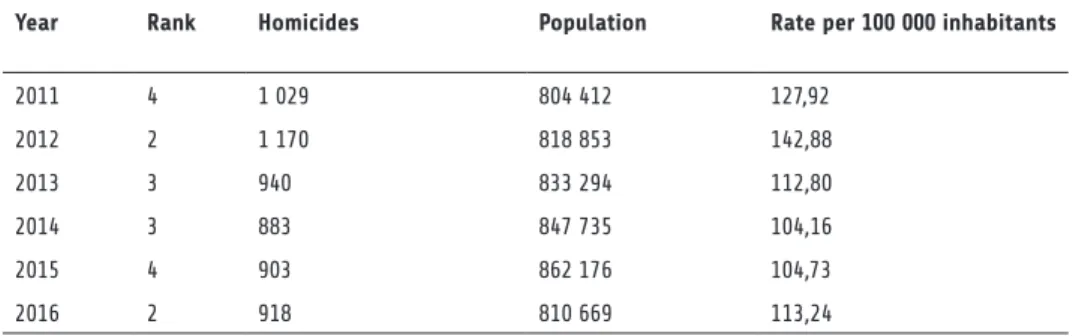
herefore, the decision to limit our analysis to CCSPJP and INEGI data is based on methodological considerations, but also has political implications that will be addressed below. Until 2010, Acapulco was not even among the 50 most violent cities in the world. As Table 1 shows, ater entering the ranking in 2011, the homicide rate decreased once again, but not enough to return to pre-2011 levels. he reasons for this trend are addressed in Section II of this article.
Table 1: Acapulco’s ranking among the violent cities in the world, 2011-2016
Year Rank Homicides Population Rate per 100 000 inhabitants
2011 4 1 029 804 412 127,92
2012 2 1 170 818 853 142,88
2013 3 940 833 294 112,80
2014 3 883 847 735 104,16
2015 4 903 862 176 104,73
2016 2 918 810 669 113,24
Source: CCSPJP.
Contemporary (in)security dynamics in Acapulco
he south-western Mexican state of Guerrero used to be known for its natural beauty, including high mountain peaks and a delightful coast. In the 1950s, the city of Acapulco was a top tourist destination, with its white beaches frequented by Hollywood movie stars and US jet-setters. Celebrities bought beachfront mansions and even hotels in the city. he destination of John and Jacqueline Kennedy’s 1953 honeymoon, and the location of one of Elvis Presley’s movies in the 1960s, Acapulco was a place to see and be seen.
However, this seemingly idyllic status switly changed into a considerably less hedo-nistic one. Natural beauty was not necessarily what brought tourists to this Mexican city. he bucolic atmosphere resulted from a combination of geography and demography in a speciic era in the international political economy of drug traicking. By the late 1970s, other Mexican destinations, such as Cancún and Cabo San Lucas, had become more ap-pealing. Acapulco’s appeal as a tourist destination declined in the 1980s and 1990s and coincided with the increasing importance of Mexican DTOs in drug traicking in the Americas. Acapulco became one of the 50 most violent cities in the world during the Mexican government’s drug war, which will be explained in more detail below.
Geographic features
Population geography, as a subield of human geography, places demographics in a geo-graphic context. he impact of demogeo-graphic cycles on territory has been studied from several perspectives (Plane 2004). he focus on who occupies what spaces in urban ter-ritories also involves scholarly literature from criminology as ‘the identiication of crime hot spots was perhaps a watershed in refocusing attention on the spatial/location features of crime’ (Anselin et al 2000: 215).
According to INEGI, Acapulco had a population of about 110 000 in the 1960s. In the 1970s, in a demographic transition similar to those in many Latin American cities, its population grew by 144.51%, a rate that declined to 64.64% in the 1980s and to 43.15% in the 1990s. In the 21st century, the rates have tended to stabilise. Demographic transitions
involve increasing birth rates and slowing death rates, overlapping in developing countries with processes of urbanisation.
he rapid increase in Acapulco’s population in the 1970s can be seen as part ‘of the complex causal forces behind violent conlicts’ (Anselin et al 2000: 12). Goldstone (2012: 12) lists economic development, regime type, and leadership as contextual elements that help to explain the impact of demographic transitions on urban violence. While not ex-plicitly cited, the geopolitical and political-economic dynamics of drug traicking are among those elements. In fact, we argue that Acapulco’s entry into the list of the 50 most violent cities in the world represents an archetype of contemporary (in)security dynamics in urban zones in the Americas afected by drug traicking, as well as militarised strategies designed to combat such problems.
Aca-pulco from the 1970s until the 1990s represents a challenge for a state, and especially a city, with limited resources. Acapulco’s local administration has not had the institutional capacity to address the increasing population. Guerrero, which is one of the poorest states in Mexico, is deined by high levels of poverty, corruption, and impunity, which have cre-ated the conditions for drug traicking organisations to operate. In recent years, these scenarios have also fostered processes of radicalisation that have signiicantly contributed, for example, to the current face of urban violence in Latin America, as well as terrorism activities in the Western world (Mathieu and Tolosa 2014; Lyon 2004).
In the course of critical geography, Milton Santos discusses the marginalisation of urban spaces by examining Armstrong’s and McGee’s concept of metropolitan involution (1968, cited in Santos 1988: 120). In the 1960s, these authors focused attention on the transfer of rural practices to urban spaces during high levels of rural-urban migration. Santos (1988: 126) argued that from then on the situation overtook the mere recreation of rural life in urban spaces: ‘the high concentration of the urban poor population creates a cultural background entailing ways of life that are less than modern, not at all dynamic, and make little or no diference to the statistics on economic growth’ (Santos 1998: 126).
Santos’s understanding of the social relevance of being part of oicial economic ig-ures, such as GDP rates, entails a rationale that intertwines population geography with human geography: since the informal economy does not provide revenue to the state, or to the most politically inluential, oicial economic role players, it sparks a process of ‘otherness’ that forges visible and invisible – yet deadly – boundaries in urban settings. he reiication of neighbourhoods and people who ‘do not matter to the statistics of economic growth’ happens through the identiication of these spaces and individuals with urban spaces characterised by a ‘new metropolitan involution,’ as pointed out by Santos.
Figures 1 and 2 record the incidence of violent crime in the AMZ in 2011 and 2012. he concentration of crime in the metropolitan zones of Colonias Zapata, Renacimiento, Jardines, and Coloso clearly illustrate this process of involution, and its results in terms of violent crime. When analysing these maps, it is important to bear in mind the displace-ment of violent crime throughout the city following the deploydisplace-ment of federal repressive forces. his displacement will be analysed in the second section of this article, which ad-dresses the recent militarisation of the war on drugs in Acapulco.
Economic and other geographic features
Criminology also helps us to understand why Acapulco epitomises the contemporary (in) security dynamics of urban zones in the Americas. Considering the economic features of the new metropolitan involution and its visible and intangible boundaries are also helpful in this analysis. For Bursik and Grasmick:
assumed that this relationship was an indirect one, mediated in turn by the residential instability and heterogeneity of the neighborhood and by the regulatory capacity of the area. Nevertheless, despite the indirect nature of its efect on crime rates, the economic composi-tion of local urban communities was the key ecological factor that set in operation the dynamics associated with social disorganisation (Bursik and Grasmick 1993: 263-264).
In the case of Acapulco, it is precisely the ‘Acapulco boomers,’ efectively trapped in areas of involution, who are caught up in drug traicking and whose lives are being wast-ed. Not surprisingly, statistics show that men in their twenties are the main sources of violent labour for DTOs, with ‘homicides […] committed primarily by men and against men’ (Heinle et al 2015: 21). hese ‘worthless boomers,’ disconnected youths, are more vulnerable to being recruited for the most violent tasks, and more likely to be killed due to disputes among DTOs as well as state repression: ‘When separated by age, however, the leading cause of death for young men in Mexico hinges on economic status, since wealthy young men are more likely to die of car accidents, and those of modest means more likely to be murdered’ (Heinle et al 2015: 15).
During Acapulco’s demographic transition (1970s-1990s), ‘US narcotics policy to-wards Mexico was [considered] ultimately a success, but only because the Mexican gov-ernment chose to crack down on marijuana and poppy producers and traickers’ (Lupsha 1981: 97). In the mid-1970s, Mexico supplied 90% of the heroin and 70% of the marijuana consumed in the United States. In the 1980s, however, only 30% of those drugs came from Mexico itself, and the country began to serve as a transit zone for cocaine and marijuana destined for the United States from other South American countries (Lupsha 1981).
he diminished role of Mexican DTOs did not mean that the US war on drugs or the repressive policies of the Mexican state had succeeded, but that the drug economy had been reshaped, notably by the rise of Andean cocaine interests in the United States and Western Europe, which displaced the core of this illegal activity to South America (Marcy 2010; Santana 2004). In the process, Mexico lost US funding and other forms of support for combatting drug traicking, and, despite the US State Department’s recognition that crop substitution played a key role in avoiding a relapse, no such policy was implemented (Lupsha 1981: 97). Moreover, politicians and police oicials in Acapulco had grown ac-customed to the lure of narco-dollars (Lupsha 1981: 100).
he demographic transition and the advent of drug traicking in Acapulco added to the herd behaviour that drew tourists away from the city. his reduced the revenues of the Guerrero and Acapulco authorities, and therefore their ability to combat drug traicking, during the very period of the city’s demographic transition.
Guerrero’s suitability for producing marijuana and poppy, the raw material for her-oin, and the AMZ’s comparative advantages in relation to the political economy of drug traicking also need to be factored into the analysis of Acapulco as an archetype of the dynamics of (in)security in the urban spaces of the Americas. his includes the fact that Acapulco’s proximity to Puerto Vallarta as well as Baja California and the US Paciic Coast makes it ‘a perfect setting for marijuana and poppy production as well as heroin manufac-turing’ (Kyle 2015: 11).
By 2010, Guerrero was already on the verge of surpassing the northern state of Du-rango as the main source of heroin, and succeeded, accounting for 70% of heroin pro-duced in Mexico (Kyle 2015). his output is aimed primarily at markets in the United States and Canada, and secondarily at the Mexican market, consisting not only of Mexi-cans but also gringo tourists. Guerrero is also a hub of the so-called Paciic Route which the transnational DTOs regard as a strategic path ‘not only [of cocaine] to North America, but also, for the arrival of raw materials for the production of cocaine and for the industry of synthetic drugs’ (Pérez 2016: 136) (Saviano 2015; Pérez 2016; Rosen and Zepeda 2016).
Following Krauthausen and Sarmiento (1991) about the logic behind the violent conduct of DTOs, the possession of territory is vital for DTOs to control areas for the production, storage, sales, and distribution of raw materials. In an environment of illegal-ity, this oten leads to violent disputes and the exercise of control over local populations, via coercion as well as patronage, in order to retain the conquered territories (Rodrigues and Labate 2016; Rodrigues 2017). In this respect, Krauthausen’s and Sarmiento’s insights into the political economy of drug traicking in the Americas support our analysis of the political interactions that provided borders which, aggravated by Acapulco’s role in the America’s political economy and geopolitics of drug traicking, led to the city becoming an epitome of contemporary (in)security in urban zones in the region.
Contemporary (in)security dynamics in Acapulco’s urban zones
The political factor
that divides markets, eliminates concurrents, and establishes a retail price for consumers. Instead, the notorious Colombian DTOs of the 1980s operated as oligopolies, without explicit or durable centralisation, which led to agreements among them on how to secure their operations in Colombia as well as their transnational connections with major whole-sale DTOs, such as the Italian maia (Krauthausen and Sarmiento 1991: 35-53).
he third dimension of this intercontinental economy is the retail level, where local DTOs buy ‘pure drugs’ from the logistics DTOs and then prepare them for retail sales (usually by adulterating them to increase their volume). hese groups control the urban areas of the new metropolitan involution, and tend towards ierce territorial conlicts among themselves aimed at securing their exclusive territories and preserving the coni-dence of the wholesale DTOs. Krauthausen and Sarmiento (1991) maintain that the irst and third phases are deined by competition, as many actors ight over a very proitable business. hey argue that competition over illegal markets tends to be violent, since there is no legitimate actor capable of persuading, inducing, or coercing the parties involved to maintain peace. he second phase tends to be less violent. Given a (subtle) balance among a smaller number of DTOs capable of penetrating, corrupting, and controlling state ap-paratuses and some sectors of the formal economy, the major players act as kingpins, as successful and feared business people, who prefer to negotiate and to corrupt rather than to ight each other.
Until the 2000s, Mexican DTOs occupied a secondary position in the political econo-my of drug traicking in the Americas, behind the Colombian cartels. Until then, Mexican DTOs were also less fragmented, while dedicated to the production of heroin and mari-juana for a limited share of the US market, mainly smuggling Colombian cocaine into the United States. Nevertheless, business was on the rise, and Colombia’s dominant position in this economy was about to change.
From 2005 onwards, various DTOs (CIDA, La Barredora, Guerrero Seguro, and oth-ers) in the AMZ began to ight each other, counting on unstable alliances with two rival ‘cartels’: Los Zetas and the Sinaloa cartel (Revelo 2011; Kyle 2015). hey were competing over control of Guerrero’s smuggling routes and heroin output (Kyle 2015: 18). By then, these DTOs were signiicantly fragmented, while, in 2012, La Barredora is said to have disappeared from the streets of AMZ (Kyle 2015). Since 2010, Guerrero has witnessed the emergence of a ‘multitude of [drug-related] criminal groups with unstable internal and external relations’ (Kyle 2015: 22). he volatility of these organisations has altered the pre-vious established illegal connections with local politicians, entrepreneurs, economic elites, land owners, local populations, and local police forces. he open competition among small and unstable DTOs has intensiied the violent dispute over territory as well as so-cial, political and economic inluence. his situation has become even more complex and violent since federal forces began to combat the DTOs in Guerrero, focusing on Acapulco.
reined drugs. Furthermore, these organisations have the capacity to corrupt politicians, business people, police, and military oicers. hey also control crucial logistical networks in South America, the Caribbean, Asia, and the United States. Mexico’s proximity to the world’s biggest drug market feeds a non-stop scenario of competition. herefore, the operation of Mexican DTOs can be viewed as a hybrid oligopolistic-competitivemodel comprisingconstant confrontation, leeting alliances, struggles to survive, and eforts to expand illegal activities.
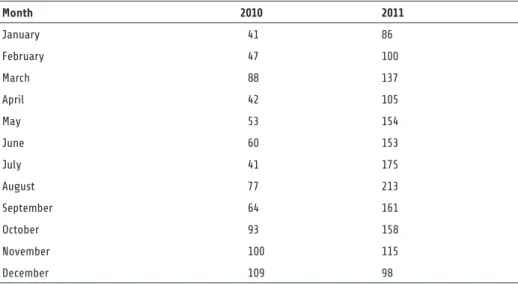
Table 2 corroborates Krauthausen and Sarmiento’s claims that competition among many actors ighting over highly proitable illegal business operations tend to generate high levels of violence. In the case of the AMZ, Guerrero’s only metropolitan area, this translated into an increase in homicides, concentrated in the spaces of the new metro-politan involution, the marginalised urban areas outside the spaces of historical income concentration. Table 2 relects the growth in homicides that turned Acapulco into one of the ive most violent cities in the world.
Table 2: Violent deaths in Guerrero by month, 2010 and 2011
Month 2010 2011
January 41 86
February 47 100
March 88 137
April 42 105
May 53 154
June 60 153
July 41 175
August 77 213
September 64 161
October 93 158
November 100 115
December 109 98
Source: INEGI.
The Mexican war on drugs, militarisation, and Acapulco
A brief contextualisation of the war on drugs in Mexico after the 1990s
In the 1990s, due to increased US surveillance, the Caribbean drug smuggling route from the Americas to the United States became more problematic, thus forcing kingpins such as Colombia’s Pablo Escobar, the leader of the Medellín cartel, to develop alternatives. As a result, Mexico returned to the core of the political economy and geopolitics of drug traf-icking in the Americas.
he balloon efect is at the core of the shiting priorities in the international political economy of drug traicking at the start of the 21st century. In December 2006, when
Calde-rón took oice in Mexico, local DTOs controlled nearly 90% of all cocaine smuggled into the United States, producing substantial amounts of heroin and synthetic drugs (Rosen and Zepeda 2006: 22). When Calderón’s electoral victory was tainted by allegations of fraud, he managed to boost his campaign numbers by declaring ‘total war’ against DTOs.
Nevertheless, drug traicking and violence skyrocketed during his administration (Carpenter 2012; Grillo 2012), with organised crime groups ighting among each other over territory and drug routes (Watt and Zepeda 2012; Jones 2016). A common belief that police forces were corrupt or prone to corruption bolstered Calderón’s decision to deploy the military instead of the police, which demanded changes to the constitution. In 2007, Calderón and George W Bush signed the Mérida Initiative, a bilateral agreement to ight drug traicking, which was quickly compared to Plan Colombia, especially since it ‘allocated the vast majority of the resources to hard components [military equipment and training]’ (Rosen and Zepeda 2016: 20). he key modus operandi was to equip the military to intervene in domestic law enforcement and security (Benítez Manaut 2010; Anaya 2014).
Ater becoming president in 2012, Enrique Peña Nieto promised to revamp Mexico’s security strategy. He distinguished himself from the previous government by focusing less on the discourse of the drug war and more on social reform – a strategy that has not been very successful. Indeed, Semple (2016) has argued that ‘[t]he surge in violence around Mexico relects an increasingly volatile criminal landscape, and the limitations of North America’s counternarcotics strategy’. his may help to explain why politicians seek to por-tray the escalating violence in a certain way, especially following the escape of the notori-ous drug lord Joaquín ‘El Chapo’ Guzmán from a federal prison in July 2015 as well as the assassination of 43 students at a teacher’s college in Ayotzinapa, Guerrero, in September 2014, with the complicity of local authorities, including the police (Boullosa and Wallace 2015; Stone 2016; Gallegos 2017). he latter incident drew international attention to the state of Guerrero and its increasing levels of urban violence.
Militarisation and practices of urban security
In the 20th century, ‘war re-entered the city’ in tandem with massively increased levels of
new zones of involution and enemy formation, of visible and invisible boundaries within urban spaces (Graham 2010: 49). Indeed, Graham has described the current phase of the relationship between warfare and cities as the ‘new urban militarism’ (2010: 121) He iden-tiies a trend to ‘extend and revivify the urban militarisation, securitisation,2 Manichean
thinking, and fmongering that were a central feature of the Cold War but also of ear-lier wars’ (Graham 2010: 121).
his ‘new militarism’ reclaims features of historical processes of militarisation such as ‘the social construction of a conceptual division between the inside and the outside of a nation or other geographic area, and the orchestrated demonisation of enemies and enemy places beyond the boundaries of inside’ (Graham 2010: 122). Given this, he deines militarisation as a ‘complex and multidimensional process’ involving:
the normalisation of military paradigms of thought, action and policy; aggressive attempts to discipline bodies, places and identities deemed not to beneit masculinised (and interconnected) notions of nation, citizenship or body; and the deployment of a wide-range propaganda which romanticises or sanitises violence as a means of righteous revenge (Graham 2010: 122).
Beyond notions developed by Zaverucha (2000) and Bagley (1993), who understood militarisation as the presence of military troops in policing activities, the nomination of high-ranking military oicers for key public safety positions, and the formation of special military battalions to ight criminal organisations, Graham’s ‘new military urbanism’ is a comprehensive concept that recognises the tangible and intangible features of militarisa-tion. Additionally, Graham’s notion allows analyses of how a set of technologies originally developed for military purposes, such as GPS and video surveillance, has been applied for ‘civilian’ purposes, recalling Foucault’s relection on the ‘society of disciplines’ that, from the late 18th to the mid-20th century, aimed at the production of docile and useful bodies
within institutions such as prisons and factories (Foucault 1995).
his notion of society was gradually superseded by Deleuze’s (1992) idea of ‘societies of control’ in which electronic monitoring and open-air surveillance have introduced new forms of social control. In this context, militarisation is not only related to the use of force, but also to a particular mindset, distinguishable within public security policies as well as among civil society – as demonstrated by the difusion of restrained urban areas, walls and electronic monitoring, and the widespread use of private security companies for personal and property protection.
and DTOs, as major threats to security reinforces the articulation between internal and external security practices, which further blurs the separation of the national and the in-ternational, the police and the military.
Neocleous (2014) develops a broader deinition of security, leading him to Foucault’s relections on the genealogy of the concept of police, linked to the emergence of modern European states. Foucault (2009) claimed that when the irst modern states were in the process of formation, the predominant notion of ‘police’ among the Absolutist princes was related to a complex set of royal decisions and policies aimed at controlling the economy, or the total circulation of goods and people within the territory in question and between it and other countries, and the territorialisation of subjects and their occupations in the name of the splendour and wealth of the kingdom. According to Foucault (2009), the con-temporary notion of police as a repressive law enforcement state agency emerged in the late 18th century, ater the liberal criticism of its centralised economic control by the state.
However, the modern tradition of political philosophy established a deinition of the state as the institution legitimised by a social contract that restricted ‘peace’ within nation-al borders. Neocleous (2014) underscores the abstraction of socination-al contract theory, un-veiling the production of legitimacy through a violent history of state formation marked by military victories of certain groups over others. Politics and the state, then, would be pervaded by conlict, since governmental practices comprise complex tactics seeking the production of certain social behaviours, mindsets, discipline, and order. In this sense, the political is not synonymous with peace but with paciication (i.e., the imposition of some-one’s order over a territory and a population) (Neocleous 2014; Rodrigues forthcoming).
As noted by RBJ Walker (1993), the production of modern political thought involved the construction of an internal order corresponding with ‘peace’ in contrast with an exter-nal environment of chaos and anarchy: a peaceful ‘inside’ threatened by a violent ‘outside’. his inside/outside duality is crucial for deining the ‘national self ’ in the face of an ex-ternal (and potentially threatening) ‘otherness’, which is basically the transposition of the modern concept of subjectivity based on a remote Western Manichaean tradition built upon divisions between good and evil, peace and war, salvation and damnation.
he contemporary emergence of transnational non-state actors sheds light on the per-manent ‘state of violence’ (Gros 2010) within, across and outside state borders, providing the current dynamics of violence in which the city is the main battleield, and unveiling the perennial animosity of a process of otherness within the borders of the nation-state. Governments, then, become entities whose responsibility includes ‘to separate people and circulations deemed risky or malign [for the lows of global capitalism] from those deemed risk-free or worthy of protection’ (Graham 2010: 158).
The militarisation of the war on drugs in Acapulco
against drug traicking in urban areas, it is not hard to infer why it opts to report records of judicial inquiries, which tends to underplay the number of homicides, since there are cases in which one inquiry accounts for several homicides – a particular law in the case of the post-militarisation AMZ – instead of establishing how many homicides occurred in the course of a given incident or investigation.
Since the militarisation of the ight against drug traicking in Acapulco (in October 2011), the Homicide Monitor has provided the following data:
Table 3: Homicide Monitor data for the City of Acapulco, 2011-2016
Year Number of homicides Population Rate per 100 000 inhabitants
2011 1 008 813 443 123,9
2012 1 170 822 422 142,3
2013 883 830 309 106,3
2014 590 837 271 70,5
2015 902 843 413 107
2016 918 838 841 108,2
Source: Homicide Monitor.
he contrast between Table 3 and Table 1 is revealing.
Table 4: Comparison of average and median homicide rates
CCSPJP Homicide Monitor
Average homicide rates 117,62 109,7
Median homicide rates 108,48 88,4
(Average - Median) 9,14 21,3
Source: Compiled by the authors from CCSPJP and Homicide Monitor data.
he diference between the average homicide rate is relatively slight when compared to the diferences between the medians. his is alarming, as it shows that the samples dif-fer signiicantly in terms of the concentration of homicide rates per year. In both samples, homicide rates decrease from 2011 until 2016, yet the level of decrease is strikingly dif-ferent. While CCSPJP’s homicide rates tend to stabilise following a slight decrease ater the militarisation of Acapulco’s campaign against drug traicking, Table 3 shows that the lowest homicide rates are concentrated in the years following militarisation.
drug traicking in Mexico are more prone to maximising the positive impacts of milita-risation on homicide rates in urban areas than public agents who are regionally bound, avoiding at least some of the local pressures to portray data in certain ways, besides being disconnected from the decision-making process of militarisation.
Furthermore, while the internal variations in homicide rates in 2011 and 2012 are relatively similar, there are signiicant diferences in the rates of decrease in 2013. Since the Homicide Monitor sample focuses on opened investigations, it is possible to infer that, following the early years of militarisation, when homicide rates increased with the entrance of yet another armed actor in the urban violence surrounding drug traicking in Acapulco, this became normalised under the paradigm of a new urban militarism (Gra-ham 2010). In the case of the Homicide Monitor sample, this normalisation follows a signiicant drop in homicide rates. Given that the CCSPJP rates are signiicantly higher, this points to a concentration of violent incidents, which in both cases, albeit to diferent degrees, can be deemed a result of normalisation. Figures 1 and 2 corroborate this, as they depict a decrease in violent incidents throughout the AMZ as well as a concentration of these incidents in areas of metropolitan involution.
As Graham (2010) contends, the new urban militarism entails the deployment of wide-ranging propaganda that romanticises and/or sanitises the massive use of power against a particular grouping. When this propaganda emphasises the reduction of vio-lence through the legitimate use of force, it tends to disguise what Neocleous (2014) and Rodrigues (forthcoming) characterise as a desire for social revenge, especially in a situa-tion in which the inherent tendency of the social contract to legitimise the violent process of silencing and targeting certain groups of people is increasingly revealed. he Igarapé Institute’s use of Sistema data, especially in the light of the former’s credibility in the me-dia, could then be interpreted as propaganda which seeks to depict liberal patterns of eiciency, through which the state is successfully disciplining and controlling the urban areas of the new metropolitan involution.
When the Igarapé Institute’s data and methods are presented in its user-friendly, 3D Homicide Monitor, in contrast with CCSPJP’s and INEGI’s conventional texts and more technical approaches, the Institute becomes a tool in the transition of a society of disci-plines to a society of control, by normalising – and technically glamourising – death tolls in urban regions objectiied by the geographic, economic, and political boundaries in the city of Acapulco. Also, when this data gloriies the tactics of discipline and control that further difuse the existence of constricted areas within metropolitan zones, it lends cred-ibility as well as eiciency to the normalisation of segregation through other technological means, such as walls, electronic monitoring, and private security companies.
with all its lethal power, and backed up by a superpower, the United States, has failed to re-establish the pre-2011 status quo.
h e importance of the CCSPJP and INEGI data in illustrating the processes of ‘oth-erness’ in these involuted areas cannot be overstated. h e visible and invisible boundar-ies created by geographic, political, and economic processes of ‘otherness’ are the depen-dent variables that explain the outburst of violence in the AMZ through the worsening of the political economy and the geopolitics of drug trai cking in the Americas, as well as through practices of militarisation. Since processes of otherness are deeply entrenched in perceptions of the other, the data adds to a set of beliefs that tends to vary according to the identity of the individual or group.
In a city, these individuals and groups are generally bound to certain territories, de-marcated by spatial divisions that are enforced and reinforced by all the parties involved in drug trai cking conl icts. Even though, in the 21st century, social media can help to
overcome social segregation, practices of militarisation still rely on physical borders to highlight otherness, as restrained urban areas, both for their potential threat and for their potential as targets, not rarely portray walls – some made of barricades; others, of glass and surveillance – marking down dif erences and limitations, friendship and animosity, inside and outside.
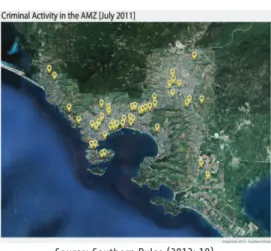
Maps provide a helpful visual representation of the territorial dynamics of a given phenomenon. In this instance, Figures 1 and 2 are particularly relevant as territoriality is intrinsic to geography, economics, and geopolitics. Figure 1 depicts criminal activity in the AMZ in July 2011, a few months before Operation Guerrero Seguro began.
Figure 1: Criminal Activity in the AMZ, July 2011
Source: Southern Pulse (2012: 10).
h e hotels and other properties of 1950s and 1960s fame are on the right side of the bay, where tourist activity and wealthy residential areas are still concentrated. h e pins are concentrated in the areas of metropolitan involution, and helped to make Acapulco the second most violent city in the world in that year.
was promoted as part of the bilateral co-operation between the United States and Mexico through the Mérida Initiative. Implemented from October 2011 onwards by federal police and Mexican military forces in the AMZ, Operation Guerrero Seguro brought back the counter-narco-dollars to the state. By then, there was a quasi-oligopoly in the AMZ due to the dominant role of two local DTOs – La Barredora and the Independent Cartel of Acapulco – operating on Krauthausen’s and Sarmiento’s supposedly less violent second level. h e remnants of the Beltrán Leyva DTO were trying to survive, while the Jalisco New Generation – based in the neighbouring state of Jalisco – were planning incursions into Acapulco due to its proximity to Puerto Vallarta (one of the most important ports for Latin American trade with Asia), American spring breakers, as well as Mexican tourists.
As Figure 2 shows, the federal police and military forces successfully reduced the size of the area of involution in which these crimes against life were concentrated. However, the number of casualties only stabilised in relation to the peak months preceding the op-eration. h erefore, it could be argued that although DTOs, the police, and the military did not confront each other over as large an area, or as frequently, the level of violence and perhaps of weapons sophistication (and mortality), tended to increase.
Figure 2 depicts criminal activity in the AMZ in January, February, March, and April 2012. It depicts a phenomenon similar to other urban zones in the Americas following military deployment in so-called slums, namely the spread of violence to Acapulco’s tradi-tional tourist area. h e intangible geographic, political and economic boundaries between these areas and those of metropolitan involution explain why the spread of crime into these elite neighbourhoods are crimes against property rather than crimes against life. h ese dynamics represent an institutionalised, visible boundary separating the subject from the object, reifying the inhabitants and territories of involuted metropolitan regions whose lives then do not matter, at least not as much as those of the elites and their pos-sessions.
Figure 2: Criminal activity in the AMZ (January, February, March, and April 2012)
Even though ‘inter-cartel’ violence was already evident in 2010, it was only when these igures were associated with the militarisation of Acapulco’s strategies against drug traicking that the city entered the ranking of the 50 most violent cities in the world, in a context that already tended to escalate following Calderón’s militarisation of Mexico’s war on drugs. Due to these policies, violence increased in urban centres that were previously secondary to the political economy and the geopolitics of drug traicking. Moreover, the process of otherness that had developed visible and intangible social boundaries within these areas guaranteed fertile grounds for DTOs, as well as for the militarisation of the campaign against them.
here are two possible explanations for the high levels of violence following the de-ployment of the federal police and military forces. One is that both forces tend to elevate the deadly range of weaponry used by all sides of the conlict. Another is that these forces simply act as peacekeepers, with a mandate to combat people on all sides of the dispute, which leads to increases in homicides.
Moreover, the militarisation of Mexico’s war on drugs has tended to force DTOs to expand or displace their activities to other regions. In line with this, the inluence of DTOs from other Mexican states in Acapulco also increased, adding more complexity and vio-lence to the regional dynamics. According to Kyle (2015: 21), ‘the viovio-lence was distrib-uted throughout [Acapulco], but was especially common in the sprawling working-class neighbourhoods of Colonias Zapata, Renacimiento, Jardines, and Coloso.’ In other words, violence related to drug traicking was concentrated in areas of Acapulco that are home to representatives of the outside, the objectiied side of the process of otherness: those who inhabit areas of the new urban involution.
he deployment of the federal police and military forces did not avert the prolifera-tion of struggles among DTOs, or reverse the problem of high homicide rates by contain-ing the violence in certain geographic areas. he federal police and armed forces simply began to play a symbolic role in the social imaginary, addressing the fears harboured by one group about another.
Final remarks
his hybridity of Mexico’s landscape, one of oligopoly and competition among DTOs, has its pinnacle in the city of Acapulco. While analysts tend to concentrate on cities located on the US border, Acapulco’s current status as the deadliest city in Mexico provides grounds for an archetype of the urban dynamics of drug traicking in the Americas. hrough a process of ‘otherness’ that breeds visible and invisible boundaries separating subject from object, inside from outside, friend from enemy – a rationale traditionally applied in in-terstate relations – the new metropolitan involution, economic inequalities embedded in segregated spaces within the AMZ, and political struggles, especially among DTOs, are central to this.
eco-nomically, and politically in the AMZ. When, in October 2011, urban militarisation was added to these variables, Acapulco entered the ranks of the 50 most violent cities in the world.
Debates about the methods used to compile data about homicides in Acapulco in particular and Mexico in general have led to indings about the political attitudes inherent to portraying the data of various institutions. It has also allowed us to trace certain spatial trends that feed into the production of new boundaries in the city.
he real estate market, for example, has beneited from the territorial concentration of violent incidents following the militarisation of the war on drugs in Acapulco, since it has proited from the gentriication of formerly violent regions (Paley 2014: 163). Among others pointed out in this study, this trend provides a clue for researches who seek to trace the efects of the militarisation of the campaign against drug traicking in urban spaces.
Notes
1 From now on, the phrase ‘war on drugs’ wil be used without quotation marks, not because of the authors’ personal opinions about this matter, but for reasons of practicality (Labrousse and Laniel 2001; Marcy 2010; Nixon 1971; Rodrigues and Labate 2016: 11).
2 he concept of ‘securitisation’ has gained currency in international studies since the 1990s, when it was proposed by members of the Copenhagen School. Despite later revisions and updates, it can be summarised as the process that causes a given ‘public issue’ to be classiied as ‘an existential threat, requiring emergency measures and justifying actions outside the normal bounds of political procedure’ (Buzan, Wæver and De Wilde 1998: 24).
References
Anaya Muñoz, Alejandro. 2014. Violaciones a los derechos humanos en el marco de la estrategia mili-tarizada de lucha contra el narcotráico en México (2007-2012). Aguascalientes: Cuadernos de Tra-bajo del Monitor de Programa de Política de Drogas del CIDE Región Centro.
Anselin, Luc, Jacqueline Cohen, David Cook, Wilpen Gorr and George Tita. 2000. ‘Spatial analyses of crime’. In David Dufee (ed), Criminal Justice 2000: Volume 4.Measurement and Analysis of Crime and Justice. Washington, DC: National Institute of Justice, pp. 213-262.
Ashworth, Gregory J. 1991. War and the City. New York/London: Routledge. Astorga, Luis. 2015. Drogas sin Fronteras. Mexico: Del Bolsillo.
Bagley, Bruce. 1993. ‘Los mitos de la militarización: las fuerzas armadas en la guerra contra las dro-gas’. In Peter H Smith (ed), El combate a las drogas en América. México: Fondo de Cultura Económi-ca, pp. 181-206.
Benítez Manaut. Raúl. 2010. ‘México 2010. Crimen organizado, seguridad nacional y geopolítica’, In Raúl Benítez Manaut (ed), Crimen organizado e Iniciativa Mérida en las relaciones México-Estados Unidos. México DF: CASEDE, pp. 9-30.
Bigo, Didier. 2002. ‘Guerres, conlits, transnational et territoire (Partie 1)’. Cultures & Conlits, 21(21): 01-10.
Buzan, Barry, Ole Wæver and Jaap De Wilde. 1998. Security: a new framework for analysis. Boulder/ London: Lynne Rienner Publishers.
Carpenter, Ted Galen. 2012. he Fire Next Door: Mexico’s Drug Violence and the Danger to America.
Washington, D.C.: CATO Institute.
Citizen Council for Public Security and Criminal Justice of Mexico (CCSPJP). 2017. Metodolo-gía del ranking (2016) de las 50 ciudades más violentas del mundo. At http://www.seguridadjusti- ciaypaz.org.mx/biblioteca/prensa/send/6-prensa/239-las-50-ciudades-mas-violentas-del-mun-do-2016-metodologia [Accessed on 4 July 2017].
Corva, Dominic. 2009. ‘Biopower and the Militarisation of the Police Function’. ACME: An Interna-tional E-Journal for Critical Geographies, 8(2): 162-175.
Deleuze, Gilles. 1992. ‘Postscript on the Societies of Control’. October, 59: 3-7. Esquivel, J Jesús. 2013. La DEA en México. Mexico: Grijalbo.
Feldman, Allen. 2004. ‘Securocratic Wars of Public Safety’. Interventions: International Journal of Post Colonial Studies, 6(3): 330-350.
Freeman, Laurie and Jorge Luis Sierra 2005. ‘México: la trampa de la militarización’, In Coletta Youngers and Eileen Rosin (eds), Drogas y Democracia en América Latina: el impacto de la política de Estados Unidos. Buenos Aires: Biblos, pp. 325-371.
Foucault, Michel. 1995. Discipline and Punish: the Birth of Prison. Transl. Alan Sheridan. New York: Vintage Books.
______. 2009. Security, Territory, Population. Lectures at the Collège de France 1977-78. Editor Mi-chel Senellart; Transl. Graham BurMi-chell. New York: Picador.
Gallegos, Zorayda, 2017. ‘With “El Chapo” Guzmán gone, war erupts in Mexican state of Sinaloa’, El País, March 7, p. 10A.
Giddens, Anthony. 1985. Nation-state and Violence (Vol. 1). Berkley/Los Angeles: University of Cali-fornia Press.
Goldstone, Jack A. 2002. ‘Population and Security: How Demographic Change Can Lead to Violent Conlict’. Journal of International Afairs, 56(1): 3-21.
Graham, Stephen. 2004. ‘Introduction: Cities, Warfare, and States of Emergency’. In Stephen Graham (ed), Cities, War and Terrorism: towards an urban geopolitics. Malden: Blackwell Publishing, pp. 01-30. ______. 2010. Cities under Siege: the new military urbanism. London/New York: Verso Books. Grillo, Ioan. 2012. El Narco: Inside Mexico’s Criminal Insurgency. New York: Bloomsbury Press. Gros, Frédéric. 2010. States of Violence: an essay on the end of war. London/New York/Calcuta: Seagull Books.
Gutiérrez, Alejandro. 2007. Narcotráico: el gran desafío de Calderón. Mexico: Temas de Hoy. Heinle, Kimberly, Cory Molzahn and David A Shirk. 2015. Drug Violence in Mexico: Data and Analysis through 2014. Special Report, Justice of Mexico Project, Department of Political Science International Relations. San Diego: University of San Diego.
Jones, Nathan P. 2016. Mexico’s Illicit Drug Networks and the State Reaction. Washington D.C.: Georgetown University Press.
Keegan, John. 1993. A History of Warfare. New York: Alfred A. Knopf
Krauthausen, Ciro and Luis Sarmiento. 1991. Coca & Cocaína: un mercado ilegal por dentro. Bogotá: Tercer Mundo.
Kyle, Chris. 2015. Building Resilient Communities in Mexico: Civic Responses to Crime and Violence. Washington/San Diego: Woodrow Wilson Centre / University of San Diego.
Labrousse, Alain and Laurent Laniel. 2001. he World Geopolitics of Drugs. Dordrecht: Springer. Langton, Jerry. 2013. Gangland: the rise of the Mexican cartels from El Paso to Vancouver. Ottawa: HarperCollins.
Lupsha, Peter A. 1981. ‘Drug Traicking: Mexico and Colombia in Comparative Perspective’. Journal of International Afairs, 35(1): 95-115.
Lyon, David. 2004. ‘Technology vs. “Terrorism”: circuits of city surveillance since September 11, 2001’. In Stephen Graham (ed), Cities, War and Terrorism: towards an urban geopolitics. Malden: Blackwell Publishing, pp. 297-311.
Marcy, William L. 2010. he politics of cocaine: how the U.S. foreign policy has created a thriving drug industry in Central and South America. Chicago: Lawrence Hill Books.
Mathieu, Hans and Saruy Tolosa (eds). 2014. Violencia Urbana: radiografía de una región. Bogotá: Aguilar/FES.
Neocleous. Mark. 2014. War Power, Police Power. Oxford: Oxford University Press. Paley, Dawn. 2014. Drug War Capitalism. Oakland/Edinburgh: AK Press.
Pérez, Ana Lilia. 2014. Mares de Cocaína: las rutas náuticas del narcotráico. Mexico: Grijabo-Proceso. Plane, David A. 2004. ‘he Post-Trewartha Boom: he Rise of Demographics and Applied Popula-tion Geography’. Population, Space and Place, 10(4): 285–288.
Ravelo, Ricardo. 2011. El narco en México: historia e historias de una guerra. Mexico: Grijalbo. Rodrigues, hiago. 2017. Política e drogas nas Américas: uma genealogia do narcotráico. São Paulo: Desatino.
_______. Forthcoming. Politics is Warfare: Agonism and International Relations. Edinburgh /Oak-land/Baltimore: AK Press.
Rodrigues, hiago and Beatriz Caiuby Labate. 2016. ‘Prohibition and the War on Drugs in the Americas: an analytical approach’. In Beatriz Caiuby Labate, Clancy Cavnar and hiago Rodrigues (eds), Drug Policies and the Politics of Drugs in the Americas. Cham: Springer, pp. 11-32.
Rosen, Jonathan and Roberto Zepeda. 2016. Organised Crime, Drug Traicking, and Violence in Mexico: the transition from Felipe Calderón to Enrique Peña Nieto. Lanham: Lexington Books. Sabet, Daniel M. 2012. Police Reform in Mexico: informal politics and the challenge of institutional change. Stanford: Stanford University Press.
Santana, Adalberto. 2004. El narcotráico en América Latina. México: Siglo Veintiuno. Santos, Milton. 1993. A urbanização brasileira. São Paulo: Hucitec.
Saviano, Roberto. 2015. Zero, Zero, Zero. New York: Penguin Random House.
Shirk, David. A. 2010. Drug Violence in Mexico: Data and Analysis from 2001-2009. San Diego: Trans-Border Institute: Joan B Kroc School of Peace Studies.
Southern Pulse. 2012. Acapulco Criminal Environment. At www.southernpulse.com [accessed on 26 April 2017].
Stone, Hannah. 2014. ‘he Disappeared of Iguala, Mexico: A Crime Foretold.’ InSight Crime, No-vember 20, pp. 13-16.
he Economist. 2017. ‘he World’s Most Dangerous Cities: the cities with the highest homicide rates are once again nearly all in Latin America’. At http://www.economist.com/blogs/graphicde-tail/2017/03/daily-chart-23 [Acessed on 20 April 2017].
Tilly, Charles. 1990. Capital, Capital, and European States - AD 990-1990. Cambridge: Basil Black-well.
Walker, RBJ. 1993. Inside∕Outside: international relations as political theory. Cambridge: Cambridge University Press.
Zaverucha, Jorge. 2000. ‘Fragile Democracy and the Militarisation of Public Safety in Brazil.’ Latin American Perspectives, 27(3): 8-31.
About the authors
hiago Rodrigues is Head of Department in the Institute for Strategic Studies (INEST) at Fluminense Federal University (UFF) in Brazil; Communications Director of the Global South Caucus (International Studies Association, ISA); and Director of Institutional Rela-tions of the Brazilian Association for Defence Studies (ABED). He specialises in the study of drug traicking and International Relations theory. He is also Assistant Editor of the Oxford academic journal International Political Sociology, and co-editor of the books Drug Policies and the Politics of Drugs in the Americas (Springer, 2016), and Drogas, Política y Sociedad en América Latina y Caribe (CIDE, 2015), among others.
Mariana Kalil is a PhD candidate in International Relations at the University of Brasilia (UnB), Brazil. She is Vice-Chair of the Global South Caucus, Grad Student Representa-tive in the heory Section of the International Studies Association (ISA), and integrates the Communications Team of the Oxford academic journal International Political Sociol-ogy. She is also a lecturer (Professor in Collaboration) in International Relations at the Institute for Strategic Studies (INEST/UFF), and a former temporary lecturer (Substitute Professor) in the Department of Defence and International Strategic Logistics (DGEI/ UFRJ). She is the author of ‘Brazil’s Rise in the 21st Century: Ambitions and Diiculties’,
in Jacqueline Braveboy-Wagner (ed), Diplomatic Strategies of Nations in the Global South: he Search for Leadership (Palgrave, 2016), among others.
Implica-tions’, in Bruce M Bagley, Jonathan D Rosen and Hanna S. Kassab(eds), Reconceptualising Security in the Americas in the Twenty-First Century (Lexington Books 2015), and Drug War Mexico: Politics, Neoliberalism, and Violence in the New Narco-economy (Zed Books, 2012). Since 2014, he has been a member of the National System of Researchers (SNI Level 1) in Mexico. He specialises in the study of neoliberalism, migration, labour unions, and narcotraicking.
Jonathan D Rosen is a Research Scientist at Florida International University’s Jack D Gordon Institute for Public Policy, and a former Research Professor at the Universidad del Mar–Oaxaca, Mexico. He is the author of US-Cuba Relations: Charting a New Path (Lexington Books, 2016), heLosing War: Plan Colombia and Beyond (State University Press of New York, 2015), and Fragile States in the Americas (Lexington Books, 2016). He is co-editor of Drug Traicking, Organized Crime, and Violence in the Americas Today (University Press of Florida, 2015), and Colombia’s Political Economy at the Outset of the Twenty-First Century: From Uribe and Beyond (Lexington Books, 2015), among others.
Zona de Guerra Acapulco: Tráfico Urbano
de Drogas nas Américas
Resumo: A hipótese aqui proposta é que Acapulco representa de maneira exemplar a dinâmica de segurança contemporânea nas zonas urbanas das Américas, onde a produção de fronteiras geográicas, políticas e econômicas é agravada pela econo-mia política e geopolítica do narcotráico, bem como pelas tentativas militarizadas de combatê-lo. O principal argumento desta tese é que a Zona Metropolitana de Acapulco (ZMA) sofreu um processo de alteridade que, geograicamente, politi-camente e economipoliti-camente, tem resultado em fronteiras visíveis e intangíveis que, à luz do lugar da cidade na economia política e na geopolítica do narcotráico nas Américas, além de ter levado à militarização das questões relativas ao narcotráico, levou Acapulco a se classiicar entre as 50 cidades mais violentas do mundo. Os resultados e conclusões dessas dinâmicas tornariam as variáveis contidas nesta po-sição reaplicáveis a outros cenários urbanos do narcotráico nas Américas.
Palavras-chave: Tráico de Drogas; Urbanização; Militarização; Acapulco; México; Criminologia; Otherness.
Received on 29 April 2017, and approved for publication on 18 June 2017.