Mercator, Fortaleza, v. 15, n. 3, p.85-106, jul./sep., 2016.
SEASONAL VARIATION OF SURFACE ENERGY
BALANCE OF A CENTRAL BRAZIL CITY
variação sazonal do balanço de energia em cidade localizada na região central do Brasil Ivan Julio Apolonio Callejas *
Marta Cristina de Jesus Albuquerque Nogueira ** Marcelo Sacardi Biudes ***
Luciane Cleonice Durante ****
Resumo
A concentração e o crescimento populacional experimentado pela cidade de Cuiabá desde 70 tem favorecido o rápido processo de mudanças de cobertura do solo no clima tropical local, principalmente por causa da substituição de áreas naturais por edifícios e superfícies impermeáveis. Com base neste cenário, esta pes-quisa teve como objetivo avaliar as trocas entre a superfície e atmosfera de um sítio urbano localizado nas
proximidades da região central da cidade de Cuiabá. Em geral, as frações de particionamento de luxo de calor antropogênico (QF), de calor armazenado dentro do dossel urbano (ΔQs), dos luxos de calor latente (QE) e dos luxos de calor sensível (QH) corresponderam a 3, 26, 28 e 46% e 3, 23, 31 e 46% da energia
disponível no ambiente (Q*+QF), na estação seca e úmida, respectivamente. Estas frações do balanço de energia foram semelhantes às observadas na cidade de Miami, mas diferiram em termos do momento do pico
e a intensidade. Os índices médios diurnos da razão de Bowen (β) nas estações seca e chuvosa foram 1,67 e 1,55, apresentando relação direta com a área da cobertura vegetal. Os luxos de calor sensível e latente se
correlacionaram positivamente respectivamente com a superfície impermeável e vegetada.
Palavras-chave: Fluxos de energia; Razão de Bowen; Dossel urbano.
Abstract
This intense growth and populational concentration experienced by Cuiabá City since the 70’s has favored to the rapid process of land cover changes on local tropical climate mainly because the replacement of preserved natural areas by building and impervious surfaces. Based on this scenario, this research aimed to evaluate the surface-atmosphere exchanges of an urban site located near downtown of Cuiaba City. In
general, the fraction of lux partitioning of anthropogenic heat lux (QF), heat stored inside the urban canopy (ΔQs), latent heat luxes (QE) and sensible heat luxes (QH ) corresponded to 3, 26, 28 and 46 % and 3, 23, 31 and 46% of energy available in the environment (Q*+QF) , in the dry and wet season respectively. These fractions of the energy balance were similar to those observed in Miami City, but difer in terms of the timing of the peak and the intensity. The average diurnal Bowen ratios (β) in the dry and wet seasons
were 1.67 and 1.55 and showed directed relation with decreasing vegetation cover area. Sensible and latent
heat luxes were positively correlated with impervious surface and vegetated area.
Key words: Urban energy luxes; Bowen ratio; Urban canopy.
Resumen
El crecimiento de la concentración y de la población que sufre la ciudad de Cuiabá desde el 70 ha favorecido el rápido proceso de cambio de cobertura del suelo en el clima tropical locales, principalmente debido a la
sustitución de los espacios naturales por ediicios y supericies impermeables. En este contexto, este estudio
tuvo como objetivo evaluar el balance de energía en el entorno urbano situado en el centro de la ciudad de
Cuiabá. El lujo de calor antropogénico (QF), el calor almacenado en el dosel urbana (ΔQs), el calor latente (QE) y el calor sensible (QH) correspondió en la estación seca y húmeda a 3, 26 , 28 y 46%, y el 3, 23 , 31 y 46% de la energía disponible en el medio (Q*+QF), respectivamente. Estas fracciones de balance de energía fueron similares a los observados en la ciudad de Miami, pero diieren en cuanto a la sincronización del pico y la intensidad. La relación de Bowen (β) en la estación seca y húmeda fueron 1,67 y 1,55, están directamente relacionados con el área de la cubierta vegetal. Los lujos de calor sensible y latente se corre
-lacionaron positivamente, respectivamente, con supericie impermeable y vegetación.
Palabras claves: Flujos de energía; Razón del Bowen; Canopy urbana.
(*) Lecturer Federal University of Mato Grosso (Universidade Federal do Mato Grosso) - R. Fernando Corrêa da Costa, 2367,
CEP: 78060-900, Cuiabá (MT) Brasil. Tel: (+55 65) 3615 8774 – [email protected]
(**) Lecturer Federal University of Mato Grosso (Universidade Federal do Mato Grosso) - R. Fernando Corrêa da Costa, 2367,
CEP: 78060-900, Cuiabá (MT) Brasil. Tel: (+55 65) 3615 8774 – [email protected]
(***) Lecturer Federal University of Mato Grosso (Universidade Federal do Mato Grosso) - R. Fernando Corrêa da Costa,
2367, CEP: 78060-900, Cuiabá (MT) Brasil. Tel: (+55 65) 3615 8774 – [email protected]
(****) Lecturer Federal University of Mato Grosso (Universidade Federal do Mato Grosso) - R. Fernando Corrêa da Costa,
86
INTRODUCTION
The efects of anthropogenic activities in climate of the cities have been observed to unders
-tand how minimize the efects of urbanization in climate change. Systematic studies to diagnose the efects of urbanization in the climate of the cities have been conducted since the irst decades of the 19th century. In Brazil, the studies regarding urban climate has started by the seventies, after the publication of Monteiro (1976), who elaborated a theoretical model for the investigation of the
climate behavior of the cities. According to the author,
the city generates its own climate (urban climate), as a result of the interference of all the factors that deal with the urban boundary layer and act in the direction of changing the climate at local scale. Its
straightforward efects are realized by the population through demonstrations related to thermal comfort,
air quality, storm impacts and other manifestations capable of disorganizing the life of the city and
deteriorating the quality of life of its inhabitants (MONTEIRO, 1976).
For the author, “the urban climate is a system that comprises the climate in a given boundary and its urbanization”. In his model, the author developed an analysis methodology that considers
the urban climate as a system – Urban Climate System (Sistema Clima Urbano in Portuguese - SCU) – composed by subsystems that are articulated along with climatic perception channels. On the other hand, Oke (1987) deined urban climate as a result of the changes caused by the process
of urbanization of the land surface and by the interference of this urbanization in the characteristics of the atmosphere in a given area.
The urbanization of the cities, with its rapid population growth, results in the land surface change and in its atmosphere. These changes are caused, extensively, by anthropogenic activities,
such as, pollutants emissions, which afect the radiation transfer and add condensation nuclei to
the air; intense industrial activities; suppression of native forests; population density increase; and
density and shape of the buildings. These modiications create a roughened surface that determi -nes air circulation, heat and water vapor transport inside the urban canopy. Other urban landscape
modiications like the use of paving materials change soil permeability, causing high heat stored and loods (MONTEIRO e MENDONÇA, 2003; ROTH, 2007).
The focus of the current study in urban climate concentrates, essentially, in themes such as the
energy balance, atmosphere contamination and air quality (atmospheric pollution and its efects in health), thermal comfort (heat islands coniguration) and concentrated storm impacts (which cause frequent loods).
From the point of view of energy balance, Oke (1987) stated that the climate is a physical and
thermodynamic process that connects the surface and the boundary layer. Through this process,
temperature lows and air humidity are determined, as well as supericial heat luxes (conduction exchange between the surface and the underlying substrate), that contribute signiicantly to the average potential temperature proile within the atmospheric boundary layer. In relation to the urban
surface, the intensity of turbulences are greater than in rural areas, mainly due to the nature of the
existing obstacles in the environment that indicates that heat lows and humidity depend more on
the nature of the existing turbulence within the atmospheric boundary layer. In urban areas, not only the energy balance and the turbulence change, but also the solar radiation storage (short waves) increases because of the materials which are used in the environment (with high thermal capacity).
Another alteration is referred to the multiple relections of longwave radiation that occur within
the so-called “Urban Canyons” that contribute to hold energy within the urban canopy, making it
diicult for dissipating the upper atmospheric layers. Diferently from what happens in the rural
87
bringing, as a consequence, greater heating of the urban environment mainly at night when com-pared with the rural environment that surrounds it. As a result, aiming to study the energy balance
in urban environments, Oke (1987), using the irst Law of Thermodynamics (Law of Conservation
of Energy) by means of a control volume, computed the gains, losses and the energy storage inside
the urban canopy and formulated the equation of Energy Balance that deines the behavior of the
urban surface within this control volume according to Equation 1.
Q* + QF = QH + QE + ΔQS + ΔQA Equation 1
where Q* is the net all-wave radiation (K - K + L - L ), QF the anthropogenic
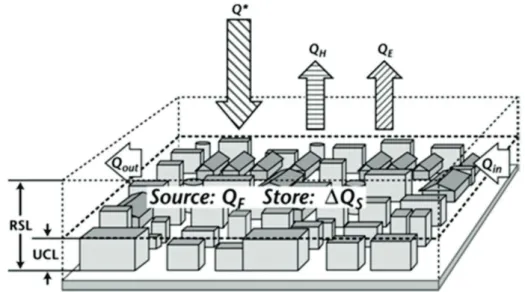
source of heat input in the control volume, QH the turbulent sensible heat lux, QE the turbulent latent heat lux, ΔQS the heat storage lux in the urban canopy and ΔQA the horizontal advective sensible and latent heat lux conducted toward or away from the control volume (Figure 1), K shortwave radiation, K relected shortwave radiation, L longwave radiation from the sky and
L longwave radiation from the surface, all of them considered inside the control volume.
Figure 1 – Schematic illustration of energy balance components in the volume control (urban surface + buildings + air). The surface energy balance per unit of area on the top of the volume control is given by Q* + QF = QH + QE +
ΔQS + ΔQA, where ΔQA = Qout –Qin is the horizontal advective lux that can occur inside the urban canopy, RSL is the roughness sub-layer and UCL is the urban canopy layer. Source: Roberts et al. (2006) adapted Oke (1998).
The urban transformation process in the city of Cuiaba, capital of the State of Mato Grosso,
started in the 1930s and it was intensiied in the 1960s when it became one of the main supply
centers for areas of high agricultural productivity in the Cerrado region and southern Amazon. In
1970, the population of Cuiabá was 88,254 inhabitants and, in 2010, it reached 551,350, increasing more than 624% (IBGE, 2010). This intense growth and population concentration favored the rapid
process of environmental changes, due to the soil surface coverage changes, mainly because of the replacement of great preserved natural areas with built environment and impervious areas. The anthropogenic land occupation was responsible for wide changes in the energy balance causing,
among other consequences, inluence in the dynamic of air movement, and air temperature increase because of the Urban Heat Island (UHI) phenomenon, afecting on the energy consumption for
heating and cooling in the urban buildings (KIM e BAIK, 2004; KOLOKOTRONI et al., 2011). Studies addressing Energy Balance in urban areas in Brazil and in (sub)tropical climates are
88
variation of the main components of energy balance in the city of São Paulo during the year of 2004.
For the diurnal period, in February, the sensible heat lux, latent heat lux and the heat storage in the urban canopy corresponded to 41%, 13% and 44% correspondingly to the net energy available, while in August, 46%, 14% e 44%. The average diurnal Bowen ratio determined for February and
August were 3.23 and 3.27, respectively. In Maitelli (2010), it was presented a study of the Energy
Balance for the city of Cuiaba, Mato Grosso, in the period of August and September of 1993. Du -ring the observations, the average Bowen Ratio observed was 1.02, with values reaching picks up
to 5.8, indicating the prevalence of sensible heat luxes over latent luxes. During daytime, it was used about 20% to 52% of net energy available to heat the air. The sensible heat luxes when added to the heat stored inside the urban canopy consumed an average of 62% of net radiation available
in the urban system.
OBJECTIVE
From the circumstances explained above, the aim of this work was to evaluate the seasonal variation of the energy balance in a high density urbanized area in the city of Cuiabá, Mato Grosso State, Brazil, located in tropical climate, during the dry and wet seasons.
MATERIAL AND METHOD
LOCATION OF THE OBJECT OF STUDY
The city of Cuiabá is located in the center-southern part of Mato Grosso state, in the western boundary of the domains of the “Cerrado” (Brazilian Savanna) and close to the eastern border of
the Pantanal in Mato Grosso (Brazilian Wetlands). Its area is currently 3,538.17 Km², 254.57 Km² corresponding to an urban macrozone area and 3,283.60 Km² to rural area. It is located in the ge -omorphic province denominated “Baixada Cuiabana”. The geographical coordinates are 15º10’ a
15º50’S and 54º50’ to 58º10’W. Altitudes vary from 146 meters to 259 meters (IPDU, 2007). The
vegetation cover is constituted by remaining of cerrado (Brazilian savanna), cerradão (xeromorphic forest), riparian forest adjacent to the rivers mainly in Cuiabá and exotic vegetation.
The predominant climate in the region is the tropical wet and dry (Köppen climate classiication
AW), being its main characteristic the constant high temperatures, registering an annual average
around 25º to 26ºC, with two well deined seasons: dry (fall-winter) and wet (spring-summer). Total annual precipitation varies from 1250 to 1500 mm (CAMPELO JUNIOR et al, 1991).
As a consequence of the population growth occurred in the last decades, new suburbs arose
in the city, while the existing ones, mainly in the central areas of the city, sufered densiication and verticalization. Therefore, aiming to evaluate the energy lux behavior in areas that sufered
intense urbanization, Site 1 was selected located in the Eastern region of the city in the district
called “Areão”, distant approximately 1.45 Km from downtown, 197 m above sea level. This site
is located inside a state public school, constituted by a central courtyard and linear blocks
sym-metrically distributed (Figure 3). This district is classiied as mixed uses, presenting commercial, institutional and residential building. According to scheme of Urban Climate Zones, it is classiied
as UCZ=3, with highly developed, medium density urban (OKE, 2006).
Based on the fact that the circle of inluence on a screen-level temperature or humidity sensor
is thought to have a radius of about 500m typically (OKE, 2006), land use and land occupation
for the urban site was characterized in terms of fractions of areas into ive categories: surface of
vegetation (trees, grass, bushes, etc.), pervious surface (bare and partially bare soil), impervious surface (concrete, asphalt, crushed stone, car parking, streets, sidewalks except buildings) and tri-dimensional surface area of buildings, subdivide in roof area and wall area (Figure 2). Thus, the
89
fS = fV + fI + fP + fR + fC Equation 2
Where fV is the fraction area of vegetation surface, fI is the fraction area of impervious surface (concrete and asphalt), fP is the fraction area of pervious surface (bare soil and partially covered), fR is the the fraction area of building’s roof and fC the fraction area of wall (evaluated from the urban canyons). It is possible to obtain the measurement of the tridimensional morphology of the site dividing the total plain fraction surface area (fplain area) by the total of fraction active
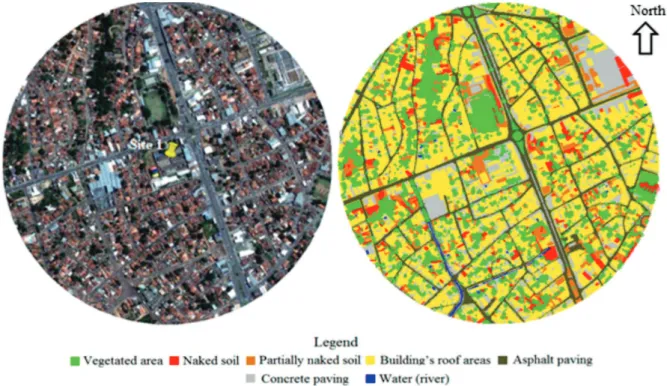
surfa-ces area (fS) inside circle of inluence for the urban site (Figure 2). The fraction of the surface for each type of category (i), as well as the tridimensional fractions can be visualized in Table 1. The
vicinity of the Site 1 and its land use e land occupation can be visualized in Figure 2. As it can be observed, when considering the wall surfaces integrating the area in contact with the atmosphere,
Site 1 presents 33% more area when considering only the plain surfaces (the existing building walls
inside the urban canyons increase the urban area in contact with the atmosphere).
Figure 2 – Land use and land occupation inside the circle of inluence for site 1 (radius of 500m).
Table 1 – Fraction of area (i) for each adopted category inside the circle of inluence for the Site 1 (radius of 500m).
Land use and occupation
Fraction of Area (fi = Apartial/Atotal area)
Impervious area (asphalt and con-crete paving) (fI)
Vegetated area (fV)
Bare and partially bare soil (fP)
Building’s roofs area (fR)
Urban Canyon area (walls areas) (fC)
fS/ fplain area
Site 1 21.72% 11.42% 8% 33.97% 24.88% 1.33
MATERIALS
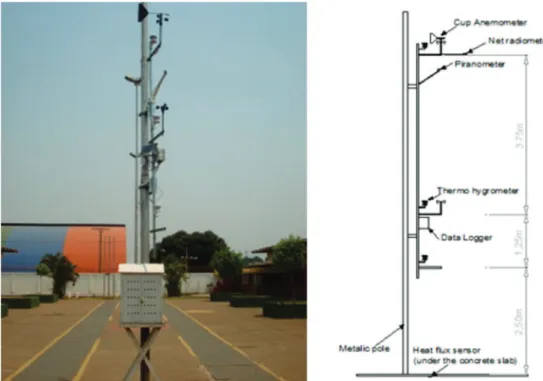
In order to execute the measurements inside the urban canopy, meteorological instruments were
ixed in a pole in the central courtyard of the school (Figure 3): three thermohygrometers, Brand OnsetComp, Model S-THB (2.5, 3.75 and 7.5m) to evaluate the temperature and air humidity pro
-ile; a net radiometer, Brand Kipp&Zonen Delft, Inc., Holland, Model NR Lite 2 (7.5m) to evaluate
the net radiation; two pyranometers, brand OnsetComp, Model S-LIB (7.5m, one installed upward
90
sensor, Brand REBS, Inc., Seattle, Washington, Model HFT-3.1 (5cm under the courtyard concre
-te slab) to evalua-te the heat lux in the concre-te; and two cups anemome-ters, brand OnsetComp,
Model S-WSA and S-WCA (5 and 7.5m) to evaluate the wind speed and direction (Figure 3). Data produced by signal and/or electric pulses from the sensors of the meteorological equipment were processed and stored by a Datalogger, brand OnsetComp, Model U30-NRC-VIA-10-S100-000 every 10 seconds and averages at every 5 minutes, and afterwards, the data were processed for intervals of 30 minutes to evaluate energy balance. The experiment was conducted from September (2010) to August (2011), during the dry and wet seasons, respectively.
Figure 3 – Meteorological Station: details of the instruments installation.
METHOD
The Bowen Ratio-Energy Method (BREB) is based on the Law of Conservation of Energy in
the system Soil- Air-Atmosphere. The idea used in the method to estimate convective lux is based on the fact that the energy available at the surface (Q* - QG or Q*+QF - ΔQS, for urban areas) can be distributed to sensible and latent heat luxes by the ratio between these luxes (β=QH/QE). The Monin-Obukhov similarity theory stablishes that KH/KE= H/ E, where H and E represent
the universal functions of similarity for the temperature and speciic air humidity proiles within the
ABL (atmospheric boundary layer). Experimentally, it has been demonstrated that H is equal to E in the atmospheric conditions regimes, which suggests it is possible to state that KH and KE are similar (FOKEN, 2006). Assuming this hypothesis, it is possible to determine the ratio between
the sensible and latent heat luxes by the Equation 3:
β = QQH
E =
KH
KE
cp
ΔTΔq = cp
ΔTΔq = ΔT Δe
Equation 3
where ΔT and Δe refer to the diference of the air temperature (oC) and water vapor pressure
(kPa) between two vertical measurement levels, y=cpp/ϵLv is the psychrometric constant, cp is the speciic heat at constant pressure (1.00467 J g-1 K-1), “p” is the atmospheric pressure, “ϵ” is the
ratio of molecular weights of water and air (0,622), and Lv is the latent heat of vaporization and the
91
to estimate the energy balance components in Site 1 by the use of air temperature gradients (ΔT) and vapor water pressure in the air (Δe) related to the elevations described in item 3.2.
Considering the Bowen Ratio (equation 3) and using the Equation (1) that express the energy balance inside the urban environment and neglecting horizontal advection, latent and sensible heat
luxes were calculated using Equations 4 and 5.
�� =1 + � [(�1 ∗+ ��) − ΔQ�]
Equation 4
�� =1 + � [(�� ∗+ ��) − ΔQ�]
Equation 5
Despite the simplicity of the method, the accuracy of sensible and latent heat luxes is a function of the Bowen ratio (β), which depends on the methodology and equipment used in ield measure -ments. Errors and inconsistent results provided by the Bowen ratio method have been studied by
some authors in the last years (KALANDA et al., 1980, PEREZ et al., 1999; FOKEN, 2008, HU et al., 2013). Perez et al. (1999) formulated objective criteria to evaluate when energy luxes are reliable and accurate, which was revised by Hu et al. (2013). Those authors executed a physical analysis of the method in order to ind some criteria to reject physically inconsistent data, including cases
falling out of instrumental precision. The BREB method fails when sensor resolution is inadequate
to resolve gradients in ΔT and Δe, during stable atmospheric conditions, because β tends to −1, such as during the dawn and dusk, and the evapotranspiration tends to ininity, and when atmospheric
conditions abruptly change leading to errors in measurement. Thus, to avoid these conditions, it
was used a iltered method where physically realistic values of β were obtained in an objective and
quantitative manner, limiting the potential for bias and error in estimating energy balance terms
(PEREZ et al., 1999; HU et al., 2013).
In order to estimate the anthropogenic heat dissipated in the urban canopy, it was used the Inventory Method proposed by Sailor and Lu (2004) in which the heat introduced in the environ-ment by the human activities can be divided in three components that represent the largest sources of heat in the urban environment. By this formulation, the anthropogenic heat was estimated by the Equation 6.
QF = QFV + QFS + QFM Equation 6
where QFV is the anthropogenic heat lux generated by vehicle sources, QFS generated by
stationary sources (electricity consumption and fuel by households, industry and commercial esta-blishments) and QFM generated by human and/or animal metabolism.
The energy stored in the urban canopy (ΔQs) was evaluated by Objective Hysteresis Model (OHM) proposed by Grimmond et al. (1991) in which it is possible to describe the non-linear rela -tionship (hysteresis) between radiative forces and the energy stored inside the urban canopy using the Equation 7.
ΔQs= ∑(fia1i)Q∗ n
1
+ ∑(fia2i n
1
)∂Q∂t +∗ ∑(fia3i) n
1
Equation 7
where ΔQS is the heat lux stored inside the urban canopy; Q* is the urban net radiation in the
studied area, Q*/ t is the time derivative of net radiation, approximated as 0.5(Q*t+1 – Q*t-1)
92
of site 1 (asphalt, concrete, walls, roofs, vegetation, exposed soil) empirically derived from studies
relating ΔQS to Q* over speciic urban surface types; i is the fraction of each surface i inside the
surface area, evaluated in 3.1 (Table 1) . In order to apply the scheme proposed by Grimmond et al.
(1991), it was necessary to value the net radiation on the site, to execute an inventory of the surfa -ce characteristics of the surrounding area (type of existing materials, buildings heights and areas, buildings morphology, fractions of impervious areas, areas with vegetation and urban canyons) as
conducted in the item 3.1 and presented in Table 1. The surface fractions attributes (i) are commonly evaluated by site aerial images, as well as by ield surveys (Figure 2). The regression coeicients
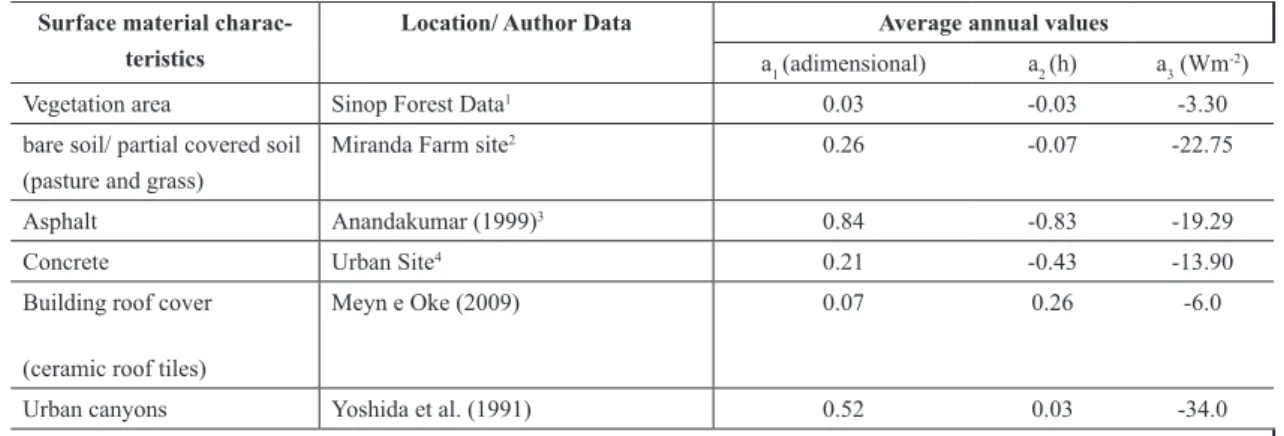
a1, a2 and a3, correspond to the response of the hysteresis model for each type of surface existing within the urban environment. Thus, to apply the scheme to the Cuiabá site, the corresponding a1i,
a2i e a3i coeicients were derived utilizing data from site 1 (luximeter inside the concrete slab),
from Miranda Farm site (for soil) and from Sinop Forest Site (for vegetation). For Building roofs,
urban canyons and asphalt paving, it was utilized data compiled by Meyn e Oke (2009), Yoshida et al. (1991) and Anandakumar (1999). Table 2 presents only average annual coeicients, but it was utilized average moth coeicients to model the ΔQS inside the Site 1.
Table 2 – Average annual coeicients adopted for OHM Model proposed by Grimmond et al. (1991) to estimate the heat lux stored inside urban canopy (Site 1).
Surface material charac-teristics
Location/ Author Data Average annual values
a1 (adimensional) a2 (h) a3 (Wm
-2)
Vegetation area Sinop Forest Data1 0.03 -0.03 -3.30
bare soil/ partial covered soil (pasture and grass)
Miranda Farm site2 0.26 -0.07 -22.75
Asphalt Anandakumar (1999)3 0.84 -0.83 -19.29
Concrete Urban Site4 0.21 -0.43 -13.90
Building roof cover
(ceramic roof tiles)
Meyn e Oke (2009) 0.07 0.26 -6.0
Urban canyons Yoshida et al. (1991) 0.52 0.03 -34.0
(1) Coeicients determined for Sinop forest located in the Amazon-Cerrado transition zone; (2) The regional soil type at Miranda Farm site is rocky dystrophic red-yellow Latosol, also known as a Plinthosol Coeicients were obtained for the period from September 2010 to August 2011
in this rural site located near the city of Cuiabá - MT; (3) It was utilized average negative values of a2 e a3; (4) The a1. a2 e a3 coeicients were
derived by a luximeter installed under the concrete slab in the Site 1
The results found in this research were compared to those obtained in the same region by
Biudes et al. (2009). It was also utilized the research of Ferreira (2010) and Maitelli (2010) because
they were the only two researches that conducted urban energy balances inside the urban area at Brazil. Special attention was given to the research conducted in the city of Miami (Florida, USA)
(NEWTON et al., 2007) because of its similarity in terms of climate (also classiied as Köppen AW)
and population to the city of Cuiabá. Results from energy balance of temperate climate countries like
those obtained by Grimmond and Oke (2002) (American sites) and Oferle et al. (2006) (European
sites) were utilized to contrast the energy balance in the region researched.
ANALYSIS OF RESULTS
NET RADIATION BALANCE (Q*)
The average monthly hourly variation of net radiation (Q*) and the solar radiation (Rg) can be observed in Figure 4 for dry and wet period respectively. In average, the maximum diurnal values
93
at 11:30 LT with 510.2 Wm-2. The average nocturnal values were -83.0 Wm-2 and -71.3 Wm-2, at 18:00 and 19:00 LT, in dry and wet season, respectively. The maximum diurnal average values of solar radiation (Rg) were observed at 12:00 LT in dry season, reaching values of 694.5 Wm-2,
while in wet season, at 11:00 LT with 663.7 Wm-2. Thus, Q* and Rg were in phase in dry season and delayed for half an hour in wet season.
In the energy balance estimated by Ferreira (2010) for the City of São Paulo, the author found maximum average diurnal values of Q* equals to 452 Wm-2 in August and 520 Wm-2 in February, both at 13h, representative periods of dry and wet seasons, respectively. In the nocturnal period, the
minimum average value was -72 Wm-2 at 19:00 LT in August and -41 Wm-2 at 20:00 LT in February. In a rural site located near the city of Cuiabá, Biudes et al. (2009) found maximum average diurnal values for Q* around 575 Wm-2 and 586 Wm-2 in dry and wet season, respectively. The nocturnal luxes were not provided by the author. Maitelli (2010) estimated the energy luxes inside urban
canopy of Cuiabá City in the end of dry season and beginning of the wet season. Results indicated that Q* reached the maximum value of 510.6 Wm-2 in diurnal period and -55 Wm-2 during the
irst hours of nocturnal period. In the city of Miami (NEWTON et al., 2007), Q* reached maximum
diurnal value of approximately 570 Wm-2 while during nighttime, values remained almost constant around -50 Wm-2. Based on these results, we can infer that diurnal Q* values are similar to those observed in the region and in other localities, like São Paulo and Miami. On the other hand, the
nocturnal luxes were higher than those veriied in the 90´s for city of Cuiaba and in Miami’s City. A possible reason for this behavior can be attributed to the diferences in the thermal and physical properties of the surfaces inside the urban canopy and to the complex morphometric coniguration
of the building (like orientations, density, height etc.).
Figure 4 – Average seasonal variation of solar radiation (Rg)/ net radiation (Q*) and dispersion diagram for Rg and
Q* in dry and wet seasons.
94
equal to 80.5% and for dry and wet season, 69.6% and 91.4%, respectively. In the energy balance quantiied by Maitelli (2010), the Q*/Rg ratio from August to September (61.9%) is quite similar
to that observed in the Cuiabá City. For São Paulo and Miami city, authors did not presented the solar radiation in their researches, not allowing comparisons. The results found in this research are
close to that registered by Maitelli (2010) but difer considerably from those obtained by Biudes et al. (2009), a rural area near Cuiabá City where soil is covered by pasture and grass vegetation. The diferences in the radiation energy balance between the urban and rural surfaces can be attributed to the thermal and spectral characteristics which are inluenced by surface albedo, canyon radiative geometric and the moisture state of the ground during the seasons in the region (OKE et al., 1991; CHRISTEN and VOGT, 2004; FERREIRA, 2010).
ANTHROPOGENIC HEAT (QF)
By analyzing the average daily variation curves of QF during dry and wet seasons (Figure 5), it
is possible to verify that anthropogenic heat luxes presented three periods of maximum dissipation inside the urban canopy: irst in the beginning of the morning, from 7:00 to 8:00 LT (~10 Wm-2), the second at noon, from 11:00 to 12:00 LT (~10.3 Wm-2) and the third, in the end of the afternoon, from 17:00 to 18:00 LT (~9.3 Wm-2). These behavior is similarly to that observed in the city of São Paulo with peaks in the beginning of the morning (~19.1 Wm-2), another around noon (~18.6 Wm-2) and the last one in the end of the afternoon (~19.3 Wm-2) (FERREIRA, 2010). Biudes et al. (2009) did not estimate the anthropogenic heat luxes in rural area because they are usually not
considered in energy balance due to the small release of heat inside the rural environment. In turn, in Maitelli (2010) and Newton et al. (2007), they were considered small when compared to the
others luxes, being discarded. On the other hand, Sailor e Hart (2006) estimated anthropogenic heat luxes dissipated within the urban canopy for various American cities, including the city of Miami, South of Florida. The maximum QF value found for summer was 28.5 Wm-2, almost three
times higher than the maximum value observed in the city of Cuiabá.
The anthropogenic heat lux dissipated within the urban canopy relects mainly the pattern of vehicle traic in the city of Cuiabá, since the vehicle sources (QFV) were the main heat dissipation inside the environment, corresponding to approximately 66.6% of QF while stationary sources (QFS) and metabolic sources (QFM) corresponded for only 18.2% and 15.1%, respectively. In São Paulo, QFV was responsible for approximately 53% of QF while QFS and QFM were responsible for 38% and 9% respectively (FERREIRA, 2010). The lower fraction of stationary sources can be justiied by the low fossil fuels consumption (liqueied petroleum gas, fuel oil and natural gas) veriied in the city of Cuiabá, compared to the consumption of the city of São Paulo. We can infer
that vehicle sources are the main source of heat dissipation inside the urban canopy, especially in cities with smaller population, like Cuiabá.
95
By the QF/Q* ratio, we can infer that anthropogenic heat luxes presented lower contribu
-tion in the urban energy balance during the diurnal period, average of 3.1%, both in dry and wet seasons. However, during the nocturnal period, its contribution raised, reaching values of 30.6%.
Based on these results, we can state that in cities located in tropical climates, the anthropogenic
heat lux component presents lower contribution in the energy balance. However in those located
in temperate climates, due to the elevated consumption of electricity and fossil fuels during winter
season for domestic or industrial heating purposes QFS/QF can reaches values up to 70%, elevating
its contribution to the energy balance, mainly during nocturnal period (SAILOR and LU, 2004).
HEAT FLUX STORED WITHIN THE URBAN CANOPY (ΔQS)
In average, the maximum diurnal values of ΔQS in dry season occurred at 12:30 LT with an intensity of 148.4 Wm-2 while in wet season at 11:30 LT with 134.9 Wm-2. The average nocturnal values were -42.6 Wm-2 and -38.1 Wm-2, at 18:00 and 19:00 LT, in dry and wet season, respectively (Figure 6) and ΔQS and Q* were in phase. When comparing the city to the vicinity’s rural site, heat luxes inside de soil (G) were considerably lower than in Cuiabá’s city (41.4 W m-2 and 37.6 W m-2 in dry and wet seasons) (BUIDES et al., 2009) because it doesn’t present three-dimensional
surfaces (urban canyons) and no impervious surfaces. In turn, soil presents smaller thermal heat
capacity and admittance than the traditional artiicial materials utilized in the cities, reducing the energy store inside it and cooling down more rapidly at night than urban areas (OKE et al., 1991).
In São Paulo, the intensity in diurnal period reached 273 and 226Wm -2 both at 12:00 LT,
and in nocturnal period, -67 e -98Wm-2 at 18:00 and 19:00h, in wet and dry seasons, respectively. Maitelli (2010) estimated ΔQS by a Net Radiation Parameterization Method and found maximum average diurnal and nocturnal luxes equal to 100Wm-2 and -50Wm-2, respectively. In Miami, the average diurnal luxes were estimated indirectly by Residual Method, reaching values of 200Wm-2 and -50Wm-2 during daytime and nighttime, respectively. Thus, we conclude that heat luxes stored
inside urban canopy at Cuiabá’s City were lower than in other cities but higher than the rural site
located near the city. We can airm the process of urbanization modiied the preexisting climate, altering the energy balance in the region. The heat luxes estimated by Maitelli (2010) were 49% lower to those observed in this research, probably because of the simpliication utilized by the net radiation parametrization method, the diferences in the urban morphologic (sky view factor of surface, H/W of the canyons etc), thermophysical characteristics between the sites studies and process of urbanization experienced by the city of Cuiabá since 90’s.
The diurnal course between ΔQS and Q* didn’t show a pronounced temporal hysteresis (Fi -gure 6). The daily peak values were reached almost in the same time of the maximum intensity of Q*. This behavior diverges from that observed in Miami’s City (temperate climate) and in The
São Paulo’s City (subtropical) where it was veriied a pronounced temporal hysteresis and peak
values were reached 1h before the maximum intensity of Q*. Thus, in the Cuiabá urban canopy, the sensible heat conduction process was slower than the ones observed in cities in high altitudes. We speculate the behavior observed by Ferreira (2010) for São Paulo City resulted by the
appli-cation of empirical coeicients (a1, a2 and a3) determined for temperate cities to the estimation of the heat stored inside the urban canopy (ΔQS). It is important to mention that the hysteresis is
associated to the thermophysical characteristics of the materials found in the environment, such
96
Figure 6 - Average seasonal variation of heat lux (ΔQS) in the urban canopy and dispersion diagram between ΔQS e
Q* in dry and wet seasons.
The annual average ratio of ΔQS/ Q*+QF in the diurnal (nocturnal) period corresponded to approximately 24% (63%), while in dry and wet seasons, the ratios were 26% (60%) e 24% (66%), respectively (Table 3). The diurnal monthly average ratio of the heat lux stored in São Paulo City corresponded to 24% of Q* and in Miami City, to 30%. Maitelli (2010) estimated the heat stored inside the urban canopy by a net radiation parameterization and found ratio of ΔQS/ Q* equal to 22%, close in percentage, but lower in intensity than the ones veriied in this research.
SENSIBLE HEAT FLUX (QH) AND LATENT (QE)
The diurnal variations of the hourly average monthly values for the sensible and latent heat
luxes can be visualized in Figures 7 and 8 for the dry and wet seasons, respectively. It was observed that the maximum diurnal (nocturnal) luxes of QE and QH, in average, occur at 12:00 (18:00 and 19:00 LT) with intensity 134,0 Wm-2 (-29,2 Wm-2) and 243,4 Wm-2 (-8,9 Wm-2) in the dry period and at 10:30 (19:00 LT) and 11:30 (2:00 LT) in the wet season with intensities of 142,1 Wm-2 (-31,1 Wm-2) and 242,6 Wm-2 (1,82 Wm-2), respectively. When comparing these values with the average maximum diurnal values of net radiation (Q*), we noted that the QE and QH were in phase with
Q*in the dry season. On the other hand, in the wet season, the maximum value of QE peaked 1h
before the maximum intensity of Q*, while QH and Q* were in phase.
Ferreira (2010) found the maximum value in the diurnal period (nocturnal) of QE and QH equal to 65 (1 Wm-2) and 197 Wm-2 (-56 Wm-2) at 14:00 (20:00 LT) in August, 67 (1 Wm-2) and 209 Wm-2 (-19 Wm-2) also at 14:00 (23:00 LT) in February, period that represents dry and wet seasons, respectively. QE and QH showed hysteresis, delayed 2h in relation of Q*, which diver
-ges from those observed in Cuiabá canopy, which are in phase. Despite the diferences between Cuiabá and São Paulo, we noted that the sensible heat luxes were higher than the latent heat lu
-xes. The temporal hysteresis efects observed on sensible and latent heat luxes at Sao Paulo and
97
Figure 7 – Average seasonal variation of Latent Heat lux (QE) and dispersion
diagram between QE e Q* in dry and wet seasons.
98
of atmospheric stability (FERREIRA, 2010). On the other hand, the urbanization is responsible for
the elevation of sensible heat luxes and reduction of latent luxes inside the urban canopies as will
be demonstrated in the next paragraphs. Por outro lado, a urbanização é responsável pela elevação
dos luxos de calor sensível e redução dos luxos de calor latente no interior dos dosséis urbanos
como será demonstrado na sequencia.
In the rural site near Cuiabá City, Biudes at al. (2009) veriied that the intensities of QE and QH reached 259.7Wm-2 and 159.3Wm-2 in dry season and 319.7Wm-2 e 234.4Wm-2 in wet sea
-son, preponderating QE over QH. The rural area is composed by deforested “Cerrado” and pasture and the elevation of the latent heat lux was expected because presence of no impervious surfaces. In the 90’s, Maitelli (2010) veriied that the maximum average hourly values of QE and QH were equilibrated, around 200 Wm-2. We might expect such reduction in the sensible heat lux since it was observed an intense densiication of the urbanization in the Cuiabá central districts, from ~14.3 to ~34.4% between the years of 1986 and 2007 (CALLEJAS et al., 2011a). In Miami, QE and QH reached maximum diurnal values of 160 Wm-2 and 250 Wm-2 at 13:00 LT, wet period in the region, close to those values veriied in the city of Cuiabá.
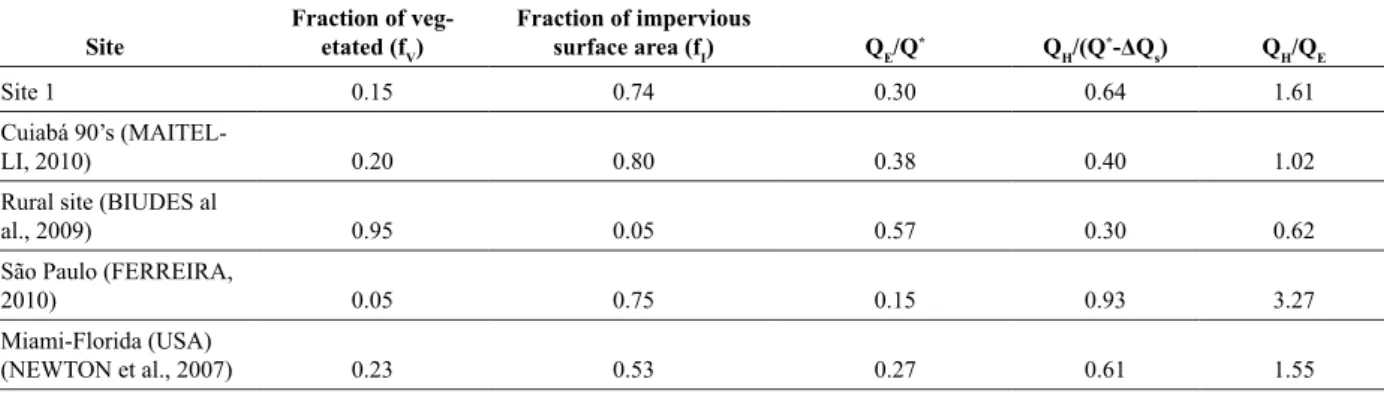
To demonstrate the inluence of urbanization in the sensible and latent heat luxes, we quantiied
the plan fraction of vegetated area (fV) and plan fraction of impervious surfaces area (fI) on the
Cuiabá site (Table 3). We also presented fV and fI informed by Maitelli (2010), Biudes et al. (2009), Ferreira (2010) and Newton et al. (2007) and the ratios of QE/Q*, QH/QE and QH/(Q*-ΔQS) for
Q* > 0, aiming to compare them with the results obtained in temperate climate sites located in north
American (GRIMMOND and OKE, 2002) and European cities (OFFERLE et al., 2006) (Figure 9). Table 3 – Plain fraction of vegetated area, plain fraction of impervious area and relations between QE/Q*, QH/
QE e QH/(Q*-ΔQS) for Sites 1, Cuiabá (90’s) (MAITELLI,2010), Rural site (BIUDES at al.,2009), São Paulo
(FERREIRA, 2010) and Miami (NEWTON et al., 2007) for Q*> 0.
Site
Fraction of veg-etated (fV)
Fraction of impervious
surface area (fI) QE/Q
* Q
H/(Q *-ΔQ
s) QH/QE
Site 1 0.15 0.74 0.30 0.64 1.61
Cuiabá 90’s (MAITEL
-LI, 2010) 0.20 0.80 0.38 0.40 1.02
Rural site (BIUDES al
al., 2009) 0.95 0.05 0.57 0.30 0.62
São Paulo (FERREIRA,
2010) 0.05 0.75 0.15 0.93 3.27
Miami-Florida (USA)
(NEWTON et al., 2007) 0.23 0.53 0.27 0.61 1.55
We observed that the relation QE/Q* in the Cuiabá canopy (Site 1) was above the theoretical
curve obtained by Grimmond and Oke (2002) (Figure 9a), indicating that latent luxes were higher
than those measured in the temperate and subtropical climate sites located at North hemisphere. It is
also possible to observe that fraction of QH/(Q*-ΔQs) related to the fraction of impervious surface
(fI) and followed the theoretical curve established with data from north hemisphere sites (Figure
9b). On the other side, the QH/QE ratios were below the theoretical curve (Figure 9c), which indi
-cates that the sensible heat luxes measured inside the urban canopy were smaller. We plotted the relations of QE/Q* and QH/QE for Cuiabá in the 90’s (MAITELLI, 2010) and we observed similar relations between then and the ones observed at Site 1, what can be justiied by the imprecision quantiication of vegetation and impervious area in the vicinity of site since high resolution satellite images were diicult to be found at that time. Since the sensors level installation was not informed
in the research, screen-level air temperature or humidity sensor area may have extended to several
hundred meters, being inluenced by regions of diferent fractions of vegetated and impervious
99
also smaller than the ones indicated in the research, because lower urban densiication is expected in the central area of Cuiabá in the 90’s as observed by Callejas et al. (2011a), what would justify higher rates of latent heat lux.
Figure 9 – Relations between (a) QE/Q* and vegetated surface (fV); (b) QH/(Q*-ΔQs) and fraction of impervious surface (fI) and (c) QH/ QE and vegetated surface (fV)for sites presented in Table 3 and temperate climate cities.
Representative data from 10:00 to 14:00h, local time. Source: (a) and (b) adapted from Grimmond and Oke (2002)
and (c) from Oferle et al. (2006).
In the city of São Paulo (FERREIRA, 2010), QE/Q* was smaller than the ones observed in
Cuiabá canopy, while QH/QE was above the theoretical curve established for the temperate cli
-mate cities. In the rural site (BIUDES at al., 2009), it was observed elevated latent heat luxes and smaller sensible heat luxes, which provided QH/QE smaller than 1 (Figure 9c). In the city of
Miami-Florida (EUA), it was observed similar ratios to those observed in Cuiabá’s city, but smaller because of the lower impervious surface and high vegetated area in the vicinity of Miami’s Site.
We observed a great dispersion in the diagram between QE/Q* and QH/(Q*-ΔQs), as well as in the QH/QE for temperate climates. Thus, it is necessary to perform more experiments in urban tropical climates, especially with diferent fraction of impervious (fI) and vegetated areas (fV) to verify a tendency observed in this work, i.e, higher latent luxes and lower sensible luxes than those
observed in temperate climates.
100
BOWEN RATIO (β = QH/QE)
By analyzing the average daily variation curves of Bowen ratio during dry and wet seasons
(Figure 10), it can be observed that the average maximum value of β during daytime and nightti
-me was 1.87 e 0.33 at 13:30 and 4:30 LT, respectively, in dry period. The average dayti-me (Q*> 0) and nighttime (Q*< 0) values were 1.66 e 0.30, indicating that sensible heat luxes prevailed over the latent heat luxes during the day, due to low precipitation in period and elevated rates of impervious surfaces inside the Cuiabá urban canopy. (~74%) During the wet season, the average maximum value of β during daytime and nighttime was 1.98 e -0.70 at 17:00 and 17:30 LT, res -pectively. Due to the increased water availability in the wet season, the average diurnal (Q*> 0)
and nocturnal (Q*< 0) values were lower (1.54 e -0.08) than the ones observed in the dry period, because large amount of energy was utilized to evaporate water (latent heat luxes), as expected. Due to the small luxes intensities during nocturnal period, Bowen ratio were erratic and lower
than -1, value commonly found in the temperate cities (GRIMMOND and OKE, 2002; LORIDAN AND GRIMMOND et al., 2012).
Figure 10 – Average seasonal variation of Bowen ratio in dry and wet seasons.
The seasonal variation of the Bowen ratio in Site 1 indicated minimum average monthly value
occurred in the month of February (1.28) and the maximum value in September (2.82). The β annual
average was 1.61. In dry and wet season, averages values observed were 1.67 and 1.55, respectively,
indicating predomination of sensible heat luxes over latent heat luxes in Cuiabá urban canopy. The
results are consistent with those found in temperate climate cities since vegetation suppression and the sealing of land by impervious surfaces like streets, pavements, car parks and buildings reduces the evapotranspiration inside the urban areas, which corroborates for the predomination of sensible
heat luxes over latent heat luxes, even in the wet season.
In São Paulo, the β average monthly presented a minimum value of 2.92 in September and maximum of 4.29 in June and the annual average was 3.54 (FERREIRA, 2010). These values are
much higher than the seasonal value and annual average observed in the Cuiabá urban site. In the
rural site, Biudes at al. (2009) veriied that the average Bowen ratio in dry and wet seasons were 0.54 and 0.70, respectively, with an annual average of 0.62. How rural sites are almost complete
pervious, it allows higher evapotranspiration than the urban sites, even in the dry season. For Miami, the average daily intensity of the Bowen ratio was 1.47 in the period of May to July (NEWTON et al., 2007), close to that observed to the Cuiabá City, because similarity in tridimensional
101
the daytime were 1.02, and during nighttime, lower than the -0.5 (MAITELLI, 2010). The daytime values obtained in this work are inside the observed range for suburban sites (β = 1.2 to 2). Those
obtained by Biudes at al. (2009) are next to the range for rural sites (β < 0.5), while those observed by Ferreira (2010) for urban downtown sites (β > 4) (LORIDAN and GRIMMOND et al., 2012). The Bowen ratio behavior inside the Cuiabá’s urban canopy indicated that during daytime,
luxes were directed away from the urban canopy (positive). During nighttime, in dry season, the sensible and latent heat luxes were directed towards to the urban canopy (negative), from upper to the lower urban atmosphere. On the other hand, during the wet season, the sensible heat lux
remained positive (upward) and the latent remained negative (downward) inside the urban canopy.
The peaks observed in the sunrise and sunset time (Figure 10) occur because of the energy luxes signal change, as consequences of low vapor pressure deicits/ temperature gradients between the
measurements levels (close to the sensor limit accuracy) and with low input/output energy,
gene-rating numerical inconsistence in the BREB method (PEREZ et al., 1999; HU et al., 2013). The positive sensible and latent heat luxes within the urban canopy occurs due to the release of heat stored (ΔQS) when there is no radiation input in the urban system (Q*<0). This behavior
results in the appearance of thermal convection during the nocturnal period because of the regions closer to the surfaces (due to radiative cooling of materials that compose the urban canopy) being warmer and more humid than the upper regions of the urban canopy, inducing turbulence, genera-ting a mixed layer during the nocturnal period. The behavior observed in the lower layers of urban
canopy difer from the ones observed in the rural environments, where QH is directed from the
atmosphere to the surface because of the thermal inversion observed in these environments during
nocturnal period (BIUDES at al., 2009). It is important to mention that the ascendant luxes and the
changes in the turbulent exchanges observed in the city explain the formation of the phenomenon
Urban Heat Island veriied between urban and rural environments.
ENERGY BALANCE
By the analysis of Table 4 and Figure 11, it is possible to verify that anthropogenic heat luxes were the smaller luxes in the energy balance during daytime (just 3.1% in dry and wet seasons). However, during the nocturnal period, because of the suppression of direct solar radiation, its contri
-bution elevated to 30.6%. In general, the net radiation and the anthropogenic heat dissipated within the urban canopy represented annually approximately 97% and 3% of the total energy available
within the Cuiabá urban canopy. Thus, the contribution of QF in this tropical city were smaller than the ones observed in temperate cities which presents high consumption of electricity and fossil fuels for domestic or industrial heating purposes, especially during nighttime in the winter season.
Heat lux stored within the urban canopy (ΔQS) is responsible for a large fraction of the energy balance. The average diurnal fractions of ΔQs /(Q*+QF) were 26% and 24% in dry and wet seasons,
respectively. It was noted that after sunrise there was an intense contribution to thermal conduction and convection and a large amount of energy was stored within the urban canopy and transported to the urban boundary layer (UBL), warming and increasing the turbulence inside the urban canopy in daytime. On the other hand, during the afternoon, it was observed reduction in conduction and
convection sensible heat luxes. The diurnal course between ΔQS and Q* didn’t show a pronounced
temporal hysteresis. Thus heat stored inside the urban canopy is in phase with Q*+QF. During the
nocturnal period, the average fraction ΔQs /(Q*+QF) was 60% and 66% in dry and wet season. Based on these results we can airm that the radiation loss during nighttime was supplied almost
entirely by removal of heat from storage, inputting energy inside the urban system. The removal
of stored sensible heat was partitioned into evaporation (QE) and into nocturnal convection (QH)
102
Table 4 – Daily average values for the energy balance components (Wm-2) and fractions between energy luxes in
diurnal and nocturnal period (dry and wet season).
Dry season Wet season
Period Diurnal (Q*>0) Nighttime (Q*<0) Diurnal (Q*>0) Nighttime (Q*<0)
Q* 332 -66 300 -54
QF 10 4 10 4
ΔQs 87 -37 71 -33
QE 94 -20 92 -19
QH 158 -6 143 3
Fractions
QH/QE 1.67 0.28 1.55 -0.13
ΔQs /(Q *+Q
F) 0.26 0.60 0.23 0.66
QE/(Q*+Q
F) 0.28 0.33 0.31 0.39
QH/(Q*+Q
F) 0.46 0.09 0.46 -0.05
QH/ΔQs 1.80 0.15 2.02 -0.08 (ΔQs + QH)/QE 2.60 2.09 2.31 1.56
Figure 11 – Daily average monthly values of the energy balance components in dry and wet seasons.
The turbulent latent heat luxes were systematically inferior to the sensible heat luxes. The diurnal average fractions of QE /(Q*+QF) corresponded only to 28% and 31% in dry and wet se -asons, respectively. It was noted that during morning, the latent heat rates were larger than those observed in the afternoon due to the reduction of the surface humidity as evaporation processes during daytime, mainly during wet season. The diurnal course between QE and Q* in dry season were in phase and do not showed hysteresis. On the other hand, in the wet season, the maximum value of QE peak 1h before the maximum intensity of Q*. During the night, the average fraction
QE /(Q*+QF) was 33% and 39% in dry and the wet season. The latent heat luxes remained po -sitive inside the urban canyon in the diurnal period and negative, although small, throughout the night. The overall temporal form of QE /(Q*+QF) and daytime fractions were reasonably similar to those observed in Miami and other North hemisphere cities (NEWTON et al., 2007; LORIDAN AND GRIMMOND et al., 2012).
The turbulent sensible heat luxes presented the largest contributions inside the energy ba
103
the dry and wet season. During the night, the average fraction of QH /(Q*+QF) reached 9% and 5%, in dry and wet seasons, respectively. The sensible heat luxes remained positive inside the urban
canyons during daytime and it was related to the diurnal variation in the atmosphere conditions, as
instability is increased after sunrise, favoring convection over conduction. During nighttime, lu -xes turn negative after sunset (energy is transported away from the urban canopy) and then remain negative until near sunrise in dry season. As mentioned before, the nocturnal urban atmosphere
close to the surface remains unstable, an efect mainly driven by the large storage release inside the urban canopy. On the other hand, there were observed small quantities of positive luxes in wet season. The upward sensible heat lux (ΔQS and QH) and the atmosphere instability inside the
urban canopy during dry season were responsible for the nocturnal urban heat island in the region
(CALLEJAS et al., 2011b). The overall temporal form of QH /(Q*+QF) and daytime fractions were
reasonably similar to those observed in Miami, other North American and European cities and near
the middle of the range of values observed in urban areas (NEWTON et al., 2007; CHRISTEN and
VOGT, 2004).
The fraction of QH/ΔQs represents the partition of sensible heat lux into convection and con
-duction (heat stored inside the urban canopy). During daytime, QH and ΔQs are mainly provide by Q* while in nighttime, due to the suppression of solar radiation, the sensible heat lux (convection - QH and latent - QE) , are fed by the dissipation of the sensible heat lux stored within the urban canopy (ΔQs). During the dry and wet seasons, in daytime, the turbulent luxes of sensible heat were superior to the conductive sensible heat stored inside the urban canopy (fractions of 1.8 and 2.0, respectively). During nighttime, ΔQs was the responsible for providing energy to warm the air and promoting evaporation inside the urban canopy (fractions of 0.15 and -0.08, respectively). The fraction of (ΔQs+QH)/QE indicated that the sensible heat luxes by conduction and convection are larger (at least 1.5 times) than the latent heat luxes both in diurnal and nocturnal period, in dry and
rainy seasons. By the analysis of these fractions, it is possible to infer that during daytime, most part net radiation is used to warm the urban canopy and stored inside the urban surfaces. In turn, during nighttime, the release of stored heat inside the urban surfaces compensates net radiation losses, warms the urban air, and maintains turbulence and the evaporation throughout nighttime. This behavior was also observed in the suburban sites in the northern hemisphere (GRIMMOND
and OKE, 2002; CHRISTEN and VOGT, 2004). The energy balance’s fractions evaluated for Site
1 were also similar to those observed for the city of Miami, Florida, USA (Climate Aw) (NEWTON et al., 2007).
FINAL CONSIDERATIONS
Our motivation in this study was to evaluate the energy luxes in a dense urbanized area at
Cuiabá City, Mato Grosso State, Brazil, located in a hot and dry-wet tropical climate (Köppen
climate classiication AW). Our intentions were to compare the results with those one obtained for
cities located at the north hemisphere, in tropical and temperate climates. Our expectations were to
ind great diferences between the south and north hemisphere sites. However, we observed more similarities than diferences. The interaction between properties of surfaces (building, paving, wall
etc), soil and atmosphere seems to combine to produce a similar partition on energy balance to those observed in the low and high latitudes located in the north hemisphere.
Cuiabá’ city is located under the equator and above tropic of Capricorn, with frequent pre-cipitation and great availability of heat and moisture and also surrounded by wetlands. For these reasons, we expected high taxes of evaporation in the region, but it was not observed. Instead, the
high impervious surfaces (74%) and low vegetated areas (15%) afected the partition of energy balance inside the Cuiabá’s urban canopy, reducing the energy dissipation in form of latent luxes (QE) when compared to vicinity rural site (reduction of 46 and 24% in the dry and wet period). We
104
latent luxes is highly dependent on the total vegetation cover in the vicinity of the site. On the other
hand, the heat stored inside the urban canopy was increased by at least three times when compared to rural values. The high three dimensional enlargement proportionated by building surfaces and
the physical and thermal properties of the urban fabric, composed basically of artiicial materials, allow additional heat storage into buildings. The remaining energy was put into sensible heat lux (QH) which is higher than in the vicinity rural site (increase of 53 and 5% in the dry and wet pe
-riod). Thus, a large amount of energy (~70% on average) inside the site was used to warm the air by convection (QH) and was stored inside the urban canopy (ΔQs). During nighttime, the release of ΔQS and ascendant luxes of QH inside the urban canopy were responsible for the nocturnal urban heat island observed in the region. The contribution of anthropogenic heat lux (QF) within the urban canopy were small (3%) during daytime, but at nighttime, the suppression of direct solar radiation, increased its contribution (33%), despite the small intensity veriied inside the urban
canopy in this period.
The fractions of QH, QE and ΔQS in the energy balance for Cuiabá’s City were similar to those
observed in Miami and other residential districts of North American/ European cities. Bowen ratio
(β = QH /QE) were 1.67 and 1.55, in dry and wet season respectively, higher than the ones obser -ved in the vicinity rural site and close to the Miami’s City (1.47). It is a result of a large amount of waterproofed surface and small amount of area covered by vegetation inside the researched urban site. These values are inside the observed range for suburban sites (β = 1.2 to 2) and consistent with a medium density urban area (UCZ = 3).
Despite the similarities in the partition of energy balance, we observed that the intensity of
luxes measure inside the Cuiabá’s canopy were smaller than those observed in Miami’s City, which resulted fractions of QE/Q* and QH/(Q*-ΔQs) plotted respectively above and under the theoretical
curve obtained by temperate climates. It was also observed that diurnal cycles of heat stored in the
urban canopy, sensible and latent heat luxes difer from those observed in temperate climate cities, since ΔQs, QH, and Q* were in phase during dry period, observing hysteresis efect only between ΔQs/ QE and Q*. The exception occurred in the wet period, where QE peak 1h before Q*, but QH maintained in phase. For temperate sites, hysteresis efect in ΔQs is pronounced and usually peak 1 to 2 h before the maximum intensity of Q*. In turn, QH do not presents hysteresis pattern
and peak occurs at the same time as net radiation (12:00 LT), while QE is delayed usually to 1 to
2h after the maximum intensity of Q* with hysteresis efect. In the Cuiabá’ canopy, we associate this behavior of luxes remain in phase due to the thermophysical characteristics of the materials found in the urban environment, such as thermal capacity, difusivity and efusivity, as well as the
amount of humidity in present in the soil, indicating that further research in tropical climate cities located under equator must be conducted.
Tropical climate cities usually presents high air temperature throughout the year, with eleva-ted hour of outdoor thermal discomfort and elevaeleva-ted degree-hours for building cooling. Since it
was ratiied the dependence between sensible/ latent heat luxes and the fraction of vegetated (fV)/ impervious area (fI) in the urban canopy and in order to balance the luxes inside the cities, we
recommend to review these parameters in the master plan of the cities to avoid excessive
urbani-zation and densiication. Following these strategies, we expect to reduce the formation of urban heat islands and its intensiication, do not aggravating the external environmental conditions and
therefore improving populations’ quality of life.
ACKKNOWLEGEMENTS
The authors acknowledge Mato Grosso Research Foundation (FAPEMAT) for the inancial
105
BIBLIOGRAPHIC REFERENCE
ANANDAKUMAR, K. A study on the partition of net radiation into heat luxes on a dry asphalt surface,
Atmospheric Environment, v.33, p. 3911–3918, 1999.
BIUDES, M. S.et all. Estimativa do balanço de energia em cambarazal e pastagem no norte do Pantanal
pelo método da razão de Bowen. Revista Brasileira de Meteorologia, v. 24, n. 2, p. 135-143, 2009. CALLEJAS, I. J. A., OLIVEIRA, A. S., SANTOS, F. M. M., DURANTE, L. C.; NOGUEIRA, M. C. J. A.,
ZEILHOFER, P. Relationship between land use/cover and surface temperatures in the urban agglomeration
of Cuiabá/Várzea Grande, central Brazil. Journal of Applied Remote Sensing, v. 5, 053569, 2011a. CALLEJAS, I. J. A., OLIVEIRA, A. S., SANTOS, F. M. M., DURANTE, L. C.; NOGUEIRA, M. C. J. A. Estudo comparativo de temperatura e umidade entre meio urbano e rural. In. XI Encontro Nacional de Conforto no Ambiente Construído (ENCAC), Búzios-RJ, Anais. Búzios, 2011b.
CAMPELO JÚNIOR, J. H.; PRIANTE FILHO, N.; CASEIRO, F. T. Caracterização macroclimática de Cuiabá. III In: Encontro Nacional de Estudos sobre o Meio Ambiente. 1991, Londrina. Anais... 1991. Londrina, 1991.
CHRISTEN, A.; VOGT, R. Energy and radiation balance of a central European city. International Journal of Climatology, v.24, p.1395–1421, 2004.
FERREIRA, M. J. Balanço de energia na superfície da cidade de São Paulo. 2010. 183f. Tese. (Douto -rado) - Departamento de Ciências Atmosféricas, IAG-USP. São Paulo. SP. Brazil, 2010.
FOKEN, T. 50 years of the Monin–Obukhov similarity theory. Bound. Lay. Met., v.119: p.431–447, 2006.
GRIMMOND, C.S.B.; CLEUGH, H.A. and OKE, T.R. An objective urban heat storage model and its com -parison with other schemes. Atmospheric Environment, Urban Atmosphere, v.25, n.3, p.311-326, 1991.
GRIMMOND, C. S. B.; OKE, T. R. Turbulent Heat Fluxes in Urban Areas: Observations and a Local-Scale
Urban Meteorological Parameterization Scheme (LUMPS), J. App. Met., v.41, n.7, p.792-810, 2002.
HU, S., ZHAO, C., LI, J., WANG, F., CHEN, Y. Discussion and reassessment of the method used for accep -ting or rejec-ting data observed by a Bowen ratio system. Hydrol. Process., 2013.
IBGE. Instituto Brasileiro de Pesquisas Geográicas. Estimativas Populacionais 2010.
IPDU. Inst. Pesq. e Desenv. Urbano. Peril Socioeconômico de Cuiabá, V. III, Cuiabá: Central de Texto, 2007. KOLOKOTRONI, M., REN, X.; DAVIES, M.; MAVROGIANNI, A. London’s urban heat island: Impact on
current and future energy consumption in oice buildings. Energy and Buildings, v.47, p. 302–311, 2012. LORIDAN, T.; GRIMMOND, C. S. B. Characterization of Energy Flux Partitioning in Urban Environments: Links with Surface Seasonal Properties. J. App. Met. and Clim., 51(2), p.219-241, 2012.
MAITELLI, G. T. Balanço de Energia Estimado para a Cidade de Cuiabá: Uma Abordagem de Balanço de Energia pelo Método de Bowen. Clima Urbano e Planejamento das Cidades, v.4, n.2, 2010.
MEYN, S., OKE, T. R. Heat Fluxes Through Roofs and Their Relevance to Estimates of Urban Heat Storage.
Energy and Building, v.41, p.745-752, 2009.
NEWTON, T. et all. The suburban energy balance in Miami, Florida. Geogr. Ann., v. 89, p.331–347, 2007.
MONTEIRO, C. A. F. Teoria e Clima Urbano. São Paulo: IGEO/USP, 1976.
MONTEIRO, C. A. F.; MENDONÇA, F. Clima Urbano. São Paulo: Contexto, 2003.
OKE, T. R; JOHNSON, G. T; STEYN, D. G; WATSON, I. D. Simulation of surface urban heat islands under
‘ideal’conditions at night part 2. Boundary-Layer Meteorology, v.56, p.339-358, 1991. OKE, T. R. Boundary Layer Climates. 2a. Edição, New York: Routledge, 1987. 435p.
OKE, T. R. The Urban Energy Balance. Progress in Physical Geography, v.12, p.471-508, 1988.
OKE, T. R. Initial guide to obtain representative metorological observations at urban site. Word Me-teorological Organization. Canada, 2006.
OFFERLE, B. et all. Intraurban Diferences of Surface Energy Fluxes in a Central European City. J. Appl.
Meteor. Climatol., v.45, p.125–136, 2006.
PEREZ, P.J. et all. Assessment of reliability of Bowen ratio method for partitioning luxes. Agric. and Forest
106
ROBERTS, S. M.; OKE, T. R.; GRIMMOND, C. S. B.; VOOGT, J. A. Comparison of Four Methods to
Estimate Urban Heat Storage. J. App. Met. and Clim., v. 45, n.12, p. 1766-1781, 2006.
ROTH, M. Review of urban climate research in (sub)tropical regions. Int. J. Clim. v.27, p.1859-1873, 2007. SAILOR, D.J.; LU, L.A top-down methodology for developing diurnal and seasonal anthropogenic heating
proiles for urban areas. Atmospheric Environment, v.38, 2737–2748, 2004.
SAILOR, D. J, HART, M. An anthropogenic heating database for major U.S. cities. In: Sixth Symposium on the Urban Environment, Boston, Paper 5.6, 2006.
YOSHIDA, A.; TOMINAGA, K.; WATATANI, S. Field measurements on energy balance of an urban canyon
in the summer season. Energy Building, v.15-16, p.417–423, 1991.