Abstract
Objective: To assess the health-related quality of life (HRQoL) of children surviving to pediatric intensive care discharge.
Methods: A prospective evaluation of HRQoL at admission and 6 months later was carried out with children aged 6 years or more, admitted to three tertiary pediatric intensive care units (PICUs) from May 2002 to June 2004. HRQoL was measured with the Health Utilities Index Mark 3 (HUI3) questionnaire, administered to a child’s proxy.
Results: From the 517 eligible admissions, 44 children died in the PICU (8.5%) and 320 cases were evaluated at admission; among those, follow-up data were available in 252 cases. There were no statistically signiicant differences between preadmission and follow-up HUI3 global scores (medians [interquartile range] of 0.86 [0.42-1.00] and 0.83 [0.45-[0.42-1.00]; p = 0.674, respectively). At the individual level, 21% of children had their HRQoL unchanged, improvement was seen in 40% and deterioration in 38% of the cases. Severe disability before admission (HUI3 global score < 0.70) was present in 36% of the cases, with improvement at the 6-month follow-up in 60% of them. Among those with deterioration of HRQoL at follow-up, 45% were trauma victims.
Conclusions: Although the HRQoL was globally similar in both evaluations, several differences were found at the individual level. Children with low preadmission HRQoL (severe disability) may beneit from pediatric intensive care, since many of these children improved their HRQoL compared to preadmission status.
J Pediatr (Rio J). 2012;88(1):25-32: Quality of life, pediatric, intensive care units, morbidity, outcome assessment.
O
riginala
rticleCopyright © by Sociedade Brasileira de Pediatria
25
Introduction
During the last decades, the progressive reduction in pediatric intensive care unit (PICU) mortality rates and the recognition that some children were surviving with poor functional status suggested the need of other quality of care indicators in addition to the traditional PICU outcomes (such
as mortality, length of stay, or use of mechanical ventilation), and generated a movement towards the evaluation of PICU survivors regarding their morbidity and physical and psychological sequelae, as well as the evaluation of their health-related quality of life (HRQoL).1-5
Health-related quality of life
of pediatric intensive care survivors
Francisco Cunha,1 Luís Almeida-Santos,2 Armando Teixeira-Pinto,3Farela Neves,4 Deolinda Barata,5 Altamiro Costa-Pereira6
1. MD. Unidade de Cuidados Intensivos Pediátricos, Unidade Autónoma de Gestão da Mulher e da Criança (UAG-MC), Hospital São João, Porto, Portugal. 2. MD, PhD. Unidade de Cuidados Intensivos Pediátricos, UAG-MC, Hospital São João, Porto, Portugal.
3. PhD. Departamento das Ciências da Informação e Decisão em Saúde, Centro de Investigação em Tecnologias e Sistemas de Informação em Saúde (CINTESIS), Faculdade de Medicina, Universidade do Porto (UP), Porto, Portugal.
4. MD. Unidade de Cuidados Intensivos Pediátricos, Hospital Pediátrico Coimbra, Coimbra, Portugal. 5. MD. Unidade de Cuidados Intensivos Pediátricos, Hospital Dona Estefânia, Lisboa, Portugal.
6. MD, PhD. Departamento das Ciências da Informação e Decisão em Saúde, CINTESIS, Faculdade de Medicina, UP, Porto, Portugal. No conflicts of interest declared concerning the publication of this article.
Financial support: Foundation for Science and Technology (Fundação para a Ciência e a Tecnologia) and the European Regional Development Fund (Fundo Europeu de Desenvolvimento Regional, FEDER) (POCTI/ESP/41472/2001).
Suggested citation: Cunha F, Almeida-Santos L, Teixeira-Pinto A, Neves F, Barata D, Costa-Pereira A. Health-related quality of life of pediatric intensive care survivors. J Pediatr (Rio J). 2012;88(1):25-32.
Additionally, many children admitted to the PICU have chronic disease, with functional disability and impaired HRQoL.6 Thus, it is extremely important to evaluate the true beneits of intensive and invasive care in these children by assessing the changes in their health status before and after PICU care. Several studies evaluated the HRQoL of children admitted to the PICU3,5-14 but few provided a prospective evaluation of changes after PICU discharge.7,10
In this study, we aimed to assess the HRQoL status of children admitted to three PICUs before admission and 6 months later, and to compute the changes in the HRQoL between these two moments. To our knowledge, this is the irst study in the PICU setting that applies the Health Utilities Index Mark 3 (HUI3) questionnaire15 and performs a longitudinal evaluation of HRQoL changes in children admitted to the PICU.
Methods
Health Utilities Index
HRQoL was measured using the Health Utilities Index (HUI) instrument. The HUI includes three different questionnaires: the HUI Mark 1,16,17 the HUI Mark 2 (HUI2),18,19 and the HUI3,15 developed to address some limitations of the previous versions and to be able to measure HRQoL in adults and children above 5 years old.
The version of the questionnaire used in this study is the HUI23P1P.40Q, referred as HUI3 hereafter. It was administered by interview (direct or telephone) with children’s proxies, referring to the child’s health status with a recall period of 1 week (“during the last week”).
HUI3 is a multi-attribute generic questionnaire, based on preferences from general population, about eight different attributes - vision, hearing, speech, ambulation, dexterity, emotion, cognition, and pain. Each attribute has ive or six different levels (depending on the attribute), from perfect function to the most abnormal function. The health status of each child can also be described as a vector of responses to the eight attributes (X1X2X3X4X5X6X7X8), where Xi represents the level (from 1 to 5 or 6) in each attribute. For example, the sequence 11111111 indicates a child with perfect function in all eight attributes. Answers like “Don’t know” or “Refuse to answer” are allowed, but in these cases the attribute being evaluated, as well as the global score, cannot be computed; for this reason, the number of cases varies slightly across attributes and for the global score.
The HUI3 global score is obtained by a multiplicative formula of the values for each attribute evaluated [global score = 1.371 * (X1*X2*X3*X4*X5*X6*X7*X8) - 0.371], ranging from -0.36 to 1.00. This scale has anchors at zero and one, corresponding to death and perfect health, respectively; negative values are interpreted in the literature as health status theoretically “worse than death.”20
More detailed information about the HUI system and its psychometric properties have been published elsewhere.15,20-24
Study participants
Demographic and clinical data were collected prospectively from May 2002 to June 2004 for all children admitted to three PICUs located at tertiary hospitals.
The HUI3 was applied to proxies (parents or guardians) of all children aged between 6 and 18 years old, at two different time points: (1) at PICU admission, referring to the health status of the child in the “last week” (i.e., 7 days before admission) and (2) 6 months after admission, referring to the child’s health status in the week previous to the interview. The irst questionnaire was applied by direct interview with one of the physicians involved in the study, as early as possible after the admission. The second questionnaire was applied by telephone interview conducted by one of the two research assistants, who were not members of the clinical team and were blinded to the initial clinical condition of the child.
Children were excluded from the study at admission if they were readmitted to the PICU within 30 days after admission (only the irst admission was analyzed) or if they died in the PICU. Children were excluded at follow-up in case of wrong contact information and if no answer was obtained after ive phone call attempts during a 1-week period.
Statistical analysis
The change in HRQoL was deined as a variation greater than 0.05 in the global score, between pre and post PICU admission. If the change in HRQoL between the 6-month follow-up and admission was higher than 0.05, it was considered an improvement in HRQoL; if it was inferior to -0.05, it was considered a deterioration in HRQoL; and if it was between -0.05 and 0.05, it was classiied as “no change” in HRQoL.
HUI3 global score was analyzed in relation to demographic and clinical variables and was also recoded into three disability categories, as suggested by David Feeny24: no disability (1.00), mild/moderate disability (0.70-0.99), and severe disability (< 0.70).
Chi-square and Fisher’s tests were used to study the association between categorical variables. The comparison of health status before and after admission was performed with the McNemar and Wilcoxon tests, for categorical and continuous scales respectively. Statistical signiicance was considered at p < 0.05 and the analysis was performed using the software SPSS® v.17.0.
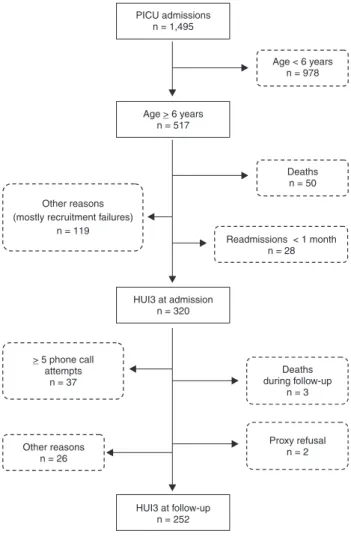
Figure 1 - Flow diagram of exclusions from the study at admission to the PICU and at follow-up
HUI3 = Health Utility Index Mark 3 questionnaire; PICU = pediatric intensive care unit.
Results
A total of 1,495 children were admitted to the three PICUs during the study period. After protocol exclusions, a total of 320 cases were evaluated at admission (62% of the 517 eligible cases and 21% of total admissions) and the follow-up interview was obtained in 252 cases (79% follow-up rate) (Figure 1).
The PICU mortality rate was 8.5% (44/517) within the eligible cases. Six other children died in hospital after PICU discharge (1.2%). Only two proxies refused to participate in the study (2/322; 0.6%). The main cause of study exclusion at admission to the PICU was unavailability of an investigator to contact and interview the proxies. At the follow-up, two other proxies (2/257) refused to be interviewed despite initial agreement, and three children died during this time, accounting for 1.2% of cases (3/257). Most of the other exclusions at follow-up were due to impossibility to establish contact within the ive phone calls attempts.
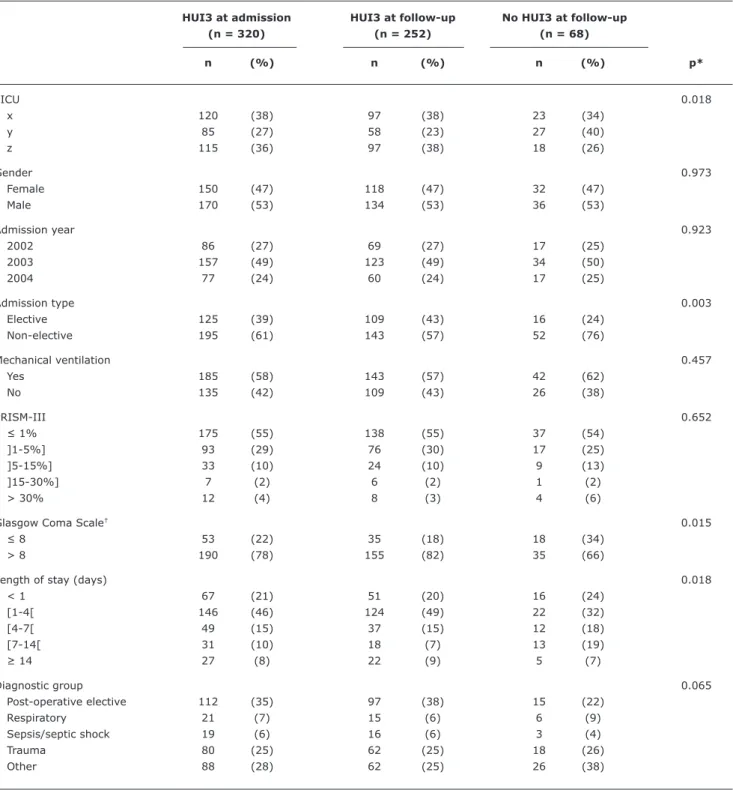
Demographic and clinical data from our population are presented in Table 1.
We found signiicant differences between children with and without follow-up regarding type of admission, Glasgow Coma Scale, and length of stay.
HUI3 attributes’ distribution, at admission and at follow-up, showed that all worst levels of function were represented with at least two cases. Of the 45 possible different attribute levels, only four of them had no cases, with three of these levels belonging to the hearing attribute. Attributes with more abnormalities were emotion, cognition, and pain, both at admission and follow-up.
From the 320 cases, only 294 had complete questionnaires at admission. The health status of these 294 cases can be described using 120 different vectors (0.41 vector/case). The ratio between the number of different vectors and the number of cases provides a measure of heterogeneity in the health status. After exclusion of the 92 cases with the vector representing perfect health ([11111111]), this ratio increased to 0.59 vector/case. At follow-up, the 219 fully completed questionnaires resulted in 101 vectors (0.46 vectors/case) and in 0.65 vector/case after exclusion of the 65 cases with the [11111111] vector. Analysis of the resulting 210 paired vectors revealed that “no change” occurred in 31 cases (15%), with the remaining 85% of children having changes in at least one of the HUI3 attributes. From the 31 cases with no change, the majority (84%) were children with perfect health status at both moments. In the paired analysis, deterioration was observed in 62% (43/69 cases) of children with perfect health before PICU admission. This number is counter-balanced by the 36 cases with preadmission morbidity but perfect health status at follow-up (representing 58% of the total 62 cases with perfect health at follow-up).
The number of affected attributes in each individual case showed that the majority of cases (54 and 56% at admission and follow-up, respectively) had none or at most one attribute affected.
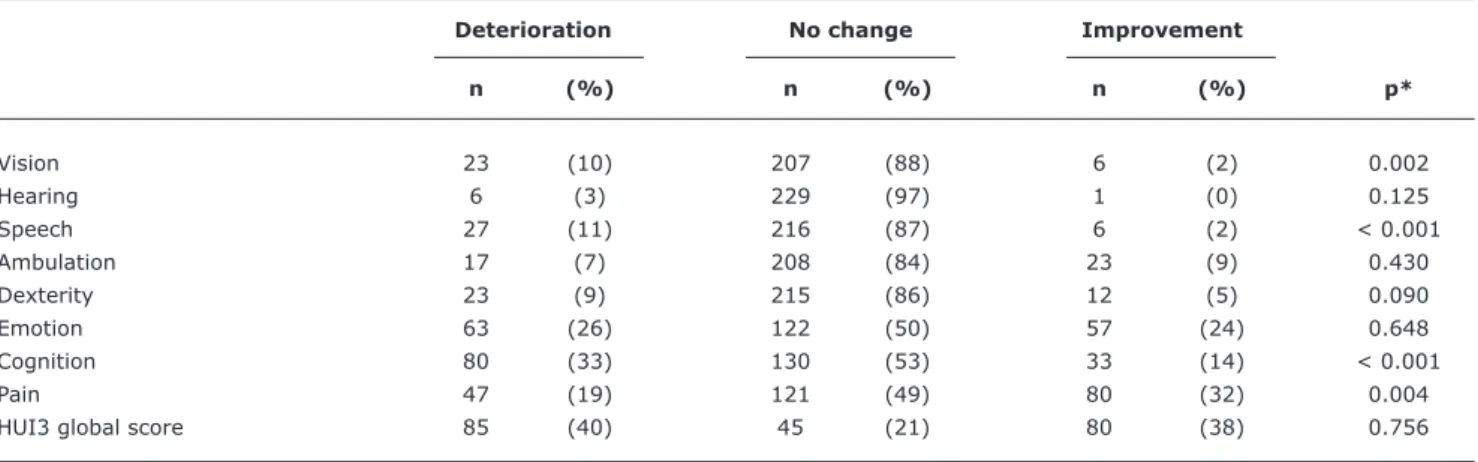
The medians (interquartile range) of the HUI3 global score were 0.86 (0.42-1.00) and 0.83 (0.45-1.00) for admission and follow-up, respectively; differences were not statistically signiicant (p = 0.674). Negative values of the HUI3 global score were found in 9 and 7% of cases at admission and follow-up, respectively. The number of children with improvement in the HUI3 global score was similar to those who had some deterioration in their health status (38% vs. 40%, p = 0.756). However, there were signiicant differences regarding the individual attributes (Table 2).
Table 1 - Demographic and clinical characteristics of the studied children (n = 320) according to the completion (or not) of the HUI3 questionnaire at the 6-month follow-up
HUI3 at admission HUI3 at follow-up No HUI3 at follow-up
(n = 320) (n = 252) (n = 68)
n (%) n (%) n (%) p*
PICU 0.018
x 120 (38) 97 (38) 23 (34)
y 85 (27) 58 (23) 27 (40)
z 115 (36) 97 (38) 18 (26)
Gender 0.973
Female 150 (47) 118 (47) 32 (47)
Male 170 (53) 134 (53) 36 (53)
Admission year 0.923
2002 86 (27) 69 (27) 17 (25)
2003 157 (49) 123 (49) 34 (50)
2004 77 (24) 60 (24) 17 (25)
Admission type 0.003
Elective 125 (39) 109 (43) 16 (24)
Non-elective 195 (61) 143 (57) 52 (76)
Mechanical ventilation 0.457
Yes 185 (58) 143 (57) 42 (62)
No 135 (42) 109 (43) 26 (38)
PRISM-III 0.652
≤ 1% 175 (55) 138 (55) 37 (54)
]1-5%] 93 (29) 76 (30) 17 (25)
]5-15%] 33 (10) 24 (10) 9 (13)
]15-30%] 7 (2) 6 (2) 1 (2)
> 30% 12 (4) 8 (3) 4 (6)
Glasgow Coma Scale† 0.015
≤ 8 53 (22) 35 (18) 18 (34)
> 8 190 (78) 155 (82) 35 (66)
Length of stay (days) 0.018
< 1 67 (21) 51 (20) 16 (24)
[1-4[ 146 (46) 124 (49) 22 (32)
[4-7[ 49 (15) 37 (15) 12 (18)
[7-14[ 31 (10) 18 (7) 13 (19)
≥ 14 27 (8) 22 (9) 5 (7)
Diagnostic group 0.065
Post-operative elective 112 (35) 97 (38) 15 (22)
Respiratory 21 (7) 15 (6) 6 (9)
Sepsis/septic shock 19 (6) 16 (6) 3 (4)
Trauma 80 (25) 62 (25) 18 (26)
Other 88 (28) 62 (25) 26 (38)
HUI3 = Health Utility Index Mark 3 questionnaire; PICU = pediatric intensive care unit; PRISM = pediatric risk of mortality. * Pearson chi-square test.
† Collected only in cases with known or suspected acute neurologic changes. signiicantly more improvement (32%) in the attribute pain (p = 0.004), a considerable number of children (19%) experienced some deterioration in this attribute.
Nearly half of the children with non-elective admission had deterioration in their health status, while 72% of
Table 2 - Changes in HRQoL status between preadmission and follow-up: absolute numbers and relative frequencies (%) for attributes and HUI3 global score
Deterioration No change Improvement
n (%) n (%) n (%) p*
Vision 23 (10) 207 (88) 6 (2) 0.002
Hearing 6 (3) 229 (97) 1 (0) 0.125
Speech 27 (11) 216 (87) 6 (2) < 0.001
Ambulation 17 (7) 208 (84) 23 (9) 0.430
Dexterity 23 (9) 215 (86) 12 (5) 0.090
Emotion 63 (26) 122 (50) 57 (24) 0.648
Cognition 80 (33) 130 (53) 33 (14) < 0.001
Pain 47 (19) 121 (49) 80 (32) 0.004
HUI3 global score 85 (40) 45 (21) 80 (38) 0.756
HRQoL = health-related quality of life; HUI3 = Health Utility Index Mark 3 questionnaire.
* McNemar test: comparison between the proportions of patients that improved vs. patients that deteriorated.
Table 3 - Absolute numbers and relative frequencies (%) of the change between preadmission and follow-up HUI3 global scores, according to some clinical variables
HUI3 global score
Deterioration No change Improvement
(n = 85) (n = 45) (n =80)
n (%) n (%) n (%) p*
Children health status at admission† < 0.001
Excellent/very good/good 66 (52) 33 (26) 29 (23)
Fair/poor 18 (22) 12 (15) 51 (63)
Admission type 0.008
Elective 24 (28) 23 (27) 39 (45)
Non-elective 61 (49) 22 (18) 41 (33)
Main diagnostic group < 0.001
Elective post-operative 23 (30) 24 (32) 29 (38)
Trauma 40 (75) 9 (17) 4 (8)
Other 22 (27) 12 (15) 47 (58)
Mechanical ventilation < 0.001
Yes 55 (47) 29 (25) 34 (29)
No 30 (33) 16 (17) 46 (50)
HUI3 = Health Utility Index Mark 3 questionnaire. * Pearson chi-square test.
† One proxy refused to answer this question.
Frequency distribution of HUI3 global score recoded into three disability categories showed that severe disability at admission (HUI3 global score < 0.70) was present in 36% of the paired cases, among which 60% had an improvement, with 25% of those returning to a perfect HRQoL status. Mild/moderate preadmission disability was present in 31% of cases, and 33% had no disability (of these, 45% had some disability at follow-up).
Discussion
In this study, we characterized the magnitude of the HRQoL phenomena in the PICU setting in order to promote more objective and ine-tuned “clinical impressions” on the HRQoL of PICU patients.
scale (1.00 - perfect health state), both before and 6 months after admission to the PICU. However, 9 and 7% of cases, at preadmission and follow-up respectively, had negative scores, representing a small but important proportion of PICU patients with severe impairment.
The most affected attributes, both before admission and at follow-up, were emotion, cognition and pain, which coincides with other studies involving populations with severe health problems, such as oncologic children.25 Despite signiicant changes in half of the attributes, the HUI3 global score had no signiicant differences between the two evaluations.
Distribution of cases within each attribute is also skewed to the upper value limit at admission and follow-up. However, there were cases represented in most levels of all attributes. Of the 45 different possible levels for the HUI3 attribute classiication, only four levels had no case represented (three at admission and one at follow-up) but, in a joint evaluation of both questionnaires, all the 45 levels were represented, which indicates a good discriminant validity of the HUI3 questionnaire and also relects the high heterogeneity and morbidity of the children cared in our PICUs.
HRQoL global score remained unchanged in only 21% of cases, although much higher percentages of “no change” (from 49% in pain up to 97% in hearing) were observed in the individual attributes. This difference can be explained by the multidimensional and multiplicative formula for calculation of the HUI3 global score, which accumulates any difference in the attributes. Deterioration of HRQoL occurred in 40% of patients, indicating that the majority of children beneited or were not affected by PICU care, regarding their HRQoL status. As clinically expected, nearly half of the cases with deterioration were trauma patients. Overall, 38% of the cases showed an improvement in HRQoL. As also expected, a higher improvement was seen in the elective admission patients, in non-trauma cases, and in patients with no need of mechanical ventilation.
Vector analysis also adds information from the perspective of morbidity among this population, showing that higher numbers of vector/case mean more heterogeneity and morbidity in the sample; in this study, after excluding perfect health states, we found more heterogeneity in the sample at follow-up (0.65 vs. 0.59 vector/case at preadmission).
These results clearly demonstrate that studies about HRQoL should incorporate measures of baseline status and should be focused on changes in the patient level rather than on the analysis of mean values for groups of patients. Despite the importance of individual measures, we do not endorse any use of these HRQoL values to guide clinical decisions in individual patients; individual results should only be used to evaluate and improve health care delivery.
The present study has several limitations. The problems of using proxies to evaluate HRQoL are well known, but there
is also agreement that young and critically ill children are unable to understand or answer a questionnaire.26-28 In these cases, using parents or guardians as proxies is better than using physicians/pediatricians.26,28,29 Moreover, the need to have baseline data to compute changes in HRQoL favors the strategy of interviewing proxies to evaluate preadmission status as close as possible to PICU admission, with the purpose of preventing and reducing recollection bias.
The 6-month time we deined to follow-up may be debatable, because during this period children may have suffered events not related to PICU admission that could alter their HRQoL or because this period may be insuficient to allow complete recovery of children more severely affected by the cause of PICU admission. Data were collected between 2002 and 2004, but we consider that this time lag did not interfere with the study results.
There are no studies assessing the validity and reliability of the HUI3 questionnaire specifically for the pediatric intensive care setting. However, HUI3 precursors were validated and used in the PICU population,3,6,9,10,13 and the HUI3 itself has been extensively validated in different clinical conditions and in different countries.15,20-24
Other limitations of the study include the large number of children excluded due to age limitation of the HUI3 instrument and the exclusions due to study protocol, resulting in a small sample of the PICU population. In our study, initial and 6-month evaluations were done to 21 and 17% of the total population, respectively. These numbers are similar to values from an UK multicenter general PICU study (20%).13 Other studies in the PICU setting range from 1% of total population in a study including only children with PICU length of stay higher than 28 days9 to larger values in single PICU studies - 42,6 45,12 70,9 and 77%.10 If we consider only the eligible children (≥ 6 years), our values would be 62 and 49% for initial and follow-up samples, respectively, which are much closer to the values reported in single PICU studies. Larger and more representative samples need to be studied to conirm these indings and to allow identiication of other variables that might predict improvement in children’s health status before HRQoL-based decisions can be suggested for admission criteria and/or prognostic purposes.
References
1. Hofhuis JG, van Stel HF, Schrijvers AJ, Rommes JH, Bakker J, Spronk PE. Health-related quality of life in critically ill patients: how to score and what is the clinical impact? Curr Opin Crit Care. 2009;15:425-30.
2. Knoester H, Grootenhuis MA, Bos AP. Outcome of paediatric intensive care survivors. Eur J Pediatr. 2007;166:1119-28.
3. Gemke RJ, Bonsel GJ. Reliability and validity of a comprehensive health status measure in a heterogeneous population of children admitted to intensive care. J Clin Epidemiol. 1996;49:327-33.
4. Knoester H, Bronner MB, Bos AP. Surviving pediatric intensive care: physical outcome after 3 months. Intensive Care Med. 2008;34:1076-82.
5. Taylor A, Butt W. The evaluation of outcome following paediatric intensive care: the major issues identiied. Clin Intensive Care. 2000;11:239-44.
6. Gemke RJ, Bonsel GJ, van Vught AJ. Long-term survival and state of health after paediatric intensive care. Arch Dis Child. 1995;73:196-201.
7. de Keizer NF, Bonsel GJ, Gemke RJ. Health status prediction in critically ill children: a pilot study introducing Standardized Health Ratios. Qual Life Res. 1997;6:192-9.
8. Conlon NP, Breatnach C, O’Hare BP, Mannion DW, Lyons BJ.
Health-related quality of life after prolonged pediatric intensive care unit stay. Pediatr Crit Care Med. 2009;10:41-4.
9. Ambuehl J, Karrer A, Meer A, Riedel T, Schibler A. Quality of life of survivors of paediatric intensive care. Swiss Med Wkly. 2007;137:312-6.
10. Jayashree M, Singhi S, Malhi P. Follow up of survival and quality of life in children after intensive care. Indian Pediatr. 2003;40:303-9.
11. Taylor A, Butt W, Ciardulli M. The functional outcome and quality of life of children after admission to an intensive care unit. Intensive Care Med. 2003;29:795-800.
12. Morrison AL, Gillis J, O’Connell AJ, Schell DN, Dossetor DR, Mellis C. Quality of life of survivors of pediatric intensive care. Pediatr Crit Care Med. 2002;3:1-5.
13. Jones S, Rantell K, Stevens K, Colwell B, Ratcliffe JR, Holland P et al. Outcome at 6 months after admission for pediatric intensive care: a report of a national study of pediatric intensive care units in the United kingdom. Pediatrics. 2006;118:2101-8.
Using the HUI2 global score in a 1-year follow-up study of children admitted to a Dutch PICU, de Keizer et al.7 reported 21% improvement, 26% deterioration and 52% of “no change” in HRQoL. The percentages of improvement and deterioration are close to each other, as in our study, but with very different absolute values. Differences in percentage of “no HRQoL change” might be due to the absence of trauma patients and a larger percentage of post-operative patients in their sample. Another possible explanation is the larger follow-up time, allowing the children who deteriorated at 6 months to improve and regain their previous preadmission HRQoL, as reported in other studies.12,14
Only 31% of our cases were in perfect health prior to PICU admission and 30% at follow-up, numbers that are similar to other studies. Using the HUI2 questionnaire, percentages of full health in PICU samples were reported as 32% at preadmission,6 27% at follow-up,13 and 37% preadmission and 21% at follow-up.10 Taylor et al.11 reported, with the GOS, 29 and 15% of perfect health status at preadmission and follow-up, respectively, in an Australian PICU.
Mean HRQoL values of our sample are lower than those found in general populations30 and in patients with other diseases that cause no or small lesions to the central nervous system31,32; are similar to those found in samples of children surviving brain tumors25; but are higher than those found in adults with stroke30 and in blind children who were newborns with extremely low birth weight.33 These low values might be due to the increasing number of children with chronic diseases that are admitted to the PICU, either in non-elective acute events or in elective admissions, and due to the higher impact of the developmental/neurological attributes on the HRQoL, in comparison to the physical attributes.
Despite HUI3 global score being similar at both evaluations, differences were found at individual level, with only a relatively small proportion of children having their HRQoL unchanged. Preadmission data are essential to evaluate changes at individual level and this is even more important in populations with high percentages of preadmission morbidity, like patients cared in the PICU.
Low preadmission HRQoL or severe disability should not be a reason, by itself, to exclude children from being cared in the PICU setting, as many of these children have beneited from pediatric intensive care.
Acknowledegments
The authors would like to acknowledge the work and dedication of the other investigators of the “Development and assessment of optimal risk scores for outcomes in pediatric intensive care” (Desenvolvimento e avaliação de índices de prognóstico [mortalidade e morbilidade] em cuidados intensivos pediátricos em Portugal, DAIP-CIP)
project (POCTI/ESP/41472/2001), during all the 3 years of this project: Clara Tavares and Cláudia Dias (Service of Biostatistics and Medical Informatics, School of Medicine, Universidade do Porto, Porto, Portugal); António Marques and João Estrada (PICU, Hospital Dona Estefânia, Lisboa, Portugal); Leonor Carvalho (PICU, Hospital Pediátrico de Coimbra, Coimbra, Portugal); and Ana Rosa Lopes and Teresa Cunha Mota (PICU, Hospital São João, Porto, Portugal).
14. Knoester H, Bronner MB, Bos AP, Grootenhuis MA. Quality of life in children three and nine months after discharge from a paediatric intensive care unit: a prospective cohort study. Health Qual Life Outcomes. 2008;6:21.
15. Furlong W, Feeny D, Torrance G, Goldsmith C, DePauw S, Zhu Z, et al. Multiplicative multi-attribute utility function for the Health Utilities Index Mark 3 (HUI3) system: a technical report. Hamilton: McMaster University Centre for Health Economics and Policy Analysis Research; 1998. (Working Paper #98-11).
16. Torrance GW, Boyle MH, Horwood SP. Application of multi-attribute utility theory to measure social preferences for health states. Oper Res. 1982;30:1043-69.
17. Boyle MH, Torrance GW, Sinclair JC, Horwood SP. Economic evaluation of neonatal intensive care of very-low-birth-weight infants. N Engl J Med. 1983;308:1330-7.
18. Feeny D, Furlong W, Barr RD, Torrance GW, Rosenbaum P, Weitzman S. A comprehensive multi-attribute system for classifying the health status of survivors of childhood cancer. J Clin Oncol. 1992;10:923-8.
19. Torrance GW, Zhang Y, Feeny D, Furlong W, Barr R. Multi-attribute preference functions for a comprehensive health status classiication system. Hamilton: McMaster University Centre for Health Economics and Policy Analysis; 1992. (Working Paper #92-18).
20. Horsman J, Furlong W, Feeny D, Torrance G. The Health Utilities Index (HUI): concepts, measurement properties and applications.
Health Qual Life Outcomes. 2003;1:54.
21. Furlong W, Feeny D, Torrance G, Barr R. The Health Utilities Index (HUI) system for assessing health-related quality of life in clinical studies. Hamilton: McMaster University Centre for Health Economics and Policy Analysis Research; 2001. (Working Paper #01-02)
http://www.chepa.org/Research-Products/Working-Papers/ Working-Papers-Archive.aspx.
22. Feeny D, Furlong W, Torrance GW, Goldsmith CH, Zhu Z, DePauw S, et al. Multiattribute and single-attribute utility functions for the health utilities index mark 3 system. Med Care. 2002;40:113-28.
23. Feeny D, Furlong W, Barr RD. Multiattribute approach to the assessment of health-related quality of life: Health Utilities Index. Med Pediatr Oncol. 1998;1:54-9.
24. Feeny, D. The Health Utilities Index: a tool for assessing health beneits. Patient Reported Outcomes Newsletter. 2005;34:2-6.
25. Barr RD, Simpson T, Whitton A, Rush B, Furlong W, Feeny DH. Health-related quality of life in survivors of tumours of the central nervous system in childhood-a preference-based approach to measurement in a cross-sectional study. Eur J Cancer. 1999;35:248-55.
26. Janse AJ, Sinnema G, Uiterwaal CS, Kimpen JL, Gemke RJ. Quality of life in chronic illness: perceptions of parents and paediatricians.
Arch Dis Child. 2005;90:486-91.
27. Colver A, Parkinson K, Arnaud C, Beckung E, Fauconnier J, McManus V, et al. SPARCLE - Study of PARticipation of Children with Cerebral Palsy Living in Europe. Qual Life Newslett. 2004;32:5-6.
28. JG, Dios. Dios JG. Calidad de vida relacionada con la salud: conocer e implementar en la toma de decisiones basada en pruebas en pediatría. An Pediatr (Barc). 2004;60:507-13.
29. Janse AJ, Gemke RJ, Uiterwaal CS, Tweel I, Kimpen JL, Sinnema G. Quality of life: patients and doctors don’t always agree: a meta-analysis. J Clin Epidemiol. 2004;57:653-61.
30. Grootendorst P, Feeny D, Furlong W. Health Utilities Index Mark 3: evidence of construct validity for stroke and arthritis in a population health survey. Med Care. 2000;38:290-9.
31. Barr RD, Chalmers D, De Pauw S, Furlong W, Weitzman S, Feeny D. Health-related quality of life in survivors of Wilms’ tumor and advanced neuroblastoma: a cross-sectional study. J Clin Oncol. 2000;18:3280-7.
32. Szecket N, Medin G, Furlong WJ, Feeny DH, Barr RD, Depauw S. Preliminary translation and cultural adaptation of Health Utilities Index questionnaires for application in Argentina. Int J Cancer Suppl. 1999;12:119-24.
33. Quinn GE, Dobson V, Saigal S, Phelps DL, Hardy RJ, Tung B, et al. Health-related quality of life at age 10 years in very low-birth-weight children with and without threshold retinopathy of prematurity. Arch Ophthalmol. 2004;122:1659-66.
Correspondence: Francisco Cunha