www.jped.com.br
ORIGINAL ARTICLE
A double-blind placebo-controlled randomized trial on probiotics
in small bowel bacterial overgrowth in children treated with
omeprazole
夽
Badriul Hegar
a, Esther I. Hutapea
b, Najid Advani
b, Yvan Vandenplas
c,∗aMD. PhD. Department of Child Health, University of Indonesia, Dopok, Indonesia bMD. Department of Child Health, University of Indonesia, Dopok, Indonesia
cMD. PhD. Department of Pediatrics, UZ Brussel, Vrije Universiteit Brussel, Brussels, Belgium
Received 29 October 2012; accepted 28 December 2012 Available online 21 June 2013
KEYWORDS (Hydrogen) breath test;
Diarrhea; Flatulence; Omeprazole; Probiotic; Proton pump inhibitor;
Small bowel bacterial overgrowth
Abstract
Objective: To evaluate the incidence of small bowel bacterial overgrowth (SBBO) in children treated with omeprazole, and to test whether probiotics influence the incidence.
Methods: A double-blinded, placebo-controlled trial was performed in 70 children treated orally during four weeks with 20 mg omeprazole per day. Lactobacillus rhamnosus R0011 (1.9×10⁹cfu) andLactobacillus acidophillusR0052 (0.1×10⁹cfu) were simultaneously given
daily to 36 subjects (probiotic group), while 34 subjects received placebo (placebo group). The diagnosis of SBBO was based on the development of suggestive symptoms, in combination with a positive glucose breath test.
Results: After one month of proton pump inhibitor (PPI) treatment, 30% (21/70) had a positive breath test suggesting SBBO; of these 62% were symptomatic. Five children developed SBBO-like symptoms, but had a negative breath test; and 44 (63%) were symptom free and had a negative breath test. There was no difference in the incidence of positive breath tests in the probiotic
versusthe placebo group (33%vs26.5%; p = 0.13).
Conclusions: Since symptoms suggesting SBBO developed in 26% of PPI-treated children, and since the glucose breath test was abnormal in 72% of these, this side-effect should be more frequently considered. The probiotic tested did not decrease the risk to develop SBBO. © 2013 Sociedade Brasileira de Pediatria. Published by Elsevier Editora Ltda. All rights reserved.
夽 Please cite this article as: Hegar B, Hutapea EI, Advani N, Vandenplas Y. A double-blind placebo-controlled randomized trial on probiotics in small bowel bacterial overgrowth in children treated with omeprazole. J Pediatr (Rio J). 2013;89:381---7.
∗Corresponding author.
E-mail:[email protected] (Y. Vandenplas).
PALAVRAS-CHAVE Teste de hidrogênio no ar expirado; Diarreia; Flatulência; Omeprazol; Probiótico;
Inibidor da bomba de prótons;
Supercrescimento bacteriano do intestino delgado
Um ensaio randomizado duplo-cego e controlado por placebo com probióticos em casos de supercrescimento bacteriano no intestino delgado em crianc¸as tratadas com omeprazol
Resumo
Objetivo: Avaliar a incidência de SBID em crianc¸as tratadas com omeprazol e testar se os probióticos influenciam essa incidência.
Métodos: Um ensaio duplo-cego controlado por placebo foi realizado em 70 crianc¸as tratadas oralmente, durante 4 semanas, com 20 mg de omeprazol por dia. Desses, 36 indivíduos rece-beram diária e simultaneamenteLactobacillus rhamnosusR0011 (1,9×10⁹cfu) eLactobacillus acidophillusR0052 (0,1×10⁹cfu) (grupo probiótico), enquanto 34 receberam placebo (grupo
placebo). O diagnóstico de SBID teve como base o desenvolvimento de sintomas sugestivos em combinac¸ão com um teste respiratório com glicose positivo.
Resultados: Após um mês de tratamento com IBP, 30% (21/70) apresentaram um teste respi-ratório positivo sugerindo SBID; desses, 62% foram sintomáticos. Cinco crianc¸as desenvolveram sintomas parecidos com os de SBID, mas apresentaram um teste respiratório negativo; 44 (63%) não apresentavam sintomas e tiveram teste respiratório negativo. Não houve diferenc¸a na incidência de testes respiratórios positivos no grupo probiótico em comparac¸ão ao grupo placebo (33% em comparac¸ão a 26,5%; p: 0,13).
Conclusões: Como houve sintomas sugestivos de SBID em 26% das crianc¸as tratadas com IBP e o teste respiratório com glicose deu resultados anormais em 72% delas, esse efeito colateral deve ser levado em considerac¸ão com mais frequência. O probiótico testado não reduziu o risco de desenvolver SBID.
© 2013 Sociedade Brasileira de Pediatria. Publicado por Elsevier Editora Ltda. Todos os direitos reservados.
Introduction
Proton pump inhibitors (PPIs) such as omeprazole are administered in gastrointestinal diseases such as gas-troesophageal reflux disease, gastric or duodenal ulcer, Zollinger-Ellison syndrome, and eradication therapy for
Helicobacter pylori.1---3 The gastric acid secretory inhibitor effect of PPIs is much more potent than the effect of his-tamine receptor antagonists.2,4
Small bowel bacterial overgrowth (SBBO) is a condi-tion marked by an increased number of intestinal bacteria and a change in bacterial composition in the gastroin-testinal tract.5,6 Risk factors for SBBO are long term hypo/achlorhydria (as induced by PPI), intestinal anatom-ical abnormalities (such as diverticulum, fistula, stricture, adhesion, removal of ileocecal flap), hypomotility (such as in diabetic neuropathy, scleroderma), and severe immunodeficiency.5,6 The diagnosis of SBBO is based on clinical manifestations and on the results of a glucose breath test. Clinical manifestations of SBBO are marked by symptoms such as abdominal pain, flatulence, frequent fla-tus, diarrhea or constipation, and steatorhea.5---7In chronic conditions, SBBO can cause anemia, failure to thrive, neu-ropathy, tetany, and paresthesia.5---7The golden standard to diagnose SBBO is to culture intestinal aspirate. However, the latter is not performed in routine practice because of its invasive nature, its difficulty, its relatively high cost and time consumption, and its inability to diagnose SBBO in the distal area of the intestine.5---9 The Rome Consensus of 2009 recommended the glucose hydrogen breath test as the
best diagnostic tool for SBBO, since it is non-invasive, easy to perform, has direct results, and has a good diagnostic accuracy.8
Probiotics are living microorganisms which, if ingested in adequate amounts, will result in a health benefit for the host.10 A role for probiotics in many diseases such as infectious diarrhea, antibiotic associated diarrhea, atopy, and constipation has been suggested.11---13 Efficacy has also been reported for some strains, such asLactobacillus shi-rota, in SBBO.14 Probiotics’ mechanisms of action consist of competition with harmful bacteria, synthesis of antimi-crobial conjugate (bacteriocin, lactic acid, organic acid, microsin, reuterin, and volatile fatty acid), stimulation of the immune response, and stimulation of the intesti-nal epithelium through production of short chain fatty acids.15---19 Until now, studies on the role of probiotics in prevention and therapy of SBBO in children are very limited.
The aims of this study were to test whether PPIs induce SBBO in children, and to evaluate whether the probiotic strains tested can prevent the development of SBBO.
Methods
Study design and subjects
This double-blinded, placebo-controlled randomized clinical trial was conducted in children ≥5 years old seen mainly
Clinic of the Cipto Mangunkusumo Hospital. When it was decided, on clinical grounds, that the presenting symptoms justified a therapeutic trial with omeprazole, and in the absence of exclusion criteria, a glucose breath test was per-formed to rule out SBBO prior to PPI-therapy.
All the subjects were treated with 20 mg of oral omepra-zole daily for four weeks. Patients swallowed the intact omeprazole capsule; patients with difficulties to swallow the capsule were allowed to open it and swallow the micro-granules in media such as orange juice or berry juice. Furthermore, the patients were randomized in two groups: group A (probiotic group) received one probiotic capsule per day during four weeks, while group B (control group) was given a placebo capsule. The probiotic used is Lacidofil®, which contains 1.9×10⁹cfuLactobacillus rhamnosusR0011 and 0.1×10⁹ cfu Lactobacillus acidophillus R0052. A cold
chain for the administration of the probiotic was preserved, as the probiotics were stored in a cooler and transported using a cold chain bag with gel ice packs inside.
The following patients were excluded: known SBBO; treatment with anti-acid agents or antibiotics during the past two weeks; immune suppression (steroid treatment, antituberculosis therapy, antiretroviral, or cytostatics); or warfarin, phenytoin or diazepam use.
Observation for medication compliance (PPI and probio-tic/placebo) was performed twice a week through phone, by asking the parents about compliance. Subjects who did not take their medication during at least three days during the four-week intervention period were considered as ‘‘poor compliant’’. A second glucose breath test was performed four to ten days after the end of therapy.
Hydrogen breath test8,9,20
The patients fasted for ten to 12 hours, and brushed their teeth in the morning prior to the examination. The breath
test started by measuring the baseline hydrogen; the latter had to be < 10 ppm to be considered as normal (Gastrolyzer2, Bedfont Scientific Ltd.; distributor for Indonesia: CV Andalan Batara, Jakarta). A normal baseline hydrogen value was nec-essary to be eligible for inclusion. The patients ingested 2 g/kg body weight glucose (maximum of 50 g), which was diluted in 10 mL/kg body weight water (maximum 250 mL). The hydrogen level was measured every 15 minutes up to two hours after ingestion of the glucose. Every clinical symptom or complaint during the breath test was recorded. A posi-tive breath test was defined as an increase of > 10 ppm from baseline.21
Patients, parents, and all study participants were blinded. Study evaluators were blinded by omission of the name of patient on the hydrogen breath test data. The placebo was made by the Pharmacy Department of the Fac-ulty of Medicine of the University of Indonesia.
Statistical analysis was performed with the Statistical Package for Social Sciences (SPSS) version 17. The proto-col was approved by the local ethical committee, and all parents signed an informed consent.
Results
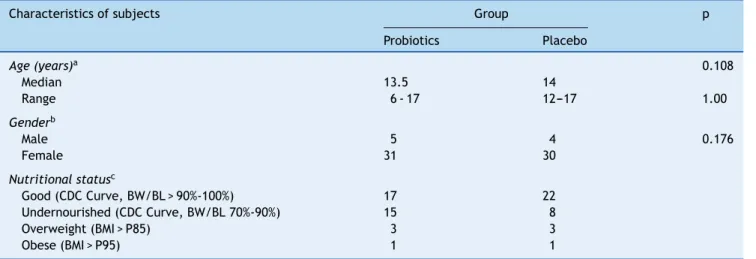
Initially, 73 patients were included in the study. However, home visits found that three patients did not have a refrig-erator at home. Since it was not known whether they were in the probiotic or the placebo group, and since the probio-tic needed to be conserved in a cool environment, these patients were considered as dropout. Thus, data of 70 patients were available for analysis. Most of the subjects were female (61/70), with a good nutritional status (39/70) (Table 1).
The mean age was 13.5 years (range 6-17 years). Of the 70 subjects, 36 were included in the probiotic and 34 in the
Table 1 Characteristics of subjects and its distribution between groups.
Characteristics of subjects Group p
Probiotics Placebo
Age (years)a 0.108
Median 13.5 14
Range 6 - 17 12---17 1.00
Genderb
Male 5 4 0.176
Female 31 30
Nutritional statusc
Good (CDC Curve, BW/BL > 90%-100%) 17 22
Undernourished (CDC Curve, BW/BL 70%-90%) 15 8
Overweight (BMI > P85) 3 3
Obese (BMI > P95) 1 1
BMI, body mass index; BW/BL, birth weight/birth length; CDC, Centers for Disease Control and Prevention.
Table 2 Hydrogen breath test results related to probiotic or placebo, regardless of symptoms.
SBBO Total
+
-Omeprazole + probiotics 12 (33%) 24 (67%) 36
Omeprazole + placebo 9 (26%) 25 (73%) 34
Total 21 49 70
p = 0.13.
SBBO, small bowel bacterial overgrowth.
placebo group. Medication compliance was rather low since ‘‘good compliance’’ was only observed in 41/70 patients (59%). Compliance was ‘‘poor’’ in 29 patients; 11 complied poorly with the probiotic or placebo, and 18 complied poorly with the PPI. Nevertheless, 66/70 (94%) of the patients said to be symptom-free or to have a clinically significant improvement of their symptoms after the intervention. Only 4/70 (6%) said to have not improved.
In total, 18 subjects developed symptoms suggesting pos-sible SBBO; in 13 of these, the second breath test suggested SBBO. 16 of these 18 patients had a ‘‘good PPI compliance’’. According to the results of the breath test (regardless of the presence/absence of symptoms), SBBO was found in 21/70 (30%) of the patients, with a slight trend of more SBBO in the probiotic group (33%; 12/36) than in the placebo group (26%; 9/34) (p = 0.13, Table 2). From the 21 subjects with positive hydrogen breath test, 13 subjects presented recurrent SBBO symptoms during therapy (Table 3), while eight were asymp-tomatic. Finally, 44/70 (63%) patients were asymptomatic and had a negative glucose breath test under PPI treat-ment. Five patients had symptoms suggesting SBBO, but had a normal breath test result. 13/21 (62%) developed at least one symptom compatible with SBBO during PPI therapy; four (19% of the total group, or 31% of the symptomatic group) presented more than one symptom (Table 4). Two subjects developed extensive SBBO with diarrhea, abdominal pain, and flatulence.
Discussion
This was the first study conducted in children that focused on SBBO incidence with PPI treatment as single risk factor,
Table 3 Number of children with symptoms suggesting small bowel bacterial overgrowth (SBBO) and result of the second glucose hydrogen breath test.
Symptoms suggesting SBBO
Yes No
Result H2breath test
Positive 13 8 21
Negative 5 44 49
18 52
p < 0.001 (chi squared test).
and also evaluated the role of probiotics in prevention of SBBO. The results suggest a placebo-effect of the PPI, since 18/70 were not compliant; only four reported no significant improvement, all of which in the non-compliant group. A cohort study by Boissieu et al. in 53 children, aged between 2 months and 12 years, with complaints of chronic diarrhea, abdominal pain, or both, reported SBBO as a frequent cause (34%), especially before the age of 2 years.22 Scarpellini et al. reported the prevalence of SBBO to be as high as 65% in children aged 3 to 16 years with irritable bowel syndrome (IBS).23 Ratuapli et al. published recently a large retro-spective analysis on the effect of PPI on SBBO in adults.21 Overall, the authors reported that PPI did not induce SBBO;
Table 4 Complaints and therapy response.
Characteristics of subjects Proportion
Initial complaints
Epigastric pain 70 (70/70)
Nausea 65 (65/70)
Vomiting 10 (10/65)
Gastrointestinal bleeding* 3 (3/10)
Flatulence 30 (30/70)
Limitation of activity 45 (45/70)
Medication compliance
Yes 41 (41/70)
No 29 (29/70)
Therapy response
Cured 46 (46/70)
Improvement 20 (20/70)
No improvement 4 (4/70)
SBBO symptoms during therapy in groups with positive hydrogen breath test
Diarrhea 1 (1/21)
Mid abdominal pain 1 (1/21)
Flatulence 5 (5/21)
Frequent flatus 1 (1/21)
Constipation 1 (1/21)
Flatulence and abdominal pain 2 (2/21) Diarrhea, flatulence, and abdominal pain 2 (2/21)
No complaints 8 (8/21)
SBBO, small bowel bacterial overgrowth.
HBT-positivity was associated with older age and use of antidiarrheal products.21However, Del Pioano almost simul-taneously confirmed a strong bacterial overgrowth in the stomach and duodenum of adults treated with PPI, increas-ing with treatment duration.24 The glucose breath test at baseline was normal in all children included in the present study.
In the present study, the subjects involved were chil-dren with a mean age of 13.5 years, who presented with the single chief complaint of epigastric pain. The propor-tion of girls in this study was much higher than boys, but gender was normally distributed in both groups (p = 1.00). This difference can be explained by coincidence, by the fact that there are more girls than boys in this age group in Jakarta, and/or by the fact that functional gas-trointestinal complaints might be more frequent in girls. However, this striking difference needs further investiga-tion.
Sixty-two percent of the subjects with positive hydro-gen breath test developed SBBO symptoms during therapy and during the breath test (Tables 2 and 3). This is in agreement with studies in children, which have showed SBBO to be a common cause of abdominal pain and diarrhea in children.22 16 of 18 children with SBBO symp-toms had a ‘‘good compliance to PPI’’, reinforcing the argument of PPIs as a cause of SBBO. To the authors’ knowledge, studies on SBBO incidence in children related to omeprazole therapy have not been performed; how-ever, this incidence was reported to be as high as 45% to 56% in adult subjects.25---27 The difference in SBBO inci-dence in the present study (19%) with that of the adult studies can be explained by several factors, such as dif-ference in dosage and duration of omeprazole treatment, different characteristics of the patients, and different diag-nostic methods. This differs from the characteristics of adult studies, in which the mean age of the patients is over 50 years. SBBO incidence is higher later in life due to the decline in immunity and intestinal motility, as well as hypo/achlorhydria.5,6,21 The incidence of SBBO and hypo/achlohydria in a senior age group (mean age 84 years) was reported to be 80%.28The high metabolism of omepra-zole in certain age ranges (between 1 and 6 years and 13 and 16 years), which is in line with the subjects’ age in this study, may contribute to the lower incidence of SBBO in adolescents.29
The duration of omeprazole therapy is directly related with SBBO incidence.24 This finding is also supported by a study by Lombardo et al., which showed that SBBO incidence is significantly higher in the group with PPI therapy for over 13 months (p < 0.001).30In the present study, SBBO incidence was evaluated in children treated with 20 mg of omeprazole daily for four weeks. The dosage and duration of therapy is smaller in the present study than in the reports in adults using 20 to 40 mg of omeprazole for≥four weeks, up to 9.5
months.25---27
The probiotic strains administered did not decrease the development of SBBO. However, probiotics are a thera-peutic option of potential benefit.31 Lactobacillus shirota was shown to be effective in altering fermentation pat-terns in the small bowel, consistent with SBBO reduction.14 Del Piano et al. demonstrated that four probiotic strains with a marked antagonistic activity towards five E. coli
bacteria and an effective amount of N-acetylcysteine (NAC) reduced bacterial overgrowth in long-term PPI-treated subjects.24 A significant decrease in fecal enterococci, total coliforms, E. coli, molds, and yeasts in subjects treated with PPIs was recorded at the end of the probiotic supplementation.24
The hydrogen breath test measures the amount of expired hydrogen in the expired air after fasting for ten to 12 hours, followed by ingestion of glucose substrate. If the glucose is not absorbed, but metabolized by intesti-nal bacteria, intralumiintesti-nal gasses such as hydrogen (H2), methane (CH4), and carbon dioxide (CO2) will be pro-duced, which can be measured by the breath test.20 The glucose hydrogen breath test is reported to have a sensi-tivity, specificity, and diagnostic accuracy of 62.5%, 81.8%, and 71.7%, respectively. According to the Rome consen-sus of 2009, the glucose hydrogen breath test is the recommended diagnostic tool in patients with suspected SBBO.8
In the present study, five subjects developed SBBO-like symptoms but had a negative hydrogen breath test. The glucose breath test can be false negative due to intesti-nal colonization with non-hydrogen producing bacteria, or because the level of hydrogen production is not high enough to be detected, and SBBO is occurring in the dis-tal part of ileum (where all the glucose has already been absorbed).20,32 According to literature, the prevalence of colonization with non-hydrogen producing bacteria varies from 2% to 43%.33 However, non-hydrogen producing bacte-ria produce methane, resulting in an increase of expired methane despite normal hydrogen. Levit et al. reported that 36.4% of adults (aged 18 to 88 years) with SBBO had a methane-producing gastrointestinal colonization.34 Since the device used in the present study only measures hydrogen and not methane, further information on this aspect can-not be provided. In some patients, SBBO-related symptoms are similar to the initial presenting symptoms. Although it cannot be excluded that in a few patients it was the ini-tial symptoms that persisted, this is unlikely for different reasons: i) the initial symptoms had strong improvement; ii) symptoms were reported as being different; iii) there was an association with the positive breath test. Moreover, 16 of 18 children with symptoms suggesting SBBO were compli-ant to PPI treatment. The second breath test was performed four to ten days after stopping PPI therapy, when the poten-tial acid rebound secretion period caused by PPI interruption was over.35
In conclusion, SBBO was found to be frequent in children treated with 20 mg/day of omeprazole for four weeks (26% if only symptoms are considered; 30% if only results of hydro-gen breath test are considered; 19% if both symptoms and positive hydrogen breath test are considered). The probiotic tested did not prevent the development of SBBO. Children who develop symptoms such as diarrhea, abdominal pain, and flatulence under PPI treatment should be investigated for SBBO.
Funding
Conflicts of interest
YV is a consultant for Biocodex and United Pharmaceuticals. The other authors declare no conflicts of interest.
References
1. Gibbons TE, Gold BD. The use of proton pump inhibitors in children: a comprehensive review. Pediatr Drugs. 2003;5: 25---40.
2. Gunasekaran TS, Hassal EG. Efficacy and safety of omepra-zole for severe gastroesophageal reflux in children. J Pediatr. 1993;123:148---54.
3. Zimmermann AE, Walters JK, Katona BG, Souny PF, Levine D. A review of omeprazole use in the treatment of acid-related disorders in children. Clin Ther. 2001;23: 660---79.
4. Brunton LL. Agents for control of gastric acidity and treat-ment of peptic ulcers. In: Gilman AG, Rall TW, Nies AS, Taylor P, editors. Goodman and Gilman’s The pharmacological basis of therapeutics. 8th ed. New York: McGraw-Hill Inc; 1990. p.
897---913.
5. Bures J, Cyrany J, Kohoutova D, Förstl M, Rejchrt S, Kvetina J, et al. Small intestinal bacterial overgrowth syndrome. World J Gastroenterol. 2010;16:2978---90.
6. Dukowicz AC, Lacy BE, Levine GM. Small intestinal bacterial overgrowth: a comprehensive review. Gastroenterol Hepatol (NY). 2007;3:112---22.
7. DiBaise JK. Nutritional consequences of small intesti-nal bacterial overgrowth. Prac Gastroenterol. 2008;32: 15---28.
8. Gasbarrini A, Corazza GR, Montalto M, Gasbarrini G, 1st
Rome H2-Breath Testing Consensus Conference Working Group.
Methodology and indications of H2-breath testing in
gas-trointestinal diseases: final statements from the 1st Rome
Consensus Conference. Aliment Pharmacol Ther. 2009;29: 32---49.
9. Parodi A, Capurso G, Perri F, Cuocos L, Lauritano C. H2
-breath testing for small intestinal bacterial overgrowth. Aliment Pharmacol Ther. 2009;29:18---22.
10. Food and Agriculture Organization of the United Nations; World Health Organization (WHO). Health and nutritional properties of probiotics in food including powder milk with live lactic acid bacteria: report of a joint FAO/WHO expert consultation on evaluation of health and nutritional prop-erties of probiotics in food including powder milk with live lactic acid bacteria. Córdoba (AR): Food and Agriculture Organization of the United Nations; World Health Orga-nization (WHO); 2012. [cited 12 Jan 2011]. Available from: http://www.who.int/foodsafety/publications/fs management/ en/probiotics.pdf
11. Marteau PR, de Vrese M, Cellier CJ, Schrezenmeir J. Protection from gastrointestinal diseases with the use of probitics. Am J Clin Nutr. 2001;73:430S---6S.
12. Rolfe RD. The role of probiotic cultures in the con-trol of gastrointestinal health. J Nutr. 2000;130: 396S---402S.
13. Thomas DW, Greer FR. American Academy of Pediatrics Committee on Nutrition; American Academy of Pediatrics Sec-tion on Gastroenterology, Hepatology, and NutriSec-tion. Clinical report: probiotics and prebiotics in pediatrics. Pediatrics. 2010;126:1217---31.
14. Barrett JS, Canale KE, Gearry RB, Irving PM, Gibson PR. Pro-biotic effects on intestinal fermentation patterns in patients with irritable bowel syndrome. World J Gastroenterol. 2008;14: 5020---4.
15. Gibson GR, Fuller R. Aspects of in vitro and in vivo research approaches directed toward identifying probio-tics and prebioprobio-tics for human use. J Nutr. 2000;130: 391S---5S.
16. Millar MR, Bacon C, Smith SL, Walker V, Hall MA. Enteral feed-ing of premature infants withLactobacillus GG. Arch Dis Child. 1993;69:483---7.
17. Macfarlene GT, Cumming JH. Probiotics and prebiotics: can reg-ulating the activities of intestinal bacteria benefit health? BMJ. 1999;318:999---1003.
18. Salminen S, Isolauri E, Salminen E. Probiotics and stabiliza-tion of the gut mucosal barrier. Asia Pac J Clin Nutr. 1996;5: 53---6.
19. Quigley EM, Quera R. Small intestinal bacterial overgrowth: roles of antibiotics, prebiotics, and probiotics. Gastroenter-ology. 2006;130:S78---90.
20. Eisenmann A, Amann A, Said M, Datta B, Ledochowski M. Imple-mentation and interpretation of hydrogen breath tests. J Breath Res. 2008;2:046002.
21. Ratuapli SK, Ellington TG, O’Neill MT, Umar SB, Harris LA, Foxx-Orenstein AE, et al. Proton pump inhibitor therapy use does not predispose to small intestinal bacterial overgrowth. Am J Gastroenterol. 2012;107:730---5.
22. de Boissieu D, Chaussain M, Badoual J, Raymond J, Dupont C. Small-bowel bacterial overgrowth in children with chronic diarrhea, abdominal pain, or both. J Pediatr. 1996;128: 203---7.
23. Scarpellini E, Giorgio V, Gabrielli M, Lauritano EC, Pan-tanella A, Fundarò C, et al. Prevalence of small intestinal bacterial overgrowth in children with irritable bowel syndrome: a case-control study. J Pediatr. 2009;155: 416---20.
24. Del Piano M, Anderloni A, Balzarini M, Ballarè M, Car-magnola S, Montino F, et al. The innovative poten-tial of Lactobacillus rhamnosus LR06, Lactobacillus pento-sus LPS01, Lactobacillus plantarum LP01, and Lactobacil-lus delbrueckii Subsp. delbrueckii LDD01 to restore the ‘‘gastric barrier effect’’ in patients chronically treated with PPI: a pilot study. J Clin Gastroenterol. 2012;46: S18---26.
25. Singh VV, Toskes PP. Small bowel bacterial overgrowth: pre-sentation, diagnosis, and treatment. Curr Gastroenterol Rep. 2003;5:365---72.
26. Thorens J, Froehlich F, Schwizer W, Saraga E, Bille J, Gyr K, et al. Bacterial overgrowth during treatment with omeprazole compared with cimetidine: a prospective randomised double blind study. Gut. 1996;39:54---9.
27. Hutchinson S, Logan R. The effect of long-term omeprazole on the glucose-hydrogen breath test in elderly patients. Age Ageing. 1997;26:87---9.
28. Husebye E, Skar V, Høverstad T, Melby K. Fasting hypochlorhydria with Gram-positive gastric flora is highly prevalent in healthy old people. Gut. 1992;33: 1331---7.
29. Andersson T, Hassall E, Lundborg P, Shepherd R, Radke M, Marcon M, et al. Pharmacokinetics of orally administered omeprazole in children. International Pediatric Omepra-zole Pharmacokinetic Group. Am J Gastroenterol. 2000;95: 3101---6.
30. Lombardo L, Foti M, Ruggia O, Chiecchio A. Increased inci-dence of small intestinal bacterial overgrowth during proton pump inhibitor therapy. Clin Gastroenterol Hepatol. 2010;8: 504---8.
31. Gibson PR, Barrett JS. The concept of small intestinal bacterial overgrowth in relation to functional gastrointestinal disorders. Nutrition. 2010;26:1038---43.
33. Di Stefano M, Certo M, Colecchia A, Sorges M, Perri F. H2-breath
tests: methodological audits in adults and children. Aliment Pharmacol Ther. 2009;29:8---13.
34. Levitt MD, Furne JK, Kuskowski M, Ruddy J. Stability of human methanogenic flora over 35 years and a review of insights
obtained from breath methane measurements. Clin Gastroen-terol Hepatol. 2006;4:123---9.